💥Join UPSC 2027,2028 Mentorship (August Batch) + XFactor Notes & Microthemes PDF

GS Paper: GS1

  • Retreating Monsoon is a global phenomenon: Study

    Rainfall during retreating monsoon, which parts of South India experience every year, is not a local anomaly and is global in nature and scale, according to a recent study by the University of Sydney.

    What is Retreating Monsoon?

    • In India, retreating monsoon is the withdrawal of south-west monsoon winds from North India.
    • The withdrawal is gradual and takes about three months.
    • With the retreat of the monsoons, the clouds disappear and the sky becomes clear. The day temperature starts falling steeply.
    • Monsoon rains weaken all over India except few southeastern states.
    • It is helpful in Rabi crop cultivation.

    What has the research found?

    • The research has identified regions in the northern hemisphere that receive the bulk of the rainfall during September, October and November and southern hemisphere that receive most of the rainfall from March to August.
    • The discovery that these are part of a global pattern and not one-off occurrences means they can be systematically studied, which will help understand how these communities could be affected by climate change.
    • Peninsular India and parts of South-East Asia are among the eight regions examined in the study.

    Factors affecting the retreat

    • The eight global regions identified by the study that receive most of their rainfall after summer, have several things in common.
    • They lie on the eastern fringes of landmasses and are in close proximity to mountain ranges with modest heights.

    Two predominant factors cause the phenomenon:

    • First, the low mountain range in each region runs from north to south, shielding it from west-bound winds that trigger summer monsoon.
    • After summer, the range aids in the ‘orographic lift’ or rising of east-bound air mass from a lower to higher elevation, forming clouds and resulting in rain.
    • The second factor is atmospheric convection or vertical movement of air.
    • As the earth is heated by the sun, different surfaces absorb different amounts of energy and convection may occur where the surface heats up very rapidly.
    • As the surface warms, it heats the overlying air, which gradually becomes less dense than the surrounding air and begins to rise.
    • This condition is more favorable from September to February because of the role played by sea surface temperature or water temperature.

    Answer this PYQ in the comment box:

    Q.The seasonal reversal of winds is the typical characteristic of:

    (a) Equatorial climate

    (b) Mediterranean climate

    (c) Monsoon climate

    (d) All of the above climates
  • What is Summer Solstice?

    The summer solstice will happen today around 9:02 am on Monday (Indian Standard Time).

    What is Summer Solstice?

    • Solstice means “sun stands still” in Latin.
    • The longest day of 2021 for those living north of the Equator is June 21.
    • This day is characterized by a greater amount of energy received from the sun.
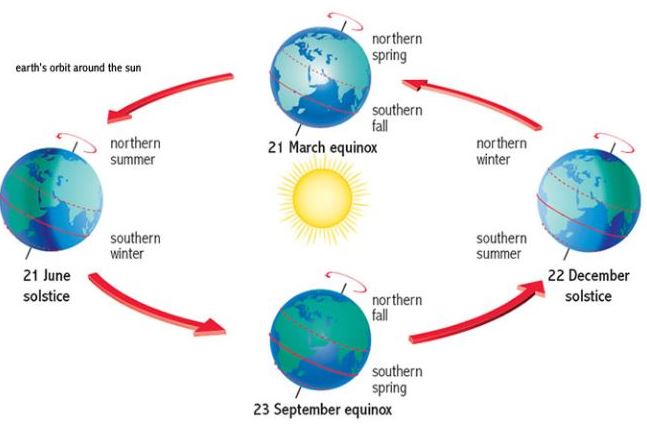
    • In technical terms, this day is referred to as the summer solstice, the longest day of the summer season. It occurs when the sun is directly over the Tropic of Cancer, or more specifically right over 23.5-degree north latitude.

    The Southern Hemisphere receives most sunlight on December 21, 22 or 23 when the northern hemisphere has its longest nights– or the winter solstice.

    Why do we have summer solstice?

    • Since Earth rotates on its axis, the Northern Hemisphere gets more direct sunlight between March and September over the course of a day.
    • This also means people living in the Northern Hemisphere experience summer during this time.
    • The rest of the year, the Southern Hemisphere gets more sunlight.
    • During the solstice, the Earth’s axis — around which the planet spins, completing one turn each day — is tilted in a way that the North Pole is tipped towards the sun and the South Pole is away from it.

    Answer this PYQ in the comment box:

    Q.On 21st June, the Sun (CSP 2019):

    (a) Does not set below the horizon at the Arctic Circle

    (b) Does not set below the horizon at Antarctic Circle

    (c) Shines vertically overhead at noon on the Equator

    (d) Shines vertically overhead at the Tropic of Capricorn

    Some other facts

    • Summer solstice does not mean the earliest sunrise or latest sunset.
    • Although June 21 will be the longest day in 2021, it does not necessarily mean that it brings the earliest sunrise or latest sunset.
    • It depends on the latitudinal location of the country.
  • [pib] Flag Satyagraha

    The Minister of State (IC) for Culture and Tourism has organized to observe the Flag Satyagraha in Jabalpur to commemorate the Jhanda Satyagraha of the year 1923.

    Flag Satyagraha

    • Flag satyagrahas were one of the most common acts of defiance during the nationalist rebellions led by Gandhi and the Indian National Congress throughout the struggle.
    • It is a campaign of peaceful civil disobedience during the Indian independence movement.
    • It was against the defiance of laws prohibiting the hoisting of nationalist flags and restricting civil freedoms.
    • Flag Satyagrahas were conducted most notably in the city of Jabalpur and Nagpur in 1923 but also in many other parts of India.

    Answer this PYQ in the comment box:

    Q.The ‘Swadeshi’ and ‘Boycott’ adopted as methods of struggle for the first time during the:

    (a) Agitation against the Partition of Bengal

    (b) Home Rule Movement

    (c) Non-Cooperation Movement

    (d) Visit of the Simon Commission to India

    Course of the movement

    • The arrest of nationalist protestors demanding the right to hoist the flag caused an outcry across India especially as Gandhi had recently been arrested.
    • Nationalist leaders such as Sardar Vallabhbhai Patel, Jamnalal Bajaj, Chakravarthi Rajagopalachari, Dr. Rajendra Prasad, and Vinoba Bhave organized the revolt.
    • Thousands of people from different regions including as far south as the Princely state of Travancore traveled to Nagpur and other parts of the Central Provinces to participate in civil disobedience.
    • In the end, the British negotiated an agreement with Patel and other Congress leaders permitting the protestors to conduct their march unhindered and obtaining the release of all those arrested.
  • National Maritime Heritage Complex

    In order to showcase the maritime heritage and history of India, a National Maritime Heritage Complex (NMHC) will be developed in the Lothal region of Gujarat.

    National Maritime Heritage Complex

    • It is to note that the National Maritime Heritage Complex will be made within the ASI site of Lothal that is located 80 km away from Ahmedabad in Gujarat.
    • The project, once completed, will be made an international tourist destination in India where people from across the countries can take a look at the maritime heritage of India from ancient to modern times.
    • The government is aiming to showcase this via an edutainment approach where the latest technology would be adopted to spread awareness.
    • The development will be done in an area expanding 400 acres.
    • The complex will have many offerings including National Maritime Heritage Museum, Heritage Theme Park, and Light House Museum.

    About Lothal

    • Lothal was one of the southernmost cities of the ancient Indus Valley Civilization located in Gujarat.
    • Construction of the city began around 2200 BCE.
    • According to the ASI, Lothal had the world’s earliest known dock, which connected the city to an ancient course of the Sabarmati river on the trade route between Harappan cities in Sindh and the peninsula of Saurashtra.
    • Lothal was a vital and thriving trade Centre in ancient times, with its trade of beads, gems, and valuable ornaments reaching the far corners of West Asia and Africa.
    • The techniques and tools they pioneered for bead-making and in metallurgy have stood the test of time for over 4000 years.
    • The Lothal site has been nominated as a UNESCO World Heritage Site, and its application is pending on the tentative list of UNESCO.

    Answer this question from CSP 2019 in the comment box:

    Q. Which one of the following is not a Harappan site?

    (a) Chanhudaro

    (b) Kot Diji

    (c) Sohgaura

    (d) Desalpur

  • NatGeo recognizes ‘Southern Ocean’ as globe’s fifth ocean

    The National Geographic magazine has recognized the ‘Southern Ocean’ as the world’s fifth ocean June 8, 2021 hoping others will soon follow suit.

    Answer this PYQ from CSP 2019 in the comment box:

    Q.The most important fishing grounds of the world are found in the regions where:

    (a) warm and cold atmospheric currents meet

    (b) rivers drain out large amounts of freshwater into the sea

    (c) warm and cold oceanic currents meet

    (d) continental shelf is undulating

    Southern Ocean

    • The Southern Ocean, also known as the Antarctic Ocean, comprises the southernmost waters of the World Ocean, generally taken to be south of 60° S latitude and encircling Antarctica.
    • As such, it is regarded as the second-smallest of the five principal oceanic divisions: smaller than the Pacific, Atlantic, and Indian oceans but larger than the Arctic Ocean.
    • Over the past 30 years, the Southern Ocean has been subject to rapid climate change, which has led to changes in the marine ecosystem.

    What has NatGeo attempted?

    • The magazine says the Southern Ocean is the only ocean ‘to touch three other oceans and to completely embrace a continent rather than being embraced by them’.
    • Its northern limit is a latitude of 60 degrees south.
    • It is also defined by its Antarctic Circumpolar Current that was formed 34 million years ago. The current flows from west to east around Antarctica.
    • The Southern Ocean is home to large populations of whales, penguins, and seals.

    Why such a move?

    • Usually, the magazine has followed the International Hydrographic Organization (IHO) on marine names, it said in an article notifying the change.
    • The IHO too had recognized ‘Southern Ocean’ as a distinct body of water surrounding Antarctica in 1937 but had repealed the same in 1953.
  • [pib] Northern Limit of Monsoon (NLM)

    The Northern Limit of Monsoon (NLM) continues to pass through Diu, Surat, Nandurbar, Bhopal, Nowgong, Hamirpur, Barabanki, Bareilly, Saharanpur, Ambala & Amritsar.

    Try this question from CS Mains 2017:

    Q.What characteristics can be assigned to monsoon climate that succeeds in feeding more than 50 percent of the won population residing in Monsoon Asia?

    What is the Northern Limit of Monsoon?

    • NLM, is the northernmost boundary of India up to which monsoon rains have advanced on any given day.
    • So, it is a way of tracking the progress of monsoon clouds as they move over India’s landmass.
    • The India Meteorological Department (IMD) adds that the monsoon “advances northwards, usually in surges, and covers the entire country around July 15″.

    What are the Eastern and Western Arms?

    • It is the mountains of southern India that split the south-western winds, giving the Indian monsoon its ‘two arms.
    • The western arm of the monsoon is deflected northwards, by the Western Ghats, to (Mumbai) and then on to Pakistan.
    • The eastern arm travels up through the Bay of Bengal to (Kolkata) and Assam and is deflected north-westwards by the Himalayas.

    Also refer this link:

    Explain the formation of Indian monsoons. Highlight the link between monsoons and India’s cropping pattern. (15 marks)

  • Delhi’s Master Plan 2041

    The Delhi Development Authority gave its preliminary approval to the draft Master Plan for Delhi 2041.

    What is the Master Plan 2041 for Delhi?

    • The draft of the Master Plan seeks to “foster a sustainable, liveable and vibrant Delhi by 2041”.
    • It includes analysis, recommendations, and proposals keeping in mind the population, economy, housing, transportation, community facilities, and land use.
    • The current master plan of Delhi — Master Plan 2021 — expires this year.
    • The first volume is an introduction, providing an overview of Delhi in present times, its global and regional positioning, estimates of population, and projections for 2041.
    • The draft MPD presents a plan for the city for the next 20 years.

    What are the main focus areas of the master plan?

    • In the housing sector, it talks about incentivizing rented accommodation by inviting private players and government agencies to invest more, keeping in mind the large migrant population.
    • It addresses parking problems and suggests a ‘user pays principle, which means users of all personal motor vehicles, except for non-motorized ones, have to pay for authorized parking facilities, spaces and streets.

    How does the master plan tackle environmental pollution?

    • The draft plan aims to minimize vehicular pollution through key strategies, including a switch to greener fuels for public transport and the adoption of mixed-use of transit-oriented development (also known as TOD).
    • It also addresses improving the quality of water, which is taken from the Yamuna river as well as various lakes, natural drains and baolis.
    • The draft lays a clear boundary of the buffer zone near the Yamuna river and explores how to develop it.
    • As per the plan, a green buffer of 300-metre width shall be maintained wherever feasible along the entire edge of the river.

    How is it different from the 2021 Master Plan?

    • The world has gone through a drastic change due to the pandemic, and the growing population has led to shrinking spaces and unemployment.
    • The 2041 plan aims to develop common community spaces to provide refuge spots, common kitchens and quarantine space in an emergency.
    • To improve the nighttime economy, the plan focuses on cultural festivals, bus entertainment, metro, sports facilities, and retail stores included in Delhi Development Authority (DDA)’s Night Life Circuit plan.
    • It also proposes to reduce vulnerability to airborne epidemics through decentralized workspaces, mandatory creation of open areas, better habitat design and green-rated developments to reduce dependence on mechanical ventilation systems.

    What challenges will its implementation face?

    • The master plan on paper looks like a perfect document for the city’s progress.
    • However, when the implementing agencies try to replicate it on the ground, they face challenges like confrontation from political wings, lack of resources and funds, corruption in different departments, lack of political and bureaucratic will and multiplicity of agencies.
    • For instance, despite talks of increasing surface parking, removing junk vehicles, imposing fines for dumping debris, garbage burning, and segregation of waste, a lot of these things could never be implemented.
    • In some cases like, increasing parking or increasing its charges, there is resistance from politicians due to vote-bank politics. In other cases, lack of funds and improper implementation mar the projects.
  • [pib] Aerosol Nucleation

    Scientists tracing the concentration, size and evolution of aerosol particles smaller than 3 nanometers at an urban location in India have found the frequent formation of sub-3nm aerosol particles in the atmosphere.

    What is Aerosol Nucleation?

    • The formation of small molecular clusters of sub-3nm size is technically called aerosol nucleation, and subsequent growth of these newly formed clusters to the large sizes is called atmospheric new particle formation (NPF).
    • NPF occurs everywhere in the terrestrial troposphere, and therefore it is a large source of aerosol numbers to the atmosphere.
    • Though extensively studied globally using field observations, laboratory experiments and modelling approach, it is largely unexplored in India.

    What has the new research found?

    • The research showed that a pool of sub-3nm particles is often present in the atmosphere, but how fast these clusters grow depends on various factors.
    • The scientists observed that only half of these events showed newly formed molecular clusters growing past 10 nm size.
    • Thus particle size distributions display a conventional banana-shaped aerosol growth, which is indicative of regional NPF event.

    Role of Sulphur

    • The team found a strong positive correlation between sub-3nm particle concentrations and sulphuric acid concentrations, confirming the potential role of sulfuric acid in the formation of sub-3nm particles.
    • While NPF often starts with sulphuric acid in the atmosphere, sulphuric acid alone fails to explain observed particle formation and growth rates in the atmosphere.
    • Other vapours such as ammonia, amines and organics play a crucial role in the growth of newly formed particles.
    • This has critical importance as a major fraction of these newly formed particles can reach to sizes of cloud condensation nuclei where they have climatic impacts.
  • Glacier melting in Hindu Kush Himalayas

    Up to two billion people in southeast Asia can face food and water shortages even as the Hindu Kush Himalayan (HKH) mountain ranges lose up to two-thirds of its ice by 2100, a United Nations-backed research flagged.

    Hindu Kush Himalayas

    • The HKH region, often referred to as the ‘Third Pole’, is spread over 3,500 square kilometers across eight countries including India, Nepal, and China.
    • The range forms the western section of the Hindu Kush Himalayan Region (HKH) and is the westernmost extension of the Pamir Mountains, the Karakoram, and the Himalayas.
    • It divides the valley of the Amu Darya (the ancient Oxus) to the north from the Indus River valley to the south.
    • It contains the world’s third-largest storage of frozen water after the Antarctica and Arctic.
    • Over 240 million people live in the region’s mountains; 1.7 billion live in the river basins downstream, while food grown in these basins reaches three billion people.

    Continuous warming

    • HKH region continues to warm through 21st century even if the world was able to limit global warming at the agreed 1.5 degrees Celsius.
    • Another study published in 2019 on the ice thickness of glaciers had estimated that glaciers in the HKH may contain 27 percent less ice than previously suggested.
    • The HKH region lies downwind from some of the most heavily polluted places on Earth. This threatens agriculture, climate as well as monsoon patterns.
  • Adoption of COVID-19-orphaned children

    The Supreme Court has directed the States and Union Territories (UTs) to take stringent action against private individuals and NGOs who invite people to illegally adopt children orphaned by the COVID-19 pandemic.

    Also read

    Legal issues involved in adoption pleas for Covid-19 orphans

    SC ruling against illegal adoption

    • The court ordered the government to step in and prevent private entities from revealing the identities of COVID-19 affected children, usually on social media and inviting people to adopt them.
    • No adoption of affected children should be permitted contrary to the provisions of the Juvenile Justice Act, 2015 the court-ordered.
    • It was illegal to invite strangers to adopt children, already traumatized by their personal losses, without the involvement of the Central Adoption Resource Authority (CARA).

    About CARA

    • Central Adoption Resource Authority (CARA) is an autonomous and statutory body of the Ministry of Women and Child Development. It was set up in 1990.
    • It functions as the nodal body for the adoption of Indian children and is mandated to monitor and regulate in-country and inter-country adoptions.
    • CARA is designated as the Central Authority to deal with inter-country adoptions in accordance with the provisions of the 1993 Hague Convention on Inter-country Adoption, ratified India in 2003.
    • It primarily deals with the adoption of orphaned, abandoned and surrendered children through its associated and recognized adoption agencies.
    • In 2018, CARA has allowed individuals in a live-in relationship to adopt children from and within India.