💥Mains Ready By December. Smash Mains & Smash PYQ Admissions Open

GS Paper: GS3-16.Achievements of Indians in Science & Technology

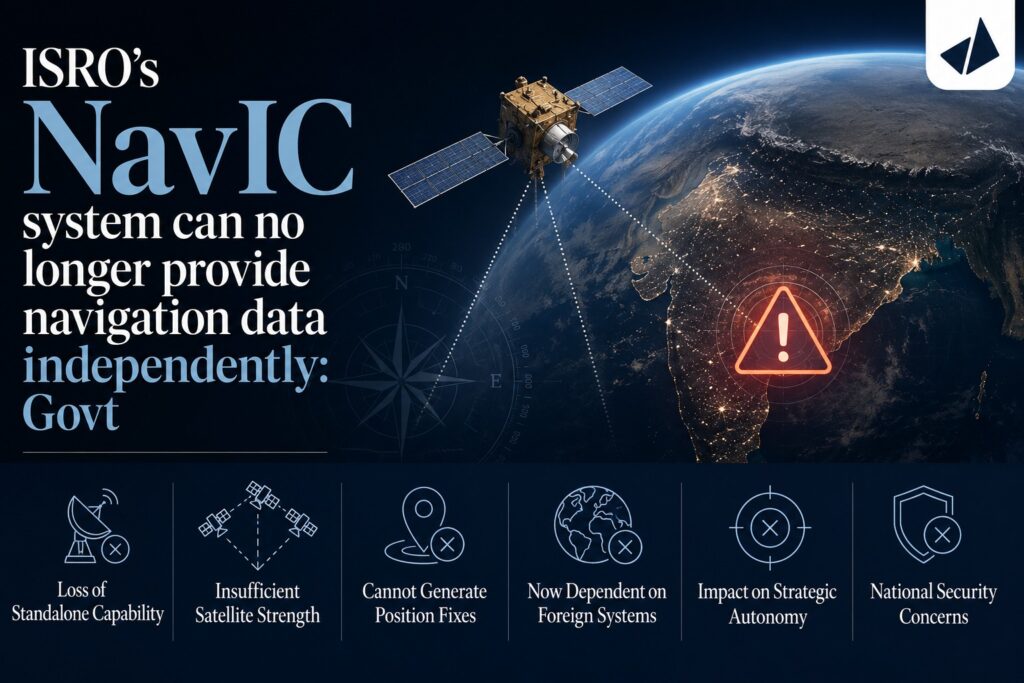
  • ISRO’s NavIC System Can No Longer Provide Standalone Navigation Services

    Why in the News?

    For the first time, the Government has admitted in Parliament that India’s NavIC (Navigation with Indian Constellation) cannot currently provide standalone positioning services, as only 3 operational satellites are available for navigation, while at least 4 satellites are required.

    What is the issue?

    • IRNSS-1F, launched in March 2016, completed its mission life and its onboard atomic clock failed, reducing the operational navigation satellites.
    • At present, only IRNSS-1B, IRNSS-1I, and NVS-01 are providing Positioning, Navigation and Timing (PNT) services.
    • As a result, NavIC cannot independently provide positioning services, though its timing service remains functional.

    What is NavIC?

    • NavIC (Navigation with Indian Constellation) is India’s regional satellite navigation system, developed by ISRO under the Indian Regional Navigation Satellite System (IRNSS).
    • It provides Positioning, Navigation and Timing (PNT) services over:
      • India, and
      • up to 1,500 km beyond its borders.
    • The original constellation was designed with 7 satellites.

    Why are four satellites necessary?

    • A navigation receiver determines its position through trilateration.
    • At least 4 satellites are required to accurately calculate Latitude, Longitude, Altitude, and Time correction
    • Without four operational satellites, standalone navigation becomes unreliable.

    Does this affect users?

    • No major impact on most users.
    • Smartphones, aircraft, ships and vehicles use multi-constellation GNSS receivers, combining signals from GPS (USA), Galileo (European Union), GLONASS (Russia), BeiDou (China), and NavIC (India)
    • Hence, navigation services continue without significant disruption.

    Current status

    • Standalone positioning: Not available.
    • Timing service: Functional.
    • Emergency message broadcasting: Functional.
    • Armed Forces: Continue using NavIC as part of a multi-constellation GNSS framework.

    Future roadmap

    • NVS-03 is ready for launch.
    • NVS-04 and NVS-05 are in advanced stages of development.
    • These satellites are expected to restore NavIC’s independent navigation capability.

    Significance of NavIC

    • Enhances strategic autonomy by reducing dependence on foreign navigation systems.
    • Supports: Defence operations, Disaster management, Maritime navigation, Aviation, Railways, Road transport, Precision agriculture, and Surveying and mapping
    • Provides secure and reliable navigation during emergencies or geopolitical conflicts.

    [2023] Which one of the following countries has its own Satellite Navigation System?

    [A] Australia

    [B] Canada

    [C] Israel

    [D] Japan

  • Celebrating 25 Years of the Himalayan Chandra Telescope (HCT)

    Why in News?

    The Himalayan Chandra Telescope (HCT) at Hanle, Ladakh, completed 25 years of operation. The occasion was marked by a conference highlighting its scientific achievements and future expansion plans.

    Key Highlights

    • Location: Indian Astronomical Observatory (IAO), Hanle, Ladakh (4,517 m).
    • Managed by: Indian Institute of Astrophysics (IIA) under the Department of Science and Technology (DST).
    • First Light: 26 September 2000; dedicated to the nation in 2001.
    • Named after Subrahmanyan Chandrasekhar.
    • Operated remotely from Bengaluru via INSAT-3B since 2001.

    Why is Hanle Important?

    • Over 250 clear nights annually.
    • Very low atmospheric water vapour and minimal light pollution.
    • Ideal for optical and near-infrared astronomy.
    • Protected under the Hanle Dark Sky Reserve.

    Major Scientific Contributions

    • Studies of gamma-ray bursts, comets, exoplanets, supernovae, variable stars, galaxies, and active galactic nuclei (AGN).
    • Contributed to the discovery of TRAPPIST-1b.

    Key Instruments

    • HFOSC – Optical camera and spectrograph.
    • uTIRSPEC – Near-infrared spectrometer.
    • HESP – High-resolution Echelle spectrograph.

    Future Plans

    The Union Budget announced:

    • 3.7-m Upgraded Himalayan Chandra Telescope (UHCT).
    • 13.7-m National Large Optical-Infrared Telescope (NLOT) at Hanle.

    Prelims Facts

    • HCT: 2-m optical telescope at Hanle, Ladakh.
    • Nodal Agency: Indian Institute of Astrophysics (IIA).
    • Administrative Ministry: Department of Science and Technology (DST).
    • Hanle Dark Sky Reserve: India’s first Dark Sky Reserve.

    [2016] With reference to ‘Astrosat’,’ the astronomical observatory launched by India, which of the following statements is/are correct?
    1. Other than USA and Russia, India is the only country to have launched a similar observatory into space.
    2. Astrosat is a 2000 kg satellite placed in an orbit at 1650 km above the surface of the Earth.
    Select the correct answer using the code given below.

    [A] 1 only

    [B] 2 only

    [C] Both 1 and 2

    [D] Neither 1 nor 2

  • DRDO Successfully Flight Tests Indigenous Long-Range SAM ‘Kusha’

    Why in News?

    The Defence Research and Development Organisation (DRDO) successfully conducted the maiden flight test of the indigenous Long-Range Surface-to-Air Missile (LR-SAM) ‘Kusha’ from APJ Abdul Kalam Island, Odisha.

    What is Project Kusha?

    • An indigenous Long-Range Surface-to-Air Missile (LR-SAM) system developed by DRDO.
    • Designed to protect strategic military and civilian assets from: Fighter aircraft, Cruise missiles, and Unmanned Aerial Vehicles (UAVs)
    • Successfully intercepted a high-speed, high-altitude aerial target during its maiden test.

    Key Highlights

    • Long-range SAMs generally have a range of over 200 km.
    • Developed with indigenous missiles, radars, and command & control systems.
    • Will reduce India’s dependence on imported long-range air defence systems.

    Mission Sudarshan Chakra

    • Proposed indigenous multi-layered national air defence shield.
    • Project Kusha and the Integrated Air Defence Weapon System (IADWS) are its key components.
    • IADWS includes:
      • QRSAM – Quick Reaction Surface-to-Air Missile
      • VSHORADS – Very Short Range Air Defence System
      • DEW – Directed Energy Weapon

    Prelims Value Added

    • DRDO: Defence Research and Development Organisation.
    • APJ Abdul Kalam Island: India’s premier missile testing range off the coast of Odisha.
    • SAM: Surface-to-Air Missile designed to intercept aerial threats.

    [2026] Consider the following statements about Mission Sudarshan Chakra of India :
    1.It aims to enhance India’s air defence and aerial offensive capabilities.
    2.This Mission is being designed to enhance rapid, precise, and powerful defence responses, reinforcing India’s strategic autonomy.
    3.One of the aims of this Mission is to cover all public places od India by an expanded nationwide shield by 2035.
    Which of the statements given above is/are correct ?

    [A] 1,2 and 2

    [B] 1 and 2 only

    [C] 2 and 3 only

    [D] 1 only

  • Making Sense of Embodied AI: The Next Frontier in Robotics

    Why in the News?

    On April 14, Boston Dynamics and Google DeepMind gave Spot, a robot dog long confined to scripted routines, an AI brain (Gemini Robotics-ER 1.6). This revived global interest in “embodied AI” as robots moved from labs into real-world settings such as the FIFA World Cup 2026 football field and America’s Got Talent. This has sharpened the debate over whether robotic intelligence is fundamentally a software problem or one rooted in the physical body itself.

    What does ’embodied AI’ actually mean, and why is intelligence not just software placed in a robot body?

    1. Definition: Embodied AI is a paradigm of artificial intelligence where algorithms are integrated into physical systems (such as humanoid robots, robotic arms, and autonomous vehicles) to perceive, learn from, and interact with the physical world through sensory motor control.
    2. Body as computation, not container: Researchers argue a robot’s body is not merely a delivery mechanism for intelligence but part of the computation itself. This claim is advanced by Rolf Pfeifer (Zurich) and Josh Bongard (Vermont) in How the Body Shapes the Way We Think.
    3. Subsumption architecture: Rodney Brooks showed in the late 1980s-90s that layered reflexes coupled directly to sensors and motors can produce robust real-time behaviour without any internal world-model. This challenged the dominant symbolic-AI paradigm of the time.
    4. Morphological computation: Physical body structure offloads work that would otherwise require a brain. A passive-dynamic walker descends a slope using only leg geometry, with no motors or control system.
    5. Adaptive material design: A soft, compliant robotic hand grips oddly shaped objects without an explicit shape model, because the material itself deforms and adapts.
    6. Common thread: Across Pfeifer’s lab, Brooks’s robots, and today’s humanoids, intelligence is distributed between brain, body, and environment, not confined to one part.

    Why does mastering the physical world remain far harder for AI than mastering language and images?

    1. Different learning problem: Unlike chatbots trained on text, images, and video, embodied AI must master gravity and balance across countless physical scenarios a robot may face.
    2. Simulation-to-real gap: Success in simulation rarely translates perfectly to the real world, since simulated environments cannot capture every physical contingency.
    3. Market-performance mismatch: The embodied AI market is projected to reach $23 billion by 2030, yet most humanoid robots still run only about 90 minutes on a charge.
    4. Lab-to-field performance drop: Policies that succeed 95% of the time in the lab drop to roughly 60% in the real world.
    5. Central bottleneck: The gap between demo and deployment remains the field’s unglamorous but defining problem.

    How does embodied AI differ from neuromorphic AI, despite both drawing on biology?

    1. Different questions: Embodied AI asks where intelligence lives, treating cognition as distributed across brain and body; neuromorphic AI asks how the processor itself is built.
    2. Hardware-agnostic: Embodied AI is largely indifferent to processor type; a robot’s “brain” can run on an ordinary GPU cluster.
    3. Spiking neural networks (SNNs): Neuromorphic AI most commonly uses SNNs, where each neuron fires only once incoming signals cross a threshold, suiting time-sensitive tasks like motion sensing.
    4. Power efficiency: Neuromorphic chips consume energy only when neurons are actively spiking, making them notably power-efficient.
    5. Convergence in practice: A growing body of research on “embodied neuromorphic intelligence” places spiking, event-driven chips inside physical robots specifically for their low power draw and fast response.

    How can co-designing body and brain through evolutionary computation address the body-task mismatch?

    1. The design question: If bodies perform computation, the right approach is to design the body for the task, rather than bolting an AI model onto whatever frame engineers have already built.
    2. Jin’s argument: Yaochu Jin, Alexander von Humboldt Professor at Bielefeld University, holds that neural control and physical form must be developed together, not designed separately and combined.
    3. Biological parallel: This mirrors how biological organisms grow nervous systems and bodies in tandem, shaped by continuous environmental feedback.
    4. Research focus: Jin’s work centres on co-evolving nervous systems and morphology, and on how environmental feedback shapes an organism’s sensory distribution.
    5. Practical payoff: Evolutionary computation lets simulated robot populations compete and replicate based on task performance before any physical prototype is built, addressing the costly, slow problem of manually re-engineering hardware whenever a task changes.

    Why is embodied AI a systems challenge that no single breakthrough can resolve?

    1. Persistent sim-to-real gap: Policies trained cheaply in simulation, run millions of times over, still degrade sharply once deployed on real hardware.
    2. Speed-reflex mismatch: Reasoning models are often too slow for robot limbs that must react in milliseconds, forcing a split between heavy “thinking” done off-device and lighter reflexive control on the robot itself.
    3. Hardware fragility: Short battery runtimes and vulnerable components undercut otherwise successful pilots.
    4. Data scarcity: Embodied systems lack an internet-scale training corpus. The Open X-Embodiment dataset and Generalist AI’s GEN-0 are early attempts to build one, but real-world deployment needs at least tens of millions of hours of training data.
    5. A systems problem, not just a software one: Safe deployment depends on sensors, hardware robustness, operational design limits, human interaction, cybersecurity, and organisational processes, not algorithms alone. Regulators must define evidentiary standards for deploying learning-enabled robots.
    6. Form factor as evidence: Boston Dynamics’ Atlas adapting to uneven turf at the FIFA World Cup 2026, and China’s Unitree G1 robots performing alongside professional dancer Wu Yufei on America’s Got Talent Season 21, show gains coming as much from redesigned quadruped and avian-inspired forms as from smarter software.

    Conclusion

    Embodied AI reframes robotic intelligence as something distributed across brain, body, and environment, not a software layer simply installed onto hardware. Progress is bottlenecked not by algorithmic sophistication but by physical constraints, the simulation-to-real gap, data scarcity, actuation-speed mismatches, and bodies poorly matched to their tasks. Closing this gap requires treating embodied AI as a systems-engineering and regulatory challenge, including the evolutionary co-design of body and brain, rather than a problem that better software alone can solve.

    PYQ Relevance

    [UPSC 2015] What are the areas of prohibitive labour that can be sustainably managed by robots ? Discuss the initiatives that can propel research in premier research institutes for substantive and gainful innovation.

    Linkage: The PYQ asks what areas of prohibitive labour can be sustainably managed by robots, and what initiatives can propel research in premier institutes for gainful innovation. It connects to the article’s broader theme of advancing robotics research.

  • Electronic Gold Receipts: A New Way to Own Gold

    Why in the News?

    The National Stock Exchange (NSE) introduced Electronic Gold Receipts (EGRs) in May 2026, a new exchange-traded segment for buying and selling gold electronically. The launch extends a SEBI-led regulatory push, begun in 2021, to move gold ownership from informal physical custody into standardised market infrastructure.

    What Explains the Shift from Physical Gold Custody to Exchange-Based Receipts?

    1. Definition: An EGR is an exchange-traded security representing ownership of physical gold of a specified purity, held in SEBI-regulated vaults and tradeable electronically through a demat account.
    2. Regulatory foundation laid in 2021: SEBI approved the framework for Gold Exchange and the SEBI (Vault Managers) Regulations, 2021 on September 28, 2021.
    3. Legal status as securities: The Centre notified EGRs as securities under the Securities Contracts (Regulation) Act, 1956 in December 2021.
    4. Risk framework added in 2022: SEBI issued a Comprehensive Risk Management Framework for EGRs on April 1, 2022, completing the regulatory base for EGR trading.
    5. First mover was BSE, not NSE: The Bombay Stock Exchange received SEBI’s final approval in September 2022 and launched EGR trading on October 24, 2022, starting with 995 and 999 purity products traded in multiples of 1 gram.

    How Do EGRs Function as a Market Instrument?

    1. Trading window: EGRs trade Monday to Friday, from 9 a.m. to 11:30 p.m., extended to 11:55 p.m. during the U.S. daylight saving period.
    2. Settlement cycle: EGRs follow a T+1 settlement cycle, with receipts credited to the buyer’s demat account the next trading day.
    3. Eligible participants: Retail investors, jewellers, bullion traders, refiners and institutional investors can all buy EGRs through registered stockbrokers.
    4. Dual account requirement: Both a trading account and a demat account are mandatory to buy and sell EGRs.
    5. Purity and denomination structure: EGRs are available in 999 (99.9% pure) and 995 (99.5% pure) standards, each offered in six denominations from 10 mg to 1 kg.

    What Advantages Does the EGR Structure Offer Over Traditional Gold Ownership?

    1. Transparent price discovery: Exchange trading ensures a uniform gold price across India at any given point in time, unlike fragmented physical jewellery market pricing.
    2. Removal of storage and purity risk: Gold backing an EGR is held in SEBI-regulated vaults, removing the investor’s need to store gold at home or verify its purity independently.
    3. Liquidity and settlement guarantee: EGRs can be bought and sold during market hours with an exchange-backed settlement guarantee.
    4. Flexible entry points: Denominations from 10 mg to 1 kg allow both first-time small investors and larger accumulators to participate.
    5. Portfolio diversification and fungibility: EGRs can be held as a financial asset within a broader investment portfolio while retaining the option of conversion to physical gold.

    Does the Promise of Seamless Convertibility Between Physical and Electronic Gold Hold Up in Practice?

    1. Layered transaction costs: Beyond the purchase cost, investors bear brokerage, demat (depository) charges and vault-storage charges for holding EGRs electronically.
    2. Additional costs on conversion: Investors opting for physical delivery must separately bear purity testing and transportation charges not applicable to those who stay electronic.
    3. Tax asymmetry: EGR trading itself attracts no GST, but converting an EGR into physical gold triggers 3% GST on the gold value, the same as buying physical gold directly.
    4. Practical implication: The cost structure rewards investors who remain within the electronic system and penalises the physical-conversion route, so electronic and physical gold are not fully interchangeable in cost terms even though they are interchangeable in form.

    Conclusion

    EGRs formalise India’s gold market by converting informal physical gold holding into a SEBI-regulated, exchange-traded financial instrument with transparent pricing and vaulted custody. The layered brokerage, storage and conversion charges, particularly the 3% GST triggered only on physical delivery, show that electronic and physical gold remain only partially fungible in cost terms. 

    PYQ Relevance

    [UPSC 2015] Craze for gold in Indians have led to a surge in import of gold in recent years and put pressure on balance of payments and external value of rupee. In view of this, examine the merits of Gold Monetization Scheme.

    Linkage: The PYQ discusses the Gold Monetization Scheme, introduced to channel idle household gold into the formal economy and ease pressure on India’s balance of payments. Both the PYQ and the article concern state efforts to formalise gold within the financial system.

  • International Biology Olympiad (IBO) 2026

    Why in News?

    India won 1 Gold and 3 Silver medals at the 37th International Biology Olympiad (IBO) 2026, held in Vilnius, Lithuania.

    Key Highlights

    • Host: Vilnius, Lithuania.
    • Participants: 307 students from 78 countries.
    • India’s Performance: 1 Gold and 3 Silver medals.
    • India’s Overall IBO Medal Tally: 17 Gold, 69 Silver, 17 Bronze, and 1 Honourable Mention
    • This was India’s 26th participation in the IBO.

    About the International Biology Olympiad (IBO)

    • International Biology Olympiad (IBO) is an annual global biology competition for secondary school students.
    • Established: 1990.
    • Hosted by a different country every year.
    • Includes theoretical and practical examinations.
    • Covers Cell & Molecular Biology, Genetics, Evolution, Plant & Animal Biology, Ecology, and Biosystematics.

    Prelims Value Addition

    Homi Bhabha Centre for Science Education (HBCSE)

    • HBCSE is a constituent institution of the Tata Institute of Fundamental Research (TIFR).
    • It coordinates India’s Science Olympiad Programme and prepares Indian teams for international Olympiads.

    [2026] X’, born in the UK, was conferred the Nobel Prize in 2025. He was a professor in an American university when this prize was announced. Identify X’:

    [A] Michel H. Devoret

    [B] Richard Robson

    [C] John Clarke

    [D] Joel Mokyr

  • Engineering Biology Roadmap 2035

    Why in News?

    The Government launched the Roadmap: “Building India as a Leading Bioeconomy Powerhouse by 2035” and announced India’s first Engineering Biology undergraduate course to develop a future-ready biotechnology workforce.

    Key Highlights

    • First Engineering Biology Graduation Course to be introduced in India.
    • Objective: Build a sovereign biotechnology ecosystem by integrating engineering, biology, medicine and AI.
    • IITs are preparing interdisciplinary programmes in collaboration with medical institutions.
    • Focus on AI-driven biology, synthetic biology and advanced biomanufacturing.
    • Bioeconomy Growth Fund: Proposed ₹50,000 crore to support innovation and commercialization.
    • Emphasis on industry-academia partnerships, talent development and indigenous biomanufacturing.

    What is Engineering Biology?

    • Engineering Biology is an interdisciplinary field that applies engineering principles to biological systems for designing and modifying organisms to develop useful products and technologies.

    Applications

    • Precision medicine and gene therapies, CAR-T cell therapy, Sustainable biofuels and bio-based chemicals, Climate-resilient agriculture, Alternative proteins and food systems, and Environmental remediation

    India’s Bioeconomy: Key Facts

    • Grew from ~USD 10 billion (2014) to ~USD 95 billion (2026).
    • Expected to reach USD 300 billion by 2030.
    • Roadmap targets USD 700 billion by 2035.
    • Over 11,000 biotechnology startups.
    • Nearly 100 bio-incubators.
    • Annual growth rate: 15 to 18%.
    • Contributes around 4.8% of GDP.

    Government Initiatives

    • BioE3 Policy (Biotechnology for Economy, Employment and Environment)
    • Promotion of AI-enabled biology and synthetic biology.
    • Strengthening bio-manufacturing and biotechnology innovation ecosystem.
    • Expansion of biotechnology education and skilled workforce.

    Prelims Facts

    • Synthetic Biology: Designing or modifying biological systems for useful applications.
    • Biomanufacturing: Using living organisms or biological processes to manufacture products.
    • CAR-T Cell Therapy: Personalized immunotherapy where a patient’s T cells are genetically modified to attack cancer cells.
    • DNA Vaccine: Uses genetically engineered DNA to trigger an immune response.

    [2025] With reference to monoclonal antibodies, often mentioned in news, consider the following statements:
    I. They are man-made proteins.
    II. They stimulate immunological function due to their ability to bind to specific antigens.
    III. They are used in treating viral infections like that of Nipah virus.
    Which of the statements given above are correct?

    [A] I and II only

    [B] II and III only

    [C] I and III only

    [D] 1, II and III

  • Guardians of India’s Maritime Frontiers

    Why in News?

    The Indian Navy recently commissioned INS Mahendragiri, INS Dunagiri, INS Sanshodhak, and INS Agray, strengthening India’s indigenous maritime capabilities.

    Key Highlights

    • Three indigenous naval classes strengthen India’s layered maritime security:
      • Nilgiri Class: Stealth Frigates (Project 17A)
      • Sandhayak Class: Survey Vessel (Large)
      • Arnala Class: Anti-Submarine Warfare Shallow Water Craft (ASW-SWC)
    • Designed by the Warship Design Bureau (WDB) with high indigenous content under Aatmanirbhar Bharat.
    • Protect India’s 11,098 km coastline, 2.4 million sq km Exclusive Economic Zone (EEZ), and sea lanes carrying ~90% of India’s trade by volume.

    About the Three Classes

    • Nilgiri Class (Project 17A): Next-generation stealth guided missile frigates for anti-air, anti-surface, and anti-submarine warfare.
      • Equipped with BrahMos missiles, advanced radar, sonar, and helicopters.
    • Sandhayak Class: Conducts hydrographic surveys, seabed mapping, and nautical charting.
      • Supports the Blue Economy, navigation safety, and disaster relief.
    • Arnala Class: Designed for coastal anti-submarine warfare in shallow waters.
      • Equipped with lightweight torpedoes, ASW rockets, and shallow-water sonar.

    Strategic Significance

    • Strengthens Aatmanirbhar Bharat through indigenous shipbuilding.
    • Supports SAGAR (Security and Growth for All in the Region) and MAHASAGAR (Mutual and Holistic Advancement for Security and Growth Across Regions) visions.
    • Enhances maritime security, defence exports, and the Blue Economy.

    [2016] Which one of the following is the best description of ‘INS Astradharini’, that was in the news recently?

    [A] Amphibious warfare ship

    [B] Nuclear-powered submarine

    [C] Torpedo launch and recovery vessel

    [D] Nuclear-powered aircraft carrier

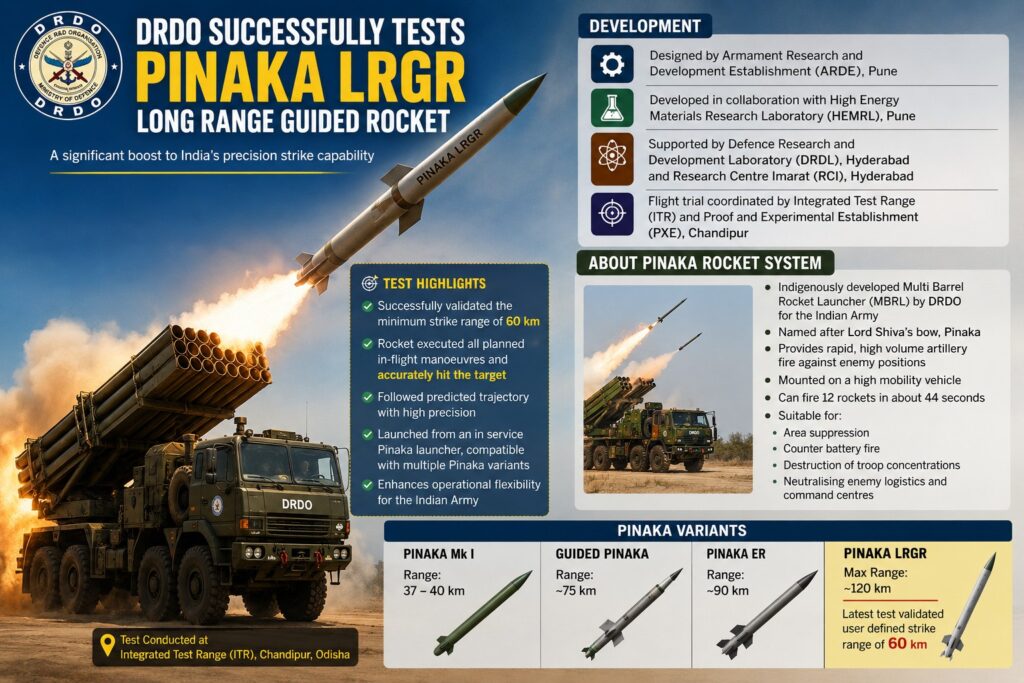
  • DRDO Successfully Tests Pinaka Long Range Guided Rocket

    Why in News?

    The Defence Research and Development Organisation (DRDO) successfully conducted a flight test of the Pinaka Long Range Guided Rocket (LRGR) from the Integrated Test Range (ITR), Chandipur, Odisha. The test validated its user defined minimum strike range of 60 km and demonstrated high precision strike capability.

    Key Highlights

    • Successfully validated the minimum strike range of 60 km.
    • The rocket executed all planned in flight manoeuvres and accurately hit the designated target.
    • It followed the predicted trajectory with high precision.
    • Launched from an in service Pinaka launcher, demonstrating compatibility with multiple Pinaka rocket variants.
    • This enhances operational flexibility for the Indian Army.

    Development

    • Designed by the Armament Research and Development Establishment (ARDE), Pune.
    • Developed in collaboration with the High Energy Materials Research Laboratory (HEMRL), Pune.
    • Supported by the Defence Research and Development Laboratory (DRDL), Hyderabad and Research Centre Imarat (RCI), Hyderabad.
    • Flight trial coordinated by the Integrated Test Range (ITR) and Proof and Experimental Establishment (PXE), Chandipur.

    About Pinaka Rocket System

    • Pinaka is an indigenously developed Multi Barrel Rocket Launcher (MBRL).
    • Developed by DRDO for the Indian Army.
    • Named after Lord Shiva’s bow, Pinaka.
    • Provides rapid, high volume artillery fire against enemy positions.
    • Mounted on a high mobility vehicle.
    • Can fire 12 rockets in about 44 seconds.
    • Suitable for: Area suppression, Counter battery fire, Destruction of troop concentrations, and Neutralising enemy logistics and command centres

    Pinaka Variants

    • Pinaka Mk I: Range of about 37 to 40 km.
    • Guided Pinaka: Precision guided rocket with a range of about 75 km.
    • Pinaka Enhanced Range (ER): Range of about 90 km.
    • Pinaka Long Range Guided Rocket (LRGR): Maximum range of about 120 km, while the latest test validated a user defined strike range of 60 km.

    [2023] Consider the following statements
    1. Ballistic missiles are jet-propelled at subsonic speeds throughout their fights, while cruise missiles are rocket-powered only in the initial phase of fight.
    2. Agni-V is a medium-range supersonic cruise missile, while BrahMos is a solid-fuelled intercontinental ballistic missile.
    Which of the statements given above is/are correct?

    [A] 1 only

    [B] 2 only

    [C] Both 1 and 2

    [D] Neither 1 nor 2

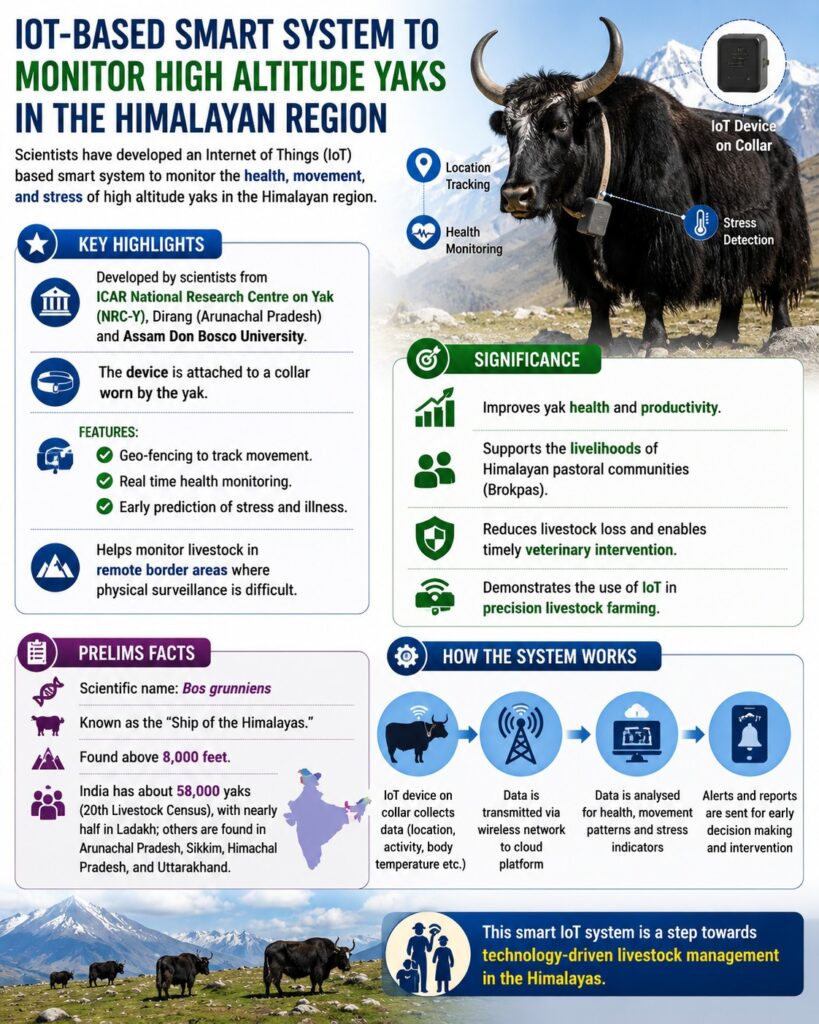
  • IoT Based Smart Health Tracker for Himalayan Yaks

    Why in News?

    Scientists have developed an Internet of Things (IoT) based smart system to monitor the health, movement, and stress of high altitude yaks in the Himalayan region.

    Key Highlights

    • Developed by scientists from ICAR National Research Centre on Yak (NRC-Y), Dirang (Arunachal Pradesh) and Assam Don Bosco University.
    • The device is attached to a collar worn by the yak.
    • Features:
      • Geo-fencing to track movement.
      • Real time health monitoring.
      • Early prediction of stress and illness.
    • Helps monitor livestock in remote border areas where physical surveillance is difficult.

    Significance

    • Improves yak health and productivity.
    • Supports the livelihoods of Himalayan pastoral communities (Brokpas).
    • Reduces livestock loss and enables timely veterinary intervention.
    • Demonstrates the use of IoT in precision livestock farming.

    Prelims Facts

    • Scientific name: Bos grunniens
    • Known as the “Ship of the Himalayas.”
    • Found above 8,000 feet.
    • India has about 58,000 yaks (20th Livestock Census), with nearly half in Ladakh; others are found in Arunachal Pradesh, Sikkim, Himachal Pradesh, and Uttarakhand.

    [2018] When the alarm of your smartphone rings in the morning, you wake up and tap it to stop the alarm which causes your geyser to be switched on automatically. The smart mirror in your bathroom shows the day’s weather and also indicates the level of water in your overhead tank. After you take some groceries from your refrigerator for making breakfast, it recognises the shortage of stock in it and places an order for the supply of fresh grocery items. When you step’ out of your house and lock the door, all lights, fans, geysers and AC machines get switched off automatically. On your way to office, your car warns you about traffic congestion ahead and suggests an alternative route, and if you are late for a meeting, it sends a message to your office accordingly. In the context of emerging communication technologies, which one of the following terms best applies to the above scenario?

    [A] Border Gateway Protocol

    [B] Internet of Things

    [C] Internet Protocol

    [D] Virtual Private Network