💥Mains Ready By December. Smash Mains & Smash PYQ Admissions Open

GS Paper: Diversity Of India

  • Why the sex ratio in Haryana dropped to an eight-year low in 2024?

    Why in the News?

    The sex ratio at birth in Haryana, which reached a peak of 923 in 2019, declined to 910 in 2024, marking an eight-year low.

    What is the present sex ratio in India? 

    As of January 2025, the sex ratio at birth in India is approximately 933 females per 1,000 males.

    World Bank

    Why Historically has there been an Imbalance in the Sex Ratio in India?

    Historically, India has faced a skewed sex ratio primarily due to cultural preferences for male children, leading to practices such as female foeticide. The sex ratio was recorded at 943 females per 1,000 males during the 2011 Census. Factors contributing to this imbalance include:

    • Cultural Preference for Sons: Societal norms often favour male children, viewing them as economic assets while daughters are seen as financial burdens due to dowry practices.
    • Female Foeticide: The availability of prenatal sex determination technologies has led to sex-selective abortions, contributing to the skewed ratio.
    • Economic Factors: Families may prefer fewer children and opt for sons to secure lineage and support in old age.

    What are the Government Initiatives to Improve the Sex Ratio?

    The Indian government has implemented several initiatives aimed at improving the sex ratio:

    • Beti Bachao Beti Padhao Campaign: Launched in 2015, this campaign focuses on preventing female foeticide and promoting the welfare of girls.
    • Pre-Conception and Pre-Natal Diagnostic Techniques Act (PNDT Act): Enforced to curb sex-selective abortions and promote gender equality.
    • Financial Incentives: Programs such as providing financial assistance at the birth of a girl child (e.g., Rs 21,000) encourage families to value daughters.
    • Education and Awareness Programs: Efforts are made to improve female education and reduce dropout rates among girls, which are crucial for long-term improvements in gender equality.

    Way forward: 

    • Strengthen Law Enforcement and Monitoring: Ensure strict implementation of the PCPNDT Act with increased vigilance and swift action against violations.  
    • Address Cultural and Economic Barriers: Launch targeted campaigns to challenge patriarchal norms, promote gender equality, and incentivise families to raise daughters.  

    Mains PYQ:

    Q Why do some of the most prosperous regions of India have an adverse sex ratio for women? Give your arguments. (UPSC IAS/2014)
  • Citizenship and diversity of India

    Context

    Given the diversity and complexity of India, the only constitutionally valid common denominator is citizenship.

    Social security

    • An eminent sociologist and former president of the International Sociological Association, T.K. Oommen, has written extensively on the concept of social security.
    • Evolution of nation: He says the principal challenges to the evolution of a nation lie in minimising disparity, eradicating discrimination, and avoiding alienation.
    • Excluded groups in our society: He has listed nine categories of socially and/or politically and/or excluded groups in our society: “Dalits, Adivasis, OBCs, cultural minorities — both religious and linguistic, women, refugees-foreigners-outsiders, people [of] Northeast India, the poor and the disabled”.
    • Sources of exclusion in India: He has suggested that “the three sources of exclusion in India — stratification, heterogeneity and hierarchy — create intersectionality.”
    • This insecurity manifests itself in genocide, culturocide and ecocide and in its absence, a society may be conceptualised as secure.
    • The Indian polity, he says, “has the most elaborate set of identities based on class, religion, gender, caste, region, language and their intersectionalities as well as consequent permutations and combinations.
    • Citizenship as a common denominator: Given the diversity and complexity of India, the only constitutionally valid common denominator is citizenship.
    • This is the point at which fraternity can and should be practiced among equals.
    • Prof. Oommen opines that it is “only through the conflation of state and nation” can our Republic be considered a nation.

    Conclusion

    Cultural monoism and secularism are insufficient, Prof. Oommen says; instead, “the idea of conceptualizing India as a multicultural polity is more amenable than a secular India.” The sheet anchor of this has to be citizenship.

    UPSC 2023 countdown has begun! Get your personal guidance plan now! (Click here)

  • Tribes in news: Mundapota Kela

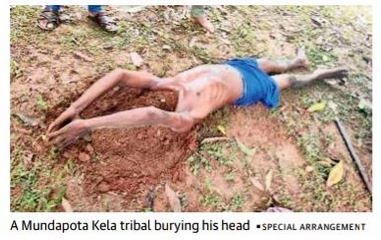
    Members of the Mundapota Kela community in Odisha perform an unthinkable act of their head buried in soil, which requires exceptional breath control, for a living.

    Mundapota Kela

    • The community — Mundapota Kela (a denotified tribe) — is left with few members who earn a livelihood with this bizarre act.
    • It is believed to have migrated to Odisha from Rayalaseema area of Andhra Pradesh decades ago.
    • Being street performers, they travel from one village to another and bury their heads in soil for several minutes.
    • They collect rice, vegetables and money from villagers for putting up the show.

    Try answering this PYQ:

    Q.Consider the following statements about Particularly Vulnerable Tribal Groups (PVTGs) in India:

    1. PVTGs reside in 18 States and one Union Territory.
    2. A stagnant or declining population is one of the criteria for determining PVTG status.
    3. There are 95 PVTGs officially notified in the country so far.
    4. Irular and Konda Reddi tribes are included in the list of PVTGs.

    Which of the statements given above are correct?

    (a) 1, 2 and 3

    (b) 2, 3 and 4

    (c) 1, 2 and 4

    (d) 1, 3 and 4


    [wpdiscuz-feedback id=”b9k5ymz91z” question=”Please leave a feedback on this” opened=”1″]Post your answers here:[/wpdiscuz-feedback]


    Back2Basics: De-Notified Tribes

    • Denotified Tribes (DNTs), also known as Vimukta Jati are the tribes that were listed originally under the Criminal Tribes Act of 1871 as Criminal Tribes.
    • Once a tribe became “notified” as criminal, all its members were required to register with the local magistrate, failing which they would be charged with a “crime” under the Indian Penal Code.
    • The Criminal Tribes Act was repealed in 1949 and thus ‘de-notified’ the tribal communities.
    • The denotified tribes were reclassified as “habitual offenders” in 1959.
    • The UN’s anti-discrimination body Committee on the Elimination of Racial Discrimination (CERD) asked India to repeal the Habitual Offenders Act (1952) and effectively rehabilitate the denotified and nomadic tribes on 9 March 2007.
    • A National Commission for Denotified, Nomadic and Semi-Nomadic Tribes (NCDNSNT) was setup in 2003 to study various developmental aspects under the chairmanship of Shri. Balkrishna Renke.


    UPSC 2022 countdown has begun! Get your personal guidance plan now! (Click here)

  • Festival in news: Nuakhai

    In Odisha, Nuakhai, an important agrarian festival in the State is being celebrated today.

    Nuakhai

    • Nuakhai or is an agricultural festival mainly observed by people of Western Odisha and Southern Chhattisgarh in India.
    • It is observed to welcome the new rice of the season.
    • As per the customary practice, people offer the new grains of crops to the deities before their own consumption.
    • According to the calendar it is observed on Panchami tithi (the fifth day) of the lunar fortnight of the month of Bhadrapada or Bhadraba (August–September), the day after the Ganesh Chaturthi festival.
    • This is the most important social festival of Western Odisha and adjoining areas of Simdega in Jharkhand, where the culture of Western Odisha is much predominant.
    • It is also a festival of social cohesion as all the members of the family come together to celebrate Nuakhai.

    Try this PYQ:

    Consider the following pairs:

    Tradition                                    State

    1. Chapchar Kut Festival   —  Mizoram
    2. Khongjom Parba ballad —  Manipur
    3. Thang-Ta Dance           —   Sikkim

    Which of the pairs given above is/are correct?

    (a) 1 only

    (b) 1 and 2

    (c) 1 and 2

    (d) 2 and 3


    [wpdiscuz-feedback id=”dqep2sq3fg” question=”Please leave a feedback on this” opened=”1″]Post your answers here.[/wpdiscuz-feedback]

    UPSC 2022 countdown has begun! Get your personal guidance plan now! (Click here)

  • Arunachal Pradesh ST List

    The Parliament has passed a bill that seeks to amend the nomenclature of certain tribes from Arunachal Pradesh mentioned in the Constitution (Scheduled Tribes) Order, 1950.

    What does the Bill amend?

    • The Bill seeks to modify Part-XVIII of the Schedule to the Constitution (Scheduled Tribes) Order, 1950.
    • Part-XVIII lists 16 tribes of Arunachal, in order: Abor, Aka, Apatani, Nyishi, Galong, Khampti, Khowa, Mishmi [Idu, Taroon], Momba, Any Naga tribes, Sherdukpen, Singpho, Hrusso, Tagin, Khamba, and Adi.
    • The Bill corrects the names of tribes spelled incorrectly and adds names of a few tribes that were either named ambiguously or had their parent group named only.

    Why is it significant?

    • Self-identification: It is an essence for much-needed respect for small indigenous communities in the Northeast.
    • Indigenous nomenclature of tribes: This has been a long-standing demand in Arunachal Pradesh for two reasons: for the recognition of individual identity and to do away with the ambiguity as a result of errors in their names.
    • Identity assertion: For long, communities — whether civil society members or student leaders — have demanded that they must be known by their respective names.

    UPSC 2022 countdown has begun! Get your personal guidance plan now! (Click here)