đŸ’„Join UPSC 2027,2028 Mentorship (July Batch) + XFactor Notes & Microthemes PDF

GS Paper: E-Governance

  • Riding on data for mobility

    Context

    Data-based governance can assist in reducing traffic congestion, as illustrated by a pilot study in Hyderabad.

    How the Digital revolution is transforming lives

    • Seamless and efficient interaction: The digital revolution has made interactions between humans and machines, and among citizens, governments and businesses, seamless and efficient.
    • Helping efficient delivery of services: Today, e-governance enables and empowers citizens to directly engage with the state, thereby eliminating barriers in the delivery of public services.
    • The next wave of transformation: The next wave of transformation in digital governance is at the intersection of data and the public good.
      • Data as a strategic asset: The key to this transformation lies in incorporating data as a strategic asset in all aspects of-
      • Policy.
      • Planning.
      • Service delivery and-
      • Operations of the government.

    Transportation system improvement by leveraging Digital revolution

    • Loss caused by the congestion
      • Congestion caused an estimated $24 billion to the four metro cities in India in 2018.
      • Given the limited land resources available, the key to solving congestion lies in improving the efficiency of existing transportation systems.
    • How can Digital revolution help tackle the problem?
      • An efficient transportation system would help ease congestion, reduce travel time and cost, and provide greater convenience.
      • How it will work? Data from multiple sources such as-
      • CCTV cameras.
      • Automatic traffic 
      • Map services and-
      • Transportation service providers could be used.
    • Results of the previous studies
      • London example: A study by Transport for London estimates that its open data initiative on sharing of real-time transit data has helped add ÂŁ130 million a year to London’s economy by improving productivity and efficiency.
      • Results from China: In China, an artificial intelligence-based traffic management platform developed by Alibaba has helped improve average speeds by 15%.

    Hyderabad Open Transit Data portal

    • Hyderabad Open Transit Data, launched by Open Data Telangana, is the country’s first data portal.
      • What does it do? It publishes datasets on bus stops, bus routes, metro routes, metro stations, schedules, fares, and frequency of public transit services.
    • The objective of the portal: The objective is to empower start-ups and developers to create useful mobility applications.
      • The datasets were built after an intensive exercise carried out by the Open Data Team and Telangana State Road Transport Corporation to collect, verify and digitise the data.
    • Collaboration with the private sector: Hyderabad has also begun collaborating with the private sector to improve traffic infrastructure.
      • MoU with Ola Mobility Institute: One such partnership followed a Memorandum of Understanding signed between the Telangana government and Ola Mobility Institute.
      • Monitoring the quality of roads in the city: Under this collaboration, Ola has developed a tool, Ola City Sense, to provide data-based insights that can monitor the quality of Hyderabad’s roads and identify bad quality patches.
      • Other areas in which the data is used: The information thus given is useful not only for carrying out road repairs, it also helps officials take initiatives to improve road safety, monitor quality of construction, and study the role of bad roads in causing congestion.
    • A pilot project to prioritisation of repairs: A pilot was implemented in a municipal zone to gauge the efficacy of the data in supporting road monitoring and prioritisation of repairs.
      • The early results of this pilot project were encouraging. The dashboard helped city officials plan the pre-monsoon repair work and budget for repairs last year.

    Conclusion

    • The willingness of the government to apply data-based insights: The Hyderabad project and the pilot demonstrated the willingness of government departments to apply data-based insights for better decision making.
      • This could also serve as a model for other cities to emulate.
    • Making the departments data-centric: The Hyderabad example also shows that governments can make their departments data-centric by-
      • Institutionalising data collection.
      • Building technology platforms.
      • And helping the departments develop the capacity to handle the insights generated from the data.
      • Smart cities as a starting point: Command and control centres under the ‘smart cities’ initiative can be an ideal starting point.
      • Data security and privacy: Such interventions, however, also need to address genuine concerns around data security and privacy.


  • ‘MANI’ app

    With an eye to aid the differently-abled, the Reserve Bank of India (RBI) has launched a mobile app to identify currency notes.

    MANI App

    • ‘MANI’, is an acronym for Mobile Aided Note Identifier.
    • The visually challenged can identify the denomination of a note by using the application, which can also work offline once it is installed.
    • A user will have to scan the notes using the camera and it will give the audio output to give out results in Hindi and English.
    • RBI has clarified that the app does not authenticate a note as either genuine or counterfeit.
  • Digital India Initiatives

    Budget to boost Digital India vision

    The Union Budget 2016-17 has given a big boost to the Digital India vision of the Hon’ble Prime Minister. Let’s understand it in brief.

    Narendra-Modi-Digital-India


    Announcements for Digital India

    • Budget announcements will give a big boost to Digital India initiatives, Digital literacy, greater application of Cloud and above all big push to the Electronics Manufacturing
    • Focus on the larger involvement of post office platform for financial inclusion, including delivery of services

    Let’s now take an overview of some profound changes of last 20 years –

    • IT / ITeS exports have crossed USD 100 billion
    • India’s share in global IT services outsourcing presently 56%, is growing every year
    • Total employment in IT / ITeS sector is 37 lakhs in this financial year, out of which the net addition is 2 lakhs
    • Electronics Manufacturing has seen remarkable improvement, due to the initiatives of government in this sector

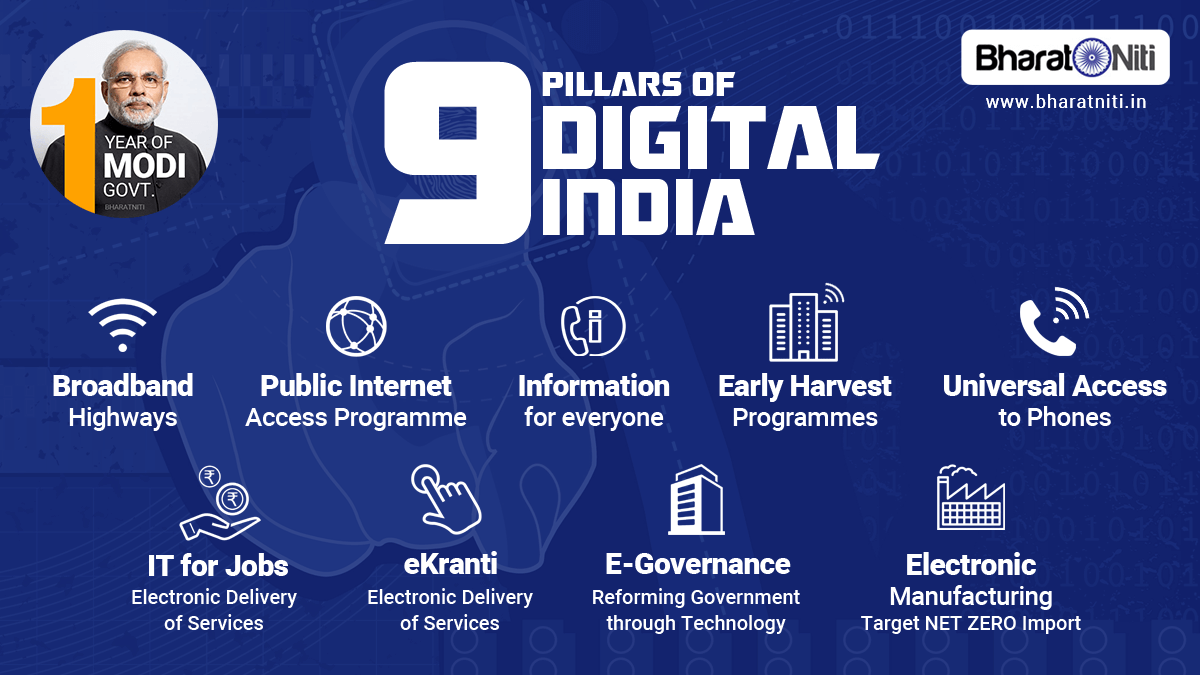
    Digital India 9 pillars

    New Incentives announced in the Budget 2016-17

    Electronics Manufacturing

    • Electronic manufacturing in India has got boost by further rationalization of duty structure
    • Tax benefits for IT units in SEZs has been extended from 2017 till 2020.
    • This will enable technology units to set up and commence operations in SEZs and also significant move for skill development to services companies as well
    • This will permit 30 % of additional wages paid to new workmen, deductible for 3 years. This will give a big boost to the BPO operations and generate new jobs (essential for India to reap it’s demographic dividend)

    Encouragement to Digital Literacy & Digital Lockers

    • Digital depository of school leaving certificates, college degrees and mark-sheets will be created
    • This would enhance the footprint of cloud technology in the Country
    • The IT department has already laid down the framework for cloud technology and will assist in the expansion <Cloud Technology is the delivery of on-demand computing resources— everything from applications to data centers over the Internet on a pay-for-use basis>
    • Extraordinary expansion to Digital Literacy in the country; imparting digital literacy to 6 crore households in next 3 years
    • As of now, against the target of 52.5 lakhs, more than40 lakhs have been trained

    Use of Aadhaar platform for delivery of services

    • A legislation will be brought to give a statutory backing to Aadhaar, for delivery of services /subsidies / benefits, corning out of Consolidated Fund of India
    • This will prevent leakages by identifying the beneficiaries correctly and would encourage good governance
    • Greater stress on the use of digital platform across various departments
    • This will further encourage consolidation of seminal programmed of Digital India

    Reforms in Postal department

    • Effort is being made to leverage the vast network of India Post for implementing the mandate of financial inclusion
    • Today, India Post has not only installed more than 576 ATMs but has overtaken the SBI to become India’s largest Core Banking Network having 18,231 branches
    • By March, 2016 all the 25,000 Departmental Post Offices would offer Anywhere Banking facilities using Core Banking Solutions
    • Further, India Post has achieved new heights in tapping the potential of e-commerce
    • Its parcel revenues have witnessed a growth of 110% and it has collected more than Rs.1200 Crores from Cash on Delivery mode of payment for e-Commerce services

    Read more-

    1. Digital India Initiative : What is Buzzing  
    2. Seven Mission for Transformation of Railways

    Published with inputs from Arun Source - Ministry of Communications & IT | Pic - 9 Pillars of Digital India