💥Join UPSC 2027,2028 Mentorship (July Batch) + XFactor Notes & Microthemes PDF

GS Paper: GS2-19.Effect of policies and politics of developed and developing countries on India’s interests, Indian diaspora.

  • US Withdraws from UNFCCC and IPCC

    Why in the News?

    US President Donald Trump has signed a presidential memorandum withdrawing the United States from 66 international organisations, including the United Nations Framework Convention on Climate Change (UNFCCC) and the Intergovernmental Panel on Climate Change (IPCC). This makes the US the first country to formally exit the UNFCCC.

    United Nations Framework Convention on Climate Change (UNFCCC)

    The UNFCCC is the foundational global treaty that governs international cooperation on climate change. It provides the legal and institutional framework under which global climate negotiations take place.

    Established

    • Adopted in 1992 at the Rio Earth Summit
    • Entered into force in 1994
    • Nearly universal membership among UN countries

    Key role

    • Organises annual Conference of Parties (COP) climate negotiations
    • Hosts the Paris Agreement, which aims to limit global warming
    • Establishes systems for
      • Emissions reporting
      • Transparency and accountability
      • Climate finance mechanisms
      • Carbon markets and rule making

    Legal implications of US withdrawal

    • Withdrawal takes effect one year after formal notice
    • Exit from UNFCCC automatically means exit from the Paris Agreement
    • US will no longer be a Party to COP negotiations
    • Can attend meetings only as an observer, without bargaining rights

    Intergovernmental Panel on Climate Change (IPCC)

    The IPCC is the UN body that assesses and synthesises global scientific research on climate change, its impacts, and mitigation and adaptation options.

    Functions

    • Produces comprehensive assessment reports
    • Provides scientific benchmarks for climate negotiations
    • Informs global and national climate policy

    Impact of US exit

    • Reduces US influence over global climate science assessments
    • Limits formal nomination of US experts to IPCC author teams
    • US scientists may still contribute as reviewers or through non government nominations
    [2009] The United Nations Framework Convention on Climate Change (UNFCCC) is an international treaty drawn at: 

    (a) United Conference on the Human Environment, Stockholm, 1972 

    (b) UN Conference on Environment and Development, Rio de Janeiro, 1992 

    (c) World Summit on Sustainable Development, Johannesburg, 2002 

    (d) UN Climate Change Conference, Copenhagen, 2009

  • Law on ‘ suspension of sentence’

    Introduction

    Suspension of sentence under Section 389 of the Code of Criminal Procedure operates after conviction and differs fundamentally from bail during trial. While conviction displaces the presumption of innocence, appellate courts retain limited discretion to suspend execution of sentence. In serious offences, particularly those punishable with life imprisonment, judicial precedent has consistently required heightened scrutiny. The Unnao case foregrounds the tension between individual liberty during appeal and the collective interest in deterrence, victim protection, and institutional credibility of the criminal justice system.

    Why in the News

    The Supreme Court, through a three-judge Bench, stayed the Delhi High Court’s order suspending the life sentence of former MLA Kuldeep Singh Sengar in the Unnao rape case. The High Court had granted suspension pending appeal, citing prolonged incarceration and arguable legal questions under the POCSO Act. The intervention is significant because suspension of sentence in life imprisonment cases is an exception, not the rule.

    What is ‘suspension of sentence’ under criminal law?

    1. Post-conviction mechanism: Operates after a finding of guilt, unlike bail which applies during trial.
    2. Statutory basis: Section 389 CrPC empowers appellate courts to suspend execution of sentence.
    3. Limited scope: Suspends punishment, not the finding of guilt.
    4. Exceptional nature: Particularly restrictive in life imprisonment and heinous offences.
    5. Judicial standard: Requires assessment of offence gravity, trial court reasoning, and possibility of miscarriage of justice.

    How does the law distinguish suspension of sentence from bail?

    1. Stage differentiation: Bail applies pre-conviction; suspension applies post-conviction.
    2. Presumption shift: Conviction replaces presumption of innocence with judicial finality.
    3. Threshold requirement: Suspension demands exceptional circumstances, not routine considerations.
    4. Supreme Court precedent: In Bhagwan Rama Shinde Gosai v. State of Gujarat (1999), liberal suspension allowed only for short-term sentences.
    5. Life imprisonment standard: Suspension is a narrow exception requiring compelling justification.

    Why is the suspension of sentence controversial in life imprisonment cases?

    1. Severity of offence: Life imprisonment reflects judicial determination of extreme culpability.
    2. Victim rights: Premature release undermines survivor confidence and sense of justice.
    3. Deterrence impact: Weakens penal consequences in crimes involving abuse of power.
    4. Precedent consistency: Atul Tripathi v. State of Uttar Pradesh (2024) mandates strict scrutiny.
    5. Public interest: Requires balancing individual liberty against societal harm.

    What were the High Court’s grounds for suspending Sengar’s sentence?

    1. Statutory interpretation: Held that Section 5(c) of the POCSO Act was inapplicable.
    2. Definition gap: Relied on absence of a defined term “public servant” under POCSO.
    3. Incarceration period: Cited prolonged imprisonment of over seven years.
    4. Appeal pendency: Considered possibility of success on legal interpretation.
    5. Relief granted: Suspended sentence and granted bail during appeal.

    Why did the Supreme Court intervene?

    1. Misapplication of discretion: Held that life imprisonment cases require higher threshold.
    2. Incorrect reliance: Clarified that incarceration duration alone cannot justify suspension.
    3. Victim-centric approach: Emphasised gravity of sexual offences involving power asymmetry.
    4. Precedent reliance: Cited Chhote Lal Yadav v. State of Jharkhand (2025).
    5. Outcome: Set aside suspension order; restored custody.

    How does the POCSO Act complicate the issue of ‘public servant’?

    1. Statutory silence: POCSO does not define “public servant”.
    2. Judicial borrowing: Courts rely on IPC, CrPC, JJ Act, IT Act definitions.
    3. Anomalous outcome: Police constable qualifies as public servant; elected MLA excluded.
    4. Legislative intent: Aggravated punishment reflects abuse of authority and victim vulnerability.
    5. Interpretative gap: Narrow construction undermines child protection objectives.

    Why is narrow statutory interpretation problematic in sexual offence jurisprudence?

    1. Purpose dilution: Defeats protective intent of special criminal statutes.
    2. Power asymmetry: Ignores coercive authority wielded by political office holders.
    3. Judicial warnings: Attorney General for India v. Satish (2022) cautioned against hyper-literalism.
    4. Comparative rulings: Independent Thought v. Union of India (2017) endorsed purposive interpretation.
    5. Normative risk: Enables unequal treatment of functionally similar authority figures.

    What broader systemic concerns does the case reveal?

    1. Political influence: Risk of appellate leniency in cases involving powerful accused.
    2. Victim intimidation: Historical record of systemic intimidation and obstruction.
    3. Trial court findings: Detailed documentation of intimidation, custody abuse, and violence.
    4. Institutional trust: Undermines faith in equality before law under Article 14.
    5. Judicial responsibility: Necessitates restraint in post-conviction relief.

    Conclusion

    The jurisprudence on suspension of sentence reaffirms that appellate discretion is not an unfettered power but a constitutionally conditioned exception, especially in cases involving life imprisonment and sexual offences. Judicial independence, when exercised with restraint, purposive interpretation, and sensitivity to power asymmetries, strengthens rule of law, protects victim dignity, and preserves public confidence in the criminal justice system.

    PYQ Relevance

    [UPSC 2023] “Constitutionally guaranteed judicial independence is a prerequisite of democracy.” Comment.

    Linkage: Judicial independence ensures impartial adjudication, limits executive and legislative overreach, and preserves separation of powers, core to democratic governance. In the context of suspension of sentence and sexual offence cases, it must operate with restraint and accountability to uphold rule of law, equality before law, and victim-centric justice under Articles 14 and 21.

  • [3rd December 2025] The Hindu OpED: A template for security cooperation in the Indian Ocean

    PYQ Relevance

    [UPSC 2024] Discuss the geopolitical and geostrategic importance of Maldives for India with a focus on global trade and energy flows. Further also discuss how this relationship affects India’s maritime security and regional stability amidst international competition?

    Linkage: This PYQ is directly linked to India’s strategic engagement with the Colombo Security Conclave (CSC), where Maldives is a core maritime partner. The question becomes relevant as Maldives’ political shifts, China’s growing presence, and competition over Indian Ocean trade and energy routes directly shape India’s maritime security priorities.

    Mentor’s Comment

    This article breaks down the evolving relevance of the Colombo Security Conclave (CSC) for India and the wider Indian Ocean region in 2025. China’s growing presence in the region is reshaping the geopolitical environment. In this setting, the CSC becomes an important platform for India to strengthen maritime security cooperation.

    Introduction

    The CSC has emerged as a critical framework for regional security cooperation in the Indian Ocean. It initially focused on issues such as maritime security, counter-terrorism, cybersecurity, and human trafficking. Now it is attempting to institutionalise itself and broaden its mandate to address the increasingly complex geopolitical and maritime challenges in the region. India’s leadership in reviving and expanding the grouping has placed CSC at the centre of its Indian Ocean strategy.

    How is the evolving Indian Ocean environment reshaping CSC’s relevance?

    1. Strategic Shifts: The Indian Ocean region is witnessing significant changes in the broader Indo-Pacific, making cooperative security frameworks more urgent.
    2. Economic Interdependence: Littoral states depend heavily on ocean-based economies; maritime disruptions create widespread developmental challenges.
    3. Non-traditional Threats: Issues such as organised crime, cyberattacks, and trafficking continue to expand, requiring coordinated regional responses.

    What has shaped the CSC’s institutional trajectory so far?

    1. Initial Trilateral Framework: Established between India, Sri Lanka and the Maldives; momentum slowed due to political transitions in Sri Lanka and Maldives.
    2. Revival in 2020: India reinstated its engagement, establishing structured cooperation across four pillars, maritime security, counter-terrorism, trafficking, and cybersecurity.
    3. Progressive Expansion: Mauritius joined as full member (2022); Bangladesh added in 2024; Malaysia joined as observer in 2025.
    4. Growing Synergies: NSA-level coordination has strengthened common frameworks across member states.

    Why does China’s growing presence create strategic dilemmas for CSC?

    1. Contrasting Perceptions:
      1. India: Views China’s activities as a major security challenge.
      2. Other Members: Depend on China economically and see it as a developmental partner rather than a threat.
    2. Need for Balance: India must carefully manage CSC’s agenda such that the grouping does not fracture over divergent China-related security views.
    3. Anchoring India’s Priorities: CSC allows India to place maritime security and regional stability at the centre of cooperative action.

    What institutional challenges does the CSC currently face?

    1. Fragmented Frameworks: Lack of integrated institutional structures limits effective coordination.
    2. Need for Policy Consistency: Member states’ domestic disturbances (e.g., in Bangladesh) can affect the group’s resilience.
    3. Operational Limitations: Without an institutionalised Secretariat or joint mechanisms, coordination remains NSA-driven and episodic.

    What opportunities does CSC expansion create for regional security?

    1. Wider Membership: Growing membership allows for more inclusive maritime-security cooperation in the Indian Ocean.
    2. Enhanced Information-Sharing: Expanding partnerships help create common threat-perception frameworks.
    3. Forward Momentum: Malaysia’s possible future membership indicates sustained interest in CSC’s work
    4. Aligning Actionable Pathways: Collective policies on maritime issues can strengthen resilience across the region.

    Conclusion

    The CSC stands at a defining moment in 2025. Its expansion, renewed momentum, and India’s leadership provide a framework to address the growing complexity of maritime security in the Indian Ocean. However, institutional strengthening, policy coherence, and careful handling of China-related sensitivities will determine how successfully the CSC evolves into a reliable, long-term regional security architecture.

  • Why is there no peace in Ukraine

    Introduction

    Since Russia’s full-scale invasion in February 2022, several attempts at negotiations, from Belarus to Turkey, have collapsed. With Russia consolidating control over Ukrainian territories and Ukraine facing military constraints, the conflict shows signs of becoming a prolonged war. The Trump plan, recent Russian advances, and fatigue in Western capitals have complicated the strategic landscape, placing Ukraine at a turning point.

    Why in the news

    The Ukraine-Russia war has again entered headlines as Russia captured Pokrovske, marking the first major territorial gain after a year of stalled frontlines. Simultaneously, a 28-point U.S. peace proposal surfaced, offering recognition of Russian control over key territories. Ukraine is facing troop shortages, battlefield pressure, and delays in Western aid, making negotiations both urgent and politically difficult. Recent territorial losses, a disputed peace plan, and growing pressure on President Zelensky have reopened global debate on whether a ceasefire is achievable.

    Battlefield Dynamics and Stalled Negotiations

    1. Russian Consolidation: Russia captured Pokrovske after holding back Ukrainian forces for nearly a year; repositioned units in Kharkiv and Kherson and intensified attacks on Avdiivka and Kupiansk.
    2. Ukrainian Strain: Ukraine faces troop shortages, heavy attrition, and reduced Western ammunition deliveries; unable to meet battlefield demands.
    3. Failed Negotiations History: Talks in Belarus (Feb 28, 2022), Turkey (March 2022), and subsequent engagements collapsed due to disagreements over territory, NATO membership, and security guarantees.
    4. Renewed Russian Push: Russia resumed rotated forces, strengthened defensive lines, and maintained pressure across the east and south.

    Why Have Earlier Peace Efforts Failed?

    1. Maximalist Positions:
      1. Ukraine demanded withdrawal to 1991 borders and refusal of territorial concessions.
      2. Russia insisted on recognition of annexed territories and long-term security guarantees.
    2. NATO Membership Dispute: Ukraine’s insistence on future NATO membership remained unacceptable to Russia.
    3. Shifting War Outcomes: Early battlefield gains for Ukraine pushed negotiations aside; later Russian consolidation hardened Moscow’s stance.
    4. Domestic Political Costs: Zelensky faced internal political risk if he conceded territory or NATO flexibility.
    5. Western Signalling: Changes in Western messaging during 2022, especially from UK PM Boris Johnson’s Kyiv visit, reinforced Ukraine’s resolve to fight rather than negotiate.

    What Does the New Trump Peace Plan Propose?

    1. Territorial Recognition: Recognizes Russian control of current occupied territories (Crimea, Luhansk, Donetsk, Zaporizhzhia, Kherson).
    2. Ceasefire Framework: Calls for an initial ceasefire based on “current positions”.
    3. Security Guarantees: Ukraine would receive “reliable security guarantees”, though details remain unspecified.
    4. NATO Question: Prohibits Ukraine from joining NATO but proposes alternative security arrangements.
    5. Referendum Clause: Suggests that Ukraine may hold referendums under international supervision in disputed areas.
    6. Western Package: Encourages Washington to commit additional security assurances if Ukraine accepts concessions.
    7. Controversy: Critics argue it endorses annexation and weakens Ukrainian sovereignty.

    How Is Ukraine Responding to the Proposal?

      1. Zelensky’s Dilemma:
    • Fear of Loss of U.S. Support if he rejects the plan outright.
    • Domestic Resistance to territorial concessions or NATO withdrawal.
    1. Political Stakes: Any acceptance of the Trump plan risks severe political backlash within Ukraine and among its security elite.
    2. Military Reality Check: With Russia advancing and Western aid reduced, Ukraine risks losing more territory if negotiations are delayed.
    3. Unclear U.S. Position: The White House has neither endorsed nor dismissed the plan; Washington sends mixed signals.

    What Is Russia’s Current Strategy?

    1. Gradual Territorial Expansion: Small but steady advances across Donetsk and Kharkiv fronts.
    2. Exhaustion Approach: Prolonging the war to drain Ukrainian manpower and Western support.
    3. Diplomatic Pressure: Leveraging the Trump plan to portray Ukraine as unwilling to negotiate.
    4. Military Reconfiguration: Rotations, reorganized brigades, and fortified defensive lines to prepare for prolonged combat.

    Conclusion

    The Ukraine war remains locked between military stalemate and political impossibility. With Russia consolidating gains and Western support fluctuating, the window for meaningful negotiations narrows. The Trump plan introduces a new, but highly contentious, framework. For now, peace remains elusive due to incompatible security demands, shifting battlefield realities, and the political constraints of both Kyiv and Moscow.

    PYQ Relevance

    [UPSC 2023] The expansion and strengthening of NATO and a stronger US-Europe strategic partnership works well for India. What is your opinion about this statement? Give reasons and examples to support your answer.

    Linkage: This PYQ aligns with the article’s focus on NATO’s revived strength and US-Europe unity shaped by the Ukraine war. It directly links to how these shifts hardened positions, prolonged conflict, and reshaped global security dynamics.
  • Senkaku-Diaoyu Islands Issue

    Why in the News?

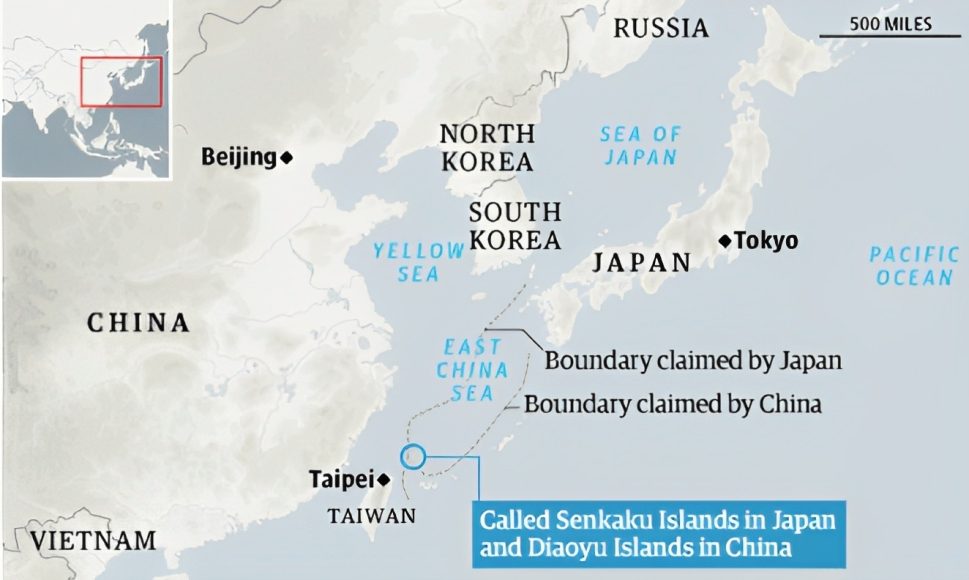
    A China Coast Guard formation patrolled the Senkaku waters as Beijing escalated tensions with Japan over recent remarks on Taiwan.

    Senkaku-Diaoyu Islands Issue

    About the Senkaku–Diaoyu Islands Issue:

    • Location & Status: A small uninhabited island group in the East China Sea, claimed by Japan, China, and Taiwan.
    • Names: Japan calls them Senkaku, China Diaoyu, and Taiwan Diaoyutai.
    • Administration: Japan has administered the islands since 1972 after the Okinawa Reversion Agreement with the United States.
    • Geography: Consists of five islands and three rocks, covering ~7 sq km; the largest is Uotsuri.
    • Strategic Location: Situated near major shipping lanes linking East Asia to global trade routes.
    • Natural Resources: Surrounding waters believed to hold oil and natural gas deposits, highlighted in a 1969 UN report.
    • Fisheries: Rich fishing grounds add significant economic importance.
    • Geopolitical Value: Located at the junction of interests of Japan, China, Taiwan, and the United States, making it a strategic flashpoint.

    What is the Dispute?

    • Japanese Claim: Japan incorporated the islands in January 1895, asserting they were terra nullius based on surveys from 1885 that found no Chinese administration.
    • Chinese & Taiwanese Claim: Cite dynastic-era maps, navigation records, and Qing documents to argue sovereignty predates Japanese control.
    • Post–World War II Status: The US took control under the 1951 San Francisco Treaty, administering the islands as part of the Nansei Shoto region.
    • 1971 Shift: Transfer of Senkaku and Okinawa back to Japan under the Okinawa Reversion Agreement sparked protests from China and Taiwan.
    • Resource Trigger: China’s active claim strengthened after the 1969 UN report identified potential hydrocarbon reserves.
    • 2012 Escalation: Japan’s purchase of three privately owned islands led to widespread protests, attacks on Japanese businesses, and a surge in nationalist sentiment in China.
    • Current Tensions: Chinese Coast Guard vessels frequently enter surrounding waters to assert Beijing’s claim.
    • Broader Dynamics: Linked to nationalism, unresolved historical grievances, and strategic competition between China, Japan, and the United States across the Indo-Pacific.
    [UPSC 2022] Which one of the following statements best reflects the issue with Senkaku Islands, sometimes mentioned in the news?

    Options: (a) It is generally believed that they are artificial islands made by a country around South China Sea.

    (b) China and Japan engage in maritime disputes over these islands in East China Sea.*

    (c) A permanent American military base has been set up there to help Taiwan to increase its defence capabilities.

    (d) Though International Court of Justice declared them as no man’s land, some South-East Asian countries claim them.


  • [14th November 2025] The Hindu Op-ed: Donald Trump shakes up the global nuclear order

    PYQ Relevance

    [UPSC 2021] The USA is facing an existential threat in the form of China, that is much more challenging than the erstwhile Soviet Union.  Explain.

    Linkage: China’s denial of nuclear testing and its call for the U.S. to uphold the moratorium illustrate the sharper, more complex strategic rivalry between the two powers. This directly aligns with the PYQ’s theme that China poses a subtler and more challenging strategic threat to the U.S. than the Soviet Union.

    Mentor’s Comment

    This editorial examines how recent U.S. actions under Donald Trump have disrupted long-standing global nuclear norms, especially the Comprehensive Nuclear-Test-Ban Treaty (CTBT) framework. The article evaluates implications for global nuclear stability, India’s strategic environment, and emerging arms-race dynamics. It has been rewritten to suit UPSC Mains standards, with structured analysis, value addition, and exam-oriented elements.

    INTRODUCTION

    The global nuclear order, built since 1945 through treaties, moratoria, and non-proliferation norms, is undergoing significant strain. The U.S. announcement of resuming nuclear testing and redefining CTBT obligations marks a decisive departure from three decades of restraint. This shift impacts nuclear doctrines, arms control regimes, and the behaviour of declared and undeclared nuclear weapon states.

    WHY IN THE NEWS 

    The CTBT framework faces its sharpest crisis in 27 years after Donald Trump declared that the U.S. may resume nuclear explosive testing, reversing the long-standing global moratorium. This marks the first major deviation from post-Cold War consensus and directly challenges existing verification norms. With Russia abandoning CTBT ratification and China refusing explosive testing, the U.S. move risks triggering a new technological arms race, raising concerns for India’s regional security environment.

    How the Nuclear Order Evolved

    1. Post-1945 restructuring: Nuclear stockpiles reduced from ~65,000 warheads in the 1970s to ~12,500 today; nine states now possess nuclear weapons.
    2. NPT framework: NPT created a hierarchy between five permanent nuclear powers and later entrants such as India, Pakistan, and North Korea.
    3. Moratorium period: CTBT negotiations from 1993-96 led to a global halt on explosive tests despite the treaty never entering into force.

    Why the U.S. Nuclear Test Resumption Matters

    1. Resumption of explosive testing: President Trump instructed the U.S. DoE and DoD to prepare for renewed testing, reversing a voluntary halt maintained since 1992.
    2. Shift in doctrine: U.S. pursuit of low-yield warheads and submarine-launched cruise missiles signals a move to battlefield-oriented nuclear systems.
    3. Erosion of restraint: The U.S. argues Russia and China conduct “non-explosive yield tests,” challenging Washington’s previous compliance stance.

    Why the CTBT Is Facing Breakdown

    1. Treaty not in force: CTBT requires ratification by 187 signatory states; key holdouts include the U.S., China, India, Pakistan, and North Korea.
    2. Russia’s reversal: Russia withdrew CTBT ratification in 2023, citing U.S. non-ratification.
    3. Competing interpretations: China and Russia continue “zero-yield” testing; the CTBT Organization’s monitoring system detects global activity through 300+ stations.

    How New Technology Is Altering the Arms Race

    1. Low-yield weapons: U.S. development of W76-2 warheads creates escalation risks due to tactical usability.
    2. Unmanned and hypersonic systems: Renewed R&D on missile defence, high-tech cruise systems, and autonomous platforms challenges existing deterrence logic.
    3. Doctrinal changes: Nuclear powers pursue counterforce-oriented designs to survive adversary first strikes.

    Implications for India

    1. Regional chain reaction: Testing by the U.S., Russia, or China is likely to push Pakistan to follow, widening the deterrence gap with India.
    2. China-Pakistan axis: Deepening technological cooperation complicates India’s security environment.
    3. NPT/CTBT dilemma: India may face pressure on whether to revisit explosive testing if others abandon restraint.

    CONCLUSION

    The breakdown of CTBT norms marks the most significant shift in the nuclear order since the 1990s. Renewed explosive testing by major powers could trigger competitive modernization cycles and weaken global arms control regimes. For India, the challenge lies in balancing credible deterrence with adherence to restraint-based global norms.

    Value Addition

    What is CTBT?

    • A multilateral arms-control treaty that bans all nuclear explosions, for both civilian and military purposes.
    • Aims to freeze qualitative nuclear arms race by preventing the development of new warhead designs.

    When was it negotiated?

    • Negotiated at the Conference on Disarmament (CD) between 1993-1996.
    • Adopted by the UNGA on 10 September 1996.
    • Opened for signature on 24 September 1996.

    Why is it not in force?

    • CTBT will enter into force only when all 44 Annex-II states (states with nuclear capabilities at the time) ratify it.
    • As of today, 8 Annex-II states have not ratified/signed:
      U.S., China, India, Pakistan, DPRK, Israel, Iran, Egypt.
    • Because of this, the treaty remains legally incomplete, though politically influential.

    Key Provisions

    1. Total Prohibition
      • Bans all nuclear explosions, including:
        • High-yield tests
        • Low-yield tests
        • Subcritical tests (disputed)
      • Applies to all environments: underground, underwater, atmospheric, outer space.
    2. Verification Regime
      • International Monitoring System (IMS) with 300+ stations, using:
        • Seismic sensors
        • Hydroacoustic monitors
        • Infrasound detectors
        • Radionuclide sampling
      • International Data Centre (IDC) analyses global test signals.
      • On-site inspections permitted after treaty enters into force.
    3. Confidence-Building Measures
      • Exchange of information, calibration explosions, technical cooperation.

    Institutional Mechanism

    • CTBTO Preparatory Commission (CTBTO-PrepCom) established in 1997.
    • Manages:
      • IMS network construction
      • Data analysis
      • Training and inspection readiness
    • Works despite treaty not being in force.

    Significance

    • Creates the strongest global norm against nuclear testing since 1998.
    • Slows modernization of nuclear arsenals.
    • Provides scientific verification for early detection of clandestine tests.
    • Complements Non-Proliferation Treaty (NPT) and FMCT debates.


  • Civil War in Sudan

    Why in the News?

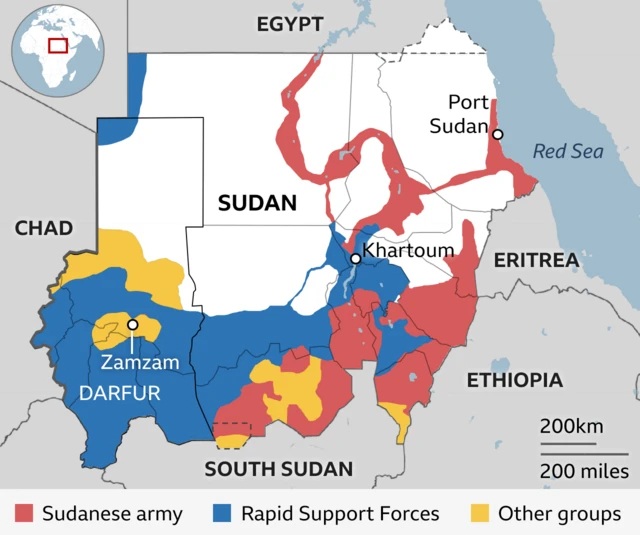
    The United Nations Secretary-General has warned that the civil war in Sudan is “spiralling out of control” after the Rapid Support Forces (RSF) seized the strategic Darfur city of El-Fasher.

    Civil War in Sudan

    About the Civil War in Sudan:

    • Outbreak: Began in April 2023 between the Sudanese Armed Forces (SAF) led by Gen. Abdel Fattah al-Burhan and the Rapid Support Forces (RSF) led by Gen. Mohamed Hamdan Dagalo (Hemedti).
    • Causes: Rooted in Sudan’s failed democratic transition after the 2019 overthrow of Omar al-Bashir and the October 2021 military coup.
    • Immediate Trigger: Power struggle over RSF integration into the national army under the proposed political framework agreement.
    • Conflict Spread: Fighting engulfed Khartoum, Omdurman, and Darfur, causing massive civilian casualties and infrastructure collapse.
    • Humanitarian Toll: Over 8.5 million displaced, famine conditions emerging, and public health systems near total breakdown.
    • Atrocities: Both sides accused of war crimes, ethnic killings, and looting, particularly in Darfur.
    • Territorial Shift: RSF’s capture of El-Fasher (2025) consolidated its control over western Sudan.
    • Foreign Actors: Egypt supports SAF; UAE and Russia’s Wagner Group back RSF, fuelling proxy dynamics.

    What Lies Ahead?

    • Risk of Partition: Sudan may split RSF holding the west, SAF dominating the northeast, leading to de-facto fragmentation.
    • Regional Destabilisation: Prolonged conflict could spill into the Horn of Africa and Red Sea corridor, worsening insecurity.
    • Political Outlook: Civilian transition appears remote; both factions remain focused on military dominance.
    • Economic Collapse: Inflation above 250%, agricultural failure deepening food insecurity.
    • Regional Impact: Refugee influx threatens Chad, South Sudan, and Ethiopia with cross-border instability.
    [UPSC 2024] Consider the following pairs: Country Reason for being in the news
    1. Argentina Worst economic crisis
    2. Sudan War between the country’s regular army and paramilitary forces
    3. Turkey Rescinded its membership of NATO
    How many of the pairs given above are correctly matched?
    Options: (a) Only one pair (b) Only two pairs* (c) All three pairs (d) None of the pairs


  • India-US seal 10 year defense partnership framework

    Introduction

    India and the United States have signed a 10-year defence partnership framework (2025-2035), signaling a new phase in their strategic collaboration. The pact provides a unified vision and policy direction for deepening cooperation across logistics, supply chains, joint production, and technology sharing. It underscores the commitment to a free, open, and rules-based Indo-Pacific, amid growing regional tensions and China’s assertive rise.

    Why in the News

    This is a landmark development in India-US relations, marking the first-ever decade-long institutionalized defence framework between the two nations. It reflects a qualitative shift from transactional defence cooperation to a strategic partnership architecture. By formalizing continuity in defence ties, the framework aims to sustain policy alignment, interoperability, and deterrence capabilities in the Indo-Pacific, making it a cornerstone for regional stability.

    Deepening Defence Convergence

    1. Framework Vision: Provides unified strategic direction to strengthen defence cooperation and stability across all military domains (land, air, sea, cyber, and space).
    2. Interoperability Focus: Prioritizes joint logistics, training, and maintenance mechanisms between forces, ensuring mission readiness and operational synergy.
    3. Symbolic Continuity: Extends beyond annual dialogues or ad hoc exercises, ensuring defence engagement remains insulated from political transitions.
    4. Technology Integration: Encourages co-production and co-development of high-end defence platforms such as Super Hercules, Globemaster, Chinooks, Apaches, and M777 howitzers.

    Evolution of India-US Defence Partnership

    1. Early Frameworks: The 2015 framework initiated by PM Modi and President Obama laid the foundation for institutional defence cooperation.
    2. Key Milestones:
      • LEMOA (2016): Enabled reciprocal logistics access.
      • COMCASA (2018): Facilitated secure communications interoperability.
      • BECA (2020): Enabled real-time geospatial intelligence sharing.
    3. 2025 Framework Significance: Builds upon these foundational agreements, institutionalizing long-term coordination on strategy, logistics, and supply chain resilience.

    Strategic Significance for the Indo-Pacific

    1. Regional Stability: Anchors both nations’ commitment to a free and open Indo-Pacific, countering coercive or unilateral actions.
    2. Maritime Domain Awareness: Supports enhanced naval cooperation and situational awareness across key maritime chokepoints.
    3. Military Exercises: Expands the scope of Yudh Abhyas and Malabar exercises for joint readiness.
    4. Quad Convergence: Aligns with broader QUAD objectives in maintaining rules-based order and crisis response architecture.
    5. Geoeconomic Angle: Bolsters defence supply chains and manufacturing cooperation amid China-centric dependencies.

    Institutional and Industrial Collaboration

    1. Defence Production: Boosts joint manufacturing of key platforms, LCA Tejas engines, MQ-9B drones, and advanced radar systems.
    2. Private Sector Linkages: Encourages collaboration between Indian and US defence industries, including Hindustan Aeronautics Limited (HAL) and General Electric (GE).
    3. R&D Synergy: Promotes innovation under the India-US Defence Acceleration Ecosystem (INDUS-X) to co-develop futuristic technologies.
    4. Skill Transfer: Enhances training, skill-building, and exchange programs for defence personnel.

    Diplomatic and Strategic Implications

    1. Policy Continuity: Reinforces long-term strategic trust and shared security outlook.
    2. Strategic Deterrence: Strengthens collective deterrence against regional instability in the Indo-Pacific.
    3. Bilateral Reliability: Demonstrates resilience of India-US defence ties beyond short-term political cycles.
    4. Global Relevance: Projects both nations as key stakeholders in shaping Indo-Pacific architecture for the 21st century.

    Conclusion

    The 10-year India-US Defence Partnership represents a strategic deepening and institutional maturity of bilateral defence relations. It embodies both nations’ shared vision of collective security, deterrence, and technological partnership in the Indo-Pacific. By ensuring interoperability and policy continuity, it not only strengthens defence preparedness but also cements India’s emergence as a regional security anchor and a global strategic partner of the United States.

    PYQ Relevance

    [UPSC 2020] What is the significance of Indo-US defence deals over Indo-Russian defence deals? Discuss with reference to stability in the Indo-Pacific region.

    Linkage: The question is important as it reflects India’s shifting defence axis from Russia to the US amid Indo-Pacific power realignments. It continues UPSC’s recurring theme of India’s strategic autonomy and evolving role in global security architecture.

  • The complicated history of U.S-Pakistan relations

    Introduction

    The U.S.-Pakistan relationship has oscillated between strategic intimacy and mutual distrust. Built on Cold War exigencies, it evolved through shared military interests, geopolitical bargains, and recurring disappointments. As new global alignments emerge, Pakistan’s dual engagement with China and the U.S. once again tests the durability and intent of its foreign policy choices.

    Evolution of the U.S.-Pakistan Strategic Partnership

    1. Cold War Origins: Pakistan aligned with the U.S. through SEATO (1954) and CENTO (1955), positioning itself as a frontline ally against communism.
    2. Military and Economic Aid: U.S. assistance included arms, technology, and infrastructure funding, strengthening Pakistan’s military elite.
    3. Transactional Nature: The partnership thrived on mutual utility rather than shared values; Pakistan sought defense support; the U.S. sought regional leverage.

    Impact of Shifting U.S. Priorities during and after the Cold War

    1. Soviet Invasion of Afghanistan (1979): The U.S. re-engaged Pakistan as a base for arming Mujahideen fighters. Aid and weapon transfers surged.
    2. Post-Withdrawal Abandonment: After Soviet withdrawal, Washington invoked sanctions under the Pressler Amendment (1990) over Pakistan’s nuclear program, halting delivery of F-16 aircraft.
    3. Cycle of Engagement and Sanctions: Every phase of cooperation was followed by punitive measures, reflecting deep distrust.

    9/11 and the Recasting of the U.S.-Pakistan Ties

    1. Post-9/11 Alignment: Pakistan became a major non-NATO ally in the U.S.-led “War on Terror,” receiving over $30 billion in aid.
    2. Military Dependence: U.S. logistics for operations in Afghanistan relied heavily on Pakistani routes and intelligence.
    3. Strategic Mistrust: U.S. accused Pakistan of harboring militants while receiving counter-terrorism aid, the Osama bin Laden incident (2011) deepened suspicion.

    Trump’s Policy Reversal and Conditional Engagement

    1. Harsh Rhetoric: In 2018, Donald Trump accused Pakistan of “lies and deceit”, suspending over $300 million in military aid.
    2. Focus on “Double Game”: The U.S. alleged Islamabad’s duplicity, fighting terrorism publicly while sheltering terror networks privately.
    3. China Factor: Trump’s tilt towards India and containment of China indirectly alienated Pakistan, pushing it further into Beijing’s orbit.

    The China Variable and Strategic Realignment

    1. Deepening Sino-Pak Ties: The China-Pakistan Economic Corridor (CPEC) and defense collaboration highlight Pakistan’s strategic drift eastward.
    2. U.S. Withdrawal from Afghanistan (2021): Reignited Pakistan’s regional leverage but also increased scrutiny of its Taliban links.
    3. Balancing Act: Pakistan now seeks to balance its Chinese dependence with limited U.S. engagement to avoid isolation.

    Sanctions, Contradictions and Mutual Suspicion

    1. Sanctions Regime: U.S. invoked multiple sanctions, Symington (1977), Pressler (1990), and Brown (1995) Amendments targeting nuclear proliferation.
    2. Contradictory Approach: Despite sanctions, Washington relied on Pakistan’s logistics during Afghan conflicts, exposing policy inconsistency.
    3. Enduring Distrust: Mutual dependence persisted but never matured into stable diplomacy, defined by suspicion rather than trust.

    India’s Dimension in the Context of U.S.-Pakistan Relations

    Positive Implications for India

    1. Strategic Leverage: Weakening U.S.-Pakistan ties strengthened India’s position as a reliable democratic partner in South Asia.
    2. Defence Cooperation: India gained access to advanced U.S. defence technology, joint exercises (like Malabar), and strategic dialogues (2+2 format).
    3. Global Standing: Partnership in QUAD and Indo-Pacific frameworks enhanced India’s geopolitical influence.
    4. Counterterrorism Support: U.S. alignment with India’s stance against cross-border terrorism increased diplomatic pressure on Pakistan.

    Negative Implications for India

    1. Regional Instability: Strained U.S.-Pakistan ties can destabilize Afghanistan, indirectly impacting India’s security interests.
    2. China-Pakistan Nexus: The gap left by U.S. withdrawal pushed Pakistan deeper into China’s orbit via CPEC and military cooperation.
    3. U.S. Policy Unpredictability: Frequent shifts in U.S. South Asia policy raises doubts about long-term reliability.
    4. Reduced Mediation Influence: India faces difficulty in balancing ties with both U.S. and Russia amid sanctions and defence dependencies.

    Way Forward

    1. Strategic Autonomy: Maintain balanced ties with all major powers while safeguarding national interests.
    2. Regional Dialogue: Promote multilateral frameworks including Afghanistan and Central Asia to counter instability.
    3. Deepened Indo-U.S. Cooperation: Expand collaboration in critical tech, energy, and intelligence without compromising sovereignty.
    4. Focus on Neighbourhood: Strengthen regional engagement to offset Pakistan’s external alignments and ensure South Asian stability.

    Conclusion

    The U.S.-Pakistan relationship remains an exemplar of “strategic utility without strategic trust.” Despite recurring phases of cooperation, both nations continue to perceive each other through transactional lenses. As Pakistan deepens ties with China and the U.S. recalibrates Indo-Pacific priorities, their future engagement will depend on how Islamabad reconciles its global ambitions with domestic constraints and regional realities.

    PYQ Relevance

    [UPSC 2019] What introduces friction into the ties between India and the United States is that Washington is still unable to find for India a position in its global strategy, which would satisfy India’s national self-esteem and ambitions’. Explain with suitable examples.

    Linkage: U.S.-Pakistan ties were transactional and interest-driven, creating India’s distrust of U.S. intentions. This history causes friction in U.S.-India ties, as India seeks equality while the U.S. retains a hierarchical outlook.