💥Join UPSC 2027,2028 Mentorship (August Batch) + XFactor Notes & Microthemes PDF

GS Paper: Executive & Judiciary

  • Explained: Recusals by Judges

    Recently a Supreme Court judge recused himself from hearing a petition filed against the government’s move to charge Omar Abdullah under the Public Safety Act.  The case was finally heard by another bench.

    Rules on Recusals

    • There are no written rules on the recusal of judges from hearing cases listed before them in constitutional courts. It is left to the discretion of a judge.
    • The reasons for recusal are not disclosed in an order of the court. Some judges orally convey to the lawyers involved in the case their reasons for recusal, many do not. Some explain the reasons in their order.
    • The decision rests on the conscience of the judge. At times, parties involved raise apprehensions about a possible conflict of interest.

    Why Judges need recusal?

    • Recusal usually takes place when a judge has a conflict of interest or has a prior association with the parties in the case.
    • For example, if the case pertains to a company in which the judge holds stakes, the apprehension would seem reasonable.
    • Similarly, if the judge has, in the past, appeared for one of the parties involved in a case, the call for recusal may seem right.
    • A recusal inevitably leads to delay. The case goes back to the Chief Justice, who has to constitute a fresh Bench.

    Should the reasons be put on record?

    • In his separate opinion in the NJAC judgment in 2015, Justice (now retired) Kurian Joseph, who was a member of the Constitution Bench, highlighted the need for judges to give reasons for recusal as a measure to build transparency.
    • It is the constitutional duty, as reflected in one’s oath, to be transparent and accountable, and hence, a judge is required to indicate reasons for his recusal from a particular case, Justice Kurian wrote.
    • One of his companion judges on the Constitution Bench, Justice (retired) Madan B. Lokur, agreed that specific rules require to be framed on recusal.
    • The two judges were referring to senior advocate Fali Nariman’s plea to Justice J.S. Khehar, who was then in line to be the next Chief Justice, to recuse himself.
    • But Justice Khehar refused to recuse himself though he admitted that Mr. Nariman’s plea left him in an “awkward predicament”.
    • Justice Khehar reasoned that he did not recuse himself for fear of leaving an impression that he was “scared”.

    What happened in the Judge Loya and Assam detention centres cases?

    • In 2018, petitioners in the Judge Loya case sought the recusal of Supreme Court judges, Justices A.M. Khanwilkar and D.Y. Chandrachud, from the Bench as they both hailed from the Bombay High Court.
    • The case banked on the written statements of two judges from that High Court, both saying that Judge Loya’s death was from natural causes. The court refused the request and called it a “wanton attack”.
    • Recusal, the court observed, would mean abdication of duty. Maintaining institutional civilities are distinct from the “fiercely independent role of the judge as adjudicator”, the court explained.
    • In May 2019, in the middle of a hearing of a PIL filed by activist Harsh Mander about the plight of inmates in Assam’s detention centres, the then-Chief Justice Ranjan Gogoi was asked to recuse himself.
    • In a lengthy order, Justice Gogoi said a litigant cannot seek recusal of the judge. “Judicial functions, sometimes, involve performance of unpleasant and difficult tasks, which require asking questions and soliciting answers to arrive at a just and fair decision.
    • If the assertions of bias as stated are to be accepted, it would become impossible for a judge to seek clarifications and answers,” the court observed.
  • Victim justice is two steps forward, one step back

    Context

    The recent judgment in Rekha Murarka vs The State Of West Bengal, the SC has held that the victims’ private counsel cannot orally examine or cross-examine the witnesses.

    Place of the victim in the present criminal justice system

    • Removed from the proceedings: Under our criminal justice system, victims find themselves removed from the proceedings.
      • Their identities are reduced to being mere witnesses.
      • The harm they suffer is reduced to being aggravating or mitigating factors at the time of sentencing.
      • Stage props in a larger scheme: With the state appropriating their victimisation, the actual victims become mere stage props in a larger scheme.
    • Need of The victim-centric notion of justice-Law Commission suggestion: In 1996, the 154th Law Commission Report suggested a paradigm shift in India’s criminal justice system towards a victim-centric notion of justice.
      • Partial acceptance: The Code of Criminal Procedure (Amendment) Act, 2009 partially accepted the Law Commission suggestion and granted some rights to the victims of crime.
      • The Act introduced victims’ right to a private counsel under Section 24(8).
      • Move toward victim’s participation: The Code of Criminal Procedure already allowed for pleaders engaged by private persons to submit written arguments with the permission of the court under Sections 301(2) and 302 allowed a person to conduct the prosecution with permission of the court.
      • These sections were read together to partially secure the victims’ right to participation.

    Steps take  towards securing justice for victims

    • Right to legal assistance to victims of sexual assault: In the case of Delhi Domestic Working Women’s Forum v. Union of India (1994), the SC called for the extension of the right to legal assistance to victims of sexual assault at the pre-trial stages.
    • The SC opinion over asymmetry in rights of victims and the accused: In Mallikarjun Kodagali (Dead) … vs The State Of Karnataka (2018), the Court accepted that under the criminal justice system, the rights of the accused far outweigh the rights of the victim.
    • Introduction of victim impact statement right to appeal against the adverse order: The Supreme Court not only called for the introduction of a victim impact statement in order to guarantee the participation of the victim in the trial proceedings.
      • The SC also reinstated the victims’ right to appeal against an adverse order.

    Provisions on the international level for the victim’s participation

    • Despite these advances, the scheme of victim participation remains far removed from the ideals embedded in the Declaration of Basic Principles of Justice for Victims of Crime and Abuse of Power; India is a signatory.
      • What does the declaration require? It requires that the views and concerns of victims should be allowed and considered at all appropriate stages without prejudice to the accused.
    • Need to increase the victims’ advocate’s role: Presently, the victims’ advocate has an extremely limited role to play wherein he “assists” the prosecutor rather than represent the interests of the victim before the court.
      • The only substantial opportunity provided to a private counsel is after the closing of evidence when written arguments may be submitted to the court only after seeking the permission of the court.
    • Contrast with ICC: In contrast, the International Criminal Court (ICC) provides for victim participation at the stage of-
      • First, a challenge to the jurisdiction of the ICC.
      • Second, framing of charges.
      • Third, opening and closing statements.
      • Fourth, making a written submission wherever the personal interests of the victims are affected.
      • And finally, for presenting witnesses to give evidence on issues relating to the personal interests of the victims.

    What the SC judgement means

    • Missed opportunity: The Supreme Court in Rekha Murarkahas missed the opportunity to forward the jurisprudence on victim justice and rectify the lacunae in our laws.
      • Instead, the judgment goes against the jurisprudential current specified above.
      • Indeed, the victim’s right to participation cannot be secured by restricting the rights of the accused.
    • Why the victim’s advocate is not allowed the right to participate in the SC’s opinion: According to the judgment, a victim’s advocate cannot be allowed the right to participate because-
      • First- Insistence by the victim’s counsel to examine a witness deliberately left out by the prosecution may weaken the prosecution’s case;
      • Second– The trial will derogate into a “vindictive battle” between the victim’s counsel and the accused.
      • Third- A lack of experience on the part of the victim’s counsel may lead to lapses.
    • The problem in the SC ruling: The judgment further assumes that prosecutions effectively take the victim’s needs into account.
      • SC ignored why the need for private counsel arise: The judgement ignores the fact that the need for a private counsel arises precisely because intentional or unintentional prosecutorial lapses directly lead to injustice to the victims.
      • The court expects the victim’s counsel to make the prosecutor aware of any aspects that have not been addressed in the examination of witnesses or the arguments advanced by the public prosecutor.
      • In the process, it assumes that the prosecutor will address such lapses.

    Conclusion

    Under the role currently envisaged in our criminal justice system, the public prosecutor cannot sufficiently take into account the interests, needs and requirements of the victims. The cause of victim justice would be greatly served if the Supreme Court decided to revisit its reasoning and assumptions to appropriately amend this provision in light of the above.


  • Explained: What is Mandamus?

    • The Supreme Court has ruled that reservation in the matter of promotions in public posts is not a fundamental right, and a state cannot be compelled to offer the quota if it chooses not to.
    • It ruled that there  is no fundamental right which inheres in an individual to claim reservation in promotions.
    • Hence no mandamus can be issued by the court directing state governments to provide reservations,” the bench of Justices L Nageswara Rao and Hemant Gupta said.

    What is ‘Mandamus’?

    • Mandamus is among the “prerogative writs” in English common law — meaning the extraordinary writs or orders granted by the Sovereign when ordinary legal remedies are inadequate.
    • These are habeas corpus, mandamus, prohibition, certiorari, and quo warranto.
    • In India, the Supreme Court can issue prerogative writs under Article 32 of the Constitution, and the High Courts under Article 226.
    • Mandamus literally means ‘we command’. When issued to a person or body, the writ of mandamus demands some activity on their part.
    • It orders the person or body to perform a public or quasi-public duty, which they have refused to perform, and where no other adequate legal remedy exists to enforce the performance of that duty.

    When is it used?

    • The writ cannot be issued unless the legal duty is of public nature, and to whose performance the applicant of the writ has a legal right.
    • The remedy is of a discretionary nature — a court can refuse to grant it when an alternative remedy exists.
    • However, for enforcing fundamental rights, the alternative remedy argument does not hold as much weight, since it is the duty of the Supreme Court and the High Courts to enforce fundamental rights.
    • When a public officer or government does an act that violates the fundamental right of a person, the court would issue a writ of mandamus against such authorities so that the person’s rights are not infringed.
    • The writ can also be issued against inferior courts or other judicial bodies when they have refused to exercise their jurisdiction and perform their duty.

    Limitations

    • Under Article 361, mandamus cannot be granted against the President or Governor of a State, “for the exercise and performance of the powers and duties of his office or for any act done or purporting to be done by him in the exercise and performance of those powers and duties”.
    • The writ also cannot be issued against a private individual or body, except where the State is in collusion with the private party for contravening a provision of the Constitution or a statute.
  • [pib] National Judicial Pay Commission

    The Second National Judicial Pay Commission has filed its report covering the subject of Pay, Pension and Allowances in the Supreme Court.

    Second National Judicial Pay Commission

    • The Commission is headed by former Supreme Court judge P V Reddy.
    • It was set up on the directions of the apex court in May 2017 during the hearing of the All India Judges Association case.

    Key recommendations

    1) Pay

    • It has recommended the adoption of Pay Matrix which has been drawn up by applying the multiplier of 2.81 to the existing pay, commensurate with the percentage of increase of pay of High Court Judges.
    • The highest pay which a District Judge (STS) will get, is Rs.2,24,100/-.

    2)  Pension

    • Pension at 50% of last drawn pay worked out on the basis of proposed revised pay scales is recommended w. e. f. 1-1-2016. The family pension will be 30% of the last drawn pay.
    • Recommendation has been made to discontinue the New Pension Scheme (NPS) which is being applied to those entering service during or after 2004. The old pension system, which is more beneficial to be revived.

    3) Allowances

    • The existing allowances have been suitably increased and certain new features have been added. However, the CCA is proposed to be discontinued.
    • Certain new allowances viz. children education allowance, home orderly allowance, transport allowance in lieu of pool car facility, has been proposed.
  • Gram Nyayalayas

    The Supreme Court has directed the states, which are yet come out with notifications for establishing Gram Nyayalayas, to do so within four weeks.

    What are Gram Nyayalayas?

    • Gram Nyayalayas were established for speedy and easy access to the justice system in the rural areas across the country.
    • The Gram Nyayalayas Act came into force on October 2, 2009.
    • In terms of Section 3(1) of the Act, it is for the State Governments to establish Gram Nyayalayas in consultation with the respective High Courts.
    • The Act authorizes the Gram Nyayalaya to hold mobile court outside its headquarters.
    • However, the Act has not been enforced properly, with only 208 functional Gram Nyayalayas in the country ( Sept. 2019) against a target of 5000 such courts.
    • The major reasons behind the non-enforcement include financial constraints, reluctance of lawyers, police and other government officials.

    Features of the Gram Nyayalayas

    • Gram Nyayalaya are established generally at headquarter of every Panchayat at intermediate level or a group of contiguous panchayat in a district where there is no panchayat at intermediate level.
    • The Gram Nyayalayas are presided over by a Nyayadhikari, who will have the same power, enjoy same salary and benefits of a Judicial Magistrate of First Class.
    • Such Nyayadhikari are to be appointed by the State Government in consultation with the respective High Court.

    Jurisdiction

    • A Gram Nyayalaya have jurisdiction over an area specified by a notification by the State Government in consultation with the respective High Court.
    • The Court can function as a mobile court at any place within the jurisdiction of such Gram Nyayalaya, after giving wide publicity to that regards.
    • The Gram Nyayalayas have both civil and criminal jurisdiction over the offences and nature of suits specified in the First, Second and Third schedule of the Act.
    • The pecuniary jurisdiction of the Nyayalayas are fixed by the respective High Courts.
    • Appeals in criminal matter can be made to the Sessions Court in the respective jurisdiction and in civil matters to the District Court within a period of one month from the date of judgment.

    Trials

    • Gram Nyayalayas can follow special procedures in civil matters, in a manner it deem just and reasonable in the interest of justice.
    • Civil suits are proceeded on a day-to-day basis, with limited adjournments and are to be disposed of within a period of six months from the date of institution of the suit.
    • In execution of a decree, the Court can allow special procedures following rules of natural justice.
    • Gram Nyayalayas allow for conciliation of the dispute and settlement of the same in the first instance.
    • Gram Nyayalayas has been given power to accept certain evidences which would otherwise not be acceptable under Indian Evidence Act.
  • Death Penalty in India (Annual Statistics Report 2019)

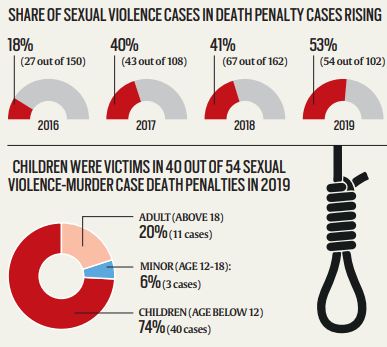
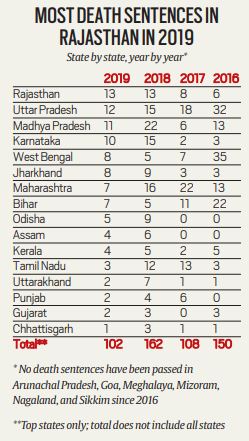
    Trial courts in India delivered 102 death sentences in 2019, over 60% fewer than the 162 death sentences passed in 2018.

    Highlights of the Report

    • In 2019, fewer death sentences overall were delivered.
    • 1 out of 2 sentences for sexual violence-murder; in 3 out of 4 sexual violence-murder death sentences, children were the killer’s victims.
    • The courts were, however, especially unforgiving of murders that involved sexual violence — the proportion of death sentences imposed for murders involving sexual offences was at a four-year high in 2019 at 52.94%.
    • 2019 also saw the highest number of confirmations by High Courts in four years; 17 out of the 26 confirmations (65.38%) were in offences of murder involving sexual violence.
    • The Supreme Court, primarily during the tenure of the previous CJI Gogoi, listed and heard 27 capital cases, the most in a year since 2001.

    Project 39A

    • These are the headline findings in the fourth edition of The Death Penalty in India: Annual Statistics, published by Project 39A at the National Law University (NLU), Delhi.
    • Project 39A is a research and litigation initiative focussed on the criminal justice system, and especially issues of legal aid, torture, death penalty, and mental health in prisons.
    • The report tracked news of death sentences awarded by trial courts published online by news organisations in English and Hindi.
    • It checked these numbers against judgments uploaded to websites of High Court and district courts.
  • [op-ed snap] Eloquently reticent: On validity of J&K curbs

    Context

    The SC verdict on the restrictions has some important takeaways.

    What the SC verdict means

    • Infinite ban on internet impermissible:  It states categorically that an indefinite ban on the internet is impermissible, but fails to direct the restoration of services. 
    • Section 144 and legitimate expression of opinion: The SC said that Section 144 of the Code of Criminal Procedure “cannot be used as a tool to prevent the legitimate expression of opinion or grievance or exercise of any democratic rights”.
    • No ruling on the Govt. actions: The disappointing aspect of the verdict is the court’s failure to give a ruling on the validity of the government’s actions.
      • The ruling fails to hold the government to account for the manner in which it exercised its powers.
      • It states categorically that an indefinite ban on the internet is impermissible, but fails to direct the restoration of services.
      • The SC does not go beyond directing the authorities to review all their orders and restrictions forthwith.

    The key takeaways from the verdict

    • Internet use constitutionally protected: The use of the Internet as a medium for free speech as well as for trade and commerce is constitutionally protected.
    • Test of proportionality: It also lays down that any reasonable restriction on fundamental rights, be it an Internet ban or a Section 144 order, will have to survive the test of proportionality.
      • The proportionality test means that is, the restriction should be proportionate to the necessity for such a measure.
      • At the same time, it cautions against the “excessive utility” of the proportionality doctrine in matters of national security.
    • No secret orders: The government is bound to publish all orders it passes regarding such restrictions so that they can be challenged in a court of law.
      • While the government’s stand that it could not produce all the orders on the restrictions imposed the SC did not strike them down on that ground.

    Conclusion

    The SC judgment, while laying down some important principles in a fundamental rights case, appears to have the character of an advisory opinion.


  • [op-ed snap] Eloquently reticent: On validity of J&K curbs

    Context

    The SC verdict on the restrictions has some important takeaways.

    What the SC verdict means

    • Infinite ban on internet impermissible:  It states categorically that an indefinite ban on the internet is impermissible, but fails to direct the restoration of services. 
    • Section 144 and legitimate expression of opinion: The SC said that Section 144 of the Code of Criminal Procedure “cannot be used as a tool to prevent the legitimate expression of opinion or grievance or exercise of any democratic rights”.
    • No ruling on the Govt. actions: The SC stops short of ruling on the validity of the government’s actions.
      • The ruling fails to hold the government to account for the manner in which it exercised its powers.
      • It states categorically that an indefinite ban on the internet is impermissible, but fails to direct the restoration of services.
      • The SC does not go beyond directing the authorities to review all their orders and restrictions forthwith.

    The key takeaways from the verdict

    • Internet use constitutionally protected: The use of the Internet as a medium for free speech as well as for trade and commerce is constitutionally protected.
    • Test of proportionality: It also lays down that any reasonable restriction on fundamental rights, be it an Internet ban or a Section 144 order, will have to survive the test of proportionality.
      • The proportionality test means that is, the restriction should be proportionate to the necessity for such a measure.
      • At the same time, it cautions against the “excessive utility” of the proportionality doctrine in matters of national security.
    • No secret orders: The government is bound to publish all orders it passes regarding such restrictions so that they can be challenged in a court of law.
      • While the government’s stand that it could not produce all the orders on the restrictions imposed the SC did not strike them down on that ground.

    Conclusion

    The SC judgment, while laying down some important principles in a fundamental rights case, appears to have the character of an advisory opinion.

  • Curative Petition

    Curative petitions were filed in the Supreme Court by two convicts in the Nirbhaya case after their execution was scheduled.  The case had shocked the nation and led to the tightening of anti-rape laws. Rape, especially gang rape, is now a capital crime.

    Background

    • The concept of Curative petition was evolved by the Supreme Court of India in the matter of Rupa Ashok Hurra vs. Ashok Hurra and Anr. (2002) Judgement.
    • The question was whether an aggrieved person is entitled to any relief against the final judgement/order of the Supreme Court, after dismissal of a review petition.
    • The Supreme Court in the said case held that in order to prevent abuse of its process and to cure gross miscarriage of justice, it may reconsider its judgements in exercise of its inherent powers.

    Curative Petition

    • For this purpose, the court has devised what has been termed as a “curative” petition.
    • In the Curative petition, the petitioner is required to aver specifically that the grounds mentioned therein had been taken in the review petition filed earlier and that it was dismissed by circulation.
    • This has to be certified by a senior advocate. The Curative petition is then circulated to the three senior most judges and the judges who delivered the impugned judgement, if available.
    • No time limit is given for filing Curative petition. It is guaranteed under Article 137 of Constitution of India i.e. powers of the Supreme Court to review of its own judgements and orders.

    Review Petition

    • Article 137 of the Constitution provides that subject to provisions of any law and rule made under Article 145 the Supreme Court of India has the power to review any judgement pronounced (or order made) by it.
    • Thus binding decision of the Supreme Court/High Court can be reviewed in Review Petition.
    • The parties aggrieved on any order of the Supreme Court on any apparent error can file a review petition.
    • Taking into consideration the principle of stare decisis courts generally do not unsettle a decision, without a strong case. This provision regarding review is an exemption to the legal principle of stare decisis.
    • Under Supreme Court Rules, 1966 such a petition needs to be filed within 30 days from the date of judgement or order.
    • It is also recommended that the petition should be circulated without oral arguments to the same bench of judges that delivered the judgement (or order) sought to be reviewed.