💥Join UPSC 2027,2028 Mentorship (July Batch) + XFactor Notes & Microthemes PDF

GS Paper: GS1-14.Important Geophysical phenomena such as earthquakes, Tsunami, Volcanic activity, cyclone etc.,

  • Why insects are crucial for ecological balance?

    This newscard is an excerpt from the original article published in the DownToEarth.  It talks about the ecological importance of insects.

    Try this PYQ:

    Q.Consider the following:

    1. Birds
    2. Dust blowing
    3. Rain
    4. Wind blowing

    Which of the above spread plant diseases?

    (a) 1 and 3 only

    (b) 3 and 4 only

    (c) 1, 2 and 4 only

    (d) 1, 2, 3 and 4

    Various threats to insects

    • Insects are increasingly susceptible to extinction due to increasing climate crisis.
    • They form the basal part of the food pyramid and impact our agriculture ecosystems as well as human health.
    • Their extinction can have a cascading effect on the upper levels of the food pyramid.
    • Rampant and indiscriminate use of chemicals in commercial agricultural practices, mainly monocropping systems, has been taking a toll on insects in the vicinity of farmlands and plantations.
    • While everyone is talking about sustainability in agriculture, the role of insects has largely been ignored.

    A few common insects whose existence is taken for granted and their ecological relevance are:

    (1) Butterflies

    • They are important pollinators like bees.
    • Species diversity and density of butterfly indicate a good diversity of plants in an area. Several types of butterflies have specific host plants.
    • Climate change, forest degradation, habitat loss, unavailability of hosts and nectar plant species are among major reasons for a decline in butterfly population.
    • This leads to loss of plants species that depend on the butterflies for pollination.
    • Backyard gardening and growing host plants in public spaces are important strategies to conserve butterfly species.

    (2) Dragonflies

    • They are one of the most widely recognised insects, need clean aquatic systems and are hence a good indicator of the health of local aquatic systems.
    • These, along with damselflies, are well-known biological predators with both larvae and adults acting as natural bio-control agents.
    • They are highly sensitive to changes in their habitats and are declining due to increasing habitat loss, anthropogenic activities, pollutants, climate change and rapid urbanisation.
    • For their conservation, use of chemical fertilizers and pesticides has to be prohibited or minimized in agriculture systems.

    (3) Grasshoppers

    • They feed on different plants and can cause serious damage to economic crops.
    • However, in a biodiversity-rich region, they are an important component of the food chain, being an important food source for many birds.
    • Grasshoppers and insects such as crickets are often consumed by people as they are rich in protein.

    (4) Ants

    • They are in the most abundance. Ants act as scavengers/decomposers by feeding on organic wastes and other dead animals.
    • Ants also aerate the soil.
    • Heavy use of chemicals in agriculture causes harm to ants.

    (5) Wild honey bees

    • They play a major role in the pollination of forest species affecting cross-pollination and maintenance of variability within species.
    • Wild honey is also a food source for humans and many wild animals.
    • When forest covers are lost, wild bees tend to migrate to newer areas where they may or may not adapt.
    • With the possibility of commercial apiaries, wild bees need to be left alone and honey tapping from wild hives discouraged.
    • This can help sustain the natural processed of pollination among forest species and maintain diversity in plants conventionally propagated through seeds.

    (6) Rainbow leaf beetles

    • They are found in forests, woodlands and mountain grasslands.
    • They mostly depend on leaves and flowers of some specific plant family like Apocynaceae.
    • These are listed as endangered species in International Union for Conservation of Nature from 1994.
    • The species is also known to be poisonous to its predators for they feed on dogbane that contains poisonous cardenolides.

    (7) Fireflies

    • They are a good indicator of a healthy environment, especially a good aquatic system. They avoid regions with chemical toxicity.
    • They are good pollinators and natural pest control agents in several ecosystems.
  • Antarctic Ozone Hole — one of the largest, deepest — closes

    The Antarctic ozone hole — one of the deepest, largest gap in the ozone layer in the last 40 years — has closed, according to the World Meteorological Organization (WMO).

    Try this PYQ:

    Q.Consider the following statements:

    Chlorofluorocarbons, known as ozone-depleting substances are used:

    1. In the production of plastic foams
    2. In the production of tubeless tyres
    3. In cleaning certain electronic components
    4. As pressurizing agents in aerosol cans

    Which of the statements given above is/are correct?

    (a) 1, 2 and 3 only

    (b) 4 only

    (c) 1, 3 and 4 only

    (d) 1, 2, 3 and 4

    Antarctic Ozone Hole

    • The Antarctic “ozone hole” was discovered by British Antarctic Survey scientists Farman, Gardiner and Shanklin in 1985.
    • It came as a shock to the scientific community because the observed decline in polar ozone was far larger than anyone had anticipated.
    • It was caused by the chemical reactions on polar stratospheric clouds (PSCs) in the cold Antarctic stratosphere caused a massive.
    • Though localized and seasonal, an increase in the amount of chlorine present in active, ozone-destroying forms.

    Role of PSCs

    • The polar stratospheric clouds in Antarctica are only formed when there are very low temperatures, as low as −80 °C, and early spring conditions.
    • In such conditions, the ice crystals of the cloud provide a suitable surface for the conversion of unreactive chlorine compounds into reactive chlorine compounds, which can deplete ozone easily.

    An annual process

    • An ozone hole is the thinning of the ozone layer boosted in size by colder temperatures.
    • The formation of the ozone hole in the Antarctic has been an annual occurrence and has been recorded for the last 40 years.
    • Human-made chemicals migrate into the stratosphere and accumulate inside the polar vortex. It begins to shrink in size as warmer temperatures dominate.
    • As the temperatures high up in the stratosphere start to rise, ozone depletion slows, the polar vortex weakens and breaks down.
    • By the end of December, ozone levels return to normal.

    The hole closes after achieving peak

    • The annually occurring ozone hole over the Antarctic had rapidly grown from mid-August and peaked at around 24 million square kilometres — one of the largest so far — in early October 2020.
    • The expansion of the hole was driven by a strong, stable and cold polar vortex and very cold temperatures in the stratosphere.
    • The same meteorological factors also contributed to the record 2020 Arctic ozone hole, which has also closed.

    Note: A polar vortex is a wide expanse of swirling cold air, a low-pressure area, in Polar Regions. During winters, the polar vortex at the North Pole expands, sending cold air southward.

  • Why Geo-engineering is still a dangerous, techno-utopian dream?

    Geoengineering has steadily shifted over the last few decades from the margins towards the mainstream of climate action discourse.

    Q.What do you mean by Geoengineering? What are its practical applications? Also, discuss its limitations. (250W)

    What is Geoengineering?

    • Climate engineering aka geoengineering is the deliberate and large-scale intervention in the Earth’s climate system, usually with the aim of mitigating the adverse effects of global warming.
    • It is a deliberate, large-scale intervention carried out in the Earth’s natural systems to reverse the impacts of climate change.
    • Its techniques fall primarily under three categories: Solar radiation management (SRM), carbon dioxide removal (CDR), and weather modification.
    • Solar radiation management refers to offsetting the warming effect of greenhouse gases by reflecting more solar radiation (sunlight) back into space.
    • Carbon dioxide removal refers to removing carbon dioxide gas (CO2) from the atmosphere and sequestering it for long periods of time.

    Debates around geoengineering have burrowed to the deepest roots of our conflict with nature — do we have the right to manage and manipulate nature?

    What are the specificities of geoengineering?

    Specific technologies include-

    • Solar geoengineering or ‘dimming the sun’ by spraying sulfates into the air to reflect sunlight back into space;
    • Ocean fertilization or the dumping of iron or urea to stimulate phytoplankton growth to absorb more carbon;
    • Cloud brightening or spraying saltwater to make clouds more reflective and more.

    CDR technologies being proposed as a means to achieve ‘net zero’ emissions by mid-century involve deliberate intervention in the natural carbon cycle:

    • Carbon capture and storage (CCS), direct air capture (DAC) and
    • Bioenergy with carbon capture and storage (BECCS)

    India and Geo-engineering

    • We had experiments such as LOHAFEX (an ocean iron fertilization experiment to see if iron can cause algal bloom and trap carbon dioxide from the atmosphere).
    • LOHAFEX was an ocean iron fertilization experiment jointly planned by the Council of Scientific and Industrial Research (CSIR) in India and the Helmholtz Foundation in Germany.
    • The purpose of the experiment was to see if the iron would cause an algal bloom and trap carbon dioxide from the atmosphere.

    How well did it fetch?

    • As expected iron fertilization led to the development of bloom during LOHAFEX, but the chlorophyll increase within the fertilized patch, an indicator of biomass, was smaller than in previous experiments.
    • The algal bloom also stimulated the growth of zooplankton that feed on them. The zooplanktons in turn are consumed by higher organisms.
    • Thus, ocean fertilization with iron also contributes to the carbon-fixing marine biomass of fish species that have been removed from the ocean by over-fishing.

    The debate over its advocacy

    • Mainstream activists are advocating solar geoengineering as a means to buy “humanity more time to cut greenhouse gas emissions”.
    • Opponents have numerous foundationally solid arguments. They warn against “taking our ecosystems even further away from self-regulation”.
    • They argue that such actions distract attention from the need for deep cuts to gross emissions which is achievable with the right political will and resource mobilization.

    Undesired consequences of geoengineering

    • Conducting tests for geoengineering is a fallacy since these methods need to be deployed at a scale large enough to impact the global climate system to be certain of their efficacy.
    • It is a large risk to take without knowing the potentially harmful consequences of such a planetary scale deployment.
    • Some of these consequences are already known. Solar geoengineering, for example, alters rainfall patterns that can disrupt agriculture and water supplies.
    • Injecting sulfate aerosols in the stratosphere above the Arctic to mimic volcano clouds, for example, can disrupt the monsoons in Asia and increase droughts.

    Geopolitical concerns

    • Manipulating the climate could have the same geopolitical function as nuclear weapons.
    • Even before geoengineering is deployed, it may be used as a threat that will likely incite countermeasures.
    • Say if governments ever gain control of changing the course of potentially damaging storms, diversions that direct storms toward other countries may be seen as acts of war.

    What lies ahead?

    • We all know that climate change is growing more rapidly than anticipated earlier.
    • Hence we should combine it with a program of deep decarbonization. This would help implement a “clean-up process” that will hasten our return to a more habitable environment.
    • Scientists agree that natural climate solutions such as forest sinks cannot be relied upon for the scale of mitigation needed.
    • Therefore, a socially just application of such technologies for carbon capture with geological sequestration offers ‘negative emissions’.

    Conclusion

    • Geoengineering cannot be treated as a magical mechanism to escape the heightening concentrations of greenhouse gases (GHGs) while accepting the viewpoint that rapid decarbonization is impossible.
    • It also cannot be treated as a license to continue emitting more GHGs with no changes to current consumption and production patterns.
    • Specific technologies that can help us achieve negative emissions need to be publicly funded and democratically administered to ensure that they serve the public interest.
    • And they can only act as a supplement to scaling back of GHG emissions in all sectors, not a substitute.
  • Mapping: Caspian Sea

    The Caspian is actually a lake, the largest in the world and it is experiencing a devastating decline in its water level that is about to accelerate.

    Note the countries bordering the Caspian Sea: Kazakhstan, Russia, Azerbaijan, Iran and Turkmenistan. Or else remember the acronym ‘TARIK(h)’ (Hindi word for date).

    You can frame a mnemonic statement of your choice. Do similarly for major lakes and inland seas. But dont let it move over TARIK pe TARIK!

    Caspian Sea

    • The Caspian Sea is the world’s largest inland body of water, variously classed as the world’s largest lake or a full-fledged sea.
    • As an endorheic basin, it lies between Europe and Asia.
    • An endorheic basin is a drainage basin that normally retains water and allows no outflow to other external bodies of water, such as rivers or oceans, but converges instead into lakes or swamps, permanent or seasonal that equilibrates through evaporation
    • Its level is the product of how much water is flowing in from rivers, mostly the mighty Volga to the north, how much it rains and how much evaporates away.
    • At the end of the century, the Volga and other northern rivers will still be there.
    • However, a projected temperature rise of about 3℃ to 4℃ in the region will drive evaporation through the roof.

    Now try this PYQ:

    Q.Which of the following has/have shrunk immensely/ dried up in the recent past due to human activities?

    1. Aral Sea
    2. Black Sea
    3. Lake Baikal

    Select the correct option using the code given below:

    (a) 1 only

    (b) 2 and 3 only

    (c) 2 only

    (d) 1 and 3 only

    Why in news?

    • By the end of the century, the Caspian Sea will be nine metres to 18 metres lower. That’s a depth considerably taller than most houses.
    • The Caspian’s surface is already dropping by 7 cm every year, a trend likely to increase.
    • It means the lake will lose at least 25 per cent of its former size, uncovering 93,000 sq km of dry land.
    • If that new land were a country, it would be the size of Portugal.

    Past strides in its level

    • The Caspian Sea has a history of violent rises and falls.
    • In Derbent, on the Caucasus coast of Russia, submerged ancient city walls testify to how low the sea was in medieval times.
    • Around 10,000 years ago, the Caspian was about 100 metres lower.
    • A few thousand years before that it was about 50 metres higher than today and even over spilt into the Black Sea.
  • World to breach 1.5°C threshold by 2027-2042

    The planet will breach the threshold of 1.5 degrees Celsius above pre-industrial levels between 2027 and 2042 according to new research.

    Ever wondered why is there so much of hue to halt the temperature rise at 1.5°C above pre-industrial levels, and why not 2°C? Read this newscard to get aware….

    What does that mean?

    • The world will heat up more than it can take much earlier than anticipated.
    • The Intergovernmental Panel on Climate Change (IPCC) had estimated that breach to occur between now and 2052.
    • But researchers have now claimed to have introduced a more precise way to project the Earth’s temperature based on historical climate data.

    The fuss over 1.5°C threshold

    • For decades, researchers argued the global temperature rise must be kept below 2C by the end of this century to avoid the worst impacts.
    • The idea of two degrees as the safe threshold for warming evolved over a number of years from the first recorded mention by economist William Nordhaus in 1975.
    • By the mid-1990s, European ministers were signing up to the two-degree limit, and by 2010 Cancun COP it was official UN policy.
    • However, small island states and low-lying countries were very unhappy with this perspective, because they believed it meant their territories would be inundated with sea-level rise.
    • They commissioned research which showed that preventing temperatures from rising beyond 1.5C would give them a fighting chance.

    Why 1.5°C is preferred over 2°C?

    • Global warming is already impacting people and ecosystems. The risks at 1.5°C and 2°C are progressively higher.
    • There will be worse heatwaves, drought and flooding at 2°C compared to 1.5°C. It is characterized as “substantial differences in extremes”.
    • Sea levels are expected to rise 10cm higher this century under 2°C of warming than 1.5°C.
    • The collapse of ice sheets in Greenland and Antarctica could lead to rises of several metres.
    • The quantity and quality of staple crops suffer under 2°C warming compared to 1.5C, as do livestock. That is bad for the availability of food in many parts of the world.

    New model shows the breach in threshold

    • The study according to which prediction model deployed reduced uncertainties by half compared to the approach used by the IPCC.
    • The IPCC uses the General Circulation Models (GCM) to express wide ranges in overall temperature projections.
    • This makes it difficult to circle outcomes in different climate mitigation scenarios.

    What is the General Circulation Model (GCM)?

    • GCM represents physical processes in the atmosphere, ocean, cryosphere and land surface.
    • It is the most advanced tool currently available for simulating the response of the global climate system to increasing greenhouse gas concentrations.
    • GCMs depict the climate using a three-dimensional grid over the globe, typically having a horizontal resolution of between 250 and 600 km.
    • Many physical processes, such as those related to clouds, also occur at smaller scales and cannot be properly modelled.

    Why GCM is tricky?

    • Climate models are mathematical simulations of different factors that interact to affect Earth’s climate, such as the atmosphere, ocean, ice, land surface and the sun.
    • The data is tricky, and predictions can more often than not be inaccurate.
    • For example, an IPCC model would predict a temperature increase of a massive range — between 1.9oC and 4.5oC — if carbon dioxide in the atmosphere is doubled.

    Back2Basics: Intergovernmental Panel on Climate Change

    • The IPCC is an intergovernmental body of the United Nations that is dedicated to providing the world with an objective, scientific information relevant to understanding the scientific basis of the risk of human-induced climate change.
    • It was established in 1988 by the World Meteorological Organization (WMO) and the United Nations Environment Programme (UNEP).
    • Its membership is open to all members of the WMO and UN.
    • The IPCC produces reports that contribute to the work of the United Nations Framework Convention on Climate Change (UNFCCC), the main international treaty on climate change.
    • The IPCC’s Fifth Assessment Report was a critical scientific input into the UNFCCC’s Paris Agreement in 2015.
  • A-68s: Largest floating Iceberg

    A research mission is held to find out the impact of a giant floating iceberg A-68s on the wildlife and marine life on a sub-Antarctic island.

    Q. How does the cryosphere affect global climate? (CSM 2017)

    What are Icebergs?

    • An iceberg is a large piece of freshwater ice that has broken off a glacier or an ice shelf and is floating freely in open (salt) water.
    • Small bits of disintegrating icebergs are called “growlers” or “bergy bits”.
    • Much of an iceberg is below the surface which led to the expression “tip of the iceberg” to illustrate a small part of a larger unseen issue.
    • Icebergs are considered a serious maritime hazard, especially for shipping industries.

    A-68s

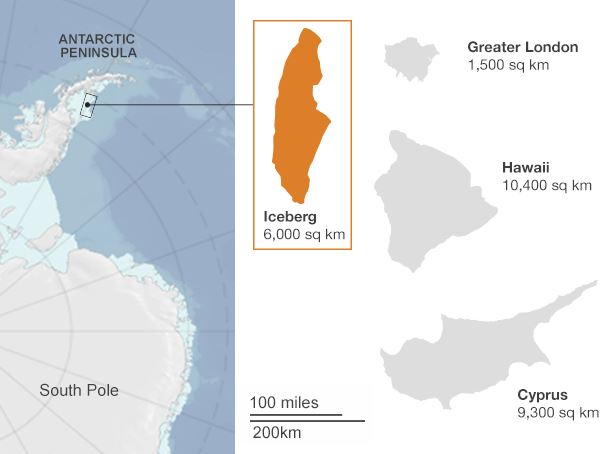
    • The iceberg — named A-68s — is travelling at varying speeds depending on local conditions, but at its fastest was travelling about 20 kilometres a day.
    • The huge iceberg — the size of the U.S. state of Delaware — has been floating north since it broke away from Antarctica’s Larsen C ice shelf in 2017.
    • It is now about 75 kilometres from the island of South Georgia, and scientists are concerned over the risks it poses to the wildlife in the area if it grounds near the island.
    • South Georgia is home to colonies of tens of thousands of penguins and 6 million fur seals, which could be threatened by the iceberg during their breeding season.
    • The waters near the island are also one of the world’s largest marine protected areas and house more marine species than the Galapagos.
    • Destruction by the iceberg will release this stored carbon back into the water and, potentially, the atmosphere, which would be a further negative impact.
  • India’s Commitment for Paris Agreement

    This week marks the fifth anniversary of the Paris Agreement, where formidable climate diplomacy ushered 196 rich and poor countries into a legally binding treaty seeking to hold global heating below 2°C at this century’s end.

    Try this PYQ first, then head with the news:

    Q.With reference to the Agreement at the UNFCCC Meeting in Paris in 2015, which of the following statements is/are correct?

    1.    The Agreement was signed by all the member countries of the UN and it will go into effect in 2017.
    2.    The Agreement aims to limit the greenhouse gas emissions so that the rise in average global temperature by the end of this century does not exceed 20C or even 1.50C above pre-industrial levels.
    3.    Developed countries acknowledged their historical responsibility in global warming and committed to donate S 1000 billion a year from 2020 to help developing countries to cope with climate change.

    Select the correct answer using the code given below.

    (a)    1 and 3 only

    (b)    2 only

    (c)    2 and 3 only

    (d)    1, 2 and 3

    The Paris Agreement

    • The Paris Agreement is a legally binding international treaty on climate change. It was adopted by 196 Parties at COP 21 in Paris, on 12 December 2015 and entered into force on 4 November 2016.
    • Its goal is to limit global warming to well below 2, preferably to 1.5 degrees Celsius, compared to pre-industrial levels.
    • To achieve this long-term temperature goal, countries aim to reach global peaking of greenhouse gas emissions as soon as possible to achieve a climate-neutral world by mid-century.
    • It is a landmark process because, for the first time, a binding agreement brings all nations into a common cause to undertake ambitious efforts to combat climate change and adapt to its effects.

    How does it function?

    • Implementation of the Paris Agreement requires economic and social transformation, based on the best available science.
    • The Agreement works on a 5- year cycle of increasingly ambitious climate action carried out by countries.
    • By 2020, countries submit their plans for climate action known as nationally determined contributions (NDCs).

    NDCs

    • In their NDCs, countries communicate actions they will take to reduce their Greenhouse Gas emissions in order to reach the goals of the Paris Agreement.
    • Countries also communicate in the NDCs actions they will take to build resilience to adapt to the impacts of rising temperatures.

    Long-Term Strategies

    • To better frame the efforts towards the long-term goal, the Paris Agreement invites countries to formulate and submit by 2020 long-term low greenhouse gas emission development strategies (LT-LEDS).
    • LT-LEDS provide the long-term horizon to the NDCs. Unlike NDCs, they are not mandatory.
    • Nevertheless, they place the NDCs into the context of countries’ long-term planning and development priorities, providing a vision and direction for future development.

    India’s commitment

    In 2015, ahead of the UN significant climate conference in Paris, India announced three major voluntary commitments called the Nationally Determined Contributions (NDC):

    1. Improving the emissions intensity of its GDP by 33–35% by 2030 over 2005 levels
    2. Increasing the share of non-fossil fuels-based electricity to 40% by 2030 and
    3. Enhancing its forest cover, thereby absorbing 2.5 to 3 billion tonnes of carbon dioxide

    A success (?)

    • The Environment Minister said that we have achieved 21% of its emissions intensity reduction target as a proportion of its GDP in line with its pledge to a 33-35% reduction by 2030.
    • India was the only major G20 country that was on track towards keeping to its nationally determined commitments to halt runaway global warming.
  • A History of Climate Change Negotiations

    China’s announcement of achieving net-zero by 2060 is a stepping stone in the fight against climate change. But it means nothing until countries share the goals they intend to follow.

    Why are we reading this news?

    We often get to hear that UPSC suddenly switches to basics after maneuvering over current affairs. This news is a perfect example which strikes the balance between basics and current affairs.

    Climate change: A disaster in making

    • Anthropogenic climate change can be traced back to the industrial revolution.
    • The atmospheric concentration of carbon dioxide equivalent (CO2e) greenhouse gas has increased to 415 parts per million (ppm) from 280 ppm since then.
    • A global momentum, therefore, was required to get all countries on board.

    Realization of climate action: Birth of UNFCCC

    • The idea led to the formation of the United Nations Framework for Climate Change Convention (UNFCCC, also known as ‘The Convention’) in 1992, at the Earth Summit in Rio de Janeiro.
    • The convention divided the countries on the basis of their differing commitments: Annex I and II consisted of industrialized and developed countries and Non-Annex I comprised developing countries.

    Wait! You need not remember everything* in this newscard. But, have walk through the timeline; it will concretize your idea about the global climate action and the possible way forward.

    A timeline

    The Conference of Parties (CoP) is the supreme decision-making body at the convention and comprises states that are party to it.

    COP 1:

    • At CoP1 in Berlin 1995, the Convention highlighted the shortcomings of UNFCCC — the voluntary nature of the agreement.
    • It stressed how no substantive action was taken to address the cause against climate change, which in turn put forward the need for “legally binding” actions.

    COP 2:

    The proposal of legally binding targets was further emphasised upon in COP2 in Geneva in 1996.

    COP 3:

    • In COP3 in Kyoto in 1997, the legally binding targets were approved of by different countries. They came to be known as the Kyoto Protocol.
    • It is considered to be one of the most important steps despite its late acceptance for it paved the way for further negotiations through legally binding targets for Annex I countries and establishment of carbon markets.
    • The mechanisms proposed by Kyoto Protocol to reduce emissions included Joint Implementation, Clean Development Mechanisms (CDM) and Emissions Trading.

    COP 4 and COP 5:

    In COP4 in 1998 and COP5 in 1999, the rulebook for implementing the Kyoto Protocol was on the process with the adoption of the Buenos Aires Plan of Action in COP4, along with continued negotiation efforts in COP5.

    COP 7:

    • In COP7 in Marrakesh in 2001, the guidelines for flexible mechanisms of joint implementation, CDM markets, emissions trading was agreed upon. It came to be known as the Marrakesh Accord.
    • It was particularly important because mitigation efforts had already started and special attention was given to developing countries.
    • It asked them to build their capacities and ensuring technology transfer through least developed countries (LDC) Fund, special climate change fund (SCCF) and adaptation fund.

    COP 8:

    The COP8 in 2002, which was held in “New Delhi”, emphasised on adaptation measures and stressed that poverty alleviation and development were the utmost priority of developing countries.

    COP 10:

    • The future course of action was discussed in COP10 in Montreal in 2005 after Russia ratified the Protocol in 2004 at COP10 in Argentina.
    • A two-track approach was formed, which included the constructive implementation of UNFCCC as well as formation an ad-hoc committee for the Kyoto Protocol.

    COP 15:

    • Copenhagen COP 2009 was set by the ad-hoc working group on Kyoto protocol formed during Montreal COP 2005.
    • The group agreed to have a deal in 2009 regarding a legally binding climate regime from 2012-2020.
    • The discussions lost track when developed countries started advocating for burden-sharing with developing countries.

    COP 16:

    • The disappointment of Copenhagen was turned into an opportunity in Cancun 2010, where the Copenhagen Accord was accepted.
    • It looked forward to a second commitment period for the Kyoto Protocol and established the Cancun Adaptation Framework.
    • For the first time, a temperature target of 2 degrees Celsius was included. The Green climate fund was formed and developed countries agreed to contribute.

    COP 17:

    • Following Cancun, Durban COP 2011 took place wherein the seed of the Paris Agreement was sown.
    • The seed started sprouting in Doha COP 2012, where countries decided to avoid the gap between Kyoto and next legal climate regime.
    • So, the second regime of Kyoto was decided from 2012-2020. The third pillar of loss and damage was incorporated for the first time.

    COP 20:

    In COP in Lima in 2014, countries submitted their own climate ambitions in the form of intended nationally determined contributions (INDCs).

    COP 21: The Pathbreaker

    • In 2015, the Paris agreement was finally adopted and the INDCs were annexed to it.
    • It was agreed that the Paris agreement would start from 2021.
    • 2015 was known as a year of multilateral agreements because, in addition to the Paris agreement, sustainable development goals and Sendai Framework was also adopted.
    • 2015, therefore, came out to be a successful year.

    Post Paris Agreement

    • The retreat of developed countries: In all these post-2020 talks, developed countries tactfully avoided their pre-2020 commitments by not ratifying the Kyoto protocol.
    • Post-Paris discussions for the finalization of the Rulebook began.
    • Most were finalised in 2018, except the market mechanism and measurement, reporting and verification (MRV) of greenhouse gas which are due in COP26 in 2021.

    Agenda for next COP in 2021

    • The next COP will be in 2021 in Glasgow with two sets of agendas for discussion.
    • The first will be to complete the rule-book of Paris Agreement implementation, whose two aspects regarding Sustainable Development Mechanism (SDM) architecture and MRV framework are yet to be completed.
    • The second will be to ensure smooth implementation of the Paris Agreement from 1st January 2021.
    • Countries are expected to revise their NDCs as the present course of activities is projected to cause an increase in temperature of 2.8-3 C rise.

    The situation today: Nothing beyong big promises

    • China’s recent announcement of achieving net-zero by 2060 comes across as the stepping stone of future climate change mitigation efforts.
    • Political announcements, however, mean nothing until countries actually share the goals they intend to follow.
    • On the contrary, India is the only country whose NDCs are in line with the 2 degrees Celsius target.
    • Another substantial happening in the domain of climate change includes Joe Biden’s promise of joining the Paris Agreement; it would bring the US back to the GCF fund.
  • Climate Change Performance Index (CCPI) 2020

    India ranked high along with the European Union and the United Kingdom in the latest edition of the Climate Change Performance Index (CCPI) 2020 released by non-profit Germanwatch.

    It’s a very rare feat that India has performed so better in any climate-related index. We can use this data to highlight India’s dedicated efforts for Paris Agreement.

    Climate Change Performance Index (CCPI)

    • The CCPI is an independent monitoring tool for tracking countries’ climate protection performance. It has been published annually since 2005.
    • It evaluates 57 countries and the European Union, which together generate 90%+ of global greenhouse gas emissions.
    • Using standardised criteria, the CCPI looks at four categories, with 14 indicators: Greenhouse Gas Emissions (40% of the overall score), Renewable Energy (20%), Energy Use (20%), and Climate Policy (20%).
    • The CCPI’s unique climate policy section evaluates countries’ progress in implementing policies working towards achieving the Paris Agreement goals.

    Global scenario

    • No country was doing enough to meet the goals of the 2015 Paris Agreement, according to the index.
    • Six G20 countries were ranked among very low performers. The United States, with a rank of 61, was the worst performer.

    India’s performance

    • India, for the second time in a row, continued to remain in the top 10. The country scored 63.98 points out of 100.
    • It received high ratings on all CCPI indicators except ‘renewable energy’, where it was categorised as having a ‘medium’ performance.
    • Last year, India had been ranked at the ninth position, with an overall score of 66.02.
    • India needed to focus more on renewable energy, both, as a mitigation strategy and for its post-novel coronavirus disease (COVID-19) green recovery, the report said.

    Renewable energy

    • No country was rated very high on indicators defining the ‘renewable energy’ category.
    • India has been ranked at 27th out of 57 countries under the category this time. Last year, it was ranked at 26th.
    • India’s performance has been rated as ‘medium’ for its current share of renewable energy. Its performance for the development of renewable energy supply during the last year was rated as ‘high’.

    A positive sign for India

    • India’s improved policy framework has been responsible for the country’s good performance in this global index. However, the report underlined the need for long-term planning.
    • Unlike the other two ‘BASIC’ countries of China and South Africa, India is yet to announce its mitigation strategy.
  • Species in news: Red Sea Turtles

    Turtle populations in the Red Sea could be turning overwhelmingly female because of a rise in sea temperatures caused due to anthropogenic climate change, a new study has showed.

    Try this PYQ:

    Q.Consider the following fauna of India:

    1. Gharial
    2. Leatherback turtle
    3. Swamp deer

    Which of the above is/are endangered?

    (a) 1 and 2 only

    (b) 3 only

    (c) 1, 2 and 3

    (d) None

    Red Sea Turtles

    • There are seven extant species worldwide, five of which can be found in the Red Sea: the green turtle, the hawksbill turtle, the loggerhead turtle, the olive ridley turtle and the leatherback turtle.
    • In order to maintain a 50:50 ratio of male and female in the population, a temperature of 29.2 degrees Celsius is pivotal.
    • Above this, hatchlings would be predominantly female.
    • The sand temperatures at four of the sites exceeded 29.2 degrees; leading the team to the conclusion that ‘feminization’ of the population could be already happening.

    Their significance

    • Marine turtles—as all top predators—have a prominent role in maintaining balanced and healthy ecosystems, in particular seagrass beds and coral reefs.
    • They also help in transporting nutrients towards naturally nutrient-poor ecosystems (the nesting beaches), and providing food and transportation for other marine species (e.g., barnacles and commensal crabs).
    • Marine turtles also play an important role in the economy of the tourism industry.