💥Join UPSC 2027,2028 Mentorship (July Batch) + XFactor Notes & Microthemes PDF

GS Paper: GS1-14.Important Geophysical phenomena such as earthquakes, Tsunami, Volcanic activity, cyclone etc.,

  • [pib] Petersberg Climate Dialogue

    India along with 30 countries deliberated on issues of Climate Change in first-ever virtual Petersberg Climate Dialogue.

    Climate change negotiations are somehow put to a halt due to ongoing pandemic. Such small dialogues are keeping alive the spirit of climate action.

    Petersberg Climate Dialogue

    • It has been hosted by Germany since 2010 to provide a forum for informal high-level political discussions, focusing both on international climate negotiations and the advancement of climate action.
    • This year’s virtual Dialogue was co-chaired by Germany and the UK.
    • The dialogue was crucial because of the efforts to contain coronavirus as well as countries preparing to move into the implementation phase of the Paris Agreement 2015 in the post-2020 period.

    India’s Contributions

    • Expressing solidarity with the world as it combats the COVID 19 pandemic the Union Minister highlighted how COVID – 19 has noticed that we can survive on less.
    • India pushed for having climate technology as an open source available to all countries at affordable prices.
    • India stressed on climate finance and urged to plan for 1 trillion USD in grants to the developing world immediately.
    • India focussed on the opportunity that the world has today to accelerate renewable energy deployment and creating new green jobs in the renewable energy and energy efficiency sector.
  • How the ozone layer hole over Arctic closed?

    Recently the EU’s Copernicus Atmosphere Monitoring Service (CAMS) announced that a hole in the Arctic ozone layer, believed to be the biggest reported, has closed.

    What healed the hole in the Ozone?

    • The ozone hole’s closing was because of a phenomenon called the polar vortex, and not because of reduced pollution levels due to Covid-19 lockdowns around the world.
    • The hole in the North Pole’s ozone layer, which was first detected in February, had since reached a maximum extension of around 1 million sq km.

    Ozone hole

    • The ‘ozone hole’ is not really a hole — it refers to a region in the stratosphere where the concentration of ozone becomes extremely low in certain months.
    • Ozone, made up of three oxygen atoms, occurs naturally in small amounts.
    • Roughly 10 km to 40 km up in the atmosphere (the layer called the stratosphere), the ozone layer is sunscreen, shielding Earth from harmful ultraviolet radiation.
    • Manufactured chemicals deplete the ozone layer. Each spring over Antarctica (it now springs there), atmospheric ozone is destroyed by chemical processes.
    • This creates the ozone hole, which occurs because of special meteorological and chemical conditions that exist in that region.

    The importance of the ozone layer

    • Ozone (chemically O3, a molecule of three oxygen atoms) is found mainly in the upper atmosphere, an area called the stratosphere, between 10 and 50 km from the earth’s surface.
    • Though it is talked of as a layer, ozone is present in the atmosphere in rather low concentrations.
    • Even at places where this layer is thickest, there are not more than a few molecules of ozone for every million air molecules.
    • They perform a very important function. By absorbing the harmful ultraviolet radiations from the sun, the ozone molecules eliminate a big threat to life forms on earth.
    • UV rays can cause skin cancer and other diseases and deformities in plants and animals.

    Why this year’s hole was massive?

    • This year, the ozone depletion over the Arctic was much larger.
    • Scientists believe that unusual atmospheric conditions, including freezing temperatures in the stratosphere, were responsible.
    • Cold temperatures (below -80°C), sunlight, wind fields and substances such as chlorofluorocarbons (CFCs) were responsible for the degradation of the Arctic ozone layer.
    • Although Arctic temperatures do not usually fall as low as in Antarctica, this year, powerful winds flowing around the North Pole trapped cold air within what is known as the polar vortex.
    • By the end of the polar winter, the first sunlight over the North Pole initiated this unusually strong ozone depletion—causing the hole to form.

    How long it will take for complete recovery?

    • As per the Scientific Assessment of Ozone Depletion data of 2018, the ozone layer in parts of the stratosphere has recovered at a rate of 1-3 per cent per decade since 2000.
    • At these projected rates, the Northern Hemisphere and mid-latitude ozone is predicted to recover by around 2030, followed by the Southern Hemisphere around 2050, and polar regions by 2060.

    Also read: Polar Vortex

    https://www.civilsdaily.com/news/whats-causing-extreme-cold-in-us-midwest/

  • Earth Day 2020 and its significance

    Yesterday, April 22nd was celebrated as Earth Day, an international event celebrated around the world to pledge support for environmental protection.

    The Earth Day designation by UN and its first observance have confusing difference. Make note of that. We can expect a question based on that. Also read about Earth Overshoot Day.

    What is Earth Day?

    • In 2009, the United Nations designated April 22 as ‘International Mother Earth Day’.
    • Earth Day aims to “build the world’s largest environmental movement to drive transformative change for people and the planet.”
    • Earth Day was first observed in 1970, when 20 million took to the streets to protest against environmental degradation.
    • The event was triggered by the 1969 Santa Barbara oil spill, as well as other issues such as smog and polluted rivers.
    • The landmark Paris Agreement, which brings almost 200 countries together in setting a common target to reduce global greenhouse emissions, was signed on Earth Day 2016.

    Significance of this year

    • The year 2020 marks the 50th anniversary of the annual celebrations.
    • This year’s theme for Earth Day is ‘climate action’.
  • Third mass bleaching of Great Barrier Reef

    A survey has found record sea temperatures had caused the third mass bleaching of the 2,300-kilometre Great Barrier Reef system in just five years.

    What is Coral Bleaching?

    • When corals face stress by changes in conditions such as temperature, light, or nutrients, they expel the symbiotic algae zooxanthellae living in their tissues, causing them to turn completely white.
    • This phenomenon is called coral bleaching.
    • The pale white colour is of the translucent tissues of calcium carbonate which are visible due to the loss of pigment-producing zooxanthellae.

    About Great Barrier Reef

    • The Great Barrier Reef is the world’s largest coral reef system composed of over 2,900 individual reefs and 900 islands.
    • It is stretched for over 2,300 kilometres over an area of approximately 344,400 square kilometres.
    • The reef is located in the Coral Sea, off the coast of Queensland, Australia.

    Importance of Corals

    Coral reefs are some of the most diverse and valuable ecosystems on Earth.

    • They support more species per unit area than any other marine environment, including about 4,000 species of fish, 800 species of hard corals and hundreds of other species.
    • This biodiversity is considered key to finding new medicines for the 21st century. Many drugs are now being developed from coral reef animals and plants as possible cures for cancer, arthritis, human bacterial infections, viruses, and other diseases.
    • Healthy coral reefs support commercial and subsistence fisheries as well as jobs and businesses through tourism and recreation.
    • Local economies receive billions of dollars from visitors to reefs through diving tours, recreational fishing trips, hotels, restaurants, and other businesses based near reef ecosystems.
    • Coral reef structures also buffer shorelines against 97 percent of the energy from waves, storms, and floods, helping to prevent loss of life, property damage, and erosion.
    • When reefs are damaged or destroyed, the absence of this natural barrier can increase the damage to coastal communities from normal wave action and violent storms.

    Back2Basics

    Coral Reefs

    • Coral reefs are built by and made up of thousands of tiny animals—coral “polyps”—that are related to anemones and jellyfish.
    • Polyps are shallow water organisms which have a soft body covered by a calcareous skeleton. The polyps extract calcium salts from sea water to form these hard skeletons.
    • The polyps live in colonies fastened to the rocky sea floor.
    • The tubular skeletons grow upwards and outwards as a cemented calcareous rocky mass, collectively called corals.
    • When the coral polyps die, they shed their skeleton on which new polyps grow.
    • The cycle is repeated for over millions of years leading to accumulation of layers of corals shallow rock created by these depositions is called reef.
  • COVID-19 and its impact on climate talks

    Context

    • Amidst the pandemic, people are breathing cleaner air and are witness to clearer, bluer skies as the human movement has been restricted due to lockdowns imposed by various countries.
    • But while the air may be getting cleaner, the lockdowns are not exactly good news for climate change research.
    • Climate talks are witnessing setbacks in the form of funding cuts, cancelled climate conferences and reduced political will to tackle climate change.

    COVID-19 impacting climate change research

    • The hard paced climate change research has been halted and it might become difficult to restart the conversation around it, even after the pandemic is brought under control.
    • The major projects that were scheduled to gather environmental data have all been cancelled or postponed and the crisis has also cast a shadow on routine monitoring of weather and climate change.
    • Further, because commercial flights are running at a lesser frequency, it has also become difficult to collect ambient temperatures and the wind speed, which is taken by in-flight sensors.
    • The other reason that other research has more or less been halted is because of restrictions including lockdowns, insistence on working from home and other social distancing requirements.

    Scope for a back seat

    • Due to the looming health crisis, human kind’s immediate survival is the biggest concern at the moment.
    • However, completely ignoring environmental policy may not be in humanity’s best interest.
    • Largely we still view the environment, and life on earth, as separate. This separation is a dangerous delusion.
    • We can and must do better if we want to prevent the next infectious pandemic.

    Climate change and infectious diseases are not separate

    • The two are not directly related, which is to say that climate change did not lead to the spread of the coronavirus.
    • However, there is a possibility that climate change could have exacerbated the impact of COVID-19 by making the consequences worse for some humans.
    • For instance, air pollution’s impact on human health could make some consequences of the disease more severe for a few humans.
    • A 2003 study on air pollution and the case fatality rate for SARS showed that people exposed to air pollution were more likely to suffer severe consequences from the disease.
  • Earth Hour

    The Earth Hour, observed annually on the last Saturday of March, was recently celebrated.

    Earth Hour

    • Earth Hour is a worldwide movement organized by the World Wide Fund for Nature (WWF).
    • It is held annually encouraging individuals, communities, and businesses to turn off non-essential electric lights, for one hour, from 8:30 to 9:30 p.m. on a specific day towards the end of March as a symbol of commitment to the planet.
    • It was started as a lights-off event in Sydney, Australia, in 2007.
  • [pib] Methanotrophs: the methane-oxidizing bacteria


    Scientists at Agharkar Research Institute (ARI), Pune have isolated 45 different strains of methanotrophic bacteria which have been found to be capable of reducing methane emissions from rice plants.

    What are Methanotrophs?

    • They are bacteria that metabolize and convert methane into carbon-di-oxide.
    • They can effectively reduce the emission of methane, which is the second most important greenhouse gas (GHG) and 26 times more potent as compared to carbon-di-oxide.
    • In rice fields, Methanotrophs are active near the roots or soil-water interfaces.
    • Besides methane mitigation studies, Methanotrophs can also be used in methane value addition (valorization) studies.
    • Bio-methane generated from waste can be used by the Methanotrophs and can be converted to value-added products such as single-cell proteins, carotenoids, biodiesel, and so on.

    Why rice fields?

    • Rice fields are human-made wetlands and are waterlogged for a considerable period. Anaerobic degradation of organic matter results in the generation of methane.
    • Rice fields contribute to nearly 10% of global methane emissions.
    • Very few studies in the world have focused on Methanotrophs from tropical wetlands or tropical rice fields.
    • Practically no cultures of indigenously isolated Methanotrophs from India were available.
    • Native and relevant Methanotrophs isolated from rice fields can be excellent models to understand the effect of various factors on methane mitigation.

    Must read:

    https://www.civilsdaily.com/news/greenhouse-gas-emissions-from-indian-paddy-fields-very-high-ny-based-study/


  • Explained: Marine Heatwave (MHW)


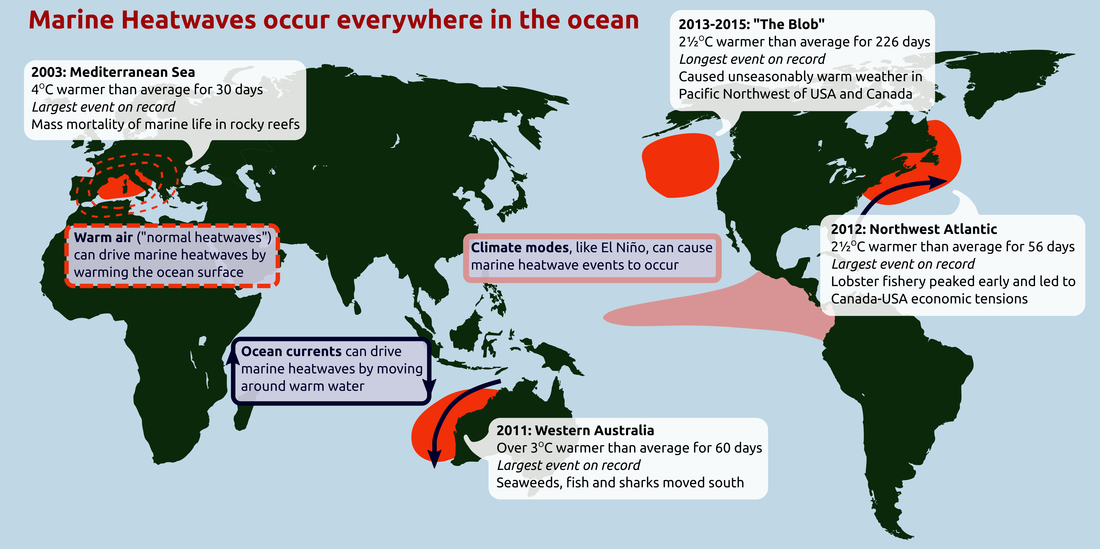
    Scientists have observed unusually high sea surface temperatures (SSTs) in the Pacific Ocean around the western coast of the United States.  This marine heatwave (MHW), covering an area of roughly 6.5 million square kilometres, can affect marine life and lead to droughts in the surrounding regions.

    What are MHWs?

    • We know that heatwaves occur in the atmosphere. We are all familiar with these extended periods of excessively hot weather.
    • However, heatwaves can also occur in the ocean and these are known as marine heatwaves, or MHWs.
    • These marine heatwaves, when ocean temperatures are extremely warm for an extended period of time can have significant impacts on marine ecosystems and industries.

    When do they occur?

    • Heatwaves can happen in summer and also in winter, where they are known as “winter warm-spells”.
    • These winter events can have important impacts, such as in the southeast of Australia where the spiny sea urchin can only colonize further south when winter temperatures are above 12 °C.

    What causes marine heatwaves?

    • Marine heatwaves can be caused by a whole range of factors, and not all factors are important for each event.
    • The most common drivers of marine heatwaves include ocean currents which can build up areas of warm water and air-sea heat flux, or warming through the ocean surface from the atmosphere.
    • Winds can enhance or suppress the warming in a marine heatwave, and climate modes like El Niño can change the likelihood of events occurring in certain regions.
    • MHWs can be caused due to large-scale drivers of the Earth’s climate like the El Niño Southern Oscillation (ENSO).

    Impacts of the MHWs

    • Marine heatwaves affect ecosystem structure, by supporting certain species and suppressing others.
    • For example, after the 2011 marine heatwave in Western Australia the fish communities had a much more “tropical” nature than previously and switched from kelp forests to seaweed turfs.
    • Marine heatwaves can cause economic losses through impacts on fisheries and aquaculture.
    • Temperature-sensitive species such as corals are especially vulnerable to MHWs. In 2016, marine heatwaves across northern Australia led to severe bleaching of the Great Barrier Reef.

    How do we measure marine heatwaves?

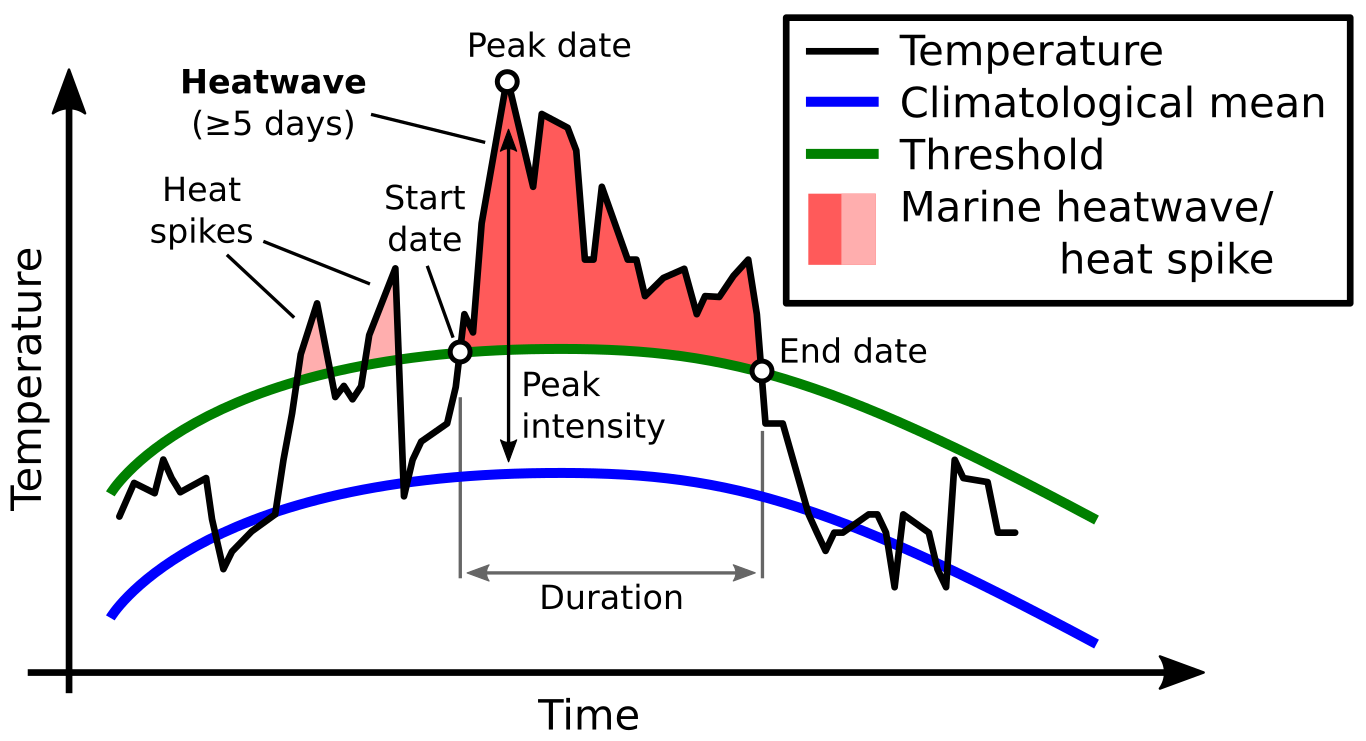
    • A marine heatwave occurs when seawater temperatures exceed a seasonally-varying threshold (usually the 90th percentile) for at least 5 consecutive days.
    • Successive heatwaves with gaps of 2 days or less are considered part of the same event.

    Why study MHWs?

    • MHWs are increasing in frequency due to climate change. MHWs increased by 54 per cent in the last 30 years.
    • Despite their potential impact on the health of marine ecosystems, MHWs remain one of the least studied consequences of global warming.

    Way Forward

    • Marine heatwaves clearly have the potential to devastate marine ecosystems and cause economic losses in fisheries, aquaculture, and ecotourism industries.
    • However, their effects are often hidden from view under the waves until it is too late.
    • By raising general awareness of these phenomena, and by improving our scientific understanding of their physical properties and ecological impacts, we can better predict future conditions and protect vulnerable marine habitats and resources.
  • Red Snow in Antarctica


    Over the last few weeks, photographs of “red snow” off the coast of Antarctica’s northernmost peninsula, have gone viral. “Red snow” or “watermelon” is a phenomenon that has been known since ancient times. Now, it raises concerns about climate change.

    Red snow in Antarctica: Why it happens 

    • Aristotle is believed to be one of the first to give a written account of red snow, over 2,000 years ago.
    • What Aristotle described as worms and grub, the scientific world today calls algae.
    • This alga species, Chlamydomonas Chlamydomonas nivalis, exists in the snow in the polar and glacial regions and carries a red pigment to keep itself warm.

    Signs of faster melting 

    • In turn, the red snow causes the surrounding ice to melt faster. The more the algae packed together, the redder the snow.
    • And the darker the tinge, the more the heat absorbed by the snow. Subsequently, the ice melts faster.
    • While the melt is good for the microbes that need the liquid water to survive and thrive, it’s bad for glaciers that are already melting from a myriad of other causes, the study said.
    • These algae change the snow’s albedo — which refers to the amount of light or radiation the snow surface is able to reflect back. Changes in albedo lead to more melting.
  • [pib] Indian National Centre for Ocean Information Services (INCOIS)


    The INCOIS Hyderabad has launched a trio of products for users in the marine realm.

    About INCOIS

    • The institute is an autonomous organisation under the Ministry of Earth Sciences.
    • INCOIS prioritises requests for specific services from its diverse user community that ranges right from fishermen to offshore oil exploration industries.

    Products launched:

    Small Vessel Advisory and Forecast Services System (SVAS)  

    The SVAS is an innovative impact-based advisory and forecast service system for small vessels operating in Indian coastal waters.

    • The SVA system warns users about potential zones where vessel overturning can take place, ten days in advance.
    • The advisories are valid for small vessels of beam width up to 7 m.
    • This limit covers the entire range of beam widths of the fishing vessels used in all the 9 coastal states and union territories of India.
    • The warning system is based on the  ‘Boat Safety Index’ (BSI) derived from wave model forecast outputs such as significant wave height, wave steepness, directional spread and the rapid development of wind at sea which is boat-specific.

    Swell Surge Forecast System (SSFS)

    SSFS is an innovative system designed for the prediction of Kallakkadal/Swell Surge that occurs along the Indian coast, particularly the west coast.

    • Kallakadal/Swell surge are flash-flood events that take place without any noticeable advance change in local winds or any other apparent signature in the coastal environment.
    • Hence the local population remains totally unaware of these flooding events until they actually occur. Such events are intermittent throughout the year.
    • Kallakkadal is a colloquial term used by Kerala fishermen to refer to the freaky flooding episodes and in 2012 UNESCO formally accepted this term for scientific use.
    • Kallakkadal are caused by meteorological conditions in the Southern Ocean, south of 30°S.
    • These swells once generated, travel northward and reach the Indian coasts in 3-5 days time, creating havoc in the coastal areas.
    • The system will now predict Kallakkadal and warnings will be given to concerned authorities at least 2-3 days in advance, which will help the local authorities for contingency plans and to reduce damage.

    Algal Bloom Information Service (ABIS)

    • The increasing frequency of algal blooms is a major concern due to its ill effects on the fishery, marine life and water quality.
    • INCOIS has developed a service for “Detection and Monitoring of Bloom in the Indian Seas”.
    • The target users are fishermen, marine fishery resource managers, researchers, ecologists and environmentalists.
    • The service also complements INCOIS’ marine fishing advisories i.e. Potential Fishing Zone advisories.
    • INCOIS-ABIS will provide near-real-time information on spatio-temporal occurrence and spread of phytoplankton blooms over the North Indian Ocean.
    • In addition, four regions have been identified as bloom hotspots viz.

    a) North Eastern Arabian Sea

    b) coastal waters off Kerala

    c) Gulf of Mannar and

    d) coastal waters of Gopalpur