đŸ’„Join UPSC 2027,2028 Mentorship (July Batch) + XFactor Notes & Microthemes PDF

GS Paper: GS1

  • [pib] Heritage of Punjab

    The Ministry of Tourism’s DekhoApnaDesh Webinar series titled “Punjab- A historic perspective” has recently gone live.

    Try this PYQ:

    Q.Rivers that passes through Himachal Pradesh are: (CSP 2012)

    (a) Beas and Chenab only

    (b) Beas and Ravi only

    (c) Chenab, Ravi, and Satluj only

    (d) Beas, Chenab, Ravi, Satluj, and Yamuna

    Heritage of Punjab

    • Punjab means ‘the land of Five Waters’ referring to the rivers Jhelum, Chenab, Ravi, Sutlej, and Beas.
    • Much of the Frontier was occupied by Maharaja Ranjit Singh also known as Sher-e-Punjab in the early 19th century and then taken over by the East India Company when it annexed Punjab in 1849.
    • The state is divided into three parts- Majha, Doaba and Malwa.
    • It’s many festivals–Teej, Lohri, Basant Panchami, Baisakhi and Hola Mahalla to name some are celebrations that mirror the farming ethos.
    • Historically, Punjab has played host to a number of ethnicities, including the Aryans, Persians, Greeks, Afghans and Mongols, thus bestowed with a rich tangible heritage.
    • The southeastern city of Punjab, Patiala was once a princely state established under Baba Ala Singh, a Jat Sikh chieftain. He laid the foundation of the fort and now, is located in the region around Qila Mubarak or the Fortunate Castle.
    • Important tourist attractions are Kali Temple, Baradari Garden, Sheesh Mahal, Gurudwara Dukh Niwaran Sahib, Qila Mubarak complex etc.

    Holy shrines

    • The most sacred of Sikh shrines, the Golden Temple, is a major pilgrimage destination for devotees from around the world, as well as, an ever-increasing popular tourist attraction.
    • Construction of the Amrit Sarovar (pool of nectar) was initiated by Guru Amar Das, the third Guru, in 1570 and was completed by Guru Ram Das, the fourth Guru.
    • His successor, Guru Arjan Dev began work on the building after inviting Mian Mir, the Sufi saint, to lay its foundation stone in 1588.
    • Three years later, the Harimandar Sahib, or Darbar Sahib got completed.
    • In step with Sikhism’s basic tenet of universal brotherhood and all-inclusive ethos, the Golden Temple can be accessed from all directions.

    Legend of Banda Bahadur

    • The city of Fatehgarh Sahib is of special significance to Sikhs. The word “Fatehgarh”, means “Town of Victory”.
    • It is so-called because, in 1710, Sikhs under the leadership of Baba Banda Singh Bahadur conquered the area and destroyed the Mughal fort.
    • Banda Bahadur announced the establishment of the Sikh rule in the city and an end to the tyranny of the Mughal rule which had spread terror and injustice.
  • In news: Malabar Rebellion

    A report submitted to the Indian Council of Historical Research (ICHR) in 2016 has termed the Malabar Rebellion leaders as ‘rioters’.

    Try this question from CSP 2015:

    Q. Which amongst the following provided a common factor for a tribal insurrection in India in the 19th century?

    (a) Introduction of a new system of land revenue and taxation- of tribal products

    (b) Influence of foreign religious missionaries in tribal areas

    (c) Rise of a large number of money lenders, traders and revenue farmers as middlemen in tribal areas

    (d) The complete disruption of the old agrarian order of the tribal communities

    What is the Malabar Rebellion?

    • The Malabar Rebellion in 1921 started as resistance against the British colonial rule and the feudal system in southern Malabar but ended in communal violence between Hindus and Muslims.
    • There were a series of clashes between Mappila peasantry and their landlords, supported by the British, throughout the 19th and early 20th centuries.
    • It began as a reaction against a heavy-handed crackdown on the Khilafat Movement, a campaign in defence of the Ottoman Caliphate by the British authorities in the Eranad and Valluvanad taluks of Malabar.
    • The Mappilas attacked and took control of police stations, British government offices, courts and government treasuries.

    Why is it contentious?

    • It largely took the shape of guerrilla-type attacks on janmis (feudal landlords, who were mostly upper-caste Hindus) and the police and troops.
    • Mappilas had been among the victims of oppressive agrarian relations protected by the British.
    • But the political mobilization in the region in the aftermath of the Khilafat agitation and Gandhi’s non-cooperation struggle served as an opportunity for an extremist section to invoke a religious idiom to express their suffering.
    • There were excesses on both sides — rebels and government troops. Incidents of murder, looting and forced conversion led many to discredit the uprising as a manifestation of religious bigotry.
    • Moderate Khilafat leaders lamented that the rebellion had alienated the Hindu sympathy.
  • OBC categorization: findings, progress by a panel so far

    While the ongoing legal debate on sub-categorisation of Scheduled Castes and Scheduled Tribes for reservations is undergoing, a Commission has been examining sub-categorisation of Other Backward Classes (OBC) for almost three years now.

    Practice question for mains:

    Q.The quota policy for OBCs needs an urgent revisit. Comment.

    What is the sub-categorisation of OBCs?

    • OBCs are granted 27% reservation in jobs and education under the central government.
    • The question of sub-categorisation arises out of the perception that only a few affluent communities among the over 2,600 included in the Central List of OBCs have secured a major part of this 27% reservation.
    • The argument for sub-categorisation — or creating categories within OBCs for reservation — is that it would ensure “equitable distribution” of representation among all OBC communities.

    Who is examining sub-categorisation?

    • The Commission to Examine Sub-categorisation of Other Backward Classes took charge on October 11, 2017.
    • It is headed by retired Delhi High Court Chief Justice G Rohini.
    • Initially constituted with tenure of 12 weeks ending January 3, 2018, it was granted an extension recently.

    What are its terms of references?

    It was originally set up with three terms of reference:

    1. To examine the extent of inequitable distribution of benefits of reservation among the castes or communities included in the broad category of OBCs with reference to such classes included in the Central List;
    2. To work out the mechanism, criteria, norms and parameters in a scientific approach for sub-categorisation within such OBCs;
    3. To take up the exercise of identifying the respective castes or communities or sub-castes or synonyms in the Central List of OBCs and classifying them into their respective sub-categories.

    A fourth was added on January 22, 2020, when the Cabinet granted it an extension:

    1. To study the various entries in the Central List of OBCs and recommend correction of any repetitions, ambiguities, inconsistencies and errors of spelling or transcription.

    What progress has it made so far?

    • In its letter to the government on July 30, 2019, the Commission wrote that it is ready with the draft report. This could have huge political consequences and is likely to face a judicial review.
    • The current tenure of the Commission ends on January 31, 2021.
    • Its budget is being drawn from the National Commission for Backward Classes (NCBC) which was given constitutional status by the government in 2018.

    What progress has it made so far?

    • The Commission is ready with the draft report. This could have huge political consequences and is likely to face a judicial review.
    • The current tenure of the Commission ends on January 31, 2021.
    • Its budget is being drawn from the National Commission for Backward Classes (NCBC) which was given constitutional status by the government in 2018.

    How do these data compare with OBCs’ share in the population?

    • A hurdle for the Commission has been the absence of data for the population of various communities to compare with their representation in jobs and admissions.
    • Sources said the data of Socio-Economic Caste Census (SECC) were not considered reliable.
    • The Commission has requested for an appropriate Budget provision for a proposed all-India survey for an estimate of the caste-wise population of OBCs.
  • NCRB data on Accidental Deaths and Suicides

    The cases of suicide and the number of accidental deaths registered an increase across the country last year compared to 2018, according to the annual National Crime Records Bureau (NCRB) report.

    Do you know?

    NCRB also released data on hate crimes, fake news, and anti-national activities etc.

    (1) Data on Suicides

    • Statewise data: The maximum cases of mass/family suicides were reported from Tamil Nadu (16), followed by Andhra Pradesh (14), Kerala (11) and Punjab (9) and Rajasthan (7).
    • Unemployed person: Suicides by unemployed persons amounting to 14% were in Kerala (1,963), followed by 10.8% in Maharashtra, 9.8% in Tamil Nadu, 9.2% in Karnataka and 6.1% in Odisha. Of the 97,613 male suicides, the maximum were daily wage earners (29,092), followed by self-employed persons (14,319) and the unemployed (11,599).
    • Farmer’s suicide: Majority of victims engaged in the farming sector were reported in Maharashtra (38.2% of 10,281), Karnataka (19.4%), AP (10.0%), MP (5.3%) and Chhattisgarh & Telangana (4.9% each),” said the report.
    • Rural-Urban: The suicide rate in cities (13.9%) was higher compared to the all-India average. Family problems (other than marriage related problems)’ (32.4%); ‘marriage related problems’ (5.5%); and ‘illness’ (17.1%) accounted for 55% of the total suicides.
    • Gender-specific cases: The overall male-female ratio was 70.2:29.8. Nearly 68.4% of males were married and the ratio was 62.5% for female victims. While 12.6% of the total victims were illiterate, 16.3% had studied up to primary level, 19.6% up to middle level and 23.3% up to Matriculation level. Only 3.7% were graduates and above.
    • Defence personnel: In the Central Armed Police Forces, a total of 36 personnel died by suicide, 38.9% were due to “family problems”.

    (2) Data on Accidents

    • Accidental deaths in the country increased by 2.3%. Compared to 4,11,824 in 2018, the figure stood at 4,21,104 last year.
    • The rate (per lakh population) increased from 31.1 to 31.5. The maximum casualties of 30.9% were reported in the 30-45 years age group, followed by 26% in the 18-30 years’ age group.
    • The highest rate was reported from Puducherry (72.8), followed by Chhattisgarh (68.6), Maharashtra (57.4), Haryana (54.3), Goa (51.5) and Madhya Pradesh (51.4).
    • Maharashtra reported the highest deaths (70,329), amounting to nearly one-sixth of the total figure. UP, the most populous state, accounted for 9.6% cases, followed by MP (10.1%).
    • Maximum deaths (85.4%) were in road accidents. While 38% of the victims were two-wheeler riders, 14.6% involved trucks.
    • Dangerous/careless driving or overtaking contributed to 25.7% road accidents, claiming 42,557 lives and leaving more than 1 lakh people injured.

    (3) Deaths due to disasters

    • A total of 8,145 deaths were due to the causes attributable to forces of nature, including 35.3% due to lightning, 15.6% by heat/sunstroke and 11.6% deaths in floods.
    • Maximum deaths (400) due to lightning was reported each from Bihar and Madhya Pradesh, followed by Jharkhand (334) and Uttar Pradesh (321).

    Back2Basics: NCRB

    • The NCRB is an Indian government agency responsible for collecting and analyzing crime data as defined by the Indian Penal Code (IPC) and Special and Local Laws (SLL).
    • It is headquartered in New Delhi and is part of the Ministry of Home Affairs (MHA).
    • It was set-up in 1986 to function as a repository of information on crime and criminals so as to assist the investigators in linking crime to the perpetrators.
    • It was set up based on the recommendation of the Task-force 1985 and National Police Commission 1977.
  • Renati Chola Era Inscription

    A rare inscription dating back to the Renati Chola era has been unearthed in a remote village of Kadapa district of Andhra Pradesh.

    Try this PYQ:

    Q.In the context of the history of India, consider the following pairs:

    Term: Description

    1. Eripatti: Land revenue from which was set apart for the maintenance of the village tank
    2. Taniyurs: Villages donated to a single Brahmin or a group of Brahmins
    3. Ghatikas: Colleges generally attached to the temples

    Which of the pairs given above is/are correctly matched?

    (a) 1 and 2

    (b) 3 only

    (c) 2 and 3

    (d) 1 and 3

    Who are the Renati Cholas?

    • The Telugu Cholas of Renadu (also called as Renati Cholas) ruled over Renadu region, the present-day Kadapa district.
    • They were originally independent, later forced to the suzerainty of the Eastern Chalukyas.
    • They had the unique honour of using the Telugu language in their inscriptions belonging to the 6th and 8th centuries.
    • The earliest of this family was Nandivarman (500 AD) who claimed descent from the family of Karikala and the Kasyapa gotra.
    • He had three sons Simhavishnu, Sundarananda and Dhananjaya, all of whom were ruling different territories simultaneously.
    • The family seems to have had its origin in Erigal in the Tunmkur district, situated in the border between Pallava and Kadamba regions.

    About the inscription

    • The inscription so found was engraved on a dolomite slab and shale.
    • The inscription was written in archaic Telugu which is readable in 25 lines — the first side with eleven lines and the remaining on the other side.
    • It was assigned to the 8th Century A.D. when the region was under the rule of Chola Maharaja of Renadu.
    • The inscription seems to throw light on the record of a gift of six Marttus (a measuring unit) of land gifted to a person Sidyamayu, one of the Brahmins serving the temple at Pidukula village.
    • It says the people who safeguard this inscription for future generations will acquire the status of conducting Aswamedha Yajna and those destroying it will incur sin equivalent to causing death in Varanasi.
  • [pib] Historic City of Hampi

    The Ministry of Tourism organised their latest webinar titled Hampi- Inspired by the past; Going into the future under Dekho Apna Desh Webinar series.

    Try this PYQ:

    Q.Building ‘Kalyaana Mandapas’ was a notable feature in the temple construction in the kingdom of-

    (a) Chalukya

    (b) Chandela

    (c) Rashtrakuta

    (d) Vijayanagara

    Facts about Hampi

    • Its name is derived from Pampa which is the old name of the Tungabhadra River on whose banks the city is built.
    • In 1336 CE, the Vijayanagara Empire arose from the ruins of the Kampili kingdom.
    • It grew into one of the famed Hindu empires of South India that ruled for over 200 years.
    • The Vijayanagara rulers fostered developments in intellectual pursuits and the arts, maintained a strong military and fought many wars with sultanates to its north and east.
    • They invested in roads, waterworks, agriculture, religious buildings and public infrastructure.
    • The site used to be multi-religious and multi-ethnic; it included Hindu and Jain monuments next to each other.
    • The buildings predominantly followed South Indian Hindu arts and architecture dating to the Aihole-Pattadakal styles.
    • The Hampi builders also used elements of Indo-Islamic architecture in the Lotus Mahal, the public bath and the elephant stables.

    Major attractions

    • One of the major attractions of Hampi is the 15th Century Virupaksha temple which is one of the oldest monuments of the town.
    • The main shrine is dedicated to Virupaksha, a form of Lord Shiva.
    • Hemkunta Hill, south of the Virupaksha temple contains early ruins, Jain temples and a monolithic sculpture of Lord Narasimha, a form of Lord Vishnu.
    • At the eastern end, there is the large Nandi in stone; on the southern side is the larger than life Ganesha.
    • Large single stone carvings seem to have been the fashion of the day in Hampi, for there is a large image of Narasimha (6.7m high), the half-lion half-man incarnation of God, as well as a huge linga.
  • Person in news: Noor Inayat Khan

    World War II spy Noor Inayat Khan is now the first woman of Indian origin to be commemorated by the distinct blue London plaque.

    Try this PYQ:

    Q.A recent movie titled “The Man Who Knew Infinity” is based on the biography of-

    (a) S. Ramanujan
    (b) S. Chandrasekhar
    (c) S. N. Bose
    (d) C. V. Raman

    Noor Inayat Khan

    • A descendant of Tipu Sultan, Noor Inayat Khan became a secret agent during the Second World War.
    • She was the first woman radio operator to be infiltrated into occupied France in 1943 and worked under the code name ‘Madeleine’.
    • Renowned for her service in the Special Operations Executive, an independent British secret service set up by Winston Churchill in 1940.
    • Noor was Britain’s first Indian Muslim war heroine in Europe and the first female radio operator sent into Nazi-occupied France.
    • She was killed at the Dachau concentration camp in 1944 and was posthumously awarded the George Cross in 1949.

    What are Blue Plaques?

    • The idea of placing commemorative plaques on historically significant buildings was first mooted in 1863.
    • The idea was to honour important people and organisations that have lived or worked in London buildings.
    • Currently, the blue plaque scheme is being run by the charity organisation, English Heritage that takes care of historic sites and buildings in England.
    • While Khan is the first woman of Indian origin to be honoured with a blue plaque, it has been erected on houses and venues associated with several Indian men including Mahatma Gandhi, Raja Ram Mohun Roy, B R Ambedkar, Sardar Patel and Swami Vivekananda among others.
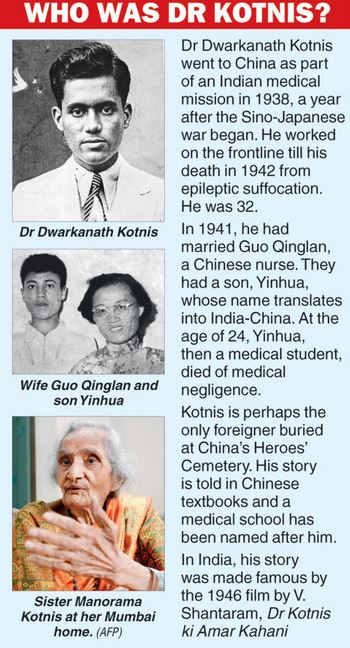
  • Who was Dr. Dwarkanath Kotnis?

    A bronze statue of Indian doctor Dwarkanath Kotnis is set to be unveiled in China.

    Try this PYQ:

    Q.A recent movie titled The Man Who Knew Infinity is based on the biography of

    (a) S. Ramanujan
    (b) S. Chandrasekhar
    (c) S. N. Bose
    (d) C. V. Raman

    Dr. Dwarkanath Kotnis

    • He is revered in China for his contributions during the Chinese revolution headed by its founder Mao Zedong and World War II.
    • He hailed from Sholapur in Maharashtra came to China in 1938 as part of a five-member team of doctors sent by the Indian National Congress to help the Chinese during World War II.
    • He joined the Communist Party of China (CPC) in 1942 and died the same year at the age of 32.
    • Kotnis’ medical assistance during the difficult days of the Chinese revolution was praised by Chinese leader Mao Zedong.
    • His statues and memorials were also set in some of the Chinese cities in recognition of his services.

    A revered personality in China

    • Late Chinese leader Mao Zedong was deeply affected by his death.
    • Mao wrote in his eulogy that “the army has lost a helping hand; the nation has lost a friend. Let us always bear in mind his internationalist spirit”.
    • Kotnis is remembered not only as a symbol inspiring medical students to work hard, but also an eternal bond between the people of China and India.
  • What is the Hangenberg Crisis?

    The explosion of a nearby star — occurred at between Devonian and Carboniferous periods — could have caused a mass extinction event that took place 359 million years ago.

    Try this question from CSP 2018:

    Q.The term “sixth mass extinction/sixth extinction” is often mentioned in the news in the context of the discussion of

    (a) Widespread monoculture Practices agriculture and large-scale commercial farming with indiscriminate use of chemicals in many parts of the world that may result in the loss of good native ecosystems.

    (b) Fears of a possible collision of a meteorite with the Earth in the near future in the manner it happened 65million years ago that caused the mass extinction of many species including those of dinosaurs.

    (c) Large scale cultivation of genetically modified crops in many parts of the world and promoting their cultivationin other Parts of the world which may cause the disappearance of good native crop plants and the loss offood biodiversity.

    (d) Mankind’s over-exploitation/misuse of natural resources, fragmentation/loss, natural habitats, destructionof ecosystems, pollution and global climate change.

    Hangenberg crisis

    • The Earth suffered an intense loss of species diversity that lasted for at least 300,000 years.
    • The event is thought to have been caused by long-lasting ozone depletion, which would have allowed much more of the Sun’s ultraviolet (UV) radiation to reach and harm life on Earth.
    • It was called the Hangenberg crisis.

    What did researchers find?

    • Extensive volcanism and global warming can also rupture the ozone layer but shreds of evidence for these are indefinite as far as the time period is concerned.
    • So, they up that one or more supernovae explosions, at a distance of 65 light-years away from the Earth, may have caused a prolonged loss of ozone.
    • Betelgeuse, a supernova, around 600 light-years away and present outside the kill distance of 25 light-years poses a danger today.
    • Events like gamma-ray bursts, solar eruptions and meteorite collisions end up very soon. As such, they cannot pave the way for gradual ozone depletion that took place at the close of the Devonian aeon.
    • A supernova event can be powerful enough to bathe its galaxy in light for days and months alike. It can be spotted across the universe as well.

    Why Supernovae are considered dangerous?

    • Supernovae (SNe) are quick sources of ionizing photons that include fatal X-rays, UV and gamma rays.
    • Over a longer period of time, the bang clashes with the nearby gas, resulting in a shockwave that causes particle acceleration.
    • As such, cosmic rays are generated by SNe. These charged particles with high energies get magnetically confined on the inside of SN remains.
    • The fossil evidence shows a 300,000-year shrink in biodiversity leading the way to Devonian-Carboniferous Boundary (DCB) mass extinction.
    • This puts forward the possibility of multiple catastrophes or multiple supernovae explosions.
  • PVTGS in Andaman

    Five members of the Great Andamanese tribe, a Particularly Vulnerable Tribal Group (PVTGs) have tested positive for COVID-19.

    Try this PYQ:

    Q. Consider the following statements about Particularly Vulnerable Tribal Groups (PVTGs) in India:

    1. PVTGs reside in 18 States and one Union Territory.
    2. A stagnant or declining population is one of the criteria for determining PVTG status.
    3. There are 95 PVTGs officially notified in the country so far.
    4. Irular and Konda Reddi tribes are included in the list of PVTGs.

    Which of the statements given above are correct?(CSP 2019)

    (a) 1, 2 and 3

    (b) 2, 3 and 4

    (c) 1, 2 and 4

    (d) 1, 3 and 4

    PVTGs in Andaman

    • Great Andamanese is one of five PVTGs that reside in Andamans archipelago.
    • The Great Andamanese speak Jeru dialect among themselves and their number stands at 51 as per the last study carried out by Andaman Adim Janjati Vikas Samiti in 2012.
    • The five PVTGS residing in Andamans are Great Andamanese, Jarwas, Onges, Shompens and North Sentinelese.

    What are PVTGs?

    • There are certain tribal communities who have declining or stagnant population, low level of literacy, pre-agricultural level of technology and are economically backward.
    • They generally inhabit remote localities having poor infrastructure and administrative support.
    • These groups are among the most vulnerable section of our society as they are few in numbers, have not attained any significant level of social and economic development.
    • 75 such groups have been identified and categorized as Particularly Vulnerable Tribal Groups (PVTGs).