China, EU, Germany, Italy, Japan, Russia, Saudi Arabia, South Korea, Türkiye, UK, US, Egypt
[2015] With reference to ‘Indian Ocean Rim Association for Regional Cooperation (IOR-ARC)’, Consider the following statements: 1. It was established very recently in response to incidents of piracy and accidents of oil spills 2. It is an alliance meant for maritime security only Which of the following statements given above is/are correct? [A] 1 only [B] 2 only [C] Both 1 and 2 [D] Neither 1 nor 2
The President of India conferred the National Florence Nightingale Awards 2026 on outstanding nursing professionals.
About the Award
Instituted in 1973.
Established by the Ministry of Health and Family Welfare, Government of India.
Recognises exceptional nursing services and contributions to public health.
Who Receives the Award?
The award is presented to:
Registered Nurses
Midwives
Auxiliary Nurse Midwives (ANMs)
Lady Health Visitors (LHVs)
Serving in:
Central Government
State Governments
Union Territories
Voluntary organisations
Award Components
Each award includes:
Certificate of Merit
Medal
Cash prize of ₹1 lakh
Role of Nurses in Healthcare
Nurses play a vital role in:
Primary healthcare
Immunisation
Community outreach
Emergency care
About Florence Nightingale
English social reformer and statistician.
Known as the founder of modern nursing.
Gained prominence during the Crimean War by organising nursing care for wounded soldiers.
Professionalised nursing practice and introduced scientific healthcare methods.
Founded the Nightingale School of Nursing at St. Thomas’ Hospital, London, considered the world’s first scientifically based nursing school.
[2024] With reference to the ‘Pradhan Manti Surakshit Matritva Abhiyan’, consider the following statements: 1. This scheme guarantees a minimum package of antenatal care services to women in their second and third trimesters of pregnancy and six months post-delivery health care service in any government health facility. 2. Under this scheme, private sector health care providers of certain specialties can volunteer to provide service at nearby government health facilities. Which of the statements given above is/are correct ? [A] 1 only [B] 2 only [C] Both 1 and 2 [D] Neither 1 nor 2
Vijay won the confidence motion in the Tamil Nadu Legislative Assembly with 144 votes, ensuring the survival of the TVK-led coalition government.
Key Highlights of the Floor Test
Confidence Motion Passed
The motion moved by Chief Minister Vijay received: 144 votes in favour
Supporting Parties
Indian National Congress
Communist Party of India
Communist Party of India (Marxist)
Viduthalai Chiruthaigal Katchi
Indian Union Muslim League
25 rebel AIADMK MLAs
One AMMK MLA
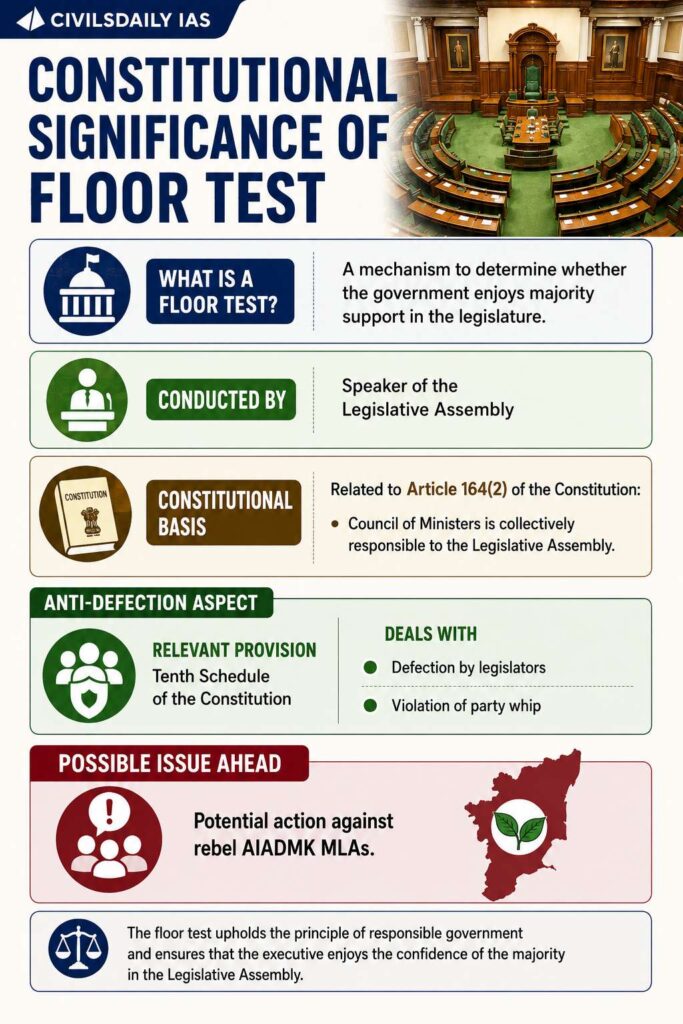
Constitutional Significance of Floor Test
What is a Floor Test?: A mechanism to determine whether the government enjoys majority support in the legislature.
Conducted By: Speaker of the Legislative Assembly
Constitutional Basis: Related to Article 164(2) of the Constitution:
Council of Ministers is collectively responsible to the Legislative Assembly.
Anti-Defection Aspect
Relevant Provision: Tenth Schedule of the Constitution
Deals With
Defection by legislators
Violation of party whip
Possible Issue Ahead
Potential action against rebel AIADMK MLAs.
Note: In India, the office of the “whip” is not explicitly mentioned in the Constitution, the Rules of the House, or any parliamentary statute; rather, it is based on convention. However, the authority to issue whips and the consequences for defying them are legally upheld by the Tenth Schedule (Anti-Defection Law).
[2020] A Parliamentary System of Government is one in which a) All political parties in the Parliament are represented in the Government b) the Government is responsible to the Parliament and can be removed by it c) the Government is elected by the people and can be removed by them d) the Government is chosen by the Parliament but cannot be removed by it before completion of a fixed term
A new paper published in BMJ Global Health (March 2026) has revived scrutiny of IMF and World Bank Structural Adjustment Programmes (SAPs), arguing that these institutions owe reparations to Global South countries for long-term socio-economic damage.
What are Structural Adjustment Programmes (SAPs)?
They are a set of economic mandates imposed by international financial institutions, principally the International Monetary Fund (IMF) and the World Bank, on developing nations. They are imposed as a strict prerequisite for securing new loans, refinancing existing debt, or avoiding sovereign default.
How did Structural Adjustment Programmes emerge in the Global South?
Debt Crisis: Developing countries borrowed heavily during the 1970s for industrialization and imports. Rising interest rates by the U.S. Federal Reserve in the late 1970s sharply increased repayment burdens.
Dollar-Denominated Loans: Countries borrowing in U.S. dollars faced rising repayment obligations due to currency depreciation beyond domestic control.
IMF-World Bank Intervention: Financial assistance became conditional upon implementing structural economic reforms aimed at restoring macroeconomic stability.
Debt Leverage: Creditor institutions used debt obligations to push policy reforms in exchange for access to loans and refinancing.
Historical Context: SAPs coincided with the rise of market-oriented neoliberal economic policies globally.
What were the major components of Structural Adjustment Programmes?
Fiscal Austerity: Reduced public expenditure on healthcare, education, subsidies, and social security to reduce fiscal deficits.
Privatization: Transferred state-owned enterprises and public services to private ownership.
Trade Liberalization: Removed trade barriers and opened domestic markets to global competition.
Deregulation: Reduced industrial regulations, labour protections, and capital controls.
Currency Devaluation: Encouraged export competitiveness through exchange-rate reforms.
Conditional Financing: Linked access to international loans with compliance to reform packages.
How did SAPs affect economic growth in the Global South?
Growth Slowdown: Economic growth reportedly declined sharply during adjustment periods. The Global South’s average growth rate fell from nearly 3.2% before SAPs to 0.7% during the 1980s-1990s.
Income Loss: Developing countries collectively lost an estimated $480 billion annually in potential national income.
Latin America: Real per capita income reportedly declined by 15% after 1980, recovering to previous levels only by 2006.
Sub-Saharan Africa: Income levels reportedly fell sharply before eventual recovery decades later.
Industrial Weakening: Liberalization exposed domestic industries to global competition before adequate institutional preparedness.
Developmental Sovereignty: Reduced state capacity to pursue independent industrial policy.
What social consequences emerged from Structural Adjustment Programmes?
Healthcare Retrenchment: Public health expenditure cuts weakened medical infrastructure and service delivery.
Education Cuts: Reduced state spending constrained human capital development.
Child Mortality: SAP-linked effects reportedly contributed to 56.62 additional child deaths per 1,000 births in Sub-Saharan Africa.
Maternal Mortality: Around 360 additional maternal deaths per 1,00,000 births were associated with SAP-linked reforms.
Excess Mortality: Nearly 3,05,000 excess infant deaths reportedly occurred between 1986-2010 relative to pre-adjustment trends.
User Fees: Privatization and reduced welfare spending increased costs of essential services.
Food Inflation: Currency depreciation increased food prices and reduced affordability.
Did SAPs reinforce historical patterns of economic dependency?
Neo-Colonial Continuity: Critics argue SAPs reopened developing economies to exploitative global market structures.
Labour Cost Compression: Reduced labour protections lowered production costs for multinational firms.
Capital Flight: Liberalized financial systems facilitated outflows of profits.
Institutional Democratization: Expands policy voice of developing countries within IMF and World Bank governance.
Policy Sovereignty: Ensures aid recipients retain flexibility over domestic development choices.
Alternative Financing: Expands access to institutions such as the New Development Bank (BRICS Bank) and the Asian Infrastructure Investment Bank (AIIB).
Inclusive Development: Balances macroeconomic stability with social welfare investments.
Conclusion
The structural adjustment debate reflects a larger tension between macroeconomic stabilization and social justice. While fiscal discipline and market reforms can support economic efficiency, externally imposed conditionalities without domestic context risk undermining welfare and developmental autonomy. Future global financial governance requires balancing economic reform with equity, democratic participation, and sovereign policy space.
PYQ Relevance
[UPSC 2024] Examine the pattern and trend of public expenditure on social services in the post-reforms period in India. To what extent this has been in consonance with achieving the objective of inclusive growth?
Linkage: The PYQ examines whether post-reform economic policies balanced fiscal reforms with social sector expenditure to ensure inclusive growth. IMF-World Bank structural adjustment policies are critiqued for reducing public spending on health, education and welfare. This highlights how austerity can undermine inclusive development outcomes.
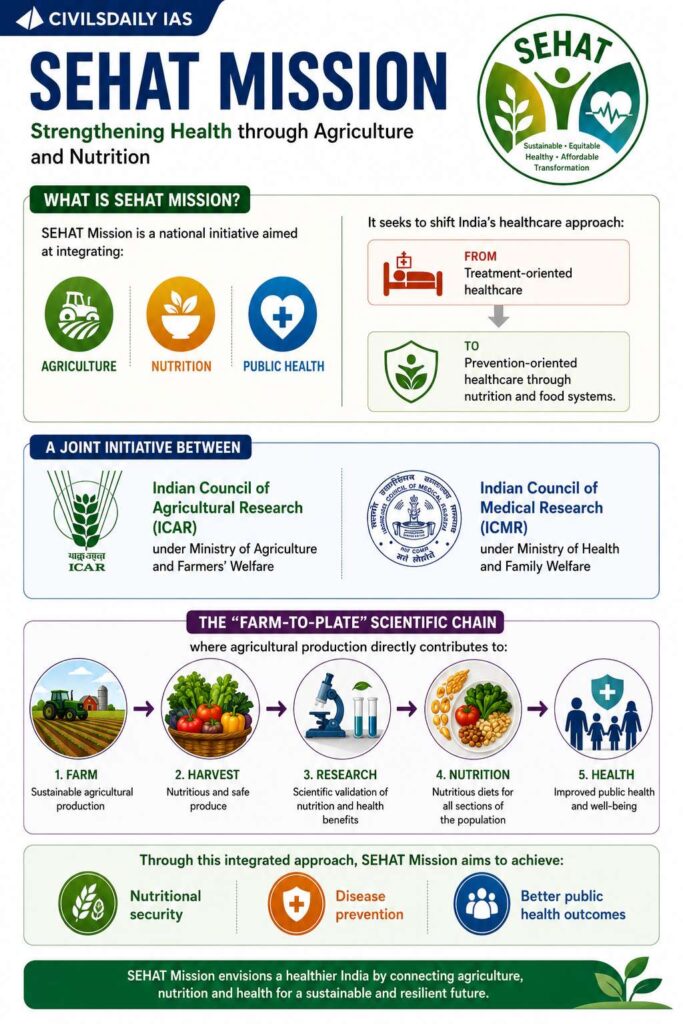
The Union Government launched the SEHAT Mission in New Delhi, marking the first major institutional convergence between India’s agriculture and health sectors to address malnutrition and non-communicable diseases (NCDs).
What is SEHAT Mission?
SEHAT Mission is a national initiative aimed at integrating: Agriculture, Nutrition, and Public Health
It seeks to shift India’s healthcare approach:
From treatment-oriented healthcare
To prevention-oriented healthcare through nutrition and food systems.
The mission is a joint initiative between:
Indian Council of Agricultural Research (ICAR) underMinistry of Agriculture and Farmers’ Welfare
Indian Council of Medical Research (ICMR) under Ministry of Health and Family Welfare
“Farm-to-Plate” scientific chain
where agricultural production directly contributes to:
Nutritional security
Disease prevention
Better public health outcomes
[2023] Consider the following statements: Statement-I: India’s public sector health care system largely focuses on curative care with limited preventive, promotive and rehabilitative care. Statement-II: Under India’s decentralized approach to health care delivery, the States are primarily responsible for organizing health services. Which one of the following is correct in respect of the above statements? [A] Both Statement-I and Statement-l are correct and Statement-II is the correct explanation for Statement-I. [B] Both Statement-I and Statement-II are correct and Statement-is not the correct explanation for Statement-l. [C] Statement-l is correct but Statement-II is incorrect. [D] Statement-I is incorrect but Statement-Il is correct.
PYQ Relevance[UPSC 2013] Discuss the political developments in Maldives in the last two years. Should they be of cause of concern to India?Linkage: The PYQ reflects UPSC’s emphasis on how regional geopolitical developments affect India’s foreign policy and strategic interests. Similarly, India-Vietnam relations must be examined through the lens of regional balancing, maritime security, and Indo-Pacific strategy.
Mentor’s Comment
The state visit of Vietnamese President Tô Lâm to India (May 5-7, 2026) marks an important step in India-Vietnam relations. It shows the growing strength of their Comprehensive Strategic Partnership, established a decade ago. The visit is significant because Vietnam, facing increasing Chinese pressure in the South China Sea, is expanding defence and economic ties with India. At the same time, India is looking for trusted partners in the region to strengthen its Act East Policy and Indo-Pacific strategy.
How has the India-Vietnam strategic partnership evolved into a comprehensive relationship?
India and Vietnam elevated their ties to an Enhanced Comprehensive Strategic Partnership in May 2026, marking 10 years of their previous 2016 partnership. This deepening of relations focuses on intensified defense cooperation, maritime security, trade, digital payments, and critical technology, with a goal of $25 billion in bilateral trade by 2030
Strategic Evolution: India-Vietnam ties have progressed from political goodwill to a Comprehensive Strategic Partnership (CSP) established in 2016, institutionalising defence and security cooperation.
Act East Convergence: Vietnam occupies a central position in India’s Act East Policy, reinforcing India’s diplomatic and economic outreach to Southeast Asia.
Historical Trust: Long-standing diplomatic engagement and political trust have strengthened cooperation in trade, defence, maritime affairs, and capacity-building.
Institutional Mechanisms: Regular high-level exchanges, defence dialogues, naval cooperation, and capacity-building initiatives have deepened bilateral engagement.
Regional Context: China’s increasing assertiveness in the South China Sea has accelerated strategic convergence between India and Vietnam.
Why has defence cooperation emerged as the backbone of India-Vietnam relations?
Defence cooperation constitutes the strongest pillar of bilateral engagement due to shared concerns over maritime security and regional stability.
Lines of Credit: India extended US $225 million in defence credit to Vietnam, facilitating military modernisation.
Naval Cooperation: Maritime engagement includes joint exercises, training assistance, port calls, and maritime cooperation mechanisms.
Cooperation has moved beyond exercises to include joint hydrographic surveys (first conducted in May 2025) and a Mutual Submarine Search and Rescue Agreement.
Defence Capacity Building: India supports training of Vietnamese armed personnel and defence institution-building.
Gifted Assets: India gifted the missile corvette INS Kirpan to Vietnam in 2023.
BrahMos Dimension: Discussions surrounding potential BrahMos supersonic cruise missile exports indicate growing defence trust and a shift in deterrence calculations in the South China Sea.
New Strategic Mechanisms: During the May 2026 visit, both nations agreed to establish a 2+2 Ministerial Dialogue (Foreign and Defence Ministers) to deepen policy coordination.
Strategic Signalling: Defence cooperation strengthens a rules-based maritime order and enhances balancing capacity against coercive regional behaviour.
Logistics & Training: Vietnam signed its first-ever Mutual Logistics Support MoU with India in 2022, facilitating reciprocal access to military bases for replenishment.
How do Indo-Pacific dynamics shape India-Vietnam cooperation?
Shared Strategic Concerns: Both countries support freedom of navigation, maritime security, and peaceful dispute resolution in the Indo-Pacific.
Vietnam formally joined India’s Indo-Pacific Oceans Initiative (IPOI) in 2026. This voluntary initiative focuses on maritime governance, sustainable development, and a rules-based order, directly countering unilateral actions in the South China Sea.
South China Sea Factor: Vietnam faces persistent Chinese assertiveness, creating convergence with India’s emphasis on a stable maritime order.
ASEAN Centrality: Vietnam supports India’s participation in an ASEAN-led regional architecture, ensuring inclusive regional cooperation.To further this, Prime Minister Modi declared 2026 as the ASEAN-India Year of Maritime Cooperation, a move supported by Vietnam to ensure inclusive regional engagement.
Supply Chain Resilience: To reduce dependence on single-country (Chinese) supply chains, the two nations have focused on:
Critical Minerals: An MoU between IREL (India) Ltd. and Vietnam’s ITRRE aims to secure the extraction and processing of rare earth elements essential for high-tech and defence sectors.
Economic Targets: A bilateral trade goal of USD 25 billion by 2030 was established to foster economic stability amid global geopolitical flux.
Minilateral Balancing: India and Vietnam increasingly participate in issue-based strategic partnerships without entering formal military alliances.
Indo-Pacific Oceans Initiative (IPOI)
The “2+2” Ministerial Dialogue (Instituted recently)
Both participate in ASEAN Defence Ministers’ Meeting Plus (ADMM-Plus) and the East Asia Summit (EAS)
Mekong-Ganga Cooperation (MGC): India uses the MGC framework to implement Quick Impact Projects (QIPs) in Vietnam.
Digital Connectivity Blocks: Agreements between NPCI International and NAPAS for cross-border QR code payments create a digital economic corridor
Rules-Based Order: Joint emphasis on international law and UNCLOS principles reflects commitment to legal mechanisms in maritime disputes.
Can economic cooperation become the next pillar of the partnership?
Trade Expansion: Bilateral trade has crossed US $15 billion, with ambitions to reach US $25 billion by 2030, indicating untapped economic potential.
Supply-Chain Diversification: Vietnam offers India an alternative manufacturing and supply-chain partner amid concerns over China-centric production networks.
Digital and Technology Cooperation: Cooperation is expanding in semiconductors, digital economy, artificial intelligence, and payment systems integration.
Manufacturing Synergies: Vietnam’s integration into global value chains complements India’s manufacturing ambitions.
Energy Cooperation: Collaboration in energy security strengthens broader economic engagement.
What role does Vietnam play in India’s Indo-Pacific strategy?
Vietnam is the central pillar of India’s Act East Policy and a critical strategic anchor in the Indo-Pacific region.
Strategic Geography: Vietnam occupies a vital position near the South China Sea, making it strategically important for India’s regional outreach.This is reinforced by India’s support for UNCLOS and freedom of navigation.
Reliable Regional Partner: Vietnam functions as a dependable partner for India in balancing regional uncertainties.
ASEAN Connectivity: Vietnam facilitates India’s engagement with Southeast Asia and broader Indo-Pacific institutions.
Gateway to ASEAN: As a key member of ASEAN, Vietnam serves as a bridge for India to deepen its engagement with the 11-nation bloc.
Vision MAHASAGAR: India officially recognizes Vietnam as a pillar in its Vision MAHASAGAR (Security and Growth for All in the Region).
Mekong-Ganga Cooperation: Vietnam facilitates India’s strategic reach into the Mekong sub-region, driving developmental and economic integration
Security Cooperation: Defence coordination with Vietnam enhances India’s maritime presence and strategic footprint.
Geopolitical Significance: Vietnam’s independent foreign policy and strategic hedging align with India’s preference for multi-alignment.
What structural challenges may constrain deeper India-Vietnam engagement?
Implementation Deficit: Strategic intent requires conversion into operational outcomes in trade, defence industrial cooperation, and connectivity.
Logistical Constraints: Limited transport and connectivity infrastructure impede faster trade integration.
Regulatory Barriers: Legal and procedural bottlenecks restrict rapid expansion of bilateral projects.
Defence Delivery Challenges: Potential transfer of advanced systems such as BrahMos may face diplomatic and logistical complexities.
Conclusion
India-Vietnam relations are transitioning from a conventional diplomatic partnership to a multidimensional strategic relationship. This is shaped by defence cooperation, economic resilience, and Indo-Pacific security concerns. Sustained institutional implementation, stronger trade integration, and deeper defence-industrial collaboration will determine if the partnership evolves into a durable pillar of regional stability and strategic balancing.
The Union Ministry of Environment, Forest and Climate Change has notified the Solid Waste Management (SWM) Rules, 2026, superseding the Solid Waste Management Rules, 2016. The rules have been notified under the Environment (Protection) Act, 1986.
What are the major changes introduced under the SWM Rules, 2026?
Mandatory Waste Segregation: Makes 4-way segregation at source compulsory, wet waste, dry waste, sanitary waste, and special-care waste.
‘Polluter Pays’ Principle: Allows environmental compensation/penalties for non-compliance, false reporting, forged documents, or poor waste management practices.
Extended Responsibility for Bulk Generators: Introduces Extended Bulk Waste Generator Responsibility (EBWGR); entities generating 100 kg/day waste, 20,000 sq. m area, or 40,000 litres/day water use must process waste responsibly.
Scientific Waste Processing: Promotes composting, bio-methanation, recycling through Material Recovery Facilities (MRFs), and waste-to-energy systems.
Centralised Online Portal: Enables end-to-end digital tracking of waste generation, collection, transport, processing, landfill audits, and legacy waste remediation.
Restrictions on Landfills: Limits landfilling to non-recyclable, inert, and non-energy recoverable waste, while discouraging unsegregated dumping through higher landfill fees.
Legacy Waste Remediation: Mandates mapping, biomining, and bioremediation of old dumpsites with time-bound implementation.
Mandatory Use of RDF: Requires industries, including cement plants, to gradually increase Refuse Derived Fuel (RDF) use from 5% to 15% over six years.
Special Rules for Hilly Areas & Islands: Enables tourist user fees, decentralised wet waste processing by hotels/restaurants, and waste regulation based on local carrying capacity.
Institutional Oversight: Creates Central and State-level Committees, with Chief Secretaries-led State Committees for implementation monitoring.
Why has India’s waste crisis become a major governance challenge?
Urban Waste Burden: Indian cities face plastic-clogged drains, worsening monsoon flooding and sanitation stress.
Landfill Hazard: Landfills increasingly generate methane, fire incidents, and leachate contamination, creating ecological and health risks.
Air Pollution:Open burning of waste contributes to deteriorating urban air quality.
Rural Waste Expansion: Rural areas increasingly face plastic waste, sanitary waste, pesticide containers, e-waste, and packaged consumption debris.
Ecological Emergency: Waste has evolved from a local nuisance to a national environmental problem, requiring systemic intervention.
How do the Solid Waste Management Rules, 2026 differ from the 2016 framework?
The Solid Waste Management (SWM) Rules, 2026, supersede the 2016 framework, shifting India from a “collect-and-dump” model to a structured circular economy focused on resource recovery. While the 2016 rules laid the foundation, the 2026 update introduces stricter enforcement, digital tracking, and expanded responsibilities.
Dimension
SWM Rules, 2016
SWM Rules, 2026
Waste segregation
Mandated 3-stream segregation: bio-degradable, non-biodegradable, and domestic hazardous waste.
Introduces mandatory 4-stream segregation: wet waste, dry waste, sanitary waste, and special-care waste, enabling more scientific processing and recycling.
Accountability & Enforcement
Limited practical enforcement and weak penalty mechanisms.
Introduces Environmental Compensation under the ‘Polluter Pays’ Principle’, with penalties for improper segregation, false reporting, forged documents, and non-compliance.
Bulk Waste Generators (BWGs)
Broad responsibility framework without clear operational thresholds.
Defines BWGs through quantified thresholds(≥100 kg/day waste generation, ≥20,000 sq. m built-up area, or ≥40,000 litres/day water use) and introduces Extended Bulk Waste Generator Responsibility (EBWGR) for on-site processing or certification.
Monitoring Mechanism
Relied largely on manual and fragmented reporting systems.
Establishes a centralised online portal for end-to-end tracking of waste generation, collection, transport, processing, disposal, audits, and legacy waste remediation.
Industrial Waste Use (RDF)
Limited emphasis on industrial fuel substitution.
Mandates gradual adoption of Refuse Derived Fuel (RDF) in industries such as cement plants, increasing substitution from 5% to 15% over six years.
Legacy Waste Dumpsites
Recognised legacy waste but lacked strict timelines.
Mandates time-bound biomining and bioremediation of legacy dumpsites, with quarterly progress reporting through the digital portal.
Does the 2026 framework undermine federalism and subsidiarity?
Constitutional Basis: The Rules derive authority from the Environment (Protection) Act, 1986, enacted under Article 253, allowing Parliament to implement international obligations such as the 1972 Stockholm Declaration.
Federal Concern: Subjects such as land, sanitation, public health, agriculture, and local governance largely fall within State or local domains.
National Floor Principle: A minimum national standard should not become a uniform operational blueprint for all States.
Subsidiarity Principle: Governance should function at the lowest competent level, moving upward only when capacity is absent.
Administrative Overreach: The Rules assume central competence and local incapacity, reducing States to implementing agencies.
Hayekian Insight: Nobel Laureate F.A. Hayek highlighted that effective decisions depend on local and contextual knowledge, not distant administrative command.
Why may a uniform waste management model fail across India?
Geographical Diversity: Waste systems suitable for resource-rich metros like Mumbai may fail in Himalayan pilgrimage towns, fragile slopes, coastal panchayats, tribal settlements, and low-density villages.
Rural Institutional Deficit: Rural local bodies often lack sanitation engineers, waste collection systems, digital capacity, and fiscal resources.
MRF Expansion Challenge: Extending Material Recovery Facilities (MRFs) to every panchayat risks creating an administratively unsustainable model.
Compliance Burden: Excessive reporting requirements may shift focus from service delivery to paperwork.
Megacity Exception: Cities like Delhi, Mumbai, Bengaluru, Kolkata, Chennai may require metropolitan-level integrated waste authorities.
How does centralised digital governance create implementation concerns?
Portal-Centric Governance: The Rules require Central Pollution Control Board (CPCB)-linked data uploads, audits, and central reporting modules.
Dashboard Governance: Officials risk spending excessive time on compliance reporting rather than actual waste management outcomes.
Blurring Accountability: Excessive centralisation may weaken local ownership and citizen accountability.
Data Federalism: States should possess shared digital platforms with flexibility to customise indicators and dashboards.
Capacity Building: Data systems should strengthen sub-national governance capacity, not merely discipline compliance.
Why is democratic participation central to effective waste management?
Citizen Engagement: Waste segregation depends on household participation, awareness, and behavioural change.
Community Institutions:Ward committees, municipal councils, self-help groups, and resident bodies strengthen compliance.
Local Reporting: Periodic waste reports should be placed before municipal councils and ward committees, not only central portals.
By treating waste as a local resource rather than a national liability, an alternative framework shifts the focus from “disposal” to “decentralised circularity.”
The Proposed “Polycentric Circularity” Model
Component
Strategic Implementation
Differentiated Governance
Megacities use tech-heavy AI-monitored collection, while Rural Panchayats use “Zero-Waste Village” models focusing on 100% on-site composting.
State-Led Innovation
States could compete on “Resource Recovery Indexes.” For example, a coastal state might pilot ocean-plastic specific rules that wouldn’t apply to a landlocked state.
Micro-Entrepreneurship
Integrating Women’s Cooperatives (like the Swachh model in Pune) turns waste into a livelihood. SHGs manage ward-level dry waste collection centers, reducing transport costs.
Cluster-Based Sharing
Towns within a 30-40km radius share a single high-tech Material Recovery Facility (MRF) or Bio-methanation plant, making advanced technology financially viable for small municipalities.
Minimum Standards: The Centre should establish minimum national environmental norms.
State Flexibility: States should receive autonomy to design context-sensitive waste systems.
Differentiated Governance:Metropolitan authorities may govern megacities, while simplified systems may suit rural regions.
Cluster-Based Facilities: Small towns can adopt shared regional waste infrastructure.
Women’s Cooperatives: Waste management can integrate self-help groups and community-based models.
Evidence-Based Review: A national body may periodically evaluate outcomes and revise standards based on evidence.
Laboratory of Democracy:Justice Louis Brandeis’ idea (New State Ice Co. v. Liebmann, 1932) theorises that States function as “laboratories of democracy”, enabling policy experimentation.
Conclusion
India’s waste crisis requires a federal, differentiated, and participatory governance model rather than a uniform compliance architecture. The Solid Waste Management Rules, 2026 can strengthen environmental outcomes. But this can be done only if they balance minimum national standards with State flexibility, local accountability, fiscal support, and citizen participation. Effective waste management depends not merely on regulation, but on institutional design aligned with India’s diversity.
PYQ Relevance
[UPSC 2018] What are the impediments in disposing the huge quantities of discarded solid wastes which are continuously being generated? How do we remove safely the toxic wastes that have been accumulating in our habitable environment?
Linkage: The PYQ directly connects with the article’s focus on scientific waste management, segregation, landfill reduction, and safe disposal of hazardous/special-care waste under the SWM Rules, 2026. It also reflects UPSC’s emphasis on environmental governance, waste-processing mechanisms, and mitigation measures for pollution.
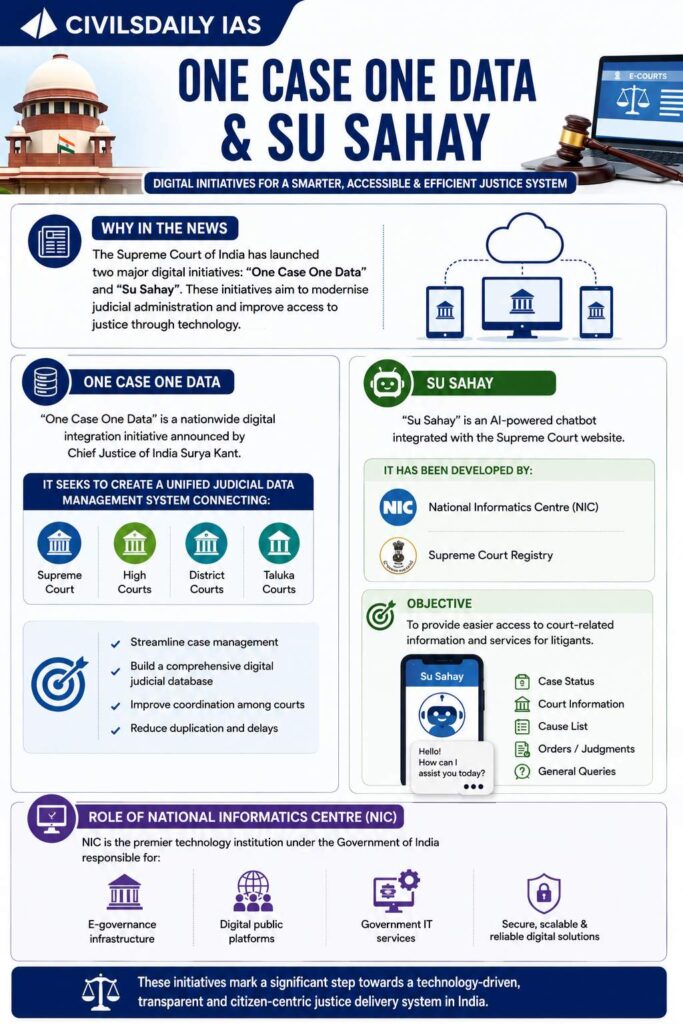
The Supreme Court of India has launched two major digital initiatives: “One Case One Data” and “Su Sahay”. These initiatives aim to modernise judicial administration and improve access to justice through technology.
One Case One Data
“One Case One Data” is a nationwide digital integration initiative announced by Chief Justice of India Surya Kant.
It seeks to create a unified judicial data management system connecting:
Supreme Court
High Courts
District Courts
Taluka Courts
Objective
Streamline case management
Build a comprehensive digital judicial database
Improve coordination among courts
Reduce duplication and delays
Su Sahay
“Su Sahay” is an AI-powered chatbot integrated with the Supreme Court website.
It has been developed by:
National Informatics Centre (NIC)
Supreme Court Registry
Objective: To provide easier access to court-related information and services for litigants.
Role of National Informatics Centre (NIC)
NIC is the premier technology institution under the Government of India responsible for:
E-governance infrastructure
Digital public platforms
Government IT services
[2022] Consider the following: 1. Aarogya Setu 2. CoWIN 3. DigiLocker 4. DIKSHA Which of the above are built on top of open-source digital platforms? (a) 1 and 2 only (b) 2, 3 and 4 only (c) 1, 3 and 4 only (d) 1, 2, 3 and 4
PYQ Relevance[UPSC 2020] What is the significance of Indo-US defence deals over Indo-Russian defence deals? Discuss with reference to stability in the Indo-Pacific region.Linkage: The PYQ examines India’s evolving strategic and defence partnerships in the Indo-Pacific and the shift toward technology-driven defence cooperation. KIND-X similarly reflects India’s move from traditional procurement to co-development, co-production, and defence innovation partnerships with South Korea.
Mentor’s Comment
India and South Korea launched the Korea-India Defence Accelerator (KIND-X) during the India-South Korea Summit on April 20, 2026. It marks a shift from conventional defence procurement to innovation-led cooperation. For the first time, both countries are institutionalising collaboration among start-ups, universities, investors, and defence firms for co-development and co-production of advanced technologies. The initiative also aligns India’s defence modernisation goals with South Korea’s Defence Innovation 4.0 strategy and may create an India-South Korea defence innovation corridor.
How has India-South Korea defence cooperation evolved over time?
Diplomatic Relations (1973): Established formal bilateral relations, creating the basis for defence and strategic engagement.
Defence Industry Agreement (2005): Signed a MoU on Defence Industry and Logistics, expanding cooperation in procurement, production, research, and development.
Research Collaboration (2010): Concluded separate memoranda on defence cooperation and defence R&D, strengthening institutional engagement.
Technology Partnerships: Expanded cooperation in maritime systems, electronics, and intelligent systems through links between India’s DRDO and South Korean defence firms.
Strategic Upgrade (2015): Elevated ties to a Special Strategic Partnership, widening defence and security cooperation.
Roadmap for Cooperation (2020): Introduced the 2020 Roadmap for Defence Industries Cooperation, covering land, naval, aero, and guided weapon systems, alongside investments and technology transfer.
Industrial Success: Enabled the K9 Vajra-T self-propelled artillery system, manufactured by L&T and Hanwha Aerospace, under the Make in India initiative, resulting in follow-on production contracts.
Why does KIND-X represent a major shift in bilateral defence relations?
Innovation Ecosystem: Connects businesses, innovators, investors, defence start-ups, and universities, shifting cooperation from procurement to joint innovation.
Institutionalisation: Creates a structured bilateral platform similar to INDUS-X (India-U.S.) and FRIND-X (France-India) defence innovation frameworks.
Co-development Model: Enables joint defence R&D, co-production, and technology development, rather than import-dependent defence relations.
Strategic Alignment: Aligns with India’s 2020 Defence Industries Roadmap and South Korea’s Defence Acquisition Program Administration (DAPA) and Defence Innovation 4.0 strategy.
Start-up Integration: Expands defence participation beyond large firms to include MSMEs, start-ups, incubators, and think tanks.
What opportunities can KIND-X unlock for both countries?
Joint Innovation Fund: Facilitates joint grants by India’s DIO/DAPA for start-ups developing defence technologies.
Testing Infrastructure: Ensures access to universities, laboratories, and testing facilities in both countries.
Standardisation: Supports joint certification and standardisation mechanisms, improving defence interoperability.
Technology Transfer: Facilitates licensing arrangements and intellectual property collaboration for co-production.
Investment Linkages: Connects innovators with venture capital and defence investors, strengthening defence start-up ecosystems.
Knowledge Exchange: Supports annual summits, accelerator programmes, incubators, and workshops to navigate export controls and defence funding mechanisms.
Track 1.5 Dialogue: Strengthens policy coordination among government, academia, industry, and think tanks.
How can KIND-X strengthen India’s defence industrial ecosystem?
Co-production: Supports joint manufacturing ventures, using successful templates such as K9 Vajra-T howitzers.
Industrial Corridors: Connects South Korean innovation clusters in Changwon, Daejeon, and Gumi with Indian defence corridors in Tamil Nadu and Uttar Pradesh, and aerospace hubs in Bengaluru, Chennai, and Hyderabad.
Private Sector Participation: Deepens engagement of firms such as Hyundai, L&T, Tata Advanced Systems Limited, Mahindra, Bharat Forge, Hanwha, LIG, and Kangnam.
Indigenisation: Strengthens India’s objective of reducing import dependence under Aatmanirbhar Bharat.
Export Capacity: Enhances defence exports through joint production and access to regional markets.
Which strategic sectors are likely to benefit from KIND-X?
Artificial Intelligence: Supports military AI platforms for decision-making and autonomous systems.
Autonomous Weapons: Facilitates development of robotics and unmanned defence systems.
Space-Based Intelligence: Expands collaboration in satellite surveillance, ISR (Intelligence, Surveillance and Reconnaissance), and Space Situational Awareness (SSA).
Critical Minerals: Enhances supply-chain security for strategic manufacturing.
Navigation and Communication: Supports advanced defence communication systems and secure navigation technologies.
What challenges may limit the success of KIND-X?
Funding Constraints: Requires sustained financing for start-ups and joint defence projects.
Technology Sensitivities: Faces barriers due to IP rights, export controls, and licensing restrictions.
Institutional Coordination: Requires effective coordination among ministries, private firms, universities, and regulators.
Execution Deficit: Success depends on tangible deliverables, measurable timelines, and project continuity.
Geopolitical Risks: Regional strategic tensions in the Indo-Pacific may affect technology-sharing priorities.
How does KIND-X fit into India’s broader strategic objectives?
Aatmanirbhar Bharat: Strengthens indigenous defence manufacturing and technology absorption.
Indo-Pacific Strategy: Diversifies strategic partnerships beyond traditional defence partners.
Defence Modernisation: Accelerates adoption of emerging military technologies.
Export Promotion: Supports India’s ambition of becoming a defence manufacturing and export hub.
Conclusion
KIND-X marks a new phase in India-South Korea defence ties by shifting focus from procurement to joint innovation and co-development. Effective implementation can strengthen defence indigenisation, technological capacity, and strategic resilience. Sustained funding, institutional coordination, and technology-sharing mechanisms will determine its long-term success.
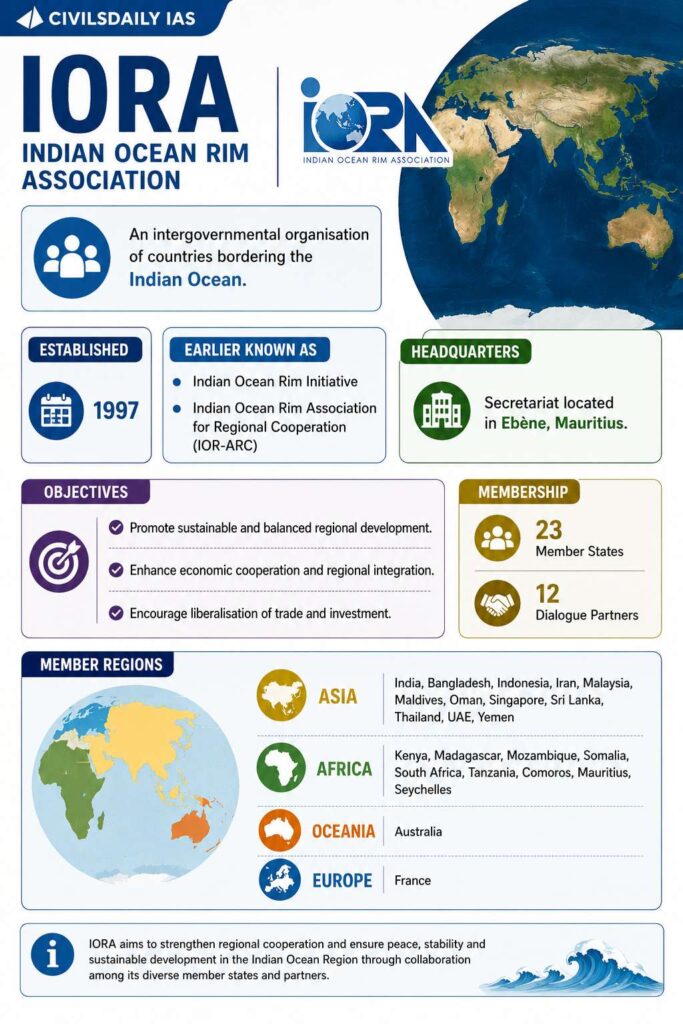
The 10th Indian Ocean Dialogue (IOD) of the 23-member Indian Ocean Rim Association (IORA) was held in New Delhi on May 7-8, 2026, under the theme “Indian Ocean Region in a Transforming World.” India, as IORA Chair (2025-27), prioritised maritime security, blue economy, and innovation under its MAHASAGAR vision. The dialogue gains significance amid rising instability in West Asia and disruptions in key sea routes, bringing maritime security to the forefront of regional economic and strategic concerns.
Key Facts about IORA
Establishment: Formed in 1997.
Members: Includes India, Australia, Bangladesh, Indonesia, Kenya, France, UAE, South Africa, Sri Lanka, and others.
Chair: India currently chairs the grouping.
30th Anniversary Summit: Expected in 2027.
What is the significance of the Indian Ocean Rim Association (IORA)?
Regional Cooperation: Strengthens collaboration among 23 member states across the Indian Ocean littoral.
Security Coordination: Facilitates dialogue on maritime safety, disaster response, and blue economy.
Economic Integration: Supports trade, fisheries, tourism, and investment partnerships.
Diplomatic Platform: Provides India a regional forum distinct from SAARC, BIMSTEC, and QUAD.
Strategic Relevance: Enhances India’s role as a net security provider in the Indian Ocean.
What are the major areas of cooperation under IORA?
Maritime Safety: Strengthens regional response against piracy, trafficking, and maritime crime.
Trade and Investment: Facilitates economic connectivity and regional commerce.
Blue Economy: Supports sustainable fisheries, marine resources, and ocean-based economic activities.
Disaster Risk Management: Enhances preparedness against cyclones, tsunamis, and coastal disasters.
Tourism and Cultural Exchange: Encourages people-to-people linkages and regional cooperation.
Institutional Weakness: Lacks enforcement mechanisms compared to stronger regional organisations.
Geopolitical Rivalries: Competing interests among regional powers limit consensus.
Limited Security Role: Functions primarily as a consultative platform rather than a defence grouping.
Unequal Priorities: Member states possess different economic and security concerns.
Fragmented Regionalism: Overlap with organisations such as BIMSTEC, ASEAN, QUAD, and IONS reduces cohesion.
Why has maritime security become a critical concern in the Indian Ocean Region?
Energy Security: Ensures uninterrupted supply of crude oil and LNG imports. India imports nearly 85% of its crude oil, much of which transits through the Indian Ocean.
The region facilitates the transit of roughly 25% of global maritime oil trade.
Trade Dependence: Facilitates movement of global commerce. Nearly 95% of India’s trade by volume and 68% by value moves through maritime routes.
Strategic Chokepoints: Increases vulnerability due to disruptions near the Strait of Hormuz, Bab-el-Mandeb, and Malacca Strait, affecting shipping and insurance costs.
Regional Livelihoods: Supports fisheries and coastal economies. Prolonged conflict affects fishermen’s livelihoods and food security.
Inflationary Pressures: Raises fuel and logistics costs. Shipping disruptions increase prices of fertilizers, fuel, and food commodities.
How has the West Asian conflict altered the maritime security architecture of the IOR?
Red Sea Disruptions: Intensifies risks to global shipping due to attacks on vessels in strategic maritime routes.
Operational Shifts: Major carriers like Maersk initially diverted most traffic around Africa’s Cape of Good Hope, a move that added 3,500 nautical miles and 10-14 days to transit.
Spillover Events: In a striking expansion of the conflict, the U.S. sank the Iranian frigate IRIS Dena near Sri Lanka in March 2026, proving that “distance is no shield” from West Asian tensions.
Hormuz Vulnerability: Creates uncertainty over oil transportation. Any blockade affects global energy markets.
Supply Impact: The closure disrupted 20% of global oil supplies and nearly all international commercial shipping through the strait starting February 28, 2026.
Price Volatility: Brent crude surged 10-13% to over $80-$82 per barrel within days. Analysts at J.P. Morgan and the IMF warning of potential $100 peaks and significant global inflation risks.
Insurance Surge: War-risk premiums for the Strait of Hormuz jumped from 0.2% to as high as 3% of a vessel’s value. For a large oil tanker, this adds tens of crores in cost for a single trip.
Freight Rates: By April 2026, freight rates on Asia-Europe lanes remained 25-40% higher than pre-crisis levels.
Supply Chain Risks: Disrupts movement of fertilizers and agricultural inputs, reducing agricultural productivity.
Fertilizer Crisis: The Strait of Hormuz handles one-third of global seaborne fertilizer trade. Disruptions in 2026 have constricted trade in these inputs, directly threatening food security for IOR nations.
Capacity Squeeze: The diversion around Africa has absorbed 5-7% of global container fleet capacity, creating a global equipment shortage that affects even routes not passing through the conflict zone.
New Security Doctrine: In response, India unveiled its Indian Navy Maritime Security Strategy 2026 (INMSS-2026), moving from a defensive posture to a proactive one focused on safeguarding undersea infrastructure and countering hybrid maritime threats.
How does maritime security align with India’s strategic vision?
SAGAR Doctrine (Security and Growth for All in the Region): Strengthens maritime cooperation and regional stability.
Indo-Pacific Vision: Expands India’s strategic engagement beyond South Asia.
MAHASAGAR Policy: Enhances India’s maritime diplomacy and regional integration.
Act East Policy: Strengthens eastern maritime connectivity.
Defence Partnerships: Expands naval exercises such as MILAN and bilateral maritime cooperation.
What measures are required to strengthen maritime security in the IOR?
Maritime Domain Awareness: Expands satellite surveillance and information-sharing mechanisms.
Naval Cooperation: Enhances coordinated patrols and joint exercises.
Economic Resilience: Diversifies supply chains and shipping routes.
Institutional Strengthening: Expands operational mandate of IORA.
Blue Economy Governance: Ensures sustainable use of marine resources.
Conclusion
Maritime security in the Indian Ocean Region has evolved from a naval concern into a multidimensional economic and geopolitical issue. Regional instability, strategic chokepoints, and supply chain disruptions underline the need for stronger maritime cooperation. India’s leadership in IORA, coupled with its SAGAR vision, positions it as a key stakeholder in ensuring a secure, stable, and inclusive Indian Ocean order.
PYQ Relevance
[UPSC 2022] What are the maritime security challenges in India? Discuss the organisational, technical and procedural initiatives taken to improve maritime security
Linkage: This PYQ directly overlaps with the article’s core theme of maritime security in the Indian Ocean Region (IOR), including threats from geopolitical conflicts, chokepoints, and regional cooperation. It also links to India’s maritime initiatives such as SAGAR, IORA, maritime domain awareness, and naval coordination, which are central to the article.