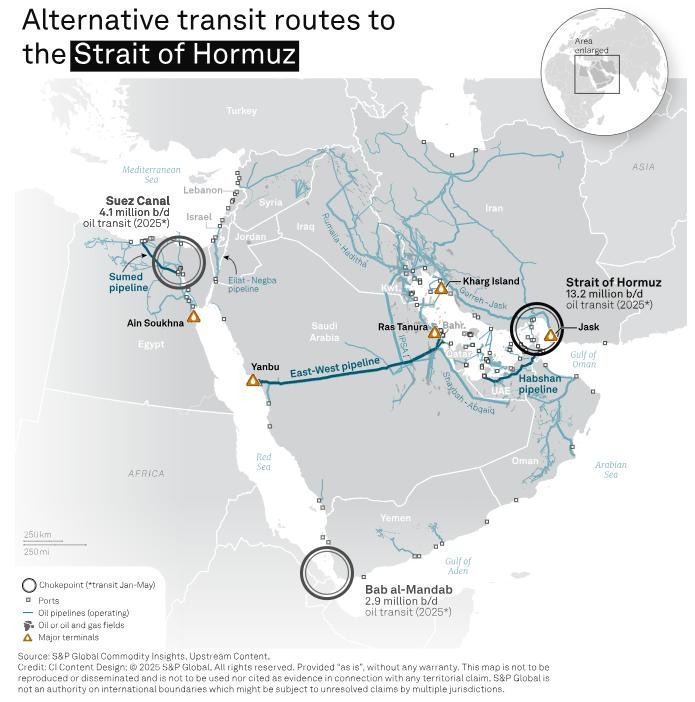
The ongoing West Asia conflict has exposed the vulnerability of the Strait of Hormuz, prompting Gulf countries to build alternative energy routes.
Strait of Hormuz
Located between: Iran and Oman
Connects: Persian Gulf to Arabian Sea
Handles: About 20% of global oil and LNG trade
What Happened
Conflict led to: Severe disruption of shipping
Demonstrated: Iran’s ability to block the chokepoint
Triggered: Global energy concerns
Why It Matters
1. Global Energy Security
Disruption affects: Oil supply and LNG supply
Leads to: Price spikes
2. Strategic Vulnerability
Overdependence on a single chokepoint
Risk to global supply chains
Gulf Countries’ Response
1. Pipeline Expansion
Aim: Bypass Hormuz
Reduce maritime dependence
2. Port Diversification
Increase exports via the Red Sea, Gulf of Oman, and Mediterranean routes
3. Regional Cooperation
Even rival countries: Collaborating for energy security
Key Pipelines (Important)
Operational
Saudi East–West Pipeline: From Persian Gulf to Red Sea (Yanbu)
Abu Dhabi Crude Oil Pipeline (ADCOP): From Habshan to Fujairah (bypasses Hormuz)
Potential / Revival Projects
Iraq–Turkey Pipeline (Kirkuk–Ceyhan)
Basra–Aqaba Pipeline (Iraq–Jordan)
Iraqi Pipeline through Saudi Arabia (IPSA)
Trans-Arabian Pipeline
[2024] Consider the following statements: Statement-I Sumed pipeline is a strategic route for Persian Gulf oil and Natural gas shipments to Europe. Statement-II: Sumed pipeline connects the Red Sea with the Mediterranean Sea. Which one of the following is correct in respect of the above statements? [A] Both Statement-I and Statement-II are correct and Statement-II explains Statement-I [B] Both Statement-I and Statement-II are correct, but Statement-II does not explain Statement-I [C] Statement-I is correct, but Statement-II is incorrect [D] Statement-I is incorrect, but Statement-II is correct [2018] Consider the following pairs : Towns sometimes mentioned in news Country 1. Aleppo: Syria 2. Kirkuk: Yemen 3. Mosul: Palestine 4. Mazar-i-sharif: Afghanistan Which of the pairs given above are correctly matched? [A] 1 and 2 [B] 1 and 4 [C] 2 and3 [D] 3 and 4
PYQ Relevance[UPSC 2023] “Development and welfare schemes for the vulnerable, by its nature, are discriminatory in approach.” Do you agree? Give reasons for your answer. Linkage: The PYQ targets GS-2 (Social Justice) and tests understanding of welfare vs development, equity vs equality, and policy design for vulnerable groups. It links directly to Capability Approach, justifies “discrimination” as equity-driven targeting to expand real freedoms and reduce capability deprivation.
Mentor’s Comment
There is rising competitive populism across Indian states, where free electricity, loan waivers, and cash transfers are increasingly shaping electoral outcomes. This marks a sharp shift from earlier development-led narratives focused on infrastructure and growth. The concern is significant because such policies risk straining public finances while failing to build long-term economic capacity. The debate is critical as India aims for sustained high growth while managing inequality and welfare demands.
What is Welfare and Development with respect to political landscape in India?
Welfare in the Political Landscape: Welfare involves state intervention to ensure the economic and social well-being of citizens, particularly the vulnerable. It is about redistribution and social security.
Scholarly Definition: A welfare state is a government that takes “key role in the protection and promotion of economic and social well-being of its citizens,” based on “equality of opportunity” and “equitable distribution of wealth“. According to T.H. Marshall (1950), it is a synthesis of democracy, welfare, and capitalism.
Indian Context & Examples:
Food Security: The Targeted Public Distribution System (TPDS) and the National Food Security Act, 2013, supply subsidized food grains to low-income families.
Employment Guarantee: The MGNREGA provides a legal right to 100 days of wage employment in rural areas.
Health Security: Free or subsidized health insurance programs (like the Ayushman Bharat scheme).
Social Safety Net: Old age pensions and subsidies for cooking fuel (Ujjwala Yojana).
Development in the Political Landscape
Development denotes a broader, long-term process of structural transformation involving sustained economic growth, improved productivity, and expanded human capabilities.
Scholarly Definition: Development is “the process of growth, or changing from one condition to another,” which aims to “improve the quality of life” through infrastructure, education, and modern technologies. It is a process that “expands human capabilities and freedoms,” shifting the focus from just GDP growth to human-centric improvements.
Indian Context & Examples:
Infrastructure: The construction of national highways, metro rail networks in cities, and rural road connectivity.
Financial Inclusion & Technology: The implementation of Aadhaar and the JAN-DHAN accounts to facilitate direct benefit transfers.
Digital Transformation: Schemes promoting internet connectivity in villages and digitalization of government services.
Education: The National Education Policy (NEP) 2020 aiming for universal access and improved learning outcomes.
Why is there a conceptual confusion between welfare and development?
Conceptual confusion between welfare and development persists because, while they differ fundamentally in purpose and time horizon, they are often conflated in political, academic, and practical settings, especially in democratic contexts.
Political Conflation (Populism vs. Growth): Political actors often blur the distinction to achieve immediate electoral gains.
Narrative Shift: “Development” is frequently used as a slogan to signal structural growth, but it is often replaced in practice by welfare schemes that offer immediate, tangible benefits to voters.
Patron-Client Politics: Welfare schemes (e.g., cash transfers, subsidies) are often designed as “freebies” that create a patron-client relationship, where voters view the government as a benefactor rather than an agent of structural transformation.
Thin Line Between Freebies and Growth: Political campaigns, particularly in India (e.g., in Andhra Pradesh or West Bengal), often promise high-end infrastructure (development) alongside extensive subsidies (welfare), treating them as the same goal
Overlap in Practice: In policy implementation, the boundaries between the two are frequently blurred.
Simultaneous Implementation: Governments often run large-scale social protection programs alongside aggressive infrastructure development, making them difficult for the public to differentiate.
Developmental Welfare: Certain welfare schemes can serve a development purpose. For instance, nutrition support (welfare) or job guarantees (MGNREGA) can build human capital or community assets (development), making it hard to classify them strictly as one or the other.
The “Dependent” Trap: When welfare focuses purely on consumption (handouts) rather than capacity building, it can lead to “dependency,” where beneficiaries lack the motivation or skills to become independent, thus hindering long-term development.
Time Horizon Difference: Welfare operates in short-term consumption space, while development unfolds over decades through structural change.
Short-Term vs. Long-Term: Welfare operates in the immediate consumption space (e.g., food security, basic income), aiming to alleviate immediate poverty. Development unfolds over decades through structural change, increased productivity, and enhanced human capabilities.
Consumption vs. Production: Welfare is often about distributing existing resources (redistribution), while development focuses on expanding the total “economic pie” through investment and infrastructure.
In summary, the confusion arises when populist, short-term welfare promises are packaged and marketed as long-term development strategies. This creates a scenario where immediate social protection is mistaken for structural economic transformation.
How do welfare and development differ in objectives and outcomes?
Welfare Orientation: Ensures immediate relief through redistribution; includes food security, income support, and access to basic services.
Development Orientation: Ensures sustained economic growth, productivity, and institutional strengthening over time.
Capability Enhancement: Welfare reduces vulnerability; development expands human capabilities (education, health, skills).
Why can excessive welfare distort development outcomes?
Fiscal Constraints: Expands subsidy burden, limiting capital expenditure on infrastructure and public goods.
In India, several states have seen their fiscal space shrink, with committed expenditures (salaries, pensions, interest, and subsidies) consuming over 80% of revenue receipts, leaving very little for developmental capital spending. In 2021-22, Punjab spent over 25% of its revenue expenditure on explicit subsidies
Crowding Out Effect: Reduces investment in productive sectors due to excessive redistribution.
Example: If the government heavily funds food or energy subsidies (e.g., agricultural electricity subsidies), it crowds out private investment in more efficient, technology-driven sectors.
Incentive Distortion: Weakens work incentives and productivity if poorly designed.
Example: The PM-Kisan scheme in India costs over ₹63,500 crore annually. Critics argue it acts as a “sop” that keeps people in low-productivity subsistence farming rather than encouraging the structural transformation of labor towards higher-productivity urban sectors
Leakages and Exclusion: Poor targeting leads to inefficiencies and reduced impact.
Example: Studies on Public Distribution Systems (PDS) in India have historically shown significant leakages (sometimes up to 30% or more), where subsidized grains intended for the poor are diverted to the open market. Similarly, free electricity often disproportionately benefits wealthier farmers who have land and pump sets, rather than landless laborers.
Why is development inherently a long-term structural process?
Incremental Transformation: Involves gradual changes in economic structures, governance, and institutions.
Institutional Capacity: Strengthens rules, norms, and administrative systems over time.
Human Capital Formation: Requires sustained investments in education, health, and technology adoption.
Capability Approach: Expands freedoms and opportunities, as emphasized in development theory.
Capability ApproachDefinition: Defines development as expansion of human freedoms and choices, not just income growth.Focus: Prioritises capabilities (real opportunities) over mere resources.Key Concepts:Capabilities vs Functionings:Capabilities: Potential opportunities (e.g., ability to be educated)Functionings: Achieved outcomes (e.g., being educated)Beyond GDP: Measures development through quality of life and choices, not just economic output.Conversion Factors: Recognises variation in how individuals convert resources into outcomes due to social, personal, environmental factorsCore Pillars:Human Agency: Individuals as active agents, not passive beneficiariesEquity: Equal access to opportunitiesFreedom Expansion: Removal of constraints (poverty, ill-health, exclusion)
What are the dangers of welfare populism?
Short-Termism: Prioritises electoral gains over economic capacity building.
Fiscal Stress: Leads to unsustainable public debt and deficits.
Consumption Bias: Encourages immediate consumption instead of productive investment.
Substitution Effect: Replaces development policies with populist transfers rather than complementing them.
Can welfare and development be complementary?
Well-Designed Welfare: Enhances human capital; e.g., nutrition, employment guarantees.
Capability Enhancement: Supports productivity by reducing vulnerability.
Inclusive Growth: Ensures that growth benefits are widely shared.
Policy Integration: Aligns welfare schemes with long-term development goals.
Conclusion
The policy challenge lies not in choosing between welfare and development but in designing a coherent framework where welfare complements structural transformation. Sustainable development requires balancing immediate relief with long-term capacity creation.
CSR spending by listed companies rose by 23% in FY25, reaching about ₹22,212 crore, driven by strong profit growth.
What is CSR
Corporate Social Responsibility refers to:
Companies investing in social, environmental, and developmental activities
Mandated under:
Companies Act, 2013 (effective April 2014)
CSR Legal Framework
Mandatory Requirement
Eligible companies must spend: At least 2% of average net profits (last 3 years)
Applicability Criteria
Applies to companies with:
Net worth ≥ ₹500 crore
Turnover ≥ ₹1,000 crore
Net profit ≥ ₹5 crore
Key Trends (FY25)
CSR spending: ₹22,212 crore (up 23%)
Companies spending CSR: 98% compliance
Increase due to: Higher corporate profits
Sector-wise Allocation
Highest spending: Education
Second: Healthcare
Low spending:
Slum development
Disaster management
Armed forces welfare
[2024] With reference to Corporate Social Responsibility (CSR) rules in India, consider the following statements: 1. CSR rules specify that expenditures that benefit the company directly or its employees will not be considered as CSR activities. 2. CSR rules do not specify minimum spending on CSR activities. Which of the statements given above is/are correct? [A] 1 only [B] 2 only [C] Both 1 and 2 [D] Neither 1 nor 2
India extended OCI card eligibility to the 6th generation of the Indian-origin community in Sri Lanka.
Announced during the visit of C. P. Radhakrishnan.
What is OCI (Overseas Citizen of India)
A form of long-term visa status for persons of Indian origin
Not full citizenship, but provides:
Multiple-entry lifelong visa
Exemption from police reporting
Parity with NRIs in certain fields
Key Update
Earlier eligibility: Up to 4th generation
Now extended to: 5th and 6th generation (Sri Lanka specific)
Based on documents issued by Sri Lankan authorities
How “Generation” is counted
It is counted family-wise (lineage):
1st generation → Person born in India (original ancestor)
2nd generation → Child of that person
3rd generation → Grandchild
4th generation → Great-grandchild
5th generation → Next generation after that
6th generation → Further descendant
Significance
1. Diaspora Outreach
Benefits: Indian-origin Tamil community (~7% of Sri Lanka population)
Strengthens cultural and historical ties
2. India–Sri Lanka Relations
Reinforces: Neighbourhood First Policy
Builds goodwill and trust
3. Strategic Diplomacy
India positioning as: First responder in region
Seen in: 2022 Sri Lankan economic crisis support
[2021] With reference to India, consider the following statements: 1. There is only one citizenship and one domicile. 2. A Citizen by birth only can become the Head of State. 3. A foreigner once granted the citizenship cannot be deprived of it under any circumstance. Which of the statements given above is/are correct? [A] 1 only [B] 2 only [C] 1 and 3 [D] 2 and 3
PYQ Relevance[UPSC 2019] The reservation of seats for women in the institutions of local self-government has had a limited impact on the patriarchal character of the Indian Political Process.” Comment.Linkage: The PYQ examines effectiveness of women’s reservation in transforming patriarchal politics at grassroots. It highlights that despite limitations, PRI experience validates reservation as a necessary structural reform, supporting extension to Parliament and Assemblies.
Mentor’s Comment
The Constitution (131st Amendment) Bill, 2026, also known as the Women’s Reservation Amendment Bill, failed to pass in the Lok Sabha on April 17, 2026, after falling short of the required two-thirds majority. The bill sought to introduce one-third reservation for women in the Lok Sabha and State Assemblies, but failed to pass as 298 MPs voted in favour and 230 against. This comes amid a stark contradiction: women constitute nearly 50% of the population and show equal or higher voter turnout, yet hold only ~14-15% seats in Parliament and ~9% in State Assemblies. The widening gap between political participation and actual representation reflects a structural democratic deficit rather than a transitional issue.
Why does high female participation not translate into representation?
Participation-Representation Gap: Women voters show equal or higher turnout but remain underrepresented in legislatures.
Data Evidence: ~14-15% in Parliament; ~9% in State Assemblies; ~50% population share.
Structural Disconnect: Electoral engagement does not ensure access to decision-making power.
Candidate-Level Exclusion: High turnout does not translate into proportional ticket distribution by parties.
Institutional Bias: Electoral systems and political hierarchies favor entrenched male dominance.
What structural barriers restrict women’s political entry?
Party Gatekeeping: Political parties nominate fewer women candidates.
Resource Constraints: Electoral politics requires funding, networks, and social capital, where women face disadvantages.
Cultural Norms: Social expectations and safety concerns limit political participation.
Cycle of Exclusion: Low representation perpetuates future exclusion in candidate selection.
Violence and Intimidation: Gender-based political violence discourages participation.
Does reservation compromise merit or correct systemic bias?
Myth of Meritocracy: Existing system is influenced by privilege and networks, not pure merit.
Corrective Mechanism: Reservation addresses historical exclusion and structural inequalities.
Institutional Intervention: Acts as a catalyst, not a permanent solution.
Level Playing Field: Enables fair competition by offsetting structural disadvantages.
Evidence from PRIs: Demonstrates capable leadership outcomes under reservation.
What lessons emerge from local governance (Panchayati Raj)?
Transformational Impact: Reservation increased women’s participation and leadership effectiveness.
Policy Shift: Women leaders prioritized health, education, sanitation, and welfare.
Pipeline Creation: Encouraged future leadership among women and normalized public roles.
Evidence-Based Success: Demonstrates feasibility and positive governance outcomes.
Social Change: Reduced gender biases and increased community acceptance of women leaders.
Why is the State-Parliament gap particularly concerning?
Grassroots Deficit: ~9% representation indicates deeper structural barriers at local legislative levels.
Policy Impact: State governments directly influence key sectors like health, law and order, education.
Democratic Legitimacy: Underrepresentation weakens inclusivity and trust in governance.
Leadership Pipeline Gap: Weak state-level representation disrupts progression to national politics.
Regional Disparities: Variation across states reflects uneven political inclusion.
Why can voluntary political reforms not solve the issue?
Ineffective Promises: Political parties have historically failed to increase women candidates voluntarily.
Stagnant Representation: No significant increase despite repeated commitments.
Electoral Incentives: Parties prioritize winnability perceptions over inclusivity.
Lack of Accountability: No binding mechanism to enforce gender parity.
How does women’s reservation deepen democracy?
Decision-Making Inclusion: Moves beyond voting rights to governance participation.
Breaks the “Old Boys’ Club”: It disrupts historical power monopolies, ensuring that governance isn’t just for the people, but truly by a representative cross-section of the people.
Legitimacy Enhancement: Reflects diversity in policymaking bodies. It prioritises “invisible” issues. Women in office often champion “soft” infrastructure, like sanitation, clean water, and maternal health, that are frequently overlooked but are fundamental to public welfare.
Developmental Gains: Gender-inclusive governance improves social indicators and policy outcomes.
Institutional Balance: Strengthens democratic fairness and representational justice.
What are the consequences of delaying implementation?
Widening Gap: Faster social progress vs slower institutional adaptation. Female literacy, education, and workforce aspirations have improved significantly, but political institutions have not adapted proportionately.
Disengagement Risk: Women voters may lose trust in political systems.
Global Lag: India falls behind global standards on gender representation.
India ranks around 140+ in global women’s parliamentary representation (IPU data), far behind many developing nations.
Rwanda Model: Rwanda has ~60% women in Parliament, the highest globally due to constitutional reservation.
Nordic Countries: Nations like Sweden, Norway, Finland maintain 40-45% representation through strong party-level quotas.
Neighbourhood Comparison: Countries like Nepal (~33%) and Bangladesh (~20%+) outperform India despite similar socio-economic contexts.
Global Average Benchmark: The world average is ~26-27%, significantly higher than India’s ~14-15%, highlighting a clear lag.
Conclusion
Women’s reservation is not an issue of fairness alone. It ensures institutional balance, democratic legitimacy, and effective governance outcomes. Delay perpetuates structural inequality.
A seemingly routine blockade of a shipping strait triggered widespread industrial unrest across major manufacturing hubs like Manesar, Noida, and Ghaziabad, exposing deep-rooted worker dissatisfaction. The scale is significant: over 2,500 km away, a global disruption translated into local wage protests, highlighting the fragile linkage between global supply shocks and domestic labour distress. The data reveals a persistent and rising trend of wage complaints, peaking at 4,240 cases in 2023-24, indicating systemic failure in wage enforcement despite legal frameworks.
How did a global disruption trigger local labour unrest?
Global Supply Shock: Blockade of a key shipping strait disrupted supply chains, raising input costs.
Local Impact: Workers in industrial hubs faced real wage erosion, triggering protests.
Supply Chain Disruptions: Delays in raw material availability affected production cycles and wage payments.
Global-Local Linkage: External shocks translated into domestic inflation, intensifying labour distress.
Why is wage non-payment a persistent structural issue?
Rising Complaints: Wage-related complaints increased from 2,859 (2020-21) to 4,240 (2023-24).
Legal Weak Enforcement: Only 132 challans (2023-24) issued despite high complaints.
Partial Redressal: Full salary paid in only 2,451 cases (2023-24), indicating gaps in enforcement.
Informalisation and Lack of Evidence: Approximately 92% of India’s labour force is unorganised. Many workers lack formal contracts or digital payment records, making it difficult to prove wage theft in quasi-judicial forums.
Economic Pressures on Employers: Shocks such as the COVID-19 pandemic and GST transition disproportionately affected MSMEs, who are the primary employers of unskilled labor.
Institutional Capacity Issues: Labour departments face limitations in inspection and grievance redressal.
How has inflation worsened worker vulnerability?
Wage-Inflation Gap: Wage growth at 3.9% (2025) vs inflation at 5.4% (2023-24).
This wage-inflation mismatch means that even if a worker receives a nominal raise, their ability to afford the same basket of goods has actually declined.
Declining Real Income: Workers’ purchasing power reduced significantly. Recent analysis indicates that when adjusted for inflation, wages for regular salaried workers in India have essentially remained stagnant since 2019.
Essential Costs Surge: LPG price rise disproportionately impacted urban informal workers. For urban informal workers, the sharp rise in rents and transport costs further tightens this consumption stress.
Consumption Stress: Higher spending on essentials, reduced savings and financial security.
Why is the informal sector at the centre of unrest?
Dominant Workforce: Large share employed in unincorporated, non-agricultural enterprises.
Wage Stagnation Amid Inflation: Annual nominal wage growth for informal workers fell to 3.9% in 2025, a sharp decline from 13% in the 2023-24 period. This slow growth fails to keep pace with the rising costs of essentials like housing, food, and LPG.
Job Losses: Employment fell to 74.5 lakh (2025) from 1.1 crore (2024).
Massive Job Volatility: While the sector added 1.1 crore jobs in 2024, job creation slowed by 32% in 2025, adding only 74.5 lakh positions. Unincorporated manufacturing, in particular, saw a contraction of 4.7% in mid-2025.
Structural Disconnect (The “Dwarfism” Paradox): Approximately 86% of informal enterprises are “Own Account Enterprises” (one-person operations) that lack access to formal credit and technology. This keeps them in a cycle of low productivity and high vulnerability to shocks like trade disputes or policy shifts.
Lack of Social Security: Absence of formal contracts and benefits increases vulnerability.
Precarious Employment: High job insecurity and irregular income patterns fuel dissatisfaction.
What role did policy expectations and misinformation play?
WhatsApp Forwards: Claims of rising minimum wages created expectations.
Viral messages regarding a rumored ₹20,000 flat minimum wage under the new Labour Codes triggered widespread expectations and subsequent anger when they didn’t materialize.
Delayed Implementation: Wage hikes under Labour Codes not immediately realized.
Expectation-Reality Gap: Triggered frustration among workers.
Information Asymmetry: Lack of clear official communication created confusion.
Policy Credibility Issues: Delay in execution reduced trust in government announcements.
How have working conditions aggravated the crisis beyond wages?
Working conditions have turned the wage crisis into a broader human rights issue by treating labor as an expendable resource. When workers are forced to work longer for no extra pay in unsafe environments, the “real cost” of their labor increases while their “real income” vanishes.
Excess Working Hours: Workers report 10-12 hours/day vs official 8 hours.
The Overtime Pay “Ghost”: Despite clear mandates in the Factories Act for double wages for overtime, enforcement is nearly non-existent. In 2023-24, the discrepancy between reported extra hours and actual payroll records highlights a massive “hidden” wage theft.
Safety Concerns: Lack of workplace safety and basic facilities highlighted.
Workplace Exploitation: Reports of ill-treatment and denial of dignity at workplace.
Regulatory Blind Spots: Labour inspections have largely shifted toward “self-certification” or “web-based random inspections.” This reduced physical oversight allows employers in small-scale factories and services to bypass safety and hour regulations with minimal risk of being caught.
Why did protests spread geographically and sectorally?
The “Demonstration Effect”: A massive 35% minimum wage hike in Haryana (April 2026) acted as a catalyst. Workers in neighbouring Noida (Uttar Pradesh), earning nearly ₹4,000-₹6,000 less for similar industrial work, mobilized to demand parity, leading to city-wide unrest.
Spillover Effect: Protests that began in major hubs like Manesar quickly moved to Faridabad, Noida, Ghaziabad, and Panipat. This was fueled by workers observing successful wage notifications in adjacent districts or states, creating a chain reaction across the National Capital Region (NCR) and beyond.
Union Unity: The Bharat Bandh (February 12, 2026) saw an estimated 300 million participants across 600 districts. This was led by a joint forum of 10 Central Trade Unions and the Samyukt Kisan Morcha (SKM), linking industrial labor issues with agrarian distress.
Multi-Sector Involvement: In Noida, the movement transitioned from a purely industrial strike to a broader labor rights movement when domestic workers joined factory laborers to protest extreme income inequality and lack of dignity at the workplace
Common Grievances: Wage insecurity, inflation pressure, poor conditions.
Network Mobilisation: Worker networks and unions facilitated rapid spread.
Regional Pattern: Similar protests observed earlier in Bawal, Bihar, and Panipat.
Conclusion
Labour unrest reflects structural imbalances in wage growth, enforcement, and working conditions. Addressing these requires synchronized policy action on wages, inflation, and labour rights.
PYQ Relevance
[UPSC 2024] Discuss the merits and demerits of the four ‘Labour Codes’ in the context of labour market reforms in India. What has been the progress so far in this regard?”
Linkage: The PYQ tests labour reforms, wage regulation, and enforcement gaps in India’s labour market (GS-3 Economy). It is directly linked to the article’s issues of delayed Labour Code implementation, wage insecurity, and rising industrial unrest.
The Supreme Court of India raised a key question during the Sabarimala review case:
Should judges rise above personal religious beliefs while deciding constitutional matters?
Core Issue
Whether judges must separate personal religion from constitutional duty
Debate on:
Freedom of conscience vs religious practices
Scope of judicial review over religion
Constitutional Provisions Involved
Article 25
Freedom of: Conscience, Profession, practice and propagation of religion
Article 26
Right of religious denominations to: Manage their own affairs
Key Observations by the Court
1. Judges and Personal Beliefs
Judges must:
Rise above personal religious views
Apply constitutional principles objectively
2. Conscience vs Religion
Question raised: Is conscience broader than religion?
Suggestion: Conscience may not be limited to religion
3. Internal vs External Dimension
Freedom of conscience: Internal belief system
Freedom of religion: External expression of belief
Legal Interpretation Emerging
Article 25 contains:
Two distinct rights: Freedom of conscience and Freedom to practice religion
These are related but not identical
Key Argument (Rajeev Dhavan)
Judges act under the Constitution, not personal faith
Freedom of conscience: Broader and independent right
Important Concept
Freedom of Conscience
Right to: Hold beliefs
Think independently
Does not necessarily require: Religious expression
[2017] Which one of the following objectives is not embodied in the Preamble to the Constitution of India? (a) Liberty of thought (b) Economic liberty (c) Liberty of expression (d) Liberty of belief
The Constitution (131st Amendment) Bill, 2026 was defeated in Lok Sabha after failing to secure the required special majority.
Voting Outcome
Votes in favour: 298
Votes against: 230
Required (2/3rd majority): 352
Result: Bill failed
What the Bill Proposed
Increase Lok Sabha strength:
From 543 → ~850 seats
Delimitation based on:
2011 Census
Enable:
33% women’s reservation
Linked Bills:
Delimitation Bill
Union Territories Laws Amendment Bill
Aftermath
Government:
Withdrew related delimitation Bills
Debate continues on:
Women’s reservation
Electoral restructuring
Key Issues in Debate
1. Women’s Reservation Linkage
Government: Wanted reservation after delimitation
Opposition: Demanded immediate implementation without delimitation
2. Federal Concerns
Fear among some States: Loss of representation
Debate over: North–South balance
3. Delimitation Controversy
Based on: Latest population data
Raises concern: Impact on states with lower population growth
Government’s Argument
Based on principle: One person, one vote, one value
Concern: Unequal constituency sizes due to 1971 freeze
Constitutional Requirement
Constitutional Amendment Bill needs:
Special majority
Two-thirds of members present and voting
[2022] Consider the following statements: 1. A bill amending the Constitution requires a prior recommendation of the Président of India. 2. When a Constitution Amendment Bill is presented to the President of India, it is obligatory for the President of India to give his/her assent. 3. A Constitution Amendment Bill must be passed by both the Lok Sabha and the Rajya Sabha by a special majority and there is no provision for joint sitting. Which of the statements given above are correct? [A] 1 and 2 only [B] 2 and 3 only [C] 1 and 3 only [D] 1, 2 and 3
PYQ Relevance[UPSC 2020] Micro-Finance as an anti-poverty vaccine is aimed at asset creation and income security of the rural poor in India.” Evaluate the role of Self Help Groups in achieving the twin objectives along with empowering women in rural India.Linkage: The PYQ directly links to NRLM’s SHG-based model, which ensures financial inclusion, women empowerment, and livelihood generation at scale. It forms the core foundation of India’s development diplomacy, as this SHG model is now being replicated globally, especially in Africa.
Mentor’s Comment
India’s National Rural Livelihood Mission (NRLM) is gaining international traction as multiple African nations actively explore its Self Help Group (SHG)-based model. This marks a shift from traditional aid to replicable grassroots development frameworks. This is significant because India is no longer merely a recipient or donor of development assistance but an exporter of institutional models. This is backed by striking achievements, 10 crore households reached, 90 lakh SHGs mobilised, and women earning over ₹1 lakh annually.
What is National Rural Livelihoods Mission (NRLM)?
Also now known as Deendayal Antyodaya Yojana-NRLM (DAY-NRLM), it is a flagship poverty alleviation program run by the Ministry of Rural Development, Government of India. It aims to reduce rural poverty by mobilizing poor households into Self-Help Groups (SHGs), providing them with financial support, skills training, and sustainable livelihood options, primarily focusing on empowering rural women.
Key Aspects of DAY-NRLM:
Objective: To empower at least one woman from each of the 10 crore+ rural poor households through SHGs, enabling them to improve their livelihoods and break out of poverty.
Core Approach:
Social Mobilization: Organizing rural poor into Self-Help Groups (SHGs) and their federations.
Financial Inclusion: Providing revolving funds, community investment funds, and facilitating bank linkages to SHGs (often at 7% interest, with an additional 3% subsidy for timely repayment).
Livelihood Promotion: Supporting both farm-based (e.g., agriculture, livestock) and non-farm activities, including skill development and entrepreneurship.
Key Components:
Mahila Kisan Sashaktikaran Pariyojana (MKSP): Empowers women farmers.
Start-up Village Entrepreneurship Programme (SVEP): Supports rural start-ups.
Aajeevika Skills: Imparts vocational skills for job placement.
Implementation: It operates as a centrally sponsored program funded 75:25 by the Centre and States (90:10 for North Eastern states).
Target Group: Identified through a process called Participatory Identification of Poor (PIP), which ranks households based on vulnerability
How has NRLM transformed rural livelihoods in India at scale?
Scale Expansion: Covers 742 districts and 10 crore households, demonstrating unprecedented outreach in poverty alleviation.
Institutional Formation: Mobilised over 90 lakh SHGs, creating federated community institutions at village and cluster levels.
Income Enhancement: Women SHG members earn ₹1,00,000+ annually, indicating sustained livelihood generation.
Financial Inclusion: Over 50 million women accessed bank credit, improving formal financial participation.
Local Economy Impact: Accounts for 60% of local government expenditure, integrating SHGs into governance structures.
Why is the SHG-based model gaining global attention, especially in Africa?
Contextual Relevance: Aligns with large informal economies in Africa where micro-enterprises dominate.
Women Empowerment: Focus on collective agency resonates with gender-based development strategies.
Low-Cost Governance: Operates through community-led systems, reducing dependence on state-heavy structures.
Scalability: Demonstrates ability to scale from village to national level without losing efficiency.
Case Evidence: African nations (Ethiopia, Tanzania, Malawi, Kenya, Rwanda) engaging in knowledge exchanges and field visits.
How does India’s development diplomacy differ from traditional models?
Shift in Approach: Moves from financial aid and technical assistance to institutional model sharing.
South-South Cooperation: Promotes peer learning rather than top-down Western templates.
Capacity Building: Focuses on training missions, exposure visits, and institutional linkages.
Financial Discipline: Encourages credit linkage and repayment systems, ensuring sustainability.
Skill Development: Integrates livelihood training and entrepreneurship support.
Governance Integration: Embeds SHGs into local governance systems, ensuring accountability.
What challenges may limit global adaptation of the NRLM model?
Contextual Variations: Differences in political systems and social structures may affect replication.
State Capacity Constraints: Weak administrative systems in some countries may limit scaling.
Cultural Barriers: Variations in gender norms may hinder women-led participation.
Financial Ecosystem Gaps: Limited banking penetration in some regions affects credit linkage.
Sustainability Risks: Requires long-term commitment, not short project cycles.
How is India institutionalising this emerging development diplomacy?
Policy Integration: Embeds livelihood models within India’s development cooperation framework.
Cross-border Engagement: Facilitates training, exposure visits, and pilot projects.
Digital Collaboration: Promotes digital governance and financial inclusion tools.
Long-term Partnerships: Expands into multi-year collaborations with African governments.
Global Positioning: Positions India as a leader in grassroots development innovation.
Conclusion
India’s NRLM-led development diplomacy reflects a paradigm shift from resource transfer to knowledge transfer, rooted in grassroots realities. Its success lies in scalability, inclusivity, and sustainability, positioning India as a norm entrepreneur in global development discourse.