💥Mains Ready By December. Smash Mains & Smash PYQ Admissions Open

GS Paper: GS2

  • Govt. not in favour of treating English as ‘native’ language

    Why in the News

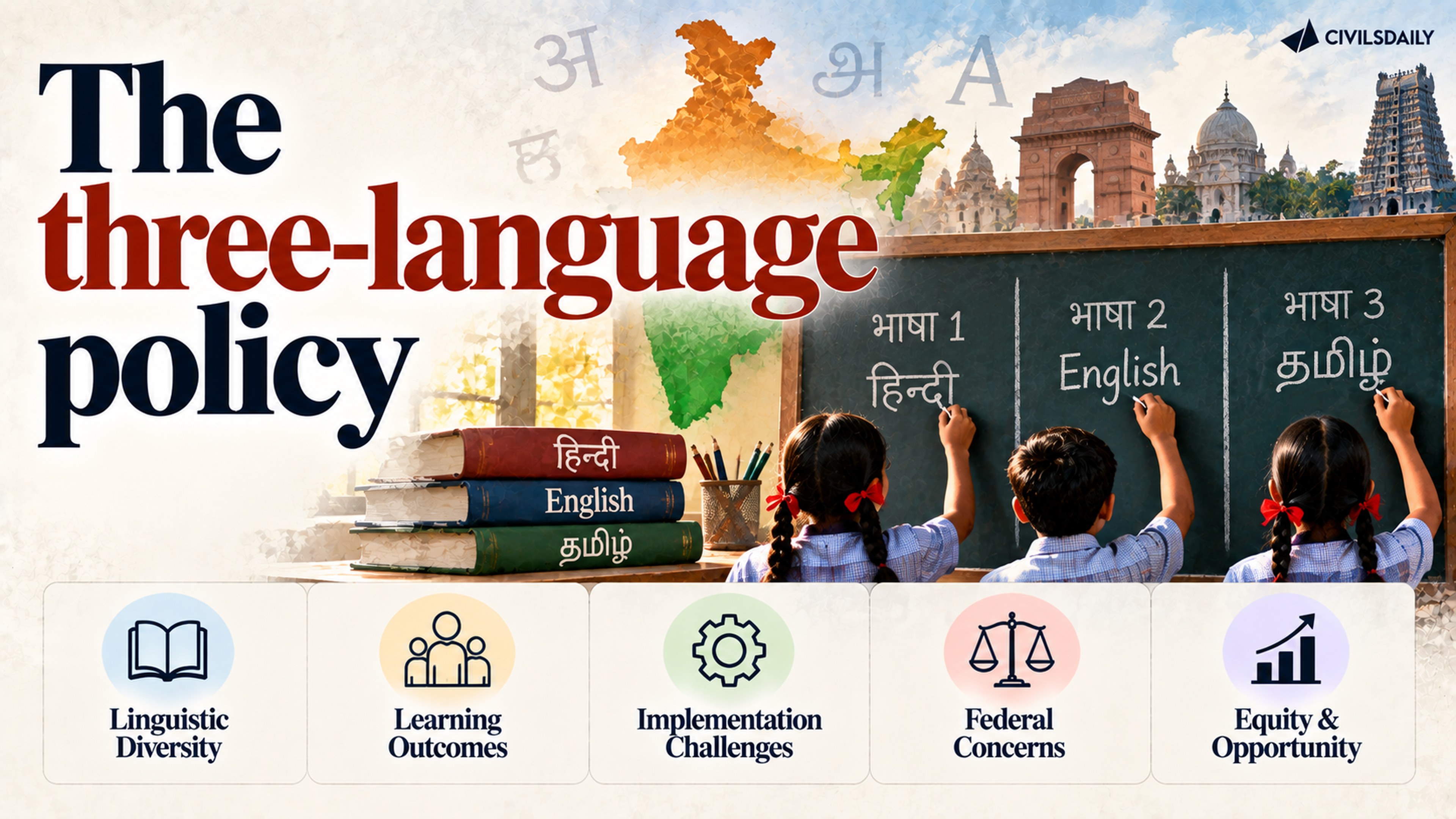
    The Union government has told the Supreme Court that it “has an issue” with treating English as an indigenous language. It has assured the court that it will move quickly on consultations to grant the current Class 6 batch a one-time reprieve from the mandatory third-language paper in the Central Board of Secondary Education (CBSE) Class 10 examination. The court had earlier asked the CBSE to consider that relief. The petitioners want English moved out of the indigenous category into the “non-native” or foreign language category, and the Centre has reserved its submissions on that question. The court has also issued notice on petitions filed by minority schools on the three-language scheme. The dispute is about classification rather than count, because what counts as an indigenous language decides how many Indian languages a student must carry.

    What is the three-language formula under the National Education Policy, 2020?

    1. What it requires: The National Education Policy, 2020 continues the three-language formula in school education. At least two of the three languages taught must be native to India.
    2. Why classification decides the burden: A language treated as indigenous can fill one of the two mandatory Indian-language slots. English placed outside that category cannot, so a student carries an additional Indian language alongside it.
    3. Choice rests with States and students: The policy states that no language will be imposed on any State. The three languages are chosen by States, regions and students themselves.

    What has the Centre now told the Supreme Court?

    1. The petitioners’ ask: Counsel for the petitioners sought an order shifting English into the “non-native” or foreign language category.
    2. The Centre’s objection: The Centre said it “has an issue” with that, and asked to make its submissions before any order is passed.
    3. The assurance on the reprieve: The Centre told a Bench headed by the Chief Justice of India that a meeting with the officials concerned would be arranged within a day or two to decide on the one-time reprieve for Class 6 students.

    Why does the current Class 6 batch sit at the centre of the case?

    1. One batch faces full implementation: Under the CBSE guidelines, students in Classes 7 to 9 were exempted from the third-language requirement. The current Class 6 batch was slated for full implementation of the scheme.
    2. The examination date: Full implementation carries a mandatory Class 10 Board examination in the third language by 2031.
    3. The court’s earlier direction: At an earlier hearing the court asked the CBSE to consider relieving Class 6 students of writing the third-language examination in Class 10.
    4. The Bench on sequencing: A judge on the Bench said time is needed for students and for infrastructure to reach parity across education boards. Starting with the mother tongue, then an indigenous language, then another indigenous or foreign language works only where it begins in a lower class.

    What else is now before the court?

    1. The minority schools’ challenge: The court issued notice to the government on petitions filed by minority schools on the implementation of the three-language scheme.
    2. The English question is undecided: No order was passed on shifting English out of the indigenous category, because the Centre asked to be heard on it first.
    3. Timeline pressure from the petitioners: Counsel for the petitioners said parents were anxious and urged the court against further adjournments. The hearing stands adjourned to 17 September.

    Challenges to the three-language formula

    1. Political resistance where the formula reads as imposition: A centrally set language requirement collides with State language policy. Eg. Tamil Nadu has followed a two-language policy of Tamil and English since 1968, after the anti-Hindi agitations of 1965, and has refused the three-language formula since.
      The Fix: Make the third language a State-notified choice, and tie central funding to teacher recruitment for whichever language a State selects rather than to adoption of the formula itself.
    2. Teacher availability limits real choice: A school cannot offer a language for which no trained teacher is posted. Eg. UDISE+ returns record over one lakh single-teacher schools in the country.
      The Fix: Sanction language-specific posts and permit a shared language teacher across a cluster of schools before the subject becomes examinable.
    3. Foundational reading is the prior constraint: A third language added at the middle stage assumes reading fluency that many students do not have. Eg. The ASER 2024 survey found under half of Class 5 students in rural India able to read a Class 2 level text.
      The Fix: Sequence the third language behind a measured foundational literacy benchmark in the mother tongue, rather than behind a fixed grade.
    4. Minority institutions’ autonomy is engaged: Article 30(1) gives minorities the right to establish and administer educational institutions of their choice, and a prescribed set of languages touches that right. Eg. In T.M.A. Pai Foundation v. State of Karnataka (2002), an eleven-judge Constitution Bench held that regulation of such institutions is permissible for standards and not for control of administration.
      The Fix: Frame the language requirement as an attainment standard rather than as a prescribed language set, so minority institutions retain the choice of which languages meet it.

    Conclusion

    The case turns on a classification question rather than on the number of languages taught. Whether English is treated as indigenous decides whether a student carries two Indian languages or three. The Centre has reserved its position on that and has offered relief only to one batch of students. What remains unresolved is what happens to every batch that follows it.

    Matching Previous Year Question

    “[2020, GS2, 15.0 marks] National Education Policy 2020 is in conformity with the Sustainable Development Goal-4 (2030). It intends to restructure and reorient education system in India. Critically examine the statement.”

  • [9th September 2026] The Hindu OpED: India-Japan defence cooperation breaks new ground

    [9th September 2026] The Hindu OpED: India-Japan defence cooperation breaks new ground

    Question (2019, GS2 – 10 Marks): “‘The time has come for India and Japan to build a strong contemporary relationship, one involving global and strategic partnership that will have a great significance for Asia and the world as a whole.’ Comment.
    Linkage: This question directly evaluates the transition of India-Japan ties into a robust “Special Strategic and Global Partnership”. It challenges candidates to analyze whether political mechanisms (like the 2+2 Ministerial Dialogues and institutional agreements) are producing meaningful regional and global security outcomes

    Mentor comment

    India and Japan have announced a new maritime cooperation framework, joint work on naval shipbuilding and design, and early implementation of the transfer of Japan’s UNICORN integrated communications antenna system. The agreements came out of a visit to India by Japan’s Defence Minister in August 2026. They follow more than a decade of institution building through annual dialogues, the 2+2 mechanism that brings the two countries’ foreign and defence ministers to a single table, joint exercises, logistics arrangements and defence technology discussions. That machinery has not produced matching operational or industrial output. The contest is whether a relationship rich in declarations of strategic convergence can now deliver usable capability.

    Why do further declarations of convergence add little?

    1. The convergence is already established: Both countries share concerns about coercive attempts to alter the status quo, the security of the maritime commons and the growing militarisation of the Indo-Pacific.
    2. Declarations now carry diminishing returns: The partnership has been more developed institutionally than operationally, so another statement of shared assessment changes nothing about what the two forces can do together.
    3. The test is joint operating capacity: The unmet task is converting shared assessments into arrangements that improve the two countries’ ability to operate together.

    What does the new maritime framework try to fix?

    1. Information sharing is the core: The framework places its emphasis on information sharing and Maritime Domain Awareness, the continuous picture of shipping, naval movement and activity in a maritime area assembled from radar, satellite, aircraft and vessel tracking inputs.
    2. The two sit at opposite ends of one theatre: Japan’s immediate security concerns are concentrated in the East China Sea and the waters surrounding Taiwan. India’s geographical position gives it a central role in the Indian Ocean maritime space.
    3. A single picture across two spaces: A closer information sharing architecture would build a more continuous strategic picture across these interconnected maritime spaces.
    4. The stated objective is operational: The aim is greater awareness, interoperability and operational familiarity between the two major maritime powers.

    What is being attempted in defence industry?

    1. Joint work on naval shipbuilding: The two sides are exploring joint development in naval shipbuilding and design, combining Japanese technological expertise with Indian production capabilities.
    2. Japanese use of Indian capacity: There was agreement to deepen discussions on Japan’s use of Indian production capabilities under the ‘Make in India’ framework.
    3. Reciprocal ship repair: The two sides agreed to move towards reciprocal arrangements for ship repair facilities.
    4. This is the weakest leg of the relationship: Defence industrial cooperation has consistently lagged behind strategic and political convergence.

    Why does the UNICORN transfer matter, and why is it not new?

    1. What the system is: UNICORN is an integrated communications antenna system that houses a warship’s antennas within a single composite mast, which reduces the ship’s radar signature.
    2. Described as a first, but already under way: Japan’s Ministry of Defence describes UNICORN as the first defence equipment transfer project between the two countries. A memorandum of understanding for the co-development of UNICORN masts, involving Bharat Electronics Limited, was signed in November 2024.
    3. The meeting advanced implementation: The August meeting represented a further step towards implementation rather than the initiation of a new project.
    4. The record it has to beat: New Delhi and Tokyo have struggled to convert their 2015 agreement on defence equipment and technology transfer into concrete outcomes.
    5. Research agencies are being linked: There are plans to deepen cooperation between India’s Defence Research and Development Organisation (DRDO) and Japan’s Acquisition, Technology and Logistics Agency (ATLA), the Japanese Defence Ministry body that runs procurement and technology development.
    6. Credibility now rests on delivery: The commitment to early implementation reflects a recognition that credibility depends on delivering projects rather than identifying possibilities.

    What do the exercises signal?

    1. Japanese fighters are flying in India: Japan’s fighter aircraft are participating in the Veer Guardian exercise in India from 9 to 22 September 2026, for the first time.
    2. Greater complexity by agreement: The two sides agreed to increase the complexity of bilateral exercises and to integrate unmanned systems.
    3. Short notice activation: They agreed to explore exercises organised at short notice, which tests readiness rather than choreography.
    4. Beyond the navies: They discussed cooperation between special operations forces, and with India’s future integrated theatre commands.

    Why does the western seaboard visit matter?

    1. The itinerary moved west: Before travelling to New Delhi, Japan’s Defence Minister visited the Western Naval Command in Mumbai and INS Chennai.
    2. Past the usual geography: The visit extended beyond the familiar strategic geography of the Bay of Bengal and the Strait of Malacca.
    3. What the western seaboard carries: It is central to India’s wider maritime interests, encompassing critical sea lanes, energy flows and India’s growing responsibilities in the western Indian Ocean.

    Is this a China-centric partnership?

    1. The message was sent without the name: The joint statement reiterated opposition to unilateral actions that impede freedom of navigation or seek to alter the status quo through force or coercion. Neither country named China.
    2. The value lies in going past China: The significance of India-Japan cooperation lies in its ability to move beyond a China-centric agenda.
    3. A wider agenda is already forming: Maritime security, resilient supply chains, defence industrial capacity, logistics and third country cooperation are becoming components of a wider regional security architecture.
    4. The civil side moved first: The July 2026 Annual Summit expanded cooperation across economic security, critical technologies and resilient supply chains, and the defence engagement followed it.

    Challenges

    1. Transfer agreements have not produced serial equipment flows: Named projects have repeatedly stalled between agreement and production. Eg. Negotiations on the US-2 amphibious search and rescue aircraft ran for years without producing a contract.
    2. Japan’s export control framework limits what can move: Japan’s post-war pacifist constitutional settlement and its restrictive export rules keep advanced and dual-use defence technology outside most transfer categories. Eg. The Three Principles on Transfer of Defence Equipment and Technology, adopted in 2014, replaced a near-total export ban but still confine transfers to defined categories.
    3. Habitual joint operation is still shallow: Interoperability is built by repetition, and the bilateral exercise tempo remains thin against the range of services involved. Eg. Japan first joined the Malabar naval exercise in 2007 and became a permanent participant only in 2015.
    4. Defence industrial cooperation remains below potential: Defence industrial cooperation has consistently lagged behind strategic and political convergence.
    5. Strategic alignment is not identical: Japan’s Indo-Pacific approach is closely coordinated with the United States and the G7. India retains strategic autonomy and stays in groupings Japan is not part of. Eg. India’s participation in the Vostok exercises in Russia sits awkwardly with Tokyo’s position.

    Way Forward

    1. Convert agreements into deliverables: Attach dated production milestones and named Indian production partners to defence transfers so that agreements move from signing to implementation.
    2. Work within Japan’s export framework: Concentrate joint projects on permitted categories such as sensors, communications, surveillance and rescue platforms.
    3. Build sustained interoperability: Establish a standing annual calendar covering naval, army and air exercises, with a short-notice activation slot.
    4. Deepen defence industrial cooperation: Move from individual technology transfers towards joint development, co-production and reciprocal maintenance, combining Japanese technological expertise with Indian manufacturing capacity.
    5. Strengthen maritime information sharing: Develop a more integrated Maritime Domain Awareness architecture and improve information sharing between the two countries’ maritime forces.
    6. Institutionalise strategic consultation: Establish a standing consultation mechanism on third-country engagements so that differences arising from India’s strategic autonomy do not become unexpected diplomatic surprises.
    7. Measure the partnership by outcomes: The ultimate benchmark should be delivered equipment, operational capability and functioning industrial partnerships, rather than another round of declarations.

    Back2Basic: About India-Japan Relations

    1. A Special Strategic and Global Partnership: The relationship was upgraded to this status in 2014, covering political, economic and security cooperation.
    2. Indo-Pacific convergence: India’s Act East Policy and its Indo-Pacific Oceans Initiative (IPOI) align with Japan’s Free and Open Indo-Pacific (FOIP) vision, and the two also work together within the Quad.
    3. Economic weight: Japan is the fifth largest investor in the Indian economy, with 6.6 per cent of India’s total foreign direct investment inflows. Bilateral trade stood at USD 25.17 billion in 2024-25.
    4. Development footprint: The Mumbai-Ahmedabad High Speed Rail project is the flagship connectivity work, and Japan is the only country undertaking development work in India’s Northeast, through the India-Japan Act East Forum.

    Initiatives and Agreements in India-Japan Cooperation

    1. Comprehensive Economic Partnership Agreement (CEPA), 2011: It covers trade in goods and services, investment and intellectual property rights.
    2. India-Japan Industrial Competitiveness Partnership, 2021: It works on India’s manufacturing base and on supply chain resilience.
    3. Acquisition and Cross-Servicing Agreement, 2020: It allows reciprocal provision of supplies and services between the two countries’ defence forces.
    4. Agreement for Cooperation in the Peaceful Uses of Nuclear Energy, 2017: It provides the legal basis for Japanese civil nuclear cooperation with India.
    5. Supply Chain Resilience Initiative: Run with Australia, it seeks to diversify supply chains away from dependence on a single country.
    6. Asia-Africa Growth Corridor: It aims to link East Asia, Southeast Asia and South Asia more closely with Africa.

    Key Facts about India-Japan Relations

    1. Joint exercises: JIMEX is the bilateral naval exercise and Dharma Guardian the army exercise. Both countries also take part in the Malabar and Milan multilateral exercises.
    2. The G4 grouping: India and Japan work with Brazil and Germany in the G4 to press for expansion of the United Nations Security Council.
    3. India Vision 2025: It frames the development of India’s Northeast as the convergence point between the Act East Policy and Japan’s Indo-Pacific vision.
  • How to appoint judges: A view from South Africa

    How to appoint judges: A view from South Africa

    Why in the News

    • The Supreme Court has held that confidentiality in judicial appointments is necessary to preserve the integrity of the appointment process.
    • The issue arose in Arvind Malhotra v. High Court of Himachal Pradesh, involving a judge who challenged the elevation of a junior judge to the Supreme Court.
    • The case brings into focus the debate between confidentiality and transparency in judicial appointments.

    Judicial Service Commission of South Africa

    • The Judicial Service Commission (JSC) is a constitutional body involved in judicial appointments in South Africa.
    • It includes judges, lawyers, legal academics and political representatives.
    • Its proceedings are conducted publicly and broadcast.
    • Process involves:
      • Calling for nominations.
      • Preparing a shortlist.
      • Inviting public comments.
      • Conducting public interviews.
      • Voting where members disagree.
    • The identity of individual votes remains confidential.

    Judicial Accountability in South Africa

    • Judges do not enjoy special immunity from complaints regarding conduct.
    • The JSC can investigate allegations of improper conduct.
    • Serious cases can lead to a public enquiry and recommendations for impeachment.

    Constitutional Provisions

    • Article 124: Appointment of Supreme Court judges.
    • Article 217: Appointment of High Court judges.
    • 99th Constitutional Amendment Act, 2014: Provided for the National Judicial Appointments Commission (NJAC).
    • 2015: Supreme Court struck down the NJAC framework and restored the Collegium system.

    Major Concerns

    • Judges appointing judges: Concerns regarding limited external checks and accountability.
    • Transparency: Collegium resolutions are published, but detailed reasons for selection are generally not disclosed.
    • Representation: Concerns regarding social and regional diversity in higher judiciary.
    • Objective merit: Absence of a publicly stated and standardised evaluation framework.
    • Regional imbalance: Some High Courts remain unrepresented in the Supreme Court.

    Way Forward

    • Develop clear and publicly stated selection criteria.
    • Improve transparency while protecting legitimate confidentiality.
    • Consider regional and social representation alongside merit.
    • Strengthen mechanisms for addressing complaints against judicial officers.
    • Maintain the essential balance between judicial independence and public accountability.

    Prelims Pointers

    • Article 124 → Supreme Court judges.
    • Article 217 → High Court judges.
    • Collegium → Judicial appointments to higher judiciary.
    • NJAC → Created through 99th Constitutional Amendment, 2014.
    • NJAC struck down → 2015.
    • South Africa JSC → Constitutional body involved in judicial appointments.
    • TRAI vs JSC: JSC is a constitutional judicial appointments body in South Africa, while India’s Collegium is a judge-led mechanism evolved through judicial decisions.

    [2012] What is the provision to safeguard the autonomy of the supreme court of India?
    1. While appointing the Supreme Court judges, the president of India has to consult the CJI.
    2. the SC judges can be removed by the CJI only
    3. the salaries of judges are charged on the consolidated fund of India to which the legislature does not have to vote.
    4. All appointments of officers and staffs of the SC are made by the govt only after consulting the CJI
    Which of the statements given above is/are correct?

    [A] 1 and 3 only

    [B] 3 and 4 only

    [C] 4 only

    [D] 1, 2, 3 and 4

  • A possible G3 is casting a shadow over BRICS

    A possible G3 is casting a shadow over BRICS

    Why in the News

    BRICS leaders meet in Delhi this week to add further layers of cooperation, ranging from agriculture, health to digitalisation. The grouping’s two principal driving forces, Russia and China, are at the same time exploring separate and joint accommodations with the United States, whose domination of the world order BRICS exists to counter.

    What will the Delhi summit actually produce?

    1. More layers, slowly added: The summit will extend cooperation into agriculture, health and digitalisation.
    2. The declaration is not the draw: The last summit, at Rio de Janeiro, issued a declaration of 126 paragraphs without changing anything in the international system.
    3. The attraction is attendance: International interest is focused on the presence of the leaders of China, Russia and Iran.
    4. One bilateral carries the weight: The Chinese President is visiting India for the first time since 2019, and the two leaders are expected to stabilise the boundary situation and reset economic relations.

    Why has BRICS become less coherent?

    1. Expansion cut both ways: Enlargement added weight to the grouping and subtracted coherence from it.
    2. The Iran war split two members: The conflict opened a sharp divide between Tehran and Abu Dhabi, now fellow members of the grouping.
    3. Two incompatible asks: Iran wants BRICS to condemn American and Israeli military action. The United Arab Emirates, which suffered Iranian attacks and disruption to commerce through the Strait of Hormuz, stresses sovereignty, protection of civilian infrastructure and freedom of navigation.
    4. It has already cost an outcome: Those differences prevented the BRICS foreign ministers from issuing a consensual joint statement in Delhi in May.

    Why is a G3 conceivable now?

    1. A leader driven American approach: The US President has long held that good personal relations with the Russian and Chinese leaders could reduce global strategic tensions and produce major political and economic deals.
    2. Domestic and allied resistance: That instinct has repeatedly encountered resistance from the American foreign policy establishment, Congress and US allies.
    3. European and Asian fears differ: The Europeans worry that an accommodation with Moscow could be made at their expense. Asian allies fear that a bargain with Beijing could weaken American commitments to regional security.
    4. Nothing has been transformed yet: Neither relationship has been changed, and the preference for leader driven diplomacy keeps the possibility of movement open.
    5. The idea has been tested before: The possibility of such a meeting was explored last summer, during the 80th anniversary of the end of the Second World War.

    What does Russia bring to that table?

    1. The war has not been won: Four and a half years of fighting have produced no decisive victory, and the front remains costly and difficult to move.
    2. A channel has reopened: Shuttle diplomacy by American envoys between Moscow and Kyiv has reopened the diplomatic channel, without any sign that the fundamental differences between Russia and Ukraine are narrowing.
    3. Both sides hedge: Moscow and Kyiv are supporting the American peace initiative and preparing for escalation at the same time.
    4. European security could become a chip: Russian security questions could be treated by Washington as part of a larger bargain with Beijing.

    What does China bring?

    1. It negotiates from strength: China approaches Washington from a stronger position than Russia does.
    2. A sequenced diplomatic run: Its journey from the Shanghai Cooperation Organisation summit at Bishkek, through Cairo and Delhi, to the White House later this month presents China as the leader of the Global South and as a co-equal manager of the international order at the same time.
    3. What a second summit could yield: An extension of the trade truce, additional Chinese purchases from the United States and negotiations over technology restrictions are the available deliverables.
    4. The differences are structural: Washington accuses China of relying on subsidised exports and industrial overcapacity. Beijing uses rare earths, market access and its control of important supply chains as leverage.
    5. Taiwan is the standing ask: China will continue to press for a reduction in American support for Taiwan.

    Can anti-Western rhetoric and a seat at the American table hold together?

    1. Alignment and hedging run together: Russia and China are closer to each other than ever and share concerns about the United States. Both also seek a workable relationship with Washington.
    2. Both claim the high table: For all their anti-Western rhetoric, each claims a place at the high table with the United States.
    3. The claim has history: Russia was once part of the G8, the group of Western industrial states, and engaged directly with NATO. China now sees itself as America’s peer.
    4. What a trilateral would signify: Both lay claim to shaping the global order established after 1945, and a summit of the three leaders would mark the beginning of triangular global leadership as a successor to the Yalta System.
    5. It is not imminent: A global directorate of three is not close, and the idea remains an exploration rather than a plan.

    What are India’s three answers?

    1. Build national power first: The first answer is internal reform and accelerated economic development.
    2. Separate multipolarity from anti-American bloc politics: Russia and China use BRICS to expand their diplomatic options and to preserve the freedom to negotiate with Washington. India must approach the emerging order with the same realism.
    3. Widen the partnership base: India must intensify bilateral and minilateral cooperation with the Anglosphere, Brazil, Europe, Japan, Korea and other middle powers that have no enthusiasm for a G3 world.

    Challenges to BRICS

    1. Internal rivalry limits cohesion: Friction between the two largest Asian members prevents a common strategic position inside the grouping. Eg. The unsettled India-China boundary has kept the two from a shared security line inside the same forum.
    2. Consensus across incompatible political systems: The membership spans vibrant democracies and autocracies, which makes agreement on human rights or democratic norms unreachable in joint declarations. Eg. The entry of Iran and Ethiopia alongside Brazil and India widened that political range further.
    3. De-dollarisation is slower than the rhetoric: Local currency settlement has grown, and the US dollar still settles the overwhelming share of global trade. Eg. Rupee-rouble and rupee-dirham settlement covers only a fraction of India’s external trade.
    4. There is no permanent secretariat: The grouping has no charter and no standing institution, so continuity depends entirely on the annual chair. Eg. Each presidency resets the agenda, and commitments lapse when the chair changes.
    5. Intra-group trade stays low: Members continue to rely on G7 markets for high technology imports and services exports. Eg. Most members source advanced semiconductors and aerospace components from the United States, Europe and Japan.
    6. Expansion risks dilution: A larger BRICS+ risks becoming a discussion forum that produces no decisions. Eg. The Non-Aligned Movement grew past 120 members and lost the ability to reach operative positions.

    Way Forward

    1. Focus on areas of common interest: Confine joint positions to areas where members already agree, such as development finance and public health, rather than seeking a security consensus that does not exist.
    2. Adopt variable geometry: Move towards a variable geometry model in which subsets of members can sign issue specific instruments without binding the whole group.
    3. Strengthen payment infrastructure: Target payments infrastructure that lowers settlement cost and time, rather than focusing primarily on the displacement of the US dollar as a reserve currency.
    4. Create a permanent institutional mechanism: Establish a small standing secretariat with a limited mandate to track implementation of past declarations and maintain institutional continuity.
    5. Promote intra-BRICS supply chains: Direct the New Development Bank towards financing intra-group industrial supply chains, particularly in strategic sectors such as advanced technology and manufacturing.
    6. Formalise expansion criteria: Establish clear entry criteria for partner countries, ensuring that future expansion is based on economic complementarity rather than political alignment.

    Conclusion

    Multipolarity has always had two possible shapes: one distributes power across many capitals; the other concentrates it among a handful and calls the result a balance. BRICS rests on the first assumption; its two strongest members hedge towards the second. For India the operative question is not whether a three cornered directorate forms, which it may not, but whether Indian diplomacy is organised for a world in which its two largest partners in the grouping negotiate separately with Washington. That answer will show up in what India builds outside the room, not in what the room declares.

    About BRICS

    1. What it is: BRICS is an informal grouping of major emerging economies that coordinates political and economic positions outside Western led institutions, without a founding treaty.
    2. Membership: Its full members are Brazil, Russia, India, China, South Africa, Egypt, Ethiopia, Indonesia, Iran, Saudi Arabia and the United Arab Emirates, with Saudi Arabia participating without having formalised its status.
    3. Its weight: The grouping accounts for over 45 per cent of the world’s population, about 37 per cent of global output measured at purchasing power parity, which exceeds the G7’s share, and roughly 42 per cent of global oil production and exports.
    4. Its stated objectives: Reform of the United Nations Security Council, the International Monetary Fund and the World Bank for more equitable representation, a multipolar order, and reduced reliance on the US dollar and on SWIFT, the messaging network banks use to instruct cross border payments.

    Key Facts about BRICS

    1. The acronym predates the grouping: ‘BRIC’ was coined in 2001 by a Goldman Sachs economist to identify high growth emerging economies.
    2. From officials to leaders: The first meeting of foreign ministers was held on the margins of the United Nations General Assembly in 2006. The first formal Leaders’ Summit was held at Yekaterinburg in Russia in 2009.
    3. How it grew: South Africa joined in 2011. Expansion was decided at the 2023 Johannesburg Summit, with Egypt, Ethiopia, Iran and the United Arab Emirates joining in 2024 and Indonesia in 2025.
    4. A partner tier: A ‘Partner Country’ category was introduced in 2024 to engage states such as Malaysia, Thailand and Nigeria without granting full membership.

    Initiatives under BRICS

    1. New Development Bank: Headquartered in Shanghai, it has approved over USD 35 billion in infrastructure lending.
    2. Contingent Reserve Arrangement: A USD 100 billion fund providing short term liquidity support to members.
    3. BRICS Pay: A cross border payment system in pilot stage, intended to work around SWIFT.
    4. BRICS Vaccine Research and Development Centre: Set up during the pandemic for technology transfer and vaccine equity.
    5. Remote Sensing Satellite Constellation: Six satellites contributed by member states, sharing data for disaster management.
    6. Partnership on New Industrial Revolution (PartNIR): Cooperation on artificial intelligence, digitalisation and green technology.
    7. BRICS Space Council: Established in 2025 to coordinate deep space exploration and lunar research.

    Back2Basics: The Yalta System

    • Why the term recurs: ‘Yalta System’ is used as shorthand for an international order settled among a small number of great powers rather than by the wider membership.f BRICS in projecting itself as an alternative to other groupings.”
    • Where the term comes from: The Yalta Conference of February 1945 brought together the leaders of the United States, the United Kingdom and the Soviet Union to settle the shape of the post-war order.
    • What it settled: It fixed the occupation and reorganisation of Europe and confirmed agreement on creating the United Nations.
    • The concert it produced: It led to a Security Council with permanent seats and a veto for five powers, entrenching great power management of international peace.

    [2026, GS2, 10.0 marks] “BRICS acts as a powerful counterweight in global governance, actively amplifying the voice and influence of the Global South.” Explain the role of BRICS in projecting itself as an alternative to other groupings.

  • India, China Corps Commander talks went on for two days: MEA

    Why in the News

    India and China held Corps Commander-level military talks in the eastern sector on 6 and 7 September, the Ministry of External Affairs has said. The talks were the first Senior Highest Military Commander-Level Flag Meeting, and were held on two consecutive days at Wacha on the Indian side in Arunachal Pradesh and at Damai on the Chinese side. They took place amid ongoing tensions in the Taksing area of the Upper Subansiri district of Arunachal Pradesh. The meeting was held pursuant to understandings reached between the Special Representatives of the two countries, and comes days before the Chinese President’s likely visit to India. The question it raises is whether a channel built to manage friction points can do anything about the undefined boundary that keeps producing them.

    What is the Corps Commander-level mechanism?

    1. Talks between field commanders: It is a military-to-military channel in which the corps commander responsible for a sector meets his counterpart, with other officers present, to resolve issues on the ground.
    2. It began in the west: The mechanism has existed in eastern Ladakh since 2020 to resolve the military standoff between India and China along the Line of Actual Control (LAC), the notional line separating the two sides’ areas of control.
    3. Its record there: India and China have held 23 rounds of Corps Commander-level meetings at the Chushul-Moldo border meeting point in eastern Ladakh.
    4. Both sectors now carry it: The Ministry of External Affairs has confirmed that a similar mechanism also exists in the Western Sector.

    Who met, and where?

    1. A two day, two country format: The flag meeting was held at Wacha on the Indian side on Sunday, 6 September, and at Damai on the Chinese side on Monday, 7 September.
    2. A corps commander led the Indian side: The commander of the Army’s III Corps, also called the Spear Corps, met his Chinese counterpart along with other officers.
    3. The formation involved: III Corps is headquartered at Rangapahar near Dimapur in Nagaland.
    4. The announcement: The Ministry of External Affairs confirmed the talks at a press conference on Tuesday, 8 September.

    What produced the meeting?

    1. A political track above it: The talks took place pursuant to understandings reached between the Special Representatives of India and China in August 2025 and August 2026.
    2. Who the Special Representatives are: India is represented by the National Security Adviser and China by its Foreign Minister, and the two met in Beijing on 25 August.
    3. An officials track below it: The talks also followed discussions at the Working Mechanism for Consultation and Coordination (WMCC), the standing forum of diplomatic and military officials on border affairs, which met in Beijing in May 2026 and in New Delhi in August 2026.

    Why does the timing matter?

    1. The friction has moved east: The mechanism that produced 23 rounds was built for eastern Ladakh. The tension now being managed is in Arunachal Pradesh.
    2. A summit is days away: The talks come ahead of the Chinese President’s likely visit to India for the BRICS Summit on 12 and 13 September.
    3. The diplomatic track has been busy: Two rounds of Special Representative understandings and two meetings of the officials’ forum preceded this flag meeting in the year before it.

    Challenges to the border talks mechanism

    1. The channel manages friction, not the boundary: Commander level talks settle patrolling, deployment and local incidents, and they do not address where the line itself runs. Eg. The rounds held in eastern Ladakh produced disengagement at specific points without altering any claim on the alignment.
      The Fix: Return the Special Representatives’ track to sector by sector clarification of the alignment, with an agreed exchange of maps as the first deliverable.
    2. Disengagement is not de-escalation: Troops pulled back from a friction point remain deployed in depth, with the roads, habitat and airfields built during the standoff still in place. Eg. Buffer zones created after 2020 removed contact but also removed patrolling access for both sides.
      The Fix: Pair every disengagement step with a verified and reciprocal reduction in rear area deployments, checked by agreed technical means.
    3. Routine contact in the east runs at a lower level: Day to day communication between the two armies operates through Border Personnel Meeting points staffed well below corps level, which slows the handling of a serious incident. Eg. In the eastern sector these points are at Bum La and Kibithu in Arunachal Pradesh.
      The Fix: Convert the new commander level flag meeting into a scheduled annual mechanism rather than an incident driven one, with a dedicated hotline between the two corps headquarters.

    Conclusion

    The commander level channel now exists in the eastern sector and has met once. What it can settle is patrolling, deployment and local incidents. What it cannot settle is where the line runs, which stays with the political track above it. The next marker is the Chinese President’s visit to Delhi later this month, and whether the two leaders convert a new military channel into a dated timetable for clarifying the alignment in the east.

    Matching Previous Year Question

    “[2024, GS3, 15.0 marks] India has a long and troubled border with China and Pakistan fraught with contentious issues. Examine the conflicting issues and security challenges along the border. Also give out the development being undertaken in these areas under the Border Area Development Programme (BADP) and Border Infrastructure and Management (BIM) Scheme.”

  • Perilous retreat: Gram sabhas must have a veto on issues relating to tribal land

    Why in the News

    The Committee on Public Undertakings has suggested that a project require the consent of only most, rather than all, of the gram sabhas affected by it. The Scheduled Tribes and Other Traditional Forest Dwellers (Recognition of Forest Rights) Act, 2006 is framed in spirit to require the consent of every affected village assembly before forest land is diverted. The Tribal Affairs Ministry has declined to claim jurisdiction over the question, leaving the reading of that requirement to the Centre and the State governments. The contest is between a consent rule that protects the specific village losing its land and a counting rule under which the villages losing least can decide for the village losing most.

    What is the Forest Rights Act, 2006?

    1. What it recognises: The Act recognises individual and community rights over forest land for Scheduled Tribes and other traditional forest dwellers who have depended on that land.
    2. Why it was passed: It was enacted to undo the “historical injustices” meted out to forest-dependent communities whose occupation of forest land had never been recorded.
    3. Where the authority sits: The gram sabha is the body that initiates the determination of the nature and extent of individual and community forest rights.
    4. What it does to land diversion: The consent of the affected gram sabhas is the barrier a project must clear before forest land is diverted for non-forest use.

    What would a majority consent threshold change?

    1. Assemblies become stakeholders: A regime deeming the acquiescence of 70 to 75 per cent of affected gram sabhas to suffice would reduce them from democratic bodies protecting the constitutional rights of their specific inhabitants to corporate stakeholders.
    2. The village that loses most can be outvoted: A project developer may bypass the consent of a village located directly within a proposed reservoir, once less affected villages provide their no-objection certificates.
    3. The change is jurisprudential, not procedural: A right held by a particular community because of its dependence on a particular forest cannot be surrendered by the agreement of other communities, so the threshold alters what the consent requirement is for.
    4. Classification disputes feed the same result: The political fight over classifying tribal communities alters who qualifies as a community member, which makes it easier to split a village assembly and engineer consent.

    What does the Tribal Affairs Ministry’s recusal produce?

    1. A regulatory vacuum: The refusal of the Tribal Affairs Ministry to claim jurisdiction leaves the Centre and the State governments unchecked in rewriting the rules by which forested land is diverted for non-forest use.
    2. The recusal rests on a technicality: The Ministry has located the question between the Forest Rights Act and the Environment Ministry’s rules in order to recuse itself.
    3. The consequence is substantive: That bureaucratic manoeuvre could strip forest-dependent communities of their most potent legal instrument.

    What is the legal position on consent as it stands?

    1. No express clause for every gram sabha: The Forest Rights Act does not include a clause requiring a no-objection certificate from every affected gram sabha.
    2. That does not make consent optional: The claim that no legal requirement presently exists, and that gram sabha decisions can be bypassed, is untrue.
    3. The route to any change is legislative: A government that wishes to move to a majority rule must change the relevant rules or legislation openly and democratically, rather than through an administrative reading of the existing text.

    Why do energy targets and forest rights collide?

    1. Infrastructure is being scaled rapidly: The government has been scaling up energy infrastructure, including the long-stalled Teesta-IV project, to meet macroeconomic goals.
    2. The same state wrote the protection: The Forest Rights Act was passed by that state to undo historical injustices, so the consent requirement is a commitment it made against its own future convenience.
    3. The chosen path avoids the argument: Proceeding on the notion that the consent requirement was never part of the Act settles the conflict by denying that it exists, rather than by weighing the claims on either side.

    What does land carry for forest-dependent communities?

    1. It is the base of everything else: Land is the foundation of these communities’ livelihoods, culture, identity and political autonomy.
    2. The struggle has been over dispossession: Communities have fought to resist displacement and dispossession and to secure customary collective ownership.
    3. They also supply public goods: Scheduled Tribe communities render social and environmental services and contribute to national development, including by helping meet India’s climate commitments.
    4. The recommendation follows from that: The Centre and the States should strengthen the powers conferred on gram sabhas in Scheduled Areas by the Right to Fair Compensation and Transparency in Land Acquisition, Rehabilitation and Resettlement Act, 2013 and the Panchayats (Extension to the Scheduled Areas) Act, 1996.

    Challenges to gram sabha consent under the Forest Rights Act

    1. Community forest rights lag individual titles: Most titles distributed under the Act are individual. Community forest resource rights, which are what a gram sabha exercises against a diversion, are recognised in a small share of eligible villages. Eg. Recognised community forest resource titles are concentrated in Maharashtra, Odisha and Chhattisgarh, with minimal recognition in several other States.
      The Fix: Complete community forest resource mapping and vesting in a village before any diversion proposal over its forest is processed.
    2. The consent requirement rests on executive instruction: It operates through Ministry circulars in the forest clearance process rather than through an express section of the Act, so it can be narrowed without going to Parliament. Eg. A 2009 circular of the Ministry of Environment and Forests made a gram sabha consent certificate part of the forest clearance record.
      The Fix: Write the consent requirement into the Act itself, so that any dilution requires an amendment debated in Parliament.
    3. Statutory exemptions have been widening: The Forest (Conservation) Amendment Act, 2023 removes categories of land from the forest clearance process, and the consent step travels with that process. Eg. Land within 100 km of an international border proposed for a strategic linear project falls outside the clearance requirement.
      The Fix: Retain the gram sabha consent step for every exempted category where forest rights have been recognised, independent of the clearance exemption.
    4. A refusal has no protected life: Nothing bars a fresh proposal over the same forest after a gram sabha has rejected one, so refusal delays a project rather than settling the question. Eg. In Orissa Mining Corporation v. Ministry of Environment and Forests (2013) the Supreme Court referred the bauxite mining question in the Niyamgiri hills to 12 gram sabhas, and all of them rejected it.
      The Fix: Bar a fresh diversion proposal over the same land for a fixed period following a gram sabha rejection, as land acquisition law already does.

    Conclusion

    The consent requirement is the one instrument that makes a village’s refusal legally consequential, and the change under discussion replaces refusal with arithmetic. Two positions cannot both hold: that the right belongs to a particular community because it depends on a particular forest, and that other communities may supply the consent on its behalf. The Environment Ministry can settle which of the two governs, and the honest route to that is an open amendment rather than a fresh reading of existing rules. Until it does, the strength of a village assembly’s veto depends on which ministry is willing to claim jurisdiction over it.

    Back2Basics: Panchayats (Extension to the Scheduled Areas) Act, 1996

    1. What it does: It extends Part IX of the Constitution, on panchayats, to the Fifth Schedule areas with modifications.
    2. The gram sabha’s status: It makes the gram sabha, rather than the elected panchayat, the primary body competent to safeguard traditions, customs, cultural identity and community resources.
    3. Consultation before acquisition: It requires consultation with the gram sabha before land is acquired in Scheduled Areas and before displaced persons are resettled.
    4. Control over resources: It vests ownership of minor forest produce in the gram sabha and gives it a role in preventing land alienation and in granting minor mineral concessions.

    Matching Previous Year Question

    “[2013] Under the Scheduled Tribes and Other Traditional Forest Dwellers (Recognition of Forest Rights) Act, 2006, who shall be the authority to initiate the process for determining the nature and extent of individual or community forest rights or both? (a) State Forest Department (b) Distrit Collector/Deputy Commissioner (c) Tahsildar/Block Develoment Officer/Mandal Revenue Officer (d) Gram Sabha ANSWER: (d)”

  • Reclaiming universities through trust, student voice

    Why in the News

    The Supreme Court has stayed the Bar Council of India (BCI)’s order against the graduating batch of the National Academy of Legal Studies and Research (NALSAR), Hyderabad. The same intervention quashed all first information reports (FIRs) against the protesting students. It declared that the BCI has no disciplinary control over students. It also reduced the three year practice condition for writing the judicial services examination to one year. The order follows a protest by law students seeking a say in their own convocation, widely attributed to an oral remark by the Chief Justice of India that was quickly clarified. The contest is over whether campus unrest is a failure of student discipline or a failure of a governance model that leaves students out of the decisions binding them.

    What is academic freedom?

    1. The freedom to teach, research and question: Academic freedom is the entitlement of those engaged in scholarly teaching and research to decide what to study, what to teach and what to challenge, without direction from the government or the university administration.
    2. No express Indian guarantee: The Constitution of India does not mention academic freedom. Article 5(3) of the German Basic Law guarantees scientific freedom (Wissenschaftsfreiheit) as a right of everyone engaged in scholarly teaching and research.
    3. A recognised right elsewhere: The Constitutions of Japan, South Africa, Portugal and Spain contain a comparable freedom. Article 137 of the Basic Law of Hong Kong provides that educational institutions may retain autonomy and enjoy academic freedom.
    4. Its limit is conduct, not speech: The freedom carries no right to defame or to engage in anti-national activity. Where an academic activity involves conduct rather than speech, the state is entitled to regulate that conduct.

    Why is curriculum the sharp edge of the dispute?

    1. Curriculum is set without the people it binds: University curriculum should be decided by the stakeholders, including students. Eg. Delhi University dropped a paper on the Delhi Sultanate along with some other papers.
    2. Students read such changes as political: Curriculum changes of this kind are seen as having ideological reasons rather than academic ones, which turns an academic decision into a governance grievance.
    3. The direction of restraint runs both ways: Government is not to dictate to universities what to teach, how to teach and what not to teach. Universities owe the same freedom to their departments and faculties.
    4. The campus exists for the contested question: Universities are meant to be a special place for reflection, inquiry and discussion, which is the function a closed curriculum process removes.

    What do experiences abroad show about academic freedom under pressure?

    1. The United States has used funding as leverage: Federal funding has been weaponised to reshape campus culture. Diversity programmes have been dismantled and research funding in areas such as climate change has been reduced.
    2. Permitting protest has itself invited pressure: Universities have faced pressure for allowing student protests, including those over Gaza.
    3. Neither ideological side is exempt: Right wing and left wing regimes have both, at times, sought to control universities.
    4. The pattern is old: Arnold Toynbee resigned from King’s College London in 1924 over his writings on the Greek army’s atrocities. Professors were persecuted during the McCarthy era.
    5. Funders now shape the research agenda: Declining public funding has left research agendas increasingly influenced by funders, corporations and pharmaceutical companies.

    What is the control model of university governance?

    1. Authority sits in one office: Most universities remain Vice-Chancellor centric. Students, who are the reason universities exist, have little say in their governance.
    2. Grievances have no route upward: Vice-Chancellors rarely hold open houses and are often inaccessible to ordinary students. Unaddressed grievances leave students feeling ignored, and some then take extreme steps.
    3. Control substitutes for dialogue: Administrations adopted the control model as governments increasingly sought to control universities. A community of highly educated faculty and young people requires dialogue, trust and openness rather than surveillance.
    4. Knowledge creation needs the opposite conditions: Universities exist to innovate and create knowledge, which requires the freedom to question everything and challenge existing ideas.

    How does under-investment compound the control problem?

    1. The policy target has not been met: The National Education Policy 2020 promises public investment of 6 per cent of Gross Domestic Product (GDP) in education. Public investment has steadily declined and hovers around 4 to 4.1 per cent.
    2. Higher education gets the smallest share: Within that spending, higher education receives the smallest allocation, so the system is over-regulated and grossly underfunded at the same time.
    3. Autonomy is not alien to the system: The ancient Gurukul system was entirely autonomous, and the present arrangement regulates far more and funds far less.
    4. The shortfall is visible on campus: Public university infrastructure has deteriorated and hostels are in acute shortage, which produced the recent deaths in New Delhi. Faculty positions remain vacant and guest faculty are poorly paid.
    5. Teaching and examinations both fail the student: Poor teaching frustrates students. Repeated examination paper leaks add to their stress.

    What do Vice-Chancellor appointments reveal?

    1. Natural justice is overlooked: In one case a Vice-Chancellor changed the composition of the selection committee, chaired it and voted in the selection of his wife. She was appointed as Vice-Chancellor.
    2. The courts did not correct it: The judiciary declined to follow its own precedents of quashing such appointments.
    3. An adverse record is not a bar: Individuals with questionable records and adverse Central Vigilance Commission (CVC) reports have been appointed, and some State universities face allegations of bribery.
    4. Recruitment rewards leaning over merit: Faculty recruitment over-emphasises ideological leanings rather than merit. Ideological governments may prefer candidates with particular leanings, and merit should not be completely undermined on that account.
    5. Examination integrity follows appointment integrity: No examination system can be foolproof where paper setters, moderators or testing officials are appointed for reasons other than absolute merit and integrity.

    Who actually absorbs the blame for campus unrest?

    1. The anger travels past the administration: Student frustration erupts against the government rather than against university administrations. The government received the criticism for the actions of the Vice-Chancellor in the appointment case.
    2. Much of it is avoidable on campus: The backlash could largely be avoided where administrations engage students in meaningful dialogue and provide timely relief.
    3. The government is not a bystander either: Administrations adopted the control model because governments sought control of universities, so the incentive that produced the model is a governmental one.

    What does the liberty model change?

    1. Trust is the operative mechanism: The liberty model of governance was implemented across three universities over 16 years. Students who are trusted act more responsibly in turn.
    2. Access without gatekeeping: Students met the Vice-Chancellor without appointments and raised personal concerns and difficulties. That access made frank conversations possible when difficult or unpopular decisions had to be taken.
    3. Unpopular ideas are protected: The model treats the university as a space where even the most unpopular ideas can be freely debated, which is the opposite of the top-down model.
    4. Students sit inside the decisions: Students are given a meaningful role in academic, administrative and financial decisions, including faculty appointments, procurement, curriculum design and the drafting of university regulations.
    5. A statutory precedent already exists: Students at Aligarh Muslim University have a statutory role in selecting the Vice-Chancellor.

    Challenges to the liberty model of university governance

    1. Participation rights can be captured by party politics: Campus unions aligned to national parties can convert a participation right into a channel for external political control. Eg. Delhi University Students’ Union elections are contested by the student wings of national parties.
      The Fix: Tie student participation to reserved seats on academic and finance bodies with fixed terms, so it runs through statutory channels rather than street mobilisation.
    2. A Vice-Chancellor cannot devolve powers that are not his: Faculty appointments and university finances are governed by University Grants Commission (UGC) regulations and State legislation, so student participation in them rests on the incumbent’s discretion. Eg. The Vice-Chancellor is himself selected by the Chancellor or Visitor from a search committee panel.
      The Fix: Amend university statutes to create student membership on selection and finance committees, so participation has a legal basis rather than a personal one.
    3. The model lapses with the person who ran it: A governance style adopted by one Vice-Chancellor ends when that office changes hands, since nothing in the statute compels a successor to continue it. Eg. Open house access is an administrative practice and not a rule.
      The Fix: Write grievance redressal timelines and open house frequency into university ordinances so the practice survives a change of office.
    4. Trust cannot supply what money supplies: Dialogue does not create hostel seats, permanent faculty or laboratory funding, which are the material grounds of much campus unrest. Eg. Sanctioned faculty posts in central and State universities stay vacant regardless of the governance style adopted.
      The Fix: Link central grants to filled sanctioned posts and audited hostel capacity, so funding follows the deficits that generate protest.

    Conclusion

    The Supreme Court’s order settles who may discipline a law student. It does not settle who governs a campus. Curriculum decisions, convocation arrangements and appointments all turn on whether students hold any formal seat in university decision making, and at present they hold almost none. The measure worth watching is whether university statutes are amended to give students standing on academic and selection bodies, since a governance practice resting on the person in office leaves with that person.

    Higher Education in India

    1. Second largest system in the world: Total enrolment is estimated at 4.65 crore in 2026, up from 3.42 crore in 2014-15.
    2. Institutional spread: India hosts over 1,168 universities and 45,473 colleges, against 760 universities in 2014-15.
    3. Participation is short of the target: The Gross Enrolment Ratio in higher education, meaning enrolment at that stage as a share of the population in the corresponding age group, stands at 28.4 per cent against the National Education Policy 2020 target of 50 per cent by 2035.
    4. Women now enrol marginally more than men: The Gender Parity Index stands at 1.01, indicating slightly higher female than male participation for the first time.

    Constitutional Framework Governing Higher Education

    1. Entry 25, List III: Education, including technical and medical education and universities, is a Concurrent List subject after the Constitution (Forty-second Amendment) Act, 1976.
    2. Entry 66, List I: Coordination and determination of standards in institutions of higher education and research is reserved to the Union.
    3. Entry 63, List I: Banaras Hindu University, Aligarh Muslim University and Delhi University are institutions of national importance under Union competence, along with any other so declared by Parliament.
    4. Article 30(1): Religious and linguistic minorities have the right to establish and administer educational institutions of their choice.
    5. Article 19(1)(a): Free speech on campus is protected, subject only to the restrictions Article 19(2) itself permits.

    Laws and Rules Governing Higher Education

    1. University Grants Commission Act, 1956: Establishes the UGC to coordinate and determine standards in university education and to disburse grants to universities and colleges.
    2. All India Council for Technical Education Act, 1987: Creates the statutory regulator for technical education, covering planning, norms and approval of technical institutions.
    3. National Council for Teacher Education Act, 1993: Creates the regulator for teacher education programmes and the institutions that run them.
    4. Anusandhan National Research Foundation Act, 2023: Establishes the National Research Foundation to seed and fund research across higher educational institutions, including State universities.

    Government Initiatives for Higher Education

    1. National Education Policy 2020: Replaces the National Policy on Education, 1986, and is built on access, equity, quality, affordability and accountability.
    2. Academic Bank of Credits: A digital repository holding course credits, which enables multiple entry and exit within a degree programme.
    3. Automated Permanent Academic Account Registry (APAAR): A single student identifier linking academic records, skills and transfers in one portal.
    4. Prime Minister’s Research Fellowship: Doctoral fellowships for research scholars, expanded to award 10,000 new fellowships.

    Challenges in Higher Education Governance

    1. Fragmented regulatory structure: Multiple bodies issue overlapping and sometimes conflicting guidelines to the same institution, which delays academic decisions. Eg. A technical department inside a university answers to the All India Council for Technical Education and the UGC at the same time.
      The Fix: Consolidate approvals under a single higher education regulator with separate verticals for funding, standard setting and accreditation.
    2. Quality is unmeasured across much of the system: Over 30 per cent of Indian higher educational institutions remain unaccredited as of early 2026. Eg. Accreditation by the National Assessment and Accreditation Council is not a precondition for most colleges to award degrees.
      The Fix: Make one completed accreditation cycle a condition for degree granting status and for central grants.
    3. Research spending is stagnant: Research and development expenditure stands at 0.64 per cent of GDP, against about 2.4 per cent in China and 3.4 per cent in the United States. Eg. India contributes under 5 per cent of global research publications.
      The Fix: Route National Research Foundation funding towards State universities, which carry most enrolment and almost none of the research grant.
    4. Employability does not follow the degree: Curricula are not aligned to hiring requirements, so enrolment growth does not convert into work. Eg. Only about 4 per cent of higher education carries formal skill training.
      The Fix: Embed apprenticeship credits inside degree programmes under the National Credit Framework.

    Back2Basics: Bar Council of India

    1. A statutory body under the Advocates Act, 1961: It regulates the legal profession and legal education in India.
    2. Standard setting: It lays down standards of professional conduct and etiquette for advocates, and prescribes the conditions on which a law degree is recognised for enrolment.
    3. Composition: Its members are elected by the State Bar Councils, with the Attorney General of India and the Solicitor General of India as ex officio members.

    Matching Previous Year Question

    “[2014, GS2, 12.5 marks] Should the premier institutes like IITs/IIMs be allowed to retain premier status, allowed more academic independence in designing courses and also decide mode/criteria of selection of students. Discuss in light of the growing challenges.”

  • PAC flags failure to transfer Rs 9,222 cr. in cess collections

    Why in the News

    The Public Accounts Committee (PAC) has flagged the failure to transfer Rs 9,222 crore of cess and levy collections to their designated reserve funds. Members questioned the Union Finance Ministry’s explanation on the issue. The committee reiterated its earlier recommendation that such collections be used only for the purposes for which they were raised. It had made that recommendation once already, in its 69th report tabled in August 2023, and the stated position of the chairperson is that ignoring the directions of a parliamentary standing committee amounts to an insult to Parliament. The tension is that a cess is justified to the taxpayer by an earmarked purpose. Its proceeds can still remain unmoved and available for ordinary expenditure.

    What is the Public Accounts Committee?

    1. A parliamentary financial committee: The PAC examines the appropriation accounts and the finance accounts of the Union government, along with the audit reports of the Comptroller and Auditor General (CAG).
    2. Its composition: It has 22 members, 15 elected by the Lok Sabha and 7 by the Rajya Sabha, each serving a one-year term. Ministers cannot be members.
    3. Chaired from the Opposition: By convention followed since 1967, the chairperson is drawn from the Opposition benches.
    4. It works after the money is spent: The committee scrutinises expenditure already incurred, so its function is post-facto accountability rather than approval of spending.

    What did the audit find?

    1. Collections that never reached their funds: An audit examination for 2024-25 found that money collected through various cesses and levies was not transferred to four designated reserve funds during the year.
    2. Where the finding is recorded: The finding forms part of Paragraph 3.3.1 of the CAG’s Report No. 6 of 2026.
    3. The explanation was not accepted: Members of the committee questioned the Finance Ministry’s account of why the transfers did not happen.

    What had the committee already recommended?

    1. Assess the amount and the duration: The 69th report called for scientific assessments of how much a cess should raise and for how long it should run.
    2. Review whether the purpose was served: It called for periodic reviews to evaluate whether the objectives a cess was raised for had actually been achieved.
    3. Credit the proceeds regularly: It called for regular crediting of cess proceeds to the reserve funds created to hold them.

    Why does the non-transfer matter?

    1. Purpose is the entire justification: The committee’s position is that cess collections must go to the purposes for which they were raised, and not toward financing the government’s budgetary deficit.
    2. The burden falls on everyone: A cess is collected from the whole population, whether or not a person pays income tax, and reaches the middle class and the poor alike.
    3. An unfunded fund is a fund in name only: A reserve fund that exists on paper but is never credited cannot finance the programme it was created for, so the earmarking becomes a description rather than a constraint.

    Conclusion

    A cess earns its political acceptance from a named purpose, and that acceptance is spent at the moment of collection whether or not the money ever reaches the fund. The committee can record the lapse and can repeat itself, but it cannot compel a transfer, which is why the same paragraph returns to it audit cycle after audit cycle. The current status is a recommendation standing reiterated and unimplemented for a third year. The next test is whether the Finance Ministry files an action taken note committing to a crediting timetable, rather than one restating the accounting position that produced the audit finding.

    Back2Basics: Cess

    1. What it is: A cess is a tax imposed on top of an existing tax, levied for a specific stated purpose rather than for general revenue.
    2. It stays outside the divisible pool: Article 270 keeps cesses and surcharges out of the pool of central taxes shared with the States, so a State receives no share of the collections.
    3. How the earmarking is meant to work: Proceeds are credited to the Consolidated Fund of India and are then to be transferred to a designated reserve fund from which the stated purpose is financed.
    4. Examples in force: The Health and Education Cess, the Road and Infrastructure Cess and the Goods and Services Tax Compensation Cess.

    Matching Previous Year Question

    “[2013] Consider the following statements : The Parliamentary Committe on Public Accounts 1. Consists of not more than 25 members of the Lok Sabha 2. Scrutinizes appropriation and finance accounts of the Government 3. examines the report of the Comptroller and Auditor General of India Which of the statements given above is/are correct? (a) 1 only (b) 2 and 3 only (c) 3 only (d) 1, 2 and 3 ANSWER: (b)”

  • Punjab stand on judge sets disturbing precedent

    Why in the News

    Justice Ashwani Kumar Mishra has taken oath as Chief Justice of the Punjab and Haryana High Court, with the front-row chair reserved for the Punjab Chief Minister left empty. A day earlier the State Cabinet had asked the Punjab Governor to hold off the oath-taking. Its stated ground was that the Centre notified the appointment without the State’s consent, in breach of the Memorandum of Procedure (MoP) that governs judicial appointments. The Supreme Court Collegium had recommended Justice Mishra and three other judges as chief justices of four High Courts on 6 August, and the Centre notified the appointment on 5 September. The contest is between a State’s right to be consulted on a High Court appointment and a consultative process that fixes no deadline for the State to answer.

    What is the Memorandum of Procedure?

    1. The rulebook for judicial appointments: The MoP sets out the sequence by which judges of the higher judiciary are recommended, consulted upon and appointed.
    2. It requires the States to be consulted: Before a High Court appointment is notified, the Centre must consult the State concerned.
    3. It fixes no time limit on the State: The document sets no deadline for a State to send its response.
    4. It is an executive document, not a statute: The MoP is settled between the Centre and the judiciary, and a revised version sought after the National Judicial Appointments Commission was struck down in 2015 remains unfinished.

    What is Punjab’s case?

    1. Consent was not obtained: The Cabinet’s position is that the Centre notified the appointment without the State’s concurrence, which it treats as a breach of the MoP.
    2. No deadline binds the State: Punjab is correct that the MoP prescribes no deadline for a State’s response, so a delayed reply violates nothing on the document’s own terms.
    3. The flexibility has a purpose: That absence of a deadline exists because judicial appointment is designed as a consultative process rather than a clearance queue.

    Why does the case not hold?

    1. Weeks were available and went unused: If the State government had reservations about Justice Mishra, it had weeks in which to put them on file, where they could have been examined on their merits.
    2. The silence blocked three other courts: The delay in Punjab’s response held up all four chief justice appointments recommended in the same Collegium resolution.
    3. The court had recently ruled against the State: As Acting Chief Justice, Justice Mishra’s bench pulled up Punjab in August for withholding dearness allowance dues and for finding ample money for advertising. His court also heard a Mohali case in which allegations were made against the Chief Minister’s wife, which the ruling party has described as politically motivated.

    Is this an isolated episode?

    1. The same move was attempted in Delhi: The Aam Aadmi Party earlier sought to have Justice Swarana Kanta Sharma taken off the appeal in the excise policy case in which its leaders are arraigned as accused.
    2. The precedent this sets: Treating an adverse order as a personal affront converts a judicial outcome into a ground for obstructing an appointment, which is a template no political party should be able to rely on.

    What reform does the episode point to?

    1. Defined timelines belong in the MoP: The episode makes the case for writing fixed response periods into a document that currently has none.
    2. A benchmark already exists on the other side: The Supreme Court has set the Centre a benchmark of three to four weeks for clearing names reiterated by the Collegium.
    3. Deemed consent closes the gap: A comparable window for State responses, after which consent is treated as given, would remove the ambiguity this episode exposed.

    Conclusion

    Disagreement between the Centre and a State over an appointment is ordinary constitutional business, and nothing about it is improper. Withholding a reply is not disagreement; it is the absence of one, and it quietly converts a consultative step into a veto that no rule ever granted. A written objection with reasons can be examined and answered; silence can only be waited out. What remains unresolved is whether the duty to consult carries a corresponding duty to respond, and the present arrangement supplies no answer either way.

    Back2Basics: The Collegium

    1. What it is: The Collegium is the body of senior judges that recommends appointments and transfers in the higher judiciary. It finds no mention in the text of the Constitution.
    2. Its composition: For Supreme Court appointments it consists of the Chief Justice of India and the four seniormost judges of the Supreme Court.
    3. Where it came from: It emerged from the Second Judges Case (1993), which read “consultation” in Articles 124 and 217 as concurrence, and was expanded by the Third Judges Case (1998).
    4. Its binding force: The government may return a recommendation once, but a name reiterated by the Collegium is binding on it.

    Matching Previous Year Question

    “[2025, GS2, 15.0 marks] Discuss the evolution of collegium system in India. Critically examine the advantages and disadvantages of the system on appointment of the Judges of the Supreme Court of India and that of the USA.”

  • Antibiotic-resistant infections: Risks, costs

    Why in the News

    Infections caused by antibiotic resistant bacteria are more likely to kill hospitalised patients in India and cost more to treat than infections caused by drug susceptible strains. A surveillance study by the Indian Council of Medical Research (ICMR) records higher mortality, longer hospital stays and higher antibiotic costs where the bacteria resist carbapenems, the broad spectrum antibiotics doctors hold in reserve for serious infections. The study links laboratory resistance results to what then happened to the patient, which Indian resistance surveillance had not previously done at this scale. Most of the severe infections it recorded began inside the hospital rather than in the community. The tension it sets up is between the search for the next antibiotic and the routine work of preventing infection in the first place.

    What is antimicrobial resistance?

    1. Bacteria survive the drugs meant to kill them: Resistant bacteria continue to grow and reproduce in the presence of antibiotics designed to stop them. Treatment narrows to whatever the organism still responds to.
    2. Resistance spreads sideways, not only down generations: Resistant bacteria pass resistance genes to their offspring. They also transfer those genes to unrelated bacteria through the exchange of DNA.
    3. Carbapenem resistance closes the reserve line: Carbapenems are held back for serious infections where other antibiotics have already failed. Resistance to them leaves few effective options behind.

    What did the ICMR surveillance study cover?

    1. Scale and period: The ICMR antimicrobial resistance (AMR) surveillance network studied 159,336 hospitalised patients across 20 tertiary care hospitals between April 2022 and April 2025.
    2. Two of the four bacteria tracked: Escherichia coli causes urinary tract infections. Klebsiella pneumoniae triggers both urinary and lung infections.
    3. The other two: Acinetobacter baumannii causes ventilator associated pneumonia, bloodstream infections, wound and surgical site infections, urinary tract infections and sometimes meningitis. Pseudomonas aeruginosa causes bloodstream, eye and ear infections.
    4. Resistance was the majority finding: Almost 61.1 percent of the patients studied carried infections resistant to carbapenem antibiotics.

    How much does carbapenem resistance raise the risk of death?

    1. Escherichia coli: 24.4 percent of patients with carbapenem resistant infections died, against 17.3 percent of those with susceptible infections. That is a 41 percent higher relative risk of death.
    2. Klebsiella pneumoniae: Mortality was 31.2 percent in the resistant group against 23.5 percent in the susceptible group, a 33 percent higher relative risk.
    3. Acinetobacter baumannii: Mortality was 37.9 percent against 32.8 percent, a 16 percent higher relative risk.
    4. Pseudomonas aeruginosa: Mortality was 28.9 percent against 20.2 percent, a 43 percent higher relative risk.
    5. Bloodstream infections carry the heaviest toll: Among patients with carbapenem resistant bloodstream infections, mortality ran from 39.3 percent for E. coli to 50.8 percent for A. baumannii. It was 44.8 percent for K. pneumoniae and 46.4 percent for P. aeruginosa.

    What does resistance add to the cost of treatment?

    1. Escherichia coli: Antibiotic cost averaged about Rs 39,846 per patient for resistant infections against Rs 20,034 for susceptible ones.
    2. Klebsiella pneumoniae: The corresponding figures were about Rs 55,688 and Rs 47,918.
    3. Acinetobacter baumannii: Treatment cost about Rs 62,150 for resistant infections against Rs 41,372 for susceptible ones.
    4. Pseudomonas aeruginosa: Treatment cost about Rs 66,599 for resistant infections against Rs 48,392 for susceptible ones.
    5. The costing is deliberately conservative: Only antibiotics priced under the Jan Aushadhi scheme were counted. Intensive care, bed and room charges, diagnostic investigations, procedures, supportive care and consultation were all left out, so the real burden on patients and the health system is larger.

    Why does the study point to infection control rather than antibiotic overuse?

    1. The severe infections began in the hospital: More than 85 percent of bloodstream infections across the four bacteria were classified as healthcare associated.
    2. The named failure points are procedural: Healthcare associated transmission, invasive devices, recent surgery and gaps in infection prevention and timely diagnosis are what the study identifies. Reducing the problem to antibiotic overuse alone misplaces it.
    3. Antibiotics cannot substitute for prevention: The measures named are hand hygiene, device associated infection prevention, appropriate insertion and early removal of invasive devices, environmental cleaning, surgical infection prevention and surveillance of healthcare associated infections. Prevention stops the reserve antibiotics from being needed at all.
    4. Diagnostics decide whether prescribing is targeted: Timely diagnostics let a doctor identify the resistant organism and select a narrow, appropriate antibiotic. Without them, broad spectrum drugs are used by default.
    5. Surveillance has to reach the patient, not stop at the isolate: Integrated surveillance connecting laboratory results with mortality and treatment outcomes is what produced these findings. Prescribing data alone would not have shown them.

    What the study could not establish

    1. A tertiary hospital population is not a national average: These hospitals manage referred and often critically ill patients, so the level of resistance found there cannot be read as the level in the country.
    2. Key clinical variables were absent: The data carried no patient level information on how sick each patient was, how quickly appropriate treatment began, the source of the infection or the specific resistance mechanism involved.
    3. The findings describe practice, not drug superiority: The results reflect real world treatment patterns in India. They do not prove that one drug is universally better than another.

    Challenges to containing antimicrobial resistance in India

    1. Antibiotics move without a prescription: Schedule H1 of the Drugs and Cosmetics Rules, 1945 requires a prescription and a separate sales register for named antibiotics, and compliance at the retail counter is weak. Eg. The Red Line campaign marks such medicines with a red stripe on the pack precisely because the schedule alone was not restricting sales.
      The Fix: Link Schedule H1 sales to an electronic prescription record, so the register is generated by the transaction instead of written up after it.
    2. Non human antibiotic use applies constant selection pressure: Antibiotics used for growth promotion and disease prevention in poultry and aquaculture select for resistant bacteria outside any clinical setting. Eg. India banned colistin, a last resort human antibiotic, in food producing animals in 2019 after its use in poultry farming was documented.
      The Fix: Replace single drug bans with a positive list of permitted veterinary antibiotics, enforced through residue testing at the point of procurement.
    3. Manufacturing effluent breeds resistance in the environment: Antibiotic residues discharged from pharmaceutical plants expose environmental bacteria to sub lethal drug concentrations, which is the condition in which resistance develops. Eg. Water bodies receiving effluent from the pharmaceutical cluster at Patancheru near Hyderabad have recorded high antibiotic concentrations.
      The Fix: Notify enforceable antibiotic residue limits for pharmaceutical effluent and make compliance a condition of the plant’s consent to operate.
    4. Infection prevention has no staffing floor: Most Indian hospitals run no dedicated infection control team to conduct hand hygiene and device audits, so prevention has no one accountable for it. Eg. National Accreditation Board for Hospitals and Healthcare Providers (NABH) accreditation requires an infection control programme, and it covers a small share of India’s hospitals.
      The Fix: Make a minimum infection prevention and control staffing norm a condition of hospital empanelment under Ayushman Bharat Pradhan Mantri Jan Arogya Yojana.
    5. Diagnostic delay forces empirical prescribing: Culture and sensitivity testing capacity sits mainly in large hospitals, and results take days, so smaller facilities start broad spectrum therapy blind. Eg. Rapid molecular testing is routine for drug resistant tuberculosis under the National Tuberculosis Elimination Programme, with no equivalent programme for bacterial bloodstream infections.
      The Fix: Fund rapid molecular resistance testing at district hospital level and tie its use to the hospital’s antibiotic prescribing audit.

    Conclusion

    India’s resistance response has been organised around what is prescribed, because prescribing is what the system can already count. This study relocates the problem to where the infection is acquired, which is a different task with a different owner inside the hospital. The unresolved part is that prevention carries no staffing norm, no dedicated budget line and no measurable output of its own, while prescribing has a surveillance network behind it. The marker to watch is whether prevention starts being counted the way prescribing already is.

    Back2Basics: Jan Aushadhi scheme

    1. What it is: The Pradhan Mantri Bhartiya Janaushadhi Pariyojana supplies quality generic medicines at prices well below their branded equivalents.
    2. Who runs it: It is implemented by the Department of Pharmaceuticals under the Ministry of Chemicals and Fertilizers, through the Pharmaceuticals and Medical Devices Bureau of India.
    3. How it reaches patients: Medicines are sold through dedicated Janaushadhi Kendras rather than through ordinary retail pharmacies.

    [2019] Which of the following are the reasons for the occurrence of multi-drug resistance in microbial pathogens in India?

    1. Genetic predisposition of some people

    2. Taking incorrect doses of antibiotics to cure diseases

    3. Using antibiotics in livestock farming

    4. Multiple chronic diseases in some people

    Select the correct answer using the code given below.

    (a) 1 and 2

    (b) 2 and 3 only

    (c) 1, 3 and 4

    (d) 2, 3 and 4