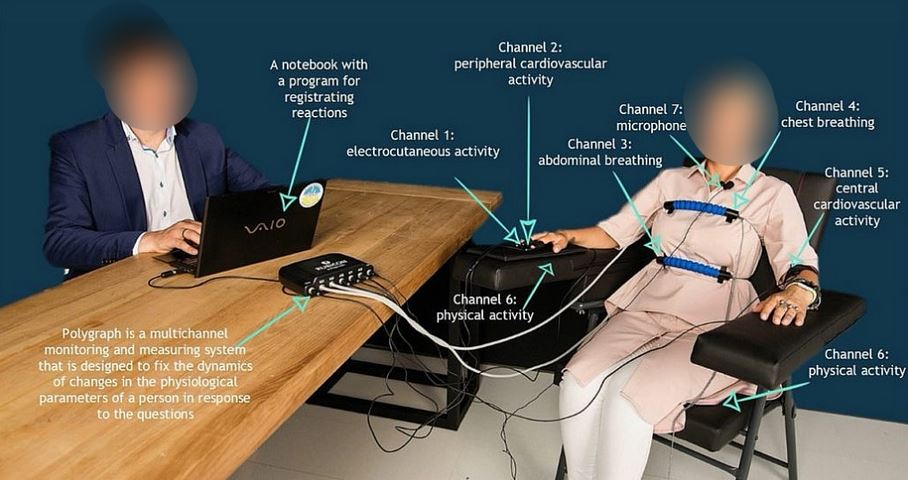
The Central Bureau of Investigation (CBI) concluded polygraph tests on the accused in the Kolkata Rape and Murder Case.
About Polygraph Tests in India
Details
Definition
A procedure measures physiological responses like blood pressure, pulse, respiration, and skin conductivity while a subject answers questions to detect deception.
Physiological Indicators
• Heart Rate and Blood Pressure: Monitored for changes.
• Respiratory Rate: Tracks breathing patterns.
• Galvanic Skin Response (GSR): Measures skin’s electrical conductance, which varies with moisture levels.
Procedure
• Sensor Connection: Attached to the chest, fingertips, and arm.
• Baseline Questions: Establish physiological response baselines.
• Control and Relevant Questions: Analyzed to identify deceptive responses by comparing physiological changes.
Constitutional Provisions
• Article 20(3): Protects against self-incrimination; necessitates consent for polygraph tests.
• Article 21: Concerns about potential violations of the right to life and privacy due to mental torture aspects of polygraph tests.
Legal and Judicial Rulings
• Selvi vs. State of Karnataka (2010): Tests must be voluntary with informed consent.
• D.K. Basu vs. State of West Bengal (1997): Involuntary tests could violate the Right to Life and Privacy.
Admissibility in Court
According to the Indian Evidence Act, 1871, results from polygraph tests are not admissible as evidence in court.
Guidelines
National Human Rights Commission Guidelines (1999): Establish consent and procedural requirements for administering polygraph tests to align with human rights standards.
PYQ:
[2018] Right to Privacy is protected as an intrinsic part of Right to Life and Personal Liberty. Which of the following in the Constitution of India correctly and appropriately imply the above statement?
(a) Article 14 and the provisions under the 42nd Amendment to the Constitution.
(b) Article 17 and the Directive Principles of State Policy in Part IV.
(c) Article 21 and the freedoms guaranteed in Part III.
(d) Article 24 and the provisions under the 44th Amendment to the Constitution.
The recent film Srikanth depicts industrialist Srikanth Bolla’s triumph over visual impairment. It highlights societal stigma, marginalization, and the lack of support for Persons with Disabilities (PwDs).
Status of Education and Jobs for PwD’s in India:
Limited Employment Opportunities: A 2023 report indicates that only five out of 50 Nifty 50 companies employ more than 1% of persons with disabilities (PwDs), with most being public sector firms.
Gap in Accessibility and Supply: Less than 1% of educational institutions in India are disabled-friendly, highlighting a significant gap in accessibility and support for PwDs in both education and employment sectors.
Inadequate Infrastructure: Data shows that fewer than 40% of school buildings have ramps, and only about 17% have accessible restrooms.
Lack of effective implementation: Despite legislative provisions for reservations in government jobs under the Rights of Persons with Disabilities Act, 2016, there is a lack of effective implementation, resulting in low participation of PwDs in the workforce.
Challenges Faced by Persons with Disabilities (PwD)
Social Stigma and Marginalization: PwDs face deep-rooted social stigma, which leads to discrimination and exclusion from various sectors, including education and employment.
Inaccessible Infrastructure: Many public and private spaces lack the necessary infrastructure to accommodate PwDs, such as ramps and accessible restrooms, which severely limits their mobility and independence. For example, Less than 40% of school buildings have ramps, and only about 17% have accessible restrooms.
Educational Barriers: Despite the Right to Education Act, many PwDs encounter barriers such as a lack of inclusive schools, trained teachers, and assistive technologies, leading to high illiteracy rates among disabled individuals.
Workplace Discrimination: PwDs often face discrimination in the workplace, including a lack of reasonable accommodations and societal prejudices that create a “glass ceiling” for their employment opportunities.
Erosion of Identity for PwDs
Negative Representation: The portrayal of PwDs in society often reduces them to objects of pity or ridicule. This negative representation contributes to a societal attitude that undermines their dignity and identity.
Perception as Burdens: Sociologists argue that PwDs are frequently seen as burdens on society, which affects their self-identity and societal participation. This perception is reinforced through media and public discourse.
Intersectionality of Disability: PwDs who also belong to marginalized castes or genders face compounded discrimination, creating a double or triple burden that further erodes their identity and social standing.
Social Exclusion: The stigma surrounding disabilities often leads to exclusion from social activities and relationships, reinforcing the idea that PwDs can only relate to one another, which diminishes their broader social identity.
Way forward:
Enhance Accessibility: Ensure that educational institutions and workplaces are fully accessible by upgrading infrastructure and implementing inclusive design standards.
Combat Stigma and Promote Inclusion: Launch targeted awareness campaigns to challenge negative perceptions of PwDs and promote their positive contributions.
Back2Basics: Sugamya Bharat Abhiyan
Accessible India Campaign or Sugamya Bharat Abhiyan is a program that is set to be launched to serve the differently-able community of the country.
The flagship program has been launched on 3 December 2015, the International Day of People with Disabilities.
The program comes with an index to measure the design of disabled-friendly buildings and human resource policies.
The initiative also in line with Article 9 of the (UN Convention on the Rights of Persons with Disabilities) which India is a signatory since 2007.
The scheme also comes under the Persons with Disabilities Act, 1995 for equal Opportunities and protection of rights which provides non-discrimination in Transport to Persons with Disabilities.
Mains PYQ:
Q The Rights of Persons with Disabilities Act, 2016 remains only a legal document without intense sensitisation of government functionaries and citizens regarding disability. Comment. (2022)
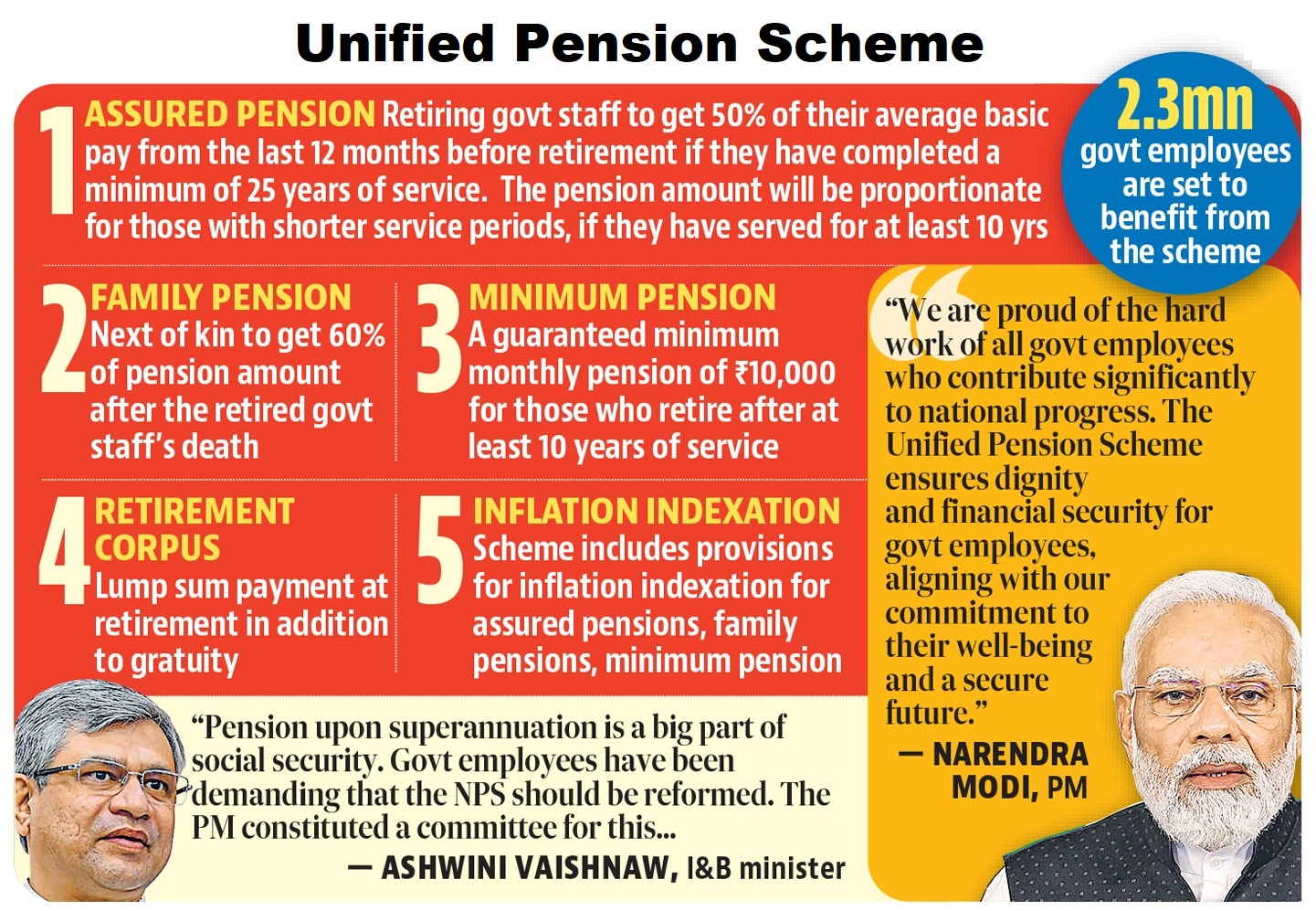
The Union Cabinet approved the Unified Pension Scheme (UPS) for 23 lakh central government employees.
About Unified Pension Scheme (UPS):
Explanation
Implementation Date
Effective from April 1, 2025.
Eligibility
Central government employees with at least 10 years of service.
Assured Pension
50% of average basic pay over the last 12 months prior to retirement for employees with 25+ years of service.
Proportionate benefits for 10-25 years of service.
Assured Minimum Pension
₹10,000 per month for employees with at least 10 years of service.
Assured Family Pension
60% of the pension that the employee was drawing before their death.
Inflation Protection
Pensions indexed to inflation;
Dearness Relief (DR) based on the All India Consumer Price Index for Industrial Workers (AICPI-IW).
Government Contribution
18.5% of basic pay and DA, increased from 14% under the National Pension System (NPS).
Employee Contribution
10% of basic pay and DA (same as under NPS).
Lump Sum Payment on Superannuation
One-tenth of the last drawn monthly pay (including DA) for every 6 months of completed service, in addition to gratuity.
Option to Choose
Employees can choose between UPS and NPS starting from the upcoming financial year; the choice is final once made.
Beneficiaries
Initially benefits 23 lakh central government employees;
May extend to 90 lakh if adopted by state governments.
Difference from NPS
Unlike the market-dependent NPS, UPS provides a guaranteed pension amount, a minimum pension, increased government contribution, fixed family pension, and a lump sum payment at superannuation.
Significance of the UPS
Financial Security: Guarantees a pension and family pension for stable post-retirement income.
Minimum Pension: Ensures at least ₹10,000 per month for retirees, supporting lower-income employees.
Inflation Protection: Indexes pensions to inflation, maintaining purchasing power over time.
Increased Benefits: Raises government contribution to 18.5%, enhancing employee retirement benefits.
Flexibility: Allows choice between UPS and NPS based on personal financial needs.
Family Support: Provides 60% of the pension to the spouse if the employee passes away.
Employee Welfare: Aligns with government goals to improve employee welfare and post-retirement life quality.
PYQ:
[2017] Who among the following can join the National Pension System (NPS)?
(a) Resident Indian citizens only.
(b) Persons of age from 21 to 55 only.
(c) All State Government employees joining the services after the date of notification by the respective State Governments.
(d) All Central Government employees including those of Armed Forces joining the services on or after 1st April, 2004.
The recent brutal rape and murder case in Kolkata has sparked widespread calls for the death penalty for the accused.
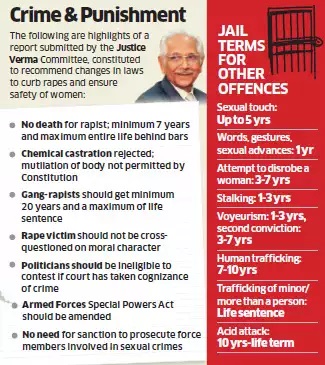
The Justice J.S. Verma Committee, formed in response to the 2012 Delhi gang rape, recommended against the death penalty for rape, even in the rarest of rare cases, arguing that it would be a regressive step.
About Justice J.S. Verma Committee Recommendations
Recommendations on
Explanation
Rape
• It recognized rape as a Crime of Power, not just passion.
• Expand definition to include all forms of non-consensual penetration.
• Remove marital rape exception; marriage should not imply automatic consent. (European Commission of Human Rights in C.R. vs U.K)
Sexual Assault
• Broaden definition to include all non-consensual, non-penetrative sexual acts.
• Penalty: Up to 5 years of imprisonment or fines.
Verbal Sexual Assault
• Criminalize unwelcome sexual threats.
• Punishable by up to 1 year in prison or fines.
Sexual Harassment at Workplace
• Include domestic workers under protections.
• Replace internal complaint committees with Employment Tribunals.
• Employers to compensate victims of sexual harassment.
Acid Attacks
• Propose a 10-year minimum punishment, separate from grievous hurt.
• Establish a compensation fund for victims.
Women in Conflict Areas
• Review AFSPA; exclude government sanction for prosecuting sexual offenses by armed forces.
• Appoint special commissioners to monitor offenses.
Trafficking
• Comprehensive anti-trafficking laws beyond prostitution.
• Protective homes for women and juveniles overseen by High Courts.
Child Sexual Abuse
• Define ‘harm’ and ‘health’ in the Juvenile Justice Act to include both physical and mental aspects.
Death Penalty
• Opposed chemical castration and death penalty for rape.
• Recommend life imprisonment.
Medical Examination of Rape Victims
• Ban the two-finger test; victim’s past sexual history should not influence the case.
Reforms in Case Management
• Set up Rape Crisis Cells, increase police accountability, allow online FIR filing.
• Encourage community policing and increase police personnel.
Union Cabinet’s Decision on the Death Penalty
The Union Cabinet, while clearing an ordinance on sexual assault in 2013, chose NOT to adopt the committee’s recommendation against the death penalty.
Key amendments included:
Section 376A: Death penalty for rape leading to the death of the victim or reducing her to a persistent vegetative state.
Section 376E: Death penalty for repeat offenders.
2018 Amendments: Death penalty for gang rape of a victim under 12 years (Section 376DB) and life imprisonment for rape of a victim under 16 years (Section 376DA).
The Bharatiya Nyaya Sanhita (BNS) includes similar provisions for rape, with specific sections detailing the punishment, including the death penalty for certain cases.
PYQ:
[2014] We are witnessing increasing instances of sexual violence against women in the country. Despite existing legal provisions against it, the number of such incidences is on the rise. Suggest some innovative measures to tackle this menace.
Q The quality of higher education in India requires major improvement to make it internationally competitive. Do you think that the entry of foreign educational institutions would help improve the quality of technical and higher education in the country? Discuss. (UPSC IAS/2015)
Q Professor Amartya Sen has advocated important reforms in the realms of primary education and primary health care. What are your suggestions to improve their status and performance? (UPSC IAS/2016)
Q National Education Policy 2020 conforms with the Sustainable Development Goal-4 (2030). It intends to restructure and reorient education system in India. Critically examine the statement. (UPSC IAS/2020)
Q The Right of Children to Free and Compulsory Education Act, 2009 remains indadequate in promoting incentive-based system for children’s education without generating awareness about the importance of schooling. Analyse. (UPSC IAS/2022)
Mentor comment: The consistently high pass rates, variations across boards, impact on higher education, and CBSE’s own concerns have kept the topic of mark inflation in the news spotlight, with calls for urgent exam reforms to restore credibility to the system. The perception of mark inflation has led to increased demand for entrance exams for college admissions. It also forces colleges to raise cut-offs, making it harder for diligent students to get admitted. The Former Education secretary Anil Swarup had attempted to abolish CBSE’s marks moderation policy in 2017 to check inflation but faced opposition from stakeholders. Experts argue that ending moderation and reforming exams is crucial to address the issue.
Let’s learn!
__
Why in the News?
The Central Board of Secondary Education (CBSE) recently issued an advisory to its affiliated schools, urging them to reevaluate practical exam assessment procedures.
A significant variation was detected between theory and practical marks for over 50% of students in around 500 CBSE schools.
Present status of School Boards in India:
Indian school boards face allegations of inflating marks for classes 10 and 12.
• High Pass Percentages: Evidence includes high pass rates—85% for class 10 and 82% for class 12 in 2023. • Students scoring above 60%: Approximately 61% of class 10 students and 56% of class 12 students scored over 60%. • Mark Compression: High clustering of marks at the top is referred to as mark compression, related to mark inflation.
What are the impacts of such marks inflation?
• Impact on Education Credibility: Both mark inflation and compression undermine the credibility of the education system. • Consequences for Students: These practices hinder student preparedness for higher education and the job market. • Demand for Entrance Exams: The perception of inflated marks has increased demand for higher-education entrance examinations.
What are the current disparities in the Indian School Education System?
Lack of a Standardized Measure: The present examination curriculum pattern makes it difficult to assess the relative academic credentials of students certified by different boards.
For example, in both secondary and higher secondary examinations, the proportion of students securing above 60% was lower than the national average in several states.
However, this does not necessarily mean that students in other states performed better on a comparable scale.
Lack of Corrective Measures: Marks are supposed to reflect a student’s academic knowledge and skills, but comparing them with standardized national-level tests like NEET and JEE is problematic.
These tests are designed as elimination processes for admission to specific higher education programs, and not to evaluate subject knowledge as per the prescribed curriculum.
Moreover, not all class 12 students appear for these entrance exams, and those who do usually undergo special coaching which incurs huge costs.
Lack of Policy Suggestions: The National Achievement Survey (NAS) conducted by NCERT for a sample of students annually is scientifically designed but fails to serve as a benchmark for studying mark inflation.
There is little scope to connect estimated scores with factors like curriculum design, school efficiency, and teaching-learning processes.
Need for Accountability in the System: The current opaque system leads to various issues, necessitating transparency in all processes, from question paper setting to marking and result publication.
What can be done for the System’s Revaluation and Enhanced Accountability?
Establish a standardized system: The govt needs to provide resources outlining how learning outcomes are assessed and marks awarded, including examples.
Further, standardize the procedures for question paper handling, answer book printing, distribution, and collection. Allow students to view their answer scripts post-results and apply for revaluation at a nominal fee.
Need for Technical Intervention: States should establish clear guidelines for question formats and expected answers. Secondly, they need to implement scanning and online evaluation to minimize errors in the marking system.
Updating the curriculum to align with higher educational standards can ensure that students are adequately prepared, reducing the need for inflated marks to reflect competence.
Public Awareness Campaigns: Educating stakeholders about the implications of mark inflation can foster a culture of integrity and accountability in educational assessments.
Collaboration with Educational Institutions: Governments can work with schools and universities to create clear pathways for students, ensuring that grades reflect true academic ability and readiness for further education or the job market.
Conclusion: While the Indian government has managed to make education accessible (SDG 4) for millions of children, the quality of said education remains still poor due to non-transparent examinations. India can attain quality school education in the real sense shortly, but it will require addressing the abovementioned challenges.
The Supreme Court of India denied permission to the parents of Harish Rana, a 32-year-old man in a vegetative state for 11 years, to remove his Ryles tube which is a device used for feeding.
A Ryles tube, also known as a nasogastric (NG) tube, is a medical device used for various purposes related to nutrition and gastric management. It is inserted through the nose, passing through the nasal cavity, down the esophagus, and into the stomach.
Recent Supreme Court Judgment:
The Bench headed by CJI D.Y. Chandrachud observed that the Ryles tube is not a life support system and therefore could not be withdrawn.
This decision has stirred legal and ethical debates, as the Supreme Court’s 2018 judgment permits the withdrawal of life support in terminal cases under the concept of “passive euthanasia.”
Passive euthanasia involves the withdrawal of medical treatment with the intention of hastening the death of a terminally ill patient.
The Supreme Court initially legalized this practice in 2018, allowing patients to create a “living will” to refuse life-sustaining treatment when they are unable to communicate their wishes.
Ethical Challenges:
Question of whether the decision benefits the patient: The judgment raises concerns about whether the decision benefits the patient, as prolonging life in such a condition may increase suffering.
Prolonged suffering: The principle of not causing harm is challenged since keeping the patient in a vegetative state with artificial feeding may lead to prolonged suffering for both the patient and their caregivers.
Against Right to Life and Death: The patient’s rights to a dignified life and death may be compromised which is addressed in various judgments like Common Cause v. Union of India (2018). This judgment recognised the right to die with dignity as part of the right to life under Article 21.
Autonomy: The patient’s right to choose, which is central to the concept of dignity, has been overlooked. The judgment did not consider the wishes of the patient or their family in determining the course of action.
Need for Legal Clarity:
Distinguishing Euthanasia from Withdrawal of Life Support: There is a pressing need to legally clarify the difference between euthanasia and the withdrawal of futile life-sustaining interventions.
Involvement of Medical and Ethical Experts: The decision-making process in such sensitive cases should involve palliative care physicians and ethical experts to ensure that medical and ethical considerations are fully addressed.
Advance Care Planning: Promoting Advance Medical Directives and Advance Care Planning is crucial to empower individuals to have control over their end-of-life decisions, ensuring that their rights to a good quality of life and death are respected.
Systemic Reforms: The judgment highlights the need for systemic reforms to avoid forcing families into legal battles and to ensure that patients’ rights are safeguarded with appropriate legal frameworks.
Conclusion: The recent Supreme Court judgment highlights the urgent need for legal clarity, ethical considerations, and systemic reforms to protect patient rights and ensure dignity in end-of-life decisions.
Mains question for practice:
Q Discuss the need for legal clarity and systemic reforms to uphold the dignity and rights of patients in end-of-life decisions. (150 words) 10M
Prime Minister Modi has presented the BHISHM Cube, a state-of-the-art mobile hospital designed for rapid deployment in disaster zones to Ukraine.
What is the BHISHM Cube?
The BHISHM Cube is an advanced mobile hospital unit designed for rapid deployment in disaster zones and emergency situations.
It is developed under the “Project BHISHM” (Bharat Health Initiative for Sahyog, Hita, and Maitri), reflecting India’s commitment to providing swift medical assistance in crisis areas.
The unit is capable of treating up to 200 casualties.
Key Features:
It weighs 720 kg and is composed of 72 components that can be easily transported by hand, bicycle, or drone.
The unit can be fully operational within 12 minutes of deployment, a critical feature in emergencies where every second counts.
It includes an operating theatre, X-ray machines, ventilators, and facilities for treating a wide range of injuries.
It incorporates AI and data analytics for real-time monitoring and coordination of medical services.
It also uses RFID-tagged equipment for efficient tracking and management of medical supplies.
The unit is robust and waterproof, making it suitable for diverse environments and capable of withstanding various weather conditions.
Significance of the move
By providing the BHISHM Cube to countries in need, such as Ukraine, India demonstrates its commitment to global humanitarian efforts.
The project aligns with India’s broader initiatives like ‘Aarogya Maitri’, aimed at supporting developing countries affected by natural disasters or crises.
The deployment of the BHISHM Cube enhances disaster preparedness by ensuring that essential medical services are available when and where they are needed most.
The gifting serves as a tool of soft diplomacy, strengthening India’s international relations by contributing to global health and safety.
PYQ:
[2022] With reference to the Ayushman Bharat Digital Mission, consider the following statements:
Private and public hospitals must adopt it.
As it aims to achieve universal, health coverage, every citizen of India should be part of it ultimately.
It has seamless portability across the country.
Which of the statements given above is/are correct?
Bridge gaps in health, education, and livelihoods; enhance infrastructure in PVTG communities aligned with existing schemes from nine ministries.
Total Outlay
Rs 24,104 crore over three years
Rs 15,000 crore allocated under the Development Action Plan for the Scheduled Tribes (DAPST) for the housing component over three years.
Implementation
Central Sector and Centrally Sponsored Schemes designed to enhance socio-economic conditions of PVTGs.
The Ministry of Tribal Affairs through the State Governments/ UT Administration/departments have undertaken habitation level data collection exercise through PM Gati Shakti mobile application to estimate PVTG population figures and infrastructure gaps under PM-JANMAN Mission.
Coverage
Targets 75 PVTGs in 18 states and 1 Union Territory, focusing on health, education, and livelihoods.
Competitive Federalism
Performance-based ranking of districts; top districts and Ministries recognized and rewarded for outstanding performance.
PYQ:
[2017] What are the two major legal initiatives by the State since Independence addressing discrimination against Scheduled Tribes (STs)?
[2019] Consider the following statements about Particularly Vulnerable Tribal Groups (PVTGs) in India:
PVTGs reside in 18 States and one Union Territory.
A stagnant or declining population is one of the criteria for determining PVTG status.
There are 95 PVTGs officially notified in the country so far.
Irular and Konda Reddi tribes are included in the list of PVTGs.
Which of the statements given above are correct?
(a) 1, 2 and 3
(b) 2, 3 and 4
(c) 1, 2 and 4
(d) 1, 3 and 4
The NHRC India has taken suo motu cognizance of the two alleged incidents of food poisoning related deaths in an orphanage in Andhra Pradesh.
About National Human Rights Commission (NHRC)
Details
Establishment
As a Statutory Body and established under the Protection of Human Rights Act, 1993.
Functions
Inquire into any violation of human rights
Recommend immediate interim relief to victims or their families
Intervene in court proceedings involving human rights violations
Review constitutional and legal safeguards for human rights
Study international instruments on human rights
Support the efforts of NGOs working in the field of human rights
Powers
Regulate its own procedure
Possess all the powers of a civil court
Proceedings have a judicial character
May take any of the following steps upon the completion of an inquiry:
To recommend to the concerned government or authority to make payment of compensation or damages to the victim.
To recommend to the concerned government/authority the initiation of proceedings for prosecution or any other action against the guilty public servant.
To recommend to the concerned government/authority for the grant of immediate interim relief to the victim.
To approach the SC or the HC concerned for the necessary directions, orders, or writs.
Chairperson
Must be a former Justice of the Supreme Court or CJI(appointed by the President of India)
Members
Four full-time members;
Chairperson: former Supreme Court Justice or Chief Justice;
Other Member: former Judge of the Supreme Court;
Other Member: former Chief Justice of a High Court;
Three Members: with knowledge or experience in human rights, including at least one woman –
Seven ex-officio members: Chairpersons of National Commissions viz., National Commission for Scheduled Castes, National Commission for Scheduled Tribes, National Commission for Women , National Commission for Minorities, National Commission for Backward Classes, National Commission for Protection of Child Rights; and the Chief Commissioner for Persons with Disabilities.
Appointment
Appointed by the President based on a committee recommendation including the Prime Minister, Speaker of Lok Sabha, Home Minister, Leaders of the Opposition in Lok Sabha and Rajya Sabha, and others
Consultation with the Chief Justice of India for judicial appointments
Removal
By order of the President of India
Consultation with the Supreme Court before removal
Terms of Office
Hold office for a term of three years or until the age of 70
Ineligibility for further government employment after office
Eligible for reappointment
Salaries
Determined by the Central government
Reporting
Submits annual or special reports to the Central government and the concerned State government
Reports laid before the respective legislatures, along with a memorandum of action taken on the recommendations and reasons for non-acceptance of any recommendations
Limitations
The commission is not empowered to inquire into any matter after the expiry of one year from the date on which the act constituting the violation of human rights is alleged to have been committed
Functions are recommendatory in nature, with no power to punish or award relief to violators
Limited role concerning armed forces violations
PYQ:
[2011] Consider the following:
Right to education.
Right to equal access to public service.
Right to food.
Which of the above is/are Human Right/Rights under “Universal Declaration of Human Rights”?
PYQ Relevance: Q (a): Russia and Ukraine war has been going on for the last seven months. Different countries have taken independent stands and actions keeping in view their own national interests. We are all aware that war has its own impact on the different aspects of society, including human tragedy. What are those ethical issues that are crucial to be considered while launching the war and its continuation so far? lllustrate with justification the ethical issues involved in the given state of affair. (b): Write short notes on the following in 30 words each: (i) Constitutional morality (ii) Conflict of interest (iii) Probity in public life (iv) Challanges of digitalization (v) Devotion to duty (UPSC IAS/2022)
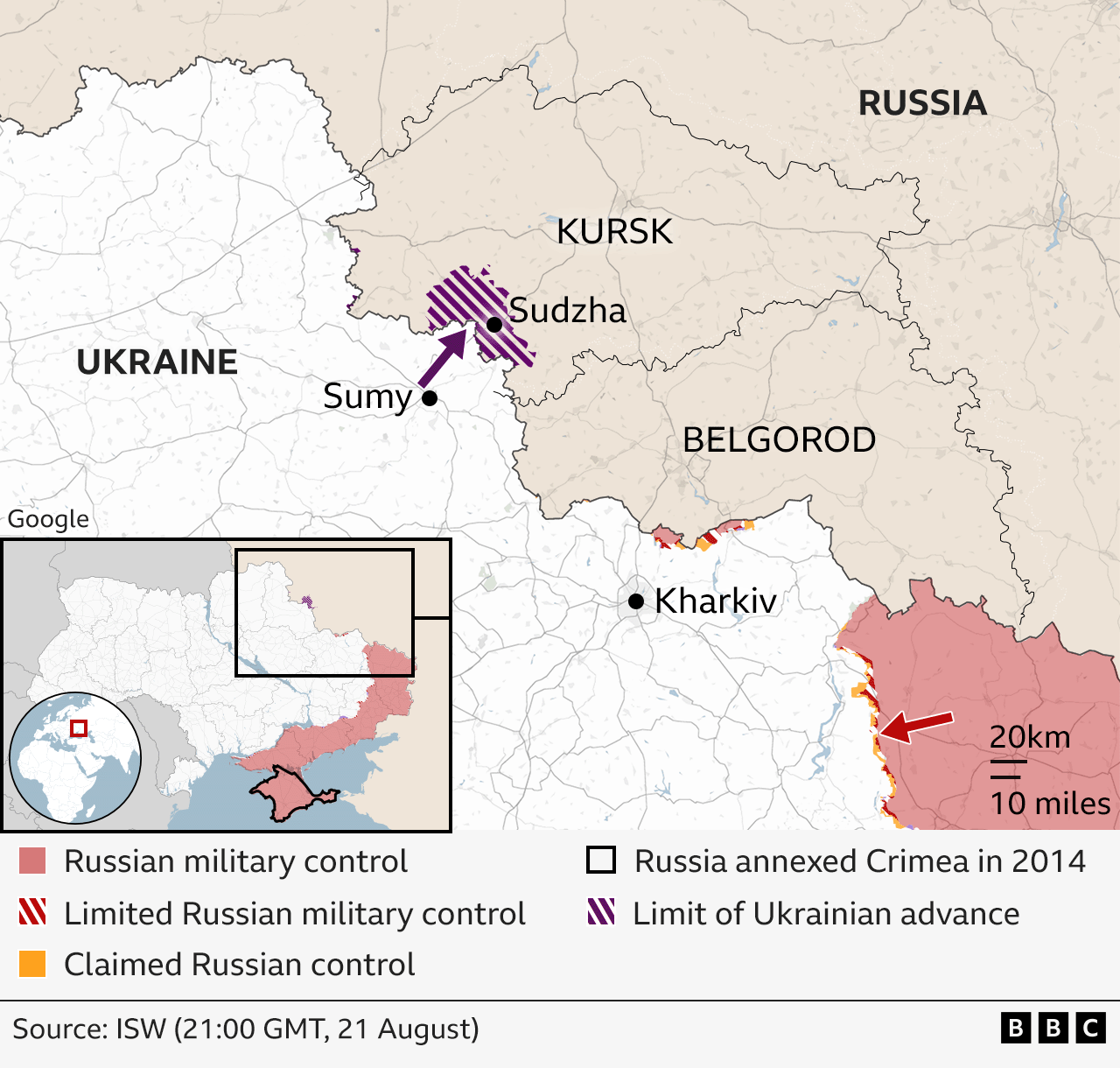
Mentor comment: Ukraine had recently launched a surprising military offensive into the Kursk region of Russia, capturing several hundred Russian soldiers and gaining control over approximately 1,000 square kilometers of territory. This move is seen as a bold tactic to shift the war dynamics and boost morale among Ukrainian forces and civilians. While Ukraine made gains in Kursk, Russian forces are advancing towards the Ukrainian city of Pokrovsk, a crucial logistics hub. The capture of Pokrovsk could again escalate the political tensions reflecting Russia’s position in the ongoing conflict
Let’s learn!
__
Why in the News?
Ukraine’s recent military incursion into the Kursk region of Russia outlines its tactical and political implications in the ongoing conflict.
Ukrainian Incursion:
Surprise Attack: Ukraine launched an unexpected offensive into the Kursk region, capturing several hundred Russian soldiers and seizing approximately 1,150 square kilometers of territory.
Strategic Goals: The operation aims to divert Russian forces from their offensive in Ukraine, particularly around the critical city of Pokrovsk, which is under siege and vital for Ukrainian logistics.
What are the long-term implications of Ukraine’s capture of Kursk for future negotiations?
•Territorial Gains as Leverage: By occupying Kursk, Ukraine has secured valuable territory that can serve as a bargaining chip in future negotiations. This strategic advantage is crucial, especially if Ukraine faces reduced military support from the West, particularly in the event of a change in U.S. leadership.
•Pressure on Russia: The need for Russia to defend its territory in Kursk diverts resources from ongoing offensives in Eastern Ukraine, particularly in Donbas. This could weaken Russia’s overall military effectiveness and complicate its strategy, potentially leading to a more favorable environment for negotiations for Ukraine.
Significance of Pokrovsk: It is formerly known as Krasnoarmiisk and Grishino, is a city and the administrative center of Pokrovsk Raion in Donetsk Oblast, Ukraine.
Key Logistics Hub: Pokrovsk’s capture by Russian forces would significantly enhance their operational capabilities in Eastern Ukraine, potentially leading to further territorial gains.
Ukrainian Withdrawal: Ukrainian troops are being ordered to withdraw from Pokrovsk, indicating the pressure they face from advancing Russian forces.
Tactical and Political Analysis:
Operational Secrecy: Ukraine’s successful execution of the incursion was attributed to exceptional operational security, which prevented leaks and allowed for a covert buildup of forces.
Russian Response: Russia’s military has reacted slowly, focusing on containing the incursion rather than reversing it, revealing weaknesses in their intelligence and troop readiness.
Increase in Bargaining Power: The incursion enhances Ukraine’s negotiating position for potential future discussions, especially with looming uncertainties regarding Western military support.
Risks for Ukraine: While the offensive has been a tactical success, it poses risks of overstretching Ukrainian forces and facing significant losses in the overall region if Russia mounts a concentrated counterattack.
Can India make Putin stop Russia’s War in Ukraine?
India has been warming to the West in recent years, especially given rising border tensions with China, but, at the same time, India cannot disallow its relationship with Russia considering United States. India’s visit (in July 2024) comes as Ukraine pushes its initiative in Russia’s southwestern region of Kursk.
•Humanitarian Concern: India during the recent talks with Putin in July, secured several concessions and seemingly chided the Russian leader over the war, calling the deaths of children killed in a Russian strike on a hospital “unbearable.” •Economic interests of India: Bilateral trade with Russia soared last year on the back of its energy purchases, with India in July topping China as the largest importer of Russian oil. PM Modi and Zelensky are expected to discuss issues of bilateral and multilateral cooperation” and sign multiple documents.
Conclusion: The Kursk operation marks a significant shift in the conflict, with Ukraine demonstrating its capability to operate within Russian territory. Ukrainian offensive stands out and deserves and merits closer scrutiny because no country since Hitler’s Germany has ever invaded any part of Russia.
However, the long-term viability of this strategy remains uncertain as both sides prepare for ongoing military engagements.
![[24th August 2024] The Hindu Op-ed: The annual accusation of board exam mark inflation](https://www.civilsdaily.com/wp-content/uploads/2024/08/24-Aug-1568x882.jpg)
![[23rd August 2024] The Hindu Op-ed: The Kursk gambit, Ukrainian tactics, and battle realities](https://www.civilsdaily.com/wp-content/uploads/2024/08/23-Aug-1568x882.jpg)