India was ranked 126th out of 143 nations in the World Happiness Report 2024, a global happiness index which was released, March 20 to mark the UN’s International Day of Happiness.
AbouttheWorld Happiness Report
The WHR is an annual publication of the UN Sustainable Development Solutions Network.
It is released inpartnership by Gallup, the Oxford Wellbeing Research Centre, the UN Sustainable Development Solutions Network (SDSN), and the World Happiness Report’s Editorial Board
It measures three main well-being indicators: life evaluations, positive emotions, and negative emotions (described in the report as positive and negative affect).
The report considers six key factors: social support, income, health, freedom, generosity, and the absence of corruption.
It was adopted by the UN General Assembly based on a resolution tabled by Bhutan.
Key Highlights of the 2024 Report
Top: For the seventh successive year, Finland topped the list of the happiest countries in the world.
Runner-ups: The other countries in the top ten were Denmark, Iceland, Sweden, Israel, the Netherlands, Norway, Luxembourg, Switzerland and Australia.
Bottom: Afghanistan was at the bottom of the list.
Indian Scenario
Ranking: India maintains its position at 126th in the happiness index. Surprisingly, it is behind Pakistan, Libya, Iraq, Palestine and Niger.
Neighbourhood: China was ranked 60th, Nepal at 93, Pakistan at 108, Myanmar at 118, Sri Lanka at 128 and Bangladesh at 129th spots.
Influencing Factors: Marital status, social engagement, physical health, and satisfaction with living arrangements influence life satisfaction among older Indians.
Gendered Happiness: Older Indian women tend to report higher life satisfaction despite facing more stressors and health challenges.
Key Predictors: Factors like education level, social caste, social support, perceived discrimination, and self-rated health significantly impact life satisfaction among older Indians.
PYQ:
2018: “Rule of Law Index” is released by which of the following?
Amnesty International
International Court of Justice
The Office of UN Commissioner for Human Rights
World Justice Project
Practice MCQ:
With reference to the World Happiness Report, 2024, consider the following statements:
The report is an annual publication of the UN Sustainable Development Solutions Network.
It was adopted by the UN General Assembly based on a resolution tabled by Bhutan.
India’s ranking has been consistently improved in this report in last two years.
Karnataka has become the third state in South India to prohibit the use of specific coloring agents in cotton candy and gobi manchurian due to their identified harmful effects.
Context-
While the Government plans to create awareness among manufacturers, it has also urged consumers to be aware of what they are consuming.
The Food Safety and Standards Act, 2006 stipulates a fine of not less than ₹10 lakh and a jail term of a minimum of seven years, extending to life imprisonment, against those using banned chemical substances in food products.
What did the survey results show?/Key findings from the sample testing
Presence of Harmful Chemicals: Laboratory tests revealed the presence of harmful chemicals in many samples collected from the state.
Cotton Candy Samples: Out of 25 cotton candy samples collected, 15 were found to be unsafe as they contained added colors, while the remaining 10 were deemed safe as they were made without added colors.
Gobi Manchurian Samples: Among the 171 samples of gobi manchurian collected, 107 were declared unsafe due to the presence of added colors, while 64 were considered safe as they did not contain added colors.
What were the harmful chemicals?
Harmful Chemicals: The unsafe samples of cotton candy contained traces of sunset yellow, tartrazine, and rhodamine-b, while unsafe gobi Manchurian samples had tartrazine, sunset yellow, and carmoisine. Rhodamine-b, a suspected carcinogen, is already banned.
Restrictions on Tartrazine: Although tartrazine is an approved artificial food color, there are restrictions on its usage. It can only be used in specific packed food items, with prescribed amounts. It cannot be used in freshly prepared food items.
Health Concerns: The Food Safety Commissioner emphasized that prolonged consumption of snacks containing artificial colors can lead to severe diseases like cancer, highlighting the importance of the ban in safeguarding public health.
What are the Penalties?
Prohibition on Artificial Colors: Rule 16 of the Food Safety and Standards Act prohibits the use of artificial colors in the preparation of gobi manchurian.
Approved Limits for Food Colors: While certain food colors are allowed within approved limits, non-permitted colors like rhodamine-b should not be used in the preparation of cotton candy.
Penalties for Offenders: Violators face severe penalties, including cancellation of licenses for commercial activities, hefty fines, and imprisonment. The Food Safety and Standards Act specifies a minimum fine of ₹10 lakh and a jail term of at least seven years, which can extend to life imprisonment, for those found using banned chemical substances in food products.
Way Forward:
Enforcement and Monitoring: Health safety officials will likely conduct random checks to ensure compliance with the ban on harmful chemicals and artificial colors.
Public Awareness Campaigns: The government will continue its efforts to raise awareness among manufacturers and consumers regarding the risks associated with harmful chemicals and artificial colors in food products.
Regulatory Review: There might be a review of existing regulations and standards related to food safety to further strengthen controls and ensure comprehensive coverage of potentially risky food items beyond gobi manchurian, such as kebabs, that may use coloring agents.
Collaboration with Stakeholders: Collaboration between government authorities, food manufacturers, and other stakeholders in the food industry will be crucial to implement and enforce the ban effectively. This may include consultations, partnerships, and dialogues to address challenges and ensure compliance with regulations.
Conclusion: Karnataka banned certain coloring agents in response to findings of harmful chemicals in food samples. Strict penalties and enforcement measures are in place, alongside awareness campaigns and collaboration with stakeholders to ensure compliance and safeguard public health.
The Ministry of Electronics and Information Technology (MeiTY) released the National Data Governance Framework Policy (NPD Framework) which was touted as the first building block of the digital architecture being conceived to maximize data.
Context:
The role of digitization in realizing India’s vision of becoming a $5 trillion economy cannot be overstated.
As per a NASSCOM report, data and artificial intelligence (AI) can add approximately $450-500 billion to India’s GDP by 2025.
Types of data:
Personal Data – Data containing identifiers that can be used to identify specific individuals.
Non-Personal Data (NPD)- data excluding personal data. It constitutes the primary type of citizen data obtained by the government and holds the potential to serve as a ‘public good’.
Significance of Non-personal data-
NPD as a Public Good: NPD (Non-Personal Data) is considered the primary type of citizen data collected by the government. It holds the potential to serve as a ‘public good’, implying its utility and value to society as a whole.
Integration of NPD in Public Services: Advocates for integrating NPD into the delivery of public services to create synergies and scalable solutions. Integration aims to enhance the effectiveness and efficiency of public service delivery.
Application of Advanced Analytics and AI: Utilizing high-value advanced analytics and artificial intelligence (AI) on NPD can lead to predicting socially and economically beneficial outcomes. Such applications can span across various sectors of the economy.
Key Sectors for Data-Driven Insights: Meteorological and disaster forecasts: Utilizing NPD to enhance predictions and preparedness for weather-related events and disasters. Infrastructure capacity and citizen use patterns: Understanding how citizens interact with infrastructure to optimize usage and planning.
Mobility and housing patterns: Analyzing data to inform transportation and housing policies.
Employment trends: Using NPD to predict and address changes in employment patterns and workforce needs.
Informing Governance and Public Functions: NPD-driven insights can better inform decision-making in governance and public functions. Data analytics can provide valuable information for policy formulation and resource allocation.
Challenges related to NDP:
Privacy and Security Concerns: The unprotected inter-flow of NPD across government departments, third parties, and citizens can lead to privacy breaches and make sensitive data vulnerable. This vulnerability can disproportionately benefit capacity-carrying actors such as Big Tech.
Risk of Faulty Decision-making: Imperfect analysis of crucial public trends resulting from the exchange of NPD can lead to faulty decision-making. The inefficient exchange of data fails to unlock the power of interdisciplinary legislative and policy-making.
Gaps in the NPD Framework: The NPD Framework lacks actionable guidance and practical operationalization, focusing on abstract high-level principles and objectives. It overlooks mechanisms for pricing data, appropriate legal structures for data exchange, and standardized governance tools.
Lack of Legislation and Operationalization: While legislation is expected, the practical implementation and operationalization of the NPD Framework are overlooked. Questions remain unanswered regarding stakeholder rights and obligations across sectors.
Steps by Government:
Agriculture Data Exchange in Telangana: Telangana State has developed an agriculture data exchange platform. The platform aims to facilitate the exchange of agricultural data among various stakeholders. It is likely designed to enhance decision-making, productivity, and innovation in the agriculture sector.
India Urban Data Exchange (IUDX): The Ministry of Housing & Urban Affairs, in collaboration with the Indian Institute of Science, has established the India Urban Data Exchange (IUDX).
IUDX enables better urban planning, infrastructure development, and governance through data-driven insights.
Data Exchanges for Geospatial Policy: The Department of Science & Technology has announced plans to establish data exchanges to implement aspects of the National Geospatial Policy.
Measures to address these challenges:
Need for Critical Evaluation and Enhancement: A critical evaluation of the NPD Framework is necessary to address existing gaps. Enhancements to the framework can supplement MeiTY’s efforts to regulate NPD and facilitate interoperability across sectors.
Learn from International practice: countries like Australia, the UK, and Estonia highlight the adoption of data exchange frameworks and protocols. These frameworks have been applied across various sectors such as housing, employment, aged care, and agriculture to address specific issues like unemployment.
Regulatory Design for Data Exchanges: Creating a regulatory design for data exchanges in India can digitize and automate public welfare functions. It can reduce administrative burden, facilitate inter-sectoral integration, and build safeguards for using and sharing NPD, making civic functions more participatory.
Stakeholder Consultation: Engage stakeholders from government, industry, academia, and civil society in the evaluation process. Gather feedback on practical challenges faced in implementing the framework and areas needing clarification or enhancement.
Conclusion: A comprehensive evaluation and enhancement of the NPD Framework are imperative. Learning from international practices, establishing regulatory designs for data exchanges, and fostering stakeholder consultations will pave the way for effective governance of non-personal data.
The Ministry of Electronics and Information Technology has designated the Press Information Bureau’s Fact Check Unit to point out misinformation about Central government departments on social media platforms ahead of the election.
Context-
According to the IT Rules of 2021, social media platforms might lose their legal protection from being held responsible for content posted by users if they decide to keep the misinformation flagged by the Fact Check Unit.
Background of this news-
Due to the controversy surrounding the concept, the Union government had delayed officially notifying the Fact Check Unit as there was ongoing litigation at the Bombay High Court challenging the provision.
However, this month, the court decided not to prolong a temporary halt that prevented the government from implementing the rules.
Key points as per IT Rules, 2021-
Mandates: In essence, the IT Rules (2021) demand that social media platforms exercise heightened diligence concerning the content present on their platforms. Legal obligation on intermediaries to make reasonable efforts to prevent users from uploading such content.
Appoint a Grievance Officer: Social media platforms are mandated to set up a grievance redressal mechanism and promptly remove unlawful and inappropriate content within specified timeframes.
Ensuring Online Safety and Dignity of Users: Intermediaries are obligated to remove or disable access within 24 hours upon receiving complaints about content that exposes individuals’ private areas, depicts them in full or partial nudity, shows them engaged in sexual acts, or involves impersonation, including morphed images
Informing users about privacy policies is crucial: Social media platforms’ privacy policies should include measures to educate users about refraining from sharing copyrighted material and any content that could be considered defamatory, racially or ethnically offensive, promoting pedophilia, or threatening the unity, integrity, defense, security, or sovereignty of India or its friendly relations with foreign states, or violating any existing laws.
Fake news on social media can have several negative impacts on governments-
Undermining Trust- Fake news can erode public trust in government institutions and officials. When false information spreads widely, it can lead to scepticism and doubt about the government’s credibility.
Destabilizing Democracy- Misinformation can distort public perceptions of government policies and actions, potentially leading to unrest, protests, or even violence. This can destabilize democratic processes and undermine the functioning of government.
Manipulating Public Opinion- Fake news can be strategically used to manipulate public opinion in favour of or against a particular government or political party. By spreading false narratives, individuals or groups can influence elections and policymaking processes.
Impeding Policy Implementation- False information circulating on social media can create confusion and resistance to government policies and initiatives. This can impede the effective implementation of programs and reforms.
Wasting Resources- Governments may be forced to allocate resources to address the fallout from fake news, such as conducting investigations, issuing clarifications, or combating disinformation campaigns. This diverts resources away from other important priorities.
Fueling Division- Fake news can exacerbate social and political divisions within a country by spreading divisive narratives or inciting hatred and hostility towards certain groups or communities. This can further polarize society and hinder efforts towards unity and cohesion
Measures to Tackle Fake News on Social Media:
Mandatory Fact-Checking: Implement a requirement for social media platforms to fact-check content before dissemination.
Enhanced User Education: Promote media literacy and critical thinking skills to help users discern reliable information from fake news.
Strengthened Regulation: Enforce stricter regulations on social media platforms to curb the spread of misinformation and hold them accountable for content moderation.
Collaborative Verification: Foster partnerships between governments, fact-checking organizations, and social media platforms to verify the accuracy of information.
Transparent Algorithms: Ensure transparency in algorithms used by social media platforms to prioritize content, reducing the spread of false information.
Swift Removal of Violative Content: Establish mechanisms for prompt removal of fake news and penalize users or entities responsible for spreading it.
Public Awareness Campaigns: Launch campaigns to raise awareness about the detrimental effects of fake news and promote responsible sharing practices.
Conclusion: To address misinformation, governments should enforce IT Rules (2021), empower fact-checking units, and promote media literacy. Collaboration between authorities, platforms, and citizens is vital for combating fake news and upholding democratic values.
India is strongly pursuing its proposal for lowering the cost of cross-border remittances, which it presented at the WTO’s 13th Ministerial Conference in Abu Dhabi last month.
It has now requested the WTO’s general council (GC) to initiate a work program to make recommendations for reducing remittance costs.
Lowering the costs of remittances would primarily benefit low and middle-income countries, which accounted for 78% of remittances flow in 2023, according to estimates.
India’s draft proposal at MC13 highlighted that the global average cost for sending remittances remained high at 6.18%, more than twice the SDG target.
What is Cost of Remittances?
Remittances are financial transfers sent by migrant workers to their families or relatives in their home countries.
The cost of remittances refers to the expenses incurred by individuals or businesses when sending money from one location to another, typically across international borders.
The cost components of cross-border payments can include:
Bank fees,
Intermediary fees,
Compliance fees,
Operational costs, and
FX (foreign exchange) rate margin
Innovative technologies like DeFi payment rails are emerging to reduce the total cost of payments for cross-border transactions.
About World Trade Organization (WTO)
Details
Establishment
1995, replacing GATT
Objective
To regulate international trade
Headquarters
Geneva, Switzerland
Members
164
India is a Founding Member.
Objectives
Formulate rules for trade
Negotiate further liberalization
Settle disputes
Assist developing countries
Cooperate with major economic institutions
Principles
Non-Discrimination
Most Favored Nation
National Treatment
Reciprocity
Predictability through Binding Commitments
Transparency
Encourage Development and Reforms
Important Trade Agreements
Agreement on Agriculture (AoA),
Agreement on TRIPS (Trade-Related Aspects of Intellectual Property Rights),
Agreement on the Application of Sanitary and Phytosanitary Measures (SPS),
Agreement on Technical Barriers to Trade (TBT),
Agreement on Trade-Related Investment Measures (TRIMS),
General Agreement on Trade in Services (GATS) etc.
WTO Agreement on Agriculture (AoA)
Negotiated during Uruguay Round (1995)
Aims to reform trade in agriculture
Allows support for rural economies with fewer trade “distortions”
Focuses on improving market access, reducing subsidies, and eliminating export subsidies
Subsidies Types:
Green Box – No distortion in trade
Amber Box – Can distort production and trade (subject to limits)
Blue Box – Subsidies linked to production-limiting programs
Most Favoured Nation Clause
Ensures non-discriminatory trade
Prevents discrimination among trade partners
First clause in GATT
Special trade statuses extended to all WTO members
PYQ:
Q.The terms ‘Agreement on Agriculture’, ‘Agreement on the Application of Sanitary and Phytosanitary Measures’ and Peace Clause’ appear in the news frequently in the context of the affairs of the: (2015)
Food and Agriculture Organization
United Nations Framework Conference on Climate Change
World Trade Organization
United Nations Environment Programme
Q.Which of the following constitute Capital Account? (2013)
Foreign Loans
Foreign Direct Investment
Private Remittances
Portfolio Investment
Select the correct answer using the codes given below.
1, 2 and 3
1, 2 and 4
2, 3 and 4
1, 3 and 4
Practice MCQ:
Consider the following statements:
India is the highest recipient of remittances globally.
UAE is the largest source of remittances to India.
The current cost of remittances meets the SDG target.
The National Internet Exchange of India (NIXI) is proud to announce the launch of the BhashaNet portal for the upcoming Universal Acceptance (UA) Day.
Universal Acceptance is the principle that all domain names and email addresses should be treated equally, regardless of the characters used in them.
What is BhashaNet Portal?
The Bhasha-Net Portal is a digital platform launched by NIXI, aimed at promoting Universal Acceptance (UA).
The portal specifically focuses on ensuring that individuals, regardless of the language or script they use, can fully participate in the digital world.
The portal is designed to provide resources, tools, and information to support the integration of diverse languages and scripts into online platforms, websites, and applications.
Objectives:
To provide a truly multilingual internet, where local language website name and local language email id, work everywhere seamlessly.
To foster digital inclusivity by addressing linguistic barriers and promoting the use of local languages and scripts in digital communication.
About National Internet Exchange of India (NIXI)
Established on June 19, 2003, the NIXI is a not-for-profit organization under the auspices of MeitY.
NIXI is dedicated to enhancing internet penetration and adoption in India by facilitating essential infrastructure and services.
It plays a crucial role in enabling the internet ecosystem to be accessible and utilized by the masses, thereby promoting digital empowerment and inclusion nationwide.
Four key services include-
1. Setting up Internet Exchange Points,
2. Managing the .IN Registry,
3. Promoting IPv4 and IPv6 address adoption through IRINN, and
4. Offering data center services under NIXI-CSC.
Back2Basics:
IPv4
IPv6
Address Format
32-bit address format (e.g., 192.0.2.1)
128-bit address format (e.g., 2001:0db8:85a3:0000:0000:8a2e:0370:7334)
Vast address space (approximately 3.4×10^38 addresses)
Header Length
Fixed-length header (20 bytes)
Variable-length header (40 bytes or more)
Header Options
Limited options
Expanded options for quality of service, security, and mobility
Broadcast
Uses broadcast addresses for network discovery and ARP (Address Resolution Protocol)
Uses multicast addressing for efficient communication
Security
Limited built-in security features
Built-in IPsec (Internet Protocol Security) support for end-to-end encryption and authentication
Adoption Status
Widely deployed and used
Increasing adoption but not yet fully ubiquitous
PYQ:
2011: What is “Virtual Private Network”?
It is a private computer network of an organization where the remote users can transmit encrypted information through the server of the organization
It is a computer network across a public internet that provides users access to their organization’s network while maintaining the security of the information transmitted
It is a computer network in which users can access a shared pool of computing resources through a service provider
None of the statements (A), (B) and (C) given above is a correct description of Virtual Private Network
Q) What is meant by Gujral doctrine? Does it have any relevance today? Discuss. (2013)
Q) Analyze internal security threats and transborder crimes along Myanmar, Bangladesh, and Pakistan borders including the Line of Control (LoC). Also, discuss the role played by various security forces in this regard. (2020)
Prelims:
Q) What is the importance of developing Chabahar Port by India? (2017)
(a) India’s trade with African countries will enormously increase. (b) India’s relations with oil-producing Arab countries will be strengthened. (c) India will not depend on Pakistan for access to Afghanistan and Central Asia. (d) Pakistan will facilitate and protect the installation of a gas pipeline between Iraq and India.
Note4Students:
Prelims: Constitutional Provisions for Women;
Mains: Women Issues; Government Schemes and Initiatives for Minorities;
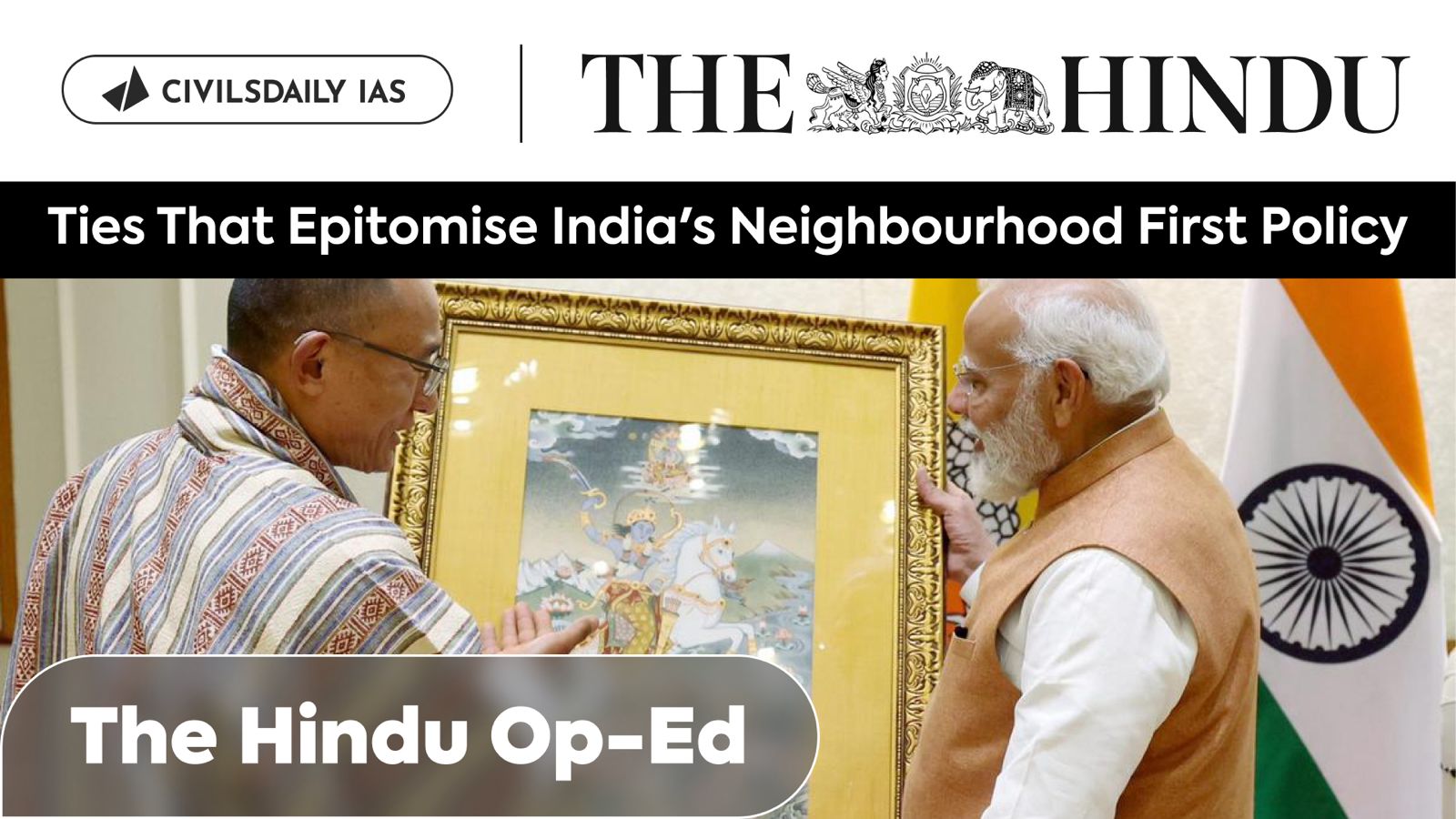
Mentor comments: Since the recent infrastructure project – ‘Gelephu’,Bhutan has long known that there is no real threat to its sovereignty or identity from its southern flank. Hence, it has looked to India to help it grow, develop and prosper. India has lived up to this expectation. Over the past decade, India has demonstrated its unwavering support for its neighbouring nations during times of crisis. Whether responding to natural disasters, health emergencies, economic challenges, or providing support on the international stage, India has consistently been the first to offer assistance and will continue to do so. Furthermore, we have established sustained diplomatic outreach within India’s Neighborhood First Policy.
Let’s learn.
—
Why in the News?
According to recent observations, ‘Neighborhood Policy’ has continued to develop through dialogs and sentiments considering South Asian demography.
Context:
Gelephu Project is near remote parts of West Bengal and Assam, and the success of this city will have positive socio-economic spillovers for these geographies as well.
It will provide yet another example of the win-win cooperation between India and Bhutan on the lines of Neighborhood First Policy.
About India’s ‘Neighborhood First’ policy:
The South Asian region, which is home to eight countries, and the Indian Ocean region come under the broad geographic expanse of India’s neighborhood – the nations include Afghanistan, Bhutan, Bangladesh, Maldives, Pakistan, Nepal, Myanmar, Tibetan (autonomous region of China) and Sri Lanka.
The ‘Neighborhood First’ policy is a foreign policy initiative introduced by India in 2014 which aims to strengthen India’s relations with its immediate neighbours emphasizing on creating a peaceful, prosperous, and stable neighborhood.
Principles of ‘Neighborhood First’ policy
Sovereignty and territorial integrity
Mutual respect and sensitivity
Non-interference in internal affairs.
Shared prosperity
Connectivity for regional integration
People-to-people exchanges
Govt. of India initiatives to harmonize the relations in the neighborhood: Country-specific initiatives:
Bhutan: India signed the Indo-Bhutan Treaty of Peace and Friendship in 1949 and the Agreement on cooperation in Hydropower in 2006. India also provides financial support to Bhutan’s five-year plans. India is also part of the sub-regional grouping of the Bangladesh–Bhutan–India–Nepal (BBIN) network.
Myanmar: India has also been assisting in various fields such as education, healthcare, disaster management, capacity-building culture etc.Promoting connectivity initiatives such as the Kaladan multimodal transit transport project in Myanmar.
Sri Lanka: India is assisting in implementing the ‘Unitary digital identity framework’. India has also been providing financial support in the face of the recent balance of payment crisis in Sri Lanka.
Afghanistan: PM Narendra Modi went to visit Afghanistan in 2015 and inaugurated the Afghan Parliament, which was made with the help of India. He visited Afghanistan again in 2016 to inaugurate the Salma Dam in Herat.
Nepal: India signed the Treaty of Peace and Friendship in 1950. There are various agreements related to hydropower projects like the Arun hydropower project etc. PM Modi was the first Indian PM to visit Nepal after 17 years in 2014.
Bangladesh: India has signed agreements relating to the sharing of river waters with Bangladesh.
Maldives: Greater Male connectivity project by an Indian company to provide connectivity in Maldives, restoration of Addu atolls, etc.
Other initiatives: Development cooperation: Providing development assistance through various initiatives such as the Indian Technical and Economic Cooperation (ITEC) Program, the Indian Council for Cultural Relations (ICCR), etc. Vaccine Maitri: India, through its vaccine diplomacy, extended help on priority to its neighbors during the COVID-19 pandemic. Leveraging Science and Technology: India successfully launched the first-ever South Asia Satellite (SAS) to boost communication and improve disaster links among its South Asian neighbors.
What are the challenges in India’s relations with its Neighbours?
India’s relations with its neighbors have been marked by a range of challenges and issues over the years.
Terrorism and Illegal Immigration: India has been a victim of terrorism perpetrated by groups based in neighboring states, especially Pakistan and Bangladesh.
Example: Recent Assam and Tripura Issue (2024)
Border disputes: India has long-standing border disputes, particularly with China (Line of Actual Control) and Pakistan (Line of Control), which have led to military conflicts and tensions.
China Factor: India’s growing geopolitical and economic influence in the region has led to competition with China. This has led to tensions over issues such as borders, trade and investment.
Example: Recent Galwan Valley and border conflicts with Arunachal Pradesh (2023).
Water sharing: India shares rivers with several of its neighbors like Pakistan, Bangladesh, and Nepal, and water sharing has been a source of tension, which has led to disputes.
Example: Disputes over the Indus Water Treaty with Pakistan (the recent being on the Ravi water dispute).
Political instability: Several of India’s neighbors have experienced political instability and internal ethnic conflicts, which have had an impact on regional stability and security.
Example: Recent Manipur issue (2023).
Way forward for strengthening India’s relations with its neighbors:
Economic cooperation: South Asia’s intra-regional trade is the lowest globally, constituting only 5% of the region’s total trade. By increasing trade, investment, and cross-border connectivity we can stand on weighted sides.
People-to-people exchanges: India can promote people-to-people exchanges by facilitating cultural, educational, and tourism exchanges.
Security cooperation: India can strengthen security cooperation with its neighbors to address common security challenges such as terrorism, cyber threats, and transnational crime. SAARC and BIMSTEC frameworks can play an important role in this.
Regional integration: India can support regional integration by participating actively in regional forums such as SAARC, BIMSTEC, and IORA.
Diplomatic outreach: India should engage in sustained diplomatic outreach to its neighbors to promote dialogue, resolve outstanding issues, and build mutual trust.
Some of the India’s Neighborhood Policies:
Look East policy: Launched in 1991, it aimed to strengthen economic and political ties with countries in Southeast Asia.
The Gujral Doctrine of 1996: It was a set of five principles to guide the conduct of foreign relations with India’s immediate neighbors.Non-reciprocity with neighbours.Territory should not be used against the interest of another country.Non-interference in internal affairs.Respect each other’s territorial integrity and sovereignty.Settle all disputes through peaceful bilateral negotiations.
Bay of Bengal Initiative for Multi-Sectoral Technical and Economic Cooperation (BIMSTEC), 1997: BIMSTEC was established as a regional organization comprising seven member states (Bangladesh, Bhutan, India, Nepal, Sri Lanka, Myanmar, and Thailand) lying in the littoral and adjacent areas of the Bay of Bengal constituting a contiguous regional unity.
Indian Ocean Rim Association (IORA) of 1997: It is an intergovernmental organization that brings together countries bordering the Indian Ocean to promote regional cooperation and economic integration.
The National Commission for Women (NCW) and the Railway Protection Force (RPF) signed a MoU to combat human trafficking within the Indian Railway network.
NCW-RPF MoU: Key Objectives
Prevention and Rescue: The MoU aims to prevent human trafficking and facilitate the rescue of trafficked women through joint efforts.
Role of RPF Personnel: RPF personnel stationed at railway stations are crucial in preventing trafficking and addressing crimes against women.
Expanding Collaboration: NCW, which established an Anti-Human Trafficking Cell on April 2, 2022, has already been working with the Central Industrial Security Force (CISF) to combat the trafficking of women.
About National Commission for Women (NCW)
The NCW is the Statutory Body generally concerned with advising the government on all policy matters affecting women.
It was established on 31 January 1992 under the provisions of the Indian Constitution as defined in the National Commission for Women Act, 1990.
The first head of the commission was Jayanti Patnaik.
The Indian Constitution doesn’t contain any provision specifically made to favor women intrinsically.
Article 15 (3), Article 14 and Article 21 protect and safeguard women. They are more gender-neutral.
Objectives
The objective of the NCW is to represent the rights of women in India and to provide a voice for their issues and concerns.
The subjects of their campaigns have included dowry, politics, religion, equal representation for women in jobs, and the exploitation of women for labor.
They have also discussed police abuses against women.
Composition of the NCW
The Commission shall consist of:
Chairperson: To be nominated by the Central Government.
Five Members: To be nominated by the Central Government from amongst persons of ability, integrity and standing who have had experience in law or legislation, trade unionism, management of an industry potential of women, women’s voluntary organizations (including women activists), administration, economic development, health, education or social welfare;
Special Representations: At least one Member each shall be from amongst persons belonging to the Scheduled Castes and Scheduled Tribes respectively;
Powers of NCW
Provide consultation on all major policy matters that affect women.
Issuing summons for the examination of documents and the witnesses.
Requisitioning any public record or copy thereof from any court or office.
Receiving evidence on affidavits
Discovery and production of documents
Summoning and enforcement
Functions of the NCW
Submission of Annual Reports: Table reports should be submitted to the Central Government every year, when deemed appropriate by the commission. These reports focus on the functioning and working of the safeguards.
Investigation and Examination: Proper investigation and examination are conducted under the Constitution and other laws, primarily aimed at protecting the rights of women.
Review and Scrutiny of Laws: Constant review and scrutiny of all laws are undertaken, with necessary amendments and alterations made to meet the needs of the current world.
Prevention of Violations: Ensuring there is no violation against women and taking due care of such cases to protect their rights.
Handling Complaints and Suo Motu Matters: Handling complaints and addressing suo motu matters about the deprivation of rights of women, with a focus on implementing laws favoring women’s welfare.
Assessment of Development and Progress: Assessing the development and progress of the women community at both the Center and State levels.
Identification and Mitigation of Systemic Limitations: Understanding the limitations in the system and devising strategic plans and mechanisms to address them effectively.
Issues faced by NCW
Limited Enforcement Power: The NCW is only recommendatory and lacks the power to enforce its decisions, often taking action only when issues are brought to light.
Lack of Constitutional Status: The Commission lacks constitutional status, resulting in no legal powers to summon police officers or witnesses.
Dependency on Grants: NCW’s functions are heavily dependent on grants offered by the central government, with insufficient financial assistance to cater to its needs.
Limited Autonomy in Member Selection: The Commission does not have the power to choose its own members, impacting its autonomy and effectiveness.
PYQ:
Q.Is the National Commission for Women able to strategize and tackle the problems that women face at both public and private spheres? Give reasons in support of your answer. (2017)
Q.According to the Constitution of India, it is the duty of the President of India to cause to be laid before the Parliament which of the following?
The Recommendations of the Union Finance Commission
The Report of the Public Accounts Committee
The Report of the Comptroller and Auditor General
The Report of the National Commission for the Scheduled Castes
Select the correct answer the using the codes given below:
1 only
2 and 4 only
1, 3 and 4 only
1, 2, 3 and 4
Practice MCQ:
Which of the following does not constitute to the powers of National Commission for Women (NCW)?
The government’s procurement portal, GeM (Government e-Marketplace), is looking to encourage more and more start-ups and small and micro enterprises to list themselves as sellers.
About Government e-Marketplace (GeM)
The GeM is a one-stop National Public Procurement Portal to facilitate online procurement of common use Goods & Services required by various Government Departments / Organizations / PSUs.
It was launched in 2016 by the Ministry of Commerce and Industry.
It has been developed by the Directorate General of Supplies and Disposals (under MCI) with technical support from the National e-governance Division (MEITy).
Functions for GeM
Enhancement of Public Procurement: GeM aims to enhance transparency, efficiency, and speed in public procurement processes.
Paperless and Cashless Transactions: It is a completely paperless, cashless, and system-driven e-marketplace that enables procurement of common-use goods and services with minimal human interface.
Facilitation of Best Value: GeM provides the tools of e-bidding, reverse e-auction, and demand aggregation to facilitate government users in achieving the best value for their money.
Mandatory Purchases by Government Users: The purchases through GeM by Government users have been authorized and made mandatory by the Ministry of Finance by adding a new Rule No. 149 in the General Financial Rules, 2017.
Key Developments on GeM:
GeM Outlet Stores: GeM has introduced outlet stores for various product categories like SARAS, Ajeevika, Tribes India, Startup Runway, Khadi India, India Handloom, India Handicraft, Divyangjan, etc.
Bamboo Market Window: GeM, in collaboration with the National Bamboo Mission, has introduced a dedicated window on its portal for marketing Bamboo Goods.
Country of Origin Tag: Since 2020, the government has made it mandatory for sellers on the GeM portal to clarify the country of origin of their goods when registering new products.
PYQ:
Q.‘SWAYAM’, an initiative of the Government of India, aims at (2016) –
Promoting the Self Help Groups in rural areas
Providing financial and technical assistance to young start-up entrepreneurs
Promoting the education and health of adolescent girls
Providing affordable and quality education to the citizens for free
Practice MCQ:
With reference to the Government e-Marketplace (GeM), consider the following statements:
It is a one-stop National Public Procurement Portal launched in 2016.
It is developed by the Department for Promotion of Industry and Internal Trade (DPIIT)
Recently, there are some findings from a nationwide private haemodialysis network’, the Lancet Regional Health-Southeast Asia, on the survival of patients receiving haemodialysis in India
Context:
India has amongst the highest number of patients receiving chronic dialysis, globally estimated at around 1,75,000 people in 2018. Daily, the number of patients on dialysis has been increasing.
The launch of the National Dialysis Service in 2016 to improve access, and ongoing efforts to develop affordable dialysis systems, are all underlined by the rising incidence of end-stage renal disease in the country.
What is Hemodialysis?
A machine filters wastes, salts and fluid from your blood when your kidneys are no longer healthy enough to do this work adequately.
Key Highlights as per study:
Survival with Centre- and Patient-Level: The study found that both centre- and patient-level characteristics are associated with survival rates among patients undergoing haemodialysis.
Unexplained Variation Between Centres: Despite considering various centre-based characteristics, there remained unexplained variations in survival rates between dialysis centres across India. This suggests that factors beyond those accounted for in the study may influence patient outcomes.
Large Sample Size: The study included a substantial sample size of over 23,600 patients undergoing haemodialysis at any centre in the NephroPlus network between April 2014 and June 2019. This large sample size enhances the robustness of the study’s findings.
Primary Outcome: The primary outcome of the study was all-cause mortality, measured from 90 days after patients joined a center. This outcome measure provides valuable insights into patient survival rates over time following the initiation of haemodialysis treatment.
Consideration of Individual-Level Variables: The study accounted for various individual-level variables such as sex, smoking status, medical history (e.g., diabetes, heart disease, hypertension, hepatitis B, hepatitis C), education level, monthly household income, dialysis frequency, and vascular access. These variables offer comprehensive insights into patient characteristics and their impact on survival rates.
Evaluation of Centre-Level Variables: Centre-level variables, including the frequency of nephrologist visits, number of beds, number of staff, and number of patients, were also considered. These variables help assess the influence of center resources and practices on patient outcomes.
What were the measuring differences?
Limited Data: The only significant study conducted previously in Andhra Pradesh used claims data from a publicly-funded insurance scheme between 2008 and 2012. It included 13,118 beneficiaries and reported a 10.2% mortality rate within six months of starting hemodialysis.
Absence of Centre-Level Effects: The previous study did not consider center-level effects on survival, limiting the understanding of differences in survival rates between dialysis centers, as observed in other countries.
Gaps in Understanding: Major gaps existed in understanding dialysis outcome patterns in India due to the absence of comprehensive studies, hindering efforts to improve patient care.
Lack of National Benchmark: There was no established national benchmark for survival rates among patients undergoing dialysis in India at the time of the study.
Need for Further Research: The study highlighted the importance of conducting more extensive research to fill the gaps in knowledge and establish benchmarks for dialysis outcomes in India.
What is the recent issue related to the Mortality rate?
Administrative challenges associated with Mortality:
Impact of Centre-Level Factors: Including center-level factors such as staffing, care processes, and patient volume in the analysis reduced the variability in survival rates across dialysis centers by 31%. This suggests that center-level characteristics play a significant role in influencing patient outcomes and survival rates.
Survival Range: After adjusting for multi-level factors, the estimated 180-day survival among patients undergoing hemodialysis ranged between 83% and 97%. This variability indicates differences in survival outcomes across dialysis centers in India.
Urban-Rural Divide: Patients attending rural dialysis centers experienced a 32% higher mortality rate compared to those at urban centers. This disparity underscores the unique challenges faced by rural healthcare facilities in providing hemodialysis services.
Patient Characteristics Associated with Mortality:
Catheter-Based Vascular Access: Patients using catheter-based vascular access had a higher mortality rate compared to those using arteriovenous fistula or graft access.
Financial Support: Patients receiving financial support for dialysis treatment through government panel schemes or private insurance had a lower mortality rate compared to those paying out-of-pocket.
Dialysis Vintage: There was an inverse relationship between mortality rate and dialysis vintage, with patients receiving dialysis for at least a year before joining a center experiencing a 17% lower mortality rate than those starting dialysis less than 30 days before joining.
Presence of Diabetes: The presence of diabetes was associated with a higher mortality rate among hemodialysis patients.
Way Forward:
Establishment of National Benchmark: The study proposes the first national benchmark for survival among dialysis patients in India. This benchmark will serve as a reference point for evaluating the quality of care and outcomes across dialysis centres in the country.
Ongoing Quality Improvement Programs: As dialysis access continues to expand in India, ongoing quality improvement programs are crucial for ensuring that patients receive the best possible care and experience optimal outcomes at the point of care.
Collaborative Quality Improvement System: The authors emphasize the need for a collaborative quality improvement system across the country to address the increasing demand for dialysis services. This system should involve stakeholders at various levels of healthcare delivery to enhance standards of care and patient outcomes.
Understanding Multilevel Effects: It is essential to understand the multilevel effects of both centre- and patient-level characteristics on dialysis outcomes. Establishing national standards for dialysis outcomes in India requires comprehensive insights into these factors to drive improvements in care delivery.
Comparison and Monitoring: Establishing national benchmarks enables comparison and monitoring of dialysis centres’ performances over time. This approach facilitates the identification of variations in practice patterns and outcomes, paving the way for targeted interventions and improvements in healthcare delivery.
Conclusion: The nationwide study on haemodialysis outcomes in India highlights disparities and the need for standardized care. Establishing national benchmarks, ongoing quality improvement, and collaborative efforts are essential for enhancing dialysis care and patient outcomes.
Mains PYQ-
Q- Public health system has limitations in providing universal health coverage. Do you think that private sector can help in bridging the gap? What other viable alternatives do you suggest? (UPSC IAS/2015)