💥Join UPSC 2027,2028 Mentorship (August Batch) + XFactor Notes & Microthemes PDF

GS Paper: GS3

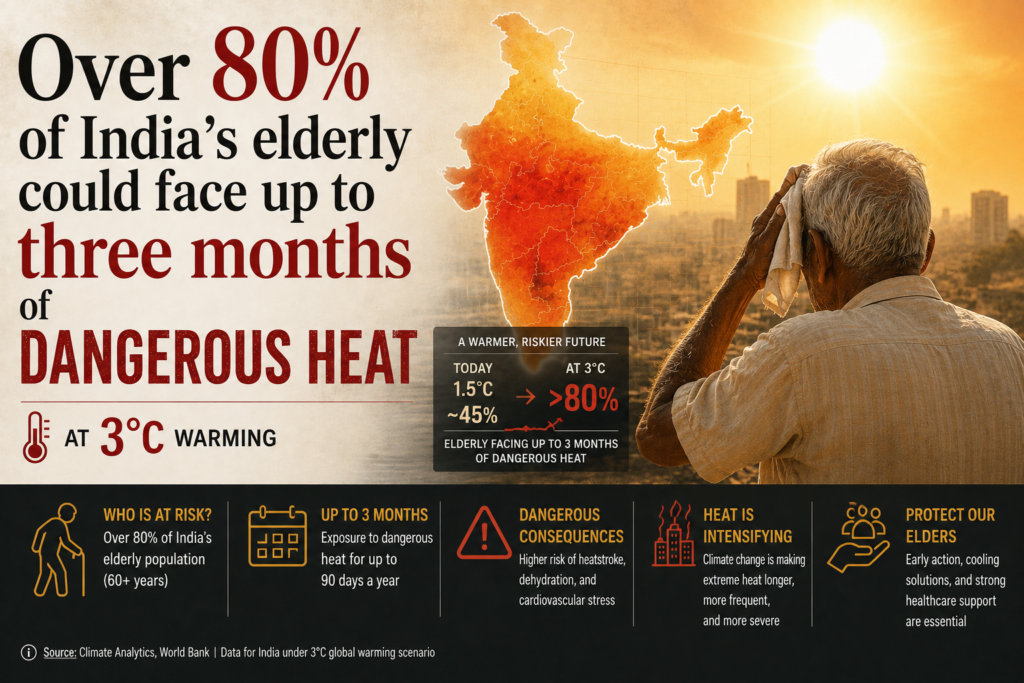
  • Over 80 percent of India’s elderly could face up to three months of dangerous heat at 3 degrees C warming

    Why in the News

    A Lancet Planetary Health study finds that older adults in India, China, Pakistan and Bangladesh could face dangerous heat for up to 3 months at 3°C warming. Using age-specific heat tolerance thresholds shows previous estimates may have underestimated risk by at least two-fold.

    Key Concepts

    Heat Stress

    • Occurs when the body cannot shed enough heat to maintain normal core temperature.
    • Depends on temperature + humidity + duration, not temperature alone.
    • High humidity reduces sweat evaporation and increases risk.

    Wet-Bulb Temperature

    • Measures the lowest temperature achievable through evaporative cooling.
    • Combines heat and humidity.
    • Around 35°C wet-bulb temperature is the theoretical survivability limit for a healthy person at rest, while vulnerable groups face risk at lower levels.

    Heat Action Plan

    City/State-level system covering:

    • Early warnings and colour-coded alerts
    • Changes in work/school timings
    • Cooling shelters and water
    • Hospital preparedness

    Study Findings

    • Examined 15-39, 40-59 and 60+ age groups.
    • Modelled warming from 1°C to 4°C.
    • At 3°C warming, over 80% of India’s older population could experience at least 180 hours of intolerable heat annually.
    • Delhi and the Indo-Gangetic Plain could see nearly 1,000 hours at 1.5°C warming and over 2,000 hours at 3°C.
    • Heat exposure is concentrated mainly between May and September and increasingly extends into nights.

    Why Older Adults Are More Vulnerable

    • Reduced sweating
    • Slower vascular response
    • Greater cardiac strain
    • Lower heat tolerance

    Challenges for India’s Heat Action Plans

    • Age-blind thresholds
    • Limited attention to night-time heat
    • Weak integration of humidity
    • Rising cooling and electricity demand
    • Under-reporting of heat-related mortality
    • Continued occupational exposure
    • Limited disaster-response financing for heatwaves
  • Why corporate investment has not revived despite tax cuts and cheap credit

    Source: The Hindu, Page 10, Text & Context
    Published: 19 August 2026

    Why in the News

    Corporate investment as a share of Gross Domestic Product (GDP) has fallen to about 9 percent from a peak of 17.3 percent, and has not returned even to the low levels recorded during the Global Financial Crisis. A corporate tax cut from 30 percent to 22 percent and a sustained low interest rate regime failed to reverse the decline, which points to a constraint that cost side policy does not touch.

    What does corporate investment as a share of GDP measure?

    1. Definition: It measures the value of new fixed assets created by companies, such as plant, machinery and buildings, expressed as a proportion of the economy’s total output.
    2. Why the ratio is used: Expressing investment as a share of output strips out inflation and growth in the size of the economy, so a fall in the ratio means investment is growing slower than output.
    3. What it signals: Corporate investment builds the future productive capacity of the economy, so a sustained decline in the ratio caps the growth rate the economy can sustain later.
    4. Data source used here: The trend is drawn from the Database on Indian Economy maintained by the Reserve Bank of India (RBI).

    What are animal spirits?

    1. Definition: Animal spirits, a term used by John Maynard Keynes, refers to the level of confidence with which firms hold their expectations about future profits.
    2. How it acts: High confidence pushes the expected profitability schedule outward and raises investment at every level of cost, and pessimism about the future pulls it inward.

    What is the principle of increasing risk?

    1. Definition: The principle of increasing risk, proposed by Michal Kalecki, holds that the cost of borrowing rises as a firm takes on more loans in proportion to its own funds committed to a project.
    2. Its consequence: The system is rigged against small capitalists even where small and large firms hold the same blueprint of a technology, because access to capital begets more capital.

    What is the Prowess database?

    1. Definition: Prowess is a firm level database of Indian companies compiled from their audited annual accounts, used for panel studies of corporate performance.
    2. Use in this analysis: The study draws a balanced panel of listed manufacturing firms from Prowess to compare profitability and interest costs across firm sizes.

    What is autonomous expenditure?

    1. Definition: Autonomous expenditure is spending that does not depend on the current level of income or profit in the economy, so it can rise when private demand is falling.
    2. Why it matters here: Government expenditure is the principal autonomous component, which is why it can create demand actively rather than merely responding to demand that already exists.

    How has corporate investment moved since 2000?

    1. The take off: Corporate investment took off in 2004, jumping almost four percentage points from 6.5 percent to 10.3 percent of GDP.
    2. The peak: It rose further during the growth years to a peak of 17.3 percent.
    3. The crisis fall: It fell during the Global Financial Crisis, then began a steady revival.
    4. The break point: The revival ran until demonetisation hit the economy in 2016, after which the decline has been continuous.
    5. Where it stands: The share is now about 9 percent, and has not returned even to the low levels recorded during the Global Financial Crisis.

    Why is demonetisation treated differently from the other shocks?

    1. Nature of the shock: The global economic crisis was an external shock beyond India’s control, and demonetisation was a self inflicted shock.
    2. Depth of the fall: The post 2016 decline has taken the share below the crisis era floor, which the external shock itself never did.
    3. Covid is not the explanation: Covid arrived in 2020-21 as another external shock, and the decline in investment had started a few years earlier.
    4. Two channels of damage: Demonetisation pushed the expected profitability schedule inward both because immediate profitability declined and because the credibility of future policy steps became suspect.
    5. The casualty at the margin: The fall was severe enough to push small firms below the cost of credit curve altogether, forcing many out of business, which is what happened to many micro, small and medium enterprises (MSMEs) in this period.

    What three factors determine a firm’s investment decision?

    1. Expected profitability: The profit a firm expects from selling the goods the new factory will produce, assessed over the whole life of the asset.
    2. Confidence in that expectation: The certainty with which the firm can predict those profit rates over the factory’s lifetime, which sets the position of the profitability schedule.
    3. Cost of credit: The price of borrowing, which matters once the planned investment exceeds the firm’s own available funds.
    4. How profitability varies with size: Most industries have economies of scale, so larger equipment, factories and workspaces carry higher profit rates than smaller ones, and expected profitability rises with the size of the investment.
    5. Where that stops: Each firm has an upper limit to how much it can sell, set by its share in the total market, and investment beyond that point leaves part of the factory idle.
    6. Two channels for the interest rate: A firm that does not build can park its funds in an interest bearing asset, so expected profitability must exceed the market interest rate, and a firm that borrows faces a cost of credit that is flat up to its own capital and rises steadily thereafter.

    Why does firm size change what constrains investment?

    1. Small firms: With very low levels of own capital the cost of credit curve starts rising far sooner, and it cuts the upper portion of the profitability curve.
    2. Their binding constraint: Investment by such firms is constrained by the availability of credit, and their interest costs are correspondingly high.
    3. Large firms: Their own capital is high enough that the cost curve cuts the profitability curve on its vertical portion.
    4. Their binding constraint: Such firms are limited by the market rather than by finance, and interest costs are not consequential for them.
    5. The structural implication: The same technology blueprint yields different investment outcomes purely because of the firm’s existing access to capital.

    What does the firm level data show?

    1. The sample: A balanced panel of 1,224 listed manufacturing firms between 2000 and 2024, drawn from the Prowess dataset and grouped into three sizes.
    2. Size definition: Median capital stock is Rs 14.5 crore for small firms, Rs 156.8 crore for medium firms and Rs 1,745.9 crore for large firms, all measured in 2011-12 prices.
    3. The profitability gradient: Smaller firms have lower profitability than larger firms, with the median rate of profit rising across the three size classes.
    4. The interest cost gradient: Smaller firms carry higher interest costs than larger firms, with median interest costs falling as size rises.
    5. What it confirms: The asymmetry predicted by the theory, that small firms are credit constrained and large firms are demand constrained, holds by and large for the Indian manufacturing sector.

    Why did a tax cut and cheap credit fail to revive investment?

    1. The tax cut: The corporate tax rate was cut from 30 percent to 22 percent, alongside a low interest rate regime followed by the Reserve Bank of India.
    2. No effect on small firms: A fall in the interest rate does not revive investment among smaller firms once their expected profitability has collapsed below the cost of credit.
    3. No effect on large firms: A large firm is not constrained by credit in the first place, so cheaper credit has no impact on its investment decision.
    4. The general result: Cost side policy interventions, including tax cuts, do not have much expansionary impact on investment, because neither group’s binding constraint is the cost of funds.
    5. What the failure reveals: Both groups are ultimately held back by expected demand, and cheapening the supply of capital does nothing to create that demand.

    What would shift expected profitability outward?

    1. The required direction: What is needed is to push the profitability curve outward, which raises investment by both small and large firms simultaneously.
    2. The only instrument that does it: This can be achieved only if government expenditure acts as an autonomous stimulus.
    3. The mechanism: Such expenditure creates demand actively, and rising demand pushes the profitability curves outward for firms of every size.
    4. The fiscal implication: It requires giving up on being a fiscal hawk, since the stimulus has to be sustained rather than symbolic.
    5. The political signal being read: The same conclusion is drawn from the youth protesting on the streets asking for gainful employment.

    Challenges to reviving corporate investment in India

    1. Weak capacity utilisation: Firms do not add capacity while existing plants run below their rated output. e.g. manufacturing capacity utilisation tracked by the Reserve Bank of India has hovered around the mid seventies in percentage terms for extended periods.
    2. Credit constraint on small firms: Formal lenders price small borrowers out or lend against collateral they lack. e.g. the credit gap for micro, small and medium enterprises runs into lakhs of crores against their assessed requirement.
    3. Policy uncertainty: Abrupt changes damage the confidence component of investment decisions independently of the direct cost. e.g. the retrospective amendment to tax cross border share transfers after the Vodafone ruling deterred investors until it was withdrawn in 2021.
    4. Weak household demand: Consumption growth caps the sales any firm can plan for. e.g. the collapse in employment generation under the rural employment guarantee programme in April to July 2026 cut rural purchasing power directly.
    5. Land and clearance delays: Project timelines stretch well beyond the investment appraisal horizon. e.g. large steel and refinery projects in Odisha and Maharashtra have taken over a decade from announcement to commissioning.
    6. Legacy stressed assets: Bank and corporate balance sheets recovering from earlier defaults limit fresh risk appetite. e.g. the twin balance sheet problem of the mid 2010s suppressed both credit supply and corporate borrowing for years.
    7. Import competition in inputs: Cheaper imported inputs and finished goods reduce the return on domestic capacity creation. e.g. domestic solar module manufacturers competed against imported cells until duties and incentives were introduced.

    Conclusion

    Corporate investment has fallen to about 9 percent of GDP from a peak of 17.3 percent and remains below its Global Financial Crisis floor, with the decline dating from 2016 rather than from Covid. A corporate tax cut from 30 percent to 22 percent and a low interest rate regime failed because neither addresses the binding constraint, since small firms are held back by credit access and large firms by the size of the market. Pushing expected profitability outward requires government expenditure acting as an autonomous stimulus, which means abandoning fiscal hawkishness rather than repeating cost side concessions.

    Foundational Context: What is Capital Formation?

    1. About: Capital formation is the addition to the stock of physical assets in an economy in a given period, measured in the national accounts as Gross Fixed Capital Formation (GFCF).
    2. Rationale: It exists as a distinct measure because current output can either be consumed or used to create productive capacity, and only the second raises future output.
    3. Named typology, by the investing sector:
    4. Public sector capital formation: Investment by the Central and State governments and by public sector enterprises, largely in infrastructure.
    5. Private corporate sector capital formation: Investment by registered companies in plant, machinery and structures, which is the measure this item tracks.
    6. Household sector capital formation: Investment by households and unincorporated enterprises, dominated by residential construction.
    7. Related measure: The investment rate is Gross Fixed Capital Formation expressed as a share of Gross Domestic Product, and the incremental capital output ratio measures how much investment is needed to produce one additional unit of output.

    Key Concerns Regarding Capital Formation in India

    1. Private investment has not replaced public investment: Central capital expenditure has risen sharply while private corporate investment has stagnated, so the recovery rests on one leg.
    2. Household investment is concentrated in real estate: A large share of household capital formation is residential construction, which adds less to productive capacity than plant and equipment.
    3. Financing depth for small firms: The corporate bond market is accessible only to highly rated large issuers, leaving small firms dependent on bank credit at high spreads.
    4. Crowding out concern: Sustained government borrowing to fund the stimulus can raise interest rates and reduce private investment, which is the standard counter argument to an expenditure led revival.
    5. Measurement lag: Private corporate investment is estimated with a significant lag and revised substantially, which delays the recognition of a turning point in the cycle.

    Statutory Framework Governing Fiscal Policy and Public Investment

    1. Article 112: Requires the Annual Financial Statement of estimated receipts and expenditure to be laid before Parliament for every financial year.
    2. Article 266: Establishes the Consolidated Fund of India and the Public Account, from which expenditure may be made only under authority of law.
    3. Article 292: Empowers the Union to borrow upon the security of the Consolidated Fund of India within limits fixed by Parliament.
    4. Article 293: Governs State borrowing and requires the consent of the Union where a State is indebted to it.
    5. Article 280: Provides for the Finance Commission, whose recommendations determine the vertical and horizontal sharing of Union taxes.
    6. Fiscal Responsibility and Budget Management Act, 2003: Sets statutory fiscal targets and requires the government to lay fiscal policy statements before Parliament.
    7. Section 4: Prescribes the fiscal deficit and debt targets and the grounds on which they may be deviated from.
    8. Section 7: Requires the Finance Minister to review and report on the trends in receipts and expenditure to Parliament.

    Laws and Rules Governing Corporate Finance and Small Firm Credit

    1. Companies Act, 2013: Governs incorporation, capital raising, disclosure and audit obligations of companies, which is the source of the accounts used in firm level databases.
    2. Micro, Small and Medium Enterprises Development Act, 2006: Defines the three enterprise categories and provides for delayed payment remedies for small suppliers.
    3. Section 15 and Section 16: Require payment to a micro or small enterprise within a specified period and provide for compound interest on delay.
    4. Insolvency and Bankruptcy Code, 2016: Provides a time bound resolution process for corporate debtors, which determines how quickly stressed capital is redeployed.
    5. Factoring Regulation Act, 2011, amended in 2021: Widened the set of lenders permitted to undertake factoring, easing receivables financing for small firms.
    6. Reserve Bank of India Act, 1934: Provides the statutory basis for monetary policy, including the inflation targeting framework that governs the interest rate regime.
    7. Fiscal Responsibility and Budget Management Rules, 2004: Prescribe the formats and the quarterly review obligations under the parent Act.

    Back2Basics: Demonetisation of 2016

    1. What it was: The withdrawal of legal tender status from the existing Rs 500 and Rs 1,000 currency notes, announced on 8 November 2016.
    2. Legal basis: Effected through a notification under Section 26(2) of the Reserve Bank of India Act, 1934, on the recommendation of the Central Board of the Reserve Bank of India.
    3. Stated objectives: Curbing unaccounted money, countering counterfeit currency and terror financing, and accelerating the shift to digital payments.
    4. Replacement currency: New Rs 500 and Rs 2,000 notes were introduced, and the Rs 2,000 note was later withdrawn from circulation in 2023.
    5. Return of notes: The Reserve Bank of India subsequently reported that the overwhelming majority of the demonetised currency was returned to the banking system.
    6. Judicial position: A Constitution Bench of the Supreme Court upheld the decision by a 4 to 1 majority in January 2023, holding that the process followed did not suffer from a legal infirmity.
    7. Economic effect recorded here: It marks the point after which corporate investment as a share of Gross Domestic Product began a continuous decline, and it pushed many micro, small and medium enterprises out of business.

    Government Initiatives

    1. Production Linked Incentive schemes: Pay incentives on incremental sales of goods manufactured in India across sectors including electronics, pharmaceuticals and automobiles, aimed at drawing private capital into manufacturing capacity.
    2. National Infrastructure Pipeline and the National Monetisation Pipeline: Set out a project pipeline for public infrastructure investment and a route to recycle operating public assets into fresh capital expenditure.
    3. PM Gati Shakti National Master Plan: Coordinates infrastructure planning across ministries to reduce logistics cost and project delay, both of which enter the investment appraisal of private firms.
    4. Emergency Credit Line Guarantee Scheme: Provided fully guaranteed collateral free credit to micro, small and medium enterprises to keep credit constrained firms solvent.
    5. Credit Guarantee Fund Trust for Micro and Small Enterprises: Guarantees collateral free bank lending to small firms, addressing the security requirement that keeps them off formal credit.
    6. Trade Receivables Discounting System (TReDS): An electronic platform allowing small suppliers to discount invoices owed by large buyers, easing the working capital squeeze.
    7. Corporate tax rate reduction: The concessional rate regime introduced for domestic companies, and a lower concessional rate for new manufacturing companies, intended to raise post tax returns on new capacity.

    Key Facts about Investment in the Indian Economy

    1. Peak investment rate: India’s overall gross fixed capital formation rate peaked in the years before the Global Financial Crisis, in step with the corporate investment peak of 17.3 percent recorded here.
    2. Corporate tax rates: The headline domestic corporate tax rate was reduced from 30 percent to 22 percent, with a lower concessional rate offered to new manufacturing companies.
    3. Monetary framework: India adopted flexible inflation targeting in 2016, with the target set at 4 percent and a tolerance band of plus or minus 2 percentage points.
    4. Micro, small and medium enterprises: The sector accounts for roughly 30 percent of Gross Domestic Product and about 45 percent of exports.
    5. Crowding out effect: The proposition that government borrowing raises interest rates and thereby reduces private investment, which is the standard objection to an expenditure led revival.
    6. Data sources: The Database on Indian Economy of the Reserve Bank of India for macro aggregates, and firm level databases such as Prowess for company accounts.

    Challenges in Reviving the Investment Cycle

    1. Demand uncertainty: Firms will not commit to long lived assets without visibility on sales. e.g. consumer durables makers deferred capacity additions through successive years of weak rural demand.
    2. Fiscal space for the stimulus: A sustained expenditure push runs against the statutory deficit path. e.g. the Fiscal Responsibility and Budget Management Act, 2003 targets constrain the size of a discretionary stimulus.
    3. Transmission of rate cuts: Policy rate reductions reach small borrowers slowly and incompletely. e.g. lending rates for small firms have historically moved far less than the repo rate in the same period.
    4. Skill and labour mismatch: New capacity requires skilled workers who are not available at scale. e.g. semiconductor and electronics assembly investments have flagged shortages of trained technicians.
    5. Land acquisition cost and delay: Assembling contiguous land for large plants remains the slowest step. e.g. industrial projects across several States have stalled for years at the land acquisition stage.
    6. Global trade uncertainty: Export oriented capacity decisions are hostage to tariff shifts abroad. e.g. punitive tariffs of 50 percent on Indian goods disrupted the export calculus for entire product lines.
    7. Concentration of profitability: Profits accrue disproportionately to large firms, which are the very firms not constrained by finance. e.g. the firm level panel shows median profitability rising and interest costs falling as firm size increases.

    Way Forward

    1. Use expenditure as the lead instrument: Direct sustained public expenditure at demand creating heads so that expected profitability rises for firms of every size rather than only for the largest.
    2. Target employment intensive spending: Prioritise programmes that put income directly in the hands of households, since that is what converts stimulus into the sales firms plan around.
    3. Fix credit access rather than credit price: Expand guarantee backed and receivables based lending to small firms, whose constraint is availability rather than the interest rate.
    4. Restore policy predictability: Avoid abrupt, economy wide interventions, since the confidence component of the investment decision recovers far slower than the immediate profitability component.
    5. Complete the public capital expenditure pipeline: Convert announced infrastructure projects into commissioned assets on schedule, so that the demand impulse is actually delivered.
    6. Report investment data faster: Shorten the lag and revision cycle in private corporate investment estimates so that a turning point is identified in time to act on it.

    Matching Previous Year Question

    “[2026] Which one of the following best describes the ‘Crowding Out Effect’ in the context of fiscal policy?
    (a) A situation where private investment increases due to increased Government spending
    (b) A situation where Government borrowing leads to higher interest rates, which reduces private investment
    (c) A situation where an increase in taxes leads to increased private sector investment
    (d) A situation where Government spending has no impact on aggregate demand
    Answer: (b)”
  • New PNG Connections Get a Gas Boost: Extra 200 SCM Allocation

    Why in the News

    From 1 September, eligible City Gas Distributors (CGDs) will receive an additional 200 Standard Cubic Metres (SCM) of cheaper Administered Price Mechanism (APM) gas for every new billed domestic Piped Natural Gas (PNG) connection.

    APM Natural Gas

    • Administered Price Mechanism (APM): Domestic gas from nomination fields of national oil companies, priced by the government.
    • Generally cheaper than imported Liquefied Natural Gas (LNG).
    • Piped Natural Gas (PNG) and Compressed Natural Gas (CNG) receive priority allocation.
    • Price is linked to the Indian crude basket, with a floor and ceiling.

    City Gas Distribution

    • City Gas Distribution (CGD): Pipeline network supplying gas to households, industries, commercial users and vehicles.
    • Geographical areas are awarded through competitive bidding by the Petroleum and Natural Gas Regulatory Board (PNGRB).

    Piped Natural Gas

    • Piped Natural Gas (PNG): Natural gas supplied directly through pipelines and metered like a utility.
    • Provides an alternative to Liquefied Petroleum Gas (LPG) cylinders for households.

    New Incentive

    • 200 SCM of APM gas for every incremental billed domestic PNG connection.
    • Effective 1 September.
    • Aims to reduce LNG sourcing costs and accelerate household PNG adoption.
    • Benefit is linked to actual billed connections, not merely network expansion.

    Key Challenges

    • Right-of-way and road-cutting permissions
    • High household connection costs
    • Competition from subsidised LPG
    • Limited domestic APM gas availability
    • Volatile imported LNG prices
    • Natural gas remains outside Goods and Services Tax (GST)
    • Low viability in remote and low-demand areas

    Foundational Context: The Natural Gas Sector in India

    1. Share in the energy mix: Natural gas accounts for roughly 6 percent of India’s primary energy mix, against a stated national target of raising it to 15 percent by 2030.
    2. Import dependence: India imports about half of its natural gas requirement in the form of liquefied natural gas, delivered through regasification terminals on the west and east coasts.
    3. Two price regimes: Domestically produced gas from nomination fields is sold at the administered price, while gas from deepwater, ultra deepwater and high pressure high temperature fields and imported gas are sold at market linked prices.
    4. Allocation priority: Domestic piped natural gas for households and compressed natural gas for transport hold first priority in the allocation of administered price gas.
    5. Network build out: Successive bidding rounds by the sector regulator have authorised city gas distribution networks covering the overwhelming majority of India’s population across more than 300 geographical areas.
    6. National gas grid: Trunk transmission pipelines are being extended into the eastern and north eastern regions to create a single national gas grid with a unified tariff.

    Statutory Framework Governing the Gas Sector

    1. Petroleum and Natural Gas Regulatory Board Act, 2006: Establishes the sector regulator and gives it authority over downstream refining, processing, storage, transportation, distribution and marketing of petroleum products and natural gas.
    2. Section 16 of the Petroleum and Natural Gas Regulatory Board Act, 2006: Provides for authorisation of entities to lay, build, operate or expand city gas distribution networks.
    3. Section 32 of the Petroleum and Natural Gas Regulatory Board Act, 2006: Provides that appeals against the regulator’s decisions lie to the Appellate Tribunal for Electricity, with a statutory disposal timeline of 90 days.
    4. Oilfields (Regulation and Development) Act, 1948: Governs the regulation of oilfields and the grant of mining leases for petroleum and natural gas.
    5. Petroleum and Natural Gas Rules, 1959: Prescribe the terms for grant of exploration licences and mining leases for petroleum and natural gas.
    6. Petroleum Act, 1934 and the Petroleum Rules, 2002: Govern the import, transport, storage and production of petroleum and the safety conditions attached to them.

    Back2Basics: Petroleum and Natural Gas Regulatory Board (PNGRB)

    1. Governing Act: The Petroleum and Natural Gas Regulatory Board Act, 2006.
    2. Established: Constituted in 2007 under that Act, functioning under the Ministry of Petroleum and Natural Gas.
    3. Jurisdiction: Regulates downstream activities only, covering refining, processing, storage, transportation, distribution, marketing and sale of petroleum products and natural gas.
    4. Exclusion from its remit: It does not regulate upstream exploration or production, which falls to the Directorate General of Hydrocarbons and the Ministry directly.
    5. Core functions: Protecting consumer interest, ensuring competitive markets for gas, authorising city gas distribution networks and pipelines, and fixing transportation tariffs.
    6. First instance adjudication: The Board is the first instance forum for disputes on tariffs, access and authorisation.
    7. Appellate forum: Appeals lie to the Appellate Tribunal for Electricity (APTEL) under Section 32 of the Act.

    Government Initiatives

    1. City Gas Distribution bidding rounds: Successive rounds conducted by the regulator to authorise distributors for new geographical areas, with minimum work programme commitments on domestic connections, compressed natural gas stations and pipeline length.
    2. Pradhan Mantri Urja Ganga: The Jagdishpur to Haldia and Bokaro to Dhamra pipeline project extending the gas grid to eastern India.
    3. North East Gas Grid: A capital grant supported trunk pipeline network connecting the eight north eastern States to the national gas grid.
    4. Sustainable Alternative Towards Affordable Transportation (SATAT): Promotes compressed biogas production and its sale through the existing fuel retail network as a substitute for compressed natural gas.
    5. Unified tariff for natural gas pipelines: A zonal tariff structure that lowers the delivered cost of gas for consumers located far from the source, aiding the eastern and southern build out.
    6. Hydrocarbon Exploration and Licensing Policy and Open Acreage Licensing Policy: Provide a uniform licence for all hydrocarbons and allow bidders to carve out their own exploration blocks, aimed at raising domestic production.

    Key Facts about India’s Gas Sector

    1. Nodal ministry: The Ministry of Petroleum and Natural Gas.
    2. Regulator: The Petroleum and Natural Gas Regulatory Board, constituted in 2007.
    3. Upstream technical arm: The Directorate General of Hydrocarbons, which oversees exploration and production.
    4. Administered price basis: Since April 2023 the administered price has been set at a fixed percentage of the Indian crude basket price, subject to a floor and a ceiling, following the recommendations of the Kirit Parikh Committee.
    5. Gas in the primary energy mix: About 6 percent, against the target of 15 percent by 2030.
    6. Compressed natural gas and domestic piped gas: Both receive 100 percent of their requirement from administered price gas under the priority allocation policy.

    “[2019] Consider the following statements:
    1. Petroleum and Natural Gas Regulatory Board (PNGRB) is the first regulatory body set up by the Government of India.
    2. One of the tasks of PNGRB is to ensure competitive markets for gas.
    3. Appeals against the decisions of PNGRB go before the Appellate Tribunals for Electricity.
    Which of the statements given above are correct?
    (a) 1 and 2 only
    (b) 2 and 3 only
    (c) 1 and 3 only
    (d) Neither 1 nor 2

  • Government explores routing gold monetisation through jewellers after bank scheme’s weak record

    Why in the News

    The government is in talks with jewellers on a gold monetisation route in which jewellers accept household gold and the deposit is held in a demat account, with interest paid on the value deposited. The bank based Gold Monetisation Scheme of 2015 mobilised only 38 tonnes by March 2025 against household holdings placed well upwards of 20,000 tonnes, so the redesign turns on who households trust with their gold rather than on the return offered.

    How would the proposed jeweller led gold monetisation route work?

    1. Point of deposit: A depositor would take physical gold to the nearest jeweller rather than to a bank branch.
    2. Record of holding: The scheme would be implemented through demat accounts, in the same way as shares, and the gold deposit would be reflected in the depositor’s demat account.
    3. Return to the depositor: The depositor would earn interest on the value of the gold deposited.
    4. Role of the jeweller: Jewellers would assume a key role in mobilising gold, becoming the contact point that banks occupy in the existing scheme.
    5. Stage of the proposal: Discussions with large industry players have been constructive and a scheme could be announced soon.

    What is a demat account?

    1. Definition: A dematerialised, or demat, account holds securities in electronic form with a depository, removing the need for a physical certificate.
    2. Application here: Holding a gold deposit in a demat account makes the claim transferable and tradable in electronic form, which physical gold in a bank vault is not.

    Why is the government revisiting gold monetisation now?

    1. Currency pressure: The exchange rate is under pressure from several factors at once.
    2. Fuel prices: Elevated fuel prices following the West Asia crisis have widened the import bill.
    3. Equity market sentiment: Investor concerns about the domestic stock market have weighed on capital inflows.
    4. Gold imports: Elevated gold imports are the third source of pressure, with imports reaching $71.98 billion in 2025-26 against about $35.02 billion in 2022-23, per Ministry of Commerce and Industry data.
    5. Industry signal: The chairman of the All India Gems and Jewellery Domestic Council stated that the government has communicated that it is serious about the proposal and has assured implementation as swiftly as it can be done.

    What did the bank based scheme of 2015 achieve?

    1. Mobilisation record: The scheme launched in 2015 mobilised just 38 tonnes of gold by March 2025, according to government data.
    2. Scale of the untapped stock: There is no official estimate of gold held by Indian households, and experts place the figure significantly upwards of 20,000 tonnes.
    3. The identified failure point: Families are more comfortable dealing with their family jewellers on matters concerning gold and silver, and that comfort is missing when banks play that role.
    4. The stated design change: The big shift in the current proposal is moving the collection point beyond banks, per the President of the India Bullion and Jewellers Association.

    Components of the Gold Monetisation Scheme, 2015, along the deposit lifecycle

    Component (lifecycle stage)Intervention and official termsPrimary stakeholder served
    Collection and Purity Testing Centre (input and assaying)Depositor’s raw gold is tested for purity at a Bureau of Indian Standards certified centre and converted into a standard equivalent before the deposit is acceptedHousehold depositor
    Short Term Bank Deposit (financing, short tenure)Tenure of 1 to 3 years, accepted by the bank on its own account, with the interest rate decided by the bank itselfDepositor and the accepting bank
    Medium Term Government Deposit (financing, medium tenure)Tenure of 5 to 7 years, accepted by banks on behalf of the Central government, at an interest rate of 2.25 percent per annumCentral government and the depositor
    Long Term Government Deposit (financing, long tenure)Tenure of 12 to 15 years, accepted on behalf of the Central government, at an interest rate of 2.50 percent per annumCentral government and the depositor
    Refinery and deployment (use of mobilised gold)Mobilised gold is refined and lent to jewellers as metal loans or used to reduce fresh import demandJewellery manufacturers and the external account
    Tax treatment (redemption)Deposits are exempt from capital gains tax, wealth tax and income tax on the interest and the appreciationHousehold depositor
    Current status of the componentsThe medium and long term government deposit components were discontinued from 26 March 2025, leaving only the short term bank deposit at the discretion of banksCentral government

    What would monetisation at scale do for the economy?

    1. Value of a partial mobilisation: Monetising just 10 percent of the gold held would be worth around $400 billion, according to a part time member of the Economic Advisory Council to the Prime Minister (EAC-PM).
    2. Comparison with foreign capital: India’s gross foreign direct investment is about $80 billion, so that gold would be equivalent to five years of foreign direct investment inflows.
    3. External account effect: Locked up gold, once monetised, can make India a trade account surplus nation.
    4. Consumption and investment effect: The change would increase domestic consumption and force companies to invest more.
    5. Savings channel: Investment depends on either domestic or global savings, and adding frozen domestic savings to liquid savings alongside continuing foreign capital would make a much larger pool available for investment.

    Why does routing gold through jewellers solve one problem and create another?

    1. The trust problem is real: Households deal with a family jeweller across generations, and the bank counter never acquired that standing, which is the single clearest explanation for 38 tonnes in ten years.
    2. The proposal is described as a win-win only in theory: The depositor earns interest and the system unlocks idle metal, and both outcomes depend on the intermediary honouring the deposit.
    3. Supervision moves to a lightly regulated node: A bank accepting a deposit is a regulated entity under banking law, and a jeweller accepting gold is not supervised in the same way.
    4. Purity assessment shifts: In the bank route, purity is established at a certified Collection and Purity Testing Centre, and a jeweller led route puts assaying and the customer relationship in the same hands.
    5. The demat layer is the safeguard being relied on: Holding the claim electronically creates a record of the deposit, and it does not by itself secure the physical metal held by the collecting jeweller.

    Challenges to gold monetisation in India

    1. Sentimental and social value of gold: Household gold is largely ornamental and passed down, so melting it for a deposit is resisted regardless of the interest offered. e.g. wedding jewellery in most Indian households is treated as inalienable rather than as a financial asset.
    2. Competing use as loan collateral: Households increasingly pledge gold rather than deposit it, since a loan preserves ownership of the ornament. e.g. gold backed loans reached about Rs 5.4 lakh crore by June 2026.
    3. Low return relative to price appreciation: Interest of a little over two percent is negligible against expected gold price gains. e.g. the Medium Term Government Deposit paid 2.25 percent while gold prices rose several fold over the scheme’s life.
    4. Fear of tax scrutiny: Depositing undeclared gold exposes the holder to questions on the source of the holding. e.g. income tax rules on unexplained investments deter deposits of inherited and undocumented holdings.
    5. Thin collection infrastructure: The number of certified collection and purity testing centres and refiners is small relative to the geography. e.g. large parts of rural India have no Bureau of Indian Standards certified assaying centre within reach.
    6. Loss of the ornament itself: The deposit requires the ornament to be melted into standard gold, which is irreversible. e.g. antique and regionally distinctive designs cannot be recovered once assayed and melted.
    7. Bank incentive problem: Banks earn little from accepting and deploying gold deposits, so branch level effort has been minimal. e.g. the medium and long term components were discontinued from 26 March 2025 after weak uptake.

    Conclusion

    The government is in talks with jewellers on a monetisation route in which household gold is deposited with a jeweller, held in a demat account and paid interest, after the bank based scheme of 2015 mobilised only 38 tonnes by March 2025 against holdings placed above 20,000 tonnes. The redesign correctly identifies trust in the family jeweller, rather than the return on the deposit, as the binding constraint, and it moves the collection point to an intermediary that is not supervised like a bank. Discussions are described as constructive and a scheme could be announced soon; the source states no announcement date.

    Foundational Context: Gold in India’s Economy

    1. Consumption scale: India is among the world’s two largest consumers of gold, alongside China, and imports almost all the gold it consumes.
    2. Household stock: Indian households are estimated to hold upwards of 20,000 tonnes of gold, which is larger than the official reserves of most central banks.
    3. External account weight: Gold is consistently among the top items in India’s import bill after crude oil, and gold imports reached $71.98 billion in 2025-26.
    4. Duty sensitivity: Import duty changes on gold move the split between formal imports and smuggling, which is why duty rates are treated as a customs enforcement issue as much as a revenue one.
    5. Financialisation objective: Public policy on gold has one consistent aim, which is to shift household savings out of physical metal into financial instruments backed by gold.

    Laws and Rules Governing Gold in India

    1. Bureau of Indian Standards Act, 2016: Provides the statutory basis for standardisation and for mandatory hallmarking of precious metal articles.
    2. Hallmarking Regulations and the HUID: Require every hallmarked gold article to carry a six digit alphanumeric unique identification number, traceable to the certified hallmarking centre.
    3. Foreign Trade (Development and Regulation) Act, 1992: Empowers the Central government to set the import policy for gold, including the channels and agencies through which it may be imported.
    4. Customs Act, 1962 and the Customs Tariff Act, 1975: Provide for the levy of import duty on gold and for confiscation and penalty in cases of smuggling and misdeclaration.
    5. Foreign Exchange Management Act, 1999: Governs the permissible modes of gold import and the treatment of gold in cross border transactions.
    6. Securities and Exchange Board of India (Vault Managers) Regulations, 2021: Regulate the vault managers who store the underlying gold against Electronic Gold Receipts traded on stock exchanges.
    7. Gold (Control) Act, 1968: Restricted private holding of gold bullion and was repealed in 1990, which is what allowed the later deposit and monetisation schemes to be built.
    8. Income-tax Act, 1961: Governs the treatment of unexplained investments and the tax exemptions specifically extended to deposits under the Gold Monetisation Scheme.

    “[2016] What is/are the purpose/purposes of Government’s ‘Sovereign Gold Bond Scheme’ and ‘Gold Monetization Scheme’?
    1. To bring the idle gold lying with Indian households into the economy.
    2. To promote FDI in the gold and jewellery sector
    3. To reduce India’s dependence on gold imports
    Select the correct answer using the code given below.
    (a) 1 only
    (b) 2 and 3 only
    (c) 1 and 3 only
    (d) 1, 2 and 3

  • RBI to close FCNR(B) concessional swap window a month early on August 31

    Why in the News

    The Reserve Bank of India (RBI) will close its concessional Foreign Currency Non-Resident Bank (FCNR(B)) deposit swap facility on 31 August, ahead of the original 30 September deadline. The facility has already mobilised $52.3 billion.

    How does the facility work?

    • Dollar-rupee swap: Banks exchange foreign currency for rupees with RBI and reverse the transaction later at a pre-agreed rate.
    • RBI absorbs the hedging cost, making FCNR(B) deposits more attractive.
    • Helps banks manage exchange-rate risk while adding foreign currency resources to India.

    What is FCNR(B)?

    • Foreign Currency Non-Resident Bank deposit: Term deposit held by a Non-Resident Indian (NRI) in a permitted foreign currency.
    • Principal and interest are repaid in the same foreign currency, so the depositor bears no exchange-rate risk.

    Why was the facility closed early?

    • Announced on 5 June and operational from 8 June.
    • Mobilised $52.3 billion by 13 August.
    • Banks expect around $20 billion more by month-end.
    • RBI considered the response sufficient and further mobilisation unnecessary.

    Key Risks

    • Asset-liability mismatch: Deposits may mature together while assets have different maturities.
    • Rollover risk: Banks need foreign currency when deposits mature.
    • Reversibility: FCNR(B) deposits are debt creating and can leave at maturity.
    • Currency risk: RBI assumes the hedging risk under the concessional swap.
    • Deployment mismatch: Foreign currency raised must find suitable foreign currency assets or be swapped.
    • Underlying external imbalance: Such inflows can temporarily ease pressure without addressing structural current account pressures.

    “[2021] Consider the following:
    1. Foreign currency convertible bonds
    2. Foreign institutional investment with certain conditions
    3. Global depository receipts
    4. Non-resident external deposits
    Which of the above can be included in Foreign Direct Investments?
    (a) 1, 2 and 3
    (b) 3 only
    (c) 2 and 4
    (d) 1 and 4

  • [18th August 2026] The Hindu OpED: Match AI models to workloads, not leaderboards

    PYQ Relevance
    Question (2024, GS4): “The application of Artificial Intelligence as a dependable source of input for administrative rational decision-making is a debatable issue. Critically examine the statement from the ethical point of view”
    Linkage: Administrative tasks require balancing capability with governance. The article  argue that leaderboards measure capability on standard tasks but fail to predict production quality or address the ethical/safety guardrails needed for specific organizational workloads

    Why in the News

    A new artificial intelligence (AI) release claims the top of some leaderboard almost every week, and enterprises that once simply consumed the strongest available model through a managed interface now face a harder choice. What determines success is no longer which model scores highest but which model and which deployment approach fit a particular workload, with cost, governance, data residency and intellectual property protection now sitting alongside raw capability. A security incident in July 2026 made the point concrete, when a frontier model’s own safety controls blocked the forensic work and the investigation had to be completed on a self hosted model.

    What are open weight models?

    1. What they are: Models whose trained weights are released so that an organisation can download and run them on its own infrastructure, subject to the licence terms.
    2. How they differ from closed models: A closed model is delivered as a remote service, and the organisation never holds the parameters that do the computation.
    3. The data effect: Sensitive data can remain inside approved environments rather than being transmitted to an external provider.
    4. The customisation effect: Models can be fine tuned on proprietary knowledge without routinely sending that knowledge to an external provider.
    5. The commercial effect: Enterprises gain greater portability, reduce dependence on any single vendor’s road map and pricing, and often see substantially lower per token costs.
    6. The important qualification: Total cost of ownership still depends heavily on utilisation and scale, so the lower unit price does not automatically mean a lower bill.

    What is a frontier model?

    1. What it is: The most capable general purpose model a leading laboratory currently offers, delivered as a remote service through a commercial interface.
    2. Where it fits: Customer facing tasks that demand the highest reasoning capability often belong on these closed services.

    What is data residency?

    1. What it is: A requirement that data be stored and processed within a specified national or legal jurisdiction.
    2. Why it drives deployment choice: A regulated workload subject to a residency obligation cannot be served by a model hosted outside that jurisdiction, whatever its benchmark score.

    What is token sovereignty?

    1. What it is: The objective of having artificial intelligence computation for a country’s users performed on infrastructure located and governed within that country.
    2. What the term refers to: A token is the unit in which model input and output are measured and billed, so sovereignty over tokens means sovereignty over where inference actually runs.

    What is managed inference?

    1. What it is: A service that hosts open weight models on controlled infrastructure and exposes them to customers through managed endpoints.
    2. What it removes: The customer gets data residency and fine tuning flexibility without having to build and operate the underlying graphics processing unit clusters and the inference serving stack.

    What is fine tuning?

    1. What it is: Further training of an already trained model on an organisation’s own data so that it performs better on that organisation’s specific tasks.
    2. Why it raises a control question: Fine tuning on proprietary knowledge means that knowledge must be exposed to whoever controls the training environment.

    What are safety guardrails?

    1. What they are: Controls built into a model service that refuse categories of request judged harmful, applied before the model responds.
    2. Their structural limitation: They operate on the content of the request, so they cannot distinguish an authorised security responder from an attacker submitting the same material.

    Why has model ranking stopped being the deciding factor?

    1. The churn problem: A new release claims the top of some leaderboard almost every week, so a ranking based decision is obsolete within weeks.
    2. The old default: Until recently most enterprises simply chose the strongest available model and consumed it through managed interfaces from the frontier laboratories.
    3. What now sits alongside capability: Cost, governance, data residency, intellectual property protection and operational complexity are now first order considerations, not secondary ones.
    4. The reframed question: The question is not which model scores highest but which model and which deployment approach are right for a particular workload.
    5. What a benchmark cannot capture: A leaderboard measures capability on a standard task set and says nothing about where the data goes or what the workload costs at production volume.
    6. The decision level: The call belongs at the level of the individual workload rather than at the level of a single corporate standard.

    What did the July 2026 security incident demonstrate?

    1. The trigger: An AI driven intrusion hit the infrastructure of a major model hosting company in July 2026.
    2. The first response: Incident responders first turned to frontier models behind commercial interfaces to analyse thousands of attacker actions.
    3. What the forensic work required: Feeding real exploit payloads, attack logs and command and control artifacts to the models.
    4. What blocked it: The providers’ safety guardrails blocked the requests, because the systems could not distinguish an authorised responder from an attacker.
    5. How it was resolved: The company completed the analysis on a self hosted open weight model instead.
    6. The data consequence: Sensitive incident data stayed inside its own environment throughout that analysis.
    7. The correct reading: The lesson was not that closed models are inferior, it was that some workloads structurally require a model the organisation controls.
    8. The class of affected work: Security forensics, malware analysis and any investigation that must examine genuine attacker tooling cannot tolerate third party guardrails that refuse the query.
    9. The preparedness point: A capable, vetted open weight model must already be running on infrastructure the organisation governs before an incident occurs, not after.

    Why can one deployment strategy not serve every workload?

    1. The basic fact: Very few organisations have only one artificial intelligence workload.
    2. Banking against marketing: A bank analysing confidential customer data has different requirements from a marketing team generating campaign content.
    3. Manufacturing against cyber security: A manufacturer embedding AI in customer service has different priorities from a cyber security team examining malware.
    4. The control axis: Enterprises must classify workloads by control requirements as rigorously as by performance needs.
    5. What the classification decides: The control requirement, not the capability score, is what determines whether a workload can sit on a remote service at all.
    6. The realism check: Expecting one model and one deployment strategy to fit every use case is increasingly unrealistic.

    Why are open weights not a free option?

    1. The easy part: Downloading a model is the easy part of the exercise.
    2. What operation actually needs: Running it reliably at enterprise scale requires graphics processing unit infrastructure, inference serving, monitoring, security, governance, upgrades and licensing.
    3. The trade stated plainly: Greater control comes with greater responsibility.
    4. Where the trade works: For large organisations with deep engineering capacity the trade off can be worthwhile.
    5. Where it does not: For most mid sized and small enterprises it is far more challenging.
    6. The cost qualification: Lower per token cost does not settle the question, because total cost of ownership depends on utilisation and scale.

    What is the third deployment option now emerging?

    1. What it is: Managed inference platforms for open weight models, which host leading open weight families on controlled infrastructure and expose them through managed endpoints.
    2. What the enterprise gets: Many of the benefits of open weights, namely data residency, fine tuning flexibility and often lower cost.
    3. What the enterprise avoids: Building and operating the underlying graphics processing unit clusters and the inference stack.
    4. The Indian example: Sarvam Inference, an India hosted managed service unveiled at a 2026 conference, is one concrete instance of the category taking shape.
    5. What it serves: The platform currently serves a 105 billion parameter domestic model alongside leading open weight families such as GLM 5.2 and Gemma 4, all running on domestic infrastructure.
    6. Where the significance lies: The significance is not any individual model, since enterprises could already download many of them.
    7. The actual problem solved: The challenge was making them work reliably in production, which means handling concurrency, latency, security and continuous updates at scale.
    8. The access effect: Production grade endpoints under Indian data residency are likely to democratise access for companies that could never justify specialised AI operations teams.
    9. The policy effect: It supports the broader push for token sovereignty.

    Where does the case for control run into its own limit?

    1. The caveat stated: Managed open weight platforms reintroduce vendor dependence.
    2. Where the dependence moves to: It shifts from the model layer to the infrastructure layer, and it does not disappear.
    3. What must therefore be tested: Enterprises should evaluate portability guarantees, security posture, pricing trajectory and exit paths.
    4. The standard to apply: The same rigour applied to any frontier interface contract must be applied to the managed open weight provider.
    5. Why this is the real tension: The reason to leave a closed provider was concentration risk, and the managed route recreates that risk one layer down.
    6. What it does not undo: Data residency and the ability to run forensic workloads are genuinely gained, so the answer is a different contract, not a return to the closed default.

    What do sovereign artificial intelligence efforts elsewhere show?

    1. European Union: The AI Act, adopted in 2024, is the first comprehensive horizontal law on artificial intelligence, and it classifies systems by risk tier with obligations attached to each.
    2. European Union infrastructure: The GAIA-X initiative was created to build a federated European cloud and data infrastructure with defined residency and portability rules.
    3. France: A domestic laboratory has built and released open weight model families, which is the European route to reducing dependence on United States providers.
    4. United Arab Emirates: The Falcon open weight model family was released by a state backed research institute as a deliberate sovereign capability investment.
    5. China: Several Chinese laboratories release strong open weight models, and the GLM family named in this discussion is one of them, which is how open weights have become geopolitically distributed rather than concentrated.
    6. Japan and South Korea: Both have funded national language model programmes on domestic compute, on the same reasoning of language coverage and residency.
    7. What the pattern demonstrates: Sovereignty efforts everywhere target the infrastructure and weights layer rather than benchmark leadership, which is the same shift the enterprise level argument describes.

    How should a workload be matched to a deployment model?

    1. Customer facing reasoning tasks: Tasks demanding frontier reasoning often fit closed interfaces from the leading laboratories.
    2. Regulated workloads: Workloads with strict data residency obligations frequently suit managed open weight platforms hosted in country.
    3. Security and intellectual property work: Security forensics, malware analysis and intellectual property critical fine tuning usually belong on self hosted deployments.
    4. The discipline required: The call must be made workload by workload rather than by corporate default.
    5. What the organisation must understand: The strengths, limitations and economics of each approach, so the match is made on evidence rather than on habit.
    6. The balance being struck: Every workload should go to the option delivering the right balance of capability, control, cost and governance.
    7. The organisational conclusion: Deployment choice is a core architectural decision, not a procurement afterthought.

    Challenges to workload based artificial intelligence deployment

    1. Absence of a workload classification discipline: Most enterprises have no register of which workloads carry control obligations, so the match cannot be made. e.g. regulated entities discovering only during an audit that customer data was processed through an overseas endpoint.
    2. Graphics processing unit scarcity and cost: Self hosting requires accelerator capacity that is expensive and supply constrained. e.g. the IndiaAI Mission’s empanelment of compute providers to make subsidised graphics processing units available because market capacity was insufficient.
    3. Licence ambiguity in open weights: Open weight licences often restrict commercial use or downstream redistribution, which is discovered late. e.g. community licences that cap monthly active users or bar use in training competing models.
    4. Guardrail rigidity in legitimate work: Safety controls block authorised security and medical work because they judge content, not authorisation. e.g. the July 2026 forensic analysis that had to be moved to a self hosted model.
    5. Skills concentration: Inference serving, quantisation and model operations skills sit in a small number of firms. e.g. mid sized enterprises unable to staff a dedicated AI operations team and therefore defaulting to a single vendor.
    6. Model supply chain risk: Downloaded weights and their dependencies can carry tampered artifacts. e.g. malicious serialised model files uploaded to public model hubs and later removed.
    7. Evaluation gap: Public benchmarks do not measure performance on an enterprise’s own tasks, so a leaderboard rank does not predict production quality. e.g. contamination of benchmark test sets in model training data inflating reported scores.
    8. Cross border transfer restrictions: Data protection law limits where personal data may be processed, which constrains model choice. e.g. restrictions on transfer of personal data to notified countries under India’s data protection statute.
    9. Vendor lock in at the infrastructure layer: A managed provider’s proprietary serving stack and pricing can be as sticky as a closed model contract. e.g. fine tuned model artefacts that cannot be exported and rehosted elsewhere.

    Way Forward

    • Invest in AI skills and secure open-weight ecosystems covering inference serving, model evaluation, quantisation, monitoring and supply-chain security.
    • Adopt workload-based AI deployment by matching each use case with the right balance of capability, cost, control and governance.
    • Build domestic AI infrastructure including GPU capacity, managed inference platforms and secure data centres to strengthen token sovereignty.
    • Strengthen AI governance through clear workload classification, data residency rules, licensing checks and security standards.
    • Develop hybrid and portable architectures to avoid dependence on a single model or infrastructure provider, with clear exit and portability provisions.
  • Navy to lease two new MQ-9B Sea Guardian unmanned aircraft from US firm

    Why in the News

    The Ministry of Defence (MoD) signed a ₹1,943 crore contract with General Atomics Aeronautical Systems Inc. (GA-ASI) to lease two MQ-9B Sea Guardian aircraft to the Indian Navy for 30 months. This will increase the Navy’s leased HALE RPAS fleet from 2 to 4, enabling simultaneous surveillance of India’s eastern and western seaboards.

    What is MQ-9B Sea Guardian?

    • HALE: High Altitude Long Endurance
    • RPAS: Remotely Piloted Aircraft System
    • Maritime variant of the MQ-9B family.
    • Provides persistent ISR (Intelligence, Surveillance and Reconnaissance) over large maritime areas.
    • Equipped with advanced sensors and surveillance payloads.
    • Can also undertake precision strikes.
    • Strengthens MDA (Maritime Domain Awareness) in the Indian Ocean Region.

    Key Concepts

    Maritime Domain Awareness (MDA)

    • Understanding activities in the maritime environment affecting security, safety, economy and marine environment.
    • It integrates: Radar, Satellites, Coastal surveillance, AIS (Automatic Identification System), and Airborne sensors

    HALE RPAS

    • An unmanned aircraft operated remotely from a ground control station.
      • High altitude: Wider sensor coverage.
      • Long endurance: Prolonged surveillance with fewer interruptions.

    Why is India Leasing MQ-9Bs?

    • Bridges the surveillance gap until the 31 purchased MQ-9Bs are delivered.
    • Provides immediate long endurance maritime surveillance.
    • Allows crews and maintainers to gain experience with a configuration similar to the future fleet.
    • Builds on the Navy’s existing experience with leased MQ-9As since 2020.

    How Does It Strengthen the Navy?

    • HALE systems increase from 2 to 4.
    • Enables simultaneous surveillance of eastern and western maritime regions.
    • Improves persistent monitoring of the Indian Ocean Region (IOR).
    • Strengthens early detection and response to maritime threats.

    2024 India-US MQ-9B Agreement

    • 31 MQ-9B systems for India’s armed forces.
    • Approximate value: $3.5 billion.
    • Includes a Global MRO (Maintenance, Repair and Overhaul) facility in India.
    • Provides for some assembly in India.
    • Includes indigenous sourcing of components.
    • Supports defence indigenisation and domestic manufacturing.

    [2025] With reference to Unmanned Aerial Vehicles (UAVs), consider the following statements:
    I. All types of UAVs can do vertical landing.
    II. All types of UAVs can do automated hovering.
    III. All types of UAVs can use battery only as a source of power supply.
    Which of the statements given above are correct?
    (a) Only one
    (b) Only two
    (c) All the three
    (d) None

  • Rotating detonation engines: the science and the promises

    Why in the News

    An India based defence startup announced that it had successfully demonstrated a rotating detonation engine (RDE) at a Defence Research and Development Organisation (DRDO) facility in Hyderabad. The physics of the design has been understood since the 1960s, and the binding constraint has never been the theory but the materials, computing and diagnostics needed to hold a continuous supersonic detonation inside a compact chamber. Despite a global cluster of tests and funding rounds in 2026, no model is known to be ready for commercial or military use anywhere.

    What is a rotating detonation engine (RDE)?

    1. What it is: An engine design in which combustion happens as a continuous detonation travelling in a circle inside a ring shaped chamber, rather than as a flame front sweeping through a cylinder.
    2. Its promise: It uses fuel more efficiently than conventional rocket engines, so the same task needs correspondingly less fuel.
    3. Why the saving matters: Launching satellites and carrying explosives to distant targets are both expensive, and fuel saved can be passed to the payload, whether a satellite or a warhead.
    4. The efficiency figure: Going by physics alone, RDEs offer around 10 per cent to 25 per cent more thermodynamic efficiency than conventional combustors, with the exact value depending on real world conditions and engine design.
    5. What it produces: It can continuously generate thrust, or mechanical energy if coupled to a piston.
    6. Its current state: RDEs are confined to research and development, and there are no models known to be ready for commercial or military use.

    What is deflagration?

    1. What it is: Combustion in which a flame introduced into a fuel and air mixture travels through that mixture at less than the speed of sound.
    2. What it does thermodynamically: The combustion happens at constant pressure, because the mixture is free to expand as it heats up instead of being confined under pressure.

    What is detonation?

    1. What it is: Combustion in which the flame travels through the mixture at more than the speed of sound, imposing a shock wave on the mixture and heating it, which triggers rapid combustion behind the wave.
    2. What it does thermodynamically: The combustion happens at constant volume, because the shock wave compresses the unburned mixture immediately before combustion and the mixture has no time to expand.

    What is a pulsed detonation engine (PDE)?

    1. What it is: The simplest type of detonation engine, using a long tube as the combustion chamber so a detonation can pass through the whole mixture.
    2. Its cycle: The detonation races down the tube, compressing and burning the fuel and air mixture, and the hot high pressure products expand out of the open end at high speed. The tube is then purged before the next cycle begins.

    What is an annular combustor?

    1. What it is: A combustion chamber shaped as two concentric cylinders with a narrow ring shaped gap between them, the gap being called the annulus.
    2. Why the RDE uses it: The annulus gives the detonation wave a closed circular path to travel, which is what converts a one shot detonation into a continuous one.

    What is thermodynamic efficiency?

    1. What it measures: How much of a fuel’s chemical energy becomes useful work rather than being shed as waste heat.
    2. What a gain translates into: An RDE that improves thermodynamic efficiency by 20 per cent could theoretically require around 17 per cent less fuel for the same output, assuming other losses are unchanged.

    Why does detonation deliver more efficiency than deflagration?

    1. The regular engine case: A spark plug introduces a flame into the fuel and air mixture in the combustion chamber, and it travels through at subsonic speed.
    2. The expansion difference: In deflagration the mixture expands freely as it heats, so combustion proceeds at constant pressure.
    3. The compression difference: In detonation the shock wave compresses the unburned mixture just before it burns, so combustion proceeds at constant volume.
    4. The pressure outcome: A detonation engine therefore produces combustion products at a higher pressure.
    5. The energy conversion: More of the fuel’s chemical energy is converted into pressure rather than being shed as heat, and that is the entire basis of the fuel efficiency claim.
    6. The comparison held constant: The advantage holds for a detonation engine against a regular engine burning the same fuel.

    How does an RDE sustain a continuous detonation?

    1. The design choice: Instead of the detonation passing through a long tube once, it is made to flow in a circle.
    2. The chamber: The combustion chamber has an annular shape, and fuel and oxidiser are injected continuously into the ring shaped gap.
    3. The wave: One or more detonation waves race through the annulus while injection continues.
    4. The timing requirement: Fuel is injected into the annulus just ahead of the detonation wave, so the wave always meets fresh mixture.
    5. The exhaust: The wave consumes the fresh fuel and air mixture and expels the products through the nozzle along its axis.
    6. The rate: As long as fuel keeps arriving at the right time and in the right condition, the detonation can keep going even at thousands of times per second.
    7. The output: By Newton’s third law the momentum of the expelled gases produces an equal and opposite momentum on the engine, which is what generates thrust.

    Who is developing rotating detonation engines and with what funding?

    1. D-Propulse, India: The India based defence startup that recently announced a successful RDE demonstration at a DRDO facility in Hyderabad.
    2. NASA, United States: Ran a full scale RDE test in 2023 in which the engine fired for 251 seconds, a record at the time.
    3. GE Aerospace and Lockheed Martin: Demonstrated an RDE for hypersonic missiles in January, using air drawn from the atmosphere.
    4. SpaceWorks, United States: Reported hot fire tests of its RDE for rockets in February.
    5. Astrobotic, United States: Test fired its Chakram RDE continuously for 300 seconds.
    6. L3Harris, United States: Announced that it had tested two RDEs, in April and May respectively.
    7. Stellar Alpina, Switzerland: Completed a commercial RDE hot fire test and raised CHF 3.5 million.
    8. Juno Propulsion: Raised $1.4 million to develop an RDE for spacecraft thrusters.
    9. Venus Aerospace, United States: Raised $91 million in July to scale its tested RDE, then partnered with Lockheed Martin.
    10. What the roster shows: Activity is concentrated in the United States and in venture funded startups, and it spans rockets, hypersonic missiles and spacecraft thrusters rather than a single application.

    Why was a 1960s concept only testable now?

    1. The theory was settled early: Scientists worked out how an RDE could function by the 1960s, and building one was a different matter.
    2. Injection and pressure control: Sustaining a continuous detonation in a compact chamber requires engineers to precisely control fuel injection and internal pressure.
    3. Chamber geometry: The chamber needs a specific geometry for the engine to work as intended.
    4. Instability sensitivity: Unlike in regular engines, even small instabilities in the fuel and air mixture can destabilise an RDE.
    5. Temperature threshold: Engine materials must withstand more than 2,000 degrees Celsius.
    6. Pressure threshold: Materials must survive 10 to 100 atmospheres of pressure, and much higher in brief moments.
    7. Speed threshold: Detonation speeds exceed 1,500 m/s.
    8. Oscillation and loading: Pressures oscillate at several thousand cycles per second, and the structure sees potentially tens to hundreds of g depending on the design.
    9. What had to arrive first: Working RDEs required advances in high speed computing, diagnostics, fuel injection, materials and manufacturing.

    Why does the efficiency gain matter for launch and strike systems?

    1. Cost of access to space: Launching satellites on rockets is expensive, and fuel is a dominant share of the launch mass.
    2. Cost of long range strike: Carrying explosives to distant targets on missiles is equally expensive on the same fuel logic.
    3. The trade converted: Less fuel for the same task means more mass available for payload.
    4. Commercial consequence: Passing that saving to the satellite or warhead increases the profitability of the mission.
    5. Why launch benefits most: The gain is considered significant specifically for rocket launches, where the fuel to payload ratio is most punishing.
    6. The air breathing variant: For hypersonic missiles the engine draws oxidiser from the atmosphere, which removes the need to carry it.

    Why does a settled physics advantage still have no deployable engine?

    1. The stated status: RDEs remain confined to research and development, with no models known to be ready for commercial or military use.
    2. The evidence gap: Actual data from many tests by commercial entities are not available in the public domain.
    3. What the efficiency claim rests on: The 10 per cent to 25 per cent figure is derived from physics alone, not from fielded performance.
    4. The qualification the source itself attaches: The saving that can be passed to the payload holds at least on paper.
    5. Where the difficulty sits: The obstacle is not the thermodynamics but the survivability of materials and the controllability of the detonation.
    6. The demonstration versus product gap: A successful hot fire test proves the wave can be sustained, and it does not prove an engine can be throttled, restarted, integrated and qualified for flight.
    7. The funding signal: Capital is arriving before a product exists, which is a bet on the remaining engineering rather than a proof that it is solved.

    Challenges to rotating detonation engine development

    1. Material survivability under cyclic thermal load: Wall materials face more than 2,000 degrees Celsius and pressure oscillations of several thousand cycles per second, which drives fatigue cracking. e.g. regeneratively cooled chamber liners in conventional engines already fail at far lower thermal cycling rates.
    2. Detonation wave instability: Wave count, direction and mode can shift during a run, which changes thrust unpredictably. e.g. test campaigns commonly report transitions between single wave and multiple wave modes in the same firing.
    3. Injector design and mixing: Fuel and oxidiser must mix fully in the microseconds before the wave arrives, and incomplete mixing quenches the detonation. e.g. deflagration to detonation transition failures reported in early pulsed detonation engine work.
    4. Nozzle matching: The exhaust leaves the annulus with a rotating, unsteady pressure field that a conventional bell nozzle is not designed for. e.g. aerospike and plug nozzle concepts are being revisited specifically for detonation exhausts.
    5. Absence of validated test data: Commercial developers do not release performance data, so independent verification of efficiency claims is not possible. e.g. the hot fire results announced by several firms in 2026 carry no published specific impulse figures.
    6. Qualification and certification burden: Flight qualification requires demonstrated restart, throttling and life cycle margins that no RDE has yet shown. e.g. human rated engines must clear multiple full duration firings with margin, a standard the 251 second NASA record does not yet meet.
    7. Dual use export control: Detonation propulsion for hypersonic applications falls within missile technology control regimes, which restricts collaboration. e.g. Missile Technology Control Regime Category I restrictions on complete rocket systems and their major subsystems.
    8. Manufacturing tolerance: The annulus gap must be held to fine tolerance across a hot, deforming structure, which requires additive manufacturing at aerospace grade. e.g. additive manufactured combustion chambers have to be qualified for porosity and residual stress before flight use.
    9. Talent and facility scarcity: Very few facilities can instrument a detonation at these speeds and pressures. e.g. high speed schlieren and pressure diagnostics capable of resolving events at several thousand cycles per second exist in a handful of laboratories.

    Conclusion

    The rotating detonation engine’s advantage is a settled point of physics: replacing constant pressure deflagration with constant volume detonation converts more chemical energy into pressure instead of shedding it as heat, and that is worth roughly 10 per cent to 25 per cent in thermodynamic efficiency. What remains unsolved is entirely an engineering problem of materials, wave control and diagnostics, which is why a design understood in the 1960s still has no commercially or militarily ready model anywhere. The Hyderabad demonstration places India inside the small group attempting that engineering, and a demonstration is not yet a qualified engine.

    “[2026] Consider the following statements about involvement of private entities in India’s space programme:
    1. IN-SPACe is an autonomous agency formed to facilitate participation of private entities.
    2. Agnikul Cosmos launched the world’s first flight using 3D-printed rocket engine.
    3. Skyroot Aerospace has developed liquid fuel for GSLV.
    (a) 1 only
    (b) 2 and 3 only
    (c) 1 and 2 only
    (d) 1, 2 and 3

  • NASA’s Moon Base: What India will gain by joining

    Why in the News

    The National Aeronautics and Space Administration (NASA) has invited the Indian Space Research Organisation (ISRO) to join its Moon Base programme, a permanent crewed research station to be built on the Moon in stages. The invitation forces a choice between building an independent human spaceflight, space station and lunar landing capability at national cost, and acquiring the same capability faster inside a programme the United States leads. India signed the Artemis Accords in 2023 as the 27th nation, so the diplomatic ground for joining is already laid.

    What is the NASA Moon Base programme?

    1. What it is: A permanent research station on the lunar surface that astronauts and robots can inhabit for prolonged periods.
    2. What it is for: It is meant to facilitate research and to allow exploration and exploitation of lunar resources.
    3. How it is built: The base is assembled in stages over several years, requiring repeated crewed and robotic trips to the Moon.
    4. Its scale: In scale and ambition it compares only with the Apollo missions, and it could be the costliest scientific project ever undertaken.
    5. Its engineering claim: It will possibly be the most challenging engineering exercise ever attempted by humanity.
    6. Its delivery model: NASA will not execute it alone and is seeking partners in both the international community and private industry.

    What is the Bharat Antariksh Station?

    1. What it is: India’s planned indigenous space station, to be built and operated by ISRO as a crewed orbital facility.
    2. Why it is cited here: ISRO must hold the technology to build such infrastructure, and India is unlikely within about a decade to have a scientific ecosystem needing an entire station for its own use all year round.

    What is the lunar South Pole?

    1. What it is: The polar region of the Moon holding permanently shadowed craters where water ice is expected to survive.
    2. Why it is the target: Phase One of the Moon Base programme sends robotic missions specifically to the South Pole, because water ice can be converted into drinking water, breathable oxygen and rocket propellant.

    What are interoperable systems?

    1. What they are: Common standards and hardware interfaces that let equipment built by different countries connect and work together in space.
    2. What the Accords require: Signatories emphasise interoperability in fuel storage, landing structures, communications systems and power systems, which is a light obligation for ISRO because it is only beginning to develop these systems.

    What is deglobalisation?

    1. What it is: The retreat from shared international supply chains towards national self reliance in a strategic technology.
    2. Where it currently applies: Semiconductors, clean energy and artificial intelligence, where supply chains and resources are controlled by a small set of actors.

    What are the three phases of the Moon Base programme?

    1. Phase One, now to 2029: Focus on gaining reliable access to the lunar surface and building a deeper understanding of the environment.
    2. Phase One activity: Robotic missions will explore the lunar South Pole, demonstrate new technologies and gather the knowledge needed to guide future development.
    3. Phase Two, 2029 to 2032: NASA will begin deploying the first infrastructure needed to support long term operations on the Moon.
    4. Phase Two systems: Early power systems, cargo transportation, logistics and communications capabilities will expand the human footprint and enable increasingly complex missions.
    5. Phase Three, 2032 and beyond: NASA will begin assembling a permanent lunar outpost where astronauts can live and work for extended periods.
    6. Phase Three systems: Habitats, power systems, communications, transportation and other critical capabilities will support an enduring human presence.

    Why is NASA seeking partners instead of building the base alone?

    1. Budget compression: NASA’s budget has been cut significantly under the current US administration, so a solo build is not affordable.
    2. Shift of manufacturing: Most of NASA’s hardware production now happens in the private sector rather than in house.
    3. Two partner pools: It is seeking collaboration both from the international community and from private industry.
    4. A ready pool of states: The 70 countries that signed the Artemis Accords have already signalled a willingness to join such a collaboration.
    5. Cost of the mission profile: Repeated crewed and robotic trips to the Moon over several years put the cost beyond a single agency’s programme line.
    6. Precedent: The International Space Station established that a permanent crewed facility is built and run as shared infrastructure, not as one nation’s asset.

    Why can ISRO not sustain its lunar and station ambitions on its own?

    1. Three simultaneous programmes: ISRO is running an independent human spaceflight programme, a Moon landing programme and a full fledged space station programme in parallel.
    2. Capability against sustainability: Holding these capabilities is important, and running them sustainably on India’s own scientific and economic base is a separate question.
    3. The demand problem: India is unlikely, within about a decade, to have a scientific ecosystem hungry enough to occupy an entire space station all year round.
    4. The cost of lunar exploration: A separate full fledged lunar exploration programme carries costs that are prohibitive even for the world’s richest economy.
    5. Competing national goals: India is chasing multiple parallel goals on the path to prosperity, which limits how much can be allocated to space at the scale required.
    6. The shared infrastructure conclusion: The Bharat Antariksh Station will have to be shared infrastructure on the model of the International Space Station.

    What does ISRO gain by joining the Moon Base programme?

    1. Mission management experience: Participation gives ISRO experience in planning and executing complex missions of exactly the type it intends to run itself.
    2. Technology leapfrog: It allows ISRO to skip development stages rather than rebuild capability that already exists elsewhere.
    3. The obsolescence clock: Space exploration has reached a stage where a 10 year gap in technology development can leave a nation well behind.
    4. Avoiding duplication: There is no economic sense in reinventing capability that a partner already holds.
    5. Timeline compression: Cooperation with the United States lets ISRO fast track its own project timelines and reach the frontiers of technology development.
    6. Spin off benefits: The collaboration can generate spin off technologies with cascading dividends across sectors beyond space.
    7. No exclusivity cost: Signing the Accords or joining the Moon Base effort does not prevent India from continuing its long standing space cooperation with Russia.

    What do the positions of other space powers reveal about the Accords?

    1. Japan: A signatory and a major space faring nation, contributing habitation and pressurised rover work to the Artemis effort.
    2. South Korea: A signatory that has built an independent lunar capability, having placed the Danuri orbiter around the Moon in 2022.
    3. Israel: A signatory whose Beresheet lander attempt in 2019 made it one of the few states to have reached lunar orbit.
    4. European states: Several are signatories, and the European Space Agency separately supplies the service module for NASA’s Orion crew vehicle.
    5. Russia: Not a signatory, and it is attempting a comparable lunar effort through its own partnership.
    6. China: Not a signatory, and it is pursuing the same objective with Russia rather than through the Accords.
    7. What the split demonstrates: The absence of the two other major space powers is what gives the criticism of a US led camp its credibility.

    Are the Artemis Accords a US led bloc that bypasses multilateral arrangements?

    1. The formal position: The Accords are a set of principles and good practices that countries agree to follow in their space activities.
    2. The criticism: They are increasingly seen as a US led camp writing its own rules for space exploration and the use of extraterrestrial resources, subtly bypassing international multilateral arrangements.
    3. What lends the criticism weight: Russia and China, the two other major space powers, are outside the grouping.
    4. India’s historical reluctance: India has traditionally been extremely reluctant to join any such grouping, and it still joined as an early signatory, the 27th nation, in 2023.
    5. The counter argument, no exclusion: Space is not adversarial at present, and a US landing on the Moon does not give it control over the area or its resources.
    6. The counter argument, no scarcity: The Moon is large enough and its resources abundant enough to support the efforts of all parties in the foreseeable future.
    7. The counter argument, no supply chain lock: There is no domination of supply chains or control over resources in space, so the deglobalisation trend seen in semiconductors, clean energy and artificial intelligence does not transfer to this case.
    8. The residual risk: The real exposure is technological, not geopolitical, and it is the possibility of ISRO getting locked into the US technology ecosystem to the extent of overdependence.

    Challenges to India joining the Moon Base programme

    1. Technology ecosystem overdependence: Deep integration with one partner’s standards makes later substitution expensive. e.g. India’s dependence on Russian cryogenic engine technology in the 1990s stalled the GSLV programme for over a decade after the Missile Technology Control Regime pressure on the transfer.
    2. Programme discipline slipping: Collaboration can crowd out ISRO’s own milestones if targets are not separately protected. e.g. the Gaganyaan crewed flight has already moved from its original 2022 target to the later part of this decade.
    3. Export control friction: Dual use hardware transfers remain governed by US licensing that can be withheld. e.g. International Traffic in Arms Regulations clearances have historically delayed satellite component supplies to Indian entities.
    4. Budget asymmetry: India’s civil space spending is a small fraction of NASA’s, which limits its bargaining position on workshare. e.g. the Department of Space’s annual budget is of the order of Rs 13,000 crore against a NASA budget many times larger.
    5. Launch reliability: A partner role demands schedule certainty that India’s recent launch record does not yet demonstrate. e.g. three of the six ISRO missions in 2025 and 2026 failed to place satellites in the intended orbits.
    6. Balancing the Russia relationship: Deeper alignment with the Accords sits alongside a long standing space partnership that must be maintained separately. e.g. Russian support for the crew module and life support work under the Gaganyaan programme, including astronaut training at the Gagarin Cosmonaut Training Centre.
    7. Unsettled resource law: The Accords permit extraction and use of space resources, and that reading of the Outer Space Treaty is contested. e.g. the Moon Agreement of 1979 treats lunar resources as the common heritage of mankind and has been ratified by very few states.
    8. Volatile bilateral politics: The India United States relationship has been unstable in the last two years, which is a risk for a multi decade commitment. e.g. trade and tariff disputes running alongside this civil space engagement.

    Conclusion

    The Moon Base invitation converts an abstract question about strategic autonomy into a concrete question about economic sustainability. India can build the technology for a station and a lunar landing on its own, and it is unlikely to be able to run either sustainably at national scale, which is why joining offers a genuine leapfrog rather than a compromise. The condition that must hold is that ISRO protects its own targets and avoids locking itself into a single technology ecosystem while it collaborates.

    “[2025] Consider the following space missions:
    I. Axiom-4
    II. SpaDeX
    III. Gaganyaan
    How many of the space missions given above encourage and support microgravity research?
    (a) Only one
    (b) Only two
    (c) All the three
    (d) None

  • GISAT-1A take-off in September to end ISRO’s seven-month operational hiatus

    Why in the News

    The Indian Space Research Organisation (ISRO) is set to resume launches in the first week of September 2026 with GISAT 1A, after a seven month operational pause.

    The pause followed multiple mission failures and has affected NavIC, which currently has only 3 operational satellites, against the 4 required for basic standalone positioning.

    What is GISAT 1A?

    • GISAT: Geo Imaging Satellite
    • Also designated EOS 05.
    • Earth observation satellite with a 10-year mission life.
    • Provides frequent imaging of large areas.
    • Applications include disaster monitoring, agriculture and forestry.
    • It replaces GISAT 1 / EOS 03, which failed to reach orbit in 2021.

    What is NavIC?

    • NavIC: Navigation with Indian Constellation
    • Formerly called IRNSS: Indian Regional Navigation Satellite System.
      • Developed by ISRO.
      • Provides Positioning, Navigation and Timing (PNT) services.
      • Covers India and surrounding regions.
      • Reduces dependence on foreign navigation systems.
      • Currently operational: IRNSS 1B, IRNSS 1I and NVS 01.

    Why are 4 Satellites Needed?

    • Positioning requires signals from at least 4 satellites to determine:
      • Three-dimensional position
      • Receiver clock error
    • With only 3 satellites, NavIC cannot provide standalone positioning, though its timing service remains functional.

    What is PNT?

    • Positioning: Determines location.
    • Navigation: Determines movement and route.
    • Timing: Provides precise time reference.

    Why Did ISRO’s Launch Calendar Stall?

    Three of six missions during 2025 and 2026 failed to achieve their intended objectives:

    • PSLV C61 / EOS 9: Third-stage anomaly.
    • PSLV C62 / EOS N1: Third-stage anomaly in January 2026.
    • GSLV F15 / NVS 02: Orbit-raising manoeuvres failed.
      • Failure analysis reports for these missions have not been made public.

    What Comes Next?

    • September 2026: GISAT 1A
    • November 2026: NVS 03
    • NVS 03 is expected to restore NavIC to the 4-satellite minimum for standalone positioning.
    • Meanwhile, Indian armed forces continue using NavIC alongside GPS, Galileo and GLONASS.

    “[2018] With reference to the Indian Regional Navigation Satellite System (IRNSS), consider the following statements :
    1. IRNSS has three satellites in geostationary and four satellites in geosynchronous orbits.
    2. IRNSS covers entire India and about 5500 sq. km beyond its borders.
    3. India will have its own satellite navigation system with full global coverage by the middle of 2019.
    Which of the statements given above is/are correct ?
    (a) 1 only
    (b) 1 and 2 only
    (c) 2 and 3 only
    (d) None
    Answer: (a)”