Equity Linked Savings Schemes (ELSS) are mutual fund schemes that offer tax benefits under Section 80C of the Income Tax Act.
Recently, ELSS has seen a decline in popularity, with more money being withdrawn from these schemes than invested.
What is Section 80C of the Income Tax Act?
Section 80C permits certain investments and expenses to be tax-exempted.
By well-planning the 80C investments that are spread diversely across various options like National Savings Certificate (NSC), Unit Linked Insurance Plan (ULIP), Public Provident Fund (PPF), etc., an individual can claim deductions up to Rs 1,50,000.
By taking tax benefits under 80C, one can avail of a reduction in tax burden.
About Equity Linked Savings Schemes (ELSS)
An ELSS fund or an equity-linked savings scheme is the only kind of mutual funds eligible for tax deductions under the provisions of Section 80C of the Income Tax Act, 1961.
Investors can claim a tax rebate of up to Rs 1,50,000 and save up to Rs 46,800 a year in taxes by investing in ELSS mutual funds.
ELSS mutual funds’ asset allocation is mostly (65% of the portfolio) made towards equity and equity-linked securities such as listed shares.
They may have some exposure to fixed-income securities as well.
These funds come with a lock-in period of 3 years only, the shortest among all Section 80C investments.
Being market-linked, they are subject to market risk, but may offer potentially higher returns compared to traditional tax-saving instruments like National Savings Certificate (NSC) or Public Provident Fund (PPF).
Recent Trends in ELSS
In the past few months, more money has been taken out of ELSS than put in.
For example, last month ₹445 crore was withdrawn, while in April it was ₹144 crore.
In the last fiscal year, only ₹1,041 crore was invested in ELSS, compared to ₹7,744 crore the previous year.
Impact of the New Tax Regime
A new tax regime was introduced in 2020-21, which is now the default option.
The old tax regime offered various tax exemptions and deductions, helping to reduce income tax.
These benefits are not available under the new tax regime, making ELSS less attractive to investors.
PYQ:
[2021] Indian Government Bond Yields are influenced by which of the following?
Actions of the United States Federal Reserve
Actions of the Reserve Bank of India
Inflation and short-term interest rates
Select the correct answer using the code given below.
(a) 1 and 2 only
(b) 2 only
(c) 3 only
(d) 1, 2 and 3
The NSSO’s 2021-22 and 2022-23 survey outcomes reveal effects of significant economic shocks due to demonetisation, GST implementation, and the COVID-19 pandemic on India’s economy.
About NSSO:
The NSSO is India’s premier agency for conducting large-scale nationwide sample surveys on socio-economic aspects that collects data on employment, consumption, health, education, and other areas to provide essential inputs for policy and planning.
The NSSO was merged with the Central Statistical Office in 2019 to form the National Statistical Office.
Key highlight as per the recent survey by NSSO
Impact of Economic Shocks: The surveys reflect the aftermath of major economic events such as demonetisation (November 2016), the rollout of GST (July 2017), and the COVID-19 pandemic (starting March 2020).
Employment Trends: There has been a noticeable decline in employment within the informal sector over the past seven years, with around 16.45 lakh jobs lost.
Sectoral Dynamics: The unincorporated manufacturing sector saw a significant contraction, with the number of enterprises declining by 9.3% from 19.7 million in 2015-16 to 17.82 million in 2022-23.
What are unincorporated enterprises?
Unincorporated enterprises are informal businesses not legally registered as companies.
They include MSMEs, household units, own-account enterprises, and partnerships, operating outside formal regulatory frameworks but contributing significantly to employment and economic activity.
Why are these survey results important and what do they represent?
Timely Insights: These survey results offer current data crucial for understanding the evolving role of the informal sector in job creation, particularly during economic slowdowns when formal sector employment may decline.
Impact Assessment: They provide a detailed analysis of how significant economic events like demonetisation, GST implementation, and the COVID-19 lockdowns have affected the informal sector, highlighting vulnerabilities and resilience.
Policy Relevance: The findings inform policymaking aimed at supporting and regulating the informal sector, ensuring that measures address its unique challenges and contributions to overall economic stability and inclusivity.
What has been the pattern of ‘Informal Employment’ across states?
The data shows a mixed pattern across states, with 16 out of 34 states/UTs recording a decline in informal sector workers in 2022-23 compared to 2015-16.
Around 63 lakh informal enterprises shut down due to GST between 2015-16 and 2022-23, resulting in a loss of about 1.6 crore jobs.
The number of informal enterprises plunged from 50.32 lakh with 85.6 lakh workers in April-June 2021 at the peak of the COVID-19 second wave, to 1.91 crore firms with 3.12 crore employees in January-March 2022.
Way Forward:
The government should provide targeted support and incentives to help informal enterprises adapt to the post-GST and post-pandemic environment.
Policymakers should aim to facilitate a gradual transition of informal enterprises to the formal sector.
Mains PYQ:
Q How globalization has led to the reduction of employment in the formal sector of the Indian economy? Is increased informalization detrimental to the development of the country? (UPSC IAS/2016)
India holds the position of the second-largest agricultural producer globally however, it only accounts for 2.4% of global agricultural exports, ranking eighth worldwide due to the post-harvest loss.
A closer look at India’s post-harvest loss:
Economic Impact: India faces annual post-harvest losses amounting to approximately ₹1,52,790 crore, significantly impacting farmer incomes and the agricultural economy.
Perishable Commodities: The biggest losses occur in perishable commodities like livestock produce (22%), fruits (19%), and vegetables (18%). Export processes further add to these losses, particularly at the import-country stage.
Supply Chain Inefficiencies: There is Inefficiencies in storage, transportation, and marketing, alongside a lack of assured market connectivity, contribute to significant post-harvest losses. Small and marginal farmers, who make up 86% of the farming community, struggle with economies of scale and market access.
Initiatives taken by the Railways Department:
Truck-on-Train Service: Indian Railways introduced the truck-on-train service, allowing loaded trucks to be transported on railway wagons. This service has been expanded following successful trials with commodities like milk and cattle feed.
Parcel Special Trains: During the COVID-19 pandemic, the Railways introduced parcel special trains to transport perishables and seeds between producers and markets, ensuring timely delivery and reducing post-harvest losses.
The DFI (Doubling farmers’ income) committee recommends streamlining loading and unloading processes to minimize transit times and address staffing shortages through recruitment and training initiatives.
Kisan Rail Scheme: It was launched to connect production surplus regions with consumption regions. This scheme facilitates the transportation of perishables (including milk, meat, and fish) more efficiently.
Specialized Wagons and Facilities: Investment in specialized wagons for temperature-controlled transport and establishing rail-side facilities for safe cargo handling are essential steps taken by the Railways.
Way for Untapped Opportunities:
Enhanced Environmental Benefits: Rail transport generates up to 80% less carbon dioxide for freight traffic compared to road transport.
Public-Private Partnerships: The private sector can play a crucial role in enhancing operational efficiency and strengthening rail infrastructure through public-private partnerships, thereby improving the overall logistics ecosystem for agricultural produce.
Budgetary Support and Infrastructure Development: The budgetary allocation for agriculture in 2024 aims to bridge the farm-to-market gap with modern infrastructure and value-addition support.
Technology Integration: Incorporating advanced technologies like real-time tracking, temperature monitoring, and automated loading/unloading systems.
Way forward:
Expand climate-controlled storage facilities and cold storage capacity to accommodate a larger share of agricultural produce.
Provide small and marginal farmers access to storage facilities through cooperatives or subsidies.
Invest in specialized rail wagons for temperature-controlled transport and establish rail-side cargo handling facilities.
Mains PYQ:
Q How do subsidies affect the cropping pattern, crop diversity and economy of farmers? What is the significance of crop insurance, minimum support price and food processing for small and marginal farmers? (UPSC IAS/2017)
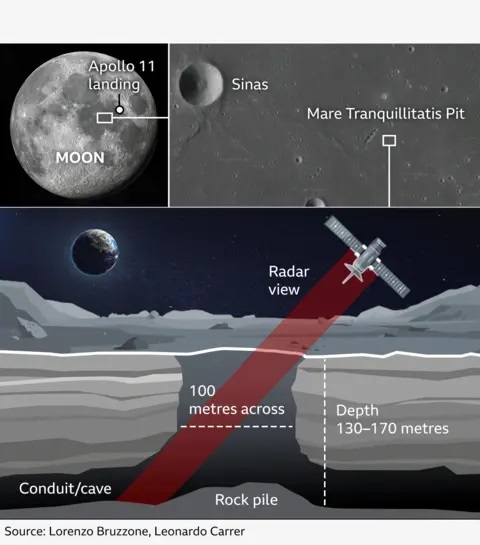
Scientists have confirmed the presence of a cave on the Moon, near the site of the first lunar landing 55 years ago.
This discovery could provide astronauts with a potential habitat on the Moon in the future.
About the Cave on Mare Tranquillitatis
A study titled “Radar evidence of an accessible cave conduit on the Moon below the Mare Tranquillitatis pit” was published in the journal Nature Astronomy.
The study established the presence of a moon cave at the Sea ofTranquillity, a large, dark, basaltic plain on the Moon’s surface.
The cave is located 400 kilometers from where astronauts Neil Armstrong and Buzz Aldrin landed in 1969.
It is roughly 45 meters wide and up to 80 meters long, with an area equivalent to 14 tennis courts.
Research Method
Researchers analyzed photos taken in2010 by NASA’s Lunar Reconnaissance Orbiter (LRO) spacecraft.
They concluded that the pit was the entry point to a cave created by the collapse of a lava tube, a tunnel formed when molten lava flows beneath a field of cooled lava.
Back2Basics:Lunar Reconnaissance Orbiter (LRO)
NASA launched the LRO on June 18, 2009.
LRO’s primary mission is to map the Moon’s surface in high detail to identify safe landing sites and locate potential resources.
It is equipped with seven scientific instruments, including a camera, a laser altimeter, and a radiation detector.
LRO has provided critical data on lunar topography, temperature, and radiation levels, significantly enhancing our understanding of the Moon.
Characteristics of Lunar Caves
Craters are bowl-shaped and result from asteroid or comet strikes.
Pits, in contrast, appear as massive steep-walled depressions.
At least 200 such pits have been discovered, with 16 believed to have formed from collapsed lava tubes due to volcanic activity over a billion years ago.
Benefits for Human Exploration
The Moon is exposed to solar radiation 150 times stronger than Earth.
The lunar surface heats to about 127 degrees Celsius during the day and cools to around -173 degrees Celsius at night.
Caves, however, maintain stable average temperatures of around 17 degrees Celsius.
They could shield human explorers from radiation and micrometeorites, making them viable for future lunar bases or emergency shelters.
Challenges and Further Research
The depth of such caves could present challenges for accessibility.
There are risks of potential avalanches and cave-ins.
Need for Further Research
Further research is needed to understand and map the structural stability of the caves.
This could be done using ground-penetrating radar, robots, or cameras.
To become viable habitats, caves would need systems to monitor movement or seismic activity and safety zones for astronauts in case of a cave collapse.
PYQ:
[2008] Selene-1, the lunar orbiter mission belongs to which one of the following?
In the farmlands of central Thailand, thousands of pythons are raised in a warehouse for their diamond-patterned skins, which are sold to high-end European fashion houses.
Some scientists and industry insiders believe the true value of these snakes lies in their meat.
Python Farming in Asia
Researchers estimate that China and Vietnam alone have at least 4,000 python farms, producing several million snakes primarily for the fashion industry.
A study published in Nature highlighted python farming as a flexible and efficient response to global food insecurity.
Benefits of Python Farming
Pythons can survive for monthswithout food or water and maintain their condition.
They were fed waste chicken and wild-caught rodents, offering a more efficient feed-to-meat ratio than poultry, beef, and even crickets.
Female pythons can lay between 50 and 100 eggs annually, leading to rapid reproduction.
Advantages of Python Meat
Pythons offer a more efficient feed-to-meat ratio than poultry, beef, and even crickets.
They can survive without food and water for months without losing condition.
Python meat has a chicken-like texture and is low in saturated fats.
It could provide a sustainable protein source with a lower environmental impact compared to traditional meat.
Challenges and Market Acceptance
Despite the advantages, the market is limited for python meat.
Python farmers struggle to convince people to consume snake meat, resulting in most of it being discarded or sold to fish farms.
Environmental Impact of Traditional Meat
The UN’s IPCC notes that meat from grazing animals has the greatest environmental impact.
The climate impact of traditional meat is significant, with beef identified as having the greatest environmental impact.
The UN and climate activists advocate for a more plant-based diet, but the demand for meat is expected to increase by 14% by 2032.
Drought and extreme weather are making traditional farming difficult in many parts of the world, increasing the need for alternative protein sources.
The paradox of rising meat demand and environmental concerns has spurred interest in alternatives like edible insects and lab-grown meats.
Python Meat as an Alternative
Protein-energy malnutrition caused nearly 190,000 deaths globally in 2021, emphasizing the urgent need for protein sources in many parts of the world.
Python meat could help address this issue, offering a sustainable and efficient alternative.
PYQ:
[2018] How far do you agree with the view that the focus on lack of availability of food as the main cause of hunger takes the attention away from ineffective human development policies in India?
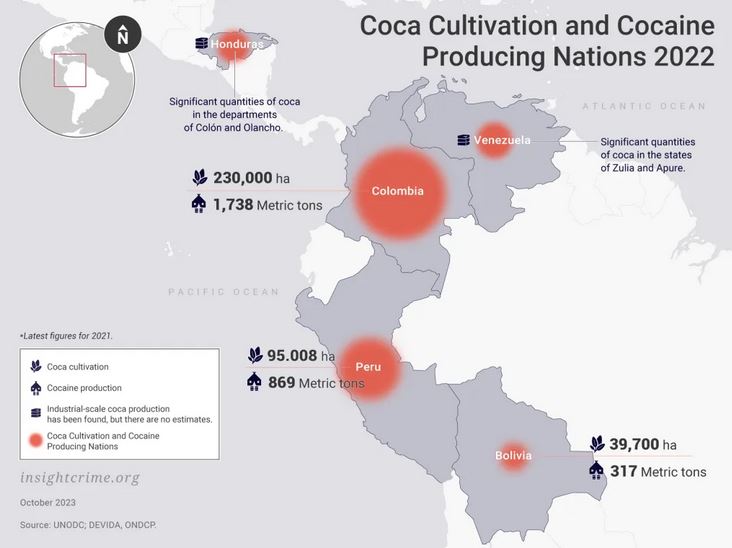
Colombia, the global center of the cocaine industry, is undergoing significant changes due to domestic and global forces.
Recent Changes: Disruption in Cocaine Trade
Colombia, the global center of the cocaine industry, is undergoing significant changes due to domestic and global forces.
Two years ago, drug traffickers who buy coca paste stopped showing up.
This sudden halt left the villagers without income, leading to food shortages and exodus in search of jobs.
The population of Cano Cabra shrunk from 200 to 40 people.
This pattern has repeated in communities across Colombia where coca is the only source of income.
About the FARC Peace Deal
It refers to the agreement reached between the Colombian government and the Revolutionary Armed Forces of Colombia (FARC) to end decades of conflict. It is a significant milestone in Colombia’s efforts to achieve lasting peace and stability.
FARC is a Marxist-Leninist guerrilla group founded in 1964 that waged an armed struggle against the Colombian government for over five decades.
The conflict resulted in over 220,000 deaths and the displacement of millions of people, making it one of the longest-running conflicts in Latin America.
A peace deal was signed on November 24, 2016, and subsequently ratified by the Colombian Congress.
How does the peace deal impact Columbia?
The FARC financed its war through cocaine, relying on farmers to provide coca leaves.
After the FARC left the cocaine industry, smaller criminal groups took over, adopting a new economic model.
These groups buy large quantities of coca from fewer farmers and limit operations to border regions for easier drug transport.
The shift in the drug trade has left the communities economically devastated.
Cocaine Production in Latin America:
Pablo Escobar the famous drug lord and the leader of the Medellín Cartel was a Colombian.
Ecuador has become a top cocaine exporter, and coca cultivation has increased in Peru and Central America.
These changes have pushed global cocaine production to record highs.
While cocaine consumption has reduced in the United States, it is growing in Europe and Latin America and emerging in Asia.
Implications on India:
Changes in the Colombian cocaine industry may alterglobal drug trafficking routes.
India, as part of the global drug trade network, could see changes in the routes used to smuggle cocaine into the country.
Increased cocaine production globally could lead to a higher availability of the drug in India.
This could result in an increase in drug trafficking activities within the country visible in increased seizures in major cities like Pune.
Higher availability of cocaine could lead to an increase in drug abuse cases in India.
PYQ:
[2018] India’s proximity to the two of the world’s biggest illicit opium-growing states has enhanced her internal security concerns. Explain the linkages between drug trafficking and other illicit activities such as gunrunning, money laundering and human trafficking. What counter-measures should be taken to prevent the same?
The Finance Ministry has announced new rules under the General Finance Rules (GFR) to give scientific Ministries more flexibility in importing and buying research equipment.
These changes address scientists’ concerns about strict rules have slowed down research.
Changes introduced in GFR
The limit for buying goods without needing a tender has been raised from ₹25,000 to ₹1,00,000.
For goods priced between ₹25,000 and ₹250,000, a committee of three members must check the market for the best value and quality.
This limit has been raised from ₹1,00,000 to ₹10,00,000.
Note: These changes only apply if the goods are NOT available on the Government e-Marketplace (GeM).
What are General Finance Rules (GFR)?
The General Finance Rules (GFR) are a set of rules issued by the Government of India to regulate financial matters in public administration.
They provide a framework for financial management, ensuring accountability, transparency, and efficiency in the use of public funds.
The GFR were first issued in 1947, post-independence.
The rules have been revised multiple times, with significant updates in 1963, 2005, and the latest in 2017.
The GFR applies to all central government departments, ministries, and organizations funded by the government.
Key Provisions:
General System of Financial Management: Guidelines on budgeting, accounting, and auditing.
Procurement of Goods and Services: Rules for procurement, emphasizing transparency and competition.
Contract Management: Procedures for awarding, managing, and terminating contracts.
Inventory Management: Guidelines for managing government inventories and assets.
Grants-in-Aid: Procedures for providing grants to institutions and individuals.
Major Highlights:
Emphasis on e-procurement to enhance transparency and efficiency.
Use of the Government e-Marketplace (GeM) for procurement of common use goods and services.
Requirement for performance security in government contracts to ensure compliance and reduce risk.
Strengthening of internal controls and audit mechanisms to ensure compliance with rules and regulations.
Back2Basics:Government e-Marketplace (GeM)
The GeM is a one-stop National Public Procurement Portal to facilitate online procurement of common use Goods & Services required by various Government Departments / Organizations / PSUs.
It was launched in 2016 by the Ministry of Commerce and Industry.
It was developedby the Directorate General of Supplies and Disposals (under MCI) with technical support from the National E-Governance Division (MEITy).
Mains: Q.1) How have the recommendations of the 14th Finance Commission of India enabled the States to improve their fiscal position? (UPSC IAS/2021) Q.2) How is the Finance Commission of India constituted? What do you know about the terms of reference of the recently constituted Finance Commission? Discuss. (UPSC IAS/2018)
Prelims: With reference to the Finance Commission of India, which of the following statements is correct? (UPSC IAS/2011) (a) It encourages the inflow of foreign capital for infrastructure development (b) It facilitates the proper distribution of finances among the Public Sector Undertakings (c) It ensures transparency in financial administration (d) None of the statements (a), (b). and (c). given above is correct in this context.
Note4Students:
Prelims: Powers and Functions of Finance Commission;
Mains:Challenges to Fiscal Federalism;
Mentor comments: Fiscal devolution (Horizontal and Vertical), the transfer of fiscal powers and resources from the central government to state/local governments, is a crucial aspect of fiscal federalism. Fiscal devolution increases the financial resources and decision-making powers of state governments, allowing them to better address local needs and priorities. This strengthens fiscal federalism by empowering states to be more fiscally responsible and accountable to their citizens. It also helps in fostering competition among states to attract investments and provide better public services, driving overall economic development. This eventually contributes to macroeconomic stability. Further, the Fiscal devolution to local bodies (Municipalities and Panchayats) by State FC empowers them to undertake development activities and provide public services more efficiently. Hence it is a key pillar of cooperative and competitive fiscal federalism, promoting fiscal autonomy, equitable development, and overall macroeconomic stability in a federal polity like India.
Let’s learn!
Why in the News?
The fiscal devolution between the Union and States, as well as the distribution formula among states, is an ongoing debate with concerns about maintaining the balance of fiscal federalism and equitable development across generations within states.
The Finance Commission (FC) is responsible for recommending the distribution of net tax proceeds between the Union and the States every five years: • The 15th FC recommended a 41% share of central taxes for the states, which is lower than the 42% share recommended by the 14th FC. • The actual share of states in central taxes has been lower than the FC recommendations due to the increasing share of cess and surcharges levied by the Union government, which are not part of the divisible pool. • The horizontal distribution formula among states prioritizes equity (income gap, population, area, forest cover) over efficiency (demographic performance, tax effort). This has led to concerns about accentuating intergenerational inequity within states.
Intergenerational fiscal equity
It refers to a situation where every generation pays for the public services it receives and does not burden the future generation through borrowings. It is also the principle of providing equal opportunities and outcomes to every generation.
There are only two ways for any government to raise its revenue:
Tax: If, in a period, the tax revenue equals the current expenditure of the government, then the current taxpayers pay for the public services they receive.
Borrowing: If the government finances the current expenditure through borrowing, it means the future generation is going to pay higher taxes to repay this borrowing and interest. In other words, borrowing to meet the current expenditure of the government amounts to intergenerational inequity.
According to the Ricardian Equivalence Theory, whenever the government depends on borrowing to finance its current expenditure, households react through higher savings and thus enable the future generation to pay higher taxes as well as keep aggregate demand in the economy constant over different periods.
Presently, the current generations worldwide pay taxes less than the value of the current public services they receive, and thus it saves too. Whereas in our Indian present federal situation, this is not the case.
Condition of Developed States: The households in developed States pay taxes that are not entirely used within the specific States, thus compelling such States to borrow more or curtail current expenditures.
Condition of Developing States: The households in developing States pay taxes much less than the value of current expenditure and fill the gap by receiving higher financial transfers from the Union government.
Issues with Intragenerational Equity:
Low-income States (Bihar, Uttar Pradesh, Madhya Pradesh, Rajasthan, Odisha, and Jharkhand) finance a smaller portion of their revenue expenditure with their own tax revenue and also receive larger amounts of Union financial transfers.
The own tax revenue (collection from GST, VAT Excise, Stamp Duty, and Motor Vehicle Tax) financed up to 59.3% of revenue expenditure in high-income States, while in low-income States, their own tax revenue was financed only 35.9%.
High-income States (Tamil Nadu, Kerala, Karnataka, Maharashtra, Gujarat, Haryana) finance a substantial portion of their revenue expenditure with their own tax revenue but receive too few Union financial transfers.
The Revenue Expenditure to GSDP(Gross State Domestic Product) ratio for high-income States was 10.9%, which is lower than the similar ratio of 18.3% for low-income States.
Nearly 57.7% of revenue expenditure in low-income States was financed by Union financial transfers, and only 27.6% of revenue expenditure was financed by Union financial transfers in high-income States.
Government can also deduce that the high-income States had to incur a deficit of 13.1%, and the low-income States ended up with a deficit of only 6.4% of revenue expenditure.
Thus, the high-income States raise higher amounts of their tax revenue and curtail their revenue expenditure, yet incur higher deficits because of lower Union financial transfers compared to low-income States.
Address the Impacts and Conflicting Equities
Issue with Indicators Used by FC: The indicators presently used by the FC are per capita income, population, and area to reflect differences in demand for public services and revenue availability among states which carries a larger weight to assure equitable distribution of Union transfers.
Efficiency indicators like tax effort and fiscal discipline have smaller weightage to reward the fiscal efficiency of states.
Impact of Lower Transfers: States have Fiscal Responsibility Acts restricting deficit and debt but the reduced Union transfers compel some states to breach these legal limits.
Larger weight to fiscal indicators and incentivizing tax effort and expenditure efficiency through higher transfers can ensure intergenerational fiscal equity and sustainable debt management by states
Way Forward:
Balancing intragenerational and intergenerational equity is crucial to balancing equity and efficiency in the tax devolution formula.
Incentivize tax effort and expenditure efficiency through higher Union transfers
The Finance Commission (FC) should assign larger weight to fiscal indicators.
![[18th July 2024] The Hindu Op-ed: Intergenerational equity as tax devolution criterion](https://www.civilsdaily.com/wp-content/uploads/2024/07/18-july-1568x882.jpg)