💥Mains Ready By December. Smash Mains & Smash PYQ Admissions Open

GS Paper: GS3

  • A big step towards the transformation of various sectors  

    Why in the news?

    The 2024-25 Budget is a progressive proposal featuring several commendable initiatives aimed at boosting India’s economic growth and advancing social progress.

    Prioritized areas in the recent Budget 2024-25

    • Job Creation and Skilling: The budget allocates ₹1.48 lakh crore towards job creation, employment, and skilling, emphasizing the importance of developing a skilled workforce to support India’s service sector. This shift from a focus on manufacturing to skilling reflects a strategic move towards building a service-oriented economy.
    • Energy Transformation: There is significant investments are directed towards energy transformation initiatives, including solar panel manufacturing and nuclear energy development. The budget allocates ₹89,287 crore to crucial sectors, indicating a commitment to sustainable energy solutions.
    • Healthcare Initiatives: The budget includes measures to enhance healthcare access, such as customs duty exemptions on life-saving cancer medications and components for advanced medical equipment.
    • Technology and Innovation: A framework with nine priorities is introduced to leverage advanced technology and foster collaboration between the government and private sector, promoting growth and innovation across various sectors.
      • For example: The budget allocates ₹1 lakh crore specifically for research and innovation, accompanied by a 50-year interest-free loan.

    What does the budget say on Accessibility and Affordability?    

    • Customs Duty Exemptions on drugs: The budget exempts customs duties on three essential cancer medications, making them more affordable and accessible to patients. This move addresses the high costs associated with cancer treatments, which often pose significant barriers to access.
    • Support for Medical Equipment: Customs duties are also waived for components of X-ray tubes and digital detectors, which are crucial for advanced medical technologies.
    • Alignment with Domestic Capacity: The budget emphasizes aligning customs duties with domestic capacity under the phased manufacturing program, fostering a conducive environment for startups and encouraging local manufacturing.

    On Prioritizing Inclusivity and Fiscal Prudence

    • Women’s Workforce Participation: The budget focuses on boosting women’s participation in the economy through targeted initiatives such as hostels, creches, and skilling programs.
      • According to a report by McKinsey, India can increase its 2025 GDP, estimated at $4.83 trillion, by 16%-60% simply by enabling women to participate in the economy on par with men
    • Research and Development: With India spending only 0.7% of its GDP on research, the budget encourages private sector collaboration with the government to increase investments in R&D. This collaboration is vital for fostering innovation and ensuring sustainable economic growth.
    • Public-Private Partnerships: The budget promotes public-private partnerships to enhance healthcare delivery and infrastructure, reflecting a commitment to inclusivity and collaboration in achieving economic and social goals.

    Conclusion: The government should expand the scope of skilling programs to cover a wider range of sectors and skill levels while ensuring the workforce is equipped to meet the evolving demands of the service-oriented economy.
  • ICMR develops CRISPR Cas-based TB Detection Kit

    Why in the News?

    The Indian Council of Medical Research (ICMR) Regional Medical Research Centre for North East has developed the “world’s cheapest CRISPR Cas-based TB testing system”.

    Back2Basics: CRISPR-Cas9 Technology

    • CRISPR-Cas9 stands for Clustered Regularly Interspaced Short Palindromic Repeats and CRISPR-associated protein 9.
    • It is a technology that allows geneticists and researchers to edit parts of the genome by altering sections of the DNA sequence.
    • Emmanuelle Charpentier and Jennifer Doudna’s work on CRISPR-Cas9 as a ‘molecular scissor’ earned them the 2020 Nobel Prize in chemistry.
    • The system consists of two key components:
    1. Cas9: This is the enzyme that acts like a pair of molecular scissors. It is responsible for cutting the DNA strand at a specific location, allowing for the removal, addition, or alteration of DNA at that site.
    2. Guide RNA (gRNA): This is a piece of RNA that is designed to find and bind to a specific sequence of DNA that matches its code. The gRNA guides the Cas9 enzyme to the exact spot in the genome where an edit is desired.
    • Mechanism:
      • The process begins with the design of a gRNA that matches the DNA sequence where an edit is needed.
      • Once inside the cell, the Cas9 enzyme and the gRNA form a complex that can identify and bind to the target DNA sequence.
      • The Cas9 then cuts the DNA at this location.
      • After the DNA is cut, the cell’s natural repair mechanisms can be harnessed to add or remove genetic material, or to make specific changes to the DNA.
    • Applications: Used for gene editing to correct genetic disorders, develop targeted cancer therapies, enhance diagnostics for infectious diseases, and create personalized medicine approaches.

    About the New TB Detection System

    • The system can detect TB bacteria using DNA from a patient’s saliva at a very low cost.
      • Specific DNA sequences unique to Mycobacterium tuberculosis (the bacteria causing TB) are identified.
    • It can identify the bacteria in preliminary stages and test over 1,500 samples simultaneously within approximately two hours.
    • The technology is simple enough to be used in primary health centres in villages.

    TB Situation in India:

    • TB kills an estimated 480,000 Indians annually, or over 1,400 patients every day.
    • India has more than a million ‘missing’ TB cases each year, which remain undiagnosed or inadequately diagnosed and treated in the private sector.

    National Goals for Elimination of TB: 

    • Pradhan Mantri TB Mukt Bharat Abhiyan (2022): It is stipulated to meet the goal of ending the TB epidemic by 2025 from the country, five years ahead of the Sustainable Development Goals (SDG) for 2030.
    • Nikshay Poshan Yojana (2018): Launched in 2018, this scheme provides nutritional support to TB patients. Under this scheme, TB patients receive a direct benefit transfer (DBT) of Rs. 500 per month to purchase food.

    PYQ:

    [2019] What is Cas9 Protein that is often mentioned in news?

    (a) A molecular scissors used in targeted gene editing

    (b) A biosensor used in the accurate detection of pathogens in patients

    (c) A gene that makes plants pest-resistant

    (d) A herbicidal substance synthesized in genetically modified crops

    [2014] Can overuse and free availability of antibiotics without Doctor’s prescription, be contributors to the emergence of drug-resistant diseases in India? What are the available mechanisms for monitoring and control? Critically discuss the various issues involved.

  • In news: Gandhi Sagar Sanctuary

    Why in the News?

    • The Gandhi Sagar sanctuary in Madhya Pradesh is the preferred location for the next batch of cheetah’s relocation plan.
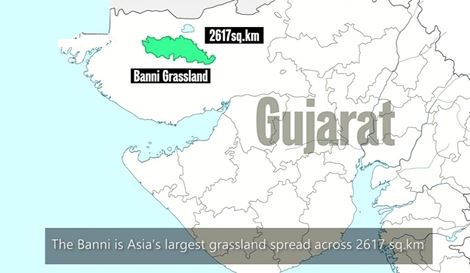
      • However, Banni in the Rann of Kutch, Gujarat is also being prepared to house some of them.

    Cheetah Reintroduction in India:

    • In India, cheetahs disappeared in the early 1950s due to hunting and the loss of their habitat.
    • The ‘Action Plan for Reintroduction of Cheetah in India /Project Cheetah (2022)’ aims to bring cheetahs from African countries to various national parks.
    • It is spearheaded by the National Tiger Conservation Authority (NTCA).
    • Recently, cheetahs from Namibia were reintroduced in Kuno National Park, Madhya Pradesh.
    • Cheetah are listed as VULNERABLE by the IUCN; Schedule II of the Wild Life (Protection) Act, 1972.
    • Kuno NP and Gandhi Sagar has an ideal habitat parallel to Maasai Mara (a National Park) in Kenya, suitable for cheetahs.

    About Gandhi Sagar Wildlife Sanctuary

    • It is located in western Madhya Pradesh and covers an area of 368.62 sq km.
    • It is a flat rocky plateau characterized by shallow topsoil and exposed sheetrock.
    • It is divided by the Chambal River, with the Gandhi Sagar dam and reservoir within its boundaries.
    • Flora and Fauna:
      • Flora: The sanctuary features a savannah ecosystem with open grasslands interspersed with dry deciduous trees. Riverine valleys within the sanctuary support evergreen vegetation.
      • Fauna: The sanctuary is home to a diverse range of wildlife, including species like leopards, sloth bears, striped hyenas, grey wolves, golden jackals, jungle cats, Indian foxes, and marsh crocodiles.

    About Banni Grasslands:

    • The Banni Grassland is located in the Kutch district of Gujarat, covering around 3,847 square km.
    • The climate is arid and semi-arid, with extremely hot summers (temperatures above 45°C) and mild winters (12°C to 25°C), receiving 300-400 mm of annual rainfall mainly during the monsoon.
      • Flora: Grasses such as Dichanthium, Sporobolus, and Cenchrus species, with salt-tolerant plants, shrubs, and trees like Acacia and the invasive Prosopis juliflora.
      • Fauna: Indian wolf, hyena, chinkara, Great Indian Bustard, flamingos, and various raptors, reptiles, and invertebrates.
    • It is inhabited by pastoral communities like the Maldharis, who rely on livestock grazing (cattle, buffalo, and sheep) for their livelihood.
    • Agriculture is limited due to arid conditions, with some areas used for salt production.

    PYQ:

    [2024]  Consider the following statements:

    1. Lions do not have a particular breeding season.

    2. Unlike most other big cats, cheetahs do not roar.

    3. Unlike male lions, male leopards do not proclaim their territory by scent marking.

    Which of the statements given above are correct?

    (a) 1 and 2 only

    (b) 2 and 3 only

    (c) 1 and 3 only

    (d) 1, 2 and 3

    [2012]  Consider the following: (2012)

    1. Black-necked crane
    2. Cheetah
    3. Flying squirrel
    4. Snow leopard

    Which of the above are naturally found in India?

    (a) 1, 2 and 3 only
    (b) 1, 3 and 4 only
    (c) 2 and 4 only
    (d) 1, 2, 3 and 4

  • Key takeaways from the 2023-24 Economic Survey   

    Why in the News?

    The 2023-24 Economic Survey highlights realistic challenges for India’s growth, projecting GDP growth at 6.5%-7% for FY 2024-25 despite 8% growth in FY 2023-24.

    What are the major five issues with the Indian Economy?  

    • Weak Demand: In India, an unfavourable environment for FDI growth is due to high interest rates in developed countries, which increases the cost and opportunity cost of investment in India.
    • Dependence on China: Due to over-reliance on China for imports, particularly in key sectors like renewable energy, limits India’s manufacturing capabilities and increases vulnerability to geopolitical tensions.
    • Tepid Private Investment: Despite tax cuts aimed at stimulating capital formation, the corporate sector has not significantly increased investment, leading to a lack of job creation and economic dynamism.
    • Employment Challenges: The need to generate approximately 78.5 lakh jobs annually in the non-farm sector until 2030 to accommodate the growing workforce, coupled with insufficient data on job creation, complicates labour market analysis.
    • Infrastructure Deficiencies: Inadequate infrastructure, such as roads, railways, and sanitation, continues to hinder economic development and efficiency, requiring substantial investment and reform to improve productivity.

    What are the suggestions given in the Economic Survey? 

    • Private Sector’s Role in Job Creation: The corporate sector should take responsibility for creating jobs, as it is in their enlightened self-interest.
    • Embracing Healthy Lifestyle: Indian businesses should learn from India’s traditional lifestyle, food, and recipes to live healthily and in harmony with nature.
    • Focusing on Agriculture: The farm sector can generate higher value addition, boost farmers’ income, create opportunities for food processing and exports, and make the sector attractive to urban youth.
    • Removing Regulatory Bottlenecks: Licensing, inspection, and compliance requirements imposed by various levels of government are an onerous burden on businesses, especially MSMEs.
    • Improving Data Quality: The lack of availability of timely data on the absolute number of jobs created in various sectors precludes an objective analysis of the labour market situation.

    Way forward: 

    • Enhance Infrastructure Development: Need to prioritize investments in essential infrastructure such as roads, railways, and sanitation to boost economic efficiency and productivity.
    • Strengthen Data Collection and Analysis: The government should develop robust mechanisms for timely and accurate data collection on employment and other key economic indicators.

    Mains PYQ: 

    Q Do you agree with the view that steady GDP growth and low inflation have left the Indian economy in good shape? Give reasons in support of your arguments. (2019)

  • Defence funds decline, BRO gets backing 

    Why in the News?

    Union Finance Minister Nirmala Sitharaman has allocated ₹6.22 lakh crore for the Defence Ministry for 2024-25, matching the amount presented in the interim Budget in February.

    Budgetary allocation for different sectors 

    • Border Roads Organisation (BRO): The BRO received a significant increase in funding, with an allocation of ₹6,500 crore, aimed at improving border infrastructure and promoting socio-economic development in border areas.
    • Indian Coast Guard: The allocation for the Indian Coast Guard is ₹7,651.8 crore, which is 6% lower than the revised estimates for FY24. Of this, ₹3,500 crore is designated for capital expenditure to enhance maritime capabilities.
    • Innovation in Defence: An additional ₹400 crore has been allocated for innovation in defence through the Acing Development of Innovative Technologies with iDEX (ADITI) scheme, aimed at engaging startups and MSMEs in developing indigenous defence technologies.
    • Overall Allocation Breakdown: The allocation for the Defence Ministry includes 27.66% for capital expenditure, 14.82% for revenue expenditure, 30.66% for pay and allowances, 22.7% for defence pensions, and 4.17% for civil organizations under the Defence Ministry.

    Marginal Capex Push

    • Slight increase in capital expenditure: The budget reflects a marginal increase in capital expenditure, focusing on strengthening the capabilities of the armed forces and enhancing domestic procurement.
    • Strategic infrastructure development: The increased allocation to the BRO and the Coast Guard indicates a strategic push towards improving infrastructure in border areas and maritime security, though the overall capital push remains modest.
    • Focus on Indigenous solutions: The emphasis on domestic capital procurement and innovation through the iDEX scheme aims to bolster self-reliance in defence technology, fostering a more robust Indigenous defence industry.
    • Long-term strategic goals: The allocations are aligned with long-term strategic goals, including enhancing operational preparedness and infrastructure development in sensitive regions, although the overall growth in capital expenditure may be viewed as conservative.
    • Balancing defence needs with budget constraints: While the budget seeks to address critical defence needs, the slight reduction in the overall percentage of the budget allocated to defence suggests a balancing act between defence priorities and other pressing social and economic needs.

    Way forward: 

    • Enhance Focus on Indigenous Production: The government should further promote indigenous production capabilities by increasing investments in research and development, and by providing incentives for domestic manufacturers to produce advanced defence technologies.
    • Strengthen Infrastructure Development: The need for continued emphasis on infrastructure projects, particularly in border areas, should be prioritized to enhance national security and socio-economic development, ensuring that allocations are effectively utilized for maximum impact.
  • What is a Climate Finance Taxonomy, announced by FM Sitharaman?

    Why in the News?

    • The 2024 Union Budget, presented by Finance Minister, includes developing a taxonomy for climate finance.
      • The aim is to enhance the availability of capital for climate adaptation and mitigation.

    What is a Climate Finance Taxonomy?

    • A climate finance taxonomy is a classification system that identifies which economic activities can be marketed as sustainable investments.
    • It serves as a guide for investors and financial institutions to direct capital towards projects that contribute to climate adaptation and mitigation, aligning with broader environmental goals.

    Significance of a Climate Finance Taxonomy

    • Net-Zero Economy: With global temperatures rising and the adverse effects of climate change worsening, countries need to transition to a net-zero economy.
    • Alignment with Transition Pathways: Taxonomies help ascertain if economic activities are aligned with credible, science-based transition pathways.
    • Deployment of Climate Capital: They provide an impetus for the deployment of climate capital by directing investments towards sustainable projects.
    • Reduction of Greenwashing Risks: Taxonomies help reduce the risks of greenwashing by providing clear criteria for what constitutes a sustainable investment.

    Why does India need a Green Taxonomy?

    • According to the IFC, India needs an estimated $10.1 trillion to achieve net-zero by 2070.
    • Public investments alone can’t match this goal, calling for standardization in investments.

    Benefits for India

    • For India, a taxonomy could attract more climate funds from international sources.
    • Currently, green finance flows in India are falling short of the country’s needs, accounting for only around 3% of total FDI inflows, according to the Landscape of Green Finance in India 2022 report by the Climate Policy Initiative.
    • A lack of clarity on what constitutes sustainable activity is a significant reason for the low green finance flows. A taxonomy would address this issue.

    India’s Climate Commitments:

    • India aims to achieve a net-zero economy by 2070.
    • The country has pledged to reduce the emissions intensity of its GDP by 45% by 2030, compared to the 2005 level.
    • India has also committed to achieving about 50% of its cumulative electric power installed capacity from non-fossil fuel-based energy resources by 2030.

    Steps taken by India:

    • In January 2021, India established a task force on sustainable finance under the Department of Economic Affairs, Ministry of Finance.
      • The task force’s objectives include creating a framework for sustainable finance, establishing pillars for a sustainable finance roadmap, suggesting a draft taxonomy of sustainable activities, and creating a framework of risk assessment by the financial sector.
    • In April 2021, the RBI joined the Central Banks and Supervisors Network for Greening the Financial System (NGFS) as a member.
    • RBI is also a member of a task force on climate-related financial risks set up by the Basel Committee on Banking Supervision and the International Platform on Sustainable Finance.

    Potential for Green Investments in India

      • According to a report by the International Finance Corporation (IFC), India has a climate-smart investment potential of $3.1 trillion from 2018 to 2030.
      • The largest investment opportunity lies in the electric vehicle segment, with a potential of $667 billion as India aims to electrify all new vehicles by 2030.
    • The renewable energy sector also presents a substantial investment opportunity, estimated at $403.7 billion.

    International Adoption of Taxonomies

    • Many countries have either started developing or have finalized their taxonomies.
    • Countries with developed taxonomies include South Africa, Colombia, South Korea, Thailand, Singapore, Canada, and Mexico.
    • The European Union has also developed its own taxonomy.

    PYQ:

    [2016] With reference to the Agreement at the UNFCCC Meeting in Paris in 2015, which of the following statements is/are correct?

    1. The Agreement was signed by all the member countries of the UN, and it will go into effect in 2017.
    2. The Agreement aims to limit the greenhouse gas emissions so that the rise in average global temperature by the end of this century does not exceed 2ºC or even 1.5ºC above pre-industrial levels.
    3. Developed countries acknowledged their historical responsibility in global warming and committed to donate $ 1000 billion a year from 2020 to help developing countries to cope with climate change.

    Select the correct answer using the code given below:

    (a) 1 and 3 only
    (b) 2 only
    (c) 2 and 3 only
    (d) 1, 2 and 3

  • What is Angel Tax that was scrapped in Budget 2024?

    Why in the News?

    Finance Minister announced the abolition of the angel tax, aiming to strengthen the startup ecosystem and support innovation in India.

    What is Angel Investment?

    • An angel investor is an individual who provides financial backing to early-stage startups or entrepreneurs, typically in exchange for equity in the company.
    • Angel investors are typically high-net-worth individuals who invest their own personal funds, rather than investing on behalf of a firm or institution.
    • Features of Angel Investing: Early-stage funding, equity investment, high-risk, high-reward, active involvement,personal investment,f lexible terms and shorter investment horizon.

    What is Angel Tax? 

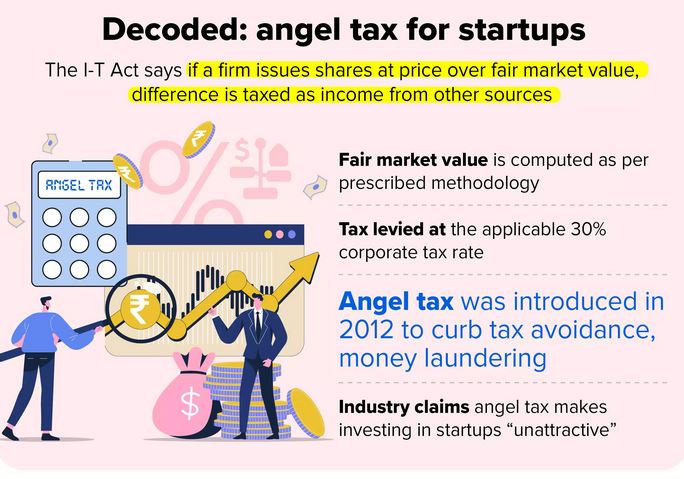
    • Referred to as Angel Tax, this rule is described in Section 56(2)(vii)(b) of the Income Tax Act, 1961.
    • Essentially it’s a tax on capital receipts, unique to India in the global context.
    • This clause was inserted by the Finance Act in 2012 to prevent laundering of black money, round-tripping via investments with a large premium into unlisted companies.
    • The tax covers investment in any private business entity, but only in 2016 was it applied to startups.

    Why was angel tax introduced?

    • The complicated nature of VC fundraising with offshore entities, multiple limited partners and blind pools is contentious.
    • There has been some element of money laundering or round-tripping under guise.

    Details of its levy

    • The Angel Tax is being levied on startups at 9% on net investments in excess of the fair market value.
    • For angel investors, the amount of investment that exceeds the fair market value can be claimed for a 100% tax exemption.
    • However, the investor must have a net worth of ₹2 crores or an income of more than ₹25 Lakh in the past 3 fiscal years.

    Key Issues with Angel Tax

    • Share Valuation: The tax impacted the valuation of shares, causing complications for startups in raising funds.
    • Discounted Cash Flow (DCF) Method: Issues arose with the treatment of estimated figures in the DCF method, leading to disputes.
    • Scrutiny of Funding Sources: The scrutiny of funding sources and investor credibility added another layer of complexity for startups.
    • Retrospective Application: The retrospective application of the tax and its effect on the conversion of convertible instruments into equity were also significant points of dispute.

    Significance for the Startup Community

    • Startups has long advocated for a more supportive and less restrictive environment for fundraising.
    • With this change, the government aims to create a more favourable atmosphere for innovation and investment in India.
    PYQ:

    [2014] What does venture capital mean?

    (a) A short-term capital provided to industries.

    (b) A long-term start-up capital provided to new entrepreneurs.

    (c) Funds provided to industries at times of incurring losses.

    (d) Funds provided for replacement and renovation of industries.

  • How children win with U-WIN, govt’s new online vaccine portal?

    Why in the News?

    • The government plans to roll out U-WIN, an online vaccine management portal for childhood vaccination, across the country.
      • Similar to CoWIN used during the Covid-19 pandemic, U-WIN aims to digitize and individualize immunization records from birth.

    What is U-WIN? 

    • Children up to 6 years old and pregnant mothers are registered on U-WIN using government IDs like Aadhaar and their mobile phone numbers.
    • Records of all 25 shots given to a child and the two given to pregnant mothers are added to the platform.
    • It’s Working:
    • The platform generates a color-coded vaccination certificate.
      • The digital vaccine certificate can be downloaded by parents using their registered mobile numbers, eliminating the need for a physical vaccination booklet.
    • After each shot is administered and recorded, the date is added to the card, which also shows the due date for the next set of vaccines.
      • U-WIN sends SMS reminders to parents before their children are due for the next dose.
      • U-WIN helps locate the nearest vaccination center and book available slots.

    Significance:

    1) For providing Immunization:
    • U-WIN’s reminders to parents are likely to improve compliance with vaccination schedules.
    • The platform ensures portability, allowing children to receive their doses anywhere in the country, particularly benefiting children of migrant workers.
    • Registration at birth may help reduce the number of “zero dose” children, those who have not received any vaccinations.
    2) For Health Workers:
    • The platform can automatically generate a due list of children in specific areas for health workers.
    • These data points can be utilized by other government programs and eventually connected through the ABHA (Ayushman Bharat Health Account) ID.

    Integration with Existing Systems

    • U-WIN will link to the government’s existing eVIN platform for inventory management.
    • eVIN tracks all vaccine vials, from central stores to each vaccination site, monitoring doses used, wasted, and returned, and tracks real-time temperature and humidity using sensors.
    • U-WIN runs on the same principles and digital infrastructure as CoWIN, making adoption straightforward.
    • Most vaccinators are familiar with similar platforms, ensuring a smooth transition.

    Zero Dose Children

    • In India, the coverage of the first dose of diphtheria, pertussis, and tetanus (DPT)-containing vaccine is taken as the proxy for zero dose children.
    • Data from WHO and UNICEF showed that while 93% of children received their first vaccine dose, there were still 1.6 million zero dose children in India in 2023.
    • The data also showed that 1.6 million children missed their first measles-containing vaccine in 2023, up from 1.1 million the previous year.
    • This is concerning as in 2022, five states — Bihar, Gujarat, Haryana, Jharkhand, and Maharashtra — reported a rise in the incidence of measles.


    PYQ:

    [2016] ‘Mission Indradhanush’ launched by the Government of India pertains to:

    (a) Immunization of children and pregnant women

    (b) Construction of smart cities across the country

    (c) India’s own search for the Earth-like planets in outer space

    (d) New Educational Policy

  • What are Rogue Waves and how can AI help predict them?

    Why in the News?

    • Rogue waves, unusually large waves compared to those before and after them, pose significant threats to ships, coastal and offshore infrastructure, and human lives.
      • Until now, there has been no method to forecast rogue waves.

    What Are Rogue Waves?

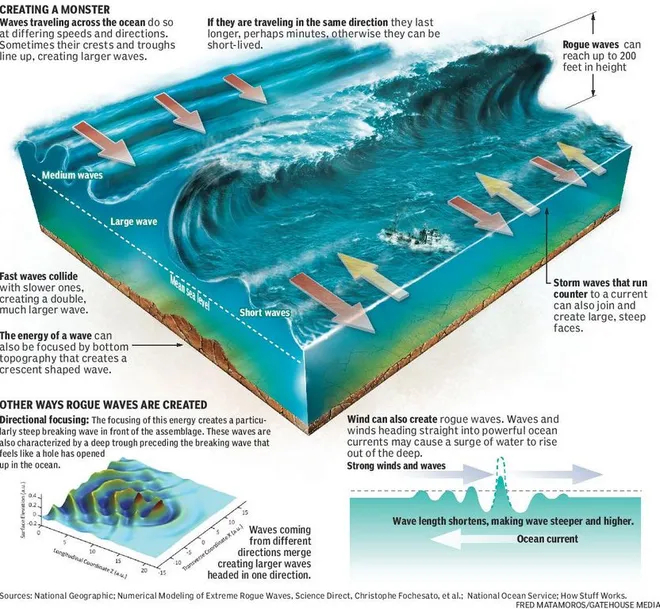
    • Rogue waves are unusually large and unpredictable waves that are much larger than the surrounding waves.
    • They are often defined as waves that are at least twice the height of the surrounding waves.
    • Formation:
      • Rogue waves can form when swells from distant weather systems converge to create a single, amplified wave.
      • They may also form when ocean currents compress swells, creating strong, high waves.
    • Features:
      • Traditionally, rogue waves have been difficult to predict due to their sudden appearance and rare occurrence.
      • The lack of real-time forecasting methods has made it challenging to mitigate their impact effectively.

    What is Sea State?

    • In oceanography, sea state refers to the condition of the surface of a large body of water at a specific location and time.
    • The World Meteorological Organization (WMO) sea state code characterizes sea state based on wave height on a scale of 0 (no waves) to 9 (waves over 14 meters).

    Characteristics:

    • Unlike typical waves, rogue waves can appear suddenly and without warning.
    • They defy the average sea state, making them exceptionally dangerous.

    Threats Posed by Rogue Waves:

    (1) Shipping

    • For Ships and Vessels: Rogue waves pose a significant threat to ships and other vessels at sea. Their unexpected and massive size can lead to capsizing or severe damage.
    • For Offshore Infrastructure: Oil rigs, wind turbines, and other offshore structures can be heavily damaged or destroyed by rogue waves.

    (2) Coastal Threats

    • Coastal Erosion: The sheer force of rogue waves can lead to accelerated coastal erosion, affecting beaches and shorelines.
    • Flooding: Rogue waves can cause sudden and severe coastal flooding, posing risks to coastal communities and ecosystems.

    (3) Human Safety

    • Loss of Life: Rogue waves have been responsible for numerous fatalities. Between 2011 and 2018, rogue waves killed at least 386 people.
    • Property Damage: The impact of rogue waves on ships, coastal areas, and offshore structures can result in significant financial losses.

    Advancements in Forecasting

    • University of Maryland mathematicians Thomas Breunung and Balakumar Balachandran have developed an artificial intelligence program capable of forecasting rogue waves.
    • The AI program was trained using billions of data points collected by a network of 172 ocean buoys.
    • The researchers analyzed 20-minute long samples recorded by ocean buoys.


    PYQ:

    [2017] At one of the places in India, if you stand on the seashore and watch the sea, you will find that the sea water recedes from the shore line a few kilometres and comes back to the shore, twice a day, and you can actually walk on the sea floor when the water recedes. This unique phenomenon is seen at:

    (a) Bhavnagar

    (b) Bheemunipatnam

    (c) Chandipur

    (d) Nagapattinam

  • India’s economy projected to grow at 6.5% to 7% in FY ending March 2025.

    Why in the News?

    • India’s economy is projected to grow at 6.5% to 7% in the fiscal year ending March 2025.
      • The Economic Survey for 2023-24 highlights the need to address inequality and unemployment as policy priorities.

    Policy Recommendations by Chief Economic Adviser (CEA)

    • Regulatory Burdens: CEA V. Anantha Nageswaran advocates for Central and State governments to reduce regulatory burdens on businesses.
    • Corporate Responsibility: He urges the corporate sector to create productive jobs, emphasizing their responsibility in generating employment.

    Various Challenges discussed

    (1) Challenges in the IT Sector:

    • Slowdown in Hiring: The CEA notes a significant slowdown in IT sector hiring over the last two years.
    • AI and Labor: He encourages the industry to use AI to augment labor rather than replace workers.

    (2) Skilling Initiatives

    • Addressing Inequality: The Economic Survey suggests steps to tackle inequality, improve health, and bridge the education-employment gap.
    • Skilling Reboot: A reboot of India’s skilling initiatives is proposed to provide the industry with people having the right attitude and skills.

    (3) Corporate Sector and Economic Growth

    • Demand and Employment: The Survey emphasizes the benefits for corporates from higher demand generated by employment and income growth.
    • Warning against Short-Termism: It warns against “short-termism” which can weaken economic linkages.

    (4) State Capacity and Consensus Building:

    • Enhancing State Capacity: Enhancing state capacity is critical for the strategy to work.
    • Need for Consensus: The CEA stresses the need for consensus between governments, businesses, and the social sectors for effective transformation.

    (5) Land Acquisition and Investment Concerns:

    • Land Use Norms: While the Survey does not mention land acquisition reform, it highlights the need to deregulate land use norms and consolidate farmland holdings.
    • Investment Cautions: The Survey cautions about private capital formation being cautious due to fears of cheaper imports, indirectly referencing China.

    (6) Foreign Direct Investment (FDI) Challenges:

    • Attracting FDI: Attracting FDI will be challenging due to higher interest rates and developed countries encouraging domestic investments through subsidies.
    • Addressing Uncertainties: Despite progress, uncertainties related to transfer pricing, taxes, and import duties need to be addressed.

    Structural Reforms

    • Existing Reforms: Structural reforms such as GST and the Insolvency and Bankruptcy Code are delivering expected results.
    • Next-Gen Reforms: The Survey calls for “next-gen reforms” that are bottom-up in nature to achieve sustainable, balanced, and inclusive growth.

    Strategic Directions for Growth

    • Six-Pronged Strategy: The Survey outlines a six-pronged strategy for growth, emphasizing private sector investments and a fair share of income for workers.
    • Focus Areas: Other focus areas include financing the green transition, removing barriers for MSMEs, and implementing intelligent farmer-friendly policies.

    Conclusion

    • Sustained Growth Potential: The economy can grow at over 7% on a sustained basis in the medium term by building on past reforms.
    • Tripartite Compact: Achieving this growth requires a tripartite compact between the Centre, States, and the private sector.

    PYQ:

    [2013] Economic growth in country X will necessarily have to occur if:

    (a) There is technical progress in the world economy.

    (b) There is population growth in X.

    (c) There is capital formation in X.

    (d) The volume of trade grows in the world economy.