Recently, astronomers have made progress in finding possible candidates as Dyson Sphere, sparking new excitement and debate about extraterrestrial life.
What is a Dyson Sphere?
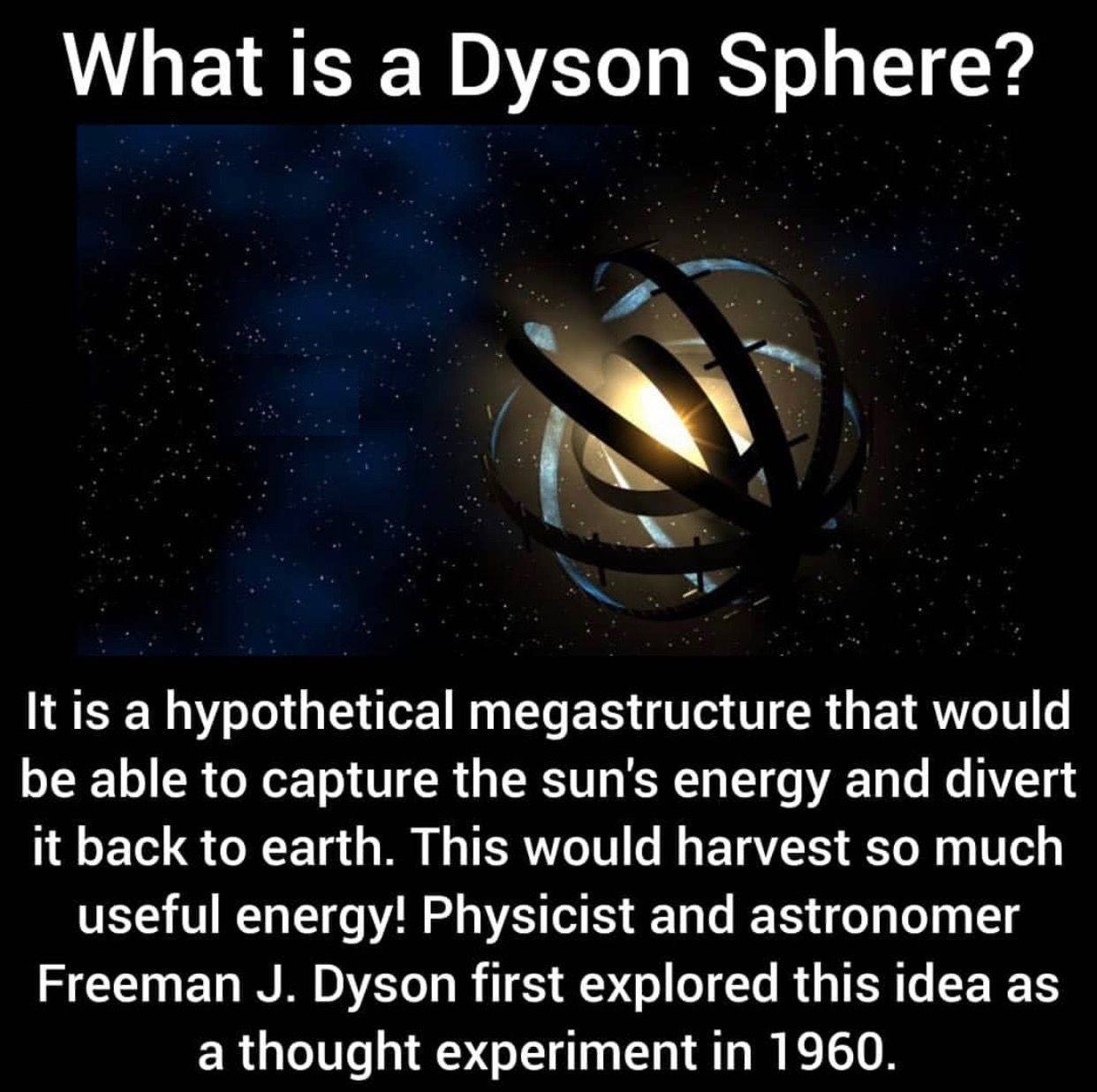
Imagine you are an astronomer looking for extraterrestrial life and you find a star covered by solar panels. This structure, collecting massive amounts of solar energy, is known as a Dyson sphere.
The concept is named after Freeman Dyson, a theoretical physicist who lived from 1923 to 2020.
Dyson proposed that advanced civilizations would need to harness a star’s energy, constructing a spherical array of solar collectors around it.
He suggested that the heat emitted as infrared radiation could indicate the presence of these massive structures and thus intelligent life.
Who was Freeman Dyson (1923-2020)?
Dyson was a renowned British-American theoretical physicist and mathematician known for his work in quantum electrodynamics, solid-state physics, and astronomy.
Born on December 15, 1923, in England, he made significant contributions to science and technology, including the Dyson Sphere concept—a hypothetical structure that could encompass a star to capture its power output.
He was also a prominent futurist and author, exploring ideas on space travel, extraterrestrial life, and the future of humanity.
Dyson spent much of his career at the Institute for Advanced Study in Princeton and was known for his interdisciplinary approach to science.
PYQ:
[2015] The term ‘Goldilocks Zone’ is often seen in the news in the context of
(a) The limits of habitable zone above the surface of the Earth
(b) Regions inside the Earth-like planets in outer space
(c) Search for the Earth-like planets in outer space
(d) Search for meteorites containing precious metals
The markets regulator, SEBI, has proposed a new asset class designed to offer investment products positioned between mutual funds (MFs) and portfolio management services (PMS).
This new category aims to fill an opportunity gap for investors and offer greater flexibility in portfolio construction.
Note:
PMS provides customized investment solutions to high net-worth individuals (HNIs) with a minimum investment limit of Rs 50 lakh.
MFs, on the other hand, have a much lower minimum investment limit of just Rs 100, managed by a professional fund manager.
About the New Asset Class
The new asset class aims to provide an intermediate option with more flexibility in portfolio construction, helping investors avoid unregistered and unauthorized schemes.
It will have a risk-return profile between MFs and PMS, targeting investors with higher risk tolerance and larger investment amounts than those typical of MFs but lower than PMS.
The current range of investment products includes:
MF schemes: Focused on retail investors,
PMS: For HNIs, and
Alternative investment funds (AIF): For sophisticated investors.
How will investments in the new asset class work?
The new asset class will be introduced under the MF structure with necessary relaxations in prudential norms.
The minimum investment amount is proposed to be Rs 10 lakh per investor within the asset management company (AMC)/MF.
This high threshold is intended to deter retail investors while attracting those with investible funds between Rs 10 lakh and Rs 50 lakh.
Significance of the New Asset Class:
SEBI noted that the gap between investment opportunities in MFs and PMS has led some investors towards unauthorized investment avenues.
The new asset class will help curb the proliferation of unregistered investment products and provide a structured and regulated option for investors.
SEBI emphasized that the new asset class would offer a regulated and structured investment suited to investors looking for opportunities between MFs and PMS.
Investment Strategies:
Like MF schemes, the new asset class will provide options for Systematic Investment Plan (SIP), Systematic Withdrawal Plan (SWP), and Systematic Transfer Plan (STP).
AMCs can offer ‘investment strategies’ under a pooled fund structure with tailored redemption frequencies (daily, weekly, monthly, etc.).
PYQ:
[2021] Indian Government Bond Yields are influenced by which of the following?
Actions of the United States Federal Reserve
Actions of the Reserve Bank of India
Inflation and short-term interest rates
Select the correct answer using the code given below.
(a) 1 and 2 only
(b) 2 only
(c) 3 only
(d) 1, 2 and 3
The Central Pollution Control Board (CPCB) has started a national audit of about 800 plastic-waste recyclers across India.
This action follows the discovery that four firms in Karnataka, Maharashtra, and Gujarat issued nearly 600,000 fake certificates under the Extended Producer Responsibility (EPR) programme.
About Central Pollution Control Board (CPCB): Overview
The Central Pollution Control Board (CPCB) is a statutory organization established in September1974.
It was constituted under the Water (Prevention and Control of Pollution) Act, 1974.
CPCB is also entrusted with powers and functions under the Air (Prevention and Control of Pollution) Act, 1981.
It serves as a technical arm of the Ministry of Environment, Forests, and Climate Change, implementing the provisions of the Environment (Protection) Act, 1986.
Principal Functions:
Water Pollution Control:
Promote the cleanliness of streams and wells in different states by preventing, controlling, and abating water pollution.
Oversee the National Water Quality Monitoring Program to collect, collate, and disseminate technical and statistical data relating to water pollution.
Air Pollution Control:
Improve the quality of air and prevent, control, or abate air pollution in the country.
Conduct air quality monitoring as part of air quality management.
Implement the National Air Monitoring Programme (NAMP) to determine current air quality status and trends, regulate pollution from industries, and provide background air quality data for industrial siting and town planning.
Key Initiatives and Programs:
National Air Monitoring Programme (NAMP): Established to monitor air quality status and trends, and to control and regulate industrial pollution to meet air quality standards.
National Air Quality Index (NAQI): Provides real-time air quality data and trends.
Graded Response Action Plan (GRAP): A set of measures to be taken based on the severity of air pollution levels.
Clean Air Campaign: Initiatives aimed at reducing air pollution through public awareness and actionable measures.
Role in Data Management:
CPCB collects, collates, and disseminates technical and statistical data related to water and air pollution.
Provides necessary data for regulatory and planning purposes, including industrial siting and urban planning.
What is Extended Producer Responsibility (EPR) Programme?
Extended Producer Responsibility (EPR) means the responsibility of a producer for the environmentally sound management of the product until the end of its life.
India had first introduced EPR in 2011 under the:
Plastic Waste (Management and Handling) Rules, 2011
E-Waste Management and Handling Rules, 2011.
The EPR scheme requires businesses using plastic packaging to recycle a certain percentage of the plastic used in the previous two years.
Implementation of EPR:
Registration: Producers must register with the Central Pollution Control Board (CPCB) and submit an EPR plan.
Collection Mechanisms: Producers set up collection centers, return schemes, or partner with authorized recyclers to manage waste.
Documentation: Producers are required to maintain detailed records of waste collected and processed and submit regular reports to the CPCB.
Compliance Audits: The CPCB conducts audits to ensure that producers comply with EPR requirements.
Every tonne of plastic recycled generates a certificate.
According to a CPCB report in May, nearly 3.7 million tonnes of recycled plastic generated certificates.
In 2022-23, about 18,000 companies using plastic packaging were registered with the CPCB, aiming to recycle about 3.3 million tonnes.
Compliance and Targets:
Companies must recycle 70% of the packaging used in the previous two financial years for 2022-23 and 100% for 2023-24. Non-compliance with these targets can result in fines.
EPR certificates are uploaded on a dedicated portal maintained by the CPCB, allowing recyclers and buyers to trade online.
PYQ:
[2019] In India, ‘extended producer responsibility’ was introduced as an important feature in which of the following?
(a) The Bio-medical Waste (Management and Handling) Rules, 1998
(b) The Recycled Plastic (Manufacturing and Usage) Rules, 1999
(c) The e-Waste (Management and Handling) Rules, 2011
(d) The Food Safety and Standard Regulations, 2011
Q Besides the welfare schemes, India needs deft management of inflation and unemployment to serve the poor and the underprivileged sections of society. Discuss. (UPSC IAS/2022)
Q “While we flaunt India’s demographic dividend, we ignore the dropping rates of employability.” What are we missing while doing so? Where will the jobs that India desperately needs come from? Explain (UPSC IAS/2014)
Mentor comment: Conflicting reports on unemployment in India highlight significant issues. While the Reserve Bank of India reported the creation of 8 crore jobs over the past few years, the Centre for Monitoring Indian Economy noted a rise in the unemployment rate to 9.2%. The disparity arises from reliance on outdated data, particularly from the unorganised sector, which employs 94% of the workforce. Additionally, economic shocks like demonetisation and the COVID-19 pandemic have altered employment dynamics, complicating accurate assessments and leading to public confusion over the true state of employment.
Let’s learn!
__
Why in the news?
Recently, Prime Minister Modi cited an RBI report claiming 8 crore jobs created in the last 3-4 years, accusing the Opposition of spreading false unemployment narratives.
Conflicting reports and statements related to employment
KLEMS Database
According to the RBI, India added 4.7 crore jobs in FY24, raising total employment to 64.33 crore. This represents a 6% growth in employment compared to the previous year, which was significantly higher than the 3.2% growth reported for FY23.
The period from 2016 to 2024 was marked by several economic shocks, including demonetization, the introduction of the Goods and Services Tax, the Non-Banking Financial Companies crisis, and the COVID-19 pandemic.
SBI’s Counter Report
The State Bank of India (SBI) released a report stating that even when excluding agriculture, 8.9 crore jobs were created in manufacturing and services from FY14 to FY23, and 6.6 crore jobs from FY04 to FY14.
It emphasized that the total labour force in India is approximately 59.7 crore, closely aligning with the 56.8 crore reported in the recent Annual Survey of Unincorporated Sector Enterprises (ASUSE) survey.
CMIE’s Unemployment Data
The Centre for Monitoring the Indian Economy (CMIE) reported a rise in the unemployment rate to 9.2% in June 2024, marking an increase from 7% the previous month.
This contrasts sharply with the optimistic employment figures presented by the RBI and SBI, suggesting a disconnect between reported job creation and actual employment conditions.
Public Sentiment and Ground Reports
Ground reports and public sentiment indicate that unemployment remains a significant issue, particularly for educated youth. High competition for limited job openings is evident, as seen in the 47 lakh applicants for 60,000 constable positions in Uttar Pradesh and 1.25 crore aspirants for railway recruitment exams in 2022. Protests related to employment schemes further highlight the frustrations of job seekers
About KLEMS Database
The Reserve Bank of India (RBI) released the India KLEMS Database on July 7, 2024, which outlines methodologies for measuring productivity and employment across 27 industries in the Indian economy.
It does not independently estimate employment but relies on official data sources, including the Employment and Unemployment Surveys (EUS) by the NSSO and the Periodic Labour Force Survey (PLFS).
The KLEMS data incorporates various economic measures, including Gross Value Added and Labour Quality, covering 27 industries across the Indian economy.
Challenges in KLEMS Database
The Indian labor market is characterized by a significant unorganized sector, which employs approximately 94% of the labor force. This sector is difficult to survey regularly, leading to gaps and outdated data.
The last Census was conducted in 2011, and the Urban Frame Survey (UFS) data is from 2012-2017, resulting in reliance on older data that may not accurately reflect current employment conditions.
The conflicting narratives from various sources, including the Prime Minister’s references to KLEMS data, have led to public confusion regarding the true state of employment in India.
Way forward:
Clear Communication of Data Sources: Government agencies and institutions should clarify how figures from different surveys (e.g., KLEMS, PLFS, ASUSE) relate to one another, and the implications of using outdated data in light of recent economic shocks.
Regular and Comprehensive Surveys: The government should prioritize conducting more frequent and comprehensive surveys, particularly focusing on the unorganized sector, which employs a significant portion of the workforce.
In 2023, natural disaster losses hit $280 billion, with only $100 billion insured, highlighting a need for innovative insurance solutions amid rising extreme weather events.
Present Method of Disaster Risk Reduction
Indemnity-based Insurance Products: Indemnity-based insurance products require a physical assessment of damage after a disaster to determine the payout amount. For example Health Insurance, Motor Insurance and Travel Insurance.
Challenges:
Verification Issues: When large-scale calamities strike, especially in economically disadvantaged areas, it is difficult to verify losses due to the lack of records and widespread destruction.
Delays in Payouts: The need for physical assessment can cause delays in providing financial assistance to the affected individuals and communities.
Insurance Gap: There is a significant gap in insurance coverage between developed and developing economies, leaving many vulnerable populations without adequate protection.
Changing course and the associated limitations:
Parametric insurance: Payments are made based on predefined parameters of weather events (e.g., rainfall exceeding 100 mm per day for two consecutive days, specific flood levels, wind speed).The payouts are made without the need for physical assessment of losses, enabling quicker disbursements.
Examples:
Disaster-prone Island Countries: Many have adopted parametric insurance for climate adaptation, moving away from risk retention models. For example, Fiji launched its first parametric insurance product in 2021
Morocco received $275 million in parametric insurance after a 6.8 magnitude earthquake, arranged with the help of the World Bank.
India has initiated crop insurance (e.g., Pradhan Mantri Fasal Bima Yojana and the Restructured Weather Based Crop Insurance Scheme).
Associated Limitations
Current Focus: Primarily used for low-frequency, high-impact disasters like earthquakes, cyclones, and hurricanes.
Data and Infrastructure Requirements: There is challenges related to developing and maintaining the necessary infrastructure for data collection and monitoring can be challenging, especially in developing regions.
Affordability and Accessibility issues: It demands high premiums can still be a barrier for economically disadvantaged communities.
Case Study of Nagaland:
Nagaland was the first state in India to buy parametric cover for extreme precipitation in 2021.
Based on lessons learned, it improved the product by fixing an absolute annual premium, duration, and rate online, allowing bidders to compete over lower threshold limits and maximized payouts.
What can be done to ensure effectiveness? (Way Forward)
Precise Thresholds and Robust Monitoring: Establish clear, accurate parameters for insurance triggers and implement reliable monitoring systems to track these parameters effectively.
Transparent Bidding and Experience Sharing: Follow a transparent bidding process for price discovery and facilitate the exchange of best practices and lessons learned between governments.
Widespread Payout Systems and Household Premium Support: Develop comprehensive systems for distributing payouts and promote long-term premium payment by households, leveraging tools like Aadhaar-based payment dissemination.
Mains PYQ:
Q Describe various measures taken in India for Disaster Risk Reduction (DRR) before and after signing ‘Sendai Framework for DRR (2015-2030)’. How is this framework different from ‘Hyogo Framework for Action, 2005’? (UPSC IAS/2018)
Over the past two decades, India’s maize production has more than tripled, emerging as a private sector-driven green revolution success story. Maize has transitioned from being primarily a feed crop to also serving as a fuel crop.
What was the Green Revolution?
Began in 1968 with the introduction of high-yielding variety (HYV) seeds, especially for wheat and rice, developed by agronomist Norman Borlaug
Institutions like CIMMYT (International Maize and Wheat Improvement Center) and IARI (Indian Agricultural Research Institute), led by scientists like Norman Borlaug and M S Swaminathan, played a crucial role.
The Green Revolution is credited to M.S. Swaminathan, known as the “Father of the Indian Green Revolution”, who introduced Borlaug’s wheat varieties and other technologies.
The initiative focused on increasing agricultural productivity through advanced breeding techniques, fertilizers, and irrigation methods.
Wheat production increased from 12 million tons in 1964-65 to 20 million tons in 1970-71.India became self-sufficient in food grain production and a major exporter
Present India’s Maize Production called as a Green Revolution in Maize
Significant Production Increase: Over the last two decades, India’s maize production has surged from 11.5 million tonnes in 1999-2000 to over 35 million tonnes in 2023-24, showcasing a remarkable increase in both yield and output.
Private Sector Leadership: This growth has been largely driven by the private sector, with more than 80% of the maize area planted with high-yielding hybrids developed by private seed companies, indicating a successful private sector-led green revolution.
Diverse Utilization: Maize in India has evolved from being primarily a feed crop for poultry and livestock to also being a vital industrial crop used for starch and ethanol production, reflecting its expanded role in the economy.
On Starch and Ethanol Production
Maize contains 68-72% starch, with significant industrial applications in textiles, paper, pharmaceuticals, food, and beverages.
Maize is emerging as a key feedstock for ethanol production, especially for blending with petrol.
IARI has developed a waxy maize hybrid with high amylopectin content, enhancing its suitability for ethanol production.
The new Pusa Waxy Maize Hybrid-1 has 71-72% starch with 68-70% recoverable, increasing ethanol yield per tonne.
Can India adopt new strategies? (Way forward)
India can adopt new strategies through innovative breeding techniques like the doubled haploid (DH) technology used by CIMMYT.
The DH facility in Karnataka speeds up the development of genetically pure inbred lines, enhancing the efficiency of maize breeding.
IARI’s waxy maize hybrid is ready for field trials and commercial release, potentially boosting ethanol production.
Collaboration between public sector institutions and private seed companies can drive the adoption of high-yielding, disease-resistant maize varieties.
Private sector-bred hybrids account for over 80% of India’s maize area, indicating strong potential for further growth and innovation in maize production.
Mains PYQ:
Q Explain various types of revolutions, that took place in Agriculture after Independence in India. How these revolutions have helped in poverty alleviation and food security in India? (UPSC IAS/2017)
India is set to establish a Joint Crediting Mechanism (JCM) with Japan for carbon trading and emission-reduction credits.
Memorandum of Cooperation for Setting Up a Joint Crediting Mechanism (JCM)
Objective and Framework: India and Japan plan to sign a Memorandum of Cooperation to establish a Joint Crediting Mechanism (JCM) for sharing emission-reduction credits. The JCM will involve a structured allocation of carbon credits and maintain a registry to track these credits, with projects needing clearance from a Joint Committee.
Implementation and Oversight: The mechanism will be governed under Article 6.2 of the Paris Agreement, adhering to relevant domestic laws and regulations of both countries. A Joint Committee will develop rules, manage project cycles, and oversee monitoring and issuance of credits.
Emission Cuts
Credit Allocation: Credits issued under the JCM will contribute to both Japan’s and India’s Nationally Determined Contributions (NDCs) under the Paris Agreement. The JCM will avoid double counting of credits and may authorize some credits for international mitigation purposes.
Technology Transfer and Capacity Building: Japan will support technology transfer, finance, and capacity building to enhance the effectiveness of the JCM and facilitate the adoption of new technologies.
Significance of JCM:
Increased Access to Clean Technologies: The JCM will facilitate the transfer of advanced decarbonizing technologies from Japan to India, such as renewable energy systems, energy-efficient appliances, and waste management solutions.
Job Creation and Skill Development: The implementation of JCM projects will create new employment opportunities in sectors like renewable energy, energy efficiency, and waste management
Bilateral ties between India and Japan
Strategic Partnership: The JCM will strengthen bilateral ties between India and Japan by fostering collaboration on low-carbon technologies and climate action, aimed at boosting job creation and investments in clean technologies.
Clean Energy Partnership: It was launched in March 2022, the India-Japan Clean Energy Partnership (CEP) aims to enhance cooperation in sustainable energy transitions to achieve net-zero emissions by 2070.
Investment Commitments: During the 14th India-Japan Annual Summit in March 2022, both nations agreed on a target of $42 billion (JPY 5 trillion) in public and private investment from Japan to India over the next five years
Low Carbon Emission Strategies: A $600 million fund was established to focus on environmental sustainability and low carbon emission strategies. This initiative is part of a broader effort to enhance Japanese investments in India while addressing climate change.
Way forward:
Prioritize the adoption of cutting-edge decarbonizing technologies: Japan should prioritize the transfer of its most advanced low-carbon technologies to India, such as renewable energy systems, energy-efficient appliances, and carbon capture and storage solutions.
Expand the scope of the JCM to include other areas of climate cooperation: While the initial focus of the JCM should be on emission reduction projects, India and Japan could explore expanding its scope to include other areas of climate cooperation, such as adaptation measures, climate finance, and capacity building.
Mains PYQ:
Q Clean energy is the order of the day.’ Describe briefly India’s changing policy towards climate change in various international fora in the context of geopolitics. (UPSC IAS/2022)
On July 8th, 1497, Vasco da Gama’s historic voyage began, reshaping global maritime routes and leaving a lasting impact on trade and culture. This era of exploration introduced and disseminated tobacco, profoundly affecting societies in numerous ways.
Cultivation and Production of Tobacco
Historical Introduction: Tobacco was originally cultivated by Native Americans and brought to Europe in the 16th century. It was introduced to South Asia by European traders and colonizers, notably the Portuguese, Dutch, and British.
Economic Significance: Tobacco is a drought-tolerant crop providing livelihoods to many. It accounts for about 2% of India’s agricultural exports and employs over 45 million people.
Revenue Generation: The tobacco industry is a major source of revenue through taxation and exports, generating over ₹22,000 crores annually.
Implications on Human Health
Health Issues: Tobacco use contributes to various cancers (lung, mouth, throat, oesophagus, pancreas, and bladder), respiratory diseases (COPD, emphysema, chronic bronchitis), cardiovascular problems (heart disease, stroke, hypertension), and other conditions like diabetes, infertility, weakened immune system, and complications in pregnancy.
Addiction: Nicotine, a highly addictive substance in tobacco, alters brain function leading to severe addiction.
Health Crisis: In India, tobacco use causes over 1.2 million deaths annually. It is responsible for 27% of all cancers and adds significant costs to healthcare and productivity losses, totaling approximately ₹1.82 trillion annually.
Ethical and Revenue Considerations
Economic Benefits vs. Health Costs: While tobacco provides economic benefits and employment, it comes with tremendous human and financial costs due to tobacco-related illnesses.
Constitutional Provisions: Under Article 21 of the Indian Constitution guarantees the right to life and health. The Directive Principles of State Policy mandate the state to improve public health and living standards.So,Govt. has responsibility to prevent tobacoo consumption.
Indian needs to Stack Up Its Priorities
Institutional Conflict: The Indian Council of Medical Research (ICMR) focuses on eliminating tobacco to mitigate health impacts, while the Indian Council of Agricultural Research (ICAR) aims to increase tobacco crop yields.
Policy and Ethical Dilemma: The conflicting priorities between ICMR and ICAR create significant policy challenges. The constitutional mandate to prioritize public health should guide policy decisions.
Will CRISPR make a difference?
Gene Editing Potential: CRISPR technology offers potential solutions by developing genetically modified tobacco plants with reduced nicotine content.
Research Developments: Studies have shown promise in using CRISPR to significantly lower nicotine levels in tobacco plants. However, further characterization is needed to ensure these modifications do not negatively impact other important traits.
Collaborative Efforts: Collaboration between ICMR and ICAR is crucial to align scientific advancements with public health goals and agricultural sustainability.
The Tobacco Lobby and Surrogate Advertising
Circumventing Regulations: The tobacco industry employs surrogate advertising to promote its products despite stringent advertising bans. These tactics perpetuate tobacco consumption, especially among youth, undermining public health efforts.
Aggressive Lobbying: The tobacco industry has a large network of 1,027 registered lobbyists at the state level in 2024, many of whom are former government employees. They engage in extensive lobbying to weaken, delay or block life-saving tobacco control measures.
Way forward:
Implement Stricter Regulations: Enforce stringent regulations on tobacco advertising, including surrogate advertising, and ensure compliance through regular monitoring and penalties.
Ban on Public Smoking: Implement and strictly enforce smoking bans in public places to reduce exposure to second-hand smoke.
Mains PYQ:
Q What are the research and developmental achievements in applied biotechnology? How will these achievements help to uplift the poorer sections of the society? (UPSC IAS/2021)
On July 5, the Assam government instructed the Border wing of the State police not to refer cases of non-Muslims who entered India illegally before 2014 to the Foreigners Tribunals (FTs).
About Foreigners Tribunals:
Foreigners Tribunals are quasi-judicial bodies established to determine if a person staying illegally in India is a “foreigner” or not.
They were set up under the Foreigners (Tribunals) Order, 1964, enacted by the central government under the Foreigners Act, 1946.
Initially, only the central government could set up these tribunals. But a 2019 amendment empowered district magistrates in all states and UTs to establish Foreigners Tribunals.
The tribunals have the powers of a civil court to summon witnesses, require document production, and examine evidence.
Decision-Making Process of Foreigners Tribunals:
Referral: Individuals suspected of being foreigners are referred to FTs by local authorities or border police. This referral can be based on various factors, including lack of documentation or doubtful voter status.
Notice Issuance: Upon receiving a reference, the FT issues a notice to the person alleged to be a foreigner. This notice is served in English or the state’s official language.The person has 10 days to respond to the notice and an additional 10 days to submit evidence supporting their claim of citizenship.
Submission of Evidence: The individual must present evidence to prove their Indian citizenship. This may include documents like birth certificates, school certificates, land records, or other official records.
Verification: The tribunal examines the documents and evidence provided, and may call witnesses or seek additional information if necessary.
Hearing: The FT has the authority to summon and examine the individual on oath, and to require the production of additional documents. The tribunal operates with certain powers of a civil court.
Judgment: If the evidence provided is deemed insufficient to prove citizenship, the individual may be declared a foreigner. If evidence is adequate, the person is recognized as an Indian citizen.
Detention and Deportation: If declared a foreigner and unable to appeal successfully, the person may be sent to a detention center (transit camp) for deportation.
Role of Border Police:
Detection and Referral: The Assam Police Border Organisation is responsible for detecting illegal foreigners and referring suspicious cases to FTs.
Patrolling and Defence: They patrol the India-Bangladesh border, work with the Border Security Force, and maintain a second line of defense.
Monitoring: They monitor people settled in riverine and char (sandbar) areas.
Cases of ‘D’ Voters: They refer cases of ‘D’ (doubtful) voters to FTs as directed by the Election Commission of India.
NRC Appeals: People excluded from the NRC can appeal to the FTs through this wing to prove their citizenship.
Challenges and Criticisms:
Supreme Court Rulings: The Supreme Court has overturned FT orders citing grave miscarriages of justice, such as the wrongful declaration of a deceased farmer, Rahim Ali, as a foreigner.
Corruption and Malpractice: Observations have been made about corruption within the system, with allegations of notices being improperly served.
Conclusion: Need to Implement stricter oversight and auditing of Foreigners Tribunals to ensure fairness and adherence to legal procedures. Regular reviews and monitoring can help prevent corruption and malpractice, ensuring that notices are properly served and tribunal processes are transparent.
Mains PYQ:
Q How far are India’s internal security challenges linked with border management particularly in view of the long porous borders with most countries of South Asia and Myanmar? (UPSC IAS/2013)
India’s tree planting schemes have garnered attention as part of the country’s efforts to combat climate change and restore degraded ecosystems. However, these initiatives face several challenges and criticisms.
Recent Trends of Special Conservation Drives:
Increased Initiatives: There has been a surge in global and national tree planting drives, such as the “One Trillion Project” by the World Economic Forum, Pakistan’s “10 Billion Tree Tsunami,” China’s “Great Green Wall,” and the “Bonn Challenge” to restore degraded landscapes.
High Media Attention: These drives often feature catchy slogans and glamorous campaigns that attract substantial media attention and public involvement.
Annual Events: India celebrates Van Mahotsava annually in July, aiming to promote tree planting and environmental conservation.
Issues Associated with These Drives:
Limited Community Participation: Many programs lack significant involvement from local communities, affecting their effectiveness and sustainability.
Post-Planting Measures: Insufficient focus on post-planting care and monitoring hinders the success of tree planting efforts.
Monoculture Risks: Some drives promote monoculture, which can be detrimental to biodiversity and carbon sequestration.
Ecological Impact: Inappropriate tree planting in non-deforested areas like grasslands or animal habitats can damage ecosystems, increase wildfire risk, and exacerbate global warming.
India’s Accountability and Challenges Toward Environmental Goals:
Achievements: India claims to have fulfilled its Paris Agreement commitments and achieved an additional carbon sink of 1.97 billion tonnes of CO2 equivalent.
Encroachment and Loss: Approximately 10 million hectares of Indian forests are under encroachment, and about 5.7 million hectares have been lost for non-forestry purposes.
Dependence on Forests: Nearly 27.5 crore people rely on forests for subsistence, highlighting the importance of sustainable management.
Restoration Goals: India aims to restore 26 million hectares of degraded forests by 2030, but faces challenges such as encroachment and the need for effective tree planting strategies.
Way forward:
Community Involvement: Need to foster local participation in tree planting drives by involving communities in planning, execution, and ongoing maintenance.
Monitoring and Maintenance: Try to implement robust post-planting monitoring and care systems to ensure the survival and growth of planted trees.
Policy and Strategy Improvements: To address criticism of mass planting drives, India needs to prioritize adequate financing, active community participation, and technical considerations in forestry and restoration strategies.
![[20th July 2024] The Hindu Op-ed: Living in denial about unemployment](https://www.civilsdaily.com/wp-content/uploads/2024/07/20-july-1568x882.jpg)