💥Join UPSC 2027,2028 Mentorship (August Batch) + XFactor Notes & Microthemes PDF

GS Paper: Parliament & State Legislatures

  • [27th May 2026] The Hindu OpED: Rajya Sabha Defections, constitutional questions

    PYQ Relevance[UPSC 2020] The anti-defection law has failed to achieve its intended purpose. Discuss.Linkage: The PYQ tests understanding of the Tenth Schedule, defections, party discipline, and constitutional loopholes. The AAP Rajya Sabha controversy exposes ambiguity in the merger exception under Paragraph 4, questioning whether legislative majorities can bypass the original political party. 

    Mentor’s Comment

    A constitutional controversy has emerged after seven of AAP’s ten Rajya Sabha MPs reportedly invoked the merger exception under the Tenth Schedule of the Constitution of India to join the BJP. They have claimed support of over two-thirds of legislators. The episode has triggered a constitutional debate on whether legislators alone can claim merger without approval of the original political party, making it a major test for the Tenth Schedule.

    How did India’s anti-defection framework evolve from permitting splits to restricting defections?

    1. 1950 (Original Constitution): Articles 102 and 191 outlined basic disqualifications like holding an office of profit or unsound mind. The President or Governor decided cases based on the Election Commission’s opinion. Political defections were not explicitly penalized.
    2. 52nd Constitutional Amendment Act, 1985: Introduced the Tenth Schedule (Anti-Defection Law) to address frequent political defections and instability.
      1. Objective of the Law: Ensures political stability by discouraging elected representatives from abandoning party affiliation for political gain.
      2. Split Provision (Paragraph 3): Recognised a “split” if one-third members of a legislature party separated, thereby protecting them from disqualification.
    3. 2003 (91st Amendment): Deleted Paragraph 3 entirely. This eliminated the “split” defense, meaning individual or minor group defections always lead to disqualification.
      1. Under Paragraph 3, if a faction consisting of one-third or more of a party’s elected legislators decided to break away, the law deemed it a “split”. This newly formed faction was completely exempt from disqualification and could function as a separate group or support an opposition coalition without losing their seats.
    4. Shift in Constitutional Philosophy: Restored primacy of the political party over temporary legislative factions.
    Dinesh Goswami Committee (1990): Recommended tightening anti-defection provisions to reduce political opportunism.170th Law Commission Report (1999): Supported removal of the split provision due to misuse in legitimising defections.

    Why does the AAP Rajya Sabha episode raise constitutional concerns beyond routine defections?

    1. National-Level Significance: Involves Rajya Sabha MPs at the Union level, unlike previous state-level controversies.
    2. Striking Data: Seven out of ten AAP Rajya Sabha MPs (over two-thirds) reportedly sought merger with BJP.
    3. Merger Exception Invoked: Legislators relied on Paragraph 4 of the Tenth Schedule, claiming exemption from disqualification.
    4. Constitutional Question: Raises uncertainty regarding whether legislators alone can engineer a merger without consent of the parent political party.
    5. Opposition Integrity: Affects the constitutional role of the Opposition in parliamentary democracy, especially if legislative majorities can dissolve party identity.
    6. Institutional Consequences: Tests the authority of the Rajya Sabha Chairman in deciding disqualification under the Tenth Schedule.

    Does the “merger exception” under Paragraph 4 permit legislators to override the original political party?

    Paragraph 4 refers to the “Merger Exception” within the Tenth Schedule of the Constitution of India. It provides legal immunity from disqualification for elected members (MPs or MLAs) when their political party merges with another party.

    The Core Mechanism: The “Twin Test”: To legally claim a merger and escape disqualification under Paragraph 4, a specific two-step requirement must be met: 

    1. Party-Level Merger (The Origin): The original political party must decide to merge with another political party.
    2. Legislative Agreement (The Numbers): Following the organizational merger, not less than two-thirds (66.6%) of the elected legislators of that party in the House must agree to accept the merger.
    Key Provisions of Paragraph 4
    Paragraph 4(1): Protection for Members: States that a legislator will not be disqualified if their original political party merges with another, and they choose to either join the new party or function as a separate group.
    Paragraph 4(2): The Deeming Fiction: Establishes that a merger is legally deemed to have taken place if and only if a minimum of two-thirds of the legislature party’s members give their consent to it.
    1. Core Constitutional Ambiguity: Uncertainty persists on whether legislators can independently trigger merger or merely implement a party-level decision.
    2. Judicial Position: In Subhash Desai (2023), the Supreme Court reinforced primacy of the political party over the legislature wing.
    3. Constitutional Concern: Allowing legislators alone to merge may enable temporary legislative majorities to appropriate party identity and electoral mandate.
    4. Democratic Implication: Risks weakening party stability and Opposition politics within parliamentary democracy.

    How has the judiciary interpreted the relationship between legislature parties and political parties?

    Core Judicial Principles

    1. Constitutional Hierarchy: The political party is the parent body. The legislature party is its subordinate wing and cannot sever ties or act independently.
    2. Source of Legitimacy: Legislators win elections based on the political party’s ticket, manifesto, platform, and campaign symbols. Therefore, their allegiance remains tied to the organizational party.
    3. The Whip Authority: The power to appoint the Chief Whip and the Party Leader belongs strictly to the political party organization, not to a majority faction of legislators.
    4. Protection vs. Usurpation: The “deeming fiction” in Paragraph 4 protects a two-thirds legislative majority from disqualification only after an actual party merger. It does not empower them to hijack the party’s identity or organizational assets.

    Landmark Judgment: Subhash Desai v. Governor of Maharashtra (2023): In this pivotal case, a 5-judge Constitution Bench of the Supreme Court firmly established the supremacy of the political party over the legislative wing:

    1. Continuous Guidance: The Court ruled that a political party’s influence does not end on election day; it continuously guides its elected representatives throughout their tenure.
    2. Illegal Appointments: The Court declared the Eknath Shinde faction’s appointment of their own Whip and Leader as illegal, stating that the Speaker must recognize only the Whip authorized by the parent political party.
    3. No Shield for Rebellion: Internal dissent or achieving a legislative majority cannot be used as a tool to bypass the Anti-Defection Law, especially since the “split” doctrine (Paragraph 3) was deleted in 2003.

    Structural Comparison

    FeaturePolitical Party (Parent Body)Legislature Party (Subordinate Wing)
    CompositionOffice bearers, cadres, and members nationwide/statewide.Only the elected MPs or MLAs in the House.
    Constitutional RoleHolds the fundamental democratic mandate and symbols.Executes the party’s agenda within the legislature.
    Control of the WhipYes. Has the exclusive right to appoint the Whip.No. Must follow the Whip appointed by the parent party.

    Can legislative majorities appropriate the identity of a political party?

    1. Constitutional Identity: A political party derives continuity from its organisation, leadership, ideology, and electoral mandate, not merely elected legislators.
    2. Risk of Party Capture: Permitting temporary legislative majorities to claim party identity may enable numerical capture of parties, weakening internal democracy and organisational autonomy.
    3. Legislature-Party Distinction: Legislators derive legitimacy from the party’s symbol and mandate; the legislature wing remains subordinate to the parent political organisation.
    4. Judicial Position: In Subhash Desai (2023), the Supreme Court reinforced primacy of the political party, including authority over appointment of the Chief Whip.
    5. Parliamentary Consequence: Allowing legislators to appropriate party identity may undermine Opposition politics and weaken the anti-defection law’s objective of preserving party-system integrity.

    What are the broader implications for parliamentary democracy and Opposition politics?

    1. Opposition Preservation: Anti-defection law indirectly protects parliamentary dissent, especially in the Rajya Sabha.
    2. Constitutional Morality: Prevents legislative arithmetic from undermining electoral mandates and voter trust.
    3. Need for Doctrinal Clarity: Ambiguity in Paragraph 4 of the Tenth Schedule over whether merger requires party approval or only legislative majority necessitates clear judicial interpretation to prevent inconsistent decisions and constitutional instability.
    4. Federal Relevance: Similar disputes in Maharashtra, Karnataka, Arunachal Pradesh, and Manipur show that ambiguity in anti-defection law is a recurring issue across States. This necessitates uniform constitutional principles to ensure consistency and political stability.
    5. Democratic Stability: Ensures continuity of party-based representation, which remains central to parliamentary governance.

    Conclusion

    The Rajya Sabha defection episode involving AAP is not merely a question of political realignment but a constitutional test regarding the relationship between legislative numbers and political legitimacy. The interpretation of Paragraph 4 of the Tenth Schedule will shape the future of India’s anti-defection regime, the integrity of political parties, and the institutional strength of parliamentary opposition.
  • Tamil Nadu Assembly Floor Test 2026

    Why in the News

    Vijay won the confidence motion in the Tamil Nadu Legislative Assembly with 144 votes, ensuring the survival of the TVK-led coalition government.

    Key Highlights of the Floor Test

    • Confidence Motion Passed
      • The motion moved by Chief Minister Vijay received: 144 votes in favour
    • Supporting Parties
      • Indian National Congress
      • Communist Party of India
      • Communist Party of India (Marxist)
      • Viduthalai Chiruthaigal Katchi
      • Indian Union Muslim League
      • 25 rebel AIADMK MLAs
      • One AMMK MLA

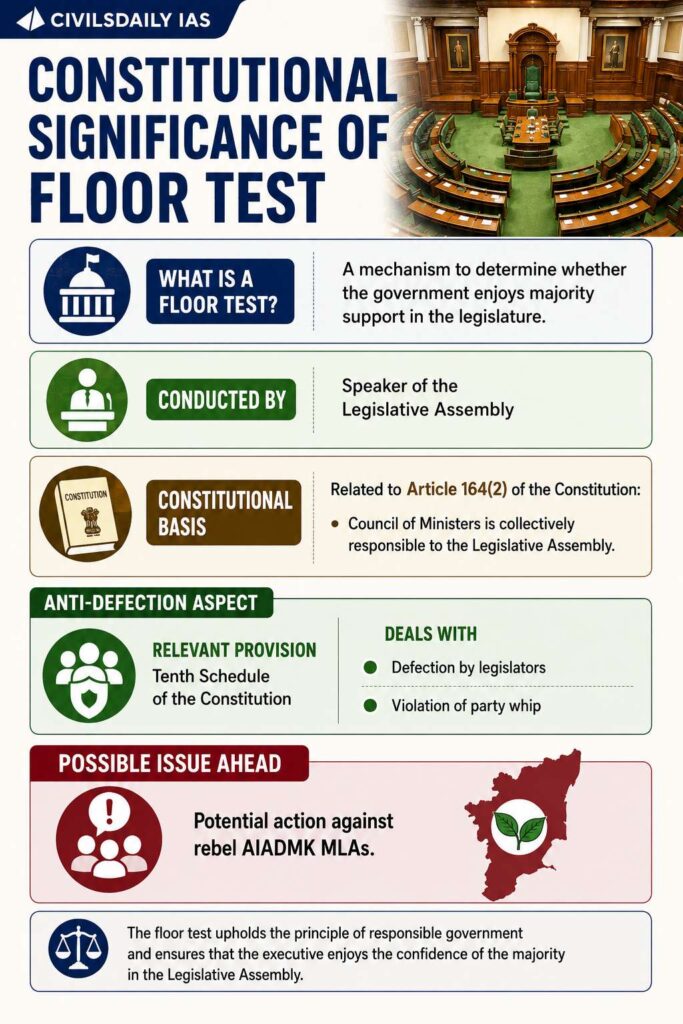
    Constitutional Significance of Floor Test

    • What is a Floor Test?: A mechanism to determine whether the government enjoys majority support in the legislature.
    • Conducted By: Speaker of the Legislative Assembly
    • Constitutional Basis: Related to Article 164(2) of the Constitution:
    • Council of Ministers is collectively responsible to the Legislative Assembly.

    Anti-Defection Aspect

    • Relevant Provision: Tenth Schedule of the Constitution
    • Deals With
      • Defection by legislators
      • Violation of party whip
    • Possible Issue Ahead
    • Potential action against rebel AIADMK MLAs.

    Note: In India, the office of the “whip” is not explicitly mentioned in the Constitution, the Rules of the House, or any parliamentary statute; rather, it is based on convention. However, the authority to issue whips and the consequences for defying them are legally upheld by the Tenth Schedule (Anti-Defection Law).

    [2020] A Parliamentary System of Government is one in which 
    a) All political parties in the Parliament are represented in the Government 
    b) the Government is responsible to the Parliament and can be removed by it 
    c) the Government is elected by the people and can be removed by them 
    d) the Government is chosen by the Parliament but cannot be removed by it before completion of a fixed term
  • AI-enabled oversight layer for continuous electoral roll monitoring 

    Why in the News?

    The debate over electoral roll transparency grew after SIR 2.0 during the West Bengal Assembly elections highlighted problems in voter verification and deletion. Even after ECINet became fully operational in January 2026, concerns arose over lack of transparency, inconsistent procedures, and a large number of disputes, including nearly 34 lakh appeals and around 7 lakh voter deletion appeals. This contrasts with the Election Commission’s claim of “error-free” electoral rolls and raises concerns about fairness, wrongful voter exclusion, and the possible role of AI in improving electoral monitoring.

    What is ECINet?

    ECINET is the Election Commission of India’s unified digital platform launched in early 2026 to streamline electoral services for over 100 crore voters. It acts as a “single-point” interface, integrating over 40 existing mobile and web applications into one seamless experience. Launched at the India International Conference on Democracy and Election Management (IICDEM) 2026, the platform is designed to enhance transparency, credibility, and public trust in the electoral process. It follows strict cybersecurity protocols and is compliant with the Representation of the People Acts.

    Key Features of ECINET

    1. Unified Services:  It subsumes previous standalone apps like the Voter Helpline, cVIGIL (for code of conduct complaints), and Saksham (for PwD voters).
    2. Multilingual Support: The platform is available in 22 scheduled Indian languages plus English.
    3. User Benefits: Electors can use it for voter registration, downloading digital IDs (e-EPIC), searching electoral rolls, and tracking application statuses.
    4. Official Tools: It provides dedicated, secure access for over 11 lakh Booth Level Officers (BLOs) and 45 lakh polling officials to manage data and monitor ground-level functions in real-time.

    Why did SIR 2.0 expose structural weaknesses in electoral roll management?

    1. Procedural Volatility: Frequent changes in Standard Operating Procedures (SOPs) reportedly excluded millions of genuine voters from electoral rolls and triggered disputes over voter eligibility.
    2. ASDD Criteria: Inclusion of Absent, Shifted, Duplicate, Dead (ASDD) filters intended to improve electoral accuracy reportedly resulted in exclusion of legitimate voters.
    3. Burden of Proof Shift: Responsibility shifted from correcting database defects to voters repeatedly proving eligibility despite long voting histories.
    4. Data Inaccuracies: Legacy SIR 2002-04 databases reportedly contained inaccurate, incomplete, and non-searchable records, creating inconsistencies.
    5. Logical Discrepancies: Variations in logical discrepancy criteria across regions produced non-uniform outcomes for similarly placed voters.
    6. Family Data Errors: Minor mismatches in names, age, or family details reportedly triggered exclusions.

    How did selective transparency raise concerns over institutional neutrality?

    1. Incomplete Disclosure: The Election Commission reportedly did not disclose the status of approximately 34 lakh appeals, including 7 lakh deletion appeals, pending before tribunals.
    2. Selective Reporting: One tribunal reportedly disposed of 1,777 appeals, allowing 1,717 citizen appeals while rejecting 60 EC appeals, whereas comparable reports from other tribunals remained unavailable.
    3. Uneven Transparency: Inclusion of only 1,607 voters before polling despite relevant ECINet data availability raised concerns over selective information disclosure.
    4. Constitutional Accountability: Limited public reporting weakened institutional transparency expected from a constitutional authority.
    5. Public Trust Deficit: Perceptions of opacity strengthened concerns regarding neutrality and procedural fairness.

    What evidence suggests large-scale disenfranchisement risks?

    1. Pending Appeals: Nearly 34 lakh pending appeals reportedly remained unresolved during the revision process.
    2. Deletion Cases: Around 7 lakh deletion appeals indicated large-scale contestation over voter exclusion.
    3. High Appeal Success Rate: Inclusion appeals reportedly recorded a success rate exceeding 99%, suggesting possible procedural overreach in deletions.
    4. Electoral Consequences: Several excluded individuals reportedly later secured electoral victories, including an elected MLA, raising concerns over accuracy.
    5. Constituency-Level Impact: Around 49 Assembly constituencies reportedly recorded higher vote margins than disputed voter exclusion numbers, raising concerns regarding electoral legitimacy.

    How can AI-enabled oversight improve electoral roll governance?

    1. Continuous Monitoring: Integration with ECINet enables real-time oversight of electoral roll revision processes.
    2. Anomaly Detection: AI systems can identify unusual spikes in voter deletions, repeated rejection trends, and geographic inconsistencies.
    3. Pattern Recognition: Monitoring of voter-official interactions facilitates identification of procedural bias or discriminatory practices.
    4. Neutrality Indicators: Real-time dashboards generate metrics related to consistency, efficiency, neutrality, and citizen satisfaction.
    5. Audit Trails: Digital tracking ensures transparency in every procedural decision and voter transaction.
    6. Predictive Alerts: Early-warning systems flag irregularities before escalation into large-scale disenfranchisement.

    What specific anomalies can an AI watchdog identify?

    1. Deletion Surges: Detects abnormal spikes in voter deletions across constituencies.
    2. Official-Level Bias: Flags repeated rejection trends linked to specific officials.
    3. Regional Variations: Identifies inconsistencies in SOP implementation across districts and States.
    4. Family Data Mismatches: Recognizes exclusion patterns emerging from minor spelling or demographic discrepancies.
    5. Community-Level Disparities: Detects concentrated deletions affecting specific regions, castes, or communities.
    6. Grievance Delays: Tracks unresolved complaints and procedural bottlenecks.
    7. Communication Gaps: Monitors delays in notifications, circulars, and institutional instructions.

    Can AI strengthen institutional neutrality without replacing constitutional authority?

    1. Decision Support: AI functions as an oversight layer rather than a replacement for Election Commission authority.
    2. Evidence-Based Governance: Algorithmic audit trails strengthen measurable accountability.
    3. Procedural Consistency: Uniform implementation reduces regional arbitrariness.
    4. Transparency Enhancement: Public auditability improves democratic legitimacy.
    5. Administrative Efficiency: Automated analysis reduces grievance pendency and verification delays.

    What are the limitations and risks of AI in electoral governance?

    1. Algorithmic Bias: Poorly designed systems may reproduce existing administrative prejudices.
    2. Privacy Concerns: Large-scale voter databases raise risks regarding data misuse.
    3. Opacity Risks: Non-transparent algorithms may weaken public confidence.
    4. Cybersecurity Threats: Electoral databases remain vulnerable to cyberattacks.
    5. Institutional Resistance: Administrative dependence on legacy systems may delay adoption.

    Conclusion

    Electoral credibility depends not merely on voting but on accurate voter inclusion. SIR 2.0 exposed concerns regarding transparency, consistency, and accountability in electoral roll management. An AI-enabled oversight mechanism integrated with ECINet can strengthen neutrality, improve procedural consistency, and reduce disenfranchisement risks. However, algorithmic transparency, legal safeguards, and constitutional oversight remain essential to preserve democratic legitimacy.

    PYQ Relevance

    [UPSC 2022] Discuss the role of the Election Commission of India in the light of the evolution of the Model Code of Conduct

    Linkage: This article directly relates to the Election Commission’s role in ensuring free, fair, and transparent elections, especially through accurate electoral rolls. It expands the debate by examining AI-based oversight, electoral neutrality, transparency, and accountability in voter verification and deletion processes.

  • “When does a CM cease to hold office? “

    Why in the News?

    The debate on the tenure and removal of a Chief Minister has re-entered public discourse after West Bengal Chief Minister Mamata Banerjee questioned the fairness of electoral processes following the BJP’s victory in the state. The controversy has revived critical constitutional questions: Can a Governor remove a Chief Minister? What does “pleasure of the Governor” actually mean? Is resignation mandatory after electoral defeat? The issue is significant because it directly concerns the balance between constitutional morality, democratic legitimacy, gubernatorial discretion, judicial review, and federalism.

    What Does “Pleasure of the Governor” Actually Mean Under Article 164?

    1. Article 164: Provides that the Chief Minister is appointed by the Governor and holds office during the Governor’s pleasure.
    2. Parliamentary System: Limits gubernatorial discretion because the Council of Ministers remains collectively responsible to the Legislative Assembly.
    3. Constitutional Convention: Ensures that the Governor acts on the aid and advice of the Council of Ministers in ordinary circumstances.
    4. Dr. B.R. Ambedkar’s Clarification: Stated in the Constituent Assembly that “pleasure” cannot be interpreted arbitrarily and survives only as long as the ministry enjoys Assembly confidence.
    5. Constitutional Morality: Prevents misuse of gubernatorial authority for partisan political intervention.
    6. Shamsher Singh v. State of Punjab (1974): Established that the Governor is only a constitutional head and ordinarily acts on ministerial advice.
    7. Nabam Rebia v. Deputy Speaker (2016): Restricted discretionary powers of Governors in legislative matters.

    Can a Governor Remove a Chief Minister Arbitrarily?

    1. Legislative Majority: Determines the continuance of the Chief Minister, not the subjective satisfaction of the Governor.
    2. Judicial Interpretation: Restricts arbitrary dismissal powers and strengthens parliamentary accountability.
    3. Floor Test Principle: Requires objective verification of majority support on the Assembly floor.
    4. S.R. Bommai Case (1994): Established that the majority must be tested in the House and not determined by the Governor’s personal assessment.
    5. Constitutional Safeguard: Prevents politically motivated dismissal of elected governments.
    6. Exceptional Situations: Permit Governor intervention only when no party demonstrates majority support or constitutional machinery collapses.

    Why Is the Floor Test Considered the Ultimate Constitutional Test?

    1. Democratic Legitimacy: Ensures that elected representatives determine the survival of the government.
    2. Collective Responsibility: Requires the Council of Ministers to retain Assembly confidence under Article 164(2).
    3. Judicial Preference: Recognizes floor tests as the most transparent mechanism for resolving majority disputes.
    4. Political Stability: Prevents horse-trading and speculative claims regarding majority support.
    5. Recent Examples: Floor tests were ordered in states such as Maharashtra, Karnataka, Madhya Pradesh, and Uttarakhand during political crises.
    6. Failure to Prove Majority: Compels resignation of the Chief Minister or dismissal of the ministry.

    Does a Chief Minister Automatically Cease to Hold Office After Electoral Defeat?

    A Chief Minister does not automatically cease to hold office the instant electoral results are declared. While the loss of majority makes resignation the standard constitutional convention, the incumbent typically transitions into a caretaker capacity until new arrangements are made, ensuring administrative continuity.

    1. Article 172: The Legislative Assembly normally continues for five years from the date of its first sitting, after which it stands dissolved by efflux of time.
    2. Majority Principle: A Chief Minister can continue only so long as they enjoy the confidence of the Legislative Assembly under Article 164(2).
    3. No Immediate Termination: The Chief Minister does not automatically cease to hold office on the day election results are declared or when the Assembly’s tenure expires.
    4. Caretaker Convention: The outgoing ministry continues in a caretaker capacity to ensure continuity of governance until a new government is formed.
    5. Loss of Mandate: Electoral defeat or loss of majority creates a constitutional expectation of resignation, though office does not terminate instantly.
    6. Governor’s Constitutional Role: If doubt exists regarding majority support, the Governor may require the Chief Minister to prove majority through a floor test.
    7. Dismissal of Ministry: The Governor may dismiss the Council of Ministers only when the Chief Minister refuses to resign despite clearly losing majority support and failing a floor test.

    Can Election Results and Electoral Processes Be Challenged in Court?

    Election results and electoral processes in India can be challenged in court, but strictly through a specific legal mechanism called an Election Petition.

    1. Representation of the People Act, 1951, Election Petition Mechanism: Under Article 329(b) of the Constitution and the Representation of the People Act (RPA), 1951, an election can only be questioned by an election petition.
      1. Who can file: Any candidate who contested the election or any elector (voter) from that specific constituency.
      2. Where to file: The petition must be filed in the High Court of the state where the constituency is located. For Presidential or Vice-Presidential elections, petitions are filed directly in the Supreme Court.
      3. Timeline: The petition must be submitted within a strict window of 45 days from the date of the result declaration.
    Article 329(b) of the Indian Constitution:It bars courts from interfering with electoral matters. It states that no election to Parliament or State Legislature can be challenged except through an election petition presented to the authorized body. It restricts judicial intervention during the election process, ensuring disputes are handled post-election.
    1. Grounds for Challenging Results: An election can be declared void by the High Court under Section 100 of the RPA, 1951, on several grounds, including:
      1. Corrupt Practices: Evidence of bribery, undue influence, or appealing to voters on the basis of religion, race, caste, or language.
      2. Nomination Issues: Improper acceptance or rejection of any nomination papers.
      3. Disqualification: The elected candidate was not qualified or was disqualified to take the seat on the date of the election.
      4. Procedural Non-compliance: Any non-compliance with the provisions of the Constitution or the RPA that materially affects the result
    2. Role of Judicial Review and Writ Jurisdiction: While Article 329(b) bars interference during the election process, courts maintain limited oversight through other avenues:
      1. Writ Petitions (Article 226/32): Courts may intervene via writ jurisdiction for broader integrity issues, such as arbitrary deletion of names from electoral rolls or administrative actions that disturb a “level playing field,” provided they do not stop the election process itself.
      2. Appeals: A High Court decision on an election petition can be appealed to the Supreme Court within 30 days

    What Happens if No Party Can Form a Stable Government?

    When no single party or pre-poll alliance secures a clear majority in a state election, the situation is known as a Hung Assembly. In such a scenario, the constitutional process follows several steps to explore options for government formation before resorting to fresh elections.

    1. The Governor’s Discretionary Role: The Governor acts as the “executive head” and must find a leader who can command the confidence of the Legislative Assembly. According to guidelines from Indian constitutional practice and the Sarkaria Commission, the Governor typically follows this order of preference:
      1. Pre-poll Alliance: The combination of parties that contested the election together.
      2. Single Largest Party: The party with the most seats, even if it lacks a majority on its own.
      3. Post-poll Coalition: A new alliance formed by parties after results are declared to reach the required numbers.
    2. Proving a Majority (Floor Test): The invited leader is appointed as Chief Minister and is usually given a specific timeframe (often around 10 days) to prove their majority through a Floor Test. If they fail to win this vote of confidence, the Governor may invite the next most viable claimant.
    3. President’s Rule (Article 356): If the Governor is satisfied that no party or coalition can form a stable government, they report a “failure of constitutional machinery” to the President. Under Article 356 of the Constitution, the President’s Rule is imposed:
      1. The State Government is suspended, and the Governor administers the state on behalf of the President.
      2. The Legislative Assembly is either suspended (kept in “animated suspension”) or dissolved.
    4. Fresh Elections: If the political deadlock cannot be resolved during the period of President’s Rule, the Governor, under Article 174(2)(b), dissolves the Assembly and calls for fresh elections. This allows the electorate to provide a new mandate.

    Conclusion

    The continuance of a Chief Minister depends fundamentally on majority support in the Legislative Assembly and not on the personal discretion of the Governor. Judicial interpretation, constitutional conventions, and parliamentary norms collectively ensure that democratic legitimacy prevails over arbitrary authority. The debate surrounding gubernatorial powers highlights the continuing need for constitutional morality, political neutrality, and institutional accountability within India’s federal parliamentary system.

    PYQ Relevance

    [UPSC 2022] Discuss the procedures to decide the disputes arising out of the election of a Member of the Parliament or State Legislature under The Representation of the People Act, 1951. What are the grounds on which the election of any returned candidate may be declared void? What remedy is available to the aggrieved party against the decision? Refer to the case laws.

    Linkage: The PYQ is directly linked to election petitions, Article 329(b), jurisdiction of High Courts, and judicial review of electoral disputes under the Representation of the People Act, 1951. It helps in understanding constitutional limits on court intervention during elections, electoral integrity, and landmark election case laws.

  • [25th April 2026] The Hindu OpED: The crisis of urban electoral disenfranchisement

    PYQ Relevance[UPSC 2024] Examine the need for electoral reforms as suggested by various committees with particular reference to ‘one nation-one election’ principleLinkage: This question directly links to electoral roll integrity, voter inclusion, and institutional reforms, which are central to the issue of urban disenfranchisement. The article provides contemporary evidence (mass deletions, SIR flaws) that strengthens answers on why electoral reforms are urgently needed in India’s democracy

    Mentor’s Comment

    There is a deepening crisis of urban electoral disenfranchisement in India. This has been triggered by the recent Special Intensive Revision (SIR) of electoral rolls, where mass deletions of voters, especially urban poor, migrants, and informal workers, have come to light. This is significant because it marks a shift from inclusion (universal adult franchise) to exclusion through bureaucratic processes, The scale is alarming, Patna saw 16.5 lakh deletions, Ghaziabad ~36.67%, Lucknow ~30.88%, and Mumbai ~14 lakh deletions with 50% from informal housing, indicating a systemic pattern rather than isolated errors.

    Why is universal adult franchise weakening in urban India?

    1. Systematic disenfranchisement: Urban voters increasingly excluded through SIR processes; reflects erosion of the constitutional promise of “one person, one vote.”
    2. Urban marginalisation: Poor, migrants, minorities face structural exclusion; example, large-scale deletions in cities like Patna, Lucknow, Ghaziabad.
    3. Demographic mismatch: Rapid urban population growth not matched by electoral inclusion; table shows low voter ratios despite rising population.

    How does the SIR process contribute to exclusion?

    1. Bureaucratic enumeration: Relies on documentation and verification; excludes those lacking stable residence proof.
    2. Limited outreach: Focuses on verification over registration; discourages new voter inclusion.
    3. Data evidence: Patna (16.5 lakh deletions), Ghaziabad (36.67%), Mumbai (14 lakh deletions) indicate systemic filtering.

    Why are migrants and the urban poor disproportionately affected?

    1. High mobility: Migrants frequently change residences; fail documentation requirements.
    2. Informal settlements: ~40% of urban population lives in slums; lack formal address proof.
    3. Dual burden: Unable to register + higher probability of deletion; example, Kolkata (25.62% deletions in unorganised workers).

    Does electoral secrecy face new challenges in urban settings?

    1. Booth-level disclosure risk: Small booth sizes enable inference of voting patterns.
    2. Technological vulnerability: Electronic voting systems may reveal demographic voting trends.
    3. Urban concentration: Tight clusters make secrecy harder compared to dispersed rural booths.

    Is there evidence of selective filtration in electoral rolls?

    1. Selective exclusion: Groups perceived as politically inconvenient may be filtered out.
    2. Documentation bias: Rigid criteria disproportionately impact working-class populations.
    3. Case evidence: Lucknow (30.88%), Ghaziabad (36.67%) deletions linked to migrant workforce mobility.

    How does urbanisation intensify electoral challenges?

    1. Migration-driven growth: Continuous inflow disrupts stable voter registration systems.
    2. Administrative lag: Electoral systems based on static populations fail dynamic urban contexts.
    3. Comparative gap: Rural areas show relatively stable rolls vs volatile urban deletions.

    Conclusion

    Urban electoral disenfranchisement represents a structural contradiction between constitutional ideals and administrative practices. If left unaddressed, it risks weakening democratic legitimacy, particularly in rapidly urbanising India. Electoral reforms must shift from documentation-centric exclusion to inclusion-oriented governance, ensuring that mobility does not become a ground for loss of citizenship rights.

  • Defection of AAP Rajya Sabha MPs 

    Why in the News?

    In a major political shift, seven out of ten Aam Aadmi Party (Aam Aadmi Party) Rajya Sabha MPs have resigned from the party to merge with the Bharatiya Janata Party (BJP), citing a departure from the party’s founding principles.

    What is the Event?

    • Seven Rajya Sabha MPs, led by Raghav Chadha, have exercised the “merger” provision of the anti-defection law to join the BJP without losing their seats in the Upper House.

    Constitutional & Legal Framework (UPSC Focus)

    The move hinges on the Tenth Schedule of the Indian Constitution (Anti-Defection Law):

    • The Two-Thirds Rule: Under the 91st Constitutional Amendment Act (2003), a split in a party is no longer recognized. However, a merger is valid if at least two-thirds of the members of the legislative party agree to it.
    • Status of AAP MPs: Since 7 out of 10 MPs (70%) have moved together, they meet the two-thirds threshold, potentially exempting them from disqualification.
    • Voluntary Membership Relinquishment: The remaining AAP leadership (Sanjay Singh) has argued for disqualification under Paragraph 2(1)(a) of the Tenth Schedule, claiming the MPs “voluntarily gave up” membership before a formal merger.
    [2025] Consider the following statements: 
    I. If any question arises as to whether a Member of the House of the People has become subject to disqualification under the 10th Schedule, the President’s decision in accordance with the opinion of the Council of Union Ministers shall be final. 
    II. There is no mention of the word ‘political party’ in the Constitution of India. 
    Which of the statements given above is/are correct? 
    [A] I only [B] II only [C] Both I and II [D] Neither I nor II
  • [18th April 2026] The Hindu Op-ED: Why women’s reservation cannot wait any longer 

    PYQ Relevance[UPSC 2019] The reservation of seats for women in the institutions of local self-government has had a limited impact on the patriarchal character of the Indian Political Process.” Comment.Linkage: The PYQ examines effectiveness of women’s reservation in transforming patriarchal politics at grassroots. It highlights that despite limitations, PRI experience validates reservation as a necessary structural reform, supporting extension to Parliament and Assemblies.

    Mentor’s Comment

    The Constitution (131st Amendment) Bill, 2026, also known as the Women’s Reservation Amendment Bill, failed to pass in the Lok Sabha on April 17, 2026, after falling short of the required two-thirds majority. The bill sought to introduce one-third reservation for women in the Lok Sabha and State Assemblies, but failed to pass as 298 MPs voted in favour and 230 against. This comes amid a stark contradiction: women constitute nearly 50% of the population and show equal or higher voter turnout, yet hold only ~14-15% seats in Parliament and ~9% in State Assemblies. The widening gap between political participation and actual representation reflects a structural democratic deficit rather than a transitional issue.

    Why does high female participation not translate into representation?

    1. Participation-Representation Gap: Women voters show equal or higher turnout but remain underrepresented in legislatures.
    2. Data Evidence: ~14-15% in Parliament; ~9% in State Assemblies; ~50% population share.
    3. Structural Disconnect: Electoral engagement does not ensure access to decision-making power.
    4. Candidate-Level Exclusion: High turnout does not translate into proportional ticket distribution by parties.
    5. Institutional Bias: Electoral systems and political hierarchies favor entrenched male dominance.

    What structural barriers restrict women’s political entry?

    1. Party Gatekeeping: Political parties nominate fewer women candidates.
    2. Resource Constraints: Electoral politics requires funding, networks, and social capital, where women face disadvantages.
    3. Cultural Norms: Social expectations and safety concerns limit political participation.
    4. Cycle of Exclusion: Low representation perpetuates future exclusion in candidate selection.
    5. Violence and Intimidation: Gender-based political violence discourages participation.

    Does reservation compromise merit or correct systemic bias?

    1. Myth of Meritocracy: Existing system is influenced by privilege and networks, not pure merit.
    2. Corrective Mechanism: Reservation addresses historical exclusion and structural inequalities.
    3. Institutional Intervention: Acts as a catalyst, not a permanent solution.
    4. Level Playing Field: Enables fair competition by offsetting structural disadvantages.
    5. Evidence from PRIs: Demonstrates capable leadership outcomes under reservation.

    What lessons emerge from local governance (Panchayati Raj)?

    1. Transformational Impact: Reservation increased women’s participation and leadership effectiveness.
    2. Policy Shift: Women leaders prioritized health, education, sanitation, and welfare.
    3. Pipeline Creation: Encouraged future leadership among women and normalized public roles.
    4. Evidence-Based Success: Demonstrates feasibility and positive governance outcomes.
    5. Social Change: Reduced gender biases and increased community acceptance of women leaders.

    Why is the State-Parliament gap particularly concerning?

    1. Grassroots Deficit: ~9% representation indicates deeper structural barriers at local legislative levels.
    2. Policy Impact: State governments directly influence key sectors like health, law and order, education.
    3. Democratic Legitimacy: Underrepresentation weakens inclusivity and trust in governance.
    4. Leadership Pipeline Gap: Weak state-level representation disrupts progression to national politics.
    5. Regional Disparities: Variation across states reflects uneven political inclusion.

    Why can voluntary political reforms not solve the issue?

    1. Ineffective Promises: Political parties have historically failed to increase women candidates voluntarily.
    2. Stagnant Representation: No significant increase despite repeated commitments.
    3. Structural Solution Needed: Reservation ensures enforceable representation.
    4. Electoral Incentives: Parties prioritize winnability perceptions over inclusivity.
    5. Lack of Accountability: No binding mechanism to enforce gender parity.

    How does women’s reservation deepen democracy?

    1. Decision-Making Inclusion: Moves beyond voting rights to governance participation.
      1. Breaks the “Old Boys’ Club”: It disrupts historical power monopolies, ensuring that governance isn’t just for the people, but truly by a representative cross-section of the people.
    2. Legitimacy Enhancement: Reflects diversity in policymaking bodies. It prioritises “invisible” issues. Women in office often champion “soft” infrastructure, like sanitation, clean water, and maternal health, that are frequently overlooked but are fundamental to public welfare.
    3. Developmental Gains: Gender-inclusive governance improves social indicators and policy outcomes.
    4. Substantive Representation: Ensures women-centric issues receive policy attention.
    5. Institutional Balance: Strengthens democratic fairness and representational justice.

    What are the consequences of delaying implementation?

    1. Widening Gap: Faster social progress vs slower institutional adaptation. Female literacy, education, and workforce aspirations have improved significantly, but political institutions have not adapted proportionately.
    2. Disengagement Risk: Women voters may lose trust in political systems.
    3. Democratic Deficit: Representation imbalance undermines institutional credibility.
    4. Policy Blind Spots: Women-centric issues remain under-prioritized.
    5. Global Lag: India falls behind global standards on gender representation.
      1. India ranks around 140+ in global women’s parliamentary representation (IPU data), far behind many developing nations.
      2. Rwanda Model: Rwanda has ~60% women in Parliament, the highest globally due to constitutional reservation.
      3. Nordic Countries: Nations like Sweden, Norway, Finland maintain 40-45% representation through strong party-level quotas.
      4. Neighbourhood Comparison: Countries like Nepal (~33%) and Bangladesh (~20%+) outperform India despite similar socio-economic contexts.
      5. Global Average Benchmark: The world average is ~26-27%, significantly higher than India’s ~14-15%, highlighting a clear lag.

    Conclusion

    Women’s reservation is not an issue of fairness alone. It ensures institutional balance, democratic legitimacy, and effective governance outcomes. Delay perpetuates structural inequality.

  • Constitution (131st Amendment) Bill, 2026 Defeated  

    Why in the News?

    • The Constitution (131st Amendment) Bill, 2026 was defeated in Lok Sabha after failing to secure the required special majority.

    Voting Outcome

    • Votes in favour: 298
    • Votes against: 230
    • Required (2/3rd majority): 352
    • Result: Bill failed

    What the Bill Proposed

    • Increase Lok Sabha strength:
      • From 543 → ~850 seats
    • Delimitation based on:
      • 2011 Census
    • Enable:
      • 33% women’s reservation
    • Linked Bills:
      • Delimitation Bill
      • Union Territories Laws Amendment Bill

    Aftermath

    • Government:
      • Withdrew related delimitation Bills
    • Debate continues on:
      • Women’s reservation
      • Electoral restructuring

    Key Issues in Debate

    1. Women’s Reservation Linkage

    • Government: Wanted reservation after delimitation
    • Opposition: Demanded immediate implementation without delimitation

    2. Federal Concerns

    • Fear among some States: Loss of representation
    • Debate over: North–South balance

    3. Delimitation Controversy

    • Based on: Latest population data
    • Raises concern: Impact on states with lower population growth

    Government’s Argument

    • Based on principle: One person, one vote, one value
    • Concern: Unequal constituency sizes due to 1971 freeze

    Constitutional Requirement

    • Constitutional Amendment Bill needs:
      • Special majority
      • Two-thirds of members present and voting
    [2022] Consider the following statements: 
    1. A bill amending the Constitution requires a prior recommendation of the Président of India.
    2. When a Constitution Amendment Bill is presented to the President of India, it is obligatory for the President of India to give his/her assent.
    3. A Constitution Amendment Bill must be passed by both the Lok Sabha and the Rajya Sabha by a special majority and there is no provision for joint sitting.
    Which of the statements given above are correct?
    [A] 1 and 2 only [B] 2 and 3 only [C] 1 and 3 only [D] 1, 2 and 3
  • Delimitation Using Old Census Data — Supreme Court View 

    Why in the News?

    • The Supreme Court of India cautioned that conducting delimitation before Census post-2026 could disturb the constitutional electoral framework.

    Core Issue

    • Whether delimitation can be done using old Census data (pre-2026)
    • Petition demanded parity with Jammu & Kashmir delimitation (2022)

    Supreme Court’s Key Observations

    1. Constitutional Timeline Must Be Followed

    • Delimitation cannot be done until:
      • First Census after 2026 is published
      • Based on: Article 82 (Lok Sabha) and Article 170 (State Assemblies)

    2. Risk to Electoral Framework

    • Using old data may:
      • Destabilize uniform electoral system
      • Disturb fair representation
      • Blur line between: Constitutional mandate and Political discretion

    3. Equality Principle (Article 14)

    • Selective delimitation (only some States) would: Violate Article 14
    • All States must be treated equally

    Court’s Decision

    • Rejected plea for delimitation in: Andhra Pradesh and Telangana
    • Reason: Violates constitutional embargo
    • In India, there is a constitutional embargo on delimitation:
    • Under:
      • Article 82
      • Article 170
    • It states that: No readjustment of seats can be done until:
      • First Census after 2026 is published
    • This is the constitutional embargo referred to by the Supreme Court.

    Judicial Review of Delimitation

    • General Rule: Courts have limited power to review delimitation
    • Exception: Court can intervene if:
      • Arbitrary
      • Unreasonable
      • Violates constitutional values
    • Reinforced in: Kishorchandra Chhanganlal Rathod case

    Important Case Reference

    • Indira Nehru Gandhi vs Raj Narain
      • Parliament responsible for: Free & fair elections and Delimitation laws

    Current Relevance

    • Important due to: Proposed Constitution (131st Amendment) Bill, 2026
      • Debate on: Using 2011 Census for delimitation
    [2023] With reference to the Delimitation Commission, consider the following statements: 
    1 The orders of the Delimitation Commission cannot be challenged in a Court of Law. 
    2 When the orders of the Delimitation Commission are laid before the Lok Sabha or State 
    3 Legislative Assembly, they cannot effect any modifications in the orders. 
    Which of the statements given above is/are correct? 
    (a) 1 only (b) 2 only (c) Both 1 and 2 (d) Neither 1 nor 2
  • Delimitation & Women’s Reservation 

    Why in the News?

    • The Centre has proposed inter-State redistribution of Lok Sabha seats based on the 2011 Census, along with implementing 33% women’s reservation.

    Key Proposals

    1. Fresh Delimitation

    • Based on latest published Census (likely 2011)
    • Ends earlier freeze based on 1971 Census
    • Mandates readjustment of seats among States

    2. Increase in Lok Sabha Strength

    • Current: 543 seats
    • Proposed:
      • Up to 850 seats
      • Around 815 for States
      • 35 for Union Territories

    3. Women’s Reservation

    • 33% reservation in Lok Sabha & State Assemblies
    • Linked to:
      • Delimitation
      • Census-based seat allocation

    Major Impact  

    Shift in Representation

    • Hindi heartland States
      • Share increases: 38.1% → 43.1%
    • Southern States
      • Share decreases: 24.3% → 20.7%

    Examples of Seat Changes

    • Uttar Pradesh: +58 seats (80 → ~138)
    • Bihar: 40 → 72
    • Maharashtra: 48 → 78
    • Tamil Nadu: 39 → 50  
    • Kerala: 20 → 23  

    Constitutional Background

    Current System

    • Seat allocation based on:
      • 1971 Census (inter-State)
      • 2001 Census (intra-State)

    Relevant Articles

    • Article 81 — Composition of Lok Sabha
    • Article 82 — Readjustment after Census

    Freeze

    • Delimitation frozen till 2026
    • Reason: Promote population control policies
    [2024] Consider the following statements regarding ‘Nari Shakti Vandan Adhiniyam’: 
    1 Provisions will come into effect from the 18th Lok Sabha. 
    2 This will be in force for 15 years after becoming an Act. 
    3 There are provisions for the reservation of seats for Scheduled Castes Women within the quota reserved for the Scheduled Castes. 
    Which of the statements given above are correct? 
    (a) 1, 2 and 3 (b) 1 and 2 only (c) 2 and 3 only (d) 1 and 3 only