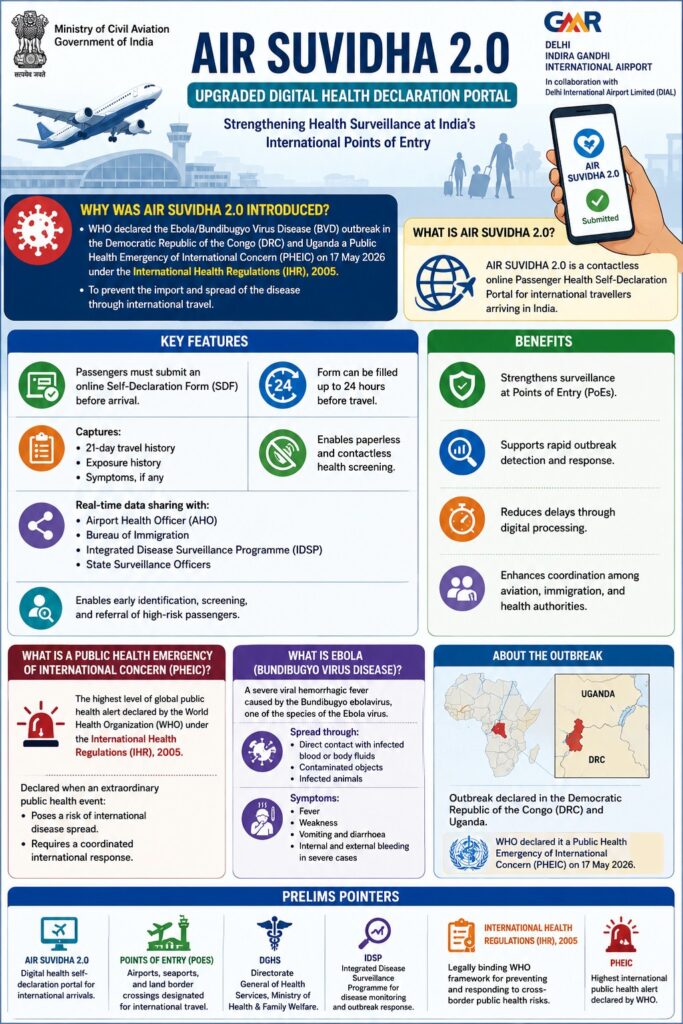
Why in News?
The Ministry of Civil Aviation, in collaboration with Delhi International Airport Limited (DIAL), launched AIR SUVIDHA 2.0, an upgraded digital health declaration portal, to strengthen health surveillance at India’s international Points of Entry following the Ebola (Bundibugyo virus disease) outbreak in Central Africa.
Why was AIR SUVIDHA 2.0 Introduced?
- WHO declared the Ebola/Bundibugyo Virus Disease (BVD) outbreak in the Democratic Republic of the Congo (DRC) and Uganda a Public Health Emergency of International Concern (PHEIC) on 17 May 2026 under the International Health Regulations (IHR), 2005.
- To prevent the import and spread of the disease through international travel.
What is AIR SUVIDHA 2.0?
AIR SUVIDHA 2.0 is a contactless online Passenger Health Self-Declaration Portal for international travellers arriving in India.
Key Features
- Passengers must submit an online Self-Declaration Form (SDF) before arrival.
- Form can be filled up to 24 hours before travel.
- Captures: 21-day travel history, Exposure history, and Symptoms, if any.
- Enables paperless and contactless health screening.
- Real-time data sharing with Airport Health Officer (AHO), Bureau of Immigration, Integrated Disease Surveillance Programme (IDSP), and State Surveillance Officers.
- Enables early identification, screening, and referral of high-risk passengers.
Benefits
- Strengthens surveillance at Points of Entry (PoEs).
- Supports rapid outbreak detection and response.
- Reduces delays through digital processing.
- Enhances coordination among aviation, immigration, and health authorities.
What is a Public Health Emergency of International Concern (PHEIC)?
- The highest level of global public health alert declared by the World Health Organization (WHO) under the International Health Regulations (IHR), 2005.
- Declared when an extraordinary public health event: Poses a risk of international disease spread and Requires a coordinated international response.
What is Ebola (Bundibugyo Virus Disease)?
- A severe viral hemorrhagic fever caused by the Bundibugyo ebolavirus, one of the species of the Ebola virus.
- Spread through:
- Direct contact with infected blood or body fluids.
- Contaminated objects.
- Infected animals.
- Symptoms: Fever. Weakness. Vomiting and diarrhoea. Internal and external bleeding in severe cases.
