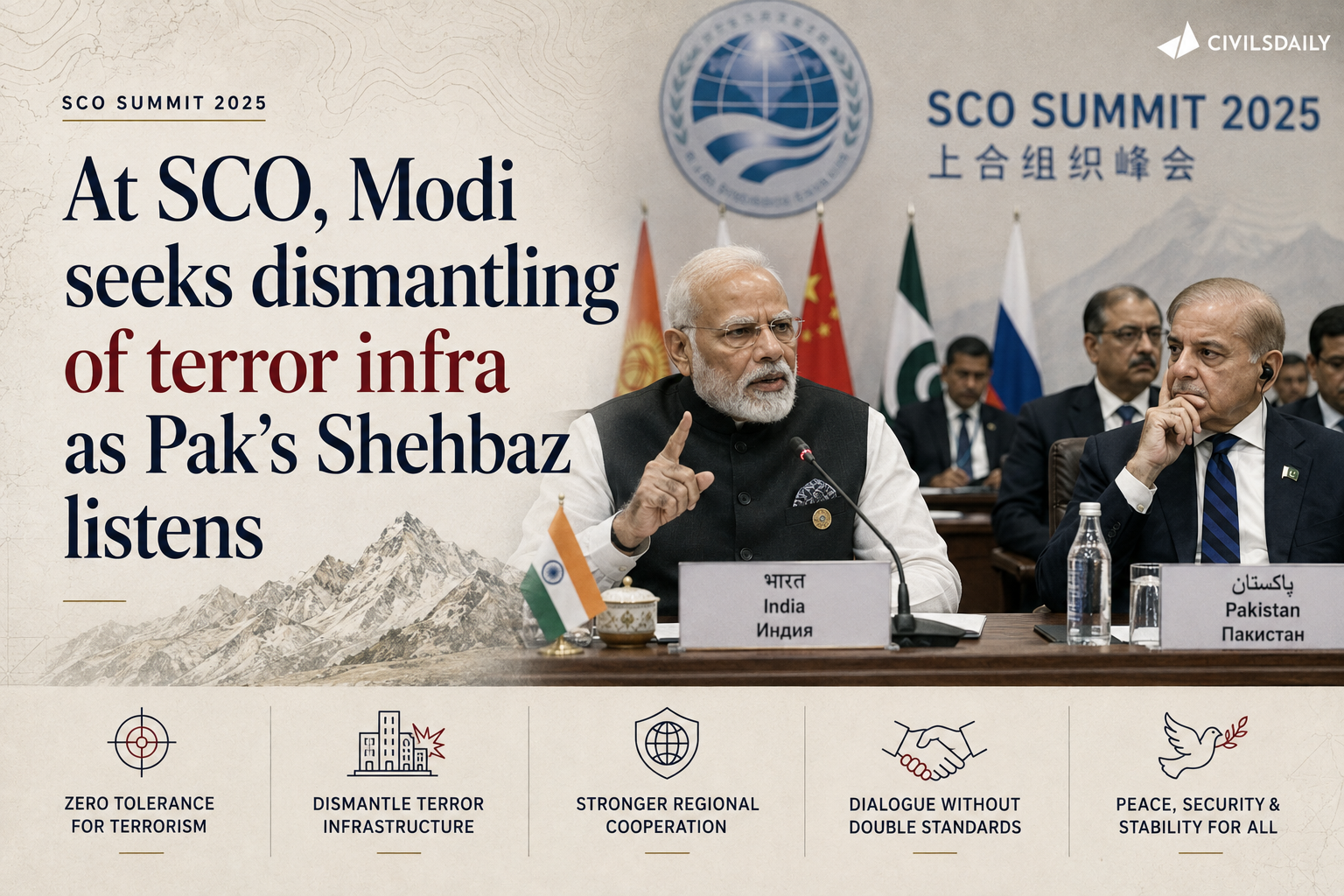
Why in the News
The Prime Minister told the leaders of the Shanghai Cooperation Organisation (SCO) (the ten member Eurasian security grouping that includes India, Pakistan, China, Russia and Iran) that the crisis in West Asia demonstrates that a conflict in one region does not remain confined there. He said it impacts global energy security, maritime trade and supply chains, and that the Global South bears the brunt of the consequences.
Why did India put the West Asia war at the centre of its SCO message?
- Security has widened: In an interconnected world the scope of security has expanded significantly, so a regional war becomes an energy, shipping and supply chain problem for every member.
- The meeting with Iran: Iran’s President was among the leaders at the summit. The Prime Minister met him on Monday, their first meeting since the start of the war.
What did India demand on terrorism, and what gives the demand its weight?
- Beyond action and reaction: With Pakistan’s Prime Minister listening, the Prime Minister said terrorism remains a grave challenge for all of humanity and that the fight cannot be limited to a mere “action-reaction” mindset.
- Dismantle the whole ecosystem: He called for dismantling the entire ecosystem of terror financing, recruitment, radicalisation and safe havens, and for members to speak in one voice that there is no room for double standards.
- Terrorism as state policy: Countries that use terrorism as an instrument of state policy and shelter terrorists must be sent a strong message that terrorism cannot be a strategic asset for anyone.
- The Operation Sindoor antecedent: In May 2025, days after the Pahalgam terror attack, India launched Operation Sindoor, striking terror targets in Pakistan-occupied Kashmir and Pakistan. Four days of hostilities followed and ended with Pakistan seeking a ceasefire.
- The Tianjin precedent: At the SCO summit in Tianjin on August 31 and September 1 last year, the Prime Minister called the Pahalgam attack the “most heinous face of terrorism” and an open challenge to every nation, and said double standards on terrorism are unacceptable.
What are the three pillars India set out for the SCO’s next 25 years?
- The framework: India’s vision for the SCO rests on three pillars, S for Security, C for Connectivity and O for Opportunity. Over 25 years the grouping built a tradition of dialogue across Eurasia, and the goal for the next 25 is to translate that cooperation into tangible results.
- Security: This pillar is the terrorism agenda set out above, carried as a demand on the grouping rather than as a bilateral grievance.
- Connectivity: Its scope must expand beyond roads, railways and air corridors to simplifying customs procedures, promoting digital documentation and enhancing the efficiency of logistics networks.
- Opportunity: The benefits of cooperation must directly reach people, with people-to-people ties at the heart of the next 25 years. The yardstick of success is new opportunities for youth, new markets for entrepreneurs, farmers benefiting from technology and improvement in citizens’ lives.
- Shared geography: As the world navigates uncertainty and instability, the task is to transform shared geography into shared opportunities.
Why is connectivity the pillar that divides the members?
- Sovereignty as the condition: India supports all initiatives that connect markets, facilitate trade and open growth avenues, on the condition that respect for the sovereignty and territorial integrity of all nations is paramount, which it described as the core spirit of the SCO Charter.
- The Iran route: India wants to access Central Asia through Iran, since Pakistan has denied India overland transit to the region.
- The corridor objection: The China-Pakistan Economic Corridor is an irritant for India because it runs through territory India claims and so violates its territorial integrity and sovereignty.
What follows the summit?
- The Delhi BRICS summit: The Chinese President and the Russian President attended, and the Prime Minister met them informally during the leaders’ group photograph. Both are expected at the BRICS summit in New Delhi on September 12 and 13.
- A Pakistan-hosted summit: Pakistan hosts the next SCO summit in 2027, and India’s participation will be watched closely by members of the grouping.
Conclusion
India has made no double standards on terrorism the price of its engagement with the SCO. The grouping’s next chair is the country that demand is aimed at. Two dates now test the position: the BRICS summit in New Delhi on September 12 and 13, where the same Chinese and Russian leaders reconvene, and the next SCO summit under the Pakistani chair, where India must decide whether and at what level to attend.
[2026] Which of the following countries are members of the European Union?
1. Belarus
2. Poland
3. Germany
4. Switzerland
(a) 1, 2 and 4 (b) 1 and 4 only (c) 2 and 3 (d) 2 and 4 only
