Why in the News?
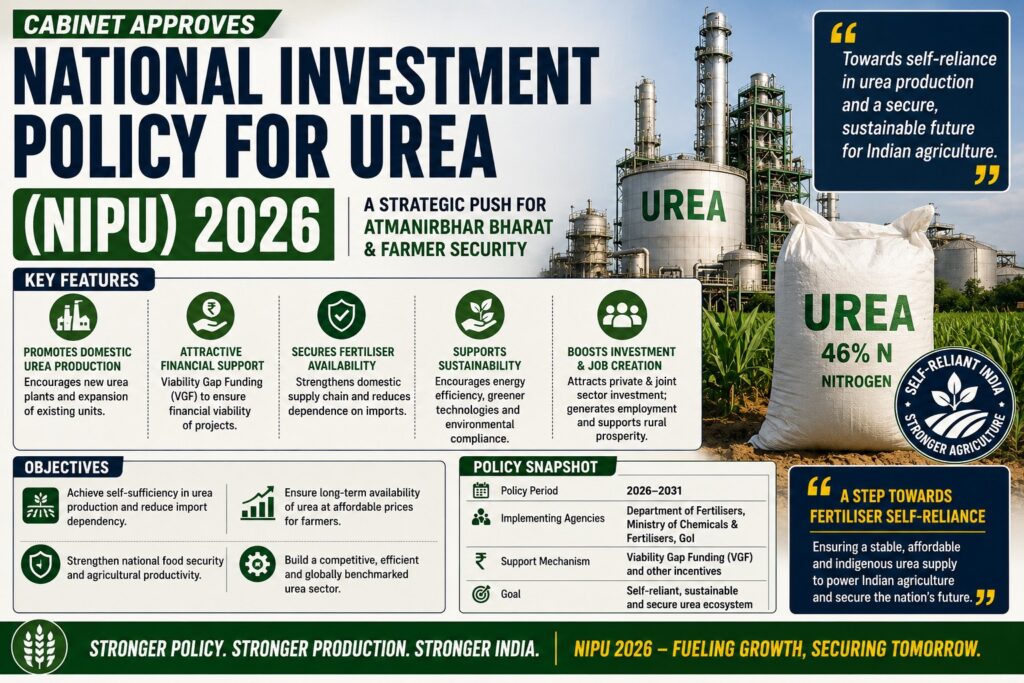
The Union Cabinet has approved the National Investment Policy for Urea (NIPU) 2026, restructuring the return framework for urea manufacturers to attract fresh investment in domestic capacity. This comes against an annual urea subsidy bill of Rs 1,42,175.74 crore for 2025-26.
What are the Pillars of the National Investment Policy for Urea (NIPU) 2026?
- Aim: The policy aims to encourage the establishment of new gas-based urea manufacturing plants across the country to reduce dependence on imports and bridge the gap between domestic production and demand.
- The National Investment Policy for Urea-2026 (NIPU-2026) rests on three core pillars: cost separation, assured returns, and foreign exchange risk mitigation.
- Return band: The policy sets a Return on Equity (ROE) band of 12 to 16 percent for new urea manufacturing investment.
- Cost restructuring: It restructures how production costs are calculated and reimbursed to manufacturers.
- Subsidy delivery: Distribution continues through Direct Benefit Transfer (DBT), credited after retailers confirm sale to farmers.
- Self-reliance objective: The stated goal is to reduce India’s dependence on imported urea by making domestic capacity commercially viable.
Why does urea self-reliance remain unresolved despite this policy?
- Subsidy scale: The current annual subsidy bill of Rs 1,42,175.74 crore reflects the price gap between controlled retail urea prices and actual production cost.
- Investment history: Previous urea policy revisions have not sufficiently attracted new private investment in domestic plants.
- Import dependence: India continues to import a share of its urea requirement despite decades of subsidy support to domestic units.
- Farmer price link: Retail urea prices remain fixed for farmers regardless of the ROE band offered to manufacturers.
Conclusion
The National Investment Policy for Urea 2026 targets manufacturer incentives rather than farm gate prices, betting that better returns on investment will draw the domestic capacity that decades of subsidy alone did not. Whether the 12 to 16 percent ROE band is sufficient to shift investment decisions remains to be tested against actual capacity additions.
Value Addition:
Urea Subsidy Scheme:
Urea fertiliser subsidy in India is a central government scheme where the state fixes a low Maximum Retail Price (MRP) of ₹242 per 45-kg bag for farmers, while the government pays the remaining high production or import cost directly to manufacturers.
Scheme Mechanics
- Fixed MRP: Farmers pay a low, controlled price of ₹242 per 45-kg bag (excluding taxes and neem-coating charges).
- Government Payout: The center pays the difference between the actual high cost of making or importing urea and the low selling price directly to the factory owners.
- Control: The Ministry of Chemicals and Fertilizers manages the policy and distribution across the country.
PYQ Relevance
[UPSC 2023] What are the direct and indirect subsidies provided to farm sector in India? Discuss the issues raised by the World Trade Organization (WTO) in relation to agricultural subsidies.
Linkage: The PYQ examines India’s fertiliser subsidy regime and related WTO concerns. NIPU 2026 reforms urea subsidies to boost domestic production while retaining farmer subsidies, linking directly to agricultural subsidy debates.
