Why in the News
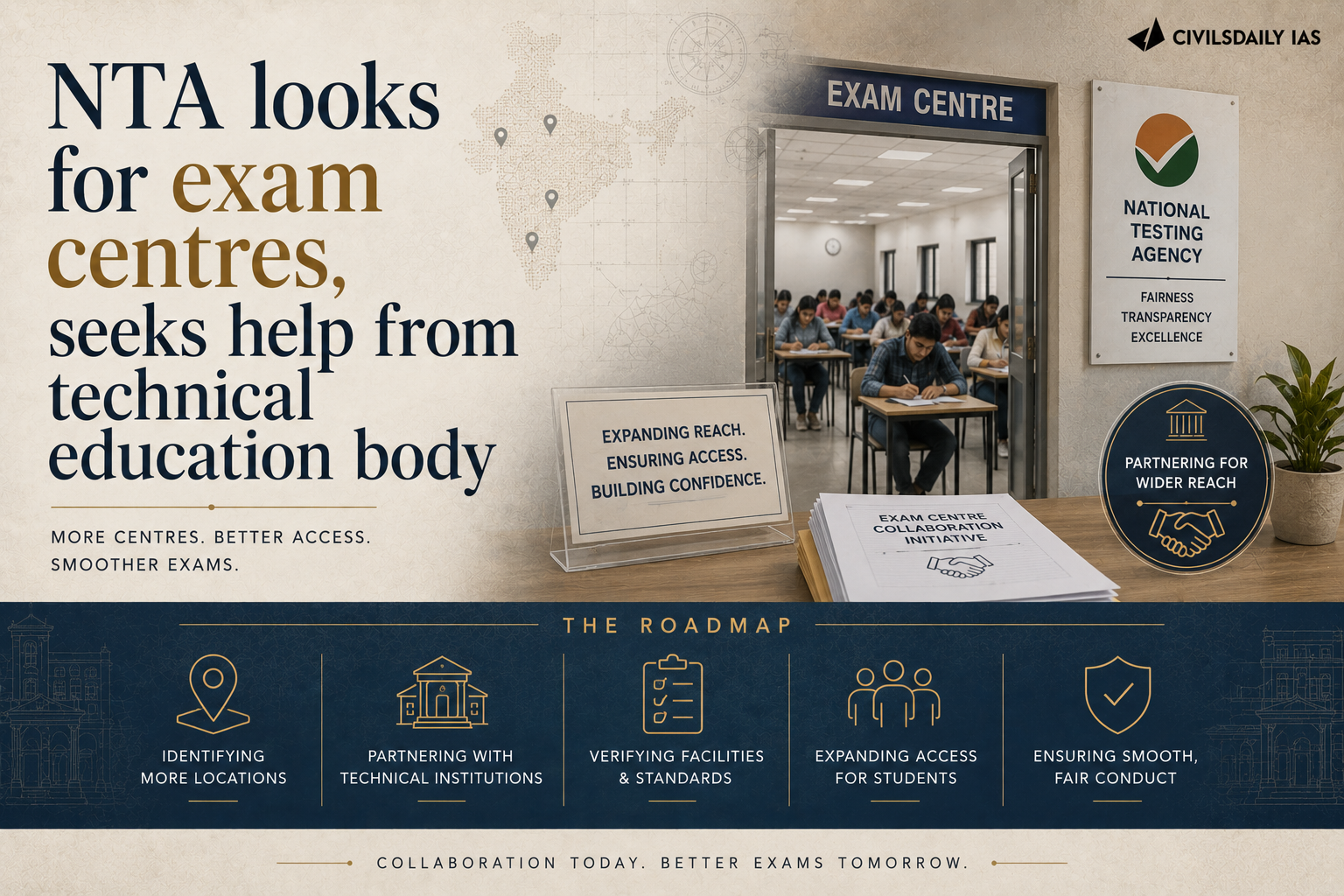
The National Testing Agency (NTA) has begun assembling a network of government owned computer laboratories to run the National Eligibility cum Entrance Test, Undergraduate (NEET-UG) as a computer based examination. It has asked the All India Council for Technical Education (AICTE) to collect information from government institutions on their information technology infrastructure and available space. The move follows the government’s decision to shift NEET-UG out of pen and paper mode from next year, taken after a question paper leak forced the cancellation of the examination and a nationwide protest. The constraint the request exposes is physical rather than procedural. A nationwide computer based test needs a geographically distributed network of secure, connected centres, and that network does not yet exist in public hands.
What is a Standard Testing Centre?
- A vetted venue rather than a hired hall: A Standard Testing Centre is a facility identified and developed in advance for computer based testing, instead of being arranged afresh for each examination cycle.
- The infrastructure it must carry: Institutions have been asked to report the number of functional computers and computer systems, their information technology systems, networking and internet connectivity, availability of power backup, and CCTV and related facilities.
- It must have usable spare capacity: Institutions have also been asked to report vacant space, since a centre needs room that is not already committed to teaching.
- Only government institutions qualify at this stage: The information has been sought only in respect of government colleges and institutions approved by AICTE.
Why is NTA routing the search through the technical education regulator?
- AICTE approved institutions are the largest pool of public computer laboratories: Engineering colleges, polytechnic institutes, government university departments and other state run technical or management institutions all sit inside its approval network.
- The requirement is geographic spread, not raw seat count: The stated reason is the progressive migration of examinations to computer based mode and the need for a wider geographically distributed network of testing centres.
- The request travelled down the institutional chain: NTA wrote to AICTE on 5 August, and AICTE then wrote to Vice Chancellors of state run technical universities and to directors and principals of approved government institutions.
- The returns are dated and must be certified: Institutions must submit details that are accurate, complete and duly verified by the competent authority of the institution, by 15 September.
What forced the shift to computer based testing?
- A paper leak invalidated the examination: The Union Education Ministry cancelled the NEET-UG entrance examination held on 3 May after the question paper leaked.
- The scale of the disruption: Around 22 lakh candidates had appeared in that examination.
- The political cost: The cancellation sparked nationwide protests and the Union Education Minister resigned.
- The stated remedy: The government has said NEET-UG will move from pen and paper mode to computer based testing from next year.
- The agency itself is being restructured: The search for centres runs alongside an ongoing overhaul of NTA, the nodal autonomous body that conducts NEET-UG and other entrance tests for higher educational institutions.
Challenges to migrating NEET-UG to computer based testing
- The scale has no precedent in computer based testing: No Indian examination has run a computer based test for a cohort of this size in a single sitting, so the centre requirement is a multiple of anything currently operated. Eg. The Joint Entrance Examination (Main) already runs on computer, and it is spread across multiple sessions and days rather than one day.
The Fix: Publish the shift and session design alongside the centre inventory, so candidates know in advance whether scores will be compared across papers. - Multiple shifts require score normalisation, which is itself contested: Candidates sitting different question papers must be compared through a statistical adjustment rather than through raw marks. Eg. Percentile normalisation in the Joint Entrance Examination (Main) has repeatedly been challenged for producing rank differences between shifts.
The Fix: Release the normalisation formula and shift wise difficulty data with the result, rather than only the final percentile. - Rural and small town candidates face a familiarity gap: A test taken on a keyboard and screen advantages candidates with routine computer access, and NEET-UG draws heavily from districts where school computer laboratories are shared or non functional. Eg. The very shortage of government computer infrastructure that NTA is now mapping is the same shortage those candidates study under.
The Fix: Fund a compulsory mock test on the actual examination software at the allotted centre before the examination day. - The centre, not the press, is the historic weak point: Leaks and impersonation cases have originated at the examination venue, and a computer based test moves that risk to local network access and administrator privileges. Eg. The compromise that led to the May cancellation happened before candidates ever reached the hall.
The Fix: Log and audit every administrator level action at a centre, with the log held by the agency rather than by the host institution. - Host institutions are being asked to supply capacity without a funding line: A college that lends its laboratory absorbs power, staff time and lost teaching hours on examination days. Eg. The AICTE communication seeks an inventory of infrastructure and states nothing about what a host institution receives in return.
The Fix: Attach a per candidate hosting grant to the Standard Testing Centre designation, paid against certified compliance with the infrastructure norms.
Conclusion
The decision to move NEET-UG onto computers has already been announced. The capacity to run it has not yet been counted. The agency is conducting an inventory now, which means the size of the network will be known only after the mode has been committed to. The point to watch is what those returns show. If the public system cannot supply enough certified centres, the test either returns to private venues, which is where the security problem originated, or it splits across shifts and sessions, which substitutes a scoring dispute for a leak.
Back2Basics
- What it is: The All India Council for Technical Education is the national body for the planning and coordinated development of technical education in India.
- Statutory basis: It was set up in 1945 as an advisory body and given statutory status by the All India Council for Technical Education Act, 1987.
- Where it sits: It functions under the Department of Higher Education in the Ministry of Education.
- What it does: It grants approval to technical institutions and prescribes norms and standards for courses and infrastructure, across fields including engineering, technology, management, architecture, pharmacy and hotel management.
Matching Previous Year Question
“No direct PYQ traced in the provided files. Closest microtheme: Domestic Bodies/Agencies.”
