Why in News?
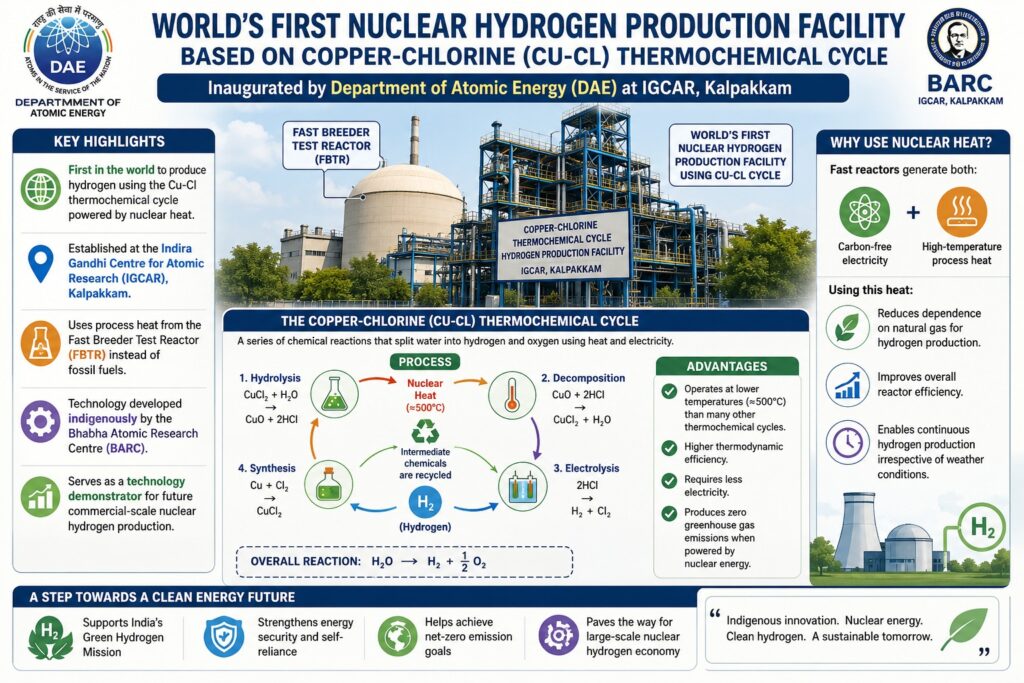
The Department of Atomic Energy (DAE) has inaugurated the world’s first hydrogen production facility based on the Copper-Chlorine (Cu-Cl) Thermochemical Cycle using nuclear process heat from the Fast Breeder Test Reactor (FBTR) at Kalpakkam.
Key Highlights
- First in the world to produce hydrogen using the Cu-Cl thermochemical cycle powered by nuclear heat.
- Established at the Indira Gandhi Centre for Atomic Research (IGCAR), Kalpakkam.
- Uses process heat from the Fast Breeder Test Reactor (FBTR) instead of fossil fuels.
- Technology developed indigenously by the Bhabha Atomic Research Centre (BARC).
- Serves as a technology demonstrator for future commercial-scale nuclear hydrogen production.
What is the Copper-Chlorine (Cu-Cl) Thermochemical Cycle?
The Cu-Cl cycle is a series of chemical reactions that split water into hydrogen and oxygen using heat and electricity.
Process
- Water reacts with copper and chlorine compounds.
- High-temperature nuclear heat drives most of the reactions.
- Hydrogen gas is produced while intermediate chemicals are recycled.
Advantages
- Operates at lower temperatures (≈500°C) than many other thermochemical cycles.
- Higher thermodynamic efficiency.
- Requires less electricity.
- Produces zero greenhouse gas emissions when powered by nuclear energy.
Why Use Nuclear Heat?
- Fast reactors generate both Carbon-free electricity and High-temperature process heat.
- Using this heat:
- Reduces dependence on natural gas for hydrogen production.
- Improves overall reactor efficiency.
- Enables continuous hydrogen production irrespective of weather conditions.
Fast Breeder Test Reactor (FBTR)
- Located at IGCAR, Kalpakkam.
- India’s only operating fast reactor research facility.
- Commissioned in 1985.
- Uses liquid sodium as coolant.
- Produces plutonium while generating power.
[2023] Consider the following heavy industries:
1. Fertilizer plants
2. Oil refineries
3. Steel plants
Green hydrogen is expected to play a significant role in decarbonizing how many of the above industries?
[A] Only one
[B] Only two
[C] All three
[D] None
