Why in News?
The Government highlighted the achievements of the Ethanol Blended Petrol (EBP) Programme, its policy evolution, and clarified common misconceptions regarding E20 fuel.
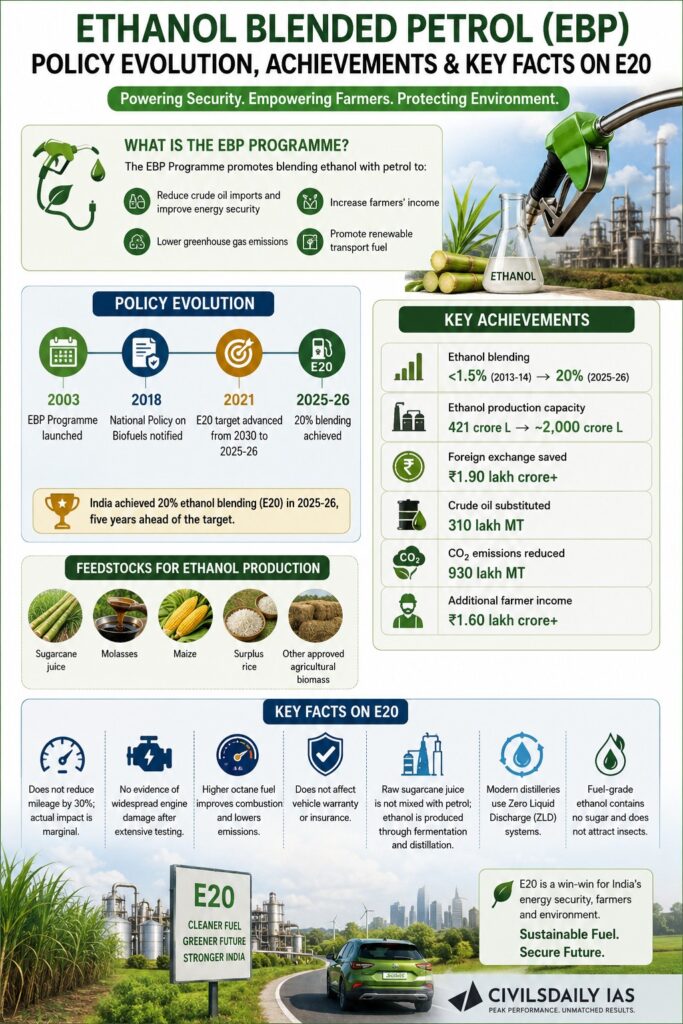
What is the EBP Programme?
- The EBP Programme promotes blending ethanol with petrol to:
- Reduce crude oil imports and improve energy security.
- Lower greenhouse gas emissions.
- Increase farmers’ income.
- Promote renewable transport fuel.
- India achieved 20% ethanol blending (E20) in 2025-26, five years ahead of the target.
Policy Evolution
- 2003: EBP Programme launched.
- 2018: National Policy on Biofuels notified.
- 2021: E20 target advanced from 2030 to 2025-26.
- 2025-26: 20% blending achieved.
Key Achievements
- Ethanol blending: <1.5% (2013-14) → 20% (2025-26)
- Ethanol production capacity: 421 crore L → ~2,000 crore L
- Foreign exchange saved: ₹1.90 lakh crore+
- Crude oil substituted: 310 lakh MT
- CO₂ emissions reduced: 930 lakh MT
- Additional farmer income: ₹1.60 lakh crore+
Feedstocks
- Sugarcane juice, Molasses, Maize, Surplus rice, and Other approved agricultural biomass
Key Facts on E20
- Does not reduce mileage by 30%; actual impact is marginal.
- No evidence of widespread engine damage after extensive testing.
- Higher octane fuel improves combustion and lowers emissions.
- Does not affect vehicle warranty or insurance.
- Raw sugarcane juice is not mixed with petrol; ethanol is produced through fermentation and distillation.
- Modern distilleries use Zero Liquid Discharge (ZLD) systems.
- Fuel-grade ethanol contains no sugar and does not attract insects.
[2025] Consider the following statements:
Statement I: Of the two major ethanol producers in the world, i.e., Brazil and the United States of America, the former produces more ethanol than the latter.
Statement II: Unlike in the United States of America where corn is the principal feedstock for ethanol production, sugarcane is the principal feedstock for ethanol production in Brazil.
Which one of the following is correct in respect of the above statements?
[A] Both Statement I and Statement II are correct and Statement II explains Statement I
[B] Both Statement I and Statement II are correct but Statement II does not explain Statement I
[C] Statement I is correct but Statement II is not correct
[D] Statement I is not correct but Statement II is correct
