Why in the news?
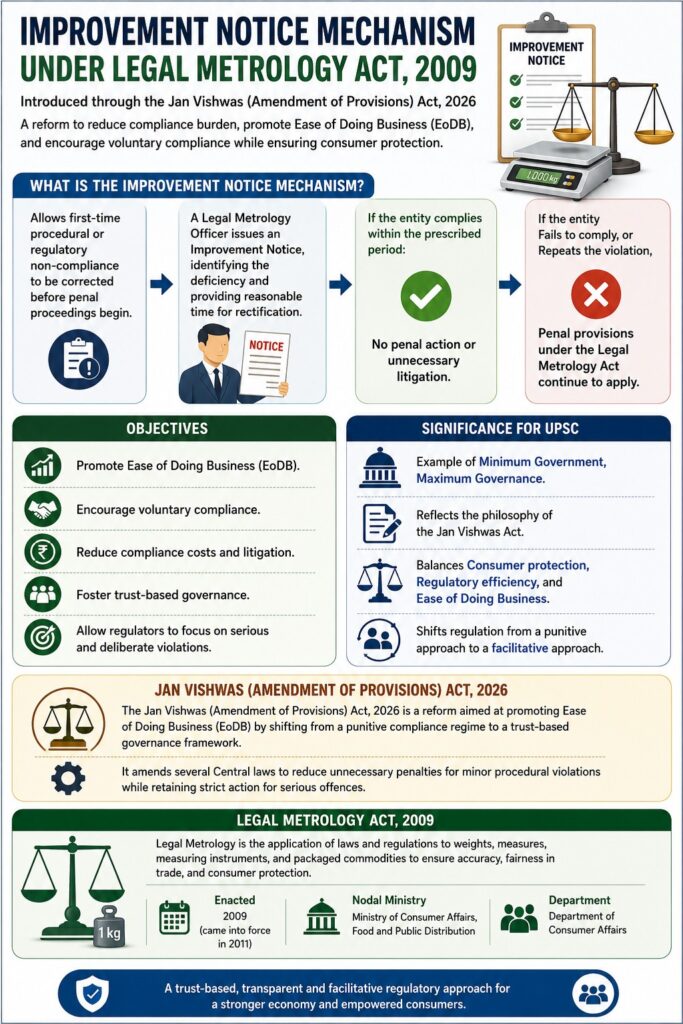
The Department of Consumer Affairs has introduced the Improvement Notice mechanism under the Legal Metrology Act, 2009 through the Jan Vishwas (Amendment of Provisions) Act, 2026. The reform aims to reduce the compliance burden, promote Ease of Doing Business (EoDB), and encourage voluntary compliance while ensuring consumer protection.
What is the Improvement Notice Mechanism?
- It allows first-time procedural or regulatory non-compliance to be corrected before penal proceedings begin.
- A Legal Metrology Officer issues an Improvement Notice, identifying the deficiency and providing reasonable time for rectification.
- If the entity complies within the prescribed period:
- No penal action or unnecessary litigation.
- If the entity Fails to comply, or Repeats the violation, Penal provisions under the Legal Metrology Act continue to apply.
Objectives
- Promote Ease of Doing Business (EoDB).
- Encourage voluntary compliance.
- Reduce compliance costs and litigation.
- Foster trust-based governance.
- Allow regulators to focus on serious and deliberate violations.
Significance for UPSC
- Example of Minimum Government, Maximum Governance.
- Reflects the philosophy of the Jan Vishwas Act.
- Balances Consumer protection, Regulatory efficiency, and Ease of Doing Business
- Shifts regulation from a punitive approach to a facilitative approach.
Jan Vishwas (Amendment of Provisions) Act, 2026
- The Jan Vishwas (Amendment of Provisions) Act, 2026 is a reform aimed at promoting Ease of Doing Business (EoDB) by shifting from a punitive compliance regime to a trust-based governance framework.
- It amends several Central laws to reduce unnecessary penalties for minor procedural violations while retaining strict action for serious offences.
Legal Metrology Act, 2009
- Legal Metrology is the application of laws and regulations to weights, measures, measuring instruments, and packaged commodities to ensure accuracy, fairness in trade, and consumer protection.
- Enacted: 2009 (came into force in 2011)
- Nodal Ministry: Ministry of Consumer Affairs, Food and Public Distribution
- Department: Department of Consumer Affairs
[2022] In India which one of the following is responsible for maintaining for prices stability by controlling inflation?
[A] Department of Consumer Affairs
[B] Expenditure Management Commission
[C] Financial Stability and Development Council
[D] Reserve Bank of India
