Why in News?
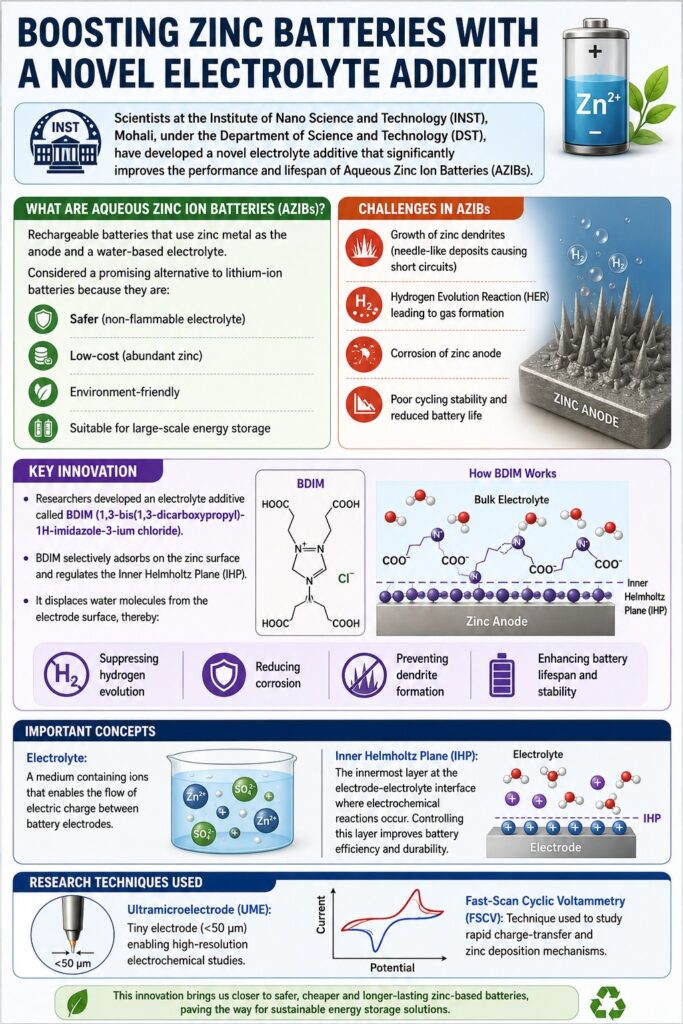
Scientists at the Institute of Nano Science and Technology (INST), Mohali, under the Department of Science and Technology (DST), have developed a novel electrolyte additive that significantly improves the performance and lifespan of Aqueous Zinc Ion Batteries (AZIBs).
What are Aqueous Zinc Ion Batteries (AZIBs)?
- Rechargeable batteries that use zinc metal as the anode and a water-based electrolyte.
- Considered a promising alternative to lithium-ion batteries because they are Safer (non-flammable electrolyte), Low-cost (abundant zinc), Environment-friendly, and Suitable for large-scale energy storage.
Challenges in AZIBs
- Growth of zinc dendrites (needle-like deposits causing short circuits)
- Hydrogen Evolution Reaction (HER) leading to gas formation
- Corrosion of zinc anode
- Poor cycling stability and reduced battery life
Key Innovation
- Researchers developed an electrolyte additive called BDIM (1,3-bis(1,3-dicarboxypropyl)-1H-imidazole-3-ium chloride).
- BDIM selectively adsorbs on the zinc surface and regulates the Inner Helmholtz Plane (IHP).
- It displaces water molecules from the electrode surface, thereby:
- Suppressing hydrogen evolution
- Reducing corrosion
- Preventing dendrite formation
- Enhancing battery lifespan and stability
Important Concepts
- Electrolyte: A medium containing ions that enables the flow of electric charge between battery electrodes.
- Inner Helmholtz Plane (IHP): The innermost layer at the electrode-electrolyte interface where electrochemical reactions occur. Controlling this layer improves battery efficiency and durability.
- Research Techniques Used
- Ultramicroelectrode (UME): Tiny electrode (<50 µm) enabling high-resolution electrochemical studies.
- Fast-Scan Cyclic Voltammetry (FSCV): Technique used to study rapid charge-transfer and zinc deposition mechanisms.
[2025] In the context of electric vehicle batteries, consider the following elements:
I. Cobalt
II. Graphite
III. Lithium
IV. Nickel
How many of the above usually make up battery cathodes?
[A] Only one
[B] Only two
[C] Only three
[D] All the four
