Why in News?
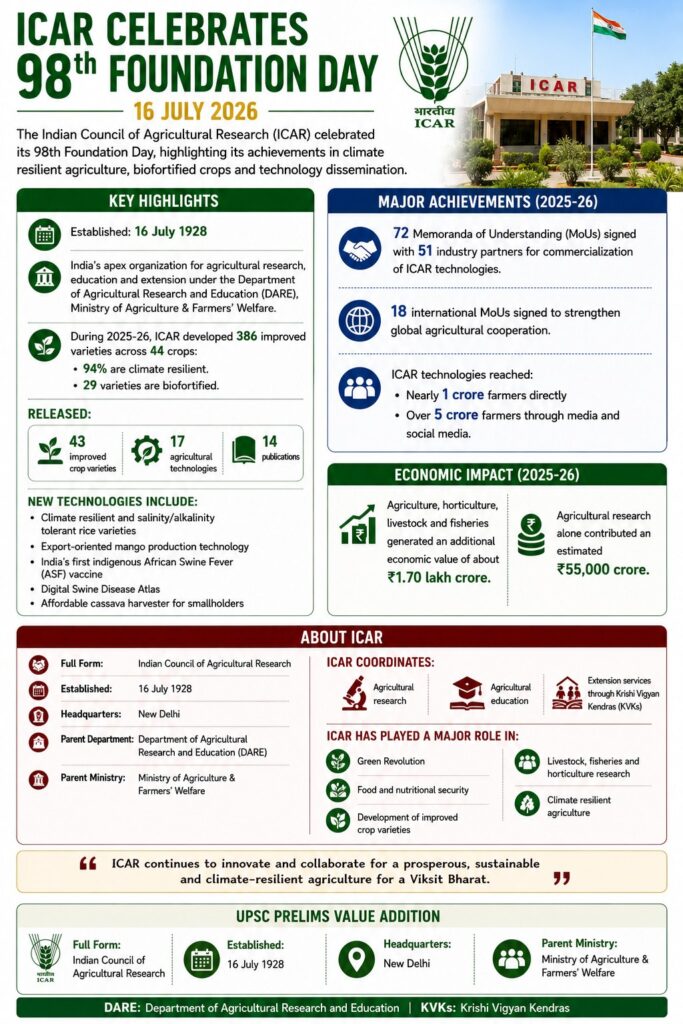
The Indian Council of Agricultural Research (ICAR) celebrated its 98th Foundation Day (16 July 2026), highlighting its achievements in climate resilient agriculture, biofortified crops and technology dissemination.
Key Highlights
- Established: 16 July 1928
- India’s apex organization for agricultural research, education and extension under the Department of Agricultural Research and Education (DARE), Ministry of Agriculture & Farmers’ Welfare.
- During 2025-26, ICAR developed 386 improved varieties across 44 crops: 94% are climate resilient and 29 varieties are biofortified.
- Released: 43 improved crop varieties, 17 agricultural technologies and 14 publications
- New technologies include:
- Climate resilient and salinity/alkalinity tolerant rice varieties
- Export-oriented mango production technology
- India’s first indigenous African Swine Fever (ASF) vaccine
- Digital Swine Disease Atlas
- Affordable cassava harvester for smallholders.
- 72 Memoranda of Understanding (MoUs) signed with 51 industry partners for commercialization of ICAR technologies.
- 18 international MoUs signed to strengthen global agricultural cooperation.
- ICAR technologies reached: Nearly 1 crore farmers directly. Over 5 crore farmers through media and social media.
Economic Impact
- Agriculture, horticulture, livestock and fisheries generated an additional economic value of about ₹1.70 lakh crore in 2025-26.
- Agricultural research alone contributed an estimated ₹55,000 crore.
About ICAR
- Full Form: Indian Council of Agricultural Research
- Established: 16 July 1928
- Headquarters: New Delhi
- Parent Department: Department of Agricultural Research and Education (DARE)
- Parent Ministry: Ministry of Agriculture & Farmers’ Welfare
- Coordinates: Agricultural research, Agricultural education and Extension services through Krishi Vigyan Kendras (KVKs)
- Played a major role in: Green Revolution, Food and nutritional security, Development of improved crop varieties, Livestock, fisheries and horticulture research, and Climate resilient agriculture
[2021] In the context of India’s preparation for climate-smart agriculture, consider the following statements:
1. The ‘Climate-Smart village’ approach in India is a part of a project led by the climate change, Agriculture and Food Security (CCAFS), an international research programme.
2. The project of CCAFS is carried out under consultative group on International Agricultural Research (CGIAR) headquartered in France.
3. The International Crops Research Institute for the Semi-Arid Tropics (ICRISAT) in India is one of the CGIAR’s research centres.
Which of the statements given above are correct?
[A] 1 and 2 only
[B] 2 and 3 only
[C] 1 and 3 only
[D] 1,2 and 3