Why in News?
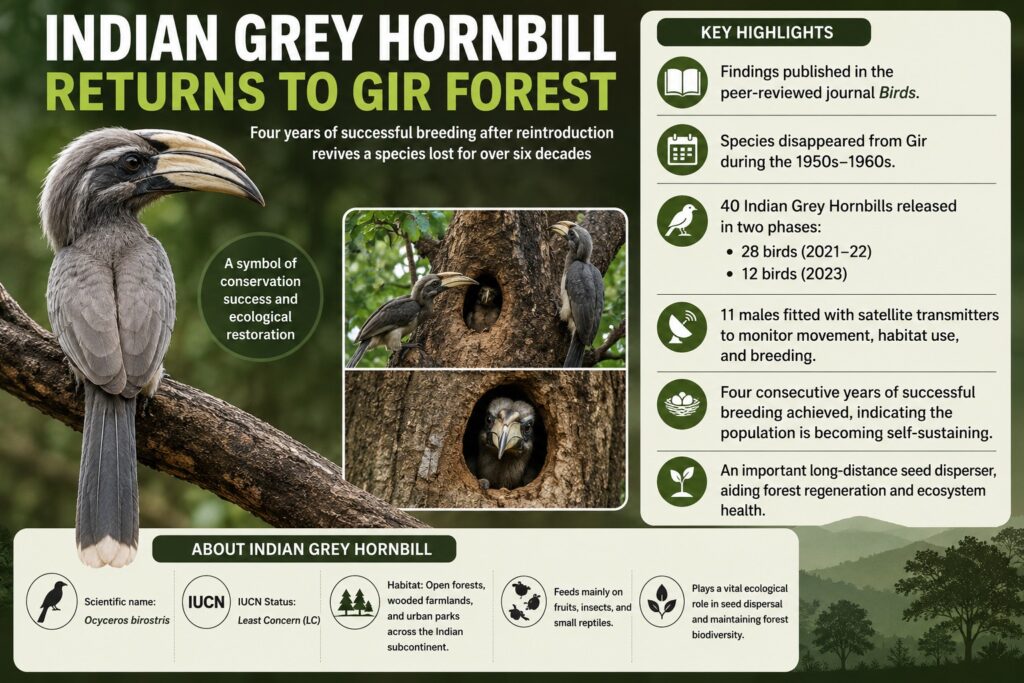
The Indian Grey Hornbill has recorded four consecutive years of successful breeding in Gujarat’s Gir Forest after being reintroduced in 2021, marking the revival of a species that disappeared from the region over six decades ago.
Key Highlights
- The findings were published in the peer-reviewed journal Birds.
- The species had disappeared from Gir during the 1950s-1960s.
- 40 Indian Grey Hornbills were released in two phases: 28 birds (2021-22) and 12 birds (2023)
- 11 males were fitted with satellite transmitters to monitor movement, habitat use, and breeding.
- The project has achieved four consecutive years of successful breeding, indicating the population is becoming self-sustaining.
- The Indian Grey Hornbill is an important long-distance seed disperser, aiding forest regeneration.
About Indian Grey Hornbill
- Scientific name: Ocyceros birostris
- IUCN Status: Least Concern (LC)
- Habitat: Open forests, wooded farmlands, and urban parks across the Indian subcontinent.
- Feeds mainly on fruits, insects, and small reptiles.
- Plays a vital ecological role in seed dispersal and maintaining forest biodiversity.
[2020] With reference to India’s biodiversity, Ceylon frogmouth, Coppersmith barbet, Gray-chinned miniyet and White-throated redstart are
a) Birds
b) Primates
c) Reptiles
d) Amphibians