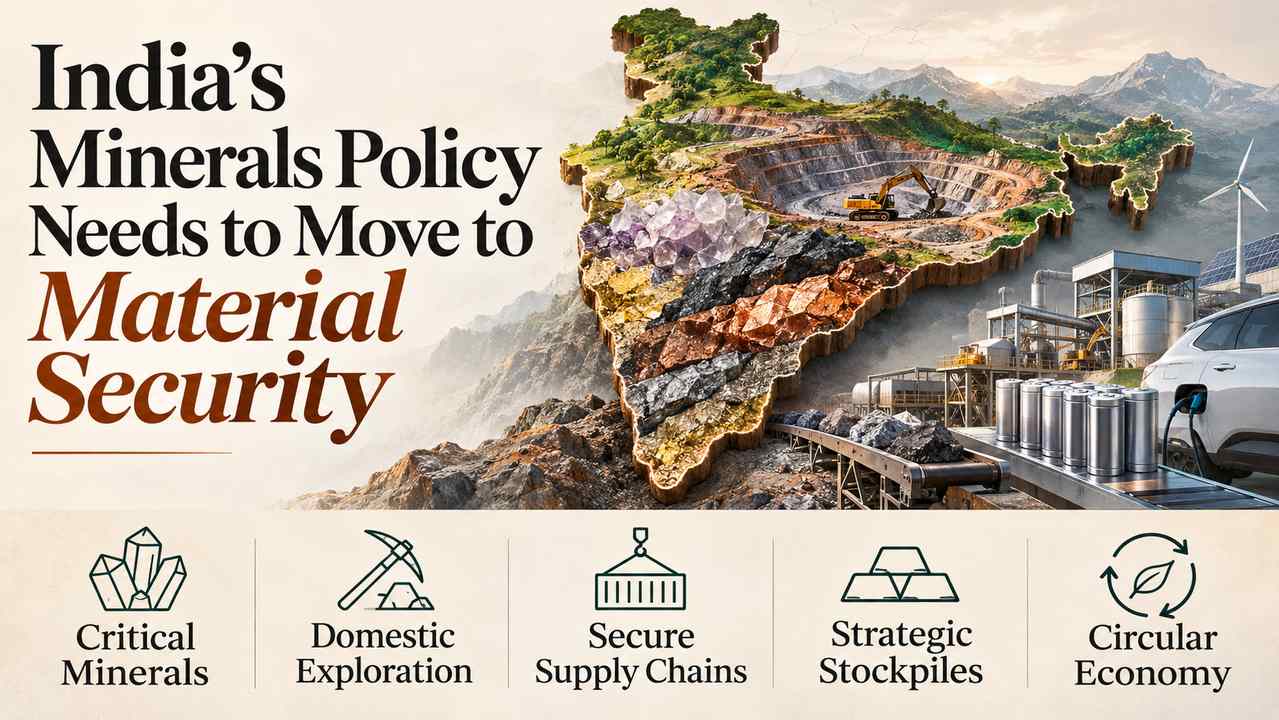
Why in the News
India has moved critical minerals up its policy agenda in two years, funding a national mission and auctioning mineral blocks. The harder task is turning those resources into processed materials that battery makers can use, so policy must shift from counting auctioned blocks to material security.
What has India done on critical minerals so far?
- Critical minerals: These are minerals whose supply is at risk and whose loss would hurt key industries.
- Industrial uses: Lithium, cobalt, nickel and rare earth elements supply electric vehicles (EVs), batteries, electronics, renewables and strategic industries, which India’s manufacturing plans need.
- National Critical Mineral Mission: The Ministry of Mines’ National Critical Mineral Mission (NCMM) has Rs 34,300 crore for a seven-year programme. It covers exploration, mining and processing of critical minerals and materials.
- Central auctions: The amended Mines and Minerals (Development and Regulation) Act, 1957 (MMDR Act) lets the Centre auction blocks of 24 critical minerals, with more auctions to follow.
- The takeaway: India has the policy and money to mine critical minerals, but a mine without processing is like a wheat field with no flour mill.
Why do mines alone not deliver material security?
- Beneficiation and refining: Mined ore must be processed before industry can use it. This often needs high-end beneficiation, meaning treatment of raw ore to remove impurities, followed by refining.
- Import dependence: India still imports most of its critical and processed materials. Without processing, it can hold vast untapped resources and still depend on imports.
- China’s processing edge: China controls critical mineral supply chains because it can process and refine minerals at scale, not only because it dominates mining.
- Slow new mines: Environmental concerns, land acquisition and limited infrastructure delay new mines and plants, so mining and processing must proceed together.
Can recycling supply materials faster?
- NCMM recycling scheme: The Mission’s recycling scheme targets recycling 400 kilotonnes of critical minerals by 2031. Sources include tailings (waste left after ore processing), fly ash, red mud (bauxite refining residue) and end-of-life products.
- Quicker than new mines: The scheme carries Rs 1,500 crore and meets only a small fraction of India’s need, but recycling delivers material faster than new mines.
- E-waste supply: India produced 3.8 million tonnes of e-waste in 2024 (Redseer). Battery storage and EV growth will add more material to recycle.
Is a national stockpile a strategy?
- Stockpile proposal: India has proposed a national stockpile of selected critical minerals, after recent export restrictions showed how suddenly supply can change.
- Limits of a reserve: A strategic reserve can soften short-term disruptions, but stockpiling alone is not a strategy.
- Auctions versus supply: Auctioning blocks and meeting exploration targets is easier than refining materials and supplying industry through recycling. Material security turns on the harder task, not blocks sold.
Challenges
- Fragmented scrap economy: Scrap is collected by many scattered players, so recovered material is hard to trace.
- Uncertain waste access: Recyclers lack predictable access to waste, which makes plants hard to plan and finance.
- Quality doubts: Manufacturers must trust the quality and consistency of recycled material before buying it.
- Stockpile design: India must decide which minerals to stock and in what quantity, as technology keeps changing which minerals matter.
Way Forward
- Traceable collection: Bring e-waste and battery scrap into formal collection, tracked digitally from producer to recycler.
- Standards for recycled material: The Bureau of Indian Standards (BIS) should set quality standards for recovered critical minerals.
- Processing with mining: Plan refining capacity alongside each auction round, so mines and plants come up together.
- Supply-based metric: Track the Mission by tonnes of refined and recycled material supplied to industry, not by blocks auctioned.
Conclusion
India has the mines, money and auction law in place, but its weak link is turning ore and scrap into usable material. Whether domestic processing and recycling grow fast enough to cut import dependence will decide its material security.
Government Initiatives for Critical Minerals
- Critical minerals list: The Ministry of Mines identified 30 critical minerals in its report *Critical Minerals for India* (July 2023), which guides duty exemptions and the Mission.
- Khanij Bidesh India Limited (KABIL): This state-owned company acquires mineral assets abroad. It signed a five-block lithium brine agreement in Catamarca, Argentina, in January 2024.
- Mineral Security Partnership: India joined this grouping of countries working to secure critical mineral supply chains in June 2023.
- 2025 MMDR amendment: A 2025 amendment widened the National Mineral Exploration Trust‘s mandate to overseas assets, recycling and processing, and allowed recovery of critical minerals from tailings.
Matching Previous Year Question
“[2026] Which of the following statements about Rare Earth Elements (REEs) and Critical Minerals is/are correct? 1. Modern technological innovations including Artificial Intelligence, robotics and space exploration extensively utilise Rare Earth Elements (REEs). 2. China has the highest share in mining of REEs followed by India. 3. The Government of India launched the National Critical Mineral Mission (NCMM) in 2025 to establish a robust framework for self-reliance in the critical mineral sector. 4. Rare Earth Elements are a set of 13 metallic elements. Select the answer using the code given below: (a) 1 and 3 only (b) 3 only (c) 1, 3 and 4 (d) 1, 2 and 4 ANSWER: A”
