Why in the News
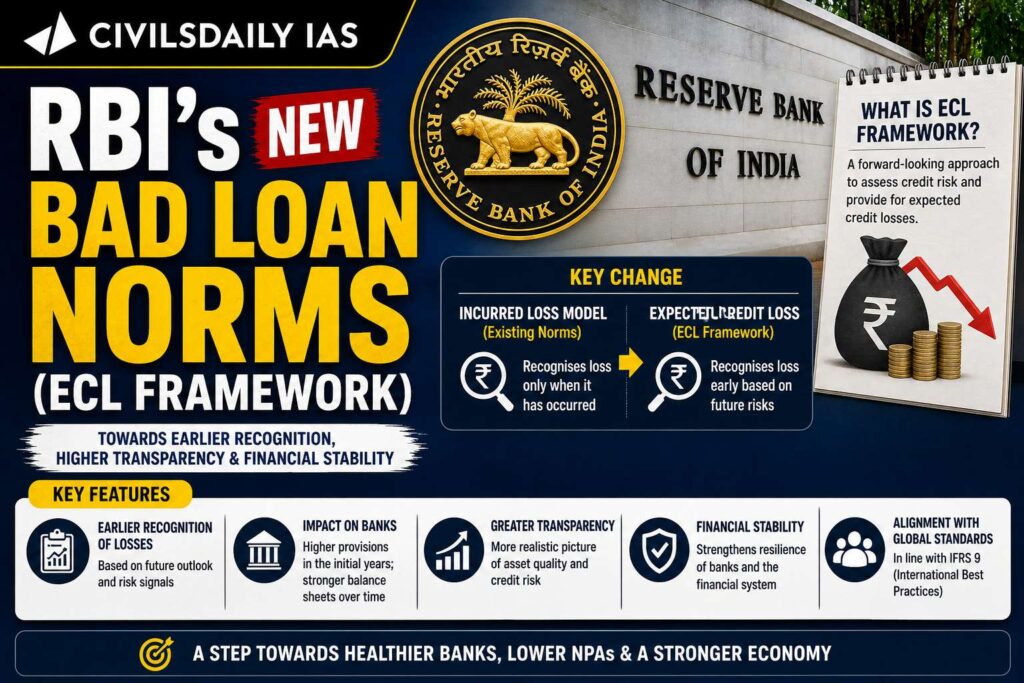
The Reserve Bank of India has introduced a new framework based on Expected Credit Loss (ECL) for provisioning of bad loans, which may lead to a short term increase in costs for banks.
What is Expected Credit Loss (ECL)
- A forward looking approach to estimate loan losses
- Considers future risk of default rather than past defaults
- Aligns with global standard IFRS 9
Key Features of New Norms
Three Stage Classification of Loans
- Stage 1: Low or no credit risk
- Provision based on 12 month ECL
- Stage 2: Significant increase in credit risk
- Provision based on lifetime ECL
- Stage 3: High credit risk or default
- Provision based on lifetime ECL
Important Changes
- Borrower Level NPA Classification: If one loan becomes NPA, all loans of the borrower become NPA
- NPA Definition: Loan classified as NPA if overdue for more than 90 days
- Upgrade Rule: Borrower must repay all dues to become a standard asset again
Impact on Banks
- Possible increase in provisioning requirements
- Short term reduction in profits
- Impact on capital (CET 1 ratio)
- Higher impact on:
- Microfinance lending
- Unsecured retail loans
Key Terms
- Non Performing Asset (NPA): Loan where repayment is overdue beyond 90 days.
- Provisioning: Setting aside funds by banks to cover potential loan losses.
- CET 1 (Common Equity Tier 1): Core capital of banks used to absorb losses.
| [2021] Consider the following statements: 1.Capital Adequacy Ratio (CAR) is the amount that banks have to maintain in the form of their own funds to offset any loss that banks incur if any account-holders fail to repay dues. 2.CAR is decided by each individual bank. Which of the statements given above is/are correct? [A] 1 only [B] 2 only [C] Both 1 and 2 [D] Neither 1 nor 2 |
