Why in News?
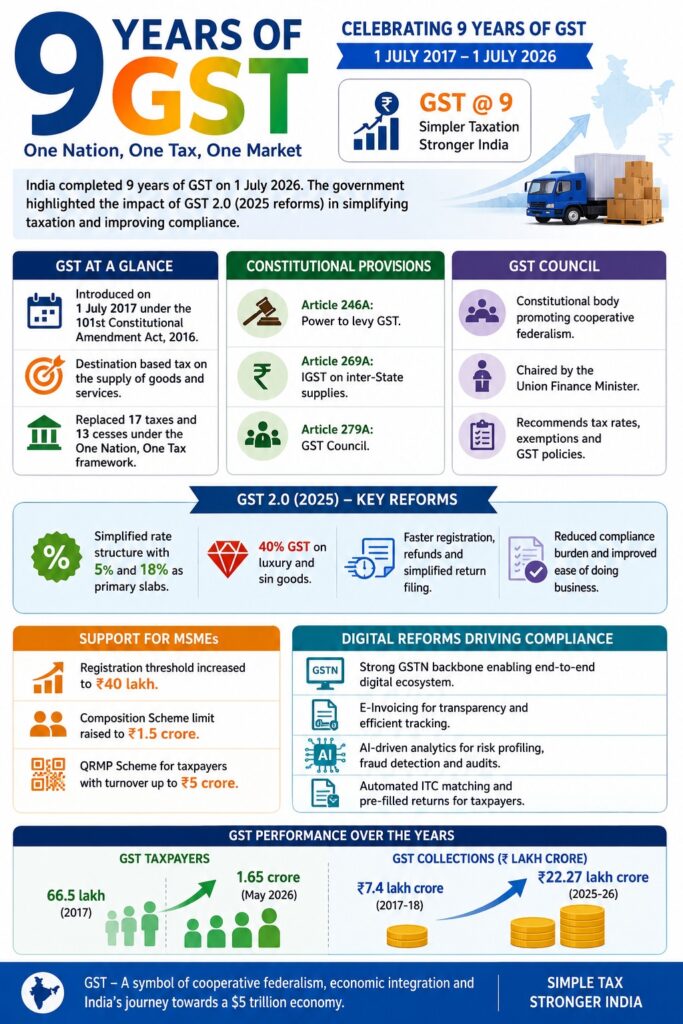
India completed 9 years of GST on 1 July 2026. The government highlighted the impact of GST 2.0 (2025 reforms) in simplifying taxation and improving compliance.
GST at a Glance
- Introduced on 1 July 2017 under the 101st Constitutional Amendment Act, 2016.
- Destination based tax on the supply of goods and services.
- Replaced 17 taxes and 13 cesses under the One Nation, One Tax framework.
Constitutional Provisions
- Article 246A: Power to levy GST.
- Article 269A: IGST on inter-State supplies.
- Article 279A: GST Council.
GST Council
- Constitutional body promoting cooperative federalism.
- Chaired by the Union Finance Minister.
- Recommends tax rates, exemptions and GST policies.
GST 2.0 (2025)
- Simplified rate structure with 5% and 18% as primary slabs.
- 40% GST on luxury and sin goods.
- Faster registration, refunds and simplified return filing.
MSME Support
- Registration threshold increased to ₹40 lakh.
- Composition Scheme limit raised to ₹1.5 crore.
- QRMP Scheme for taxpayers with turnover up to ₹5 crore.
Digital Reforms
- GSTN, e-Invoicing and AI-driven analytics.
- Automated ITC matching and pre-filled returns.
- Better compliance and fraud detection.
Performance
- GST taxpayers: 66.5 lakh (2017) → 1.65 crore (May 2026).
- GST collections: ₹7.4 lakh crore (2017-18) → ₹22.27 lakh crore (2025-26).
[2017] What is/are the most likely advantages of implementing ‘Goods and Services Tax (GST)’?
1. It will replace multiple taxes collected by multiple authorities and will thus create a single market in India.
2. It will drastically reduce the ‘Current Account Deficit’ of India and will enable it to increase its foreign exchange reserves.
3. It will enormously increase the growth and size of economy of India and will enable it to overtake China in the near future.
Select the correct answer using the code given below:
[A] 1 only
[B] 2 and 3 only
[C] 1 and 3 only
[D] 1, 2 and 3
