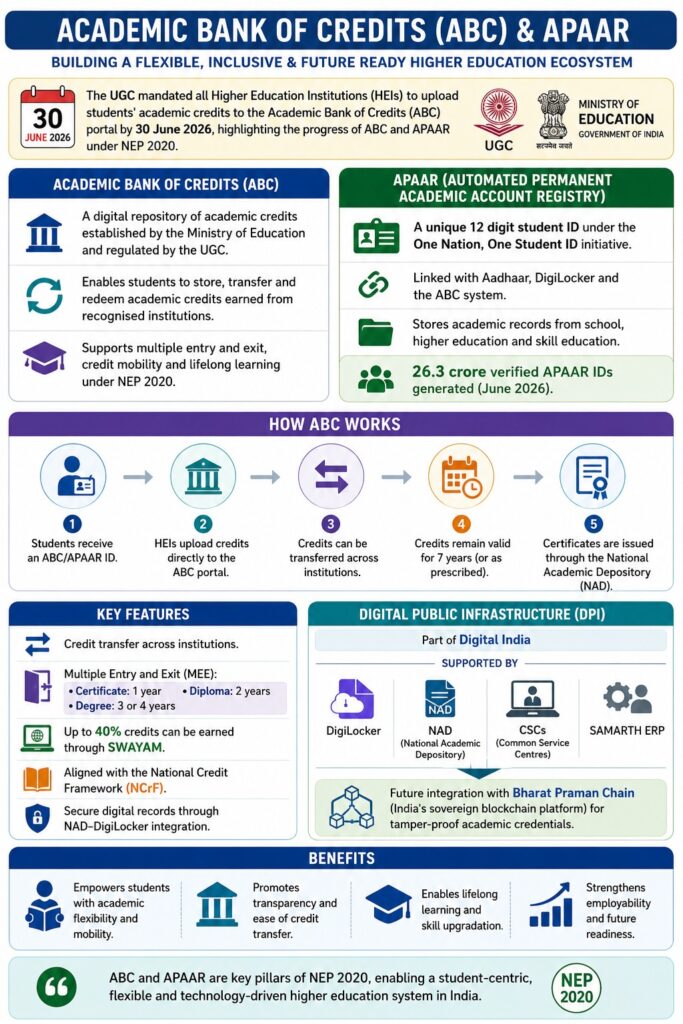
Why in News?
The UGC mandated all Higher Education Institutions (HEIs) to upload students’ academic credits to the Academic Bank of Credits (ABC) portal by 30 June 2026, highlighting the progress of ABC and APAAR under NEP 2020.
Academic Bank of Credits (ABC)
- A digital repository of academic credits established by the Ministry of Education and regulated by the UGC.
- Enables students to store, transfer and redeem academic credits earned from recognised institutions.
- Supports multiple entry and exit, credit mobility and lifelong learning under NEP 2020.
APAAR (Automated Permanent Academic Account Registry)
- A unique 12 digit student ID under the One Nation, One Student ID initiative.
- Linked with Aadhaar, DigiLocker and the ABC system.
- Stores academic records from school, higher education and skill education.
- 26.3 crore verified APAAR IDs generated (June 2026).
How ABC Works
- Students receive an ABC/APAAR ID.
- HEIs upload credits directly to the ABC portal.
- Credits can be transferred across institutions.
- Credits remain valid for 7 years (or as prescribed).
- Certificates are issued through the National Academic Depository (NAD).
Key Features
- Credit transfer across institutions.
- Multiple Entry and Exit (MEE): Certificate: 1 year, Diploma: 2 years, Degree: 3 or 4 years
- Up to 40% credits can be earned through SWAYAM.
- Aligned with the National Credit Framework (NCrF).
- Secure digital records through NAD-DigiLocker integration.
Digital Public Infrastructure (DPI)
- Part of Digital India.
- Supported by: DigiLocker, NAD, CSCs, SAMARTH ERP
- Future integration with Bharat Praman Chain (India’s sovereign blockchain platform) for tamper-proof academic credentials.
[2022] Consider the following:
1. Aarogya Setu
2. COWIN
3. DigiLocker
4. DIKSHA
Which of the above are built on to open-source digital platforms?
[A] 1 and 2 only
[B] 2, 3 and 4 only
[C] 1, 3 and 4 only
[D] 1, 2, 3 and 4
