Why in News?
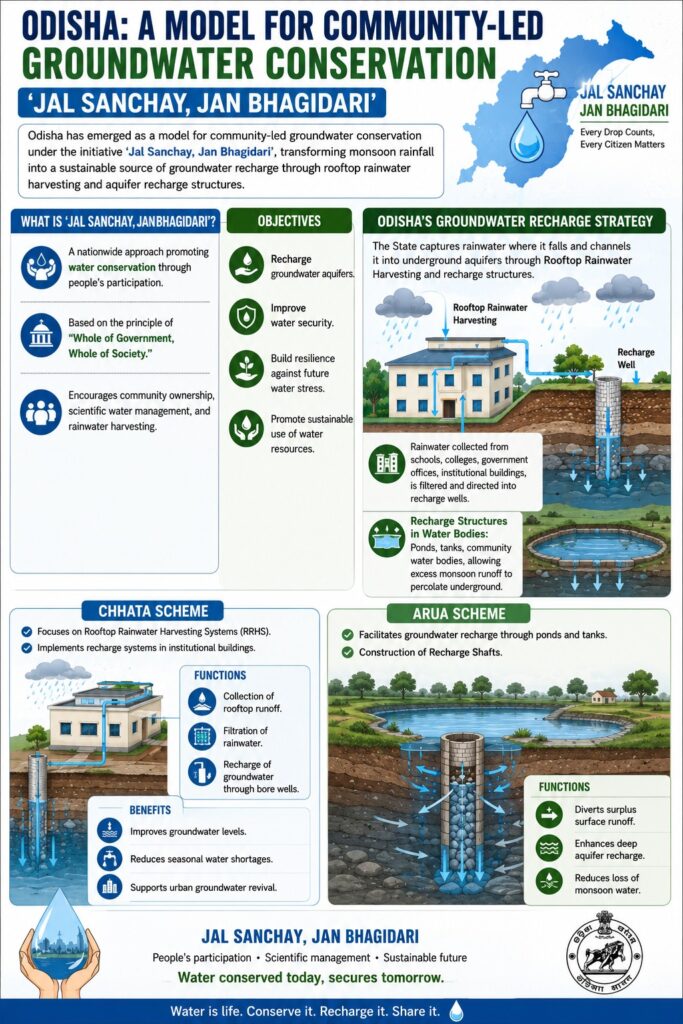
Odisha has emerged as a model for community-led groundwater conservation under the initiative ‘Jal Sanchay, Jan Bhagidari’, transforming monsoon rainfall into a sustainable source of groundwater recharge through rooftop rainwater harvesting and aquifer recharge structures.
What is ‘Jal Sanchay, Jan Bhagidari’?
- A nationwide approach promoting: Water conservation through people’s participation.
- Based on the principle of “Whole of Government, Whole of Society.”
- Encourages Community ownership, Scientific water management, and Rainwater harvesting.
Objective
- Recharge groundwater aquifers.
- Improve water security.
- Build resilience against future water stress.
- Promote sustainable use of water resources.
Odisha’s Groundwater Recharge Strategy
- The State captures rainwater where it falls and channels it into underground aquifers through Rooftop Rainwater Harvesting
- Rainwater collected from: Schools, Colleges, Government offices, Institutional buildings, is filtered and directed into recharge wells.
- Recharge Structures in Water Bodies: Ponds, Tanks, Community water bodies, allowing excess monsoon runoff to percolate underground.
CHHATA Scheme
- Focuses on Rooftop Rainwater Harvesting Systems (RRHS).
- Implements recharge systems in institutional buildings.
Functions
- Collection of rooftop runoff.
- Filtration of rainwater.
- Recharge of groundwater through bore wells.
Benefits
- Improves groundwater levels.
- Reduces seasonal water shortages.
- Supports urban groundwater revival.
ARUA Scheme
- About: Facilitates groundwater recharge through ponds and tanks.
- Construction of Recharge Shafts.
Functions
- Diverts surplus surface runoff.
- Enhances deep aquifer recharge.
- Reduces loss of monsoon water.
[2022] Which one of the following has been constituted under the Environment (Protection) Act, 1986?
[A] Central water Commission
[B] Central Ground Water Board
[C] Central Ground Water Authority
[D] National Water Development Agency
