Why in the News
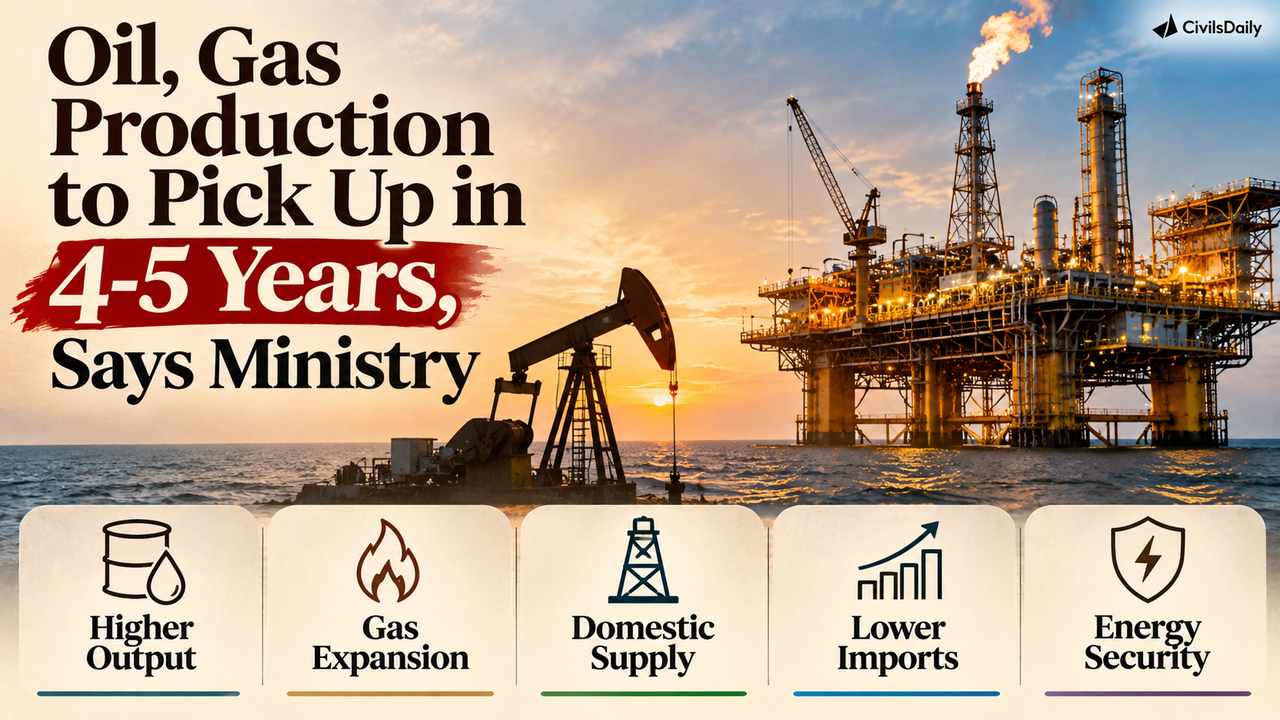
India’s oil and gas output keeps shrinking despite record drilling, and the Ministry of Petroleum and Natural Gas traces the fall to decisions taken more than a decade ago, not to current policy. Its note expects production to pick up in four to five years as new acreage, deepwater wells and the revival of Mumbai High begin to yield.
Why does output lag decisions by a decade?
- Long gestation: Moving from awarding an exploration block to first production takes five to ten years. It works like an orchard, where trees planted today bear fruit only years later.
- Exploration gap: The New Exploration Licensing Policy (NELP) offered exploration blocks to companies in bidding rounds. After its ninth round in 2010, no new round came until 2016, so no new fields were lined up to replace today’s ageing ones.
- Ageing fields: Mature fields lose 7 to 8% of their output every year as reservoir pressure falls, and most of India’s production comes from such fields.
- The takeaway: In the Ministry’s words, “the decisions of one decade decide the output of the next”, so today’s decline cannot be reversed quickly.
How did fuel subsidies drain exploration money?
- Subsidy burden: Until 2015, Oil and Natural Gas Corporation (ONGC) and Oil India funded much of the subsidy on diesel, liquefied petroleum gas (LPG) and kerosene. They did so by selling crude at a discount to oil marketing companies, the firms that sell fuel to consumers.
- Paying beyond profit: In both 2012-13 and 2013-14, ONGC gave away more than twice what it earned, money that could have gone into finding new oil and gas.
- Burden lifted: The arrangement ended from 2015-16. ONGC now keeps its earnings and has sharply raised its exploration spending.
What does current output data show?
- Core sector contraction: The Index of Eight Core Industries measures monthly output in key sectors. In it, oil and gas have contracted for 22 and 28 straight months.
- Slower crude decline: Crude output fell 4.1% in October 2026, a gentler fall than usual, because new wells, enhanced recovery (techniques that push more oil out of old reservoirs) and field redevelopment offset much of the loss.
- Private producers worst hit: The steepest fall has come from private producers, whose mature fields have seen double-digit declines over the past year.
What has the government done to revive output?
- No-Go areas opened: About 1 million sq km once closed to exploration as ‘No-Go’ areas has been opened, with deepwater blocks awarded in stages. Laws and rules were also changed to give explorers stable terms.
- Samudra Manthan mission: Its first phase commits Rs 84,084 crore to seismic surveys, more than 60 deepwater wells and shared offshore infrastructure. The government bears up to half a deepwater well’s cost.
- Record drilling: The Oil and Natural Gas Corporation (ONGC)‘s drilling in 2024-25 was its highest in 35 years.
- New reserves: ONGC added more reserves than it produced in 2025-26, a reserve replacement ratio of 1.17. A ratio above one means reserves are growing.
Challenges
- Deepwater lead time: Lasting growth must come from deepwater fields, where the time from discovery to production is long.
- Mature field dependence: Output rests on old fields losing pressure every year, so new wells only slow the decline.
- Private sector slide: Double-digit falls at private fields drag down national output even as public sector firms drill more.
Way Forward
- Uninterrupted bidding rounds: Offer exploration acreage every year so the gap after the ninth NELP round is never repeated.
- Enhanced recovery: Extend enhanced recovery and redevelopment to private mature fields with the steepest declines.
- Subsidy firewall: Keep fuel subsidies on the Budget, not on upstream company balance sheets, to protect exploration spending.
Conclusion
India’s upstream sector is paying now for a decade of diverted profits and a missing exploration round. Whether deepwater wells and the newly opened acreage actually lift output within the Ministry’s window is the test to watch.
Key numbers
- ONGC subsidy payout: Rs 49,421 crore against a profit of Rs 20,926 crore (2012-13); Rs 56,384 crore against Rs 22,095 crore (2013-14).
- ONGC wells drilled: 578 (2024-25); 501 (2025-26), 100 of them exploratory.
- ONGC offshore discoveries: three (2025-26).
Matching Previous Year Question
“[2015] In the ‘Index of Eight Core Industries, which one of the following is given the highest weight? (a) Coal Production (b) Electricity generation (c) Fertilizer production (d) Steel production ANSWER: (b)”
