Why in the News
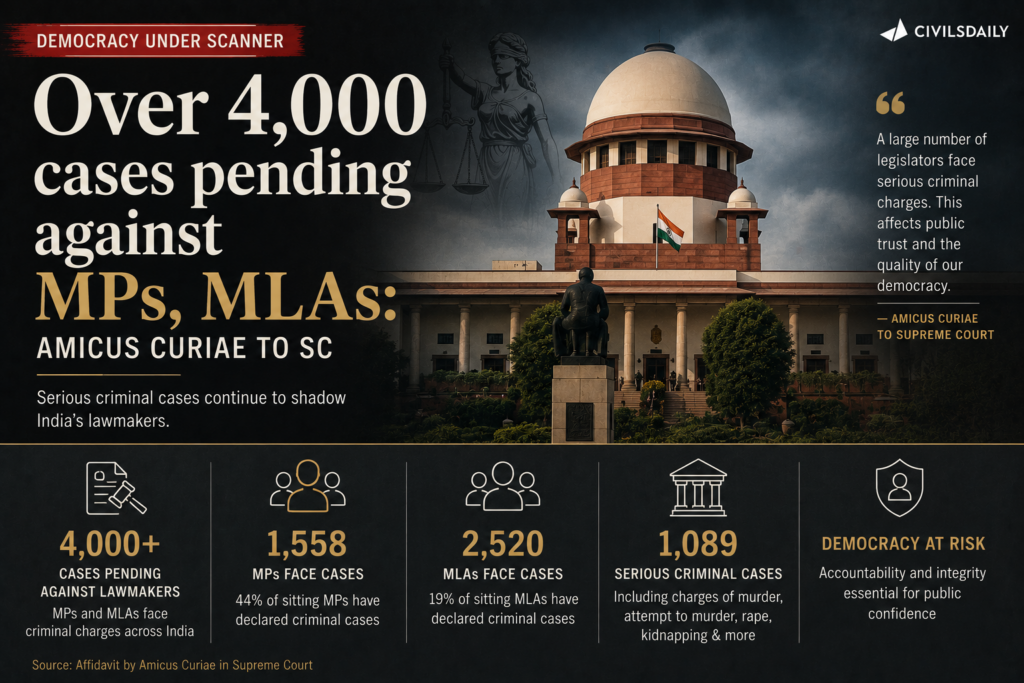
The 22nd report of the amicus curiae to the Supreme Court records 4,192 criminal cases pending trial against sitting and former Members of Parliament and Members of Legislative Assemblies, with 519 pending for more than a decade. The figure has stayed above 4,000 every year since 2018, through three rounds of Supreme Court directions creating special courts, designated courts and suo motu monitoring. The report therefore shifts the question from what should be ordered to why nine years of orders have not moved the number.
Who is an amicus curiae?
- About: An amicus curiae is a senior lawyer appointed by a court to assist it impartially in a matter, rather than to represent any party before it.
- Role here: The amicus in this public interest litigation collects pendency data from every High Court, audits compliance with earlier directions and files periodic reports with recommendations.
What is a designated court for cases against legislators?
- About: A designated court is an existing Sessions or Magisterial court identified in each district to hear criminal cases against sitting and former legislators on priority.
- Difference from a special court: A special court is constituted exclusively for such cases, while a designated court continues to carry its ordinary docket alongside them.
What does the 22nd amicus report record?
- Total pendency: 4,192 cases against sitting and former MPs and MLAs are pending trial across the country.
- The oldest bracket: 519 cases have been pending for more than a decade.
- Cases still under investigation: 700 cases are pending investigation, of which 360 have stayed at that stage for more than three years without a chargesheet.
- Source of the data: The figure is drawn from information received from High Courts and their websites, and the High Court websites together show 4,442 pending cases.
- A gap in reporting: The Allahabad High Court did not submit a report, so its figure of 1,171 cases is taken from its website as of February 2024.
- Reach into high office: Chief Ministers of 14 of 28 States have criminal cases pending trial against them.
- Where the case is listed: The matter was referred to a three judge Bench in February 2025 and was listed before that Bench on 18 August.
What is the full pendency profile in the data?
- Cases pending for 5 to 10 years: 754.
- Cases pending for 3 to 5 years: 562.
- Cases pending for less than 3 years: 1,095.
- State wise concentration: Uttar Pradesh leads with 1,171 cases, followed by Kerala at 543, Bihar at 373, Maharashtra at 364 and Odisha at 330.
- Chief Ministers facing cases: The Telangana Chief Minister faces the highest number at 89, followed by the West Bengal Chief Minister at 29, the Karnataka and Andhra Pradesh Chief Ministers at 19 each and the Kerala Chief Minister at 18.
- The trend line: Pendency rose from 4,075 in December 2018 to 5,140 in November 2022 before settling at 4,192 in July 2026, remaining above 4,000 throughout.
- Scale in the sitting Houses: 251 of 543 members of the Lok Sabha and 75 of 233 members of the Rajya Sabha have criminal cases against them.
- Data caveat: The cut off dates for the State figures vary, so the totals are indicative rather than a single day snapshot.
What has the Supreme Court already directed since 2017?
- Special courts in 2017: The Court ordered the setting up of 12 special courts in 10 States and Union Territories for speedy trial of criminal cases involving legislators.
- Designated courts in December 2018: It directed that one designated Sessions Court and one designated Magisterial Court be identified in every district to try such cases on priority.
- Suo motu monitoring in November 2023: It directed the Chief Justices of all High Courts to register suo motu cases to monitor early disposal and empowered special benches to issue directions for expeditious trial.
- Reference in February 2025: The matter went to a three judge Bench after an earlier amicus report flagged the absence of effective monitoring by most High Courts.
- The outcome so far: Pendency has remained at roughly the same level across all three rounds of directions.
Why has pendency stayed above 4,000 since 2018?
- Designated courts carry ordinary work: Courts identified for legislators’ cases continue to handle their regular judicial docket, so priority exists on paper only.
- Repeated adjournments: Hearings are deferred at the instance of parties without effective cost or consequence.
- Non appearance of accused persons: Accused legislators fail to appear on listed dates, and the trial cannot proceed in their absence.
- Delays in securing witnesses: Witnesses are not produced on the dates fixed, breaking the continuity of evidence.
- Inadequate High Court monitoring: Most High Courts have not run the suo motu monitoring the Court ordered in November 2023.
What does the amicus recommend?
- Exclusive trials: Designated courts should conduct trials involving lawmakers exclusively until their backlog is cleared.
- Day to day hearing: Cases pending for more than three years should be heard on a day to day basis.
- Non bailable warrants: Courts should issue non bailable warrants where an accused lawmaker fails to appear on two consecutive dates.
- Nodal prosecution officer: A nodal prosecution officer should be appointed to secure the attendance of witnesses.
- Real time data upload: Case data and order sheets should be uploaded in real time on High Court websites.
- Trial within one year: Trials should be completed within one year of the framing of charges.
- Monthly monitoring: High Courts should monitor cases pending for more than three years every month.
- Micro monitoring: Individual delayed cases should be tracked separately rather than only in aggregate.
Does prioritising legislators’ cases sit comfortably with equal treatment of all undertrials?
- Two competing claims: Legislators exercise public power and merit faster scrutiny, while ordinary undertrials suffer longer custody and have a stronger claim under Article 21.
- Fixed judicial capacity: Exclusive trials for legislators redirect court time within an unchanged pool of judges, so another category of case slows down.
- The trigger for priority: A legislator’s continuation in office turns on conviction under Section 8 of the Representation of the People Act, 1951, which no ordinary accused faces.
- Delay as a strategy: Prolonged trial protects the incumbent, so the beneficiary of delay is the accused who holds power.
- Why the equality objection is limited: The priority attaches to the office and its power over the criminal justice system, not to the person’s status as a citizen.
- The unresolved part: Neither the special courts of 2017 nor the designated courts of 2018 came with additional judges, so the priority was ordered without the capacity to deliver it.
Challenges to expeditious trial of legislators
- No additional judicial capacity: Priority was mandated without creating new posts. e.g. the 2017 order created only 12 special courts across 10 States and Union Territories for a national caseload above 4,000.
- Investigation stalling before trial: A case never reaches the designated court if the chargesheet is not filed. e.g. 360 cases have stayed under investigation for more than three years without a chargesheet.
- Prosecutorial dependence on the executive: Public Prosecutors are appointed by State governments that the accused may lead. e.g. Chief Ministers of 14 of 28 States face pending criminal cases.
- Witness hostility and intimidation: Witnesses turn hostile where the accused holds local power. e.g. India still has no operational witness protection framework beyond the 2018 scheme approved in Mahender Chawla v Union of India.
- Withdrawal of prosecution: Section 360 of the Bharatiya Nagarik Suraksha Sanhita, 2023 permits withdrawal with the court’s consent. e.g. Uttar Pradesh moved to withdraw a large batch of political cases in 2020, prompting High Court scrutiny.
- Inconsistent High Court reporting: Monitoring cannot work without uniform data. e.g. the Allahabad High Court, holding the largest caseload at 1,171, did not submit a report at all.
- Conviction does not follow speed: Faster trials do not by themselves improve the quality of investigation. e.g. pendency fell from 5,140 in November 2022 to 4,192 in July 2026 without any recorded rise in convictions.
Conclusion
The report shows an institutional pattern rather than a backlog problem, since pendency has stayed above 4,000 through three separate rounds of Supreme Court directions since 2017. Priority listing without additional judges, an independent prosecution and enforceable attendance simply redistributes delay. The matter now stands listed before a three judge Bench of the Supreme Court on 18 August, where the amicus has sought exclusive trials, day to day hearing of cases older than three years and completion of trial within one year of charge framing. The number to watch after that hearing is the count of cases older than a decade, currently 519.
“[2024, GS2, 15 marks] Explain the reasons for the growth of public interest litigation in India. As a result of it, has the Indian Supreme Court emerged as the world’s most powerful judiciary?”
