The Ministry of Environment, Forest and Climate Change released insights from India’s first national report on the Nagoya Protocol related to Access and Benefit Sharing (ABS), highlighting India’s progress in ensuring equitable sharing of benefits arising from biological resources.
About the Nagoya Protocol
Adopted Under: Convention on Biological Diversity (CBD)
Objective: To ensure Fair and equitable sharing of benefits arising from the utilisation of genetic resources and associated traditional knowledge.
What is Access and Benefit Sharing (ABS)?
ABS means: Users of biological resources must share benefits with:
Local communities
Indigenous groups
Traditional knowledge holders
Benefits can include:
Monetary compensation
Technology transfer
Community development
Conservation support
Key Findings of the Report
Large-Scale Implementation Between 2017 and 2025: 12,830 ABS approvals granted.
India’s Global Contribution
India issued:
3,556 Internationally Recognised Certificates of Compliance (IRCCs)
Around 60% of global issuance.
Revenue Generated: ₹216.31 crore realised by: National Biodiversity Authority (NBA)
Community Benefit: ₹139.69 crore disbursed to benefit claimers and local communities.
[2023] Consider the following statements: 1. In Biodiversity the India, Management Committees are key to the realization of the objectives of the Nagoya Protocol. 2. The Biodiversity Management Committees have important functions in determining access and benefit sharing, including the power to levy collection fees on the access of biological resources within its jurisdiction. Which of the statements given above is/are correct?
Finance Minister Nirmala Sitharaman highlighted concerns regarding “3Fs” Fuel, Fertiliser and Foreign Exchange amid the economic impact of the ongoing West Asia crisis.
Key Economic Concerns
Rupee Depreciation
Rupee weakened sharply against the U.S. dollar after the war began.
RBI reportedly intervened heavily in forex markets.
Foreign Portfolio Investment (FPI) Outflows
Foreign investors sold: Indian stocks and bonds leading to:
Capital outflows
Pressure on forex reserves
Forex Reserves Decline
India’s forex reserves reportedly fell significantly compared to pre-war levels.
Government Measures Taken
Higher import duty on:
Gold
Silver
Platinum
Restrictions on duty-free gold imports
Fuel price hikes
Appeals to reduce non-essential imports and foreign travel
[2022] With reference to the Indian economy, consider the following statements: 1. If the inflation is too high, Reserve Bank of India (RBI) is likely to buy government securities. 2. If the rupee is rapidly depreciating, RBI is likely to sell dollars in the market. 3. If interest rates in the USA or European Union were to fall, that is likely to induce RBI to buy dollars
An article in The Hindu explained the scientific principles behind thermometers, temperature scales, absolute zero, and ultra-cold atomic physics, highlighting how measurement of temperature evolved from mercury thermometers to quantum physics-based studies of cold atoms.
What is Temperature?
Temperature is a measure of the average kinetic energy of atoms and molecules in a substance.
When heat is supplied:
Atoms and molecules move faster.
When heat is removed:
Their motion slows down.
Thus, temperature reflects the degree of atomic agitation inside matter.
Celsius Scale
Developed by: Anders Celsius
Basis of the Scale
0°C: Freezing point of water
100°C: Boiling point of water
The interval between these two points is divided into 100 equal parts.
Mercury Thermometers
Why Mercury is Used
Uniform expansion on heating
Easily visible liquid metal
Good thermal conductor
Digital Thermometers
Modern digital thermometers use Semiconductor materials
Principle
Semiconductors conduct limited electricity.
Higher temperature releases more free electrons.
Increased electric current is measured electronically and converted into temperature readings.
[2021] In a pressure cooker, the temperature at which the food is cooked depends mainly upon which of the following? 1. Area of the hole in the lid 2. Temperature of the flame
3. Weight of the lid Select the correct answer using the code given below.
The Ministry of Statistics and Programme Implementation (MoSPI) released the report of the Technical Advisory Committee (TAC) on revising the base year of the All-India Index of Industrial Production (IIP) from 2011-12 to 2022-23.
About IIP
The Index of Industrial Production (IIP) measures: Growth in industrial activity in India.
Published By: National Statistical Office (NSO) Under MoSPI
Technical Advisory Committee (TAC-IIP)
Chairman: Mridul K. Saggar
Constituted: September 2024
Purpose
Guide the revision of IIP base year.
Improve methodology, coverage, and accuracy.
Major Changes in New IIP Series (2022-23)
Expanded Coverage: New sectors included:
Minor minerals
Rare earth minerals
Gas supply
Water supply
Sewerage and waste management
Revised Item Basket
Total products: 1,042
Mapped into: 463 item groups
Based on: National Industrial Classification (NIC)-2025
National Industrial Classification (NIC)-2025
National Industrial Classification (NIC) is India’s official system for classifying economic and industrial activities.
It helps in:
Collection of statistical data
Industrial surveys
National accounts compilation
Economic analysis and policy formulation
Released by the Ministry of Statistics and Programme Implementation (MoSPI) through the National Statistical Office (NSO).
[2012] In India the overall Index of Industrial Production, the Indices of Eighth Core Industries have combined weight of 37.90%. Which of the following are among those Eight Core Industries? 1. Cement 2. Fertilizers 3. Natural Gas 4. Refinery products 5. Textiles Select the correct answer using the codes given below:
PYQ Relevance[UPSC 2018] In what ways would the ongoing US-Iran Nuclear Pact Controversy affect the national interest of India? How should India respond to this situation?Linkage: The PYQ examines the impact of West Asian geopolitical instability and sanctions regimes on India’s energy security and foreign policy. The article discusses how sanctions, maritime insecurity, and disruptions around the Strait of Hormuz directly threaten India’s crude imports and economic stability.
Mentor’s Comment
The United States has allowed a key sanctions waiver on Russian seaborne crude to expire. This has forced major buyers like India to navigate stricter compliance amid volatile global energy markets. This shift restricts access to discounted Russian oil. The development comes at a time of heightened geopolitical instability in West Asia, maritime disruptions in critical sea lanes, and increasing vulnerability of global supply chains.
How does the U.S. decision alter the global energy equilibrium?
Sanctions Tightening: Restricts Russia’s ability to export seaborne oil freely, potentially reducing global supply flexibility and increasing market volatility.
Fragile Balancing Mechanism: Disturbs the earlier Western approach of sanctioning Russia while simultaneously preventing global price spikes through selective flexibility.
Geopolitical Spillover: Intensifies vulnerabilities caused by the Ukraine conflict, Red Sea disruptions, Iran-related tensions, and maritime insecurity.
Price Sensitivity: Alters freight rates, insurance premiums, and tanker availability, creating ripple effects across oil-importing nations.
Contradiction in Western Objectives: Creates tension between reducing Russia’s oil revenues and maintaining lower inflation and uninterrupted energy flows globally.
Why is India particularly vulnerable to disruptions in Russian oil trade?
Import Dependence: India imports nearly 90% of its crude oil requirements, making external energy shocks economically significant.
Third-Largest Oil Importer: India ranks among the world’s largest energy consumers, increasing exposure to global price fluctuations.
Discounted Russian Crude: Russian oil after 2022 acted as an economic stabiliser by reducing import bills and improving refinery margins.
Inflation Transmission: Rising crude prices increase transport costs, food inflation, fertiliser subsidies, and household expenditure.
Industrial Competitiveness: Expensive energy raises manufacturing costs and affects export competitiveness.
Supply Diversification: Russian imports reduced overdependence on West Asian suppliers and provided flexibility during global disruptions.
How do energy shocks transmit into India’s economy?
Higher Crude Prices: Increase landed import costs, widen the current account deficit, and pressure the rupee.
Strait of Hormuz Vulnerability: Disruptions create supply uncertainty because a large share of India’s crude and LPG imports transit through these waters.
Shipping Insurance Surge: Raises transportation costs due to higher war-risk premiums during geopolitical tensions.
Refinery Stress: Constrains refining margins and increases sourcing complexity.
Fuel Logistics Pressure: Affects LPG and petroleum product supply chains, increasing domestic energy stress.
Table: How Energy Shocks Affect India
Energy Shock
Immediate Impact
Secondary Impact on India
Higher crude oil prices
Costlier imports
Inflation and rupee pressure
Strait of Hormuz disruption
Supply uncertainty
LPG and fuel logistics stress
Shipping insurance surge
Higher landed crude cost
Refining margin pressure
Russian crude restrictions
Reduced supply flexibility
Higher sourcing costs
Freight disruptions
Delayed cargoes
Inventory management stress
Why are sanctions increasingly colliding with market realities?
Fear Premium: Oil prices react not only to shortages but also to anticipated disruptions, often driving prices sharply upward.
Hydrocarbon Dependence: Despite renewable expansion, global transport, aviation, petrochemicals, agriculture, and trade logistics remain heavily oil-dependent.
Revenue Resilience: Russia can continue earning substantial revenues through elevated prices despite reduced export volumes.
Market Pragmatism: Previous temporary waivers reflected recognition that excessive restrictions destabilise global markets.
Energy-Economics Contradiction: Harder sanctions risk worsening inflation and energy insecurity for importing economies.
How is energy security being redefined in the 21st century?
Shift from Physical Scarcity: Energy insecurity now stems less from supply shortages and more from disruptions in shipping, sanctions, tanker blacklisting, financial restrictions, and payment barriers.
Geopolitical Embeddedness: Energy flows increasingly reflect geopolitical alignments rather than purely commercial logic.
Maritime Risks: Strategic chokepoints such as the Strait of Hormuz and Bab-el-Mandeb have become central to global energy security.
Financial Vulnerability: Banking restrictions and sanctions increasingly shape energy access.
Strategic Competition: Energy trade is increasingly influenced by rival geopolitical blocs.
What long-term energy strategy should India adopt?
Strategic Autonomy: Preserves independent energy decision-making amid competing geopolitical blocs.
Conclusion
The tightening of restrictions on Russian oil underscores the growing fusion of geopolitics and energy economics. For India, the challenge extends beyond temporary price volatility to structural energy vulnerability. Long-term resilience will depend on diversified sourcing, stronger reserves, domestic exploration, maritime preparedness, and accelerated clean-energy transition. In an increasingly fragmented world, energy security will remain central to economic sovereignty and strategic autonomy.
Google recently introduced “information agents,” AI assistants capable of continuously monitoring the web on behalf of users. These agents aim to automate information gathering, recommendations, and decision-making by integrating data across Google’s ecosystem such as Search, Gmail, Maps, Chrome, YouTube, Android, and Calendar.
What are Information Agents?
Google Information Agents are AI-powered assistants, announced at Google I/O 2026, designed to run continuously in the background of Google Search to monitor the web, synthesize information, and act on your behalf 24/7. They act as an evolution of Google Alerts, proactively providing updates on topics like apartment hunting or price tracking.
Key Features & Capabilities
Proactive Monitoring: Instead of waiting for a manual query, agents constantly check the web for updates tailored to specific goals.
Synthesis & Action: Agents gather data from multiple sources, provide insights, and can trigger actions (e.g., booking, alerting).
“AI Mode” in Search: Activated within the Google App, where users can set up and track these agents.
Personalization: Agents use user-provided details (budget, location, preferences) to provide personalized, actionable results.
Why Do Google’s Information Agents Represent a Structural Shift in the Nature of Internet Use?
Passive-to-Autonomous Transition: Traditional search depends on active human input where users consciously search for information. Information agents shift this model toward persistent AI monitoring that continuously scans the internet without repeated user intervention.
Continuous Monitoring: Agents remain active over time rather than responding to one-time prompts. They monitor categories such as housing, travel, stocks, health, or shopping preferences.
Cross-Ecosystem Integration: Google integrates information from Search, Gmail, Maps, Chrome, Calendar, YouTube, and Android, enabling deeper behavioural profiling than standalone AI assistants.
Predictive Personalization: Agents function by collecting increasing amounts of personal data because improved recommendations depend on richer behavioural information.
Machine-to-Machine Internet: The article highlights a structural change where digital interactions increasingly occur between automated systems instead of humans directly browsing websites.
How Could Information Agents Intensify Data Privacy and Surveillance Concerns?
Behavioural Profiling: Agents require intimate personal details to function effectively. A housing-monitoring request may reveal location preference, family size, budget, commuting constraints, timeline, and travel plans.
Sensitive Data Accumulation: Users may unintentionally disclose religious beliefs, political preferences, sexual orientation, medical history, and financial behaviour, expanding risks of sensitive profiling.
Indefinite Data Storage: Information collected for agentic services may remain stored for prolonged periods, increasing risks of misuse or surveillance.
Data Concentration: Google already possesses vast datasets through existing platforms. Information agents deepen concentration by linking fragmented behavioural data into unified user profiles.
Limited Regulatory Protection: Current frameworks remain underdeveloped regarding liability if AI agents influence financial or personal decisions that later harm users.
Can AI Information Agents Overload the Internet’s Infrastructure?
Bot Traffic Expansion: AI-driven internet activity is already increasing sharply.
Striking Data: The article cites the Thales 2026 Bad Bot Report, which estimates bots account for 53% of global web traffic.
Sharp Increase in Attacks: AI-driven bot attacks reportedly increased 15 times in 2025.
Blocked Requests Surge: Daily blocked bot requests reportedly increased from 2 million to 25 million within a year.
Exponential Crawling: A conventional Google search may trigger one crawl after a query. Information agents repeatedly scan websites, potentially generating hundreds of automated fetches daily per user.
Infrastructure Burden: Millions of subscribers using persistent agents could impose enormous computational and bandwidth costs on websites.
Example
Housing Listings: An agent monitoring apartment prices continuously would repeatedly crawl real-estate websites to detect changes.
Stock Monitoring: Persistent stock monitoring may generate frequent automated queries throughout the day.
How Could Information Agents Threaten the Economic Sustainability of the Open Web?
Publisher Revenue Erosion: AI agents may summarize content directly instead of redirecting users to publisher websites, reducing click-through traffic.
Server Cost Burden: Publishers would continue bearing infrastructure costs while AI systems scrape and synthesize content.
Content Extraction Problem: Information harvesting without proportional traffic or revenue could weaken incentives for quality journalism.
Potential Publisher Pushback: Websites may increasingly block Google crawlers or restrict access to AI scraping.
Negative Feedback Loop: Reduced publisher incentives may degrade content quality, weakening the informational ecosystem itself.
Comparative Contex
AI Search Platforms: Similar debates have emerged around AI-generated search summaries reducing website visits.
Media Compensation Models: Countries such as Australia introduced bargaining mechanisms between digital platforms and news publishers.
Does the Rise of Information Agents Deepen Market Concentration and Digital Inequality?
Platform Entrenchment: Google’s advantage lies in unmatched digital infrastructure across search, email, navigation, devices, and browsing behaviour.
Lock-In Effect: Users embedded in Google’s ecosystem may find switching increasingly difficult due to personalized AI assistance.
Subscription Divide: The information agents may initially launch for Google AI Pro and Ultra subscribers, creating differentiated access.
Informational Inequality: Wealthier users may gain persistent AI assistants while others continue manual searches, widening informational asymmetries.
Market Power Consolidation: Persistent agents could further strengthen dominance of already large digital platforms.
Are Existing Legal and Governance Frameworks Adequate for AI Agents?
Liability Gap: No clear framework exists regarding responsibility if an AI agent nudges users toward harmful financial or medical outcomes.
Assistant-versus-Advisor Problem: Companies classify agents as “assistants” rather than advisors, limiting accountability.
Regulatory Lag: Technology deployment currently outpaces legal adaptation.
Need for Algorithmic Transparency: Users require clarity regarding how recommendations are generated and monetized.
Data Governance Deficit: Existing laws inadequately address persistent behavioural monitoring by autonomous systems.
Possible Governance Measures
Consent Architecture: Ensures granular and revocable consent mechanisms.
Transparency Mandates: Requires disclosure regarding data collection, recommendation logic, and commercial influence.
Publisher Compensation: Develops fair economic arrangements for AI-generated content extraction.
AI Liability Standards: Establishes responsibility for harmful outcomes from automated recommendations.
Bot Governance Framework: Regulates autonomous web crawling and infrastructure burden.
Conclusion
Google’s information agents represent a transformative shift from search-based internet use to persistent AI-mediated interaction. While the model promises convenience and efficiency, it intensifies concerns relating to privacy, concentration of digital power, infrastructure strain, and publisher sustainability. The challenge for policymakers lies in balancing technological innovation with data protection, platform accountability, fair digital markets, and preservation of an open web ecosystem.
Important Value Additions for UPSC MainsKey ConceptsAgentic AI: AI systems capable of autonomous action, monitoring, and decision-making.Surveillance Capitalism: Monetization of behavioural data for predictive commercial outcomes.Platform Monopoly: Dominance arising from control over infrastructure, data, and network effects.Data Colonialism: Extraction and monetization of user data at scale.Algorithmic Governance: Decision-making increasingly shaped through digital systems.
PYQ Relevance
[UPSC 2018] Data security has assumed significant importance in the digitized world due to rising cyber crimes. The Justice B.N. Srikrishna Committee Report addresses issues related to data security. What, in your view, are the strengths and weaknesses of the Report relating to protection of personal data in cyberspace?
Linkage: The PYQ reflects UPSC’s focus on institutional and legal frameworks governing personal data in the digital age. Google’s information agents intensify concerns discussed in the PYQ by enabling persistent behavioural tracking and integrated profiling across digital ecosystems.
Delhi’s road dust has come under renewed scrutiny after scientific studies and a CAQM-appointed committee identified it as a persistent and major source of particulate pollution, particularly PM10.
What is Road Dust?
Road dust is a mixture of solid particles, including soil, sand, brake/tire wear, and construction debris, that settles on road surfaces and becomes airborne.
It is a major, often unregulated source of urban air pollution and harmful heavy metals (such as Zinc and Copper)
It becomes airborne through vehicle movement and wind action.
In Delhi, road dust has emerged as a persistent urban pollutant source, contributing significantly to PM10 and PM2.5 levels.
It has implications for respiratory health, urban planning, and environmental governance.
How does road dust emerge as a major source of air pollution in Delhi?
Road Surface Deposits: Dust accumulates from soil, debris, road wear, tyre-brake friction, and construction material, becoming airborne through vehicular movement.
Primary Pollutant Source: CAQM classified road dust as a primary emission source, unlike point-source pollution from construction sites.
Vehicular Resuspension:Heavy traffic movement repeatedly lifts deposited particles into the air, particularly during dry weather.
Construction Spillover:Transport of construction and demolition (C&D) waste spreads loose particles along roads, increasing dust loading.
Dust-Carrying Corridors: Delhi’s roads function as linear pollution corridors, where contamination spreads continuously rather than remaining site-specific.
How does road dust threaten public health?
PM10 and PM2.5 Exposure: Fine particles penetrate the lungs and bloodstream, causing chronic inflammation.
Respiratory Diseases: Increases risk of asthma, chronic obstructive pulmonary disease (COPD), persistent coughing, and wheezing.
Cancer Risk: Studies identified toxic elements in roadside soil and dust linked to carcinogenic outcomes.
Childhood Vulnerability: Weakens lung growth and respiratory development in children.
Premature Mortality: Long-term PM2.5 exposure contributes to temperature-linked deaths and cardiovascular complications.
Why does road dust persist despite repeated cleaning measures?
Continuous Deposition: Dust reaccumulates due to poor road conditions, inadequate maintenance, and unregulated roadside dumping.
Unpaved Medians and Shoulders:Loose soil from unpaved stretches frequently disperses during wind events.
Poor Irrigation Practices:Leaking water pipes used for median watering dry later and convert into dust-generating surfaces.
Encroachments and Parking:Unauthorized parking and roadside encroachments obstruct mechanised sweeping and cleaning.
Median Design Reform: Maintaining an 8-12 inch soil depression below kerbs reduces soil displacement during strong winds.
Road Engineering Improvements: Better road paving, shoulder management, and drainage systems reduce dust generation.
Drip Irrigation Systems: Prevents soil displacement from leaking watering systems.
Loose Soil Stabilisation: Ensures dust control near metro infrastructure and tree plantations.
Scientific Monitoring: Supports particle-size analysis and effectiveness assessment of interventions.
Conclusion
Delhi’s road dust crisis reveals that air pollution is not solely a combustion problem but also an urban maintenance and ecological governance challenge. Sustainable mitigation requires moving beyond temporary suppression measures toward scientific road engineering, ecological restoration, mechanised cleaning, and institutional coordination. Without structural reforms, road dust will continue to undermine gains achieved through vehicle and industrial emission control.
Value Addition:CAQM (Commission for Air Quality Management): Coordinates air pollution mitigation across NCR and adjoining regions. NEERI (National Environmental Engineering Research Institute): Conducts environmental pollution assessment and mitigation research. CRRI (Central Road Research Institute): Specialises in road infrastructure and transport-related studies. TERI (The Energy and Resources Institute): Works on sustainability and environmental policy.Important Terms/Concepts PM10: Particulate matter with diameter below 10 microns, enters the respiratory tract. PM2.5: Fine particulate matter below 2.5 microns, penetrates the bloodstream. Resuspension: Re-entry of deposited particles into air through traffic or wind. Urban Ecological Barrier: Natural landscapes such as Aravallis that reduce dust transport.
PYQ Relevance
[UPSC 2020] What are the key features of the National Clean Air Programme (NCAP) initiated by the Government of India?
Linkage: UPSC frequently asks questions on institutional and policy responses to environmental pollution, especially air quality governance and mitigation frameworks. The article shows that road dust is a major but underestimated PM10/PM2.5 source, highlighting why NCAP needs targeted urban dust-control measures beyond conventional emission control.
Russia launched a large-scale missile and drone attack on Ukraine, including the use of the hypersonic Oreshnik missile near Kyiv.
Key Highlights
Russia carried out one of the heaviest bombardments on: Kyiv
Hundreds of Drones and Missiles were used.
About the Oreshnik Missile
Features
Intermediate-range hypersonic missile [Range of 3,000 km to 5,500 km]
Capable of carrying: Nuclear warheads
Strategic Significance
This was reportedly: The third use of the Oreshnik missile in the Ukraine war.
European leaders termed it:
Escalatory
Nuclear brinkmanship
[2023] Consider the following countries 1. Bulgaria 2. Czech Republic 3. Hungary 4. Latvia 5. Lithuania 6. Romania How many of the above countries share a land border with Ukraine?
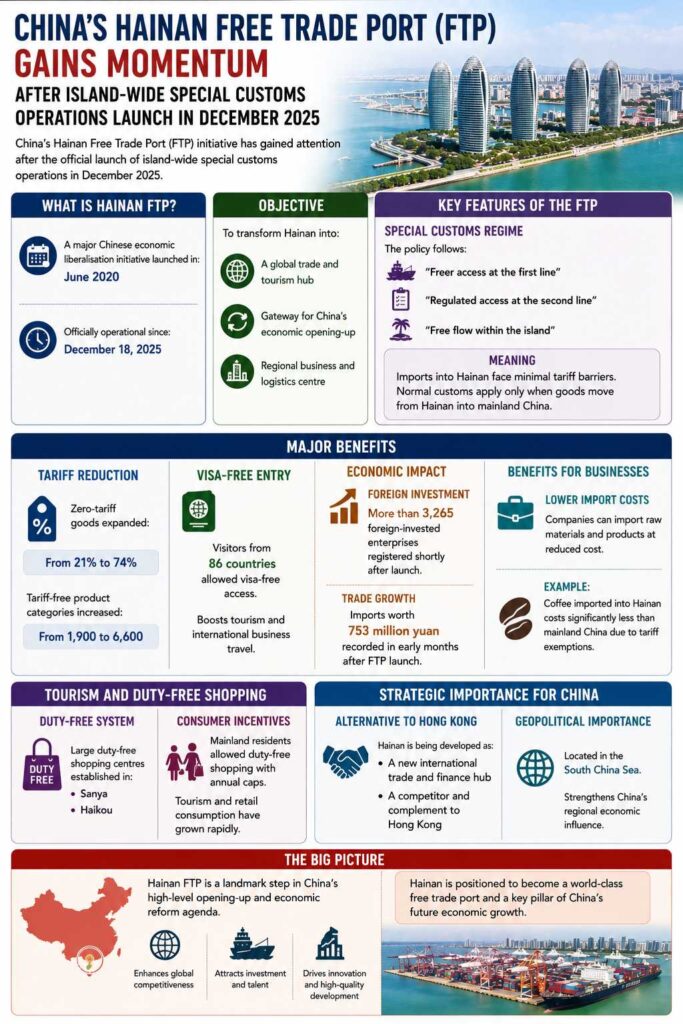
China’s Hainan Free Trade Port (FTP) initiative has gained attention after the official launch of island-wide special customs operations in December 2025.
What is Hainan FTP?
A major Chinese economic liberalisation initiative launched in June 2020
Officially operational since December 18, 2025
Objective
To transform Hainan into:
A global trade and tourism hub
Gateway for China’s economic opening-up
Regional business and logistics centre
Key Features of the FTP
The policy follows:
“Freer access at the first line”
“Regulated access at the second line”
“Free flow within the island”
Meaning
Imports into Hainan face minimal tariff barriers.
Normal customs apply only when goods move from Hainan into mainland China.
Major Benefits
Tariff Reduction
Zero-tariff goods expanded From 21% to 74%
Tariff-free product categories increased From 1,900 to 6,600
Visa-Free Entry
Visitors from 86 countries allowed visa-free access.
Boosts tourism and international business travel.
Economic Impact
Foreign Investment: More than 3,265 foreign-invested enterprises registered shortly after launch.
Trade Growth
Imports worth 753 million yuan recorded in early months after FTP launch.
Benefits for Businesses
Lower Import Costs: Companies can import raw materials and products at reduced cost.
Example: Coffee imported into Hainan costs significantly less than mainland China due to tariff exemptions.
Tourism and Duty-Free Shopping
Duty-Free System
Large duty-free shopping centres established in:
Sanya
Haikou
Consumer Incentives
Mainland residents allowed duty-free shopping with annual caps.
Tourism and retail consumption have grown rapidly.
Strategic Importance for China
Alternative to Hong Kong
A new international trade and finance hub
A competitor and complement to Hong Kong
Geopolitical Importance
Located in the South China Sea
Strengthens China’s regional economic influence.
[2022] Which one of the following statements best reflects the issue with Senkaku Islands, sometimes mentioned in the news?
a) It is generally believed that they are artificial islands made by a country around South China Sea. b) China and Japan engage in maritime disputes over these islands in East China Sea. c) A permanent American military base has been set up there to help Taiwan to increase its defence capabilities. d) Though International Court, of Justice declared them as no man’s land, some South-East Asian countries claim them.
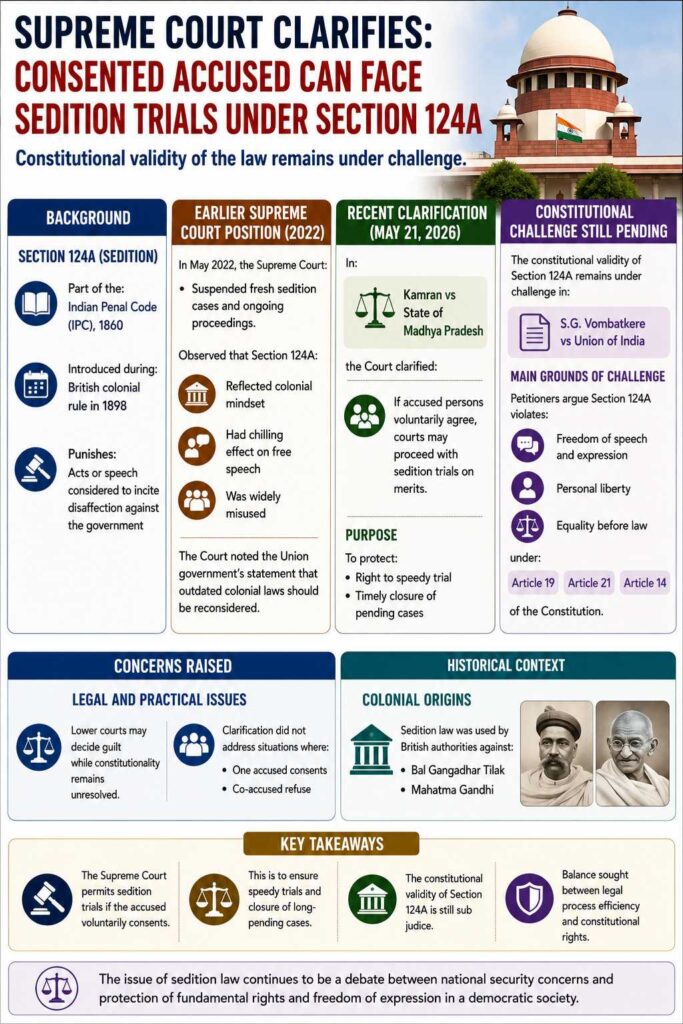
The Supreme Court of India clarified that accused persons who voluntarily consent can continue to face proceedings under Section 124A (sedition), even though the constitutional validity of the law remains under challenge.
Background
Section 124A (Sedition)
Part of the: Indian Penal Code (IPC), 1860
Introduced during: British colonial rule in 1898
Punishes: Acts or speech considered to incite disaffection against the government
Earlier Supreme Court Position (2022)
In May 2022, the Supreme Court:
Suspended fresh sedition cases and ongoing proceedings.
Observed that Section 124A:
Reflected colonial mindset
Had chilling effect on free speech
Was widely misused
The Court noted the Union government’s statement that outdated colonial laws should be reconsidered.
Recent Clarification (May 21, 2026)
Kamran vs State of Madhya Pradesh.
The Court clarified: If accused persons voluntarily agree, courts may proceed with sedition trials on merits.
Purpose
To protect:
Right to speedy trial
Timely closure of pending cases
Constitutional Challenge Still Pending
The constitutional validity of Section 124A remains under challenge in S.G. Vombatkere vs Union of India
Main Grounds of Challenge
Petitioners argue Section 124A violates:
Freedom of speech and expression
Personal liberty
Equality before law
under Article 19, Article 21, and Article 14 of the Constitution.
Concerns Raised
Legal and Practical Issues
Lower courts may decide guilt while constitutionality remains unresolved.
Clarification did not address situations where:
One accused consents
Co-accused refuse
Historical Context
Colonial Origins: Sedition law was used by British authorities against:
Bal Gangadhar Tilak
Mahatma Gandhi
[2025] “Sedition has become my religion” was the famous statement given by Gandhiji at the time of:
(a) The Champaran Satyagraha
(b) publicly violating Salt Law at Dandi
(c) attending the Second Round Table Conference in London