Why in the News
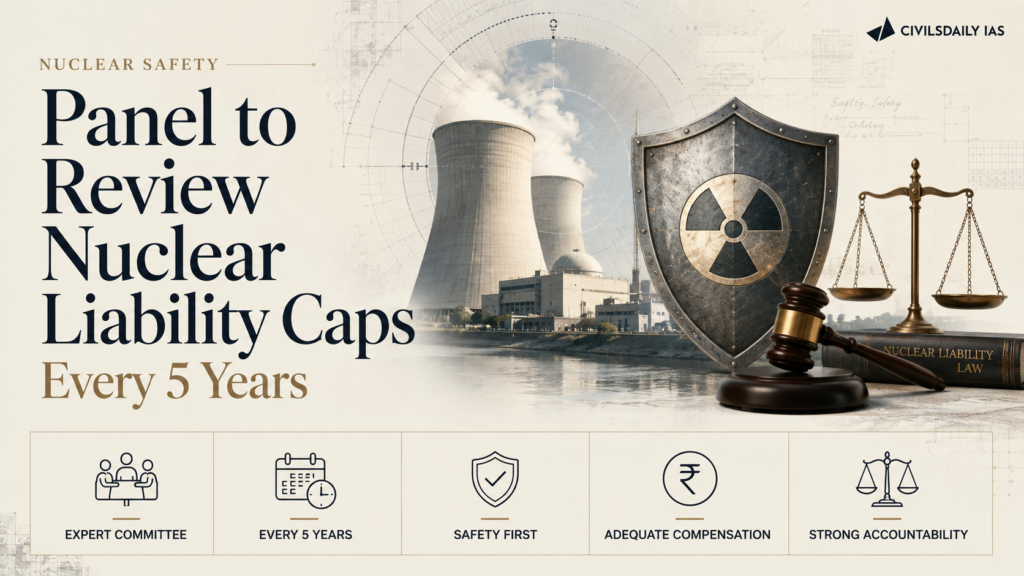
Draft rules released by the Department of Atomic Energy on 14 August 2026 require an expert group to review the graded caps on nuclear operators’ civil liability once every five years. The review reaches only the operator’s cap, and leaves untouched the removal of the supplier’s statutory liability that is now the subject of a challenge in the Supreme Court.
What is the Sustainable Harnessing and Advancing Nuclear Energy for Transitioning India (SHANTI) Act, 2025?
- About: The SHANTI Act, 2025 replaces both the Atomic Energy Act, 1962 and the Civil Liability for Nuclear Damage Act, 2010 (CLNDA) in a single unified statute, and is the first comprehensive overhaul of India’s nuclear power regime since independence.
- What it opens: The Act allows private entities to own and operate nuclear power plants for the first time, covering construction, transport, storage, import, export and handling of nuclear material, with mandatory authorisation from the Atomic Energy Regulatory Board for every activity.
- What it retains for the State: The government keeps an exclusive monopoly over enrichment, isotope separation, spent fuel reprocessing and radioactive waste management, so the fuel cycle remains entirely in the public sector.
- What it changed on liability: The Act’s Second Schedule introduced graded liability caps based on the size of a nuclear installation, replacing the earlier flat cap of Rs 1,500 crore under the CLNDA.
What is an operator’s right of recourse?
- About: A right of recourse is the operator’s ability, after paying compensation for nuclear damage, to recover that amount from another party responsible for the incident.
- Why it is contested: The scope of this right decides whether the financial consequence of a defective component rests with the plant operator or travels back to the equipment supplier.
What does Rule 78 of the draft rules provide?
- A standing review, not an occasional one: Rule 78 requires the Central government to constitute a group of experts to review the maximum limits of the operator’s civil liability for nuclear damage once every five years.
- Composition of the expert group: The group draws from nuclear science and engineering, actuarial science, insurance and law, together with public-interest representatives.
- What it can recommend: The group may propose amendments to the Second Schedule of the Act, which is where the graded caps sit.
- How this differs from the earlier law: Section 6 of the now-repealed CLNDA also allowed the Centre to periodically review the operator’s liability and notify a higher amount. The draft rules add a defined time period within which that review must happen.
What are the graded liability caps under the Second Schedule?
- Above 3,600 Megawatt-electric (MWe): Operators of reactors above 3,600 MWe face a maximum liability of Rs 3,000 crore. MWe measures the electrical output of a reactor as distinct from its thermal output.
- 1,500 MWe to 3,600 MWe: Operators in this band face a cap of Rs 1,500 crore.
- 750 MWe to 1,500 MWe: The cap falls to Rs 750 crore.
- 150 MWe to 750 MWe: The cap falls to Rs 300 crore.
- Up to 150 MWe and other facilities: For reactors up to 150 MWe, for fuel-cycle facilities other than spent-fuel reprocessing plants, and for the transportation of nuclear material, liability is capped at Rs 100 crore.
How has the operator’s right of recourse against suppliers changed?
- The three grounds under the old law: Section 17 of the CLNDA gave the operator a right of recourse where the right was expressly provided for in a written contract, where the incident resulted from an act of the supplier or the supplier’s employee including supply of equipment or material with patent or latent defects or sub-standard services, and where the incident resulted from an act or omission of an individual done with intent to cause nuclear damage.
- What survives: The new law retains the contractual ground and the intentional damage ground.
- What has been dropped: The supplier defect ground has been omitted, and it was the provision that exposed nuclear equipment vendors to long-term and uncertain liability risk in the event of an accident.
- What replaces it: Operators may now seek recourse from suppliers only through what they negotiate into a contract, which moves the question from statute to bargaining power.
- What it unblocks: Removing the statutory supplier exposure directly addresses the objection that kept foreign vendors out of Indian projects for over a decade.
Why is the liability framework being challenged in the Supreme Court?
- The grounds pleaded: A petition challenges the Act for allowing private sector and foreign companies to operate nuclear power plants in India, for capping the liability of these operators at what it calls an absurdly low level, and for exempting the supplier from any liability, in violation of the Constitution.
- The accountability objection: Opening the sector to private operators while capping their exposure shifts residual risk from the operator to the exchequer and ultimately to victims.
- The five-yearly review does not answer it: Rule 78 allows the operator’s cap to be revised upward over time. It creates no mechanism to restore a supplier’s statutory liability, which the Act has removed from the framework entirely.
- The competing objective: Liability certainty is the precondition foreign vendors set for entering Indian projects, so the same provision that draws the petition is the one that makes the capacity expansion arithmetic feasible.
What challenges does India’s civil nuclear liability framework face?
- A cap fixed in nominal terms erodes with inflation: A rupee figure written into a Schedule loses real value between revisions, so the five-year cycle sets the pace at which protection decays. Eg. The flat cap under the Civil Liability for Nuclear Damage Act, 2010 stood unrevised from 2010 until the SHANTI Act, 2025 replaced it with graded caps.
- Caps far below the actual cost of a severe accident: Graded caps measured in thousands of crores do not approach the cost of a major release. Eg. Cleanup and compensation costs after the 2011 Fukushima accident in Japan ran to tens of trillions of yen, orders of magnitude above any cap in the Second Schedule.
- Thin domestic insurance capacity for nuclear risk: Operators must place cover for the capped amount in a market with few underwriters willing to carry nuclear exposure. Eg. The India Nuclear Insurance Pool was created in 2015 precisely because individual insurers would not write the risk alone.
- Contractual recourse depends on bargaining power: With the statutory supplier ground removed, a smaller operator negotiating with a global vendor has little leverage to secure recourse in the contract. Eg. Jaitapur negotiations with the French vendor stalled for years over tariff and liability terms even while the statutory provision was in force.
- Regulatory independence still being built out: The Atomic Energy Regulatory Board has only now received statutory authority, having previously reported to the Department of Atomic Energy it was meant to regulate. Eg. The SHANTI Act, 2025 grants the Board statutory status for the first time and places its expenditure under the Comptroller and Auditor General.
- Claims machinery untested at scale: A dedicated claims commission exists on paper without a demonstrated record of settling mass claims quickly. Eg. The Act establishes a Nuclear Damage Claims Commission with appeals to the Electricity Appellate Tribunal, neither of which has adjudicated a nuclear damage claim.
- Public acceptance and siting resistance: Liability caps read as a transfer of risk to communities near installations, which hardens local opposition to siting. Eg. Sustained local protest at Kudankulam in Tamil Nadu delayed commissioning of the first units for years.
Conclusion
The five-yearly expert review converts a static Schedule of liability caps into a periodically revisable one, which is a real improvement on a flat figure left unrevised for fifteen years. It does not address the change that drew the litigation, since the supplier’s statutory exposure has been removed rather than capped, and no review clause can restore it. The measure currently stands at the draft rules stage, and the source states no date for the close of the comment window or for notification of the final rules, with the constitutional challenge to the Act pending before the Supreme Court.
“[2018, GS3, 15] With growing energy needs should India keep on expanding its nuclear energy programme? Discuss the facts and fears associated with nuclear energy.”
