Why in the News
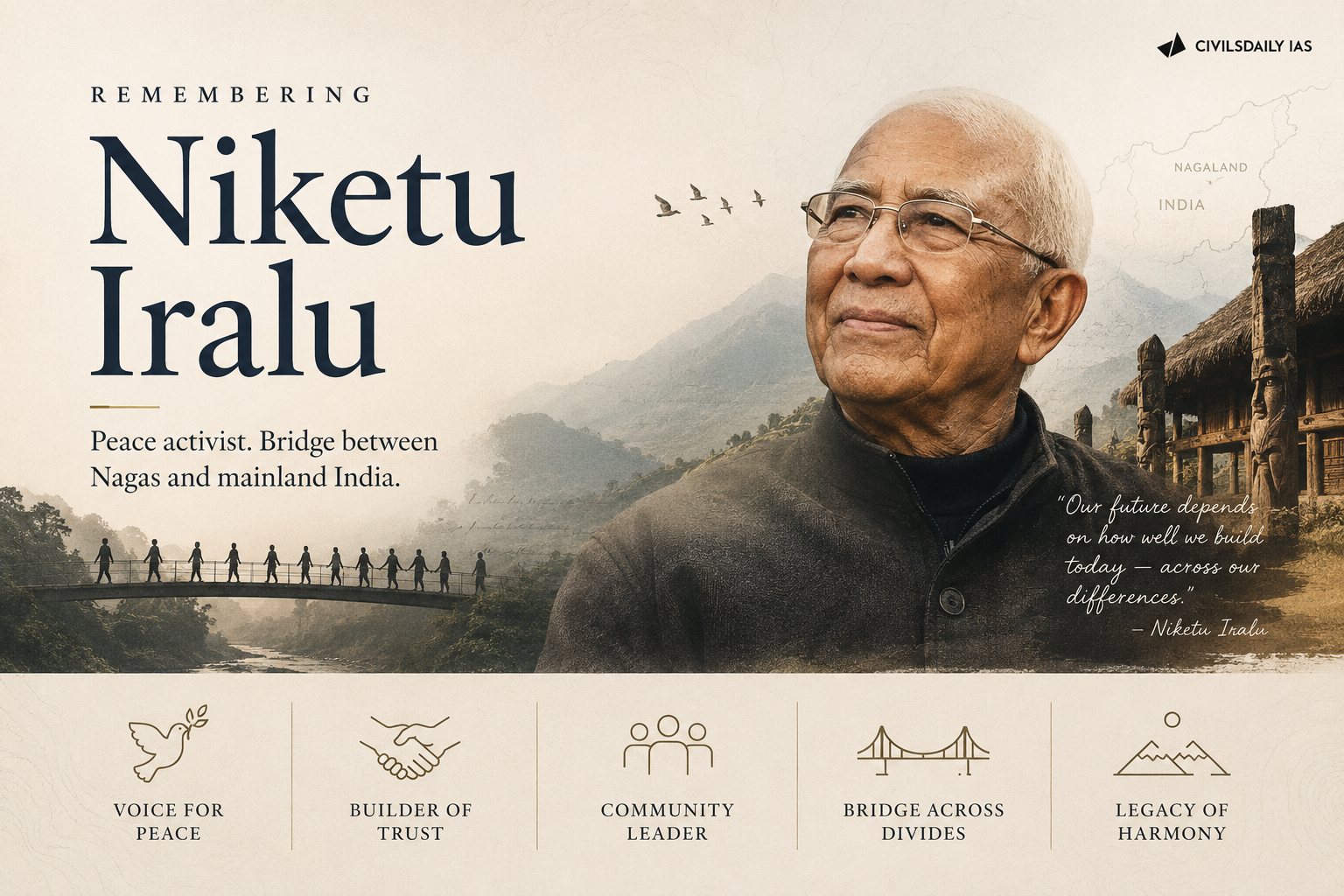
Niketu Iralu, a Naga peace activist, died in a Delhi hospital on 18 August 2026 at the age of 91. He spent six decades on reconciliation between Naga factions and between the Naga people and the rest of India, outside every formal negotiating channel. His maternal uncle, Angami Zapu Phizo, led the Naga National Council (NNC), which declared Naga independence on 14 August 1947. The Centre constituted a new ministerial panel last week to carry forward the stalled talks on a final Naga settlement. The conflict has found no solution in the nearly eight decades since that declaration. One position holds that a final text can now be signed. The competing position is that the reconciliation work behind six decades of talks has no institutional successor.
What is the Naga peace process?
- A ceasefire came before any accord: A peace camp at Chedema, on a hilltop near Kohima, negotiated a ceasefire in 1964 between the rebel Naga Federal Government and the Government of India. It was the first suspension of hostilities after more than a decade of armed insurgency.
- The Shillong Accord split the movement: NNC representatives signed the Shillong Accord in 1975, accepting the Constitution of India. A faction rejected it and formed the National Socialist Council of Nagaland (NSCN) in 1980.
- The current track opened with the 1997 ceasefire: The Centre signed a ceasefire with the NSCN (Isak-Muivah) faction in 1997. Talks under it have run for close to three decades without a final agreement.
- The Framework Agreement fixed the terms in 2015: The Centre and the NSCN (Isak-Muivah) signed a Framework Agreement on 3 August 2015 recognising the “unique history” of the Nagas. Its contents have never been published.
Why did a family at the centre of the sovereignty claim produce its leading peace advocate?
- The lineage ran through the sovereignty movement: His father, Sevilie Iralu, was among the first Naga doctors. His maternal uncle led the council that made the 1947 declaration.
- He chose a different method: He committed himself to non-violence, dialogue and reconciliation rather than armed struggle. He became known across the Northeast as a peace activist rather than a political negotiator.
- Initiatives of Change shaped that method: He worked in Initiatives of Change, an organisation that pursues social transformation through “personal change”. Its premise is that a political conflict is resolved by first changing the people inside it.
- Mainland India was a discovery, not an inheritance: He left for Madras Christian College in the 1950s, his first encounter with mainland India. He described the crowds boarding trains at Kolkata as a scale of population that felt unsurvivable.
- His house was named for the method: His home at Sechu Zubza in Kohima district was called Kerunyu Ki, “The House of Listening”. People travelled to it for counsel rather than to a party office or a negotiating table.
- Recognition came as a bridge builder: He received the Bhupen Hazarika Integration Award among other honours. Hundreds gathered at Dimapur airport when his body arrived from Delhi.
How does the Second World War figure in Naga political memory?
- The war reached Naga villages: The Japanese Army invaded Nagaland in 1944 during the Second World War. His village, Khonoma, was overrun and families fled into the forest.
- The battle of Kohima was the turning point: The Japanese retreated after the battle of Kohima. An advance past it would have taken them to the Brahmaputra valley and into mainland India.
- The cemetery fixed the memory: The Kohima War Cemetery carries the epitaph, “When you go home, tell them of us and say, for their tomorrow, we gave our today.”
- The war left a habit of seeing the enemy as human: His sister slapped a Japanese soldier helping himself to a Naga shawl, and the soldier bowed and left. He read that restraint as evidence that the soldier also had a sister at home.
What did the 1990 repatriation of Phizo’s body show about informal mediation?
- The leader died in exile: Angami Zapu Phizo died in London in April 1990. He had been in exile since 1960, when he left for the United Kingdom to mobilise world opinion for the Naga cause.
- The request came from the insurgent side: NNC leaders asked him to help bring the body back to India. No working channel existed between the NNC and the Government of India at that point.
- The government feared a funeral would trigger violence: The Janata Dal led government judged that returning the body might set off violence in Nagaland. A Janata Dal member of the Rajya Sabha, who had worked with him in Initiatives of Change for three decades, argued that denying the Nagas the right to grieve was the greater risk.
- The ask was procedural, not financial: He told the then Finance Minister at a 5 a.m. meeting that the Nagas had collected the money themselves. He asked only for foreign exchange clearance.
- The state supplied the logistics: The remains were received at the technical area of Palam airport. A Home Ministry aircraft then carried the casket to Kohima for the funeral.
Does reconciliation require a community to confront its own failures?
- The demand was turned inward, not outward: A tribute in Ukhrul Times described him as a man who spent decades asking Nagas to confront their failures, resist hatred and recover the courage to listen. The demand was addressed to Naga society, not to the Indian state.
- Moral courage was defined as internal criticism: He held that moral courage involves “telling one’s own side what it does not want to hear”. He did not treat reconciliation as a concession or as weakness.
- Factional politics penalises exactly that: Naga groups have fought each other as often as they have fought the state, and internal criticism reads as disloyalty inside a faction. Eg. The NSCN split of 1988 into the Isak-Muivah and Khaplang factions produced years of inter-factional killing.
- The obstacle is not an administrative clause: The unresolved items are a separate Naga flag and a separate Naga constitution, which are claims about identity rather than about administration. A negotiator can concede an administrative arrangement, and only the community can revise a claim about who it is.
Challenges to the Naga peace settlement
- The flag and constitution demand is unresolved: The NSCN (Isak-Muivah) insists on a separate Naga flag and a separate constitution, the Yehzabo, rejected by the Centre as incompatible with Indian sovereignty. Eg. The talks declared concluded in October 2019 ended without agreement on either demand. Fix. Settle the symbolic claim as a cultural flag protected under Article 371A’s guarantee for Naga customary practice, separated from any constitutional status.
- The territorial claim crosses three other States: The “Greater Nagalim” demand would merge Naga inhabited areas of Manipur, Assam and Arunachal Pradesh into one unit. Eg. The Manipur Assembly has repeatedly resolved against any settlement altering the State’s boundaries. Fix. Use non-territorial autonomy, giving Naga councils outside Nagaland cultural and development powers without redrawing State boundaries.
- The negotiation has two competing counterparties: The Centre talks in parallel to the NSCN (Isak-Muivah) and to the Naga National Political Groups, and each rejects a settlement signed only with the other. Eg. The Working Committee of the Naga National Political Groups signed a separate Agreed Position in 2017. Fix. Convene one joint negotiating forum so a single signed text binds every group.
- Ceasefire ground rules are routinely breached: Cadres under ceasefire run parallel taxation in Nagaland and in Naga areas of Manipur, which keeps an armed economy alive through the negotiation. Eg. Traders and salaried employees in Dimapur pay levies to more than one faction. Fix. Publish the ceasefire monitoring group’s findings with a fixed penalty schedule for each verified breach.
- A text kept secret cannot be ratified: The 2015 Framework Agreement has never been published, so no legislature or public body has examined what was agreed. Eg. Nagaland’s own legislators have sought disclosure of the text on the floor of the Assembly. Fix. Table the agreed text in Parliament and in the Nagaland Assembly before signature, so ratification precedes implementation.
- Security law feeds the grievance the talks address: The Armed Forces (Special Powers) Act, 1958 remains in force across parts of Nagaland, sustaining the alienation a settlement is meant to end. Eg. The Oting killings of December 2021 in Mon district led the Assembly to demand repeal. Fix. Complete the district by district withdrawal already begun and move residual powers to a civil authority subject to judicial review.
Conclusion
The Naga settlement is stalled on claims about identity, not on administrative detail, and identity claims are revised by a community rather than conceded by a negotiator. The reconciliation work that kept six decades of talks survivable was carried by individuals with no official standing, and it has no institutional successor. A ministerial panel can reopen the file. It cannot by itself rebuild the trust that would let a signed text hold.
“[2025, GS3, 15 marks] What are the major challenges to internal security and peace process in the North-Eastern States? Map the various peace accords and agreements initiated by the government in the past decade.”
