Why in the News?
The Supreme Court of India has agreed to examine a petition challenging the constitutional validity of the Securities Transaction Tax (STT) imposed under the Finance Act, 2004.
Legal Context of this Case:Petitioner: Aseem Juneja – contends that STT violates fundamental and economic rights. Bench: Headed by Justice J.B. Pardiwala; formal notice issued to Union Ministry of Finance.
|
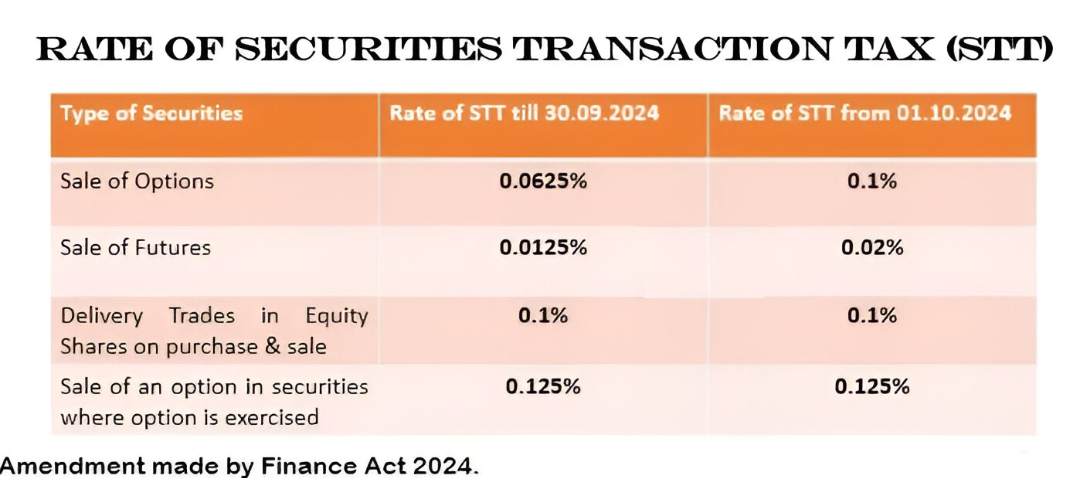
What is the Securities Transaction Tax (STT)?
- About: A direct tax levied on purchase and sale of securities through recognised stock exchanges.
- Introduction: Under the Finance Act, 2004, to ensure transparency and curb tax evasion in capital markets.
- Objective: Replace complex capital-gains tracking with a small, upfront levy to counter under-reporting and increase tax buoyancy.
- Administered by: Central Board of Direct Taxes (CBDT), Ministry of Finance.
- Scope: Applies to-
-
- Equity shares of listed companies
- Derivatives (futures & options)
- Equity-oriented mutual funds and ETFs.
- Purpose:
- Simplify tax collection from capital market participants.
- Create a traceable, automated tax mechanism.
- Generate steady revenue while discouraging speculative trading.
- Nature: A transaction-based tax (TBT) collected automatically at the time of trade, irrespective of overall profit or loss.
- Distinctive features:
-
-
- Applies even on loss-making trades payable merely for conducting a transaction.
- Non-refundable and non-adjustable, unlike TDS.
- Raises transaction costs for high-frequency traders.
-
- Imposition of STT:
-
- Mode of collection: Automatically deducted by stock exchanges on every taxable trade and deposited into the government account; Ensures near-universal compliance and minimal evasion.
- Rate & coverage: Varies across instruments and between buy/sell transactions; Periodically revised through Union Budgets.
Key Grounds of Challenge:
- Violation of Fundamental Rights:
-
- Article 14 (Equality): Unequal treatment; tax imposed irrespective of gain or loss.
- Article 19(1)(g) (Right to Trade): Penalises the act of trading itself.
- Article 21 (Livelihood & Dignity): Non-refundable levy burdens small traders.
- Double Taxation: Traders already pay Capital Gains Tax on profits; STT adds a second layer on the same transaction.
- Arbitrariness / Lack of Proportionality: Taxing even unprofitable transactions violates the principle of reasonable classification and fiscal fairness.
- No Refund or Adjustment Mechanism: Absence of provision similar to TDS refunds; creates permanent loss even when income is negative.
- Changed Circumstances: With digital audit trails, PAN-linked demat accounts, and near-complete transparency, the original rationale (to curb evasion) may no longer hold.
| [UPSC 2009] Consider the following:
1. Fringe Benefit Tax 2. Interest Tax 3. Securities Transaction Tax Which of the above is/are Direct Tax/Taxes? Options: (a) 1 only (b) 1 and 3 only (c) 2 and 3 only (d) 1,2 and 3* |

