Why in the News
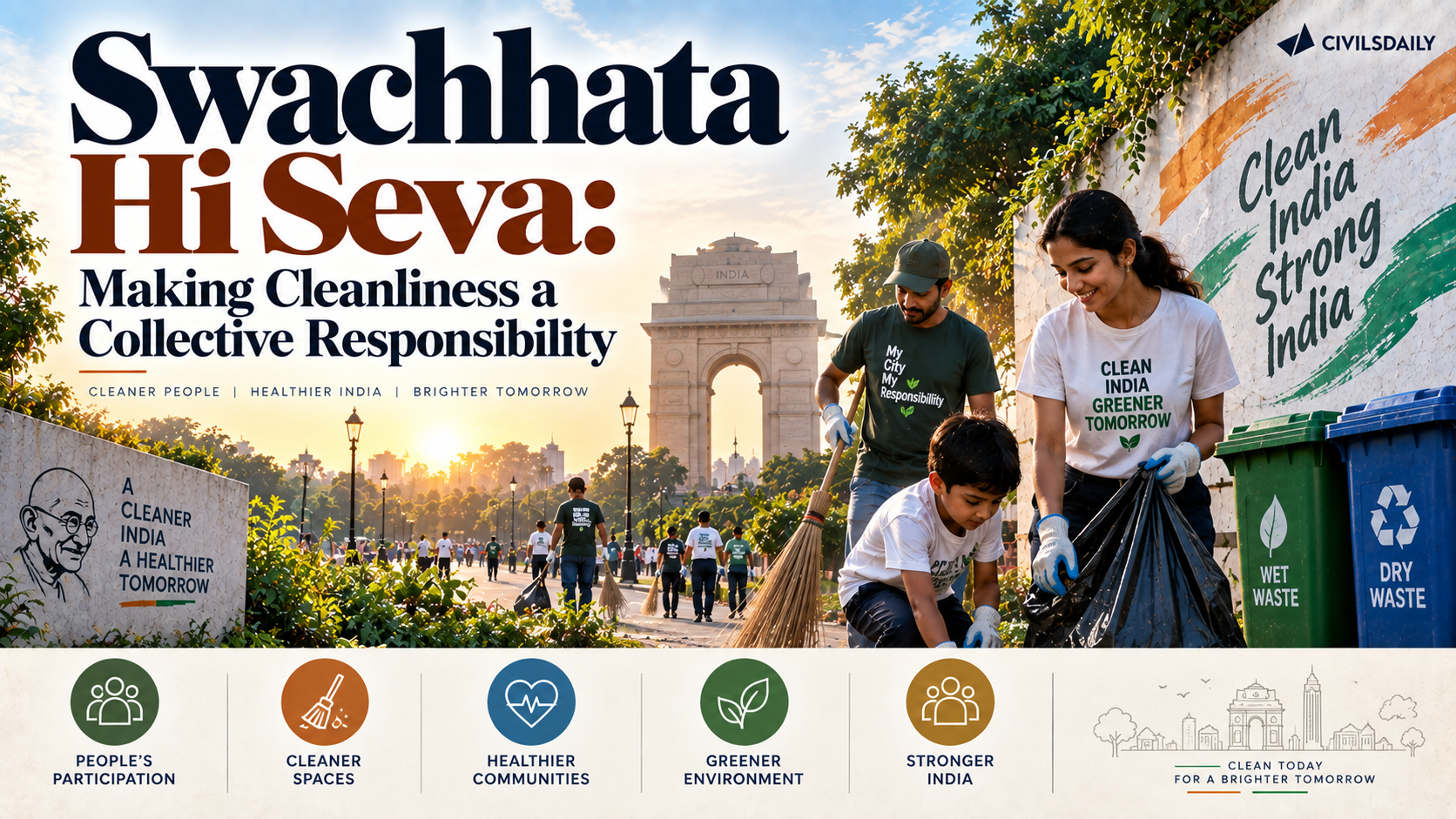
The Ministry of Jal Shakti launched Swachhata Hi Seva (SHS) 2026 on 17 September, with the theme “Swachhata Mein Sahbhag.” The campaign’s own framing marks a shift from cleanliness as an annual government-led activity to cleanliness as an embedded citizen habit and collective responsibility.
What infrastructural base does SHS 2026 build on?
- Rural coverage: Rural India was declared Open Defecation Free (ODF) in 2019; 12.22 crore individual toilets and 98,273 biogas plants have since been constructed.
- ODF Plus saturation: As of 17 September 2026, India has over 5.69 lakh ODF Plus villages, of which more than 5.25 lakh have reached ODF Plus Model status.
- Waste management systems: Over 5.38 lakh villages have solid waste management arrangements and 5.65 lakh have liquid waste management systems.
- Urban infrastructure: 95,478 urban wards have 100% door-to-door waste collection, and India operates 3,254 waste-to-compost plants and 60 waste-to-energy plants processing over 25,000 tonnes daily.
How does SHS operationalise Jan Bhagidari as the mechanism for behaviour change?
- Origin logic: SHS was created as a dedicated citizen-mobilisation vehicle under SBM’s broader Jan Bhagidari (citizen participation) approach, distinct from the infrastructure-building mandate of Swachh Bharat Mission (SBM) itself.
- Institutional design: SHS 2026 follows a “Whole of Government” and “Whole of Society” approach, assigning stakeholder-specific responsibilities rather than centralising action in one agency.
- Grievance-linked accountability: The Swachhata App allows citizens to report garbage sites directly, which are then mapped on the SHS 2026 portal for tracked action.
- Standardised assessment: Public toilets are evaluated against the FACES parameters — Functional, Accessible, Clean, Eco-friendly, Safe — converting a subjective cleanliness goal into a measurable standard.
What do the five pillars of SHS 2026 target?
- Cleanliness Target Units (CTUs): Neglected garbage points and difficult-to-clean sites undergo removal and sustained maintenance rather than one-time cleanup.
- Swachh Paathshala: Students from Classes 6–12 undertake Swachhata Gyan Yatras to sanitation facilities, extending behaviour change into school curricula.
- SafaiMitra welfare: Suraksha Seva Evam Samman Shivirs provide sanitation workers health services, safety equipment and welfare linkages.
- Jan Bhagidari activities: Source segregation demonstrations, anti-littering campaigns, and awareness of the Solid Waste Management Rules, 2026 are run through citizen and institutional channels.
- Swachhata Se Samriddhi: Kabaad Se Jugaad and Kabaad Se Kala link waste management to resource recovery and circularity rather than treating waste purely as a disposal problem.
Does SHS’s nine-year trajectory show behavioural change or expanding event scale?
- Thematic arc: SHS moved from shramdaan-based volunteerism (2017) to plastic waste focus (2019), visual cleanliness (2021–22), “Garbage-Free India” (2023), Swabhav-Swachhata values (2024), festival integration (2025), and collective ownership (2026).
- Participation scaling: Reported participation rose from 2.46 crore children in a 2017 painting competition to 109 crore total participations in the 18-day SHS 2023 campaign alone.
- Metric dependence: Each edition is documented primarily through counts — shivirs organised, pledges taken, sites cleaned — rather than measures of sustained individual behaviour after the campaign period ends.
- Unresolved distinction: The campaign’s own account does not distinguish participation in a time-bound event from adoption of a permanent practice.
Conclusion
SHS 2026 explicitly names its objective as converting an annual, event-driven cleanliness campaign into embedded collective habit. The campaign’s institutional design — app-based grievance tracking, FACES assessment, stakeholder-specific pillars — targets sustained behaviour rather than one-time action. What remains unaddressed is measurement: nine years of SHS have been reported through participation and event counts, not through evidence that cleanliness behaviour persists once the campaign period ends. The shift from activity to habit is asserted in the 2026 theme but not yet demonstrated in the metrics used to evaluate it.