The Ministry of Defence (MoD) signed a ₹1,943 crore contract with General Atomics Aeronautical Systems Inc. (GA-ASI) to lease two MQ-9B Sea Guardian aircraft to the Indian Navy for 30 months. This will increase the Navy’s leased HALE RPAS fleet from 2 to 4, enabling simultaneous surveillance of India’s eastern and western seaboards.
What is MQ-9B Sea Guardian?
HALE: High Altitude Long Endurance
RPAS: Remotely Piloted Aircraft System
Maritime variant of the MQ-9B family.
Provides persistent ISR (Intelligence, Surveillance and Reconnaissance) over large maritime areas.
Equipped with advanced sensors and surveillance payloads.
Can also undertake precision strikes.
Strengthens MDA (Maritime Domain Awareness) in the Indian Ocean Region.
Key Concepts
Maritime Domain Awareness (MDA)
Understanding activities in the maritime environment affecting security, safety, economy and marine environment.
It integrates: Radar, Satellites, Coastal surveillance, AIS (Automatic Identification System), and Airborne sensors
HALE RPAS
An unmanned aircraft operated remotely from a ground control station.
High altitude: Wider sensor coverage.
Long endurance: Prolonged surveillance with fewer interruptions.
Why is India Leasing MQ-9Bs?
Bridges the surveillance gap until the 31 purchased MQ-9Bs are delivered.
Provides immediate long endurance maritime surveillance.
Allows crews and maintainers to gain experience with a configuration similar to the future fleet.
Builds on the Navy’s existing experience with leased MQ-9As since 2020.
How Does It Strengthen the Navy?
HALE systems increase from 2 to 4.
Enables simultaneous surveillance of eastern and western maritime regions.
Improves persistent monitoring of the Indian Ocean Region (IOR).
Strengthens early detection and response to maritime threats.
2024 India-US MQ-9B Agreement
31 MQ-9B systems for India’s armed forces.
Approximate value: $3.5 billion.
Includes a Global MRO (Maintenance, Repair and Overhaul) facility in India.
Provides for some assembly in India.
Includes indigenous sourcing of components.
Supports defence indigenisation and domestic manufacturing.
[2025] With reference to Unmanned Aerial Vehicles (UAVs), consider the following statements: I. All types of UAVs can do vertical landing. II. All types of UAVs can do automated hovering. III. All types of UAVs can use battery only as a source of power supply. Which of the statements given above are correct? (a) Only one (b) Only two (c) All the three (d) None
An India based defence startup announced that it had successfully demonstrated a rotating detonation engine (RDE) at a Defence Research and Development Organisation (DRDO) facility in Hyderabad. The physics of the design has been understood since the 1960s, and the binding constraint has never been the theory but the materials, computing and diagnostics needed to hold a continuous supersonic detonation inside a compact chamber. Despite a global cluster of tests and funding rounds in 2026, no model is known to be ready for commercial or military use anywhere.
What is a rotating detonation engine (RDE)?
What it is: An engine design in which combustion happens as a continuous detonation travelling in a circle inside a ring shaped chamber, rather than as a flame front sweeping through a cylinder.
Its promise: It uses fuel more efficiently than conventional rocket engines, so the same task needs correspondingly less fuel.
Why the saving matters: Launching satellites and carrying explosives to distant targets are both expensive, and fuel saved can be passed to the payload, whether a satellite or a warhead.
The efficiency figure: Going by physics alone, RDEs offer around 10 per cent to 25 per cent more thermodynamic efficiency than conventional combustors, with the exact value depending on real world conditions and engine design.
What it produces: It can continuously generate thrust, or mechanical energy if coupled to a piston.
Its current state: RDEs are confined to research and development, and there are no models known to be ready for commercial or military use.
What is deflagration?
What it is: Combustion in which a flame introduced into a fuel and air mixture travels through that mixture at less than the speed of sound.
What it does thermodynamically: The combustion happens at constant pressure, because the mixture is free to expand as it heats up instead of being confined under pressure.
What is detonation?
What it is: Combustion in which the flame travels through the mixture at more than the speed of sound, imposing a shock wave on the mixture and heating it, which triggers rapid combustion behind the wave.
What it does thermodynamically: The combustion happens at constant volume, because the shock wave compresses the unburned mixture immediately before combustion and the mixture has no time to expand.
What is a pulsed detonation engine (PDE)?
What it is: The simplest type of detonation engine, using a long tube as the combustion chamber so a detonation can pass through the whole mixture.
Its cycle: The detonation races down the tube, compressing and burning the fuel and air mixture, and the hot high pressure products expand out of the open end at high speed. The tube is then purged before the next cycle begins.
What is an annular combustor?
What it is: A combustion chamber shaped as two concentric cylinders with a narrow ring shaped gap between them, the gap being called the annulus.
Why the RDE uses it: The annulus gives the detonation wave a closed circular path to travel, which is what converts a one shot detonation into a continuous one.
What is thermodynamic efficiency?
What it measures: How much of a fuel’s chemical energy becomes useful work rather than being shed as waste heat.
What a gain translates into: An RDE that improves thermodynamic efficiency by 20 per cent could theoretically require around 17 per cent less fuel for the same output, assuming other losses are unchanged.
Why does detonation deliver more efficiency than deflagration?
The regular engine case: A spark plug introduces a flame into the fuel and air mixture in the combustion chamber, and it travels through at subsonic speed.
The expansion difference: In deflagration the mixture expands freely as it heats, so combustion proceeds at constant pressure.
The compression difference: In detonation the shock wave compresses the unburned mixture just before it burns, so combustion proceeds at constant volume.
The pressure outcome: A detonation engine therefore produces combustion products at a higher pressure.
The energy conversion: More of the fuel’s chemical energy is converted into pressure rather than being shed as heat, and that is the entire basis of the fuel efficiency claim.
The comparison held constant: The advantage holds for a detonation engine against a regular engine burning the same fuel.
How does an RDE sustain a continuous detonation?
The design choice: Instead of the detonation passing through a long tube once, it is made to flow in a circle.
The chamber: The combustion chamber has an annular shape, and fuel and oxidiser are injected continuously into the ring shaped gap.
The wave: One or more detonation waves race through the annulus while injection continues.
The timing requirement: Fuel is injected into the annulus just ahead of the detonation wave, so the wave always meets fresh mixture.
The exhaust: The wave consumes the fresh fuel and air mixture and expels the products through the nozzle along its axis.
The rate: As long as fuel keeps arriving at the right time and in the right condition, the detonation can keep going even at thousands of times per second.
The output: By Newton’s third law the momentum of the expelled gases produces an equal and opposite momentum on the engine, which is what generates thrust.
Who is developing rotating detonation engines and with what funding?
D-Propulse, India: The India based defence startup that recently announced a successful RDE demonstration at a DRDO facility in Hyderabad.
NASA, United States: Ran a full scale RDE test in 2023 in which the engine fired for 251 seconds, a record at the time.
GE Aerospace and Lockheed Martin: Demonstrated an RDE for hypersonic missiles in January, using air drawn from the atmosphere.
SpaceWorks, United States: Reported hot fire tests of its RDE for rockets in February.
Astrobotic, United States: Test fired its Chakram RDE continuously for 300 seconds.
L3Harris, United States: Announced that it had tested two RDEs, in April and May respectively.
Stellar Alpina, Switzerland: Completed a commercial RDE hot fire test and raised CHF 3.5 million.
Juno Propulsion: Raised $1.4 million to develop an RDE for spacecraft thrusters.
Venus Aerospace, United States: Raised $91 million in July to scale its tested RDE, then partnered with Lockheed Martin.
What the roster shows: Activity is concentrated in the United States and in venture funded startups, and it spans rockets, hypersonic missiles and spacecraft thrusters rather than a single application.
Why was a 1960s concept only testable now?
The theory was settled early: Scientists worked out how an RDE could function by the 1960s, and building one was a different matter.
Injection and pressure control: Sustaining a continuous detonation in a compact chamber requires engineers to precisely control fuel injection and internal pressure.
Chamber geometry: The chamber needs a specific geometry for the engine to work as intended.
Instability sensitivity: Unlike in regular engines, even small instabilities in the fuel and air mixture can destabilise an RDE.
Temperature threshold: Engine materials must withstand more than 2,000 degrees Celsius.
Pressure threshold: Materials must survive 10 to 100 atmospheres of pressure, and much higher in brief moments.
Oscillation and loading: Pressures oscillate at several thousand cycles per second, and the structure sees potentially tens to hundreds of g depending on the design.
What had to arrive first: Working RDEs required advances in high speed computing, diagnostics, fuel injection, materials and manufacturing.
Why does the efficiency gain matter for launch and strike systems?
Cost of access to space: Launching satellites on rockets is expensive, and fuel is a dominant share of the launch mass.
Cost of long range strike: Carrying explosives to distant targets on missiles is equally expensive on the same fuel logic.
The trade converted: Less fuel for the same task means more mass available for payload.
Commercial consequence: Passing that saving to the satellite or warhead increases the profitability of the mission.
Why launch benefits most: The gain is considered significant specifically for rocket launches, where the fuel to payload ratio is most punishing.
The air breathing variant: For hypersonic missiles the engine draws oxidiser from the atmosphere, which removes the need to carry it.
Why does a settled physics advantage still have no deployable engine?
The stated status: RDEs remain confined to research and development, with no models known to be ready for commercial or military use.
The evidence gap: Actual data from many tests by commercial entities are not available in the public domain.
What the efficiency claim rests on: The 10 per cent to 25 per cent figure is derived from physics alone, not from fielded performance.
The qualification the source itself attaches: The saving that can be passed to the payload holds at least on paper.
Where the difficulty sits: The obstacle is not the thermodynamics but the survivability of materials and the controllability of the detonation.
The demonstration versus product gap: A successful hot fire test proves the wave can be sustained, and it does not prove an engine can be throttled, restarted, integrated and qualified for flight.
The funding signal: Capital is arriving before a product exists, which is a bet on the remaining engineering rather than a proof that it is solved.
Challenges to rotating detonation engine development
Material survivability under cyclic thermal load: Wall materials face more than 2,000 degrees Celsius and pressure oscillations of several thousand cycles per second, which drives fatigue cracking. e.g. regeneratively cooled chamber liners in conventional engines already fail at far lower thermal cycling rates.
Detonation wave instability: Wave count, direction and mode can shift during a run, which changes thrust unpredictably. e.g. test campaigns commonly report transitions between single wave and multiple wave modes in the same firing.
Injector design and mixing: Fuel and oxidiser must mix fully in the microseconds before the wave arrives, and incomplete mixing quenches the detonation. e.g. deflagration to detonation transition failures reported in early pulsed detonation engine work.
Nozzle matching: The exhaust leaves the annulus with a rotating, unsteady pressure field that a conventional bell nozzle is not designed for. e.g. aerospike and plug nozzle concepts are being revisited specifically for detonation exhausts.
Absence of validated test data: Commercial developers do not release performance data, so independent verification of efficiency claims is not possible. e.g. the hot fire results announced by several firms in 2026 carry no published specific impulse figures.
Qualification and certification burden: Flight qualification requires demonstrated restart, throttling and life cycle margins that no RDE has yet shown. e.g. human rated engines must clear multiple full duration firings with margin, a standard the 251 second NASA record does not yet meet.
Dual use export control: Detonation propulsion for hypersonic applications falls within missile technology control regimes, which restricts collaboration. e.g. Missile Technology Control Regime Category I restrictions on complete rocket systems and their major subsystems.
Manufacturing tolerance: The annulus gap must be held to fine tolerance across a hot, deforming structure, which requires additive manufacturing at aerospace grade. e.g. additive manufactured combustion chambers have to be qualified for porosity and residual stress before flight use.
Talent and facility scarcity: Very few facilities can instrument a detonation at these speeds and pressures. e.g. high speed schlieren and pressure diagnostics capable of resolving events at several thousand cycles per second exist in a handful of laboratories.
Conclusion
The rotating detonation engine’s advantage is a settled point of physics: replacing constant pressure deflagration with constant volume detonation converts more chemical energy into pressure instead of shedding it as heat, and that is worth roughly 10 per cent to 25 per cent in thermodynamic efficiency. What remains unsolved is entirely an engineering problem of materials, wave control and diagnostics, which is why a design understood in the 1960s still has no commercially or militarily ready model anywhere. The Hyderabad demonstration places India inside the small group attempting that engineering, and a demonstration is not yet a qualified engine.
“[2026] Consider the following statements about involvement of private entities in India’s space programme: 1. IN-SPACe is an autonomous agency formed to facilitate participation of private entities. 2. Agnikul Cosmos launched the world’s first flight using 3D-printed rocket engine. 3. Skyroot Aerospace has developed liquid fuel for GSLV. (a) 1 only (b) 2 and 3 only (c) 1 and 2 only (d) 1, 2 and 3
The National Aeronautics and Space Administration (NASA) has invited the Indian Space Research Organisation (ISRO) to join its Moon Base programme, a permanent crewed research station to be built on the Moon in stages. The invitation forces a choice between building an independent human spaceflight, space station and lunar landing capability at national cost, and acquiring the same capability faster inside a programme the United States leads. India signed the Artemis Accords in 2023 as the 27th nation, so the diplomatic ground for joining is already laid.
What is the NASA Moon Base programme?
What it is: A permanent research station on the lunar surface that astronauts and robots can inhabit for prolonged periods.
What it is for: It is meant to facilitate research and to allow exploration and exploitation of lunar resources.
How it is built: The base is assembled in stages over several years, requiring repeated crewed and robotic trips to the Moon.
Its scale: In scale and ambition it compares only with the Apollo missions, and it could be the costliest scientific project ever undertaken.
Its engineering claim: It will possibly be the most challenging engineering exercise ever attempted by humanity.
Its delivery model: NASA will not execute it alone and is seeking partners in both the international community and private industry.
What is the Bharat Antariksh Station?
What it is: India’s planned indigenous space station, to be built and operated by ISRO as a crewed orbital facility.
Why it is cited here: ISRO must hold the technology to build such infrastructure, and India is unlikely within about a decade to have a scientific ecosystem needing an entire station for its own use all year round.
What is the lunar South Pole?
What it is: The polar region of the Moon holding permanently shadowed craters where water ice is expected to survive.
Why it is the target: Phase One of the Moon Base programme sends robotic missions specifically to the South Pole, because water ice can be converted into drinking water, breathable oxygen and rocket propellant.
What are interoperable systems?
What they are: Common standards and hardware interfaces that let equipment built by different countries connect and work together in space.
What the Accords require: Signatories emphasise interoperability in fuel storage, landing structures, communications systems and power systems, which is a light obligation for ISRO because it is only beginning to develop these systems.
What is deglobalisation?
What it is: The retreat from shared international supply chains towards national self reliance in a strategic technology.
Where it currently applies: Semiconductors, clean energy and artificial intelligence, where supply chains and resources are controlled by a small set of actors.
What are the three phases of the Moon Base programme?
Phase One, now to 2029: Focus on gaining reliable access to the lunar surface and building a deeper understanding of the environment.
Phase One activity: Robotic missions will explore the lunar South Pole, demonstrate new technologies and gather the knowledge needed to guide future development.
Phase Two, 2029 to 2032: NASA will begin deploying the first infrastructure needed to support long term operations on the Moon.
Phase Two systems: Early power systems, cargo transportation, logistics and communications capabilities will expand the human footprint and enable increasingly complex missions.
Phase Three, 2032 and beyond: NASA will begin assembling a permanent lunar outpost where astronauts can live and work for extended periods.
Phase Three systems:Habitats, power systems, communications, transportation and other critical capabilities will support an enduring human presence.
Why is NASA seeking partners instead of building the base alone?
Budget compression: NASA’s budget has been cut significantly under the current US administration, so a solo build is not affordable.
Shift of manufacturing: Most of NASA’s hardware production now happens in the private sector rather than in house.
Two partner pools: It is seeking collaboration both from the international community and from private industry.
A ready pool of states: The 70 countries that signed the Artemis Accords have already signalled a willingness to join such a collaboration.
Cost of the mission profile: Repeated crewed and robotic trips to the Moon over several years put the cost beyond a single agency’s programme line.
Precedent: The International Space Station established that a permanent crewed facility is built and run as shared infrastructure, not as one nation’s asset.
Why can ISRO not sustain its lunar and station ambitions on its own?
Three simultaneous programmes: ISRO is running an independent human spaceflight programme, a Moon landing programme and a full fledged space station programme in parallel.
Capability against sustainability: Holding these capabilities is important, and running them sustainably on India’s own scientific and economic base is a separate question.
The demand problem: India is unlikely, within about a decade, to have a scientific ecosystem hungry enough to occupy an entire space station all year round.
The cost of lunar exploration: A separate full fledged lunar exploration programme carries costs that are prohibitive even for the world’s richest economy.
Competing national goals: India is chasing multiple parallel goals on the path to prosperity, which limits how much can be allocated to space at the scale required.
The shared infrastructure conclusion: The Bharat Antariksh Station will have to be shared infrastructure on the model of the International Space Station.
What does ISRO gain by joining the Moon Base programme?
Mission management experience: Participation gives ISRO experience in planning and executing complex missions of exactly the type it intends to run itself.
Technology leapfrog: It allows ISRO to skip development stages rather than rebuild capability that already exists elsewhere.
The obsolescence clock: Space exploration has reached a stage where a 10 year gap in technology development can leave a nation well behind.
Avoiding duplication: There is no economic sense in reinventing capability that a partner already holds.
Timeline compression: Cooperation with the United States lets ISRO fast track its own project timelines and reach the frontiers of technology development.
Spin off benefits: The collaboration can generate spin off technologies with cascading dividends across sectors beyond space.
No exclusivity cost: Signing the Accords or joining the Moon Base effort does not prevent India from continuing its long standing space cooperation with Russia.
What do the positions of other space powers reveal about the Accords?
Japan: A signatory and a major space faring nation, contributing habitation and pressurised rover work to the Artemis effort.
South Korea: A signatory that has built an independent lunar capability, having placed the Danuri orbiter around the Moon in 2022.
Israel: A signatory whose Beresheet lander attempt in 2019 made it one of the few states to have reached lunar orbit.
European states: Several are signatories, and the European Space Agency separately supplies the service module for NASA’s Orion crew vehicle.
Russia: Not a signatory, and it is attempting a comparable lunar effort through its own partnership.
China: Not a signatory, and it is pursuing the same objective with Russia rather than through the Accords.
What the split demonstrates: The absence of the two other major space powers is what gives the criticism of a US led camp its credibility.
Are the Artemis Accords a US led bloc that bypasses multilateral arrangements?
The formal position: The Accords are a set of principles and good practices that countries agree to follow in their space activities.
The criticism: They are increasingly seen as a US led camp writing its own rules for space exploration and the use of extraterrestrial resources, subtly bypassing international multilateral arrangements.
What lends the criticism weight: Russia and China, the two other major space powers, are outside the grouping.
India’s historical reluctance: India has traditionally been extremely reluctant to join any such grouping, and it still joined as an early signatory, the 27th nation, in 2023.
The counter argument, no exclusion: Space is not adversarial at present, and a US landing on the Moon does not give it control over the area or its resources.
The counter argument, no scarcity: The Moon is large enough and its resources abundant enough to support the efforts of all parties in the foreseeable future.
The counter argument, no supply chain lock: There is no domination of supply chains or control over resources in space, so the deglobalisation trend seen in semiconductors, clean energy and artificial intelligence does not transfer to this case.
The residual risk: The real exposure is technological, not geopolitical, and it is the possibility of ISRO getting locked into the US technology ecosystem to the extent of overdependence.
Challenges to India joining the Moon Base programme
Technology ecosystem overdependence: Deep integration with one partner’s standards makes later substitution expensive. e.g. India’s dependence on Russian cryogenic engine technology in the 1990s stalled the GSLV programme for over a decade after the Missile Technology Control Regime pressure on the transfer.
Programme discipline slipping: Collaboration can crowd out ISRO’s own milestones if targets are not separately protected. e.g. the Gaganyaan crewed flight has already moved from its original 2022 target to the later part of this decade.
Export control friction: Dual use hardware transfers remain governed by US licensing that can be withheld. e.g. International Traffic in Arms Regulations clearances have historically delayed satellite component supplies to Indian entities.
Budget asymmetry: India’s civil space spending is a small fraction of NASA’s, which limits its bargaining position on workshare. e.g. the Department of Space’s annual budget is of the order of Rs 13,000 crore against a NASA budget many times larger.
Launch reliability: A partner role demands schedule certainty that India’s recent launch record does not yet demonstrate. e.g. three of the six ISRO missions in 2025 and 2026 failed to place satellites in the intended orbits.
Balancing the Russia relationship: Deeper alignment with the Accords sits alongside a long standing space partnership that must be maintained separately. e.g. Russian support for the crew module and life support work under the Gaganyaan programme, including astronaut training at the Gagarin Cosmonaut Training Centre.
Unsettled resource law: The Accords permit extraction and use of space resources, and that reading of the Outer Space Treaty is contested. e.g. the Moon Agreement of 1979 treats lunar resources as the common heritage of mankind and has been ratified by very few states.
Volatile bilateral politics: The India United States relationship has been unstable in the last two years, which is a risk for a multi decade commitment. e.g. trade and tariff disputes running alongside this civil space engagement.
Conclusion
The Moon Base invitation converts an abstract question about strategic autonomy into a concrete question about economic sustainability. India can build the technology for a station and a lunar landing on its own, and it is unlikely to be able to run either sustainably at national scale, which is why joining offers a genuine leapfrog rather than a compromise. The condition that must hold is that ISRO protects its own targets and avoids locking itself into a single technology ecosystem while it collaborates.
“[2025] Consider the following space missions: I. Axiom-4 II. SpaDeX III. Gaganyaan How many of the space missions given above encourage and support microgravity research? (a) Only one (b) Only two (c) All the three (d) None
The Indian Space Research Organisation (ISRO) is set to resume launches in the first week of September 2026 with GISAT 1A, after a seven month operational pause.
The pause followed multiple mission failures and has affected NavIC, which currently has only 3 operational satellites, against the 4 required for basic standalone positioning.
What is GISAT 1A?
GISAT: Geo Imaging Satellite
Also designated EOS 05.
Earth observation satellite with a 10-year mission life.
Provides frequent imaging of large areas.
Applications include disaster monitoring, agriculture and forestry.
It replaces GISAT 1 / EOS 03, which failed to reach orbit in 2021.
What is NavIC?
NavIC: Navigation with Indian Constellation
Formerly called IRNSS: Indian Regional Navigation Satellite System.
Developed by ISRO.
Provides Positioning, Navigation and Timing (PNT) services.
Covers India and surrounding regions.
Reduces dependence on foreign navigation systems.
Currently operational: IRNSS 1B, IRNSS 1I and NVS 01.
Why are 4 Satellites Needed?
Positioning requires signals from at least 4 satellites to determine:
Three-dimensional position
Receiver clock error
With only 3 satellites, NavIC cannot provide standalone positioning, though its timing service remains functional.
What is PNT?
Positioning: Determines location.
Navigation: Determines movement and route.
Timing: Provides precise time reference.
Why Did ISRO’s Launch Calendar Stall?
Three of six missions during 2025 and 2026 failed to achieve their intended objectives:
PSLV C61 / EOS 9: Third-stage anomaly.
PSLV C62 / EOS N1: Third-stage anomaly in January 2026.
Failure analysis reports for these missions have not been made public.
What Comes Next?
September 2026: GISAT 1A
November 2026: NVS 03
NVS 03 is expected to restore NavIC to the 4-satellite minimum for standalone positioning.
Meanwhile, Indian armed forces continue using NavIC alongside GPS, Galileo and GLONASS.
“[2018] With reference to the Indian Regional Navigation Satellite System (IRNSS), consider the following statements : 1. IRNSS has three satellites in geostationary and four satellites in geosynchronous orbits. 2. IRNSS covers entire India and about 5500 sq. km beyond its borders. 3. India will have its own satellite navigation system with full global coverage by the middle of 2019. Which of the statements given above is/are correct ? (a) 1 only (b) 1 and 2 only (c) 2 and 3 only (d) None Answer: (a)”
The Supreme Court has directed a fresh nationwide survey of elephant corridors, noting that several corridors remain impeded, blocked or obstructed despite existing guidelines of the Ministry of Environment, Forest and Climate Change (MoEFCC).
The Court held that crop damage cannot justify placing obstacles in elephant movement paths, highlighting the conflict between wildlife conservation and local livelihood concerns.
What is an Elephant Corridor?
Meaning: A natural or narrow land passage connecting two elephant habitats, enabling movement between them.
Need: Elephants move over large areas in search of food, water and mineral licks.
Ecological role: Corridors maintain habitat connectivity and gene flow between elephant populations.
Legal status: Corridors are identified through ecological and movement studies but are not automatically Protected Areas.
Land ownership: Many corridors pass through private, revenue, plantation or community land.
India:150 elephant corridors have been identified across 15 elephant range States.
What did the Supreme Court Direct?
Fresh nationwide survey of elephant corridors.
A comprehensive report on existing corridors and measures taken to prevent their obstruction.
Identification of corridors that have been blocked, choked or obstructed.
States cannot justify blocking elephant paths merely because of crop destruction.
The Court emphasised that elephants are a wide-ranging species and require unobstructed movement.
The matter will be considered again after six weeks.
Why are Elephant Corridors Important?
Habitat connectivity: Prevents isolation of elephant populations.
Gene flow: Allows breeding between different populations.
Conflict reduction: Functional corridors can prevent elephants from being forced into settlements.
Climate resilience: Connected habitats allow species to shift their range as environmental conditions change.
Resorts and other infrastructure: Restrict access to traditional movement paths.
Railways and highways: Increase collision and fragmentation risks.
Plantations and agriculture: Conversion of corridor land narrows movement routes.
Electric fencing: Illegal or poorly designed fencing can cause electrocution.
Mining and quarrying: Remove vegetation and fragment habitats.
Canals and irrigation structures: Create physical barriers, particularly for calves.
Settlements and encroachment: Increase human presence along traditional routes.
Elephant Conservation in India
The species and its status: The Asian elephant (Elephas maximus) is listed as Endangered on the IUCN Red List and is India’s National Heritage Animal, declared in 2010.
India’s share of the global population: India holds the largest wild Asian elephant population, about 29,964 individuals, roughly 60 per cent of the global population as per the 2017 census.
Population growth under the programme: Wild elephant numbers rose from about 25,000 in 1992 to about 30,000 in 2021 under Project Elephant.
State distribution:Karnataka holds the highest population, followed by Assam and Kerala.
Elephant Reserves: India has 33 elephant reserves covering about 80,777 sq km.
Corridors:150 corridors have been identified across 15 elephant range States.
Regional spread of corridors: The East central region holds 52 corridors, or 35 per cent of the total, the North East 48 corridors, or 32 per cent, Southern India 32 corridors, or 21 per cent, and Northern India 18 corridors, or 12 per cent.
State with the most corridors:West Bengal, with 26 corridors, about 17 per cent of the national total.
Why the elephant is a keystone species: It disperses seeds over long distances and opens forest canopy and waterholes that other species depend on.
Article 48A: Directs the State to protect and improve the environment and to safeguard the forests and wildlife of the country.
Article 51A(g): Places a fundamental duty on every citizen to protect and improve the natural environment including forests, lakes, rivers and wildlife, and to have compassion for living creatures.
Seventh Schedule, Concurrent List Entry 17B: Places protection of wild animals and birds on the Concurrent List after the 42nd Constitutional Amendment, 1976.
Seventh Schedule, Concurrent List Entry 17A: Places forests on the Concurrent List, which is why State forest departments implement central wildlife law.
Article 21: Protects life and personal liberty, read to include a right to a clean and healthy environment, the basis for much environmental litigation.
Article 32 and Article 142: Give the Supreme Court the power to entertain writ petitions and to pass orders necessary for complete justice, the source of continuing mandamus in wildlife matters.
Article 253: Empowers Parliament to legislate to implement international conventions, the basis for wildlife law giving effect to treaty obligations.
Laws and Rules Governing Elephants and Their Habitat
Wildlife (Protection) Act, 1972: The primary law for protection of wild animals and plants and for the constitution of protected areas.
Key protection: The Indian elephant is listed in Schedule I, which carries the highest degree of protection and the strictest penalties.
2022 Amendment: Rationalised the schedules, gave effect to CITES obligations in domestic law, and regulated the transfer of captive elephants for religious and other purposes.
Project Elephant, 1992: A centrally sponsored scheme for protection of elephants, their habitat and corridors, and for management of human elephant conflict.
Coverage: It extends to 23 States and provides the framework under which elephant reserves are declared.
Forest (Conservation) Act, 1980, renamed the Van (Sanrakshan Evam Samvardhan) Adhiniyam: Requires prior central approval for diverting forest land, which governs infrastructure passing through corridors on forest land.
Indian Forest Act, 1927: Provides the categories of reserved and protected forest through which many corridors run.
Scheduled Tribes and Other Traditional Forest Dwellers (Recognition of Forest Rights) Act, 2006: Recognises community rights in forest areas, including in landscapes that carry elephant movement.
Environment (Protection) Act, 1986: Provides for eco sensitive zone notifications and environmental clearance conditions applicable to projects near protected areas.
Biological Diversity Act, 2002: Provides for conservation of biological diversity and equitable sharing of benefits, with biodiversity management committees at the local level.
Convention on International Trade in Endangered Species of Wild Fauna and Flora: Lists the Asian elephant in Appendix I, barring commercial international trade in the species and its parts.
Convention on the Conservation of Migratory Species of Wild Animals: Lists the Asian elephant in Appendix I, obliging range States to conserve and restore its habitats.
Back2Basics: Asian Elephant
Scientific and common name:Elephas maximus, the Asian or Asiatic elephant, of which the Indian elephant is the mainland subspecies.
IUCN Red List status:Endangered.
Convention on Migratory Species: Listed in Appendix I.
Wildlife (Protection) Act, 1972: Listed in Schedule I, the highest protection category.
Global significance: India holds the largest wild Asian elephant population in the world, about 29,964 individuals, close to 60 per cent of the global total as per the 2017 census.
Range within India: Highest numbers in Karnataka, followed by Assam and Kerala, across 15 elephant range States.
Habitat: Tropical moist and dry deciduous forest, grassland, scrub and adjoining agricultural landscapes, with populations in fragmented forests, tea estates and farmland.
Social structure: Herds are matrilineal, led by an older female, and family units combine into clans and sub populations.
Communication: Elephants use over 60 distinct calls together with gestures and physical contact, including low frequency rumbles that carry over long distances.
Behavioural notes: Elephants comfort distressed companions, mourn their dead, cooperate in raising calves and adopt orphaned young, and individual animals show distinct personalities.
Recorded mortuary behaviour: Research in fragmented forests, tea estates and farmland near the Gorumara Wildlife Division and Buxa Tiger Reserve in West Bengal documented herds carrying calf carcasses and burying them in a legs upright position, then avoiding paths near the burial site.
Genetic structure: A recent study identified five genetically distinct populations of Asian elephants in India.
Conservation framework: Project Elephant, 1992, 33 elephant reserves over about 80,777 sq km, and 150 identified corridors.
Named corridors: Kaniyanpura to Moyar in Karnataka, Chilla to Motichur in Uttarakhand, Thirunelli to Kudarakote in Kerala, the Segur corridor in Tamil Nadu, Kuldiha to Hadgarh in Odisha, Edayarahalli to Doddasampige in Karnataka, and Mudahalli to Talavadi across Tamil Nadu and Karnataka.
Major threats: Habitat loss and fragmentation, corridor blockage, railway collisions, electrocution, poaching for ivory, and retaliatory killing arising from crop and property damage.
Government Initiatives
Project Elephant, 1992: The umbrella centrally sponsored scheme for elephant protection, habitat and corridor management, and conflict mitigation across 23 States.
Elephant Reserves: 33 reserves notified over about 80,777 sq km, providing a landscape unit for management outside the protected area system.
Gaj Yatra: A national awareness campaign for securing elephant corridors, launched on World Elephant Day.
Haathi Mere Saathi: A public outreach campaign of the Ministry to build tolerance and awareness in elephant range landscapes.
Monitoring of Illegal Killing of Elephants: A site based monitoring programme run under the Convention on International Trade in Endangered Species, in which India participates.
Surakshya portal: A national portal for real time reporting and collection of human elephant conflict data from the field.
Synchronised elephant population estimation: A periodic all India estimation exercise conducted jointly by range States using common protocols.
National Wildlife Action Plan 2017 to 2031: The national policy framework for wildlife conservation, including landscape level and corridor conservation.
Compensatory Afforestation Fund Management and Planning Authority: Funds habitat improvement and conflict mitigation works, including barriers and water sources, in elephant landscapes.
Key Facts about Elephants in India
World Elephant Day: Observed on 12 August every year.
National Heritage Animal: The Indian elephant was declared India’s National Heritage Animal in 2010.
Project Elephant launch:February 1992, by the Ministry of Environment, Forest and Climate Change.
Largest land mammal in Asia: The Asian elephant is the largest terrestrial mammal on the continent.
Distinguishing feature: Only some male Asian elephants carry tusks, unlike the African elephant where both sexes commonly do.
Gestation: About 22 months, the longest of any land mammal, which makes population recovery slow.
Elephant reserves and corridors: 33 reserves and 150 identified corridors across 15 range States.
Gaj Yatra launch: Launched on 12 August 2017 as a nationwide corridor awareness campaign.
Global population share: India holds about 60 per cent of the world’s wild Asian elephants.
“[2022] With reference to Indian laws about wildlife protection, consider the following statements : 1. Wild animals are the sole property of the government. 2. When a wild animal is declared protected, such animal is entitled for equal protection whether it is found in protected areas or outside. 3. Apprehension of a protected wild animal becoming a danger to human life is sufficient ground for its capture or killing. Which of the statements given above is/are correct ? (a) 1 and 2 (b) 2 only (c) 1 and 3 (d) 3 only
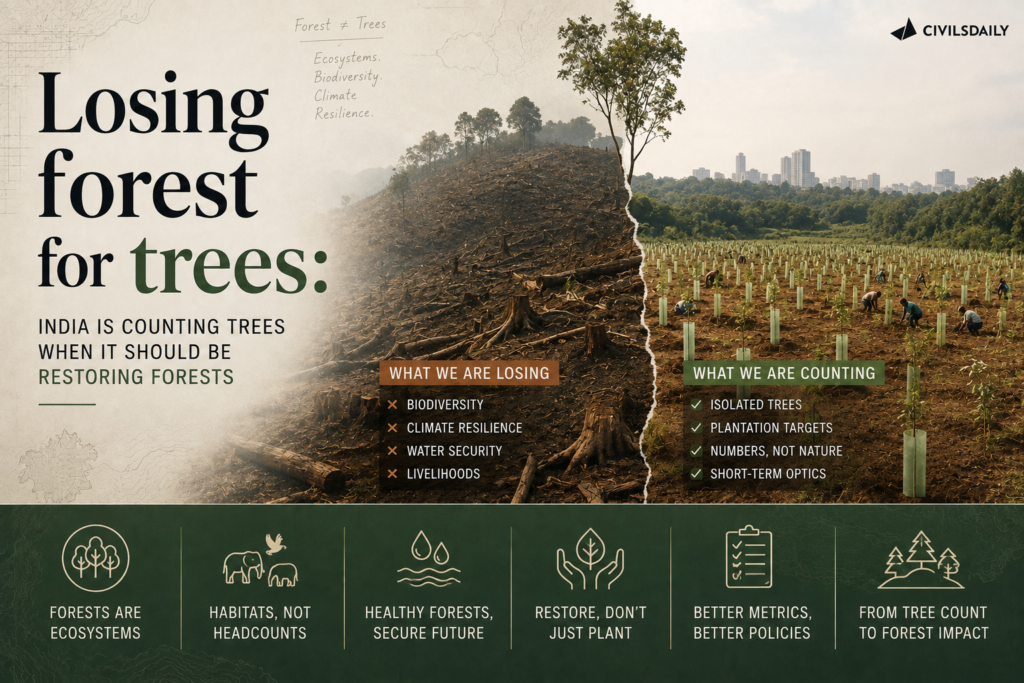
A performance audit by the Comptroller and Auditor General (CAG) of the Green India Mission (GIM) has found that across a decade the Mission improved forest quality over only 0.11 million hectares against a target of 1.4 million hectares, and achieved barely 4 per cent of its forest cover expansion goal. The Mission was designed as ecological restoration, and it has been displaced in practice by a sapling planting drive whose success is measured in trees planted rather than in forest restored. The India State of Forest Report 2023 records a green cover gain of 1,445 sq km, of which only 156 sq km is true forest.
What is the Green India Mission?
What it is: A national mission of the Ministry of Environment, Forest and Climate Change aimed at protecting, restoring and enhancing India’s forest cover and at responding to climate change through adaptation and mitigation.
Where it sits: It is one of the eight pillars of the National Action Plan on Climate Change, unveiled in 2008.
Its climate function: It is the instrument through which India promised the Paris Agreement an additional carbon sink of 2.5 billion to 3 billion tonnes by 2030.
Its animating idea: The objective is ecological, covering biodiversity, water, carbon sequestration and the revival of habitat, not the raising of tree numbers.
Its twin physical targets: The Mission set out to increase forest and tree cover on one block of land and to improve the quality of existing forest cover on another.
Its funding design: It was built to draw money and labour from other programmes rather than from its own budget line alone.
What is the Compensatory Afforestation Fund Management and Planning Authority?
What it is: The statutory authority, known as CAMPA, that manages funds collected from industry and other user agencies in return for the diversion of forest land to non forest use.
What it funds: The money is channelled into afforestation, catchment treatment and habitat improvement, which is why the Green India Mission was designed to converge with it.
What is tree cover outside recorded forests?
What it is: Tree patches smaller than one hectare and trees standing outside the legally recorded forest area, counted separately from forest cover in the national forest assessment.
Why the distinction matters: A plantation, an orchard or an avenue of trees adds to this category without adding to forest, so a rise in green cover can occur while forest itself stagnates.
What is Ek Ped Maa Ke Naam?
What it is: A tree plantation campaign launched in 2024, translated as A Tree in the Name of Mother, under which the government reports planting 140 crore saplings so far.
Its effect on the Mission: For practical purposes it has replaced the Green India Mission as the visible face of India’s forest effort.
What did the Comptroller and Auditor General audit find?
Forest quality improvement: Against a target of improving forest quality over 1.4 million hectares, the Mission managed 0.11 million hectares, less than a tenth of the target.
Forest cover expansion: On expanding forest cover the Mission achieved barely four per cent of its goal.
Recorded shortfall on quality: The audit records a shortfall of about 91.87 per cent against the forest quality improvement target over ten years.
Recorded shortfall on cover: The audit records a shortfall of about 97.57 per cent against the forest cover target over the same period.
Coverage of the audit: The performance audit examined implementation across 16 States and Union Territories.
Money actually received: Only about Rs 1,149.14 crore of budgetary support reached the Mission over the audited decade.
Convergence not achieved: The Mission’s intended convergence with its partner schemes did not materialise.
The overall verdict: A scheme conceived to heal India’s forests achieved almost nothing it set out to do across a decade.
Why did the Mission’s convergence with other funding streams fail?
The CAMPA channel: CAMPA holds money collected from industry for diverting forest land into afforestation, and that money did not flow into Mission activity as designed.
The wage labour channel: The Mahatma Gandhi National Rural Employment Guarantee Scheme, rebranded VB G RAM G, funds rural wage labour that can be used for plantation and land restoration works.
What convergence was meant to do: The Mission’s own budget line was small by design, so its physical targets depended on borrowing funds and labour from these two much larger streams.
What happened instead: The convergence never materialised, which left the Mission with a decadal target set for one scale of resources and an actual allocation of a different scale.
The consequence for accountability: A mission that does not control its own money cannot be held to its own targets, and no single agency owns the shortfall.
The displacement effect: With convergence absent, the plantation drive absorbed the political attention and the reporting space that restoration was meant to occupy.
What does the India State of Forest Report 2023 show about the quality of the gain?
The headline gain: The report records a gain of 1,445 sq km in green cover.
The forest share of that gain: Only 156 sq km of that gain is true forest.
The remainder: The other 1,289 sq km is tree cover outside recorded forests.
Inside the recorded forests: Dense canopy within recorded forest area is thinning into scrub.
What the two numbers together establish: India is planting more and foresting less, so an aggregate green cover figure conceals a decline in forest quality.
Why this matters for the carbon pledge: A carbon sink commitment measured in billions of tonnes rests on dense forest, not on scattered tree cover that stores far less carbon per hectare.
Why does the Aravalli Green Wall illustrate the limits of planting?
The state of the range: The Aravallis are among the country’s most degraded ranges, with hillocks quarried away over decades.
The invasion: Native growth has been overrun by the invasive vilayati kikar (Prosopis juliflora), which suppresses regeneration of native species.
The proposed remedy: The range is now to be rescued by a Green Wall of fresh planting.
What planting cannot do, first: Fresh saplings cannot undo the damage left by years of mining and the removal of the hill itself.
What planting cannot do, second: Planting does not halt encroachment on the range, which is a land use and enforcement problem.
What planting cannot do, third: An ecosystem that took millennia to assemble cannot be summoned back by a plantation drive.
The governing distinction: Restoration rebuilds the ecological function of a landscape, and landscaping only adds vegetation to it.
Where does counting trees diverge from restoring forests?
Two different outputs: A sapling planted is a countable annual output. A restored forest is a slow change in canopy density, species composition and soil.
Two different timelines: Planting reports results within a financial year, and restoration shows results across decades, which biases the system toward planting.
Two different failure modes: Plantation failure shows up as sapling mortality that is rarely audited. Restoration failure shows up in the forest report, as it has in 2023.
The metric drives the money: With 140 crore saplings as the reported achievement and 0.11 million hectares as the restored area, the reporting system rewards the activity that is easiest to count.
Species and structure are lost in the count: A count of trees is indifferent to whether the trees are native, whether they form a canopy, and whether they support the species the forest once held.
The ecological cost of the substitution: Biodiversity, groundwater recharge and habitat revival, the Mission’s stated objectives, do not follow automatically from a higher tree count.
What can an audit of this kind not capture?
The instrument is accountancy: The audit counts hectares and rupees, and it cannot count the worth of a living forest.
Ecological value is not a line item: Pollination, water regulation, soil stabilisation and habitat quality have no entry in a financial performance table.
Implementation reality: The assessment cannot always capture the practical difficulties of running a mission across State forest departments with varying capacity.
Time lag in forest outcomes: Restoration works undertaken late in the audit period cannot show measurable results within it.
Why the verdict still stands: Even on its own limited terms, an achievement of four per cent against a cover target and a tenth of a quality target is a failure of implementation, not a measurement artefact.
What the audit does establish: The mission designed to restore India’s forests was allowed to wither while the state busied itself counting trees.
Challenges to the Green India Mission
Sapling survival is not tracked: Plantation drives report numbers planted and rarely report survival after three years. e.g. successive State plantation drives reporting crore scale planting with no published third year survival audit.
Monoculture and exotic species: Plantations favour fast growing and commercially useful species over native mixed forest, which limits habitat value. e.g. eucalyptus and acacia blocks raised on degraded common land in Karnataka and Gujarat.
Land availability for restoration: The Mission needs degraded forest land free of competing claims, and much of it carries grazing, cultivation and settlement use. e.g. contested village common land in the Aravalli belt of Haryana and Rajasthan.
Forest rights not settled first: Restoration works on land where individual and community claims under forest rights law remain undecided create conflict with forest dwellers. e.g. pending community forest resource claims across central Indian districts.
Invasive species suppress regeneration: Restoration on invaded land fails unless the invasive is removed first, which is costlier than planting. e.g. Prosopis juliflora in the Aravallis and Lantana camara across central Indian forests.
Weak convergence architecture: The Mission depends on funds controlled by other schemes with their own targets and reporting cycles. e.g. CAMPA balances lying unspent with State authorities while Mission works waited for money.
Staffing and capacity in forest departments: Frontline forest staff vacancies limit the supervision that assisted natural regeneration requires. e.g. large vacancy levels in forest guard and forester posts reported by several State forest departments.
Diversion continues alongside restoration: Forest land continues to be diverted for infrastructure while restoration targets are missed, so the net position worsens. e.g. compensatory afforestation for the Ken Betwa link inside the Panna landscape.
Green cover accounting conflates categories: Counting orchards, plantations and avenue trees within green cover masks the loss of dense natural forest. e.g. the 1,289 sq km of tree cover outside recorded forests in the 2023 assessment.
Conclusion
India has substituted a countable output, saplings planted, for the objective it actually set itself, which is restored forest, and the audit records the cost of that substitution across a decade. The Green India Mission failed not because restoration is unachievable but because it was starved of money, denied the convergence it was designed around, and displaced by a drive that reports faster numbers. Until forest quality, canopy density and sapling survival replace planting counts as the reported metric, the Paris carbon sink commitment will rest on an inflated green cover figure. The instrument exists and the finance does not follow it.
Forest Cover and Restoration in India
What forest cover means: All land more than one hectare in area with a tree canopy density of more than 10 per cent, irrespective of ownership or legal status.
The assessment: The Forest Survey of India, Dehradun, publishes the India State of Forest Report every two years using satellite data and field inventory.
The national scale: Total forest and tree cover is about 8,27,357 sq km, which is about 25.17 per cent of the geographical area, per the 2023 assessment.
The split: Forest cover is about 7,15,343 sq km, or 21.76 per cent, and tree cover about 1,12,014 sq km, or 3.41 per cent.
The policy target: The National Forest Policy, 1988 sets a goal of 33 per cent of the geographical area under forest and tree cover.
The canopy classes: Forest cover is classed as very dense forest, moderately dense forest and open forest, by canopy density bands.
The international commitment: India has committed to restoring 26 million hectares of degraded land by 2030, a pledge raised from an earlier 21 million hectare commitment under the Bonn Challenge.
The climate commitment: India’s nationally determined contribution promises an additional carbon sink of 2.5 billion to 3 billion tonnes of carbon dioxide equivalent through additional forest and tree cover by 2030.
Why restoration differs from afforestation: Restoration rebuilds a degraded ecosystem’s native composition and function, and afforestation only establishes trees on land, often with a single species.
Constitutional Framework Governing Forests and the Environment
Article 48A: Directs the State to protect and improve the environment and to safeguard the forests and wildlife of the country.
Article 51A(g): Places a fundamental duty on every citizen to protect and improve the natural environment including forests, lakes, rivers and wildlife.
Article 21: Protects life and personal liberty, read by the courts to include the right to a clean and healthy environment.
Seventh Schedule, Concurrent List Entry 17A: Places forests on the Concurrent List after the 42nd Constitutional Amendment, 1976.
Seventh Schedule, Concurrent List Entry 17B: Places protection of wild animals and birds on the Concurrent List.
Article 253: Empowers Parliament to legislate to implement international agreements, the basis for environmental laws giving effect to treaty commitments.
Article 244 and the Fifth Schedule: Provide for administration of Scheduled Areas, which overlap substantially with India’s forest landscapes.
Article 243ZD and Part IX: Place village level planning with Panchayats, the base for Gram Sabha consultation in forest areas.
Laws and Rules Governing Forests and Compensatory Afforestation
Indian Forest Act, 1927: Consolidates the law on forests, the transit of forest produce and the duty leviable on it, and provides for reserved, protected and village forests.
Key feature: It creates the categories of legally recorded forest against which forest cover is measured.
Forest (Conservation) Act, 1980: Requires prior approval of the Union government for the diversion of forest land to non forest use.
2023 amendment: Renamed the Act the Van (Sanrakshan Evam Samvardhan) Adhiniyam, 1980 and exempted specified categories of land and projects from prior approval.
Compensatory Afforestation Fund Act, 2016: Establishes the National and State Compensatory Afforestation Funds and the authorities that manage them.
Rules, 2018: Set out the procedure for utilisation of the accumulated fund for afforestation, catchment treatment and wildlife management.
Scheduled Tribes and Other Traditional Forest Dwellers (Recognition of Forest Rights) Act, 2006: Recognises individual and community forest rights and requires Gram Sabha consent for diversion.
Wildlife (Protection) Act, 1972: Governs protected areas, and restricts activities inside national parks, sanctuaries, conservation reserves and tiger reserves.
Environment (Protection) Act, 1986: The umbrella law under which environmental clearance, eco sensitive zone notifications and emission standards are issued.
National Green Tribunal Act, 2010: Creates a specialised tribunal for environmental disputes, including challenges to forest diversion and afforestation failures.
Biological Diversity Act, 2002: Provides for conservation of biological diversity and the constitution of biodiversity management committees at the local level.
“[2016] Which of the following best describes/ describe the aim of ‘Green India Mission’ of the Government of India? 1. Incorporating environmental benefits and costs into the Union and State Budgets thereby implementing the ‘green accounting’ 2. Launching the second green revolution to enhance agricultural output so as to ensure food security to one and all in the future 3. Restoring and enhancing forest cover and responding to climate change by a combination of adaptation and mitigation measures Select the correct answer using the code given below. (a) 1 only (b) 2 and 3 only (c) 3 only (d) 1, 2 and 3
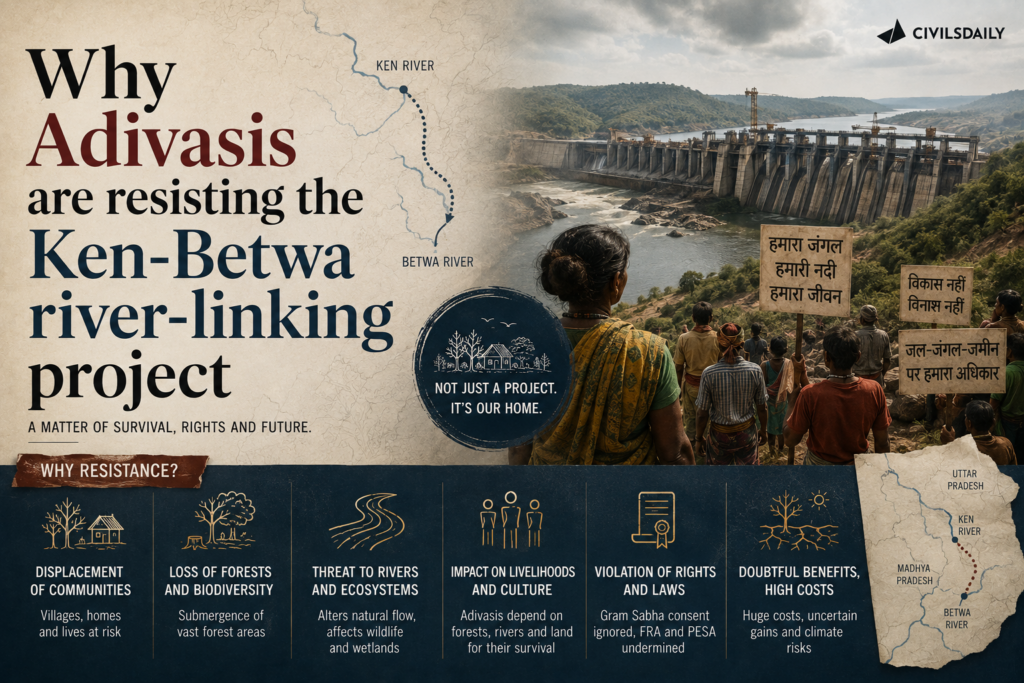
Construction on the Daudhan dam across the Ken river in Madhya Pradesh’s Bundelkhand region is advancing while 22 villages in Panna and Chhatarpur districts face displacement. The project is designed to move water to 13 water stressed districts, and the households paying for that transfer are largely Gond Adivasi families whose forest based livelihoods and absence of recorded land title place them outside the compensation package built for the transfer. A protest movement led by Adivasi women has been running since 2022 and drew national attention in April and July 2026.
What is the Ken Betwa river linking project?
What it does: It transfers water described as surplus from the Ken river to the Betwa river through a canal, for irrigation and drinking water in Bundelkhand.
Approval: The Union Cabinet approved the interlink in 2021.
The canal: A 231 km long canal carries the transferred water between the two rivers.
The dam: The Daudhan dam, built across the Ken inside the Panna landscape, is the main structure of the project.
The beneficiary area: Water stressed districts of Bundelkhand, a region spanning 13 districts across Madhya Pradesh and Uttar Pradesh.
Its status in policy: It is the first link to be taken up for implementation under the national river interlinking programme.
What is a patta?
What it is: A document of recorded title or of a recognised right over land, issued by the revenue or forest administration.
Why it decides everything here: Compensation for acquired land is paid per acre of titled land, so a family cultivating or using land without a patta has no claim to that component.
What is the Forest Advisory Committee?
What it is: The statutory committee under the Forest (Conservation) Act, 1980 that advises the Union government on proposals to divert forest land for non forest use.
Its role here: Its 2017 record carries the detailed project report’s estimate of the tree felling the project requires.
What is the Chita Aandolan?
What it is: A symbolic pyre protest in which affected villagers lie on funeral pyres to signal that displacement amounts to the end of their life in the place.
Who leads it: It has been led by Adivasi women of the affected villages and has run since 2022.
What is minor forest produce?
What it is: Non timber produce of plant origin gathered from forests, including mahua flowers, tendu leaves, fruits, resins and seeds.
Why it is the livelihood question: Households in the affected villages meet their cash and food needs by collecting charwa, mahua, tendu leaves and guli golanda, none of which is valued in a land based compensation formula.
What are the numbers behind the displacement?
Villages submerged:10 villages, including Daudhan, will be submerged by the reservoir.
Villages displaced for compensatory forest: Because the project falls within the Panna Tiger Reserve, the people of another 12 villages will be displaced to offset the loss of forest area.
Total affected:22 villages across Panna and Chhatarpur districts in all.
Population at the dam site: Around 700 people live in Daudhan village, next to which construction is under way.
A village outside the submergence zone: Narauli, home to around 300 people and inhabited mostly by the Gond community, sits on a hill outside the submergence zone and faces the same loss of forest access.
Cash compensation: Villagers who were 18 years or older in February 2024 are eligible for Rs 12.5 lakh each.
Land compensation:Rs 5 lakh per acre of acquired land, payable only against titled land.
Tree felling: A 2017 Forest Advisory Committee record carries the detailed project report estimate that 23 lakh trees will be felled. Some experts hold this to be an underestimate.
Forest area submerged: The Daudhan dam submerges about 4,141 hectares of Panna Tiger Reserve land, within a wider rehabilitation process affecting about 1,913 families.
How has the resistance developed?
Start of the movement: The Chita Aandolan, or symbolic pyre protest, has been running since 2022.
Preventive detention: The leader of the movement was placed under preventive detention in February 2026.
Gathering at the magistrate’s office: About 200 villagers assembled at the sub divisional magistrate’s office demanding his immediate release.
Police account of the escalation: The Superintendent of Police, Chhatarpur, stated that villagers later locked the office and threw stones at revenue officials and at a marriage procession, after which the police used minimum limited force.
April protest: Affected Adivasi families staged a pyre protest in Chhatarpur on 10 April 2026, which brought the movement national attention.
July protest: Villagers again lay on symbolic pyres and began a hunger strike at the Barnar river, with a protest on the banks on 18 July.
Clearance of the site: After 15 days, the police cleared the protest site.
Dialogue that did not occur: The movement’s leader stated that the administration had promised a dialogue with representatives of the Centre, and that no such conversation took place.
Why was the project approved?
The surplus framing: The Ken is treated as carrying water beyond its basin’s need, and the Betwa basin as deficient, which is the premise the transfer rests on.
The regional case: Bundelkhand is among India’s driest and most impoverished regions and has a long record of drought and distress migration.
The stated purpose: Irrigation and drinking water for the water stressed districts of the region.
The two rivers: The Ken rises in the Vindhyan plateau, flows mainly through Madhya Pradesh and joins the Yamuna at Banda in Uttar Pradesh. The Betwa also rises in the Vindhyas, flows mainly through Uttar Pradesh and meets the Yamuna at Hamirpur.
Why both matter locally: Both rivers run through the same region, so the transfer moves water within Bundelkhand rather than out of it.
The contested premise: The surplus classification is an assessment of basin yield, and it is the step that decides how much displacement is treated as justified.
Why does monetary compensation fail to reach the affected?
The title requirement: Most Adivasi families in the affected villages do not hold patta land, so the per acre component does not apply to them.
The cut off date: Eligibility for the cash component is fixed by age as on February 2024, which excludes those who reached adulthood after that date.
Forest income is unvalued: Livelihoods built on mahua, charwa, tendu leaves and other forest produce are not converted into any head of compensation.
Non submergence villages: Narauli is not in the submergence zone yet loses the forest that sustains it, a loss the acquisition framework does not recognise.
Standing assets: Trees planted over a lifetime, including mango, ber, kaitha and teak, are counted as forest loss for the project and not as household assets.
Process complaints: Houses in some villages were demolished without adequate notice or compensation, according to the movement’s leader.
What is being lost beyond land and houses?
Community: Households state that relocation breaks the kinship network in which they live, so the social relations of the village do not travel with the compensation.
Language: Villagers raise the loss of their own dialect in a new settlement as a distinct concern.
Sacred geography: Village deities and sites of worship are tied to the specific location and cannot be relocated with the households.
Birthplace claim: Residents describe the land along the Ken as their janam bhoomi, or place of birth, and treat that as an independent ground of refusal.
Forest as an economy: The forest edge supplies food, cash income and fuel, so its loss is an income shock and not only a cultural one.
The collective demand: The stated position is a forest for their forest, land for their land, water for their water and a village for their village.
Where does the water security case collide with the displacement cost?
Two legitimate claims: Drinking water and irrigation for 13 water stressed districts is a genuine public purpose. So is the security of tenure of the households inside the submergence zone.
Same region, different people: The transfer moves water within Bundelkhand, so the beneficiaries and the displaced belong to the same drought affected region.
The forest multiplier: Because the reservoir sits inside a tiger reserve, forest loss must be offset, which displaces a second set of 12 villages that the dam itself would not have touched.
Compensation without capacity: A cash package can settle a title based claim. It cannot replace a forest based livelihood or a functioning village.
The dialogue gap: Even where the project moves ahead, an immediate and structured negotiation on resettlement and rehabilitation with an organised community is missing, as the organiser of the Narmada Bachao Andolan has recorded.
Deferred rather than resolved: Building the dam settles the water question and shifts the livelihood question to a resettlement site that has not been defined.
What has the administrative response been?
Claim of redressal: The District Magistrate of Chhatarpur in April stated that most of the demands raised during the April protests had been addressed.
Silence since: The current District Magistrate and the Chief Executive Officer of the Zila Panchayat did not respond to repeated requests for comment.
Revenue department: An email to the Principal Secretary of the Madhya Pradesh Revenue Department, which oversees land acquisition, drew no reply.
Policing of protest: Villagers who went to Chhatarpur and Bijawar to press their demands state that the police responded with lathis.
Official account of force: The Superintendent of Police stated that minimum limited force was used after the office was locked and stones were thrown.
Field level messaging: Households report being told by the village revenue official that their land is going to submerge and that no further claim arises.
What are the villagers demanding?
April demands, first: A joint survey of land and houses by the administration and the affected families.
April demands, second:Rs 25 lakh in compensation per individual.
April demands, third: Four times the value of the land in compensation.
April demands, fourth: A deadline of April 2026 for settlement of these claims.
July demands, first:Three acres of land granted jointly in the names of the male and the female head of each family.
July demands, second: A village for the displaced village, so that the community is resettled together rather than scattered.
July demands, third: The same April 2026 deadline carried forward.
The organising principle: The shift from cash amounts in April to land and village in July reflects a demand for restitution in kind rather than a higher price.
Challenges to the Ken Betwa river linking project
Contested surplus assessment: The classification of a river as surplus rests on basin yield estimates that independent hydrologists dispute. e.g. objections filed before the Supreme Court’s Central Empowered Committee on the Ken’s assessed surplus.
Loss inside a protected area: The reservoir submerges core tiger habitat, which no compensatory afforestation reproduces. e.g. about 4,141 hectares of Panna Tiger Reserve land under submergence.
Cumulative pressure on the same landscape: Further projects are cleared in the same corridor while the dam is under construction. e.g. the 1,800 MW Panari pumped storage project cleared on about 411 hectares in the Panna Ranipur corridor in August 2026.
Compensatory afforestation cannot replace old growth: Plantations take decades to deliver the produce and habitat value of a felled forest. e.g. an estimated 23 lakh trees to be felled under the detailed project report.
Forest rights not settled before acquisition: Individual and community claims under forest rights law are often unsettled when land is taken. e.g. Gond families in the affected villages without patta land.
Resettlement site quality: Displaced households are commonly resettled on land without water, forest access or common grazing. e.g. the long unresolved rehabilitation record of the Sardar Sarovar oustees.
Cost and time escalation: Long gestation interlinking works overrun both budget and schedule, which pushes rehabilitation spending to the end. e.g. an approved cost of about Rs 44,605 crore in 2021 with an eight year completion schedule.
Downstream and interstate obligations: Water sharing commitments between Madhya Pradesh and Uttar Pradesh determine actual delivery, not the design capacity. e.g. the interstate memorandum of agreement signed on 22 March 2021.
Conclusion
The Ken Betwa link moves water within Bundelkhand, and it moves the entire cost of that transfer onto Adivasi households whose form of landholding and forest based income the compensation framework does not recognise. The design question is not the amount of the package but its unit: the villages are asking for land, forest and a resettled village, and the State is offering a per head cash sum against titled acres most of them do not hold. Until forest rights are settled and a defined resettlement site is negotiated with the community as a unit, construction will continue to run ahead of rehabilitation.
Interlinking of Rivers in India
The idea: Transferring water from basins assessed as surplus to basins assessed as deficient, through a network of storage dams and link canals.
The plan: The National Perspective Plan of 1980 of the Ministry of Irrigation set out the framework for such transfers.
The agency: The National Water Development Agency, set up in 1982, prepares feasibility and detailed project reports for the links.
The scale: The plan identifies 30 links, comprising 16 under the peninsular component and 14 under the Himalayan component.
The judicial push: The Supreme Court in 2012 directed the Union government to implement the interlinking programme in a time bound manner and to constitute a special committee.
The first link: The Ken Betwa link is the first project taken up for implementation under the plan, with a dedicated authority created for it in 2021.
The claimed benefit: Drought proofing, flood moderation, additional irrigated area and hydropower, drawn from moving water between basins with different rainfall regimes.
Constitutional Framework Governing Water, Land and Forest Rights
Seventh Schedule, State List Entry 17: Places water supply, irrigation, canals, drainage, embankments and water storage with the States, subject to Entry 56.
Seventh Schedule, Union List Entry 56: Allows Parliament to regulate and develop interstate rivers and river valleys in the public interest.
Seventh Schedule, Concurrent List Entry 17A and 17B: Place forests, and the protection of wild animals and birds, on the Concurrent List after the 42nd Amendment.
Article 262: Empowers Parliament to provide for adjudication of interstate river water disputes and to bar the jurisdiction of courts in them.
Article 21: Protects life and personal liberty, read to include the right to livelihood and to a healthy environment.
Article 48A and Article 51A(g): Direct the State to protect the environment and forests, and place a corresponding fundamental duty on every citizen.
Article 244 and the Fifth Schedule: Provide for the administration of Scheduled Areas and the protection of tribal interests, including through the Tribes Advisory Council.
Article 243ZD read with Part IX: Places village level planning with the Panchayats, which is the base for consultation requirements in Scheduled Areas.
Laws and Rules Governing Displacement, Forests and River Projects
Right to Fair Compensation and Transparency in Land Acquisition, Rehabilitation and Resettlement Act, 2013: Governs acquisition, compensation and the rehabilitation entitlements of affected families.
Forest (Conservation) Act, 1980: Requires prior central approval for diversion of forest land to non forest use, with compensatory afforestation and net present value payments.
Scheduled Tribes and Other Traditional Forest Dwellers (Recognition of Forest Rights) Act, 2006: Recognises individual and community rights over forest land and produce for forest dwelling communities.
Wildlife (Protection) Act, 1972: Governs protected areas, and provides for tiger reserves, critical tiger habitats and the National Tiger Conservation Authority.
Environment (Protection) Act, 1986 and the Environment Impact Assessment Notification, 2006: Provide the environmental clearance process, including public hearing and appraisal for river valley projects.
Panchayats (Extension to the Scheduled Areas) Act, 1996: Requires consultation with the Gram Sabha before land acquisition and resettlement in Scheduled Areas.
Inter State River Water Disputes Act, 1956: Provides the tribunal mechanism for adjudicating disputes over interstate river waters.
Back2Basics: Panna Tiger Reserve
Designation: A tiger reserve, listed in the Places in News record as the protected area within which the Daudhan dam is being built.
Location: Panna and Chhatarpur districts of Madhya Pradesh, on the Vindhyan range in the Bundelkhand region.
Constitution: Panna National Park was notified in 1981 and the area was declared a tiger reserve in 1994 under Project Tiger.
River: The Ken river flows through the reserve and supports its gorges, waterfalls and riverine habitat.
International recognition: It was designated a biosphere reserve and was added to the UNESCO World Network of Biosphere Reserves in 2020.
Conservation record: Tigers became locally extinct in the reserve by 2009, and a reintroduction programme rebuilt the population, treated as a landmark recovery.
Vegetation: Tropical dry deciduous forest with teak and kardhai woodland, interspersed with grassland and plateau.
Fauna: Tiger, leopard, sloth bear, chital, chinkara, sambar and nilgai on land, with gharial, mugger and the Indian vulture along the Ken.
Landscape connectivity: It links to the Nauradehi Wildlife Sanctuary and the Satpura landscape, and the Panna Ranipur corridor extends toward Uttar Pradesh.
Government Initiatives
Ken Betwa Link Project Authority: The special purpose body created in 2021 to execute the link, with an interstate memorandum of agreement signed on 22 March 2021.
National Perspective Plan and the National Water Development Agency: The 1980 plan and the 1982 agency that prepare and appraise interlinking proposals.
Pradhan Mantri Krishi Sinchayee Yojana: Consolidates irrigation schemes to expand assured irrigation and improve water use efficiency at the farm level.
Atal Bhujal Yojana: Supports community led groundwater management in water stressed blocks, including in Bundelkhand districts.
Jal Jeevan Mission: Aims at functional household tap connections in rural areas, the drinking water objective the link project is meant to support.
Project Tiger and the National Tiger Conservation Authority: Provide the statutory and funding framework for tiger reserves such as Panna, including village relocation packages.
Compensatory Afforestation Fund Management and Planning Authority: Manages funds collected from forest diversion for compensatory afforestation and habitat improvement.
Key Facts about the Ken Betwa Link Project
Approval and cost: Approved by the Union Cabinet in December 2021 at a cost of about Rs 44,605 crore, with an eight year completion schedule.
The agreement: A memorandum of agreement between the Union government, Madhya Pradesh and Uttar Pradesh was signed on 22 March 2021, observed as World Water Day.
Annual irrigation: Designed to provide annual irrigation to about 10.62 lakh hectares across the two States.
Drinking water: Designed to supply drinking water to about 62 lakh people.
Power: Includes 103 MW of hydropower and 27 MW of solar capacity.
The dam: The Daudhan dam is about 77 metres high and about 2,031 metres long, with a tunnel system feeding the link canal.
The rivers: The Ken and the Betwa are both tributaries of the Yamuna, joining it at Banda and Hamirpur respectively in Uttar Pradesh.
The region: Bundelkhand covers 13 districts across Madhya Pradesh and Uttar Pradesh and is among India’s driest and most impoverished regions.
Challenges in River Interlinking
Basin surplus is contested science: Surplus and deficit classifications rest on yield estimates that vary with the data series used. e.g. disputes over the assessed surplus of the Ken before appraisal bodies.
Ecological alteration of river regimes: Reduced downstream flow changes sediment transport, fish migration and floodplain recharge. e.g. gharial habitat along the Ken downstream of the Daudhan site.
Forest and protected area loss: Links routinely pass through forests and sanctuaries where diversion cannot be reversed. e.g. submergence of about 4,141 hectares inside the Panna Tiger Reserve.
Displacement and rehabilitation deficits: Resettlement lags construction, so families lose land before they receive an alternative. e.g. the long running rehabilitation disputes of the Sardar Sarovar project on the Narmada.
Interstate political friction: Donor States resist parting with water once a project is under way. e.g. the long deadlock over the Mahanadi and the Godavari Cauvery link proposals.
Cost and time overruns: Multi decade civil works escalate in cost, which squeezes the rehabilitation component first. e.g. the 2021 approved cost of about Rs 44,605 crore for a single link.
Climate uncertainty: Interlinking assumes stable rainfall distribution between basins, which a changing monsoon does not guarantee. e.g. simultaneous drought across both donor and recipient basins in a deficient monsoon year.
Groundwater alternatives neglected: Large transfers draw attention and funds away from cheaper local recharge and watershed options. e.g. traditional Bundelkhand tanks and chandela ponds that remain unrestored.
Way Forward
Settle forest rights first: Complete recognition of individual and community forest rights under the 2006 Act before any acquisition notification is issued.
Resettle the village as a unit: Provide a single relocation site with forest access, water and common land so that community structure survives the move, as the affected families have demanded.
Compensate the livelihood, not only the acre: Value minor forest produce income and standing trees in the entitlement package for households without titled land.
Institutionalise dialogue: Create a standing negotiation forum between the project authority, the district administration and elected village representatives, with recorded minutes.
Independent hydrological review: Publish and peer review the basin yield assessment on which the surplus classification rests, before further links are appraised.
Fund rehabilitation ahead of construction: Ring fence the rehabilitation and resettlement outlay and release it before submergence rather than after.
Restore local water systems in parallel: Revive tanks, ponds and watershed structures across Bundelkhand so that drought relief does not rest on a single project.
Compensatory afforestation in contiguous blocks: Locate the compensatory forest within the same landscape and monitor survival rates, rather than counting saplings planted.
“[2017, GS3, 10 marks] Not many years ago, river linking was a concept but it is becoming reality in the country. Discuss the advantages of river linking and its possible impact on the environment.”
An administrative order circulating in Anantnag directed government employees to take part in a Tiranga Rally, making attendance at a State sponsored event an official obligation. The order brings out the central tension in the governance of Jammu and Kashmir since August 2019, between an official account of restored normalcy and a security regime of raids, dismissals, detentions and attachments that continues without pause. Whether participation of this kind reflects public enthusiasm or administrative compulsion is the question the order leaves unanswered.
What is Article 370 of the Constitution?
What it provided: A temporary provision under Part XXI that limited Parliament’s legislative power over Jammu and Kashmir to defence, foreign affairs and communications, with other laws requiring the State government’s concurrence.
The linked provision:Article 35A, added by a 1954 Presidential Order, allowed the State to define permanent residents and reserve rights in employment and property for them.
What changed in 2019: Presidential Orders of August 2019 applied the whole Constitution to the State and rendered Article 370 inoperative, and Article 35A ceased to apply.
The statutory change: The Jammu and Kashmir Reorganisation Act, 2019 split the State into two Union Territories, Jammu and Kashmir with a legislature, and Ladakh without one.
The judicial outcome: The Supreme Court upheld the 2019 measures in In re Article 370 of the Constitution (2023) and directed that statehood be restored and elections held.
The contested question: The argument advanced in this piece treats the 2019 change as an abrogation imposed without consent, and reads subsequent governance as its continuation.
Who is an overground worker?
The term: A person alleged to provide logistical support to militants, such as shelter, transport, money or information, without taking part in armed action.
Why the term matters: It is not defined in statute, so the label carries no fixed evidentiary threshold and can be applied to large numbers after a single incident.
What is preventive detention?
What it is: Detention ordered by the executive to prevent an anticipated act, without any charge, trial or conviction.
Its basis:Article 22(3) to 22(7) carve preventive detention out of the ordinary protections against arrest, and permit detention up to three months before an Advisory Board must review it.
What is the United Liberation Council?
What it is: The name attached to a purported threat letter reported on 12 August, described by authorities and sections of the media as an affiliate of Lashkar e Taiba.
What the letter did: It reportedly named several Kashmiri Pandit government employees and carried their telephone numbers.
Why is the Tiranga Rally order treated as symptomatic rather than isolated?
The object is not the issue: The objection is not to the national flag but to the coercive form of the instruction.
Obligation replaces participation: When attendance at a government event becomes an administrative duty, the resulting turnout cannot be read as evidence of public sentiment.
A pattern of governance: The order fits a style of administration that has defined the region since the Union government took direct control in August 2019.
Display as policy output: A visible ceremony is treated as the deliverable, so the appearance of normalcy substitutes for the conditions that would produce it.
Self defeating measurement: A government that compels attendance loses the only instrument that could have told it whether sentiment had actually changed.
What measures define administration in the Valley since 2019?
Raids and investigations: Searches and investigations by multiple central and State agencies have become a recurring feature of life in the Valley.
Dismissals from service: Government employees have been dismissed over alleged links with militancy or with militant sympathisers, without the ordinary departmental process.
Mass detention: Thousands have been detained after militant incidents, at times under broad allegations of being overground workers.
Institutional closure: Educational and charitable institutions have faced closure or restriction over alleged links with banned organisations.
Property attachment: Properties worth hundreds of crores of rupees have been attached under various laws.
House demolition: Homes have been demolished where a member of the family stands accused of militancy.
Post incident crackdowns: Thousands were reportedly detained after the killing of a police constable in south Kashmir, and the cycle of raids, detentions and suspicion followed the killing of migrant workers.
What does the record on the Kashmiri Pandit community show?
The threat letter: Reports on 12 August described a purported threat letter naming several Kashmiri Pandit government employees along with their telephone numbers.
The attributed source: The letter was attributed to the United Liberation Council, described as an affiliate of Lashkar e Taiba.
The casualty count:25 members of the community have been targeted and killed since 2019.
The named victims: They include Ajay Pandita Bharti, Rakesh Pandita, Makhan Lal Bindroo, Rahul Bhat, Rajni Bala, Puran Krishan Bhat and Sanjay Sharma.
Why the memory matters: For a community displaced in the 1990s, each such threat revives the circumstances of that displacement rather than reading as an isolated crime.
The return condition: Return has to rest on an environment in which the community feels safe, not on participation in official ceremonies designed to demonstrate that everything is normal.
Why do the claim of normalcy and the continuing security regime contradict each other?
The official account: The government tells the rest of India that Kashmir has entered a new era of peace and normalcy.
The parallel reality: Extraordinary security measures, raids, detentions, dismissals and restrictions continue to shape the everyday lives of ordinary people.
Both cannot be operative: A settled peace does not require a standing apparatus of preventive detention and property attachment to maintain it.
The tourist test fails: Busy markets, full hotels and traffic on the roads are what a visitor sees in a few days. They measure commerce, not security of person.
What each side gains: The government gains a demonstrable output in the display. The population gains nothing it can rely on when the display ends.
The unresolved reminder: The threat letter of 12 August is the demonstration that the underlying problem has not closed, whatever the ceremonies record.
How should normalcy actually be measured?
Freedom to speak: Whether ordinary people feel secure enough to speak freely without anticipating consequences.
Law as protection: Whether families believe the law will protect them rather than intimidate them.
A visible future: Whether young people see a future for themselves in the region.
Safe return: Whether communities that have suffered displacement and violence feel safe enough to return and rebuild their lives.
What does the security regime do to a generation born after the conflict?
Who they are: Those in their teens and twenties in Kashmir were born decades after the worst years of the conflict and bear no responsibility for the violence of the 1990s.
What they observe: Many grow up watching fathers, brothers, relatives and neighbours being summoned, detained or questioned.
Collective punishment: Large scale detentions and punitive measures after militant attacks deepen the perception that a whole community is being punished for the acts of individuals.
The asymmetry they learn: One section of society is repeatedly assured that everything is normal while another is continually asked to prove that it is not a threat.
The outcome: This produces bruised memory rather than reconciliation, and bruised memory does not disappear because officials are instructed to display flags.
The time horizon: Brute force can silence a street for a period. It cannot silence a generation’s memory.
What distinctions must the state draw?
Militant and citizen: The State must distinguish between a militant and an ordinary citizen, which mass categorisation after an incident destroys.
Accused and convicted: It must distinguish between an accused person and a convicted person, which dismissal, attachment and demolition before trial collapse.
Family member and accused: It must distinguish between a family member and the person accused of committing a crime, which punitive action against a household erases.
Challenges to restoring political normalcy in Jammu and Kashmir
Punitive measures before adjudication: Attachment and demolition operate before a court has decided guilt, so the penalty precedes the finding. e.g. property attachments running to hundreds of crores of rupees under various laws since 2019.
Undefined categories in enforcement: Terms such as overground worker carry no statutory definition, so detention scales with suspicion rather than evidence. e.g. thousands reportedly detained after the killing of a police constable in south Kashmir.
Employment as a security instrument: Dismissal without departmental inquiry converts government service into a lever of security policy. e.g. dismissals of employees over alleged links with militancy since 2019.
Targeted killings of minorities: The safety of returning and resident minority employees remains unsecured. e.g. 25 members of the Kashmiri Pandit community killed since 2019 and a threat letter naming employees on 12 August 2026.
Statehood still pending: Restoration of full statehood remains incomplete, leaving an elected government without control over police and public order. e.g. the Supreme Court’s 2023 direction to restore statehood at the earliest.
Space for civil society: Closure of educational and charitable institutions removes the mediating layer between the State and the population. e.g. restrictions on institutions over alleged links with banned organisations.
Cross border sponsorship: Infiltration and external support keep the security justification alive irrespective of local political settlement. e.g. attacks on migrant workers in the Valley followed by area wide crackdowns.
Economic dependence on tourism: A single security incident removes the region’s main visible income source. e.g. the collapse of bookings in the Valley after major attacks on visitors.
Conclusion
The administrative order in Anantnag is a small instrument, and its significance lies in what it substitutes for. Kashmir needs healing built on dignity, justice, security and dialogue, and healing cannot be produced by an order requiring attendance. A facade of normalcy may impress visitors, and it cannot substitute for real peace. The measure of whether the situation has changed is whether the State begins to distinguish the militant from the citizen and the accused from the convict, not whether the flag is displayed on schedule.
Jammu and Kashmir after 2019
Constitutional status: The former State was reorganised on 31 October 2019 into the Union Territory of Jammu and Kashmir, with a legislature, and the Union Territory of Ladakh, without one.
Political timeline: Assembly elections were held in 2024, the first since 2014, restoring an elected government to the Union Territory.
Statehood question: Full statehood has not been restored. Public order and police remain with the Union government under the Reorganisation Act.
Security geography: The region has a Line of Control of about 740 km with Pakistan and a Line of Actual Control segment with China in Ladakh.
Displacement history: Large scale displacement of the Kashmiri Pandit community occurred from 1990, and return and rehabilitation remains an unfinished policy objective.
Economy: Horticulture, handicrafts and tourism dominate the economy, all of which are directly sensitive to security incidents.
Constitutional Framework Governing Jammu and Kashmir and Security Measures
Article 1: Declares India a Union of States and makes the territories in the First Schedule part of that Union.
Article 3: Empowers Parliament to form new States and Union Territories and to alter boundaries, the provision used for the 2019 reorganisation.
Article 370: The temporary provision governing the State’s relationship with the Union, rendered inoperative by the Presidential Orders of August 2019.
Article 14: Requires equality before the law, which limits arbitrary classification of persons or communities in security administration.
Article 19: Guarantees freedom of speech, assembly, association and movement, subject to reasonable restrictions on the specified grounds.
Article 21: Protects life and personal liberty, and requires that any deprivation follow a procedure that is fair, just and reasonable.
Article 22: Provides protections on arrest, and separately permits preventive detention with an Advisory Board review after three months.
Article 239A read with the Reorganisation Act: Provides the framework for a legislature in a Union Territory, with police and public order reserved to the Union in the case of Jammu and Kashmir.
Article 355: Places a duty on the Union to protect every State against external aggression and internal disturbance.
Laws and Rules Governing Security Administration in Jammu and Kashmir
Jammu and Kashmir Reorganisation Act, 2019: Created the two Union Territories and set out the distribution of legislative and executive power between them and the Union.
Unlawful Activities (Prevention) Act, 1967: The principal anti terrorism statute, providing for banning organisations, designating individuals and attaching proceeds of terrorism.
Jammu and Kashmir Public Safety Act, 1978: Permits preventive detention for up to two years on grounds of security of the State or maintenance of public order.
Armed Forces (Jammu and Kashmir) Special Powers Act, 1990: Confers search, arrest and use of force powers on the armed forces in areas declared disturbed, with prior sanction required for prosecution.
National Investigation Agency Act, 2008: Establishes the central counter terrorism investigation agency and defines the scheduled offences it can take over.
Prevention of Money Laundering Act, 2002: Provides for provisional attachment of property representing proceeds of crime, used in terror financing investigations.
Bharatiya Nagarik Suraksha Sanhita, 2023: Replaces the Code of Criminal Procedure, 1973 and carries the powers to issue prohibitory orders and regulate assemblies.
Back2Basics: In re Article 370 of the Constitution (2023)
What it was: A Constitution Bench judgment of the Supreme Court on the validity of the Presidential Orders of August 2019 and the Jammu and Kashmir Reorganisation Act, 2019.
Holding on sovereignty: The Court held that Jammu and Kashmir retained no element of internal sovereignty after its accession and the adoption of the Constitution.
Holding on Article 370: Article 370 was held to be a temporary provision, and the President’s power to declare it inoperative was held to survive the dissolution of the Constituent Assembly of the State.
Holding on Article 35A: The Court held that the removal of Article 35A did not violate the fundamental rights framework.
Direction on statehood: The Court directed that the statehood of Jammu and Kashmir be restored at the earliest, while upholding the carving out of Ladakh.
Direction on elections: The Election Commission was directed to hold Assembly elections by 30 September 2024.
Additional direction: The Court recommended a truth and reconciliation commission to examine human rights violations in the region since the 1980s.
Government Initiatives
Prime Minister’s Development Package, 2015: An outlay of about Rs 80,068 crore covering road, power, health, tourism and rehabilitation projects in the region.
Prime Minister’s Package for Kashmiri Migrants: Provides government jobs and transit accommodation to support the return of displaced Kashmiri Pandit families to the Valley.
Udaan and Himayat: Skill development and placement schemes for youth of the region, run through the National Skill Development Corporation and the rural livelihoods mission.
Prime Minister’s Special Scholarship Scheme: Funds higher education outside the region for students from Jammu and Kashmir and Ladakh.
Security Related Expenditure scheme: Reimburses the Union Territory for expenditure on security, relief and rehabilitation of surrendered militants and civilian victims.
Operation Sadbhavana and the Civic Action Programme: Army and central armed police force programmes that fund schools, medical camps and community infrastructure in border and affected areas.
New Central Sector Scheme for Industrial Development, 2021: An outlay of about Rs 28,400 crore of capital and interest incentives to attract manufacturing investment to the Union Territory.
Key Facts about Jammu and Kashmir
Reorganisation date: The two Union Territories came into existence on 31 October 2019, observed as National Unity Day.
Representation: The Union Territory of Jammu and Kashmir returns five members to the Lok Sabha and Ladakh returns one.
Delimitation: The 2022 delimitation raised Assembly seats to 90, with 43 in the Jammu division and 47 in the Kashmir division, besides seats reserved for Scheduled Castes and Scheduled Tribes for the first time.
Reservation extension: Central laws on reservation, including for Scheduled Tribes such as the Gujjar, Bakarwal, Gaddi and Sippi communities, now apply to the Union Territory.
Boundaries: The region borders Pakistan along the Line of Control and China along the Line of Actual Control in Ladakh.
Geography: The Pir Panjal range separates the Jammu division from the Kashmir Valley, and the Jhelum, Chenab and Indus are the principal rivers.
Treaty link: The Indus Waters Treaty of 1960 governs the use of the western rivers that flow through the region, and India placed it in abeyance in 2025.
Challenges in Internal Security Management
Balancing force and consent: Security operations that succeed tactically can widen alienation and cost the political objective. e.g. area wide cordon and search operations following a single militant incident.
Preventive detention without adjudication: Detention laws allow long custody without trial, which produces grievance even where the intelligence is sound. e.g. detention up to two years permitted under the Jammu and Kashmir Public Safety Act, 1978.
Radicalisation through digital channels: Recruitment and propaganda have moved online, beyond the reach of physical area domination. e.g. encrypted messaging used for handler communication in recent militancy cases.
Terror financing: Funding routes through hawala, cryptocurrency and front organisations are hard to interdict. e.g. investigations into non governmental organisations and trusts by central agencies since 2017.
Rehabilitation of surrendered cadre: Without livelihood and social acceptance, surrendered militants relapse. e.g. surrender and rehabilitation policies across the Northeast and Left Wing Extremism affected districts.
Centre and State coordination: Multiple agencies operating in the same theatre create gaps in intelligence handover. e.g. the multi agency centre framework created after the 2008 Mumbai attacks.
Human rights accountability: Sanction requirements delay prosecution in cases of alleged excess, which erodes trust in the process. e.g. the prior sanction requirement for prosecuting armed forces personnel.
Border management technology: Infiltration continues where terrain defeats physical fencing. e.g. tunnels detected along the international boundary in the Jammu sector.
Way Forward
Restore statehood on a stated timeline: Give the elected government responsibility for public order so accountability for security decisions is politically located.
Individualise security action: Confine dismissal, attachment and demolition to persons against whom a case is established, with reasons recorded and an appeal available.
Institutionalise dialogue: Create a standing channel with elected representatives, civil society and displaced communities rather than event driven engagement.
Secure minority employees: Provide verified protection and posting choices to Kashmiri Pandit employees rather than requiring presence at ceremonial events.
Time bound trials: Expand special court capacity so that persons in preventive detention are either charged and tried or released.
Youth employment at scale: Convert skill schemes into placement linked outcomes so that the young have a visible economic route.
Independent grievance mechanism: Set up an accessible body to examine complaints of excess, following the reconciliation mechanism the Supreme Court recommended in 2023.
“[2023, GS3, 10 marks] Winning of ‘Hearts and Minds’ in terrorism-affected areas is an essential step in restoring the trust of the population. Discuss the measures adopted by the Government in this respect as part of the conflict resolution in Jammu and Kashmir.”
Nearly 1.95 lakh state backed content blocking orders were sent to Instagram, Facebook and YouTube between March and July 2026, an average of one every 68 seconds, against a daily average of six in the preceding year. Most were routed through the Sahyog portal of the Ministry of Home Affairs and issued under Section 79(3)(b) of the Information Technology Act, 2000, the safe harbour condition, rather than the dedicated blocking power in Section 69A. The surge, combined with automated execution by the platform, converts a conditional legal duty into unconditional compliance.
What is the Sahyog portal?
What it is: A platform built by the Ministry of Home Affairs through which central and State agencies send content blocking notices to online intermediaries.
Who uses it: Various central and State law enforcement and government agencies issue notices, and all three major social media companies have joined the portal.
Legal hook: Notices are issued under Section 79(3)(b) of the Information Technology Act, 2000, the provision that conditions an intermediary’s legal immunity.
What it replaced: It centralises what were previously scattered notices from individual police units and departments into a single automated channel.
Scale of use: Between October 2024 and October 2025 the portal carried 2,312 blocking orders to 19 online platforms, a daily average of six.
What one order covers: A single blocking order can cover hundreds of individual pieces of content or accounts, so the order count understates the volume removed.
What is safe harbour under Section 79 of the Information Technology Act, 2000?
The immunity: Section 79 protects an intermediary from liability for content that its users post, provided it does not initiate, select or modify that content.
The condition: Section 79(3)(b) withdraws that immunity if the intermediary fails to remove unlawful material after receiving actual knowledge or a government notification.
What is Section 69A of the Information Technology Act, 2000?
The power: It allows the Union government to direct the blocking of public access to information in the interest of sovereignty, defence, security of the State, friendly relations, public order or the prevention of a cognisable offence.
The safeguards: Blocking under it follows the Information Technology (Procedure and Safeguards for Blocking for Access of Information by Public) Rules, 2009, which require a committee review and reasons in writing.
What is actual knowledge in intermediary liability?
The test: Actual knowledge is the point at which an intermediary is informed of specific unlawful content and becomes obliged to act on it.
Where it comes from: The Supreme Court in Shreya Singhal v. Union of India (2015) read down Section 79(3)(b) so that actual knowledge means a court order or a government notification, not a private complaint.
What is an Application Programming Interface?
What it is: A defined interface that allows one software system to send instructions directly to another without a person operating either end.
Its use here: Meta has integrated its interface with the Sahyog portal, so a flagged item uploaded to the portal is removed from its platforms automatically.
What does the scale of the blocking orders show?
Total volume: Nearly 1.95 lakh blocking orders in five months, about 1,275 a day, or one every 68 seconds.
Instagram: Around 1,00,000 orders, just over half of the total, and the platform on which the student protests were most visible.
Facebook: Around 80,000 orders.
YouTube: Nearly 15,000 orders.
Concentration: Meta owned platforms received roughly nine out of every ten orders issued to the three companies.
The baseline: The comparable figure for October 2024 to October 2025 was 2,312 orders across 19 platforms, a daily average of six.
Official record: The Ministry of Home Affairs annual report for 2024 and 2025 recorded a little over 1.11 lakh pieces of suspicious online content blocked until March 2025 under Section 79(3)(b).
Comparative removals: Meta reported removing over 23 million pieces of content in Indonesia between July and December 2025 against about 41,000 in India, which had already doubled from 28,000 in the first half of that year.
User base: India has over 600 million social media users, with an estimated 10 million to 100 million posts a day.
What changed in February 2026?
The amendment: The Ministry of Electronics and Information Technology notified amendments to the Information Technology (Intermediary Guidelines and Digital Media Ethics Code) Rules, 2021.
The new deadline: Content must now be removed within two to three hours, against the earlier window of 24 to 36 hours.
Added conditions: The amended rule requires that an order come from an officer of a prescribed rank and state its reasons.
The compliance effect: A window of two to three hours makes case by case human review commercially impossible at Indian volumes.
The platform response: Meta integrated its interface with the Sahyog portal so removal happens machine to machine, without separate human review.
What was removed: Automation eliminates the room for the company to review or contest a directive before complying with it.
Why does the shift from Section 69A to Section 79(3)(b) matter?
Different purpose: Section 69A is a dedicated blocking power. Section 79(3)(b) is a condition attached to an immunity, not a power to censor.
Different safeguards: Section 69A orders pass through a review committee under the 2009 Rules and carry recorded reasons. Section 79(3)(b) notices carry no equivalent statutory committee.
Different issuing authority: Section 69A is exercised by the Union government. Section 79(3)(b) notices come from a wide range of central and State agencies through the portal.
Different subject matter: Section 69A is largely confined to national security and public order. The portal route is used for a far wider category of content.
The legal consequence: The intermediary that refuses a Section 79(3)(b) notice does not face a penalty. It loses immunity for all user content, which is a far larger risk.
What that produces: The threat of losing safe harbour makes refusal irrational, so the conditional structure operates as a command.
What content was targeted?
The protest period: The five month window covered the student protests against examination paper leaks at Jantar Mantar in Delhi, which began in early June and were called off on 25 July after the resignation of the Union Education Minister.
Official acknowledgement: A senior government official stated that a considerable share of the orders were issued as the protests gathered momentum, particularly on Instagram.
Protest content: Users reported the removal of posts supporting the student protests.
Policy criticism: Posts criticising the government’s ethanol fuel blending policy were among those blocked.
Electoral content: Content relating to the West Bengal Assembly elections was also removed.
Synthetic media: Deepfakes formed a further category among the removals.
Political speech: The national convenor of a national political party stated that some of his Instagram posts were blocked in India.
Where does automated compliance turn against the legal design?
The doctrinal problem: Actual knowledge requires that someone at the company know of the content and assess the order. An interface that executes takedowns automatically has no knowledge at all.
No verification of authority: Nobody at the company checks whether the order comes from an officer of the prescribed rank or states the reasons the amended rule requires.
Conditional becomes unconditional: Machine to machine execution converts a conditional legal duty into unconditional compliance, which is the substance of the objection raised by the Internet Freedom Foundation.
The state interest on the other side: Coordinated disinformation, deepfakes and incitement travel faster than any human review cycle, which is the case for a short deadline.
The unequal risk: The cost of over removal falls on the user, who has no notice and no appeal. The cost of under removal falls on the company as loss of immunity for all content.
Notice denied: Meta informs users which State authority sent a request in most markets, but not in India, citing legal obligations and regulatory considerations.
No proportionality check: One order can cover hundreds of accounts, so a single instruction can remove speech at a scale no court has examined.
Challenges to the content blocking regime
Absence of a review committee: Orders under Section 79(3)(b) carry none of the committee scrutiny that Section 69A orders pass through. e.g. the 2009 Blocking Rules committee has no counterpart for portal notices.
Secrecy of orders: Blocking directions are treated as confidential, so neither the user nor the public sees the reasoning. e.g. Rule 16 of the 2009 Blocking Rules requires confidentiality of complaints and actions taken.
No pre decisional hearing for the user: The person whose speech is removed is not heard before removal and often not informed after it. e.g. account holders learning of removal only from the platform’s generic notification.
Chilling effect on lawful speech: Platforms over comply to protect immunity, which removes lawful criticism along with unlawful content. e.g. removal of posts criticising the ethanol blending policy during the same five month window.
Federal multiplication of issuers: A wide set of central and State agencies can issue notices, so there is no single accountable authority. e.g. the portal carried orders to 19 platforms from multiple agencies in the previous year.
Litigation uncertainty: Platforms that challenge the portal route face the loss of immunity while the case runs. e.g. X Corporation’s challenge to the Sahyog portal before the Karnataka High Court, dismissed in 2025.
Encryption and traceability conflict: The traceability requirement in the 2021 Rules cannot be met without weakening end to end encryption. e.g. the pending challenge by WhatsApp to Rule 4(2) of the 2021 Rules.
Capacity asymmetry: Smaller Indian intermediaries cannot build automated compliance systems and face the same deadlines. e.g. the two to three hour removal window applies to every significant social media intermediary.
Conclusion
The volume of blocking orders has risen from six a day to about 1,275 a day, and the legal route has moved from a dedicated blocking power with statutory safeguards to a safe harbour condition that carries none. Automation completes the shift, because a system that removes content without any person reading the order cannot satisfy the actual knowledge standard the Supreme Court built the provision around. The amended rules are in force and the orders continue. The unresolved question is whether Section 79(3)(b) can lawfully function as a general censorship channel when the Constitution requires every restriction on speech to be traced to a specific ground and a recorded reason.
“[2024, GS3, 15 marks] Social media and encrypting messaging services pose a serious security challenge. What measures have been adopted at various levels to address the security implications of social media? Also suggest any other remedies to address the problem.”
A Parliamentary panel report has highlighted the limited success of Khanij Bidesh India Limited (KABIL) in acquiring critical mineral assets overseas. So far, KABIL has completed acquisitions only in Argentina, while bids in Australia and Chile have failed or lapsed.
The issue highlights India’s challenge of securing critical minerals abroad without a sufficiently strong financial and domestic processing ecosystem.
What is KABIL?
Established: 2019
Purpose: Acquire and develop critical mineral assets overseas.
PSUs involved:
National Aluminium Company Limited (NALCO)
Hindustan Copper Limited (HCL)
Mineral Exploration and Consultancy Limited (MECL)
Ministry: Ministry of Mines
Major success: Five lithium brine blocks in Catamarca, Argentina, acquired in January 2024.
Key Terms
Spodumene Concentrate
Concentrated hard-rock lithium ore.
Must be processed into lithium carbonate or lithium hydroxide for battery applications.
Lithium Brine
Lithium dissolved in underground saltwater.
Extracted by pumping brine to the surface and concentrating it, traditionally through evaporation.
Non-Binding Offer
Indicative offer that does not legally commit the bidder to complete the transaction.
Allows access to the seller’s data room and due diligence stage.
Why did KABIL struggle?
Limited financial capacity: KABIL cannot independently match large international bids.
No domestic processing ecosystem: India lacks sufficient commercial-scale lithium conversion capacity.
Price volatility: Lithium prices fluctuate sharply, making valuation difficult.
Slow consortium decisions: Multiple PSUs can delay due diligence and bidding.
Strong global competition: Integrated companies can pay more because they already possess refining and battery-making capacity.
Exploration risk: Acquiring mineral acreage does not guarantee commercially viable reserves.
Australia: Why India Lost the Bid
Indian consortium initially offered $184 million.
Revised offer: $233 million.
South Korea’s POSCO eventually offered $765 million.
POSCO’s integrated mining and processing ecosystem allowed it to justify a much higher valuation.
Core lesson:Mine ownership without processing capacity provides less strategic value.
Chile: Why the Opportunity Lapsed
KABIL’s proposed Chilean lithium investment required a large financial commitment. A joint bid with other PSUs could not complete due diligence within the available timeline.
This exposed two weaknesses:
Limited capital + slow decision-making = missed strategic opportunities.
How Other Countries Approach Critical Minerals
Japan: JOGMEC provides equity support and loan guarantees to Japanese companies.
China: Combines overseas mining acquisitions with strong domestic refining capacity.
South Korea: Vertically integrated companies such as POSCO connect mining with processing.
EU: Critical Raw Materials Act targets domestic extraction, processing and recycling.
USA: Minerals Security Partnership promotes joint financing of critical mineral projects.
At present, the missing midstream processing stage reduces the economic value India can derive from an overseas mine.
“[2025] Consider the following statements: I. India has joined the Minerals Security Partnership as a member. II. India is a resource-rich country in all the 30 critical minerals that it has identified. III. The Parliament in 2023 has amended the Mines and Minerals (Development and Regulation) Act, 1957 empowering the Central Government to exclusively auction mining lease and composite license for certain critical minerals. Which of the statements given above are correct? (a) I and II only (b) II and III only (c) I and III only (d) I, II and III