Punjab’s Governor assented in April 2026 to the Jaagat Jot Sri Guru Granth Sahib Satkar (Amendment) Act, which provides punishment up to life imprisonment for sacrilege. The Act also covers words, signs, visible representations and electronic means, raising debate over the boundary between sacrilege and blasphemy.
What is the Act?
Applies to wilful and deliberate desecration of the Guru Granth Sahib.
Covers physical acts such as damage, defacement, burning, tearing and theft of Saroop.
Also covers certain spoken/written words, signs, visual representations and electronic acts.
Emerged against the backdrop of the 2015 Bargari and Burj Jawahar Singh Wala incidents.
Key Legal Provisions
Bharatiya Nyaya Sanhita, 2023 (BNS)
Replaced the Indian Penal Code, 1860 from July 2024.
Section 298: Offences involving injury/defilement of places of worship.
Section 299: Deliberate and malicious acts intended to outrage religious feelings, including through electronic means.
Section 299 carries forward the substance of former Section 295A, IPC.
Constitutional Provisions
Article 19(1)(a): Freedom of speech and expression.
Article 19(2): Permits reasonable restrictions, including for public order.
Article 25: Freedom of conscience and religion, subject to public order, morality and health.
Article 14: Equality before law.
Article 51A(e): Promotes harmony and common brotherhood.
Article 51A(h): Promotes scientific temper, inquiry and reform.
Secularism: Part of the basic structure of the Constitution.
Sacrilege vs Blasphemy
Sacrilege: Physical or conduct-based desecration of something sacred.
Blasphemy: Expressive acts showing contempt or irreverence towards religious beliefs.
Concern: Punjab’s law potentially merges the two by treating certain expressive acts as sacrilege.
Historical Background of Section 295A
Rangila Rasul pamphlet triggered controversy in Lahore in 1924.
Section 295A IPC was enacted in 1927 to criminalise deliberate and malicious acts intended to outrage religious feelings.
The Supreme Court upheld its constitutionality in Ramji Lal Modi v. State of Uttar Pradesh (1957) under the Article 19(2) public order exception.
Key Concerns
Chilling effect on speech, scholarship and satire.
Subjective interpretation of religious hurt.
Potential misuse by organised complainants.
Risk of vigilante violence despite criminalisation.
Digital communication expands the potential reach of the offence.
Different States may prescribe different levels of punishment.
The government is in talks with jewellers on a gold monetisation route in which jewellers accept household gold and the deposit is held in a demat account, with interest paid on the value deposited. The bank based Gold Monetisation Scheme of 2015 mobilised only 38 tonnes by March 2025 against household holdings placed well upwards of 20,000 tonnes, so the redesign turns on who households trust with their gold rather than on the return offered.
How would the proposed jeweller led gold monetisation route work?
Point of deposit: A depositor would take physical gold to the nearest jeweller rather than to a bank branch.
Record of holding: The scheme would be implemented through demat accounts, in the same way as shares, and the gold deposit would be reflected in the depositor’s demat account.
Return to the depositor: The depositor would earn interest on the value of the gold deposited.
Role of the jeweller: Jewellers would assume a key role in mobilising gold, becoming the contact point that banks occupy in the existing scheme.
Stage of the proposal: Discussions with large industry players have been constructive and a scheme could be announced soon.
What is a demat account?
Definition: A dematerialised, or demat, account holds securities in electronic form with a depository, removing the need for a physical certificate.
Application here: Holding a gold deposit in a demat account makes the claim transferable and tradable in electronic form, which physical gold in a bank vault is not.
Why is the government revisiting gold monetisation now?
Currency pressure: The exchange rate is under pressure from several factors at once.
Fuel prices:Elevated fuel prices following the West Asia crisis have widened the import bill.
Equity market sentiment:Investor concerns about the domestic stock market have weighed on capital inflows.
Gold imports:Elevated gold imports are the third source of pressure, with imports reaching $71.98 billion in 2025-26 against about $35.02 billion in 2022-23, per Ministry of Commerce and Industry data.
Industry signal: The chairman of the All India Gems and Jewellery Domestic Council stated that the government has communicated that it is serious about the proposal and has assured implementation as swiftly as it can be done.
What did the bank based scheme of 2015 achieve?
Mobilisation record: The scheme launched in 2015 mobilised just 38 tonnes of gold by March 2025, according to government data.
Scale of the untapped stock: There is no official estimate of gold held by Indian households, and experts place the figure significantly upwards of 20,000 tonnes.
The identified failure point: Families are more comfortable dealing with their family jewellers on matters concerning gold and silver, and that comfort is missing when banks play that role.
The stated design change: The big shift in the current proposal is moving the collection point beyond banks, per the President of the India Bullion and Jewellers Association.
Components of the Gold Monetisation Scheme, 2015, along the deposit lifecycle
Component (lifecycle stage)
Intervention and official terms
Primary stakeholder served
Collection and Purity Testing Centre (input and assaying)
Depositor’s raw gold is tested for purity at a Bureau of Indian Standards certified centre and converted into a standard equivalent before the deposit is accepted
Household depositor
Short Term Bank Deposit (financing, short tenure)
Tenure of 1 to 3 years, accepted by the bank on its own account, with the interest rate decided by the bank itself
Depositor and the accepting bank
Medium Term Government Deposit (financing, medium tenure)
Tenure of 5 to 7 years, accepted by banks on behalf of the Central government, at an interest rate of 2.25 percent per annum
Central government and the depositor
Long Term Government Deposit (financing, long tenure)
Tenure of 12 to 15 years, accepted on behalf of the Central government, at an interest rate of 2.50 percent per annum
Central government and the depositor
Refinery and deployment (use of mobilised gold)
Mobilised gold is refined and lent to jewellers as metal loans or used to reduce fresh import demand
Jewellery manufacturers and the external account
Tax treatment (redemption)
Deposits are exempt from capital gains tax, wealth tax and income tax on the interest and the appreciation
Household depositor
Current status of the components
The medium and long term government deposit components were discontinued from 26 March 2025, leaving only the short term bank deposit at the discretion of banks
Central government
What would monetisation at scale do for the economy?
Value of a partial mobilisation: Monetising just 10 percent of the gold held would be worth around $400 billion, according to a part time member of the Economic Advisory Council to the Prime Minister (EAC-PM).
Comparison with foreign capital: India’s gross foreign direct investment is about $80 billion, so that gold would be equivalent to five years of foreign direct investment inflows.
External account effect: Locked up gold, once monetised, can make India a trade account surplus nation.
Consumption and investment effect: The change would increase domestic consumption and force companies to invest more.
Savings channel: Investment depends on either domestic or global savings, and adding frozen domestic savings to liquid savings alongside continuing foreign capital would make a much larger pool available for investment.
Why does routing gold through jewellers solve one problem and create another?
The trust problem is real: Households deal with a family jeweller across generations, and the bank counter never acquired that standing, which is the single clearest explanation for 38 tonnes in ten years.
The proposal is described as a win-win only in theory: The depositor earns interest and the system unlocks idle metal, and both outcomes depend on the intermediary honouring the deposit.
Supervision moves to a lightly regulated node: A bank accepting a deposit is a regulated entity under banking law, and a jeweller accepting gold is not supervised in the same way.
Purity assessment shifts: In the bank route, purity is established at a certified Collection and Purity Testing Centre, and a jeweller led route puts assaying and the customer relationship in the same hands.
The demat layer is the safeguard being relied on: Holding the claim electronically creates a record of the deposit, and it does not by itself secure the physical metal held by the collecting jeweller.
Challenges to gold monetisation in India
Sentimental and social value of gold: Household gold is largely ornamental and passed down, so melting it for a deposit is resisted regardless of the interest offered. e.g. wedding jewellery in most Indian households is treated as inalienable rather than as a financial asset.
Competing use as loan collateral: Households increasingly pledge gold rather than deposit it, since a loan preserves ownership of the ornament. e.g. gold backed loans reached about Rs 5.4 lakh crore by June 2026.
Low return relative to price appreciation: Interest of a little over two percent is negligible against expected gold price gains. e.g. the Medium Term Government Deposit paid 2.25 percent while gold prices rose several fold over the scheme’s life.
Fear of tax scrutiny: Depositing undeclared gold exposes the holder to questions on the source of the holding. e.g. income tax rules on unexplained investments deter deposits of inherited and undocumented holdings.
Thin collection infrastructure: The number of certified collection and purity testing centres and refiners is small relative to the geography. e.g. large parts of rural India have no Bureau of Indian Standards certified assaying centre within reach.
Loss of the ornament itself: The deposit requires the ornament to be melted into standard gold, which is irreversible. e.g. antique and regionally distinctive designs cannot be recovered once assayed and melted.
Bank incentive problem: Banks earn little from accepting and deploying gold deposits, so branch level effort has been minimal. e.g. the medium and long term components were discontinued from 26 March 2025 after weak uptake.
Conclusion
The government is in talks with jewellers on a monetisation route in which household gold is deposited with a jeweller, held in a demat account and paid interest, after the bank based scheme of 2015 mobilised only 38 tonnes by March 2025 against holdings placed above 20,000 tonnes. The redesign correctly identifies trust in the family jeweller, rather than the return on the deposit, as the binding constraint, and it moves the collection point to an intermediary that is not supervised like a bank. Discussions are described as constructive and a scheme could be announced soon; the source states no announcement date.
Foundational Context: Gold in India’s Economy
Consumption scale: India is among the world’s two largest consumers of gold, alongside China, and imports almost all the gold it consumes.
Household stock: Indian households are estimated to hold upwards of 20,000 tonnes of gold, which is larger than the official reserves of most central banks.
External account weight: Gold is consistently among the top items in India’s import bill after crude oil, and gold imports reached $71.98 billion in 2025-26.
Duty sensitivity: Import duty changes on gold move the split between formal imports and smuggling, which is why duty rates are treated as a customs enforcement issue as much as a revenue one.
Financialisation objective: Public policy on gold has one consistent aim, which is to shift household savings out of physical metal into financial instruments backed by gold.
Laws and Rules Governing Gold in India
Bureau of Indian Standards Act, 2016: Provides the statutory basis for standardisation and for mandatory hallmarking of precious metal articles.
Hallmarking Regulations and the HUID: Require every hallmarked gold article to carry a six digit alphanumeric unique identification number, traceable to the certified hallmarking centre.
Foreign Trade (Development and Regulation) Act, 1992: Empowers the Central government to set the import policy for gold, including the channels and agencies through which it may be imported.
Customs Act, 1962 and the Customs Tariff Act, 1975: Provide for the levy of import duty on gold and for confiscation and penalty in cases of smuggling and misdeclaration.
Foreign Exchange Management Act, 1999: Governs the permissible modes of gold import and the treatment of gold in cross border transactions.
Securities and Exchange Board of India (Vault Managers) Regulations, 2021: Regulate the vault managers who store the underlying gold against Electronic Gold Receipts traded on stock exchanges.
Gold (Control) Act, 1968: Restricted private holding of gold bullion and was repealed in 1990, which is what allowed the later deposit and monetisation schemes to be built.
Income-tax Act, 1961: Governs the treatment of unexplained investments and the tax exemptions specifically extended to deposits under the Gold Monetisation Scheme.
“[2016] What is/are the purpose/purposes of Government’s ‘Sovereign Gold Bond Scheme’ and ‘Gold Monetization Scheme’? 1. To bring the idle gold lying with Indian households into the economy. 2. To promote FDI in the gold and jewellery sector 3. To reduce India’s dependence on gold imports Select the correct answer using the code given below. (a) 1 only (b) 2 and 3 only (c) 1 and 3 only (d) 1, 2 and 3
Parliament passed the Prevention of Insults to National Honour (Amendment) Act, 2026 in the recently concluded Monsoon Session, making it an offence to attempt to stop or prevent the singing or playing of Vande Mataram. The amendment lands on a live political dispute over whether public rendition may be confined to the first two stanzas, a practice the principal Opposition party traces to a 1937 Congress Working Committee resolution and the ruling party contests against the Constituent Assembly declaration of 24 January 1950. A statute now attaches criminal liability to conduct around a symbol whose status rests on a Presidential declaration in the Constituent Assembly rather than on any article of the Constitution.
What is the Prevention of Insults to National Honour Act, 1971?
Purpose: The Prevention of Insults to National Honour Act, 1971 penalises insults to India’s national symbols, and is the parent statute the 2026 amendment modifies.
Protection of the Flag and the Constitution: Section 2 penalises burning, mutilating, defacing, defiling, disfiguring, destroying or showing contempt to the Indian National Flag or the Constitution of India.
Protection of the National Anthem: Section 3 penalises intentionally preventing the singing of the National Anthem or causing disturbance to any assembly engaged in singing it.
Punishment: Contravention attracts imprisonment of up to three years, or a fine, or both.
Disqualification for repeat offenders: Section 3A provides for disqualification from contesting elections to Parliament and State legislatures for a specified period on a second or subsequent conviction.
Earlier amendments: The Act has been amended previously, including in 2003 to extend the prohibition on improper use of the Flag and in 2005 to permit specified respectful uses.
What does the 2026 Amendment change?
New offence created: The amendment makes it an offence to attempt to stop or prevent the singing or playing of Vande Mataram.
Extension of the Section 3 principle to the national song: The parent Act protected the National Anthem from obstruction, and the amendment extends comparable protection to the national song.
Trigger for the amendment: The controversy over the national song began after Parliament passed the amendment in the recently concluded Monsoon Session.
The conduct targeted is obstruction, not abstention: The offence attaches to attempts to stop or prevent rendition, which distinguishes it from a duty to sing.
What other provisions of the parent framework does the amendment sit alongside?
The Flag Code of India, 2002: Governs display and use of the National Flag, and was amended in 2021 to permit polyester and machine made flags and in 2022 to permit display by night.
The Orders relating to the National Anthem of India: Issued by the Ministry of Home Affairs, they specify the occasions for the full and short versions and the playing time of 52 seconds.
The Emblems and Names (Prevention of Improper Use) Act, 1950: Bars improper commercial and professional use of specified names and emblems, including the National Flag.
The State Emblem of India (Prohibition of Improper Use) Act, 2005: Regulates use of the State Emblem, adapted from the Lion Capital of Ashoka at Sarnath.
No parallel protection exists for the national song in the parent Act: Before this amendment, the 1971 Act protected the Flag, the Constitution and the National Anthem, but not Vande Mataram.
Why does the two stanza convention exist?
The 1937 resolution: The Congress Working Committee passed a resolution in 1937 on the public rendition of the national song.
The stated reason: Leading figures of the freedom movement, including Mahatma Gandhi and Rabindranath Tagore, backed limiting public rendition to the first two stanzas to avoid verses containing specific religious imagery.
Continuity claimed: The Congress president stated that the version sung was the same one sung by Mahatma Gandhi, Jawaharlal Nehru, Sardar Vallabhbhai Patel and former Prime Minister Atal Bihari Vajpayee.
The 90 year framing: The party position is that it has continued a practice in place for 90 years, and that a governing party’s preference does not by itself set a national standard.
State units following the same line: The Karnataka unit stated that only the first two stanzas would be sung at its programmes, in keeping with existing practice.
The counter allegation: The ruling party alleged that the Congress entered into a pact with the Muslim League in 1936-37, under whose pressure only two stanzas were to be sung.
What did the Constituent Assembly decide on 24 January 1950?
The declaration:Dr Rajendra Prasad, as President of the Constituent Assembly, declared on 24 January 1950 that Jana Gana Mana would be the National Anthem and Vande Mataram the national song.
Equal honour, unequal legal treatment: The declaration accorded the national song honour equal to the anthem, without conferring on it the same statutory protection the anthem later received in 1971.
The source of authority: The status of both symbols rests on this declaration and subsequent executive practice, not on any article of the Constitution.
Historical lineage invoked: The contributions of Bankim Chandra Chattopadhyay, Rabindranath Tagore and Bal Gangadhar Tilak were recalled, with the song described as a major source of inspiration during the freedom struggle.
The political point pressed: The ruling party emphasised that the person who made the declaration was himself a Congress member and later the President of India.
The broader charge: The Congress was accused of compromising national symbols and the core values of its own freedom movement.
Why does criminalising obstruction of a national song raise a free speech question?
The anthem precedent cuts both ways: Section 3 of the 1971 Act penalises preventing the singing of the anthem, and the Supreme Court has separately held that respectful silence is not an offence.
Bijoe Emmanuel v. State of Kerala, 1986: The Court held that expelling students who stood respectfully but did not sing the anthem violated Article 19(1)(a) and Article 25.
The definitional problem of attempt: An offence framed around an attempt to stop or prevent rendition turns on intention, which is inferred from conduct at a charged political event.
Partial rendition is not obstruction: Singing two stanzas of a five stanza song is a choice about what to sing, distinct from preventing others from singing.
Article 19(2) is the test: Any restriction must fall within the enumerated grounds, and the sustainability of this offence depends on locating it within public order or decency.
The unresolved consequence: The dispute has moved from a convention about rendition into a question about who can be prosecuted at a public event, without the constitutional status of the national song itself being settled.
Challenges to enforcing the amended Act
Proving intention to obstruct: Distinguishing deliberate obstruction from ordinary disorder at a crowded event is evidentially difficult, e.g. complaints under Section 3 of the 1971 Act arising from cinema hall incidents have frequently collapsed for want of proof of intent.
Risk of politically motivated complaints: A criminal provision attached to a contested symbol invites first information reports as a campaign instrument, e.g. the current dispute arose from rendition at an Independence Day event at a party headquarters and a subsequent event in Goa.
Conflict with the respectful silence doctrine: Enforcement can slide from obstruction into compelled participation, e.g. Bijoe Emmanuel v. State of Kerala, 1986 protected students who declined to sing while standing in respect.
No settled authoritative text or duration: Unlike the anthem, the national song has no notified official version or playing time, e.g. the Orders relating to the National Anthem fix a playing time of 52 seconds with no counterpart for Vande Mataram.
Judicial reversal risk from over enforcement: Courts have withdrawn mandatory rendition directions when enforcement produced harassment, e.g. the 2016 direction making the anthem compulsory in cinema halls was made optional in 2018.
Federal enforcement variation: Police being a State subject, prosecution practice will differ across States, e.g. identical conduct at party events in different States can attract different responses.
Conclusion
The amendment converts a ninety year old convention about how much of a national song is sung in public into a matter capable of criminal prosecution, without resolving the underlying question of what legal status the national song holds. The 1971 Act protected the Flag, the Constitution and the National Anthem because each has a notified form, and the national song has none, so the offence rests on a symbol defined only by the Constituent Assembly declaration of 24 January 1950. The stage reached is that Parliament passed the Prevention of Insults to National Honour (Amendment) Act, 2026 in the recently concluded Monsoon Session. The source names no commencement date, rules or further milestone, so the next step on the record is notification bringing the amendment into force.
Parliament passed the Tribunals Reforms Bill, 2026, which creates a National Tribunals Commission, fixes member tenure at five years and repeals the Tribunals Reforms Act of August 2021. The measure ends a decade in which the Centre re-enacted provisions the Supreme Court had struck down, most recently in November 2025 when a Bench called the 2021 re-enactment an impermissible legislative override. It concedes the institution the Court had demanded while retaining the appointment, funding and rule making levers that produced the dispute.
What is the National Tribunals Commission?
An independent oversight body for tribunals: The National Tribunals Commission is created to sever the dependence of tribunals on their parent government ministries for administrative and financial needs.
Composition: It will be headed by a former Supreme Court judge or a former Chief Justice of a High Court, with two judicial members and two technical members.
Qualification for technical members: Technical members must have at least 25 years of experience in fields such as public administration, finance or law.
Core functions: The Commission will conduct the selection process for vacancies, review the performance of tribunals and oversee inquiries into complaints against members.
Data function: It will maintain a National Tribunals Data Grid.
Executive appointment retained: The Centre appoints the chairperson and members, with the chairperson and judicial members appointed after consulting the Chief Justice of India.
What is the National Tribunals Data Grid?
A central case data repository: The National Tribunals Data Grid is the consolidated database of tribunal case and disposal data to be maintained by the Commission.
Purpose: It supplies the performance data on which the Commission’s review of tribunal functioning will rest, mirroring the role the National Judicial Data Grid performs for courts.
What is an impermissible legislative override?
Re-enacting a struck down provision: A legislative override is impermissible when a legislature re-enacts the same provision a court has declared unconstitutional, without removing the defect the court identified.
The settled distinction: A legislature may cure the basis of a judgment by changing the underlying law, but it cannot simply nullify the judgment by restoring the identical text.
Why did the Centre and the Supreme Court end up in a decade long confrontation?
Finance Act, 2017: The statute empowered the Centre to frame rules for tribunals, transferring service conditions and qualifications to executive rule making.
Constitution Bench ruling, 2019: A Constitution Bench struck down those rules for undermining judicial independence.
New rules and a judicial recommendation, 2020: The Centre notified fresh rules, and the Court recommended several modifications, including a five year tenure for members.
Ordinance, April 2021: Instead of incorporating those suggestions, the Centre promulgated an Ordinance fixing tenure at four years, setting a minimum appointment age of 50, and requiring selection committees to recommend a panel of two names.
Provisions struck down as arbitrary: The Court struck down those provisions.
Tribunals Reforms Act, August 2021: Parliament then passed an Act re-enacting the exact provisions the Court had just declared unconstitutional.
What did the Supreme Court hold in November 2025?
Re-enactment condemned: A two judge Bench struck down provisions of the 2021 Act, calling the re-enactment an impermissible legislative override of earlier judgments.
Criticism of persistent non compliance: The Court criticised the government for its persistent refusal to adhere to its pronouncements.
Four year tenure held anti merit: The Court ruled that a short four year tenure is anti-merit and increases interference by the executive, jeopardising the independence of the judiciary.
Panel of two names rejected: It held that the government could not demand a panel of two names, since this gave the executive undue discretion in appointments.
Direction to create the Commission: It reiterated the need for a National Tribunals Commission and directed the Centre to establish one within four months.
Transitional protection: It protected certain existing appointments and selections while the new framework was being put in place.
What are the other major changes proposed?
Repeal of the 2021 Act (change to an existing provision): The 2026 Bill repeals the Tribunals Reforms Act of August 2021 in its entirety.
Tenure fixed at five years (change to an existing provision): Chairpersons and members will hold office for a term of five years, replacing the contested four year tenure.
Age ceilings specified (change to an existing provision): The maximum age limit is set at 70 years for chairpersons and 67 years for members.
Reappointment permitted (new provision): Chairpersons and members can be considered for reappointment.
Search cum selection committee restructured (new provision): The committee for members will be headed by a judicial member of the Commission and will include a retired High Court judge, a government secretary, a technical member and experts.
One name per vacancy (change to an existing provision): The committee will recommend one suitable candidate for each vacancy, with one additional name kept on a waiting list, replacing the panel of two.
Appointment deadline imposed (new provision): The government must make the appointment within three months of receiving the recommendation.
Stated legislative intent: The Statement of Objects and Reasons says the Bill is introduced in consonance with the directions of the Supreme Court, to improve efficiency and ensure independence, transparency and uniformity in the functioning of tribunals.
Why does the Bill not fully sever executive control?
Appointment power retained: The Centre appoints the chairperson and members of the Commission itself, so the body meant to insulate tribunals is constituted by the executive.
Consultation is not concurrence: The chairperson and judicial members are appointed after consulting the Chief Justice of India, a formulation that does not bind the government to the advice.
Secretariat under the Centre: The Centre appoints the Commission’s secretary, which places the administrative machinery of the oversight body within executive reach.
Financial dependence continues: The Centre provides grants to the Commission, reproducing at one remove the funding dependence the Court objected to.
Rule making powers preserved: The Centre retains rule making powers over several aspects of tribunal members’ qualifications and service conditions.
Reappointment as a pressure point: Permitting reappointment gives the appointing authority a continuing hold over a serving member’s prospects.
Challenges to the National Tribunals Commission
Vacancies outlast reform statutes: Tribunal benches sit without presiding officers for long periods, e.g. the National Green Tribunal has functioned with single member or non functional zonal benches for extended stretches.
Parent ministry conflict of interest persists in adjudication: A tribunal often decides cases against the very ministry that shapes its service rules, e.g. the Armed Forces Tribunal adjudicates disputes against the Ministry of Defence.
Appeal architecture keeps burdening the Supreme Court: Several statutes provide a direct appeal from a tribunal to the Supreme Court, e.g. appeals from the Telecom Disputes Settlement and Appellate Tribunal go straight to the Supreme Court, bypassing the High Courts.
Technical member dominance dilutes judicial character: Benches weighted toward administrative expertise weaken the adjudicatory function, e.g. the Court in the Madras Bar Association line of cases repeatedly objected to bench composition tilted against judicial members.
Uneven infrastructure and geographic access: Litigants travel long distances because benches are concentrated in a few cities, e.g. the abolition of appellate bodies in the 2021 rationalisation pushed those appeals to High Courts already carrying large backlogs.
Rationalisation without capacity transfer: Abolishing a tribunal shifts its docket to courts without a matching increase in judicial strength, e.g. the 2021 rationalisation abolished nine appellate tribunals including the Intellectual Property Appellate Board and moved their work to High Courts.
Non compliance with judicial directions: The record of the last decade shows directions being met with re-enactment rather than implementation, e.g. the 2021 Act reproduced the very four year tenure the Court had struck down months earlier.
Conclusion
A decade of contest between the legislature and the Court has ended with the Centre conceding the institution, since the Bill creates the National Tribunals Commission the Court had demanded and restores the five year tenure the Court recommended in 2020. The concession stops short of independence, because the Centre still appoints the Commission’s chairperson, members and secretary, funds it through grants and retains rule making powers over qualifications and service conditions. The measure has reached the stage of passage by both Houses of Parliament as the Tribunals Reforms Bill, 2026, and awaits Presidential assent and notification before it can take effect. The next milestone named in the record is the constitution of the National Tribunals Commission, which the Supreme Court’s November 2025 judgment directed the Centre to complete within four months.
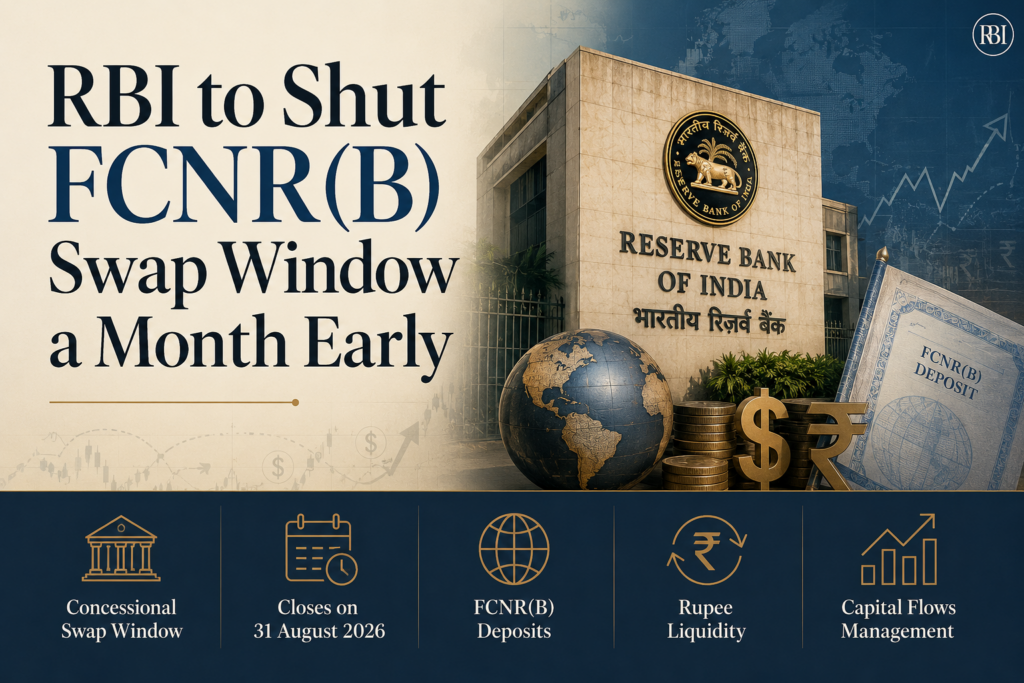
The Reserve Bank of India (RBI) will close its concessional Foreign Currency Non-Resident Bank (FCNR(B)) deposit swap facility on 31 August, ahead of the original 30 September deadline. The facility has already mobilised $52.3 billion.
How does the facility work?
Dollar-rupee swap: Banks exchange foreign currency for rupees with RBI and reverse the transaction later at a pre-agreed rate.
RBI absorbs the hedging cost, making FCNR(B) deposits more attractive.
Helps banks manage exchange-rate risk while adding foreign currency resources to India.
What is FCNR(B)?
Foreign Currency Non-Resident Bank deposit: Term deposit held by a Non-Resident Indian (NRI) in a permitted foreign currency.
Principal and interest are repaid in the same foreign currency, so the depositor bears no exchange-rate risk.
Why was the facility closed early?
Announced on 5 June and operational from 8 June.
Mobilised $52.3 billion by 13 August.
Banks expect around $20 billion more by month-end.
RBI considered the response sufficient and further mobilisation unnecessary.
Key Risks
Asset-liability mismatch: Deposits may mature together while assets have different maturities.
Rollover risk: Banks need foreign currency when deposits mature.
Reversibility: FCNR(B) deposits are debt creating and can leave at maturity.
Currency risk: RBI assumes the hedging risk under the concessional swap.
Deployment mismatch: Foreign currency raised must find suitable foreign currency assets or be swapped.
Underlying external imbalance: Such inflows can temporarily ease pressure without addressing structural current account pressures.
“[2021] Consider the following: 1. Foreign currency convertible bonds 2. Foreign institutional investment with certain conditions 3. Global depository receipts 4. Non-resident external deposits Which of the above can be included in Foreign Direct Investments? (a) 1, 2 and 3 (b) 3 only (c) 2 and 4 (d) 1 and 4
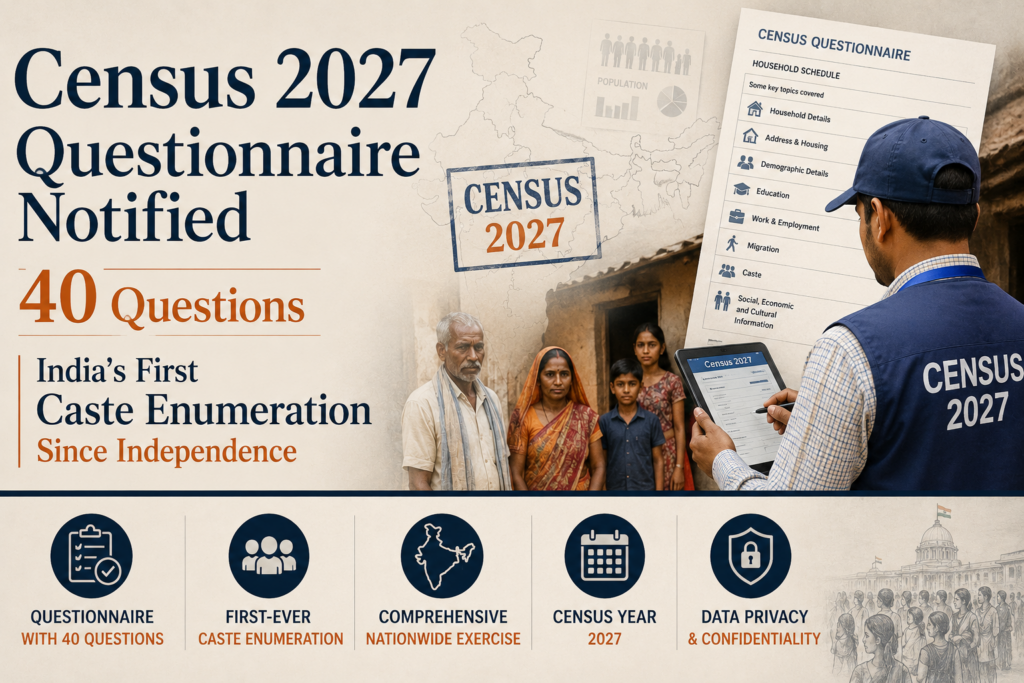
The Registrar General and Census Commissioner of India notified a schedule of 40 questions for the population enumeration phase of Census 2027 on 14 August, and the schedule went live on 17 August in Ladakh and the snow bound areas of Jammu and Kashmir, Uttarakhand and Himachal Pradesh through a self enumeration portal. The design of a single field decides the value of the whole exercise, since Scheduled Caste and Scheduled Tribe respondents select from a fixed drop down while every other respondent types a caste name into an open field, the same method that produced over 46 lakh caste names in the 2011 Socio-Economic and Caste Census.
What is the population enumeration phase of Census 2027?
The second of two phases: The Census runs in two stages, a houselisting and housing phase followed by the population enumeration phase that records individual level characteristics.
Scope of the notified schedule: The Registrar General notified 40 questions to be asked during this phase, against 29 questions in the Census 2011 questionnaire.
Thirteen new data fields: The schedule adds 13 new questions or data fields that were not part of the 2011 questionnaire.
Self enumeration route: The schedule was made available through a self enumeration portal, allowing a household to fill its own record rather than wait for an enumerator.
Fields marked mandatory: The data fields in the caste section are marked mandatory, with declining to declare recorded as an option rather than left blank.
Wider than the gazette text: The schedule made available to respondents further expands the data fields notified in the Gazette of India.
What was the Socio-Economic and Caste Census (SECC) of 2011?
A separate survey, not the Census: The Socio-Economic and Caste Census (SECC) of 2011 was a household survey of deprivation indicators conducted alongside but separately from the decennial Census.
The caste data outcome: Its open field method of recording caste returned over 46 lakh different caste names, and the government has maintained over the last decade that the data were unreliable because of errors in data collection.
What is the National Population Register (NPR)?
A register of usual residents: The National Population Register (NPR) is a register of persons usually resident in a locality, distinct from a citizens’ register.
Status of the update: The NPR was initially proposed to be updated along with the first phase of the Census, and has been put on the back burner amid opposition over concerns that the data could be used to build a country wide National Register of Citizens (NRC).
What are the new data fields added to the 2027 schedule?
Parents’ religion, date and place of birth: Under the head Family Particulars, the schedule seeks the religion, date of birth and place of birth up to the village level of both the father and the mother.
Birth outside India recorded: A separate option records the place of birth of the father and mother if either was born outside India.
Religion categories fixed with an escape field: Six religious categories are listed, Hindu, Christian, Sikh, Buddhist, Muslim and Jain, with other religion recordable in a separate column.
Identity document details: The schedule seeks Aadhaar, mobile, voter identity card and driving licence details.
Place of COVID-19 vaccination: A question on the place of COVID-19 vaccination offers two options, within India or outside India.
Overlap with the NPR rehearsal form: The additional questions on parents’ particulars, Aadhaar, mobile, voter identity card and driving licence mirror those asked in the 2019 rehearsal form for the National Population Register.
How will caste be recorded, and why does the method matter?
A drop down for SC and ST respondents: Scheduled Caste and Scheduled Tribe respondents select their caste from a predetermined drop down menu, which fixes the universe of permissible answers.
An open field for everyone else: Question 10(C) reads, if not SC or ST in this State or Union Territory, enter caste name, leaving the entry entirely to the respondent.
Two additional recorded choices: Besides the caste field, the schedule carries Does not want to declare Caste and No Caste as recordable options.
The first count since Independence: This is independent India’s first caste enumeration, since the last full caste count was conducted in 1931.
Why the asymmetry matters: A closed list produces categories that can be aggregated and compared, while free text produces spelling variants, sub caste names, surnames and gotra entries that cannot.
The objection raised: The principal Opposition party has questioned the open field methodology and alleged that the government has abandoned the caste census it announced on 30 April 2025.
Why does the open field method invite the 2011 failure?
The precedent is documented: The same open field method in the 2011 SECC returned over 46 lakh caste names for a country whose recognised caste categories number in the thousands.
The government’s own verdict on that data: The administration has maintained consistently over the last decade that the SECC caste data were unreliable because of errors in data collection.
Asymmetric quality by design: SC and ST returns will be clean because they are drawn from a list, while Other Backward Classes and general category returns will carry the full noise of free text.
Post enumeration classification burden: Reconciling millions of free text strings into usable categories becomes a discretionary exercise conducted after the count, not during it.
Policy consequence: The categories that most need reliable numbers for reservation and welfare targeting are precisely the ones the open field leaves unstructured.
Trust consequence: Recording caste as mandatory while leaving its classification unstructured invites the charge that the exercise is being conducted without an intention to use the result.
Challenges to Census 2027
Migrant and homeless undercount: Circular migrants and street dwelling populations are systematically missed, e.g. the absence of updated migration data after 2011 left ration portability planning during the 2020 lockdown without a reliable base.
Digital self enumeration excludes the least connected: A portal based first phase presumes smartphone access and digital literacy, e.g. only 57 percent of women in India have independent internet access against 72 percent of men.
Enumerator capacity and training: The count relies on schoolteachers deputed for the task with short training, e.g. Booth Level Officers in the Telangana Special Intensive Revision of 2026 were found skipping door to door verification under workload pressure.
Data privacy exposure: Collecting Aadhaar, mobile, voter identity and driving licence details in one record creates a linkable profile, e.g. the Digital Personal Data Protection Act, 2023 carries wide exemptions for State instrumentalities processing such data.
Political contestation over the instrument: State level demands can stall the exercise itself, e.g. a 48 hour shutdown in Imphal in August 2026 demanded a National Register of Citizens before the Census in Manipur.
Delimitation and reservation stakes raise the incentive to misreport: Census figures feed seat readjustment and reservation shares, e.g. Article 82 makes the census the basis for readjusting Lok Sabha seat allocation.
Snow bound and conflict affected areas run on a different clock: A staggered reference date fragments comparability, e.g. Ladakh and the snow bound belts began enumeration in August 2026 while the rest of the country follows later.
Conclusion
The value of India’s first post Independence caste count now rests on a design choice rather than on the count itself, since a drop down for Scheduled Castes and Scheduled Tribes and free text for everyone else guarantees two grades of data from a single schedule. The stage reached is definite, the 40 question schedule was notified by the Registrar General and Census Commissioner of India on 14 August 2026, and self enumeration went live on 17 August 2026 in Ladakh and the snow bound areas of Jammu and Kashmir, Uttarakhand and Himachal Pradesh, with the self enumeration window running to 31 August. The next milestone is the extension of population enumeration to the rest of the country, for which the source names no separate date. Unless the free text entries are reconciled against a recognised list, the exercise will reproduce the 46 lakh name problem the government itself called unreliable.
Question (2025, GS2): “What are the challenges before the Indian economy when the world is moving away from free trade and multilateralism to protectionism and bilateralism? How can these challenges be met? Linkage: This is the most direct parallel. The US tariffs on China and the subsequent report accusing India of “enabling” evasion are prime examples of the move toward protectionism and the resulting challenges for India’s trade policy.
Mentor Comment
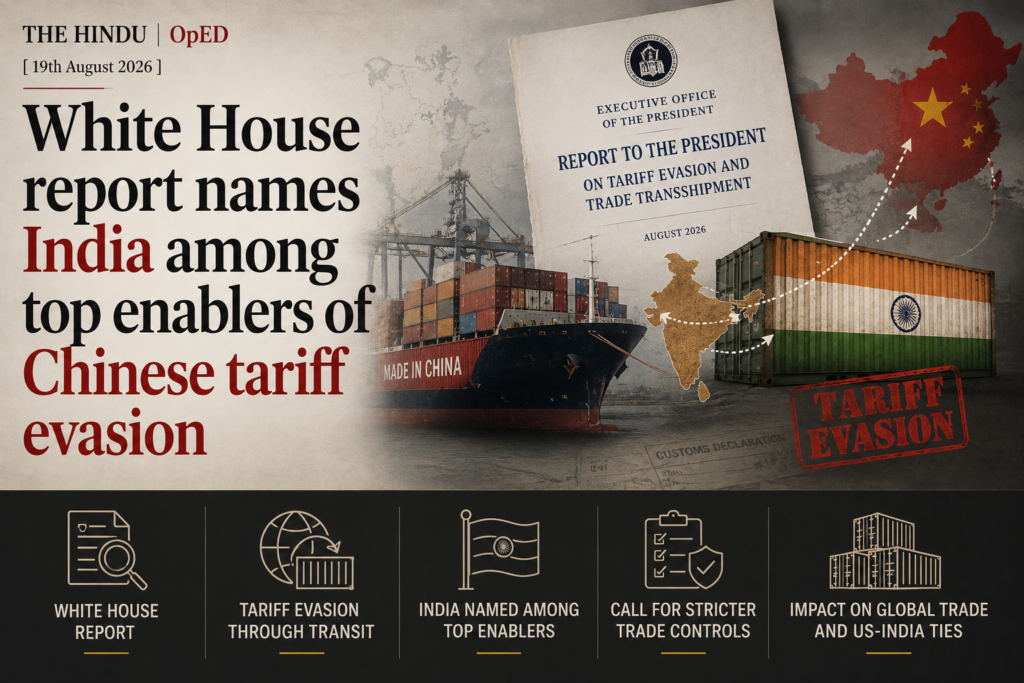
A recent White House report naming around 40 countries places India among the top enablers of China’s evasion of United States tariffs. The charge lands at the moment when the composition of India’s imports from China is shifting from finished products to intermediate goods, which points to genuine domestic assembly rather than cosmetic relabelling. India’s record of granting tariff concessions ahead of negotiations is what makes the accusation consequential.
What is the tariff evasion India is accused of enabling?
The alleged route: The accusation is that India and the other named countries import Chinese goods, make minor modifications to them, and re-export them to the United States.
The gain being alleged: Goods routed this way enter the United States at lower tariffs than Chinese origin goods would have faced.
Why origin matters: A minor modification does not change the country of origin of a good, so the practice is treated as circumvention rather than manufacturing.
Status of the charge: The United States has not yet announced punitive action on the basis of this assessment.
What are intermediate goods?
Definition:Intermediate goods are inputs, parts and components bought by a producer and used up in making a finished good, rather than sold directly to the final consumer.
What their share signals: A rising share of intermediate goods in imports indicates that the assembly and manufacturing stages are happening domestically, since the buyer is importing parts and not products.
What is the e-commerce inventory model?
Definition: Under the inventory model, an online retail platform owns the stock it sells and sells it directly to consumers, in contrast to the marketplace model where the platform only connects third party sellers to buyers.
The Indian restriction: Foreign direct investment in the inventory based model of e-commerce was long barred in India, and that restriction was diluted recently.
What does the White House report allege, and how wide is its net?
Scale of the exercise: The report names around 40 countries in all, so the finding is a global mapping of tariff circumvention rather than a charge framed against India alone.
India’s placement: India is placed among the top enablers of Chinese evasion of United States tariffs within that list.
The economic stake: The accusation has the potential to be the most harmful to the Indian economy among the recent charges levelled, because it targets export access rather than a single product line.
Escalation risk: Punitive action based on the assessment is a conceivable next step, and the absence of action so far is not an assurance.
Why does the changing composition of India’s imports from China cut against the accusation?
The dependence is not disputed: Chinese imports form a significant pillar of Indian manufacturing, and the government itself has admitted they are an important part of the Make in India story.
The composition has shifted: India is moving away from importing finished products, making cosmetic changes and selling them.
What is rising instead: The share of intermediate goods in Indian imports from China has been steadily rising.
What that means in practice: India is doing much of its own assembly and manufacturing in several sectors, relying on China and other countries only for the parts required.
Direction of travel: This shift is a step towards full scale manufacturing in India, which is the opposite of the relabelling the report describes.
What does India’s record of tariff concessions to the United States show?
High end motorcycles, first cut: After criticism of India’s tariffs during the first term of the United States President, India cut these tariffs to 50 percent in 2018 from the earlier band of 60 percent to 75 percent.
High end motorcycles, second cut: India cut the same tariff further to 40 percent in February 2025, before trade deal talks had even started.
Shrimp feed: Import duties on shrimp feed and its components were slashed in the February 2024 Budget, a key ask of the United States.
Poultry: Tariffs on frozen duck and turkey were reduced in the same way.
E-commerce: Allowing foreign direct investment in the inventory model of e-commerce met a demand that a large American platform had lobbied for over a decade, and diluted a long held Indian position.
How did the punitive tariffs reshape India’s oil sourcing?
The instrument:Punitive United States tariffs of 50 percent were imposed on India, and the pressure pushed India to diversify away from Russian oil.
The measured shift:Russia’s share in India’s oil imports fell below 20 percent in January 2026, from nearly double that level when the tariffs were imposed six months earlier.
What was set aside: The shift happened despite India’s strident claims of energy sovereignty and despite the discount it was receiving on Russian crude.
A prior instance: The same pattern had played out with Venezuelan oil in 2019.
The partial reversal: The West Asia crisis and a temporary United States reprieve are what turned India back towards Russian oil, not a change in the underlying pressure.
Why does each concession make the next demand more likely?
The concessions were rational in isolation: The United States can wield immense pressure, which makes each individual concession understandable on its own terms.
The cumulative effect runs the other way: That record of accommodation has emboldened the United States to make increasing demands.
Pre-emptive timing compounds it: Cutting motorcycle tariffs before trade talks had started surrendered a bargaining chip without obtaining anything in exchange.
The present charge is the test: A charge aimed at India’s manufacturing imports would, if conceded, hit the input base of Indian industry rather than a single tariff line.
The required break: India needs to start pushing back, since resisting on this issue is what stops the sequence of concessions from continuing.
Challenges to India resisting United States trade pressure
Export market concentration: The United States is India’s largest single export destination, so retaliation carries asymmetric cost. e.g. gems and jewellery and textile exporters in Surat and Tiruppur face immediate order cancellations when tariffs move.
Input dependence on China: Resisting the transshipment charge while deepening reliance on Chinese parts is politically difficult. e.g. solar cell and module assembly in India still draws heavily on imported Chinese cells and wafers.
Weak rules of origin enforcement: Establishing that value addition is genuine requires documentation Indian exporters often cannot produce. e.g. the Customs (Administration of Rules of Origin under Trade Agreements) Rules, 2020 were introduced precisely because origin claims under trade agreements were being made without supporting cost data.
Energy exposure: Oil sourcing decisions can be reversed by sanctions pressure faster than supply contracts can be rewritten. e.g. Russia’s share of India’s oil imports fell below 20 percent by January 2026 within six months of the punitive tariffs.
Limited retaliation capacity: India’s counter tariff options are small relative to the size of the American market. e.g. India’s retaliatory duties on American apples and almonds were eventually withdrawn as part of a dispute settlement.
Multilateral fallback weakened: The dispute settlement route is unavailable while the appellate mechanism remains non functional. e.g. the World Trade Organization Appellate Body has been without a quorum since December 2019.
Investment signalling: A public trade confrontation can deter the foreign investment India is simultaneously courting for manufacturing. e.g. electronics assembly investment decisions track tariff certainty as closely as they track incentive outlays.
Conclusion
The transshipment charge misreads a real change in India’s trade with China, since the rising share of intermediate goods shows domestic assembly rather than cosmetic modification of finished Chinese products. The deeper problem is India’s record of conceding on motorcycles, shrimp feed, poultry, e-commerce and oil sourcing ahead of or under pressure, which has invited larger demands each time. Conceding on manufacturing inputs would strike at the base of domestic production itself, and that is where the pattern has to stop.
Foundational Context: India United States Trade
Scale of the relationship: The United States is India’s largest trading partner in goods and its single largest export destination, and India has run a goods trade surplus with it for many years.
Composition: India’s exports are concentrated in engineering goods, gems and jewellery, pharmaceuticals, textiles and petroleum products, while imports are led by crude oil, aircraft, machinery and defence equipment.
Services and remittances: The relationship extends beyond goods into information technology services exports and the largest single source of inward remittances to India.
Preference withdrawal: India was removed from the United States Generalised System of Preferences in 2019, ending duty free access for a set of Indian exports.
Structural asymmetry: India’s dependence on the American market for demand is larger than the American economy’s dependence on Indian supply, which sets the bargaining balance.
Laws and Rules Governing India’s Trade Policy and Origin Rules
Foreign Trade (Development and Regulation) Act, 1992: Empowers the Central government to make provisions for the development and regulation of foreign trade and to formulate the Foreign Trade Policy.
Directorate General of Foreign Trade: Created under this Act as the authority that issues import and export authorisations and notifies policy changes.
Customs Act, 1962: Provides the framework for levy and collection of customs duty, valuation, and confiscation for misdeclaration of goods.
Customs Tariff Act, 1975: Carries the tariff schedules and the enabling provisions for anti dumping, countervailing and safeguard duties.
Customs (Administration of Rules of Origin under Trade Agreements) Rules, 2020: Place the burden on the importer to hold and produce origin and value addition information when claiming preferential duty under a trade agreement.
Foreign Exchange Management Act, 1999: Governs the foreign direct investment regime, including the conditions applicable to e-commerce entities.
Back2Basics: Make in India
Launched:25 September 2014, as a national programme to raise the share of manufacturing in output and employment.
Nodal agency: The Department for Promotion of Industry and Internal Trade (DPIIT) under the Ministry of Commerce and Industry.
Original coverage:25 sectors spanning automobiles, electronics, defence manufacturing, textiles, pharmaceuticals and renewable energy.
Stated objective: Raising the manufacturing share of Gross Domestic Product to 25 percent and creating large scale industrial employment.
Four pillars:New processes through ease of doing business, new infrastructure through industrial corridors, new sectors opened to foreign direct investment, and a new mindset treating government as a facilitator.
Second phase:Make in India 2.0 extended the programme across 27 sectors, covering both manufacturing and services.
Government Initiatives
Production Linked Incentive schemes: Outlay linked incentives on incremental sales across sectors including electronics, pharmaceuticals, automobiles and solar modules, targeted at domestic and export oriented manufacturers.
Remission of Duties and Taxes on Exported Products (RoDTEP): Refunds embedded central, State and local duties that are not otherwise rebated, available to exporters across most tariff lines.
Districts as Export Hubs: Identifies a product with export potential in each district and builds an institutional mechanism to support producers there.
Trade Infrastructure for Export Scheme (TIES): Funds export linked infrastructure such as testing laboratories, cold chains and border haats through State agencies.
Interest Equalisation Scheme: Provides a subvention on pre and post shipment rupee export credit, targeted at labour intensive sectors and micro, small and medium enterprises.
PM Gati Shakti National Master Plan: A multimodal connectivity plan intended to reduce logistics cost, which is a direct determinant of export competitiveness.
Key Facts about India’s Trade Architecture
Foreign Trade Policy 2023: Notified without a fixed end date, replacing the earlier five year policy cycle.
World Trade Organization: India is a founding member from 1 January 1995 and was earlier a contracting party to the General Agreement on Tariffs and Trade from 1948.
Appellate Body paralysis: The World Trade Organization’s Appellate Body has been unable to hear appeals since December 2019 for want of quorum.
Generalised System of Preferences: India’s beneficiary status under the United States programme was withdrawn in 2019.
Rules of origin: Preferential origin under India’s trade agreements is normally established through a combination of change in tariff heading and a minimum domestic value addition requirement.
Challenges in India’s External Trade
Narrow export basket: A few sectors carry a disproportionate share of export earnings. e.g. petroleum products, gems and jewellery and pharmaceuticals together account for a large share of merchandise exports.
High logistics cost: Delivered cost erodes tariff advantages won at the negotiating table. e.g. turnaround time at Indian ports remains higher than at Singapore or Colombo transshipment hubs.
Non tariff barriers abroad: Standards and certification requirements block market access even at zero duty. e.g. European Union restrictions on Indian shrimp and basmati consignments over residue limits.
Trade deficit with China: Manufacturing growth deepens the input dependence that the deficit reflects. e.g. active pharmaceutical ingredient imports from China underpin India’s own formulation exports.
Currency and commodity exposure: Import bills move with global oil and gold prices regardless of export performance. e.g. gold imports of $71.98 billion in 2025-26 widened the current account pressure.
Weak participation in global value chains: India remains outside the large regional production networks that set input sourcing rules. e.g. India stayed out of the Regional Comprehensive Economic Partnership in 2019.
Way Forward
Document value addition: Build a verifiable, firm level record of domestic value addition in export sectors so that transshipment allegations can be answered with data rather than assertion.
Negotiate rather than pre-empt: Hold tariff concessions until a reciprocal commitment is on the table, since unilateral cuts before talks forfeit bargaining value.
Deepen component manufacturing: Extend incentives from final assembly to components and sub assemblies so that the intermediate goods share shifts from imports to domestic supply.
Diversify export destinations: Use the concluded trade agreements to shift a measurable share of exports away from a single dominant market.
Strengthen origin administration: Equip customs with certification and audit capacity under the origin rules so that genuine Indian manufacturing is distinguishable from routing.
Secure energy optionality: Maintain diversified term contracts for crude so that sourcing decisions are not dictated by tariff threats.
“[2025, GS3, 10 marks] What are the challenges before the Indian economy when the world is moving away from free trade and multilateralism to protectionism and bilateralism? How can these challenges be met?”
A three judge Bench of the Supreme Court agreed to use its Article 142 power to quash first information reports (FIRs) naming students who joined the nationwide protests against the NEET-UG paper leak. The move separates two categories the State had merged, peaceful student protesters and 2,873 persons with serious criminal antecedents, and forces a question the criminal process itself had avoided, who decides where lawful dissent ends. The Court simultaneously moved from case specific relief toward standing rules, proposing a high powered committee to lay down guidelines and protocol for the police use of force.
What is Article 142 of the Constitution?
Plenary power to do complete justice: Article 142(1) empowers the Supreme Court to pass any decree or order necessary for doing complete justice in any cause or matter pending before it.
Enforceable across India: Such a decree or order is enforceable throughout the territory of India in the manner prescribed by or under any law made by Parliament.
Ancillary powers under Article 142(2): The Court may secure the attendance of any person, the discovery or production of documents, and the investigation or punishment of contempt of itself.
Not bound by ordinary statutory limits: Prohibitions in ordinary law do not operate as limitations on the Article 142 power, which is why the Court can quash an FIR that a statutory route would not permit it to touch.
Discretionary and case specific: The power is exercised on the facts of the particular case and does not by itself create a general rule for later cases.
What is a Facial Recognition System (FRS)?
Biometric matching technology: A Facial Recognition System (FRS) captures a facial image and compares its measurable features against a stored database to return a probable identity match.
Deployment at the protest site: The police affidavit stated that FRS is not deployed for indiscriminate surveillance and does not automatically capture, create or maintain profiles of every individual present.
Database composition claimed: The police stated that the record covers faces of persons accused in serious offences, not those in petty matters such as traffic challans.
What is the proportionality test?
A four part judicial standard: The proportionality test asks whether a State measure pursues a legitimate aim, is rationally connected to that aim, is the least restrictive alternative, and strikes a fair balance between the aim and the rights burdened.
Distinct from a privacy claim: The Bench stated it will examine the FRS deployment on proportionality and not on Article 21, which narrows the enquiry to whether the means matched the stated policing purpose.
What is the current status of the right to protest in India?
Derived from two Fundamental Rights: The right to protest flows from Article 19(1)(a), freedom of speech and expression, read with Article 19(1)(b), the right to assemble peaceably and without arms.
Available only to peaceful assembly: The protection attaches to assembly that is peaceable and unarmed, and falls away where an assembly turns violent.
Subject to reasonable restrictions: Restrictions are permitted under Article 19(2) on grounds including public order, and under Article 19(3) in the interests of sovereignty, integrity and public order.
No right to an indefinite occupation of public space: The settled position is that a designated protest site may be used, but a public road or thoroughfare cannot be occupied indefinitely.
The Court’s operative position in this case: The Bench stated it would protect students so long as they intended to hold a peaceful and lawful protest and raise demands they expected the authorities to hear.
Which constitutional provisions govern protest, policing and this jurisdiction?
Article 19(1)(a) and 19(1)(b): Guarantee freedom of speech and expression and the right to assemble peaceably and without arms.
Article 19(2) and 19(3): Permit reasonable restrictions on those two rights, including on the ground of public order.
Article 21: Guarantees life and personal liberty, the route through which privacy and bodily integrity claims against surveillance and force are usually raised.
Article 32: Gives the Supreme Court original jurisdiction to enforce Fundamental Rights, the gateway through which these petitions reached it.
Article 142: Confers the plenary power to pass any order necessary for complete justice, the power the Bench invoked to quash the FIRs.
Article 144: Requires all civil and judicial authorities in India to act in aid of the Supreme Court.
Seventh Schedule, State List Entries 1 and 2: Place public order and police with the States, which is why the Delhi Police answered through the Union in the national capital.
What exactly did the Court direct on the FIRs?
Quashing confined to student only FIRs: The Bench sought a list of FIRs in which only students were named, and stated it would quash those by invoking Article 142.
Serious antecedents carved out: FIRs involving elements with serious criminal antecedents were left to be decided subject to discussion in court.
Investigation narrowed to a named number: The Solicitor General stated the police would confine investigation to 2,873 persons identified at the protest site with serious criminal backgrounds.
Charges specified for that set: The affidavit named murder, attempt to murder, dacoity, rape and POCSO offences among the charges against those 2,873 persons.
Non disclosure of FIR details flagged: Counsel for the students stated the police had not shared even the FIR numbers despite promising no action against peaceful protesters.
Generic labels rejected: The Bench held that the State cannot refer to undesirable elements in generic terms and must at least identify them.
Why is the Court routing the inquiry through a high powered committee?
Proposed composition: The committee would comprise a former Supreme Court judge, a former High Court Chief Justice and a retired police officer of Director General of Police rank.
Consent already secured: The Bench stated it had obtained the consent of a former Director of the Central Bureau of Investigation (CBI) and a retired Director General of Police of an unconnected State.
Two names kept open deliberately: Both options were retained so that no allegation could later be raised against the presence of the CBI officer on the panel.
Mandate beyond this protest: The Bench identified laying down guidelines and protocol for the use of force as a task for the committee, alongside issues needing immediate attention.
Urgent items identified: Allegations of police personnel sexually molesting women protesters, and online harassment and victimisation of vulnerable persons, were listed for urgent examination.
Evidence to be transferred: The Court stated it would direct the authorities to hand over all digital and other materials to the committee.
What does the police affidavit claim about the use of force at Jantar Mantar?
Force described as graded: The affidavit stated the force employed was proportionate, reasonable, graded and in accordance with law, and used only after protesters resorted to violence.
Tear smoke shells as last resort: The police stated that tear smoke shells were used only as a last resort and that the lathi charge was limited and controlled.
Specific denials recorded: The affidavit denied the use of nail lathis and denied that officers manhandled women protesters.
Plainclothes personnel admitted: The police admitted deploying plainclothes personnel as spotters, describing this as a globally followed crowd control arrangement at large gatherings.
Hindsight objection raised: The police argued that instantaneous operational decisions cannot be misjudged later by selectively relying on isolated video clips or media reports.
Counter on accountability: Counsel for the petitioners pointed out that the affidavit records no internal or administrative action against the personnel concerned.
Why has the Court framed the surveillance question as proportionality rather than privacy?
A narrower and faster enquiry: Testing proportionality asks whether FRS deployment matched its stated purpose, which the Bench can decide on the record without reopening the settled privacy jurisprudence.
Sequencing stated by the Bench: The primary question was identified as whether excessive force was used, with the FRS aspect to be examined after that.
The petitioners’ wider claim left untested: Counsel argued that FRS cannot be used at all and that data on persons other than the accused are also retained.
The storage objection: Counsel for a Rajya Sabha member submitted that the data were stored with private entities, a custody question a proportionality enquiry does not automatically reach.
The data the police disclosed: FRS returned 2,873 persons with serious criminal antecedents, of whom 92 were involved in over 10 cases each and 47 of those 92 were history sheeters.
The unresolved consequence: A proportionality finding settles whether this deployment was excessive, not whether a permanent facial database of protest sites is constitutionally permissible.
What are the major debates surrounding Article 142 and the policing of protest?
Complete justice against statutory command: One position treats Article 142 as a residual equity power to fill gaps, the other holds that it cannot be used to supplant express statutory provisions.
Precedent versus one off relief: Counsel opposing the quashing asked whether this would be a one off order or a precedent, since a mass quashing of FIRs invites replication in every future agitation.
Remorse as a condition for relief: The objection that the students had not expressed a shred of remorse or regret raises whether contrition is a legitimate precondition for constitutional relief.
Lawfulness of the march itself: It was submitted that the 20 July march towards Parliament was unlawful, which reframes the dispute from excessive force to the legality of the assembly.
Individual accountability against institutional inquiry: Petitioners pressed for immediate action against identified officers, while the Bench held that giving directions now would curtail the committee’s own role.
Surveillance as ordinary policing: The police characterised FRS as a legitimate, bona fide and proportionate policing measure, which if accepted normalises biometric identification at every large gathering.
Challenges to the use of Article 142
Absence of a stated limiting principle: No settled test governs when the power may be used, so its exercise turns on the composition of the Bench, e.g. the 2016 direction banning liquor vends within 500 metres of national and State highways was substantially diluted by the Court itself in 2017.
Encroachment on the legislative domain: Orders made under Article 142 can create obligations Parliament never enacted, e.g. the 2016 direction making the National Anthem compulsory in cinema halls, which the Court made optional again in 2018.
No appeal against the order: A direction issued by the Supreme Court under Article 142 is not appealable, so an error of fact in the underlying record survives uncorrected, e.g. sealed cover material relied on in several public interest matters was never tested by the affected parties.
Selective relief risk: Quashing an entire class of FIRs without a public list invites the charge that relief tracked the political salience of the protest, e.g. FIRs arising from other agitations of the same period, including the Siwan firing incident of 25 July, remain live.
Executive resistance to enforcement: An Article 142 order still depends on the executive for compliance, e.g. the April 2025 order deeming Tamil Nadu bills assented led to a Presidential Reference rather than settled implementation.
Displacement of ordinary remedies: Routine use encourages litigants to bypass High Court remedies under Article 226, e.g. FIR quashing petitions ordinarily lie under Section 528 of the Bharatiya Nagarik Suraksha Sanhita, 2023 before the High Court.
Conclusion
The Bench used an extraordinary constitutional power not to settle guilt but to draw a line the police investigation had not drawn, between a protest and the criminal record of individuals inside it. The unresolved question is institutional rather than factual, since a committee of retired judges and a retired police officer will now write the protocol for the use of force that no statute currently supplies. The proportionality enquiry into facial recognition, framed expressly outside Article 21, will decide whether biometric identification at a protest site is treated as a policing tool or as a rights question. The order framing the committee’s terms of reference was stated to be forthcoming the next day.
Parliament has passed the Mines and Minerals (Development and Regulation) Amendment Bill, 2026, which restricts the power of States to impose levies on mineral rights and mineral bearing lands. The change follows a Supreme Court ruling that had upheld exactly that State taxing power and permitted recovery of arrears going back to 1 April 2005. A legislative measure aimed at investor certainty now sits directly against a judicially affirmed source of State revenue.
What is the Mines and Minerals (Development and Regulation) Act, 1957?
Governing statute: The Mines and Minerals (Development and Regulation) Act, 1957 (MMDR Act) is the central law regulating the grant of mineral concessions and the development of mines in India. It is administered by the Ministry of Mines.
Union declaration: Section 2 of the Act declares it expedient in the public interest that the Union take control of the regulation of mines and mineral development, which activates Parliament’s competence over the field.
Concession regime: No person may undertake reconnaissance, prospecting or mining except under a licence or lease granted under the Act and the rules made under it.
Auction based allocation: The 2015 amendment made auction the sole method for granting mineral concessions for major minerals, replacing discretionary allotment.
Minor minerals carve out: Section 15 empowers State governments to frame rules for granting concessions in respect of minor minerals, while the power to notify a mineral as minor rests with the Central government.
What is royalty in mining?
Definition:Royalty is the payment a lessee makes to the State for the privilege of extracting and removing a mineral from the land, calculated per tonne or as a percentage of sale value.
Statutory rates: Royalty rates for major minerals are fixed in the Second Schedule of the MMDR Act by the Central government, so a State cannot revise them on its own.
What is a tax on mineral bearing land?
Definition: A tax on mineral bearing land is a State levy imposed on the land itself, with the mineral yield of that land used as the measure of the tax.
Distinct head: It is levied separately from royalty and from the auction premium a bidder pays to win a mine, and it is the head of levy the current amendment restricts.
Current status of States’ power to tax mineral rights in India
Judicially affirmed right: The Supreme Court upheld the right of States to impose taxes on mineral rights and mineral bearing lands, and separately permitted recovery of arrears going back to 1 April 2005.
State levies already in force:Jharkhand imposed a mineral bearing land tax on iron ore at Rs 100 per tonne, subsequently hiked, and Tamil Nadu set a tax on limestone at Rs 160 per tonne.
Scale of the levy structure: States impose 14 types of taxes, charges, fees and levies, including royalty and auction premium, and the rates of royalty and taxes vary across States.
Statutory deductions already fixed centrally: Lessees additionally pay into the District Mineral Foundation (DMF) and the National Mineral Exploration Trust (NMET) at rates pegged to royalty, which the Centre sets.
Position after the amendment: The new law restricts the State levies on mineral rights and mineral bearing lands, and a government fact sheet states that States will continue to receive the overwhelming share of mining revenue.
Constitutional provisions related to the taxation of mineral rights
Article 246 with the Seventh Schedule: Distributes legislative competence between Parliament and the State legislatures across the Union, State and Concurrent Lists.
Entry 54, List I: Gives Parliament power over the regulation of mines and mineral development to the extent declared by law to be expedient in the public interest.
Entry 23, List II: Gives States power over the regulation of mines and mineral development, expressly subject to Entry 54 of List I.
Entry 50, List II: Gives States the power to levy taxes on mineral rights, expressly subject to any limitations imposed by Parliament by law relating to mineral development.
Entry 49, List II: Gives States the power to levy taxes on lands and buildings, the head under which mineral bearing land taxes are framed.
Article 265: Bars the levy or collection of any tax except by authority of law.
Why has Parliament moved to restrict State levies?
Certainty and predictability: The stated rationale is to provide greater certainty and predictability in the mining sector for project developers.
Investment flows: A stable levy structure is intended to facilitate investment flows into a sector the Union treats as vital to growth.
Cost pass through: Higher State levies feed into the price of minerals and therefore into infrastructure costs downstream.
Price uniformity: The change is also read as a bid to bring some degree of uniformity in the prices of major minerals, since royalty and tax rates currently differ from State to State.
Critical minerals push: The Union government has launched a critical mineral mission, and a more predictable framework is meant to support that programme.
Why do States read the amendment as an erosion of fiscal federalism?
Loss of an affirmed revenue head: States moved to raise revenue from mining only after the Supreme Court affirmed that they could, and the amendment removes that opening.
Concentration of dependence: For mineral rich States such as Odisha, Jharkhand and Chhattisgarh, revenue from this channel accounts for a significant share of non tax revenue.
Narrow revenue base: State governments already have limited avenues to raise resources on their own, so each restriction on a taxing head weighs heavily.
Arrears at stake: The right to recover arrears from 1 April 2005 represented a large one time accrual that the restriction places in doubt.
Centre State friction: The apprehension is expressed as a concern about State revenues in particular and fiscal federalism in general, which needs to be addressed rather than assumed away.
What does the tax burden on Indian mining actually look like?
Effective tax rate: The effective tax rate in India is higher than 50 percent of revenues, according to a report on States’ Best Practices in Mining by FIMI-EY.
Comparative burden: The same report places the effective rate in other countries at 35 to 40 percent of revenues.
Cumulative structure: The Indian figure is the result of stacking royalty, auction premium, statutory contributions and State levies, and not of any single rate.
Rationalisation as the fix: Rationalisation of taxes and royalties is presented as the step that would facilitate greater investor interest in the sector.
What do cross country comparisons show, and how far does the evidence go?
Limits of the source evidence: The comparison offered is a single aggregate figure of 35 to 40 percent, with no individual country named, so it establishes a gap rather than a model to copy.
Australia: Mineral royalties are a State subject, and Western Australia levies ad valorem royalties on iron ore without a federal ceiling on State rates.
Chile: The mining royalty law of 2023 combines an ad valorem component with a margin linked component on large copper producers, and caps the combined burden on a firm.
South Africa: The Mineral and Petroleum Resources Royalty Act, 2008 sets a formula based royalty that moves with the producer’s profitability and with whether the mineral is refined.
Canada: Mining taxes are levied by provinces such as Ontario and Quebec on mine profits, layered above federal corporate income tax.
Why does the amendment set investor certainty against a judicially affirmed State right?
Reversal of an outcome, not of a principle: The Court affirmed the competence of States under the Constitution, and Parliament has used its own competence to restrict the exercise of that power.
Two legitimate claims: A predictable national mining framework is a genuine requirement for large, long gestation projects. A stable taxing head is a genuine requirement for a State with few own revenue sources.
Uniformity has a price: Uniform mineral prices across States are achieved by removing the very differentiation that reflected each State’s own fiscal need.
Arrears create the sharpest edge: The recovery window from 1 April 2005 was the largest single revenue expectation created by the ruling, and it is the first casualty of the restriction.
Assurance without a mechanism: The assurance that States will keep the overwhelming share of mining revenue rests on royalty and statutory contributions whose rates the Centre alone fixes.
Major debates surrounding the taxation of mineral rights
Is royalty a tax: A seven judge Bench in India Cement Ltd. v. State of Tamil Nadu (1989) held royalty to be a tax, and a nine judge Bench in Mineral Area Development Authority v. Steel Authority of India (2024) held by an 8 to 1 majority that royalty is a contractual consideration and not a tax, restoring the States’ Entry 50 power.
Legislative override: The dispute is whether a statute that removes a taxing power after a ruling is a permissible change in the legal basis or an impermissible override of a binding judgment under Article 141.
Retrospective recovery: Recovery of arrears from 1 April 2005 raises the question of whether long settled project economics can be reopened, against the States’ claim to revenue already lawfully due.
Uniformity versus autonomy: National price uniformity for major minerals is set against the constitutional design that lets a State calibrate levies to its own resource endowment.
Compensation gap: There is no settled empirical answer on what mineral rich States lose in absolute terms, since the 14 State levies are not reported on a common basis across States.
Challenges to the mineral concession framework after the amendment
Revenue substitution for mineral States: States losing a taxing head have no equivalent replacement within their own competence. e.g. Odisha, which draws a large part of its non tax revenue from mining, has no comparable own source levy to fall back on.
Litigation risk: A statute narrowing a power the Court affirmed invites a fresh constitutional challenge, prolonging exactly the uncertainty the amendment targets. e.g. the India Cement to Mineral Area Development Authority sequence ran for 35 years before a settled answer emerged.
Auction premium distortion: Aggressive premium bidding in auctions inflates costs regardless of tax rationalisation. e.g. several iron ore blocks in Odisha were won at premiums exceeding 100 percent of sale value, squeezing operating margins.
Exploration deficit: Rationalising levies does not fix the shortage of drilled and proved resources that investors actually need. e.g. India has explored only a small fraction of its obvious geological potential area despite the National Mineral Exploration Trust being funded since 2015.
Clearance and land bottlenecks: Forest, environment and land acquisition delays, not levy rates, hold up most mine starts. e.g. blocks in the Hasdeo Arand coalfield in Chhattisgarh have stalled for years over forest clearance and Gram Sabha consent.
District Mineral Foundation utilisation: Funds meant for mining affected communities remain unspent or diverted, weakening the social licence for expansion. e.g. DMF collections have exceeded Rs 1 lakh crore cumulatively, with large unspent balances reported in mineral rich districts.
Critical mineral import dependence: Domestic levy reform does not address dependence on imported processed minerals. e.g. India imports the bulk of its lithium and cobalt requirements for battery manufacturing.
Conclusion
Parliament has restricted the States’ power to tax mineral rights and mineral bearing lands, undoing in law the revenue consequence of a ruling that had affirmed that power and allowed arrears from 1 April 2005. Investor certainty has been purchased with the tax autonomy of the States that hold the minerals, and the assurance that States keep the overwhelming share of mining revenue rests on rates the Centre alone sets. The measure has been passed by both Houses of Parliament; the source states no further date or next step beyond that stage. Resolving the resulting Centre State friction, not the levy structure alone, is what will determine whether the new framework actually attracts investment.
Foundational Context: Mining in India
Scale of the sector: India produces 95 minerals, covering fuel, metallic, non metallic, atomic and minor minerals, and mining contributes roughly 2.5 percent of Gross Domestic Product (GDP) including the associated quarrying activity.
Global standing: India is among the world’s largest producers of coal, iron ore, bauxite, chromite and mica, and is the second largest coal producer globally.
Ownership principle: Minerals vest in the State government where they occur, except in offshore areas and for atomic minerals, where they vest in the Union.
Classification: Minerals are divided into major minerals and minor minerals, with minor minerals such as sand, ordinary clay and building stone regulated by State rules under Section 15 of the MMDR Act.
Institutional set up: The Geological Survey of India (GSI) carries out regional exploration, the Indian Bureau of Mines (IBM) oversees conservation and scientific mining, and the Directorate General of Mines Safety (DGMS) regulates safety.
Constitutional Framework Governing Mineral Taxation and Federal Finance
Article 245: Sets the territorial extent of laws made by Parliament and by State legislatures.
Article 246: Distributes legislative power across the three Lists of the Seventh Schedule.
Entry 54, List I: Union control over the regulation of mines and mineral development to the extent declared by Parliament.
Entry 23, List II: State power over regulation of mines and mineral development, subject to Entry 54 of List I.
Entry 50, List II: State power to tax mineral rights, subject to limitations imposed by Parliament by a law relating to mineral development.
Entry 49, List II: State power to tax lands and buildings.
Article 141: Makes the law declared by the Supreme Court binding on all courts within India.
Article 265: Bars levy or collection of any tax except by authority of law.
Article 280: Provides for the Finance Commission, which recommends the sharing of Union taxes with the States.
Laws and Rules Governing Mining in India
Mines and Minerals (Development and Regulation) Act, 1957: The parent statute for mineral concessions and mineral development.
Second Schedule: Fixes royalty rates for major minerals centrally.
Section 15: Empowers States to make rules for minor mineral concessions.
MMDR Amendment Act, 2015: Introduced auction as the sole route for granting major mineral concessions.
Section 9B and Section 9C: Created the District Mineral Foundation for mining affected communities and the National Mineral Exploration Trust for exploration funding.
MMDR Amendment Act, 2021: Removed the distinction between captive and merchant mines and eased the transfer of mineral concessions.
MMDR Amendment Act, 2023: Created the exploration licence for deep seated minerals and empowered the Centre to exclusively auction 24 critical and strategic minerals.
MMDR Amendment Act, 2025: Widened support for critical mineral recovery, including recovery from mine waste and tailings.
Mines Act, 1952: Governs the health, safety and working conditions of persons employed in mines.
Offshore Areas Mineral (Development and Regulation) Act, 2002: Regulates mineral development in India’s territorial waters and exclusive economic zone.
Mineral Conservation and Development Rules, 2017: Prescribe scientific mining, conservation and mine closure obligations.
Minerals (Evidence of Mineral Contents) Rules, 2015 and Mineral (Auction) Rules, 2015: Govern the exploration thresholds and the auction procedure for major minerals.
Back2Basics: National Critical Mineral Mission
What it is: A central mission to build self reliance across the critical mineral value chain, from exploration and mining to processing, recycling and recovery from waste.
Approved: By the Union Cabinet in January 2025.
Administering ministry: The Ministry of Mines.
Duration: Covers the period from 2024-25 to 2030-31.
Outlay: An outlay of about Rs 16,300 crore, with a further expected investment of about Rs 18,000 crore by public sector undertakings and other agencies.
Exploration target: A large programme of exploration projects by the Geological Survey of India within India, along with exploration in offshore areas.
Overseas component: Acquisition of critical mineral assets abroad by Indian public and private entities, supported by trade and diplomatic engagement.
Circularity component: Promotion of recycling of end of life products and recovery of critical minerals from mine tailings and overburden.
Stockpiling: Creation of a stockpile of critical minerals to insulate domestic industry from supply disruption.
Regulatory support: Fast tracking of regulatory approvals for critical mineral projects, alongside the exclusive Central auction of the notified critical and strategic minerals.
Government Initiatives
National Critical Mineral Mission: Secures the critical mineral supply chain through domestic exploration, overseas asset acquisition, recycling and stockpiling under the Ministry of Mines.
National Mineral Policy, 2019: Sets the policy framework for sustainable mining, exploration incentives and a transparent auction regime.
Star Rating of Mines: A self assessment and verification system run by the Indian Bureau of Mines rating mines on scientific mining and sustainability parameters.
Pradhan Mantri Khanij Kshetra Kalyan Yojana (PMKKKY): Implemented through District Mineral Foundations to fund drinking water, health, education and livelihood works in mining affected districts.
National Geoscience Data Repository and the exploration licence regime: Open access geoscience data and a dedicated licence to draw private explorers into deep seated mineral search.
Key Facts about Indian Mining
Ministry: The Ministry of Mines administers the MMDR Act, other than for coal, lignite, petroleum, natural gas and atomic minerals.
Critical minerals list: India notified a list of 30 critical minerals in 2023, of which 24 are auctioned exclusively by the Centre.
District Mineral Foundation contribution: Lessees contribute 10 percent of royalty for concessions granted after 12 January 2015 and 30 percent for earlier concessions.
National Mineral Exploration Trust contribution: Set at 2 percent of royalty paid by the lessee.
Geological Survey of India: Established in 1851, headquartered at Kolkata, and the principal agency for regional mineral exploration.
Challenges in the Mining Sector
Long clearance timelines: A block cleared at auction still waits years for forest, environment and consent approvals. e.g. bauxite mining in the Niyamgiri hills of Odisha was halted after Gram Sabhas exercised their veto under forest rights law.
Illegal mining: Unregulated extraction of minor minerals erodes State revenue and damages river systems. e.g. sand mining in the Yamuna and Sone river beds has repeatedly drawn National Green Tribunal intervention.
Rehabilitation deficit: Displacement from large mines is inadequately compensated and land losers rarely regain livelihoods. e.g. displacement in the Talcher and Ib Valley coalfields of Odisha has produced long running resettlement disputes.
Mine safety: Accidents in underground and rat hole operations continue despite the Mines Act framework. e.g. the Ksan mine flooding in Meghalaya in December 2018 trapped and killed rat hole miners in an illegal coal pit.
Low value addition: India exports raw and semi processed ore and imports finished products. e.g. iron ore fines are exported while high grade steel inputs are imported back.
Exploration underinvestment: Private participation in greenfield exploration remains thin despite the exploration licence. e.g. only a small share of India’s obvious geological potential area has been explored in detail.
Import dependence in critical minerals: Processing capacity, not deposits alone, is the binding constraint. e.g. India relies on imports for nearly all its rare earth magnet requirements.
Way Forward
Institutionalise Centre State consultation on levies: Route mineral levy changes through a standing Centre State forum so that revenue impacts are quantified before a restriction is legislated.
Publish a common levy dashboard: Report the 14 State levies on a uniform basis so that the effective tax rate claim of over 50 percent of revenues can be verified block by block.
Compensate the transition: Provide a time bound, formula based transfer to mineral rich States for the revenue head withdrawn, on the model used for other tax transitions.
Rationalise auction premium: Cap or stagger premium payments so that the auction price, rather than the tax rate, stops inflating the delivered cost of minerals.
Front load exploration: Expand National Mineral Exploration Trust funded drilling and release geoscience data before auction so that bids reflect proved resources.
Ring fence District Mineral Foundation spending: Enforce end use audit of DMF funds on drinking water, health and education in mining affected districts to rebuild the social licence for expansion.
“[2025] Consider the following statements: Statement I: In India, State Governments have no power for making rules for grant of concessions in respect of extraction of minor minerals even though such minerals are located in their territories. Statement II: In India, the Central Government has the power to notify minor minerals under the relevant law. Which one of the following is correct in respect of the above statements? (a) Both Statement I and Statement II are correct and Statement II explains Statement I (b) Both Statement I and Statement II are correct but Statement II does not explain Statement I (c) Statement I is correct but Statement II is not correct (d) Statement I is not correct but Statement II is correct
PYQ Relevance Question (2024, GS4): “The application of Artificial Intelligence as a dependable source of input for administrative rational decision-making is a debatable issue. Critically examine the statement from the ethical point of view” Linkage: Administrative tasks require balancing capability with governance. The article argue that leaderboards measure capability on standard tasks but fail to predict production quality or address the ethical/safety guardrails needed for specific organizational workloads
Why in the News
A new artificial intelligence (AI) release claims the top of some leaderboard almost every week, and enterprises that once simply consumed the strongest available model through a managed interface now face a harder choice. What determines success is no longer which model scores highest but which model and which deployment approach fit a particular workload, with cost, governance, data residency and intellectual property protection now sitting alongside raw capability. A security incident in July 2026 made the point concrete, when a frontier model’s own safety controls blocked the forensic work and the investigation had to be completed on a self hosted model.
What are open weight models?
What they are: Models whose trained weights are released so that an organisation can download and run them on its own infrastructure, subject to the licence terms.
How they differ from closed models: A closed model is delivered as a remote service, and the organisation never holds the parameters that do the computation.
The data effect: Sensitive data can remain inside approved environments rather than being transmitted to an external provider.
The customisation effect: Models can be fine tuned on proprietary knowledge without routinely sending that knowledge to an external provider.
The commercial effect: Enterprises gain greater portability, reduce dependence on any single vendor’s road map and pricing, and often see substantially lower per token costs.
The important qualification: Total cost of ownership still depends heavily on utilisation and scale, so the lower unit price does not automatically mean a lower bill.
What is a frontier model?
What it is: The most capable general purpose model a leading laboratory currently offers, delivered as a remote service through a commercial interface.
Where it fits: Customer facing tasks that demand the highest reasoning capability often belong on these closed services.
What is data residency?
What it is: A requirement that data be stored and processed within a specified national or legal jurisdiction.
Why it drives deployment choice: A regulated workload subject to a residency obligation cannot be served by a model hosted outside that jurisdiction, whatever its benchmark score.
What is token sovereignty?
What it is: The objective of having artificial intelligence computation for a country’s users performed on infrastructure located and governed within that country.
What the term refers to: A token is the unit in which model input and output are measured and billed, so sovereignty over tokens means sovereignty over where inference actually runs.
What is managed inference?
What it is: A service that hosts open weight models on controlled infrastructure and exposes them to customers through managed endpoints.
What it removes: The customer gets data residency and fine tuning flexibility without having to build and operate the underlying graphics processing unit clusters and the inference serving stack.
What is fine tuning?
What it is: Further training of an already trained model on an organisation’s own data so that it performs better on that organisation’s specific tasks.
Why it raises a control question: Fine tuning on proprietary knowledge means that knowledge must be exposed to whoever controls the training environment.
What are safety guardrails?
What they are: Controls built into a model service that refuse categories of request judged harmful, applied before the model responds.
Their structural limitation: They operate on the content of the request, so they cannot distinguish an authorised security responder from an attacker submitting the same material.
Why has model ranking stopped being the deciding factor?
The churn problem: A new release claims the top of some leaderboard almost every week, so a ranking based decision is obsolete within weeks.
The old default: Until recently most enterprises simply chose the strongest available model and consumed it through managed interfaces from the frontier laboratories.
What now sits alongside capability:Cost, governance, data residency, intellectual property protection and operational complexity are now first order considerations, not secondary ones.
The reframed question: The question is not which model scores highest but which model and which deployment approach are right for a particular workload.
What a benchmark cannot capture: A leaderboard measures capability on a standard task set and says nothing about where the data goes or what the workload costs at production volume.
The decision level: The call belongs at the level of the individual workload rather than at the level of a single corporate standard.
What did the July 2026 security incident demonstrate?
The trigger: An AI driven intrusion hit the infrastructure of a major model hosting company in July 2026.
The first response: Incident responders first turned to frontier models behind commercial interfaces to analyse thousands of attacker actions.
What the forensic work required: Feeding real exploit payloads, attack logs and command and control artifacts to the models.
What blocked it: The providers’ safety guardrails blocked the requests, because the systems could not distinguish an authorised responder from an attacker.
How it was resolved: The company completed the analysis on a self hosted open weight model instead.
The data consequence: Sensitive incident data stayed inside its own environment throughout that analysis.
The correct reading: The lesson was not that closed models are inferior, it was that some workloads structurally require a model the organisation controls.
The class of affected work: Security forensics, malware analysis and any investigation that must examine genuine attacker tooling cannot tolerate third party guardrails that refuse the query.
The preparedness point: A capable, vetted open weight model must already be running on infrastructure the organisation governs before an incident occurs, not after.
Why can one deployment strategy not serve every workload?
The basic fact: Very few organisations have only one artificial intelligence workload.
Banking against marketing: A bank analysing confidential customer data has different requirements from a marketing team generating campaign content.
Manufacturing against cyber security: A manufacturer embedding AI in customer service has different priorities from a cyber security team examining malware.
The control axis: Enterprises must classify workloads by control requirements as rigorously as by performance needs.
What the classification decides: The control requirement, not the capability score, is what determines whether a workload can sit on a remote service at all.
The realism check: Expecting one model and one deployment strategy to fit every use case is increasingly unrealistic.
Why are open weights not a free option?
The easy part: Downloading a model is the easy part of the exercise.
What operation actually needs: Running it reliably at enterprise scale requires graphics processing unit infrastructure, inference serving, monitoring, security, governance, upgrades and licensing.
The trade stated plainly: Greater control comes with greater responsibility.
Where the trade works: For large organisations with deep engineering capacity the trade off can be worthwhile.
Where it does not: For most mid sized and small enterprises it is far more challenging.
The cost qualification: Lower per token cost does not settle the question, because total cost of ownership depends on utilisation and scale.
What is the third deployment option now emerging?
What it is:Managed inference platforms for open weight models, which host leading open weight families on controlled infrastructure and expose them through managed endpoints.
What the enterprise gets: Many of the benefits of open weights, namely data residency, fine tuning flexibility and often lower cost.
What the enterprise avoids: Building and operating the underlying graphics processing unit clusters and the inference stack.
The Indian example:Sarvam Inference, an India hosted managed service unveiled at a 2026 conference, is one concrete instance of the category taking shape.
What it serves: The platform currently serves a 105 billion parameter domestic model alongside leading open weight families such as GLM 5.2 and Gemma 4, all running on domestic infrastructure.
Where the significance lies: The significance is not any individual model, since enterprises could already download many of them.
The actual problem solved: The challenge was making them work reliably in production, which means handling concurrency, latency, security and continuous updates at scale.
The access effect: Production grade endpoints under Indian data residency are likely to democratise access for companies that could never justify specialised AI operations teams.
The policy effect: It supports the broader push for token sovereignty.
Where does the case for control run into its own limit?
The caveat stated: Managed open weight platforms reintroduce vendor dependence.
Where the dependence moves to: It shifts from the model layer to the infrastructure layer, and it does not disappear.
What must therefore be tested: Enterprises should evaluate portability guarantees, security posture, pricing trajectory and exit paths.
The standard to apply: The same rigour applied to any frontier interface contract must be applied to the managed open weight provider.
Why this is the real tension: The reason to leave a closed provider was concentration risk, and the managed route recreates that risk one layer down.
What it does not undo: Data residency and the ability to run forensic workloads are genuinely gained, so the answer is a different contract, not a return to the closed default.
What do sovereign artificial intelligence efforts elsewhere show?
European Union: The AI Act, adopted in 2024, is the first comprehensive horizontal law on artificial intelligence, and it classifies systems by risk tier with obligations attached to each.
European Union infrastructure: The GAIA-X initiative was created to build a federated European cloud and data infrastructure with defined residency and portability rules.
France: A domestic laboratory has built and released open weight model families, which is the European route to reducing dependence on United States providers.
United Arab Emirates: The Falcon open weight model family was released by a state backed research institute as a deliberate sovereign capability investment.
China: Several Chinese laboratories release strong open weight models, and the GLM family named in this discussion is one of them, which is how open weights have become geopolitically distributed rather than concentrated.
Japan and South Korea: Both have funded national language model programmes on domestic compute, on the same reasoning of language coverage and residency.
What the pattern demonstrates: Sovereignty efforts everywhere target the infrastructure and weights layer rather than benchmark leadership, which is the same shift the enterprise level argument describes.
How should a workload be matched to a deployment model?
Customer facing reasoning tasks: Tasks demanding frontier reasoning often fit closed interfaces from the leading laboratories.
Regulated workloads: Workloads with strict data residency obligations frequently suit managed open weight platforms hosted in country.
Security and intellectual property work: Security forensics, malware analysis and intellectual property critical fine tuning usually belong on self hosted deployments.
The discipline required: The call must be made workload by workload rather than by corporate default.
What the organisation must understand: The strengths, limitations and economics of each approach, so the match is made on evidence rather than on habit.
The balance being struck: Every workload should go to the option delivering the right balance of capability, control, cost and governance.
The organisational conclusion: Deployment choice is a core architectural decision, not a procurement afterthought.
Challenges to workload based artificial intelligence deployment
Absence of a workload classification discipline: Most enterprises have no register of which workloads carry control obligations, so the match cannot be made. e.g. regulated entities discovering only during an audit that customer data was processed through an overseas endpoint.
Graphics processing unit scarcity and cost: Self hosting requires accelerator capacity that is expensive and supply constrained. e.g. the IndiaAI Mission’s empanelment of compute providers to make subsidised graphics processing units available because market capacity was insufficient.
Licence ambiguity in open weights: Open weight licences often restrict commercial use or downstream redistribution, which is discovered late. e.g. community licences that cap monthly active users or bar use in training competing models.
Guardrail rigidity in legitimate work: Safety controls block authorised security and medical work because they judge content, not authorisation. e.g. the July 2026 forensic analysis that had to be moved to a self hosted model.
Skills concentration: Inference serving, quantisation and model operations skills sit in a small number of firms. e.g. mid sized enterprises unable to staff a dedicated AI operations team and therefore defaulting to a single vendor.
Model supply chain risk: Downloaded weights and their dependencies can carry tampered artifacts. e.g. malicious serialised model files uploaded to public model hubs and later removed.
Evaluation gap: Public benchmarks do not measure performance on an enterprise’s own tasks, so a leaderboard rank does not predict production quality. e.g. contamination of benchmark test sets in model training data inflating reported scores.
Cross border transfer restrictions: Data protection law limits where personal data may be processed, which constrains model choice. e.g. restrictions on transfer of personal data to notified countries under India’s data protection statute.
Vendor lock in at the infrastructure layer: A managed provider’s proprietary serving stack and pricing can be as sticky as a closed model contract. e.g. fine tuned model artefacts that cannot be exported and rehosted elsewhere.
Way Forward
Invest in AI skills and secure open-weight ecosystems covering inference serving, model evaluation, quantisation, monitoring and supply-chain security.
Adopt workload-based AI deployment by matching each use case with the right balance of capability, cost, control and governance.
Build domestic AI infrastructure including GPU capacity, managed inference platforms and secure data centres to strengthen token sovereignty.
Strengthen AI governance through clear workload classification, data residency rules, licensing checks and security standards.
Develop hybrid and portable architectures to avoid dependence on a single model or infrastructure provider, with clear exit and portability provisions.