Scientists long believed that volcanic activity on the moon ceased about a billion years ago.
However, a study based on China’s Chang’e-5 missionsamples has questioned this belief with evidence suggesting the moon had active volcanoes as recently as 120 million years ago.
Chang’e-5 Mission: Overview and Recent Findings
Chang’e-5 is a mission launched in November 2020 as part of the Chang’e lunar exploration program.
It was designed to:
Collect samples from the moon’s surface and bring them back to Earth for analysis.
Study the geologyand mineral composition of the moon.
It successfully landed on the “Mons Rumker region”, a volcanic complex in the Oceanus Procellarum (the ‘Ocean of Storms’) area on the moon’s near side, and returned about 1.7 kgof lunar material to Earth in December 2020.
Recent Findings Based on Chang’e-5 Mission
Recent studies of samples have revealed evidence of volcanic activity on the moon as recently as 116-135 million years ago.
It challenges the previous belief that the moon’s volcanic activity ceased about a billion years ago.
The analysis of lunar glass beads collected by Chang’e-5 has provided insights into both volcanic eruptions and asteroid impacts that shaped the moon’s surface.
What are the Beads on the Moon?
Lunar glass beads are small, spherical or egg-shaped glass particles found on the moon’s surface.
These beads are formed in two main ways:
Volcanic Activity: During volcanic eruptions, molten lava fragments are thrown into the air, where they cool rapidly and form glass beads.
Impact Events: When asteroids or meteorites hit the moon’s surface, the intense pressure and heat melt the surface material. The molten material cools quickly, forming glass beads as it lands back on the surface.
These beads are important because they:
Provide clues about the moon’s geological history.
Help scientists determine the age of volcanic eruptions.
Offer insights into the formation of the moon’s surface and its volcanic and impact events.
Key characteristics of Lunar Glass Beads
Composition: These beads are primarily made of silicon, magnesium, and iron, with trace amounts of other elements such as potassium, titanium, and uranium.
Volcanic vs. Impact Beads: Volcanic glass beads tend to be more uniform, while impact beads may show fractures or deformations caused by high-energy impacts. Volcanic beads often contain more volatile elements like sulphur, which are released during eruptions.
PYQ:
[2012] What do you understand by the term Aitken basin?
(a) It is a desert in the southern Chile which is known to be the only location on earth where no rainfall takes place.
(b) It is an impact crater on the far side of the Moon.
(c) It is a Pacific coast basin, which is known to house large amounts of oil and gas.
(d) It is a deep hyper saline anoxic basin where no aquatic animals are found.
The Indian Army is set to receive its first batch of three AH-64E Apache attack helicopters from Boeing in December.
About AH-64E Apache Attack Helicopters:
Details
Name and Origin
AH-64E Apache (Apache Guardian) is a highly advanced multi-role combat helicopter and lies in a heavy category.
Manufactured by Boeing, originating from the US.
India’s Acquisition
In February 2020, India signed a deal for six AH-64E helicopters, with an additional six contracted later.
Countries Operating
Operated by India, Egypt, Israel, Japan, South Korea, UAE, UK, and others.
Indigenous Production
Tata Boeing Aerospace Limited (TBAL), a joint venture, produces fuselages in Hyderabad, set to become the sole global producer, sourcing 90% of parts from India.
Combat Features
Features open architecture for advanced systems, enhanced thrust and lift, digital interoperability, improved survivability, and advanced infrared and night vision capabilities.
Deployment Plans for Apache
The Apaches are primarily suited for countering armour and will be deployed in desert regions.
However, due to their operational limitations at high altitudes, they won’t be used in regions like Ladakh.
Instead, the indigenous Light Combat Helicopter (LCH), manufactured by Hindustan Aeronautics Ltd., will be deployed in Ladakh by 2024-25.
The LCH is designed specifically for high-altitude conditions.
PYQ:
[2016] Which one of the following is the best description of ‘INS Astradharini’, that was in the news recently?
India has announced its official entry for the Best International Feature Film category at the 97th Academy (Oscar) Awards, set to take place early next year.
About the Film Federation of India (FFI)
The FFI is the main body representing the interests of the Indian film industry, including producers, distributors, and exhibitors.
It was established in 1951.
The FFI’s primary goal is to promote and protect the Indian film industry, both in India and internationally.
It plays a key role in selecting India’s official entry for the Best International Feature Film category attheOscar Awards.
How does the FFI make the choice?
Submission Process: The FFI invites filmmakers to submit their films for consideration. To be eligible, the film must:
Be at least 40 minutes long.
Have more than 50% of its dialogue in a non-English language.
Have had a theatrical release of at least seven days between November 1, 2023, and September 30, 2024.
Jury Selection: The FFI appoints a 13-member jury made up of experienced individuals from the creative field, who evaluate the films and select India’s entry.
The jury chairperson is nominated by the FFI and oversees the selection process.
Screening and Voting: The jury watches all the submissions and conducts discussions before making a final decision via voting.
Why has the FFI come under criticism?
All-Male Jury: The FFI’s current jury has drawn criticism for being composed entirely of men. This led to public discussions about the absence of women on the jury, especially since India’s official entry for the 97th Oscars focuses on women’s issues.
Arbitrary Process: FFI’s selection process can be arbitrary, and there have been calls for greater transparency and inclusiveness in choosing films for international awards like the Oscars.
PYQ:
[2014] What do understand by the concept “freedom of speech and expression”? Does it cover hate speech also? Why do the films in India stand on a slightly different plane from other forms of expression? Discuss.
The Spices Board of India aims to achieve $25 billion in annual exports of spices and spice-based products by 2047, a significant increase from the current $4.4 billion.
Current consumption is 10 million tonnes, with 1.42 million tonnes exported annually. By 2047, the export target is 2.7 million tonnes.
AboutSpices Board of India
The merger of the erstwhile Cardamom Board and Spices Export Promotion Council on 26th February 1987, under the Spices Board Act 1986 led to the formation of the Spice Board of India.
The Board functions as an International link between the Indian exporters and the importers abroad with a nodal Ministry of Commerce & Industry.
It is headed by a Chairman, a rank equivalent to Joint Secretary to the GoI.
Headquartered in Kochi, it has regional laboratories in Mumbai, Chennai, Delhi, Tuticorin, Kandla and Guntur.
Main Functions:
It promotes organic production, processing, and certification of spices.
Responsible for the overall development of Cardamom.
It focuses on post-harvest improvement programs to improve the quality of the 52 scheduled spices for export.
These programs are included under the head ‘Export Oriented Production’.
Present Scenario of Spices
Production:
Major producing states: Madhya Pradesh, Rajasthan, Gujarat, Andhra Pradesh, Telangana, Karnataka, Maharashtra, Assam, Orissa, Uttar Pradesh, West Bengal, Tamil Nadu, and Kerala.
During 2022-23, the export of spices from India stood at US$ 3.73 billion, up from US$ 3.46 billion in 2021-22.
India produces about 75 of the 109 varieties listed by the International Organization for Standardization (ISO).
Out of these spices, chili, cumin, turmeric, ginger, and coriander make up about 76% of the total production.
Chilli is the leading export earner, generating $1.1 billion annually.
Ginger exports have a compound annual growth rate (CAGR) of 27%.
Export:
In 2023-24, India’s spice exports totalled $4.25 billion, accounting for a 12% share of the global spice exports (till February 2024 data).
India exported spices and spice products to 159 destinations worldwide as of 2023-24. The top destinations were China, the USA, Bangladesh, the UAE, Thailand, Malaysia, Indonesia, the UK, and Sri Lanka. These countries accounted for more than 70% of total exports.
PYQ:
[2019] Among the agricultural commodities imported by India, which one of the following accounts for the highest imports in terms of value in the last five years?
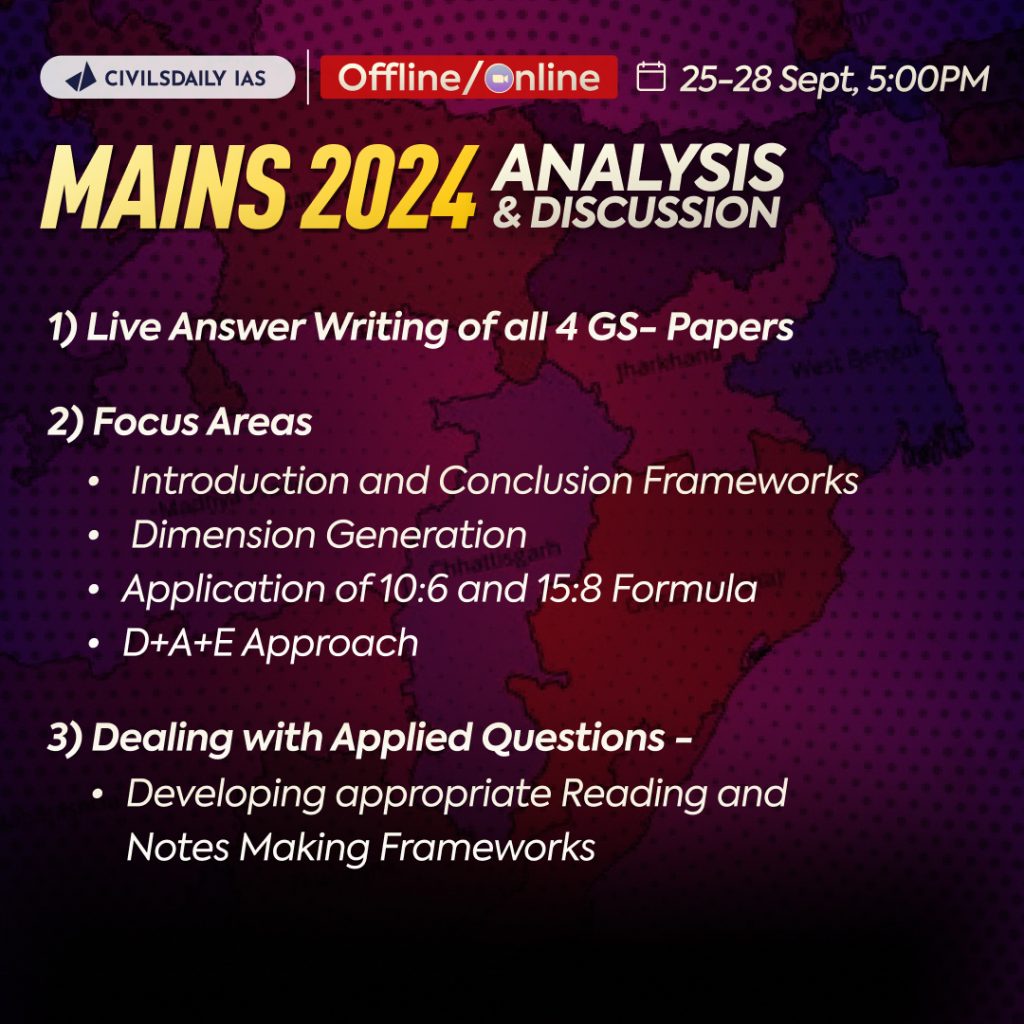
We’re excited to invite you to a masterclass that not only covers complete paper -wise analysis of UPSC Mains 2024.
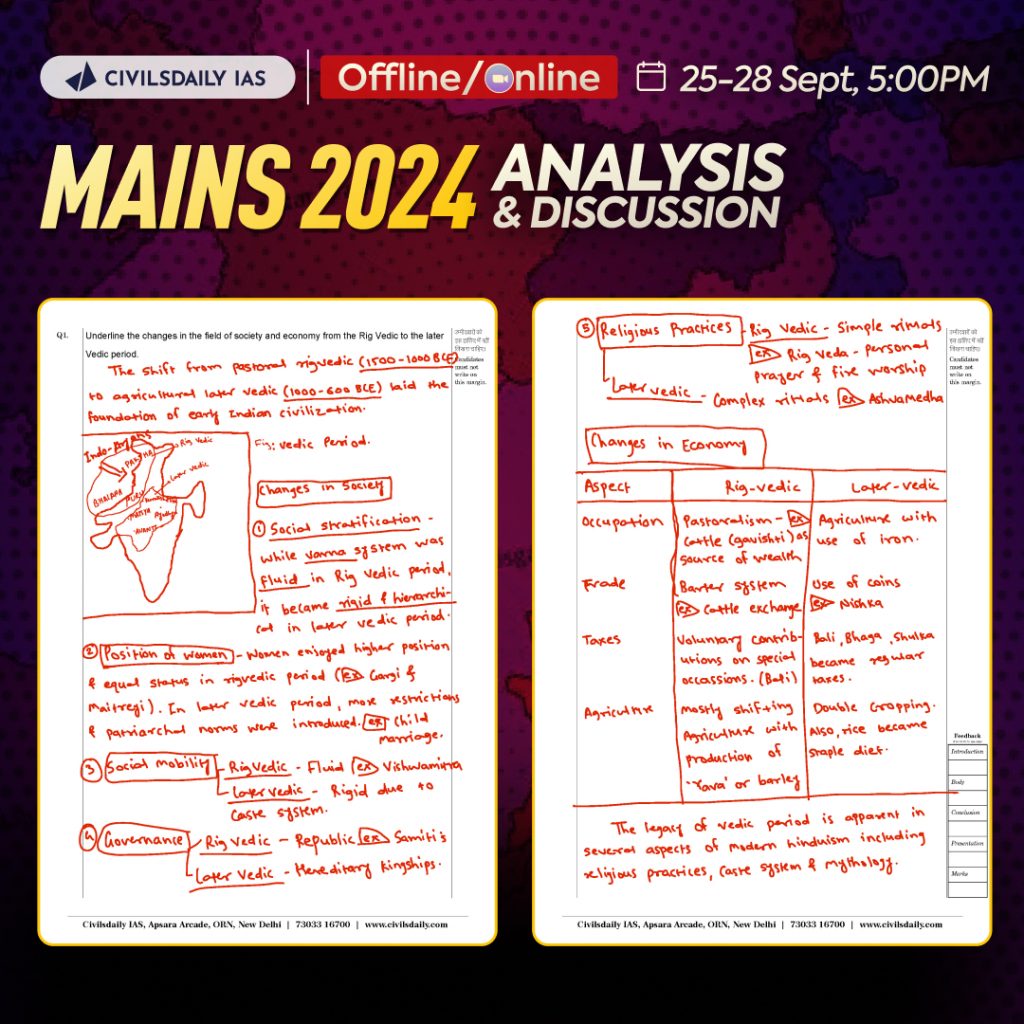
The UPSC CSE GS papers were recently completed, and we at Civilsdaily came live to give you our first reactions on those days. As promised, we will be bringing you detailed discussions on all the GS papers—GS Paper 1, 2, 3, and 4—in a 4-day conclave.
The session will be held both offline and online from 25th September to 28th September 2024 at 5 PM.
This year’s papers were a mixed bag, with UPSC covering a wide range of question types— from easy to moderate and moderate to difficult. They asked everything, from changing the name of a tornado to a twister, to out-of-the-box questions like merging urban and rural local bodies. There was also an opinion-based question in the mains format: “Is the Supreme Court of India the most powerful judiciary in the world?” The Ethics paper was lengthy, while GS Paper 3 followed the expected lines of previous year questions (PYQs). Overall, UPSC CSE Mains truly stood out from all other exams.
Our detailed discussion won’t be just a list of ChatGPT-driven pointers, but rather the result of the serious efforts our mentors have put into identifying the nuances of the papers for you. From the 25th to the 28th, we will be focusing on the following:
1) Live Answer Writing for all 4 GS papers 2) Key Focus Areas, including:
Introductions and Conclusion Frameworks
Dimension Generation—Applying Key Frameworks
Application of the 10:6 and 15:8 Formula
3) Handling Applied Questions—Developing effective Reading and Notes Making Frameworks
Join us from today onwards with just the attitude to clear the exam, and leave the rest to us! After the sessions, you’ll leave with both the confidence and the aptitude to succeed. See you all there!
Join the sessions on 25th-28th Sept 2024, 5:00 pm. This session is a must-attend for you If you are attempting UPSC for the first time in 2025 or have attempted earlier and now preparing for next year, then it is going to be a valuable session for you too.
(Don’t wait—the next webinar won’t be until Oct 24)
These masterclasses are packed with value. They are conducted in private with a closed community. We rarely open these webinars for everyone for free. This time we are keeping it for 300 seats only.
When you’re preparing for UPSC, optional subjects are a great way to maximise scoring. While there are seven papers in the UPSC mains, the last two papers are dedicated to UPSC optional subjects. You can choose from 48 optional subjects, based on what can fetch a maximum score for you. Irrespective of your education background, there’s flexibility in selecting one optional subject. However, you must not do so with whom, but with careful consideration. Let’s discover the list of UPSC optional subjects in the following discussion.
UPSC Mains Exam: At a Glance
UPSC mains exam consists of seven papers in total. Papers VI & VII are dedicated to exams on a chosen optional subject. They carry 500 marks out of 1750 in the UPSC mains.
In addition to the 25 UPSC optional subjects given above, you can choose a literature subject from any of the languages below as optional. All of them are Indian languages except English:
When you look at UPSC mains scores of two-three years, the average score of GS mains toppers is only 475-525 out of 1000.
But the toppers of UPSC optional subjects have scored 350-370 out of 500–more than 70% of marks.
So, taking advantage of UPSC optional subjects is the only way to secure a high score in UPSC. It also indicates the toughness of the exam, where the optional subject comes to your rescue towards success.
Choosing the wrong Civils optional subject can make a big difference in clearing UPSC Mains. While GS Mains scores for serious candidates may differ by 10-15 marks, the gap in optional subject scores can be as much as 40-60 marks.
UPSC doesn’t use scaling for optional subjects, unlike State PSC Exams. Instead, UPSC uses moderation, where marks are reviewed and adjusted by the chief examiner if needed.
Most Preferred UPSC Optional List
Though there are 48 subjects to choose from, UPSC allows only for choice for each candidate. So, it becomes crucial to pick the best one. In that connection, given below are the most chosen ones.
Geography: Covers physical, human, and environmental geography. Links well with General Studies papers.
History: Focuses on Indian and world history. You need to understand historical events and timelines.
Public Administration: Suitable if you’re interested in governance and government systems. Related to General Studies.
Sociology: Studies society and its issues and helps understand social problems.
Political Science and International Relations: For those into politics and world affairs.
Literature (English, Hindi, etc.) for literature lovers.
Anthropology: Studies human societies, cultures, and evolution.
Psychology: Focuses on human behaviour and mental processes. Covers personality and learning.
Best Optional Subjects in Civils 2019 as per Success Rates
Given below is the information related to the success rate of various UPSC optional subjects in 2019. It provides a clue into how you can maximise your Civils score.
UPSC Optional Subjects
No. of Candidates Appeared
No. of Candidates Recommended
Success Rate in Percentage
Animal Husbandry & Veterinary Science
16
3
18.80%
Management
54
6
11.10%
Commerce & Accountancy
183
20
10.90%
Economics
243
26
10.70%
Agriculture
124
13
10.50%
Medical Science
247
26
10.50%
Civil Engineering
146
15
10.30%
Law
186
19
10.20%
Sociology
1263
126
10.00%
Anthropology
1189
108
9.10%
Zoology
44
4
9.10%
Psychology
164
15
9.10%
Chemistry
156
13
8.30%
Mathematics
539
45
8.30%
Public Administration
705
58
8.20%
Political Science & International Relations
1662
137
8.20%
Electrical Engineering
200
16
8.00%
Physics
165
12
7.30%
Botany
28
2
7.10%
History
751
51
6.80%
Philosophy
439
27
6.20%
Mechanical Engineering
213
12
5.60%
Geography
1916
105
5.50%
Geology
30
0
0.00%
Statistics
2
0
0.00%
Choosing the Right UPSC Optional Paper
As might seem, choosing UPSC optional subjects should not be guided by whim, but with thought and deliberation. UPSC optional subjects are an opportunity if you already have expertise in one of those subjects. By selecting such a subject, you can maximise your score with little effort, given the vast syllabus of UPSC. So, evaluate the below factors before selecting one of the UPSC optional subjects.
Assess your academic background and choose a subject you’ve studied extensively.
Consider your interests and select a topic you genuinely enjoy learning about.
Evaluate syllabus overlap with General Studies to maximise preparation efficiency.
Check past years’ question papers to understand the exam pattern and type of questions asked.
Analyse scoring trends to gauge which subjects consistently yield high marks.
Review available study resources to ensure adequate material for thorough preparation.
Consult successful candidates for guidance on their selection of UPSC optional subjects.
Conclusion
UPSC optional subjects carry huge weightage and potential in helping aspirants gain maximum marks in the exam. So, paying attention and doing enough research is important before going to choose one. Making the right and strategic choice can put you ahead of the competition very easily.
FAQs
What is an optional subject in UPSC?
UPSC mains consists of seven papers for a total of 1750 marks. While the first five papers are about General studies, the choice of subject in the last two papers (VI & VII) is left to candidates. It is known as the optional subject in UPSC. Choosing the best optional can make a huge difference to the final score.
How many optional subjects are there in UPSC?
As per the official notification of 2025, there are 48 UPSC optional subjects to choose from.
What are the 26 optional subjects in UPSC?
The 26 optional subjects are Agriculture, Animal Husbandry and Veterinary Science, Anthropology, Botany, Chemistry, Civil Engineering, Commerce and Accountancy, Economics, Electrical Engineering, Geography, Geology, History, Law, Management, Mathematics, Mechanical Engineering, Medical Science, Philosophy, Physics, Political Science and International Relations, Psychology, Public Administration, Sociology, Statistics, Zoology.
Can I choose a UPSC optional subject different from my education background?
Yes, you can choose a UPSC optional subject different from your educational background. The selection should be based on your interests, strengths, and the subject’s potential to score well.
Q) “The USA is facing an existential threat in the form of China, that is much more challenging than the erstwhile Soviet Union.” Explain. (UPSC CSE 2021)
Q) Quadrilateral Security Dialogue (Quad) is transforming itself into a trade bloc from a military alliance, in present times Discuss. (UPSC CSE 2020)
Q) The China-Pakistan Economic Corridor (CPEC) is viewed as a cardinal subset of China’s larger ‘One Belt One Road’ initiative. Give a brief description of CPEC and enumerate the reasons why India has distanced itself from the same. (UPSC CSE 2018)
Mentor’s Comment: The Galwan Valley clash in June 2020 marked a significant deterioration in India-China relations, leading to profound shifts in the geopolitical and strategic calculus of both nations. The confrontation, which resulted in the deaths of 20 Indian soldiers and at least 4 Chinese soldiers, was the deadliest since the 1962 India-China war.
The future of economic cooperation between India and China will largely depend on how both nations navigate their geopolitical tensions and mutual dependencies. While there are opportunities for collaboration through investment and trade, significant barriers remain due to unresolved border disputes and India’s strategic shift towards self-reliance. As both countries reassess their positions in a rapidly changing global landscape, their economic relationship will likely continue to be characterized by cautious engagement rather than robust cooperation.
_
Let’s learn!
Why in the News?
On September 12, Indian External Affairs Minister S. Jaishankar noted that approximately 75% of disengagement issues along the border have been resolved, yet emphasized the ongoing challenge of militarization at the border.
Further, during the BRICS NSA meeting in St. Petersburg, both sides agreed to expedite efforts for complete disengagement in the remaining areas.
What are the implications of China’s border policies on India-China relations?
Escalation of Tensions: China’s aggressive border policies, particularly since the 2020 Galwan Valley clash, have led to heightened militarization along the Line of Actual Control (LAC), creating an environment of distrust and hostility between the two nations.
Strategic Reassessment: The violent confrontations have prompted India to reassess its approach towards China, moving from a stance of cautious engagement to one of strategic vigilance and preparedness for potential conflict. This includes a call for greater military readiness and strengthening alliances, such as with the Quad.
Impact on Bilateral Relations: Chinese attempts to compartmentalize the border dispute from broader bilateral ties are increasingly seen as untenable by India.
The Indian government insists that progress in overall relations is contingent upon resolving border issues.
Domestic Sentiment and Policy Changes: The public’s perception of China has deteriorated sharply following military confrontations, leading to calls for boycotting Chinese products and a general hardening of attitudes towards Beijing.
This shift in sentiment is influencing India’s foreign policy, pushing for a more adversarial stance.
Geopolitical Dynamics: China’s assertive policies in South Asia, including its close ties with Pakistan and investment initiatives through the Belt and Road Initiative (BRI), have intensified competition with India for regional influence.
This rivalry complicates diplomatic efforts and fosters a security dilemma.
What role does the QUAD play in India’s new military strategy?
•Counterbalancing China: The Quad is a platform for India to collaborate with the United States, Japan, and Australia to counter China’s assertiveness in the Indo-Pacific. This alignment helps India enhance its military capabilities and strategic posture against potential threats from China. •Enhanced Defense Cooperation: Quad Group has facilitated joint military exercises, like Malabar naval exercises, which strengthen interoperability, enhancing India’s naval capabilities and readiness to respond to regional threats.Participation in the Quad allows India to extend beyond military cooperation to global challenges such as climate change and public health. •Capacity Building and Strategic Autonomy: India leverages the Quad to build its defense capabilities through technology sharing and joint initiatives focused on maritime security, cyber defense, and humanitarian assistance.India seeks to maintain its strategic autonomy by not fully aligning itself with U.S. This approach allows India to navigate its complex relationships with both China and other regional players without compromising its interests. •Economic Opportunities: The Quad enhances India’s attractiveness as an investment destination, particularly post-COVID-19, by promoting economic cooperation among member states. For Example, vaccine distribution highlights India’s role as a leader in regional health security.
How should India respond to China’s demands for normalization of relations?
Conditional Normalization: India should continue to insist on restoring the status quo ante along the Line of Actual Control (LAC) as a prerequisite for any significant diplomatic engagement with China.
Diplomatic Engagement: India should engage in diplomatic discussions with China at various levels, including military-to-military talks and high-level political exchanges, to address mutual concerns and build confidence.
Balanced Approach to FDI: While maintaining security concerns, India could selectively ease restrictions on Chinese Foreign Direct Investment (FDI) that align with its economic interests. This approach could facilitate economic ties while ensuring that strategic sectors remain protected.
Strengthening Alliances: India should enhance collective security through QUAD and counterbalance China’s regional influence. This multilateral approach can give India greater leverage in its dealings with China.
What is the future of economic cooperation given the current geopolitical climate? (Way Forward)
The future of economic cooperation will largely depend on how both nations navigate their geopolitical tensions and mutual dependencies.
The “China plus one” strategy presents significant opportunities for India’s economic growth, particularly as global companies seek to diversify their supply chains away from China.
According to a Nomura report, India’s exports could nearly double from $431 billion in 2023 to $835 billion by 2030, driven by demand from firms relocating to India as they seek alternatives to China.
While there are opportunities for collaboration through investment and trade, significant barriers remain due to unresolved border disputes and India’s strategic shift towards self-reliance.
During the transition to the Scale-Based Regulation (SBR) framework, the NBFC sector experienced double-digit credit growth, maintained adequate capital levels, and saw a reduction in delinquency ratios.
What is Scale-Based Regulation (SBR)?
The SBR framework was first outlined in October 2021 and became effective on October 1, 2022.
It aims to categorize NBFCs based on their size, activities, and perceived riskiness rather than merely distinguishing between systemically important and non-systemically important entities.
What are the key points presented by RBI on the resilience of the NBFC sector?
Improvement in Asset Quality: Since the introduction of the Scale-Based Regulation (SBR) framework in October 2022, the asset quality of NBFCs has improved, with lower gross non-performing asset (GNPA) ratios.
By December 2023, GNPA ratios had decreased to 2.4% for government-owned NBFCs and 6.3% for non-government NBFCs, reflecting enhanced risk management.
Double-Digit Credit Growth: The NBFC sector maintained strong credit growth throughout 2023, driven by a diversified funding base, including retail credit (gold loans, vehicle loans, and housing loans) and expanding into industrial and service sectors.
Improved Profitability: The sector witnessed a rise in profitability, as evidenced by better returns on assets (RoA) and equity (RoE).
Net NPA (NNPA) Performance: Upper layer NBFCs had lower GNPA ratios than middle layer NBFCs, but the latter maintained sufficient provisions for riskier portfolios, ensuring that their NNPA ratios were also controlled.
Compliance with SBR: Major NBFCs in the “Upper Layer” identified by the RBI under the SBR framework, such as LIC Housing Finance, Bajaj Finance, and L&T Finance, have complied or initiated steps to comply with listing requirements.
Regulatory measures taken up by the NBFC sector
Scale-Based Regulation (SBR) Framework: Introduced in October 2022, the SBR framework categorizes NBFCs into different layers based on their size, systemic importance, and risk profile. For instance, strengthen asset quality, capital requirements, and risk management.
Prompt Corrective Action (PCA) Norms: Effective from October 2024, PCA norms will apply to government-owned NBFCs. These measures aim to enhance financial discipline, focusing on capital adequacy and asset quality.
Diversification of Funding Sources: Due to rising risk weights on bank lending, NBFCs have diversified their funding base by reducing dependence on bank borrowings and expanding into secured retail credit.
Listing Compliance: Many NBFCs in the upper layer have complied or are in the process of complying with listing requirements as part of regulatory mandates.
What are the emerging risks that NBFCs need to cater? (Way forward)
Cybersecurity Risks: With the increasing use of digital platforms, NBFCs need to enhance cybersecurity measures to safeguard against evolving cyber threats.
Climate Risk: The financial impact of climate change poses a new risk. NBFCs must integrate climate-related risks into their risk management frameworks to mitigate potential disruptions.
Financial Assurance Functions: The RBI emphasizes that assurance functions like risk management, compliance, and internal audit are critical in maintaining resilience in the face of rapid changes in the financial landscape.
Evolving Regulatory Environment: As the financial sector continues to evolve, NBFCs must stay ahead of regulatory changes and ensure that their risk management practices are aligned with emerging threats and new regulations.
On September 20, 1932, Mahatma Gandhi began a fast unto death in Yerawada Jail, Pune, to protest against the provision of separate electorates for Scheduled Castes.
Gandhi vs Ambedkar on Caste
Gandhi’s Views on Caste: Initially orthodox, Gandhi supported social prohibitions like restrictions on inter-dining and inter-marriage but later rejected untouchability, referring to untouchables as “Harijans.” However, he did not reject the institution of caste itself, as it was tied to Hindu religious practices.
Ambedkar’s Radical Approach: Ambedkar believed that to truly abolish caste, one needed to attack the divine authority of the Hindu scriptures (shastras) that justified it. He argued that reforms short of rejecting the religious basis of caste were insufficient.
Ambedkar’s strategy was to focus on lower castes achieving political power to challenge their subjugation within the Hindu social order.
Ambedkar’s Argument for Separate Electorates
Distinct Identity of Depressed Classes: Ambedkar argued that the Depressed Classes (Scheduled Castes) formed a distinct group, separate from the Hindus. Despite being part of Hindu society, they did not enjoy equal treatment and were subject to systemic oppression.
Political Machinery for Representation: Ambedkar advocated for separate electorates with a double vote system, where Scheduled Castes would vote for their own candidates as well as in the general electorate.
Protection from Majority Rule: Ambedkar warned that joint electorates would allow the Hindu majority to control the election of Dalit representatives, making it impossible for lower castes to effectively protect their interests against the tyranny of the majority.
Why Gandhi Opposed Separate Electorates
Integration of Lower Castes: Gandhi opposed separate electorates because he believed they would marginalize lower castes further.
Instead of being restricted to a limited share of seats, Gandhi thought lower castes should aim for broader participation in political leadership.
Fear of Dividing Hindu Society: Gandhi feared that separate electorates would divide Hindu society, further weakening it.
He believed this division would help the British continue their “divide and rule” policy, undermining India’s struggle for independence.
Strategic Concerns: The introduction of separate electorates for Scheduled Castes, in addition to those for Muslims, would fragment the Hindu political base, reducing the power and influence of upper-caste Hindu leadership.
Culmination of the Debate: The Poona Pact
Gandhi’s Fast: In 1932, Gandhi went on a fast unto death to oppose separate electorates, pressuring Ambedkar to concede. Ambedkar, despite his misgivings, agreed to the Poona Pact, which provided for reserved seats for Scheduled Castes but within a joint electorate.
Ambedkar’s Dissatisfaction: Ambedkar was never fully satisfied with the outcome, believing the joint electorate allowed upper-caste Hindus to nominate Dalit representatives, effectively controlling their political voice.
Conclusion: The Gandhi-Ambedkar debate on caste culminated in the Poona Pact, with Gandhi opposing separate electorates to maintain Hindu unity, while Ambedkar sought political power for lower castes. Though Ambedkar agreed, he remained dissatisfied with the compromise.
Mains PYQ:
Q Mahatma Gandhi and Dr. B R Ambedkar, despite having divergent approaches and strategies, had a common goal of amelioration of the downtrodden. Elucidate. (UPSC IAS/2015)
In a recent ruling, the Supreme Court has tightened child pornography laws, declaring that viewing, possessing, or failing to report such content is punishable under the Protection of Children from Sexual Offences (POCSO) Act, regardless of whether the material is shared or transmitted.
What is the law in question?
The Supreme Court expanded the interpretation of Section 15 of the POCSO Act, which deals with “Punishment for storage of pornographic material involving child”.
In 2019, the POCSO Act was amended to introduce three connected offences under Sections 15(1), (2) and (3) with increasing grades of punishment:
Any person, who stores or possesses pornographic material involving a child, but fails to delete, destroy or report the same to the designated authority with an intention to share or transmit child pornography.
Any person, who stores or possesses such material for transmitting, propagating, displaying or distributing in any manner at any time except for reporting or use as evidence in court.
Any person, who stores or possesses such material for commercial purpose.
The court refers to these as “inchoate” offences – offences in anticipation or preparation for committing a further criminal act.
About the Case and SC’s Verdict
Case Background: The Supreme Court was dealing with a case where the Madras High Court had quashed criminal proceedings against a man who had downloaded child pornography but did not share it.
The High Court had limited its ruling to Section 14 of POCSO (using children for pornography) and excluded Section 15 (punishing possession) since no evidence of sharing existed.
Supreme Court’s Verdict:
The SC overturned the Madras High Court’s ruling, expanding the definition of “possession” of child pornography to include “constructive possession”, even without physical storage of the material.
Viewing, controlling, or exercising knowledge over such material (e.g., watching without downloading) was deemed sufficient for possession.
The SC stressed that even failing to delete or report such content implies intent to share and is punishable under Section 15(1).
Even if the accused does not have the material at the time of filing the FIR, they can still be held accountable if they had possessed it “at any point”.
How will such cases be registered?
Determination of Intention: The court held that the intention (mens rea) of the accused will be determined based on the circumstances, such as how the material was stored or possessed and why it was not reported or destroyed.
Actions like storing, not deleting, or failing to report child pornography can be used as evidence of intent to share or distribute.
Role of Police: The police must not limit their investigation to only one sub-section of Section 15. Even if a specific offence isn’t made out, the police should explore the possibility of other violations under different sub-sections.
Reporting Obligation: The court emphasized the mandatory reporting of child pornography, with penalties for failing to report starting from a fine of Rs. 5,000 and increasing for repeat offences.Failure to report, even after merely viewing child pornographic material, can result in legal consequences.
Conclusion: The Supreme Court’s ruling on the POCSO Act broadened the definition of possession, emphasizing that failure to delete or report child pornography constitutes intent to share, with strict penalties for non-compliance, underscoring the obligation to report such content.

![[UPSC Openhouse] On Detailed Discussion and Analysis of UPSC Mains GS Papers 2024 | Solve Live Mains Paper with CD Mentors || Join on 25th-28th Sept 2024, 5 PM](https://www.civilsdaily.com/wp-content/uploads/2024/09/Analysis-and-Discussion_thumb-1568x882.jpg)

![[24th September 2024] The Hindu Op-ed: Weighing in on business as usual with China](https://www.civilsdaily.com/wp-content/uploads/2024/09/24-SEP-1568x882.jpg)