India is preparing to introduce the BPaL (bedaquiline, pretomanid, and linezolid)regimenfor all patients with multi/extensively drug-resistant tuberculosis (M/XDR-TB).
What is BPaL Regimen?
Details
Purpose
Treatment for multi-drug resistant (MDR) and extensively drug-resistant (XDR) tuberculosis (TB).
Provides a potent, shorter, and more effective treatment option for patients resistant to standard TB drugs.
Components of the regimen
Bedaquiline (Bdq):
Targets ATP synthase enzyme in Mycobacterium tuberculosis, disrupting energy production.
Key drug in combating drug-resistant TB.
Pretomanid (Pa):
Inhibits bacterial cell wall synthesis and kills bacteria under anaerobic conditions.
Enhances effectiveness when combined with other TB drugs.
Linezolid (Lzd):
Inhibits protein synthesis, stopping bacterial growth.
Effective against MDR and XDR TB strains.
Significance of BPaL Regimen
Studies and trials have shown that the BPaL regimen has higher success rates in treating MDR and XDR TB compared to older regimens.
It reduces treatment duration for MDR/XDR-TB from the traditional 18-24 months to 6 months approx.
It is entirely oral with NO injectable, making it easier for patients to adhere to the treatment.
It reduces number of drugs patients need to take daily from up to 14 to just 3.
PYQ:
[2014] Can overuse and free availability of antibiotics without Doctor’s prescription, be contributors to the emergence of drug-resistant diseases in India? What are the available mechanisms for monitoring and control? Critically discuss the various issues involved.
The opposition has submitted a notice in the Rajya Sabha to initiate privilege proceedings against Union Education Minister.
It is alleged that the Minister ‘misled’ the House regarding the issue of the Preamble to the Constitution being ‘dropped’ from certain NCERT textbooks.
What is a Privilege Motion?
Details
What is it?
A formal notice by an MP when rights or privileges of Parliament or its members are breached.
Parliamentary privilege refers to the right and immunity enjoyed by legislatures (Article 105).
Who can move such motion?
Any Member of Parliament (MP) from Lok Sabha or Rajya Sabha.
Governing Rules
Lok Sabha Rule book: Rule 222, Chapter 20
Rajya Sabha Rule book: Rule 187, Chapter 16
Procedure
Requires consent from Speaker/Chairperson;
Notice must concern a recent incident needing House intervention.
Role of Speaker/Chairperson
First level of scrutiny;
Can decide on the motion or refer it to the Privileges Committee.
Privileges Committee
Lok Sabha: 15 members, nominated by Speaker
Rajya Sabha: 10 members, headed by Deputy Chairperson
Outcome
Committee submits a report;
House may debate and pass a resolution based on the report.
Historical Example
1978: Privilege motion against Indira Gandhi, leading to her expulsion from the Lok Sabha.
Legal Implications
If a breach of privilege is established, the Parliament has the authority to impose penalties.
These can range from a reprimand to expulsion from the House, depending on the severity of the breach.
PYQ:
[2014] Consider the following statements regarding a No-Confidence Motion in India:
1. There is no mention of a No-Confidence Motion in the Constitution of India.
2. A Motion of No-Confidence can be introduced in the Lok Sabha only.
Which of the statements given above is/are correct?
The Union Cabinet has approved the Clean Plant Programme (CPP) proposed by the Ministry of Agriculture and Farmers Welfare.
What is the Clean Plant Programme (CPP)?
Details
Objective
To providevirus-free, high-quality planting material to farmers, enhancing the quality, productivity, and sustainability of fruit crops across India.
Aligns with Mission LiFE and One Health initiatives, promoting sustainable practices and reducing dependence on imported planting materials.
Key Features
Virus-Free Planting Material: Ensures availability of high-quality, virus-free planting material.
All-inclusivity: Accessible to all farmers, with emphasis on women’s participation.
Region-Specific Approaches: Tailored strategies for diverse agro-climatic conditions across India.
Core
Components
Clean Plant Centers (CPCs): Nine state-of-the-art CPCs equipped with advanced diagnostics and tissue culture labs will be established across India. These include:
These centers will produce and maintain virus-free planting material for large-scale propagation.
Certification and Legal Framework: Under the Seeds Act of 1966.
Nursery Infrastructure: Support for large-scale nurseries to multiply clean planting materials.
Key Benefits
For Farmers: Increased crop yields, improved income opportunities, and economic stability through access to virus-free, high-quality planting materials.
ForConsumers: Access to superior quality, virus-free fruits, resulting in better taste, appearance, and nutritional value.
For nation: Strengthened position in global fruit trade through the production of higher-quality, disease-free fruits.
PYQ:
[2013] Fruits stored in a cold chamber exhibit longer storage life because:
(a) Exposure to sunlight is prevented
(b) Concentration of carbon dioxide in the environment is increased
(c) Rate of respiration is decreased
(d) There is an increase in humidity
[2018] Assess the role of National Horticulture Mission (NHM) in boosting the production, productivity and income of horticulture farms. How far has it succeeded in increasing the income of farmers?
UK researchers suggest stricter daily silica dust exposure limits in industries could save 13,000 lives as per British Medical Journal Thorax.
What is Silicosis?
Silicosis is a lung disease that results in the hardening of the lungs. It is caused by inhaling silica dust or crystals, commonly found in soil, sand, concrete, mortar, granite, and artificial stone.
Silicosis is a chronic disease that develops slowly, often after 10 to 20 years of exposure.
Silicosis can lead to other severe conditions, including lung cancer, tuberculosis, and chronic obstructive pulmonary disease (COPD).
Note: Silicosis is a recognized disease under the Mines Act (1952) and the Factories Act (1948).
Causes of Silicosis:
Workers in industries such as construction, mining, oil and gas extraction, kitchen engineering, dentistry, pottery, and sculpting are at high risk.
The cutting, drilling, or breaking down of materials containing silica releases fine dust into the air.
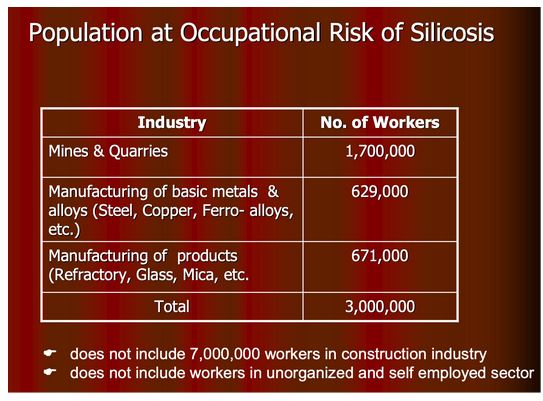
As per National Programme on Elimination of Silicosis in India
Remedies for Silicosis:
Currently, there is no cure for silicosis, and treatment focuses on managing symptoms and preventing complications.
Preventive measures:
Water Suppression Techniques: Using water or foam to suppress dust at the source.
Proper Ventilation: Ensuring adequate airflow in work environments to reduce dust accumulation.
Personal Protective Equipment (PPE): Providing workers with masks and respirators that filter out fine particles.
Regular Monitoring: Implementing regular health checks for workers and monitoring air quality in workplaces.
Case study related to reducing Silica Dust Exposure
United States: Implemented stricter regulations on silica dust, resulting in a significant reduction in silicosis cases.
Australia: Banned the use of engineered stone due to its propensity to release high levels of silica dust when cut or drilled.
PYQ:
[2019] Why is there a great concern about the ‘microbeads’ that are released into environment?
(a) They are considered harmful to marine ecosystems.
(b) They are considered to cause skin cancer in children.
(c) They are small enough to be absorbed by crop plants in irrigated fields.
(d) They are often found to be used as food adulterants.
Q1 “Policy contradictions among various competing sectors and stakeholders have resulted in inadequate ‘protection and prevention of degradation to the environment.” Comment with relevant illustrations. (UPSC IAS/2018)
Q2 Environmental Impact Assessment studies are increasingly undertaken before a project is cleared by the Government. Discuss the environmental impacts of coal-fired thermal plants located at coal pitheads. (UPSC IAS/2014)
Note4Students:
Prelims: What is just a transition concept?;
Mains: Advantages of a just transition framing;
Mentor comments: In April 2024, the Supreme Court of India delivered a significant judgment in the case of “M.K. Ranjitsinh and Others vs Union of India.” The two-judge bench, comprising Justice Sanjiv Khanna and Justice Dipankar Datta, ruled on the matter concerning the rights of wildlife and environmental protection. The court emphasized the importance of safeguarding natural habitats while balancing developmental needs, thereby reinforcing the legal framework aimed at preserving biodiversity and ecological integrity in India. This ruling reflects the judiciary’s commitment to environmental justice and sustainable development practices.
Let’s learn!
__
Why in the News?
In April 2024, the Supreme Court of India, in the case of “M.K. Ranjitsinh and Others vs Union of India”, acknowledged a human right to be free from the adverse effects of climate change.
This landmark decision has generated considerable discussion, with varying opinions. For some, it represents a significant advancement in climate action, while others contend that it inadequately safeguards endangered biodiversity.
Key points as per judgement:
Recognition of Human Rights Against Climate Change: The Supreme Court’s judgement recognized a human right against the adverse impacts of climate change, marking a significant step in the realm of environmental jurisprudence in India.
Concept of Just Transition: The judgement emphasized the importance of framing climate action through the lens of “just transition.”
Inclusion of the Non-Human Environment: A significant aspect of the judgement was the consideration of introducing the non-human environment, such as biodiversity and ecosystems, as a subject within the concept of just transition.
Mixed Reactions: The decision has sparked diverse opinions. While it is seen as a victory for climate action, some critics argue that it has not sufficiently protected endangered biodiversity, especially species like the Great Indian Bustard.
What is just a transition concept?
The concept of just transition refers to a framework aimed at ensuring that the shift from a high-carbon economy to a low-carbon economy is equitable and inclusive, addressing the social, economic, and environmental impacts of this transition.
Advantages of a just transition framing
Equitable Climate Action: Framing the case within a just transition context allows the court to promote equitable and inclusive climate action. It shifts the narrative from viewing decarbonisation and biodiversity protection as adversarial to recognising their interdependence.
This approach can prevent the marginalisation of biodiversity interests, ensuring that the burdens of climate action are shared fairly among all stakeholders, including affected communities and ecosystems.
Expansion of Just Transition Concept: The case provides a unique opportunity to broaden the just transition framework by incorporating the non-human environment, specifically the Great Indian Bustard, as an affected entity.
This inclusion can help develop jurisprudence that recognizes the rights of nature and expands the understanding of just transition beyond human communities, aligning with emerging eco-centric legal principles.
Catalyst for Research and Awareness: Introducing the just transition concept in this case can stimulate much-needed research on just transition litigation in India, an area that remains underexplored.
By mapping existing cases and integrating them into the broader discourse on just transitions, the court can contribute to filling gaps in knowledge and understanding of how climate justice can be effectively achieved in the context of renewable energy projects.
Way forward:
Developing a Comprehensive Legal Framework for Just Transition: The Supreme Court should advocate for the creation of a robust legal framework that explicitly incorporates the principles of just transition. This framework should provide clear guidelines for ensuring that climate action, particularly decarbonisation efforts, is inclusive and fair to all stakeholders, including vulnerable communities and ecosystems.
Establishing a Multidisciplinary Task Force for Monitoring and Implementation: The Court could recommend the formation of a multidisciplinary task force comprising experts in environmental law, social justice, economics, and biodiversity conservation.
The increase in drug-resistant fungal infections, especially Trichophyton indotineae, is becoming a major health problem in India.
What Is Trichophyton Indotineae?
Trichophyton indotineae is a dermatophyte commonly known as ringworm or jock itch.
First identified in India, this fungus has now spread to several countries worldwide.
It belongs to genotype VIII within the T. mentagrophytes/T. interdigitale species complex, found in regions including Australia and Oman.
Factors causing its spread
Patients often present with persistent, treatment-resistant rashes that can be mistaken for eczema or other skin conditions.
Misdiagnosis leads to the use of ineffective treatments, prolonging patient suffering and allowing the infection to worsen.
Trichophyton indotineae has shown resistance to terbinafine due to genetic mutations, with growing resistance to itraconazole also a concern.
The unregulated sale of steroid-containing combination creams further complicates treatment efforts.
Treatments available
Alternative to terbinafine and Itraconazole are available but often come with significant side effects, requiring close monitoring by healthcare providers.
Integrating comprehensive skin care regimens can enhance treatment efficacy, including maintaining skin hydration and using barrier creams.
PYQ:
[2014] Lichens, which are capable of initiating ecological succession even on a bare rock, are actually a symbiotic association of:
Former CM of West Bengal and leader Buddhadeb Bhattacharya passed away at 80.
Who was Buddhadeb Bhattacharya?
Bhattacharya was a politician who served as CM of West Bengal from 2000 to 2011.
He was known for his attempts to modernize and industrialize West Bengal while navigating the challenges of maintaining communist ideology.
In 2022, Bhattacharya was awarded Padma Bhushan by the Indian government, which he declined, citing his political principles.
Key Contributions:
Category
Details
Political Reforms
Attempted to reduce the influence of powerful trade unions in the state, particularly in the industrial sector, to attract investments and improve work culture.
Social-Cultural Reforms
Played a key role in establishing the Kolkata International Film Festival and promoted Bengali literature.
Authored several books and translated works of Gabriel Garcia Marquez and Vladimir Mayakovsky into Bengali, enriching the state’s cultural heritage.
Introduced measures to eliminate corruption in school recruitments by ensuring all hiring was conducted through transparent exams.
Initiated reforms to integrate mainstream subjects into madrassa education.
Economic Reforms
Led efforts to industrialize West Bengal by attracting investments in IT, steel, and special economic zones (SEZs), including the Tata Nano project in Singur.
Faced significant opposition and protests in Singur and Nandigram over land acquisition, which ultimately contributed to the political decline of the Left Front.
PYQ:
[2011] Karl Marx explained the process of class struggle with the help of which one of the following theories?
Lalit Kala Akademi, National Gallery of Modern Art
Objective
Enhance New Delhi’s cultural and aesthetic outlook
Key Themes
Nature tributes, Natyashastra, Gandhi ji, Toys of India, Hospitality, Ancient knowledge, Naad (Primeval Sound), Harmony of Life, Kalpataru (Divine Tree).
Artist Participation
Over 200 visual artists; significant participation from women artists
Artforms included
Phad paintings (Rajasthan), Thangka painting (Sikkim/Ladakh), Miniature painting (Himachal Pradesh), Gond art (Madhya Pradesh), Tanjore paintings (Tamil Nadu), Kalamkari (Andhra Pradesh), Alpona art (West Bengal), Cheriyal painting (Telangana), Pichhwai Painting (Rajasthan), Lanjia Saura (Odisha), Pattachitra (West Bengal), Bani Thani Painting (Rajasthan), Warli (Maharashtra), Pithora Art (Gujarat), Aipan (Uttarakhand), Kerala Murals (Kerala), Alpana art (Tripura).
PYQ:
[2018] The well-known painting “Bani Thani” belongs to the:
Facing a significant decline in its tiger population in recent years, Chhattisgarh on Wednesday approved a long-awaited proposal to establish a new tiger reserve, which will be the third largest in the country.
Process of Notification of Tiger Reserves
Proposal and Evaluation: The state government initiates the process by proposing an area to be designated as a tiger reserve. This proposal is then evaluated by the National Tiger Conservation Authority (NTCA).
Cabinet Approval: After NTCA’s recommendations, the state cabinet must approve the notification of the tiger reserve.
Integration of Areas: The Guru Ghasidas-Tamor Pingla Tiger Reserve integrates the existing Guru Ghasidas National Park and Tamor Pingla Wildlife Sanctuary, covering an area of 2,829 square kilometers.
Note: Once a tiger reserve is notified, it cannot be easily denotified. The Wildlife (Protection) Act, 1972, allows for denotification only under exceptional circumstances and with approval from the NTCA and the National Board for Wildlife.
About Guru Ghasidas-Tamor Pingla Tiger Reserve
It is Chhattisgarh’s fourth tiger reserve, following Indravati, Udanti-Sitanadi, and Achanakmar.
The reserve spans four districts: Manendragarh-Chirmiri-Bharatpur, Koriya, Surajpur, and Balrampur.
It aims to bolster conservation efforts and provide a protected habitat for tigers, thereby promoting eco-tourism and creating employment opportunities for local communities.
It aims to bolster conservation efforts and provide a protected habitat for tigers by Providing additional budgetary resources from the National Project Tiger Authority for its operations.
It would promote eco-tourism and create employment opportunities for local communities.
Tiger Reserves in India
As of June 2024, India has 55 tiger reserves. This number has increased from 9 reserves in 1973 when Project Tiger was initiated. India is home to around 75% of the global tiger population.
The latest addition to the list is the Dholpur-Karauli Tiger Reserve in Rajasthan, which is the 55th reserve established in the country.
These reserves are crucial for the conservation of the Bengal tiger, which is a keystone species in India’s ecosystems, and they collectively support around 80% of the world’s tiger population.
Madhya Pradesh has the highest number of tigers at 785, followed by Karnataka (563), Uttarakhand (560), and Maharashtra (444).
The initiative was taken by the Government:
Strengthening Legal Framework: The Wildlife (Protection) Act, 1972 provides a legal framework for tiger conservation, establishing national parks, wildlife sanctuaries, and critical tiger habitats. The 2006 amendment led to the creation of the National Tiger Conservation Authority (NTCA).
Anti-Poaching Measures:Special Tiger Protection Force (STPF) has been deployed in tiger reserves to combat poaching. Modern surveillance technologies like camera traps and drones are used to monitor tiger populations and deter poaching activities.
To avoid human-tiger conflict: As of 2023, 12,327 families from 173 villages have been successfully relocated from tiger reserves to reduce human-tiger conflict.
Way forward:
Undertake habitat restoration measures in the tiger reserves, including prey base management and removal of invasive species, to improve the quality of tiger habitats.
Deploy the Special Tiger Protection Force (STPF) in the newly notified Guru Ghasidas-Tamor Pingla Tiger Reserve to curb poaching.
Mains PYQ:
Q How does biodiversity vary in India? How is the Biological Diversity Act,2002 helpful in conservation of flora and fauna? (UPSC IAS/2018)
Wrestler Vinesh Phogat was disqualified from the Paris Olympics after the official weigh-in on Wednesday morning, before her scheduled gold medal bout in the evening, leaving her without a medal.
What is Weight Cutting?
Weight cutting is the process by which athletes systematically reduce their body weight before a competition. This typically involves a combination of dietary restrictions and intensive physical activity aimed at shedding a specific amount of weight, often over a period of weeks leading up to the event.
Wrestlers often employ extreme measures such as skipping meals, limiting water intake, and engaging in intense exercise, including sauna sessions and wearing heavy clothing to promote sweating. This can lead to rapid weight loss primarily through fluid loss.
Why Do Combat Athletes Cut Weight?
Combat sports like wrestling, boxing, and mixed martial arts (MMA) are organized by weight classes to ensure fair competition. Athletes aim to compete in lower weight classes to gain a size and strength advantage over their opponents, as they can often regain weight after the weigh-in.
By cutting weight, athletes believe they can compete against opponents who are lighter and potentially less strong, thus increasing their chances of success in the competition.
Should Weight Cutting Be Banned?
The practice of weight cutting poses significant health risks, including dehydration, electrolyte imbalances, and energy depletion, which can impair performance and lead to serious medical issues. Athletes may experience severe fatigue and reduced physical capabilities after extreme weight cuts.
There is an ongoing debate about whether weight cutting should be banned or regulated more strictly. Critics argue that the health risks outweigh the competitive advantages, while supporters maintain that it is a part of the sport’s culture and can be managed safely with proper guidance.
Some suggest that instead of banning weight cutting, sports organizations should implement better regulations and educate athletes about safe practices for weight management, including gradual weight loss and hydration strategies.
Way forward:
Implement Hydration Testing: Regular hydration tests can prevent severe dehydration, ensuring athletes remain within safe hydration levels.
Weight Class Monitoring: Monitor athletes’ weight throughout the training period to discourage rapid weight loss just before competition.
Set Minimum Weight Limits: Establish minimum weight thresholds based on athletes’ natural body weight to prevent extreme weight cuts.
Mains PYQ:
Q An athlete participates in the Olympics for personal triumph and the nation’s glory; victors are showered with cash incentives by various agencies, on their return. Discuss the merit of state-sponsored talent hunt and its cultivation as against the rationale of a reward mechanism as encouragement. (UPSC IAS/2014)
![[9th August 2024] The Hindu Op-ed: A moment for just transition litigation to take wing](https://www.civilsdaily.com/wp-content/uploads/2024/08/9-july-1568x882.jpg)