💥UPSC 2026, 2027, 2028 UAP Mentorship (March Batch) + Access XFactor Notes & Microthemes PDF

Search results for: “”

  • Overcoming all tension and stress how an Average student secured AIR 404, UPSC 2021 | a student of Sajal Sir’s Smash Mains Program | Talk to his mentors now

    Ramkrishna secured an AIR 404 in UPSC 2021 (5th attempt). A student of CD’s Mentorship programs he was mentored by Sajal sir and Sukanya ma’am.
    AIR 404. UPSC-2021. Ramkrishna Saran, a CD’s mentorship student (Sajal Sir & Sukanya Ma’am.

    His UPSC-CSE journey started in 2017. After failing 4 attempts, finally he tasted success. In the first attempt, he wasn’t able to clear Prelims. In 2018, he cleared prelims and sat for mains. In 2020, though he reached interview, his name was not in the final merit list.

    In 2021, He cleared UPSC with AIR 404 because of Smash Mains Program of Sajal Sir.

    In his interview, Ramkrishna elaborated the ways how he got massive help from CD Mentorship programs.

    • The collective support of Sajal Sir & Sukanya Ma’am made him improve his answer drastically. Discussions were extremely important because it increased writing speed and develop content ideas.
    • After every test, Sajal Sir called every student personally. And get connected over the phone to provide personalized attention. And this evaluation brought many micro-level success-oriented suggestions which are crucial for all GS papers.
    • After checking answer copies, Sukanya ma’am, suggested tips that improved his Marks in Ethics (GS-4)
    • Those Model Answers shared in Smash Programs, are extremely needful to understand UPSC’s demand.
    •  Resource consolidation on Mains’ Preparation.

    Ramkrishna believes UPSC Mains is the stage that matters in your success. It is your performance in the Mains exam hall that will decide your name on the list. Other than this “..you need clarity of vision”, says Ramkrishna, to keep yourself determined to your goal.

    It is yet another validation of CivilsDaily’s vision and approach to personalized mentorship.

    In a candid conversation with us, Ramkrishna shared his journey, hardships, lessons learned, and his secret of what kept him going.

    About Ramkrishna Saran

    Ramkrishna hails from Rajasthan and is an engineering graduate. Ramkrishna took multiple attempts to crack UPSC and secure an AIR 404 in UPSC 2021. This was his 5th attempt. Ramkrishna’s optional was Agriculture.

    Ramkrishna has really made us proud and we wish her all the very best. She is going to be a great administrator and an inspiration to millions.

    Register for Ramkrishna’s mains answers copies and notes.

    Schedule your FREE mentorship session with Ramkrishna’s mentors.

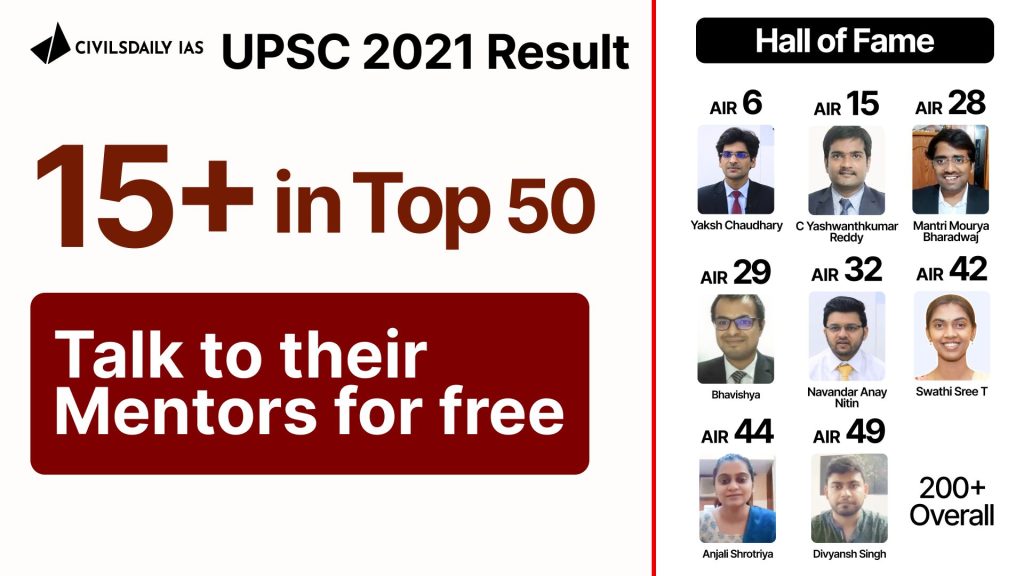
    Ramkrishna was one of 200 rankers from CivilsDaily’s mentorship programs.
  • The List of Best Geography Books for UPSC

    Hello Dear students,

    Knowing Indian and World Geography is very important if you are a UPSC aspirant. To clear UPSC prelims and even mains, your basic concepts must be cleared. In geography, only theories and concepts are not enough.  In this article, we will share the most important NCERTs Best Geography Books for UPSC IAS Preparation.


    Table of Contents:


    According to Toppers, the best sources for studying geography are the NCERT textbooks. Most of the topics in the basic textbooks are explained in very easy language and it is really valuable for basic building. 

    But acknowledging the trends of UPSC, besides NCERTs, some other advanced reference books must be followed with selective studies.

    After mentoring 5000+ students, we the Civilsdaily team suggest the best geography books for UPSC preparation. Let’s have a look:

    NCERTs Best Geography Books for UPSC Preparation

    All subjects except history should be prepared by New NCERTs. So, no need to read old NCERTs, start with new versions.

    • The Earth: Our Habitat- VI NCERT
    • Our Environment- VII NCERT
    • Resource and Development- VIII NCERT
    • Contemporary India- IX NCERT
    • Contemporary India- X NCERT

    Read and revise the above basic geography books 2, 3 times, and after that start with higher books.

    • Fundamental of Physical Geography- XI NCERT
    • India: Physical Environment-XI NCERT
    • Fundamentals of  Human Geography- XII  NCERT
    • India: People and Economy- XII NCERT 

    These books are extremely important. Read, revise take notes from the above books.

    Best Advanced Geography Books for UPSC IAS

    In addition to Indian Geography, UPSC mains consist of World geography as well. So, your advanced book list should be like this.

    • Indian Geography by Majid Hussain
    • Indian Geography by Khullar
    • Certificate Physical and Human geography by GC Leong.
    • Oxford School Atlas

    Now, the question arises, as many new aspirants do: if such well-known sources are widely available, what will successful candidates do in addition to benefiting from their competitors? What additional resources should be used to overcome the large influx of aspirants? Is there hidden or confidential content that only a few people have access to? Such resources, to be honest, do not exist. 

    Remember: despite having all the books, toppers could not be toppers without the guidance of mentors. Their smart preparation, persistence in studies, self-confidence, thirst for success, initiative to achieve goals, and patience set them apart.

  • Assessing Juvenility a ‘Delicate Task’: SC

    The Supreme Court has given some guidelines for the delicate task of deciding whether juveniles aged between 16 and 18, accused of heinous offences such as murder can be tried like adults as per the JJ Act, 2005.

    Juvenile Justice Act, 2015

    • The JJ Act, 2015 replaced the Indian juvenile delinquency law, Juvenile Justice (Care and Protection of Children) Act, 2000.
    • It allows for juveniles in conflict with Law in the age group of 16–18, involved in Heinous Offences, to be tried as adults.
    • The Act also sought to create a universally accessible adoption law for India.
    • The Act came into force from 15 January 2016.

    Key features

    • Change in nomenclature from ‘juvenile’ to ‘child’ or ‘child in conflict with law’, across the Act to remove the negative connotation associated with the word “juvenile”
    • Inclusion of several new definitions such as orphaned, abandoned and surrendered children; and petty, serious and heinous offences committed by children;
    • Setting up Juvenile Justice Boards and Child Welfare Committees in every district. Both must have at least one woman member each.
    • Special provisions for heinous offences committed by children above the age of 16 years: This was in response to the juvenile convict in Nirbhaya Case.
    • Inclusion of new offences committed against children:  Sale and procurement of children for any purpose including illegal adoption, corporal punishment in child care institutions, use of child by militant groups, offences against disabled children and, kidnapping and abduction of children.
    • Penalties for cruelty against a child: Offering a narcotic substance to a child, and abduction or selling a child has been prescribed.

    What is the recent Supreme Court assessment?

    • The “delicate task” of deciding whether juveniles aged between 16 and 18, accused of heinous offences such as murder, can be tried like adults should be based on meticulous psychological investigation.
    • They should not left to the discretion and perfunctory “wisdom” of juvenile justice boards and children’s courts across the country, the Court held.

    What delicate tasks does the apex court is referring to?

    (1) Preliminary Assessment

    • Section 15 of the JJ Act requires a “preliminary assessment” to be done of the mental and physical capacity of juveniles, aged between 16 and 18, who are involved in serious crimes.
    • The assessment is meant to gauge a child’s ability to understand the consequences of the offence and the circumstances in which he or she allegedly committed the offence.
    • If the Juvenile Justice Board is of the opinion that the juvenile should not be treated as an adult, it would not pass on the case to the children’s court and hear the case itself.
    • If the Board decides to refer the case to the children’s court for trial as an adult, the juvenile, if guilty, would even face life imprisonment.

    (2) Mental capacity

    • The evaluation of ‘mental capacity and ability to understand the consequences’ of the child in conflict with law can should not be relegated as a routine task.
    • The process of taking a decision on which the fate of the child in conflict with law precariously rests, should not be taken without conducting a meticulous psychological evaluation.
    • The court said the Board which conducts the assessment of the child should have at least one child psychologist.

    Way forward

    • The court discovered that there were neither guidelines nor a specific framework in place for conduct of the preliminary assessment.
    • The court left it open for the Centre and the National Commission for Protection of Child Rights to consider issuing guidelines or directions in this regard.
    • It should further take the assistance of experienced psychologists or psychosocial workers.


    UPSC 2023 countdown has begun! Get your personal guidance plan now! (Click here)

  • India’s imports from China rose to a record in first half of 2022

    India’s imports from China reached a record $57.51 billion in the first half of the year, according to China’s trade figures.

    India-China Bilateral Trade

    • China is India’s largest trading partner.
    • Major commodities imported from China into India were: electronic equipment; machines, engines, pumps; organic chemicals; fertilizers; iron and steel; plastics; iron or steel products; gems, precious metals, coins; ships, boats; medical, and technical equipment.
    • Major commodities exported from India to China were: cotton; gems, precious metals, coins; copper; ores, slag, ash; organic chemicals; salt, sulfur, stone, cement; machines, engines, and pumps.

    Recent measures to curb imports from China

    • Blame it on the pandemic and the border dispute, but the result is the same: some Indian businesses are boycotting China.
    • The government is now asking Indian e-commerce companies like Flipkart and Amazon India to label country of origin for all products sold on its websites.
    • The govt banned many Chinese mobile applications, including top social media platforms such as TikTok, Helo and WeChat and games such as PUBG.

    Can we completely boycott Chinese products?

    • Trade deficits are not necessarily bad: Both Indian consumers and Chinese producers are gainers through trading.
    • Will hurt the Indian poor the most: This is because the poor are more price-sensitive.
    • Will punish Indian producers and exporters: Several businesses in India import intermediate goods and raw materials, which, in turn, are used to create final goods — both for the domestic Indian market as well as the global market.
    • Pharma sector could be worst hit: For instance, of the nearly $3.6 billion worth of ingredients that Indian drug-makers import to manufacture several essential medicines, China catered to around 68 per cent.
    • Will barely hurt China: According to the United Nations Conference on Trade and Development (UNCTAD) data for 2018, 15.3% of India’s imports are from China, and 5.1% of India’s exports go to China.
    • Chinese money funds Indian unicorns: India and China have also become increasingly integrated in recent years.
    • India will lose policy credibility: It has also been suggested that India should renege on existing contracts with China.

    Way forward

    • In the long term, under the banner of self-reliance, India must develop its domestic capabilities and acquire a higher share of global trade by raising its competitiveness.
    • The government’s “Atmanirbhar” focus is expected to help ministries handhold industries where self-reliance needs to be built.
    • For the long run, a more effective strategy needs to be built to provide an ecosystem that addresses the cost disability of Indian manufacturing leading to such imports.


    We would love to see you attempting these questions. Post your answer snaps in the comment box.


    Q. India’s quest for self-reliance is still a distant dream. Critically comment in light of the popular sentiment against the Chinese imports in India.


    Q.“Curbing Chinese imports to India will do more harm than any good”. Analyse.


    UPSC 2023 countdown has begun! Get your personal guidance plan now! (Click here)

  • Election Symbol Disputes and ECI

    A political party in Maharashtra has approached the Election Commission of India (ECI), requesting it to hear its side before deciding claims to the party’s bow-arrow symbol.

    What is the news?

    • A party has lost a large number of members in the rebellion that eventually caused the fall of the government in Maharashtra.
    • The rebel has claimed to be the only original leader of the party on the basis of the support of more than two-thirds of the party’s legislators in the Maharashtra Assembly.

    Options for ECI

    • The ECI in all likelihood can freeze the symbol so that neither of the two sides is able to use it until a final decision is made.
    • EC hearings are long and detailed, and may take at least six months.

    EC’s powers in Election Symbol Dispute

    • The question of a split in a political party outside the legislature is dealt by Para 15 of the Symbols Order, 1968.
    • It states that the ECI may take into account all the available facts and circumstances and undertake a test of majority.
    • The decision of the ECI shall be binding on all such rival sections or groups emerged after the split.
    • This applies to disputes in recognised national and state parties.
    • For splits in registered but unrecognised parties, the EC usually advises the warring factions to resolve their differences internally or to approach the court.

    How did the EC deal with such matters before the Symbols Order came into effect?

    • Before 1968, the EC issued notifications and executive orders under the Conduct of Election Rules, 1961.
    • The most high-profile split of a party before 1968 was that of the CPI in 1964.
    • A breakaway group approached the ECI in December 1964 urging it to recognise them as CPI(Marxist). They provided a list of MPs and MLAs of Andhra Pradesh, Kerala and West Bengal who supported them.
    • The ECI recognised the faction as CPI(M) after it found that the votes secured by the MPs and MLAs supporting the breakaway group added up to more than 4% in the 3 states.

    What was the first case decided under Para 15 of the 1968 Order?

    • It was the first split in the Indian National Congress in 1969.
    • Indira Gandhi’s tensions with a rival group within the party came to a head with the death of President Dr Zakir Hussain on May 3, 1969.

    Is there a way other than the test of majority to resolve a dispute over election symbols?

    • In almost all disputes decided by the EC so far, a clear majority of party delegates/office bearers, MPs and MLAs have supported one of the factions.
    • Whenever the EC could not test the strength of rival groups based on support within the party organisation (because of disputes regarding the list of office bearers), it fell back on testing the majority only among elected MPs and MLAs.

    What happens to the group that doesn’t get the parent party’s symbol?

    • The EC in 1997 did not recognise the new parties as either state or national parties.
    • It felt that merely having MPs and MLAs is not enough, as the elected representatives had fought and won polls on tickets of their parent (undivided) parties.
    • The EC introduced a new rule under which the splinter group of the party — other than the group that got the party symbol — had to register itself as a separate party.
    • It could lay claim to national or state party status only on the basis of its performance in state or central elections after registration.


    UPSC 2023 countdown has begun! Get your personal guidance plan now! (Click here)

  • India ranks 135 out of 146 in Gender Gap Index

    India ranks 135 among a total of 146 countries in the Global Gender Gap Index, 2022, released by the World Economic Forum.

    What is Global Gender Gap Index?

    • The report is annually published by the World Economic Forum (WEF).
    • It benchmarks gender parity across four key dimensions or sub-indices — economic participation and opportunity, educational attainment, health and survival, and political empowerment.
    • It measures scores on a 0-to-100 scale, which can be interpreted as the distance covered towards parity or the percentage of the gender gap that has been closed.
    • The report aims to serve “as a compass to track progress on relative gaps between women and men on health, education, economy and politics”.
    • According to the WEF it is the longest-standing index, which tracks progress towards closing these gaps over time since its inception in 2006.

    How has India fared on different sub-indices?

    Here’s how it stands on different sub-indices:

    (1) Political Empowerment

    • This includes metrics such as the percentage of women in Parliament, the percentage of women in ministerial positions etc.
    • Of all the sub-indices, this is where India ranks the highest (48th out of 146).
    • However, notwithstanding its rank, its score is quite low at 0.267.
    • Some of the best-ranking countries in this category score much better.
    • For instance, Iceland is ranked 1 with a score of 0.874 and Bangladesh is ranked 9 with a score of 0.546.
    • Moreover, India’s score on this metric has worsened since last year – from 0.276 to 0.267.
    • The silver lining is that despite the reduction, India’s score is above the global average in this category.

    (2) Economic Participation and Opportunity

    • This includes metrics such as the percentage of women who are part of the labour force, wage equality for similar work, earned income etc.
    • Here, too, India ranks a lowly 143 out of the 146 countries in contention even though its score has improved over 2021 from 0.326 to 0.350.
    • Last year, India was pegged at 151 out of the 156 countries ranked.
    • India’s score is much lower than the global average, and only Iran, Pakistan and Afghanistan are behind India on this metric.

    (3) Educational Attainment

    • This sub-index includes metrics such as literacy rate and the enrolment rates in primary, secondary and tertiary education.
    • Here India ranks 107th out of 146, and its score has marginally worsened since last year.
    • In 2021, India was ranked 114 out of 156.

    (4) Health and Survival

    • This includes two metrics: the sex ratio at birth (in %) and healthy life expectancy (in years).
    • In this metric, India is ranked last (146) among all the countries.
    • Its score hasn’t changed from 2021 when it was ranked 155th out of 156 countries.
    • The country is the worst performer in the world in the “health and survival” sub-index in which it is ranked 146.

    Where does India stand amongst its neighbour?

    • India ranks poorly among its neighbours and is behind Bangladesh (71), Nepal (96), Sri Lanka (110), Maldives (117) and Bhutan (126).
    • Only the performance of Iran (143), Pakistan (145) and Afghanistan (146) was worse than India in South Asia.
    • In 2021, India ranked 140 out of 156 nations.


    UPSC 2023 countdown has begun! Get your personal guidance plan now! (Click here)

  • Places in news: Paracel Islands

    A US destroyer sailed near the disputed Paracel Islands in the South China Sea, drawing an angry reaction from Beijing, which said its military had “driven away” the ship.

    About Paracel Islands

    • The Paracel Islands, also known as the Xisha Islands and the Hoang Sa Archipelago are a disputed archipelago in the South China Sea.
    • The archipelago includes about 130 small coral islands and reefs, most grouped into the northeast Amphitrite Group or the western Crescent Group.

    What is the South China Sea Dispute?

    • It is a dispute over territory and sovereignty over ocean areas, and the Paracels and the Spratlys – two island chains claimed in whole or in part by a number of countries.
    • China, Vietnam, the Philippines, Taiwan, Malaysia, and Brunei all have competing claims.
    • Alongside the fully-fledged islands, there are dozens of rocky outcrops, atolls, sandbanks, and reefs, such as the Scarborough Shoal.
    • China claims by far the largest portion of territory – an area defined by the “nine-dash line” which stretches hundreds of miles south and east from its most southerly province of Hainan.
    • Beijing says its right to the area goes hundreds of centuries to when the Paracel and Spratly island chains were regarded as integral parts of the Chinese nation.
    • It showed the two island groups falling entirely within its territory. Those claims are mirrored by Taiwan.

    Spat over Chinese claims

    • China has backed its expansive claims with island-building and naval patrols.
    • The US says it does not take sides in territorial disputes but has sent military ships and planes near disputed islands, calling them “freedom of navigation” operations to ensure access to key shipping and air routes.
    • Both sides have accused each other of “militarizing” the South China Sea.
    • There are fears that the area is becoming a flashpoint, with potentially serious global consequences.


    UPSC 2023 countdown has begun! Get your personal guidance plan now! (Click here)

  • [Sansad TV] Mudda Aapka: Mental Illness

    UPSC 2023 countdown has begun! Get your personal guidance plan now! (Click here)

    Context

    • According to a report by the WHO, more than 25 percent increase in mental depression and anxiety was registered in the first year due to the covid-19 pandemic.
    • According to the World Mental Health Report, nearly one billion people, of whom 14 percent were adolescents, were living with some form of mental health issue in 2019.

    What is Mental Illness?

    • Mental health is not just a concept that refers to an individual’s psychological and emotional well-being.
    • Rather it’s a state of psychological and emotional well-being where an individual is able to use their cognitive and emotional capabilities, to meet the ordinary demand and functions in society.
    • According to WHO, there is no single ‘official’ definition of mental health.
    • The social determinants of health predispose individuals and populations to poor physical and mental health, and increased risk for many physical and mental illnesses.

    Mental Illness in India

    • Mental disorders are now among the top leading causes of health burden worldwide, with no evidence of global reduction since 1990.
    • In 2017, an estimation of the burden of mental health conditions for the states across India revealed that as many as 197.3 million people required care for mental health conditions.
    • This included around 45.7 million people with depressive disorders and 44.9 million people with anxiety disorders.
    • The situation has been exacerbated due to the Covid-19 pandemic, making it a serious concern the world over.

    Reasons for Persistence of Mental Illness

    • Stigma to seek help: The staggering figures are void of millions of others directly, or indirectly impacted by the challenge and those who face deep-rooted stigma, many times rendering them unable to seek help.
    • Lack of awareness: This growing challenge in dealing with mental health issues is further compounded by a lack of information and awareness, self-diagnosis, and stigma.
    • Psycho-social factors: Institutions like gender, race and ethnicity, are also responsible for mental health conditions.
    • Post-Treatment gap: There is a need for proper rehabilitation of the mentally ill persons post/her treatment which is currently not present.
    • Rise in Severity: Mental health problems tend to increase during economic downturns, therefore special attention is needed during times of economic distress.

    Need for immediate intervention

    • Neglected Area: Mental health which forms the core of our personhood is often neglected which impeded the development of an individual to full potential.
    • Disproportionate impact: It is the poor, dispossessed and marginalised who bear the greatest burden of mental health problems, but historically their sufferings are dismissed as a natural extension of their social and economic conditions.
    • Vulnerability of the ills: Mentally ill patients are vulnerable to and usually suffer from drug abuse, wrongful confinement, even at homes and mental healthcare facilities which is a cause of concern and a gross human right violation.
    • Suicidal tendencies: Suicidal behavior was found to have relation with female gender, working condition, independent decision making, premarital sex, physical abuse and sexual abuse.
    • Gendered nature: Females are more predisposed to mental disorders due to rapid social change, gender discrimination, social exclusion, gender disadvantage like marrying at young age, concern about the husband’s substance misuse habits, and domestic violence.

    Policy initiatives

    • National Mental Health Program (NMHP): To address the huge burden of mental disorders and shortage of qualified professionals in the field of mental health, the government has been implementing the NMHP since 1982.
    • Mental HealthCare Act 2017: It guarantees every affected person access to mental healthcare and treatment from services run or funded by the government.
    • Rights of Persons with Disabilities Act, 2017: The Act acknowledges mental illness as a disability and seeks to enhance the Rights and Entitlements of the Disabled and provide an effective mechanism for ensuring their empowerment and inclusion in the society
    • Manodarpan Initiative: An initiative under Atmanirbhar Bharat Abhiyan aims to provide psycho-social support to students for their mental health and well-being.

    Way Forward

    • Policy boost: Mental health situation in India demands active policy interventions and resource allocation by the government.
    • Public sensitization: To reduce the stigma around mental health, we need measures to train and sensitize the community/society.
    • Awareness: People should be made aware of the significance of mental health, as much as that of physical health.
    • Destigmatising: Sharing one’s story about mental health (through media campaigns) is the most effective strategy to reduce stigma attached with mental illness
    • Community Approach: There is need to deploy community health workers who, with appropriate training and supervision, effectively deliver psychosocial interventions for the needy
    • Broadening the scope: Mental health care must embrace the diversity of experiences and strategies which work, well beyond the narrow confines of traditional biomedicine with its emphasis on “doctors, diagnoses and drugs”.

    UPSC 2023 countdown has begun! Get your personal guidance plan now! (Click here)

  • India & FTA

    Context

    In recent months, India has signed trade agreements with Australia and UAE. n the last week of June, New Delhi began talks for a similar agreement with the EU.

    How FTA with EU could help India

    • India’s successful sectors like textiles, pharmaceuticals and leather could benefit from these deliberations, which would also be keenly watched by representatives of the services and renewable energy sectors.
    • A successful free trade agreement (FTA) with the EU could help India to expand its footfall in markets such as Poland, Portugal, Greece, the Czech Republic and Romania, where the country’s exports registered double-digit annual growth rates in the last decade.

    So, what are the factors India need to consider while signing FTA

    1] Impact of tariff on domestic industry:

    • It has been observed that when India is an importer, the preferential tariffs that accrue as a result of trade agreements are significantly lower than the rates charged from countries given Most Favoured Nation (MFN) status by India.
    • But when the partner country is the importer, preferential tariffs on Indian goods, in most cases, are closer to the MFN tariffs.
    • As a result, Indian exporters do not get the same returns as their counterparts in the partner countries.
    • India’s trade with South Korea is a case in point.
    • Before entering into a trade agreement care should, therefore, be taken to ensure that the domestic industry is not made to compete on unequal terms with the partner countries.

    2] Adherence to the rules of origin

    • The India-UAE Comprehensive Economic Partnership Agreement sets a good example.
    • It includes a strong clause on the rules of origin.
    • Forty per cent value addition or substantial processing of up to 40 per cent in the exporting country is required to qualify for lower tariffs.
    • Rules of origin have been a bone of contention in most Indian trade agreements.
    • (CAROTAR, 2020): In 2020, the country notified the Customs (Administration of Rules of Origin under Trade Agreements) Rules (CAROTAR, 2020), which require a basic level of due diligence from the importer.

    3] Including the offset clauses

    • “Offset clauses” — where the exporter is obliged to undertake activities that directly benefit the importing country’s economy — should be built into trade agreements, especially for technology intensive sectors.

    4] Emergency action plan

    •  In February 2020, the US made India ineligible for claims under GSP, America’s oldest preferential trade scheme.
    • The US Trade Representative’s Office deemed India as a developed country and suspended beneficial treatment under the GSP.
    • A contingency plan should be in place to tackle such situations.

    5] Inclusion of sunset clause

    • India should also take a cue from the US-Mexico-Canada Agreement, to incorporate a “sunset” clause in trade agreements.
    • The pact between the three North American nations provides for periodic reviews and the agreement is slated to end automatically in 16 years unless the countries renegotiate it.

    6] Parity between services and merchandise

    • India should negotiate for parity between services and merchandise.
    • Low trade in services: India’s trade in services is low, and its overall score in the OECD’s Services Trade Restrictiveness Index (STRI) exceeds the world average.
    • It is especially high in legal and accounting services due to the licencing requirements in both these segments.
    • Expansion in banking and financial services: There is also significant room for expansion of trade in the banking and financial services industry.

    Conclusion

    A well-crafted trade agreement could help India enhance its share in global trade and help attain the government’s target of making the country a $5-trillion economy.

    UPSC 2023 countdown has begun! Get your personal guidance plan now! (Click here)


    Back2Basics: CAROTAR Rules

    • Importers will have to do their due diligence to ensure that imported goods meet the prescribed ‘rules of origin’ provisions.
    • This is the essential availing concessional rate of customs duty under free trade agreements (FTAs).
    • A list of minimum information, which the importer is required to possess, has also been provided in the rules along with general guidance.
    • Also, an importer would now have to enter certain origin related information in the Bill of Entry, as available in the Certificate of Origin.

    Why need CAROTAR?

    • CAROTAR 2020 supplements the existing operational certification procedures prescribed under different trade agreements.
    • India has inked FTAs with several countries, including Japan, South Korea and ASEAN members.
    • Under such agreements, two trading partners significantly reduce or eliminate import/customs duties on the maximum number of goods traded between them.
    • The new rules will assist customs authorities in the smooth clearance of legitimate imports under FTAs.
  • 13th July 2022| Daily Answer Writing Enhancement(AWE)

    Topics for Today’s questions:

    GS-1         Modern Indian history from about the middle of the eighteenth century until the present – significant events, personalities, issues.

    GS-2       Panchayats and urban local bodies

    GS-3        Indian Economy

    GS-4        Human Values- Lessons from the lives and teachings of great leaders

    Question 1)


    Q.1 Colonialism in India gained foothold in distinct stages with debilitating impact on the Indian economy. Discuss. (10 Marks)


    Question 2)

    Q.2 The health of municipal finances is a critical element of municipal governance. In context of this, examine the challenges in strengthening the municipal finances and suggest the way forward. (10 Marks)

    Question 3)

    Q.3 A well-crafted trade agreement could help India enhance its share in global trade. Therefore, India needs to take care of a few key concerns before entering into trade agreements. What are such concerns India need to address? (10 Marks)

    Question 4)  

    Q.4 “All persons ought to endeavour to follow what is right, and not what is established.” ― Aristotle. What does this quote mean to you? (10 Marks)


    HOW TO ATTEMPT ANSWERS IN DAILY ANSWER WRITING ENHANCEMENT(AWE)?

    1. Daily 4 questions from General studies 1, 2, 3, and 4 will be provided to you.

    2. A Mentor’s Comment will be available for all answers. This can be used as a guidance tool but we encourage you to write original answers.

    3. You can write your answer on an A4 sheet and scan/click pictures of the same.

    4.  Upload the scanned answer in the comment section of the same question.

    5. Along with the scanned answer, please share your Razor payment ID, so that paid members are given priority.

    6. If you upload the answer on the same day like the answer of 11th  February is uploaded on 11th February then your answer will be checked within 72 hours. Also, reviews will be in the order of submission- First come first serve basis

    7. If you are writing answers late, for example, 11th February is uploaded on 13th February , then these answers will be evaluated as per the mentor’s schedule.

    8. We encourage you to write answers on the same day. However, if you are uploading an answer late then tag the mentor like @Staff so that the mentor is notified about your answer.

    *In case your answer is not reviewed, reply to your answer saying *NOT CHECKED*. 

    1. For the philosophy of AWE and payment: 

More posts
