💥UPSC 2026, 2027, 2028 UAP Mentorship (March Batch) + Access XFactor Notes & Microthemes PDF

Search results for: “”

  • Procedural gaps in death penalty sentencing

    Context

    In a judgment delivered last month, the Supreme Court, in Manoj & others v. State of MP, embarked on a significant attempt to reform the administration of the death penalty.

    Background: Crisis in the death penalty sentencing

    • There has long been a judicial crisis in death penalty sentencing on account of unprincipled sentencing, arbitrariness and worrying levels of subjectivity.
    • The crisis has been acknowledged by the Supreme Court, the Law Commission of India, research scholars and civil society groups.
    • Crime-centric nature: Death penalty sentencing has been, by and large, crime-centric.
    • This approach goes against the requirements imposed on sentencing judges by the Supreme Court in Bachan Singh (1980).

    The framework laid down in the Bachan Singh case

    • Take into account factors relating to crime and the accused: This framework made it binding for the sentencing judges to take into account factors relating to both the crime and accused and assign them appropriate weight.
    • Judges couldn’t decide to impose the death penalty only on the basis of the crime.
    • The background of the accused, the personal circumstances, mental health and age were considerations a sentencing judge had to account for.
    • Judges were required to weigh “mitigating” and “aggravating” factors to ascertain if a case was fit for the death sentence and also determine if the option of life imprisonment was “unquestionably foreclosed”.

    Why there is a crisis in death penalty sentencing?

    • The four decades since Bachan Singh have shown us that this framework has been followed more in breach.
    • There is utter confusion across all levels of the judiciary on the requirements of the framework laid down in the Bachan Singh case and its implementation.
    • Nature of crime a dominant consideration: An important reason for the breakdown is that factors relating to the crime — the nature of the crime and its brutality — are often dominant considerations, and there is barely any consideration of mitigating factors.
    • Little discussion on mitigating factors: There has been very little discussion on bringing the socioeconomic profile of death row prisoners as a mitigating factor into the courtroom.

    Significance of the SC judgment in Manoj & others v. State of MP

    • Efforts to plug the gap: The judgement identifies the lacuna as an explicit concern, states the consequences that flow from such a vital gap, and suggests measures to plug it.
    • Recognising reformation: A striking part of the judgment is its commitment to recognising reformation as integral to the Indian criminal justice system, especially death penalty sentencing.
    • Procedural threshold: The judgment is clear that certain procedural thresholds must be met for sentencing to be fair and explicitly rejects (once again) the idea that death sentences can be determined solely on crime-based considerations.
    • The verdict recognises that aspects of the accused’s life, both pre-offence and post-offence in prison, are relevant.
    • As practical steps in this process, the judgment asks courts to call for reports from the probation officer as well as prison and independent mental health experts.
    • Right of the accused to present mitigating factors: The right of the accused to present mitigating factors and rebut the state, if necessary, is also recognised.
    • Psychological and philosophical aspect taken into account: There is now overwhelming evidence from psychology that criminality cannot just be reduced to terrible decisions by individuals in the exercise of their free will.
    • All our actions are a result of a complex web of biological, psychological, and social factors and that understanding has a very significant bearing on discussions on criminality and punishment.

    Challenges

    • Implementation issue: Apart from this issue of implementation, even if detailed and high-quality sentencing information is to come into our courtrooms, a bigger challenge awaits.
    • The judicial treatment of sentencing information is a Pandora’s box that will inevitably have to be opened.
    • Requirement for normative basis: The Supreme Court will have to provide a rigorous normative basis for consideration of these factors.
    • In the absence of such foundations, death penalty sentencing will continue to be unprincipled and sentencing judges are not going to understand the need for this wide range of sentencing information.

    Conclusion

    The significance of last month’s judgment, authored by Justice Ravindra Bhat, is that it takes this problem head-on. It identifies the lacuna as an explicit concern, states the consequences that flow from such a vital gap, and suggests measures to plug it.

    UPSC 2023 countdown has begun! Get your personal guidance plan now! (Click here)
  • India-Iran Relations

    Context

    Iran’s Foreign Minister Hossein Amir-Abdollahian’s three-day visit to India, last week, was the first ministerial-level visit from Iran since Ebrahim Raisi assumed the Iranian presidency in August last year.

    Chabahar Port - A Rethink is Needed | Vivekananda International Foundation

    Background

    • Bilateral relations between India and Iran span millennia marked by meaningful interactions.
    • Both countries shared borders until 1947 and share several common features in their language, culture and traditions.
    • The diplomatic links were established on 15th March 1950, when both countries signed a Treaty of Friendship and Perpetual Peace.
    • However, Iran’s joining of Baghdad pact in 1954 and the Cold War politics prevented both countries from having closer relations until the 1990s.
    • Islamic Revolution of 1979, hostage of US diplomats, Iran-Iraq War and Tehran’s support for Hezbollah and Hamas among others resulted in a range of political and economic sanctions, leading to Iran being isolated at a global level
    • In the 1990s, both countries’ interests converged around energy, Central Asia and security, mostly around the Pakistan-Afghan region.
    • This resulted in the signing of ‘The Delhi Declaration’, which provided the vision of the countries’ defence and strategic partnership and “Tehran Declaration”, which set forth the areas of possible cooperation

    India-Iran relations: A shared vision for equitable, pluralistic and co-operative international order

    • The “Tehran Declaration” signed during former Prime Minister Atal Bihari Vajpayee’s visit to Iran affirmed the shared vision of the two countries for an “equitable, pluralistic and co-operative international order”.
    • It recognised then Iranian President Mohammad Khatami’s vision of a “dialogue among civilisations” as a paradigm of international relations based on principles of tolerance, pluralism and respect for diversity.
    • Advancing the standing in global order: Two decades later, as India strengthens new partnerships within its regional vision centred on the Indo-Pacific, both countries remain driven by the goals of advancing their standing at the regional and global level.
    • Both are keen to project themselves as independent strategic actors determined to play a role in shaping a new multipolar order in their shared Eurasian neighbourhood and also at the global level.

    Why does India need Iran?

    • Energy security: Conventionally, for energy security
    • Iran is amongst India’s top oil suppliers
    • Strategic importance: Since the 1990s, Iran’s importance has become ‘strategic’
    • Security reasons: Iran’s cooperation is critical for India’s security given that
    • Pak supports terrorism in India
    • Influence in Afghanistan: India’s influence in Afghanistan is marginal.
    • Countering Pakistan: India needs Iran to moderate Pak’s influence in West Asia
    • Iran is a leader in the Muslim world.
    • Access to Afghanistan and Central Asia

    Significance of Iran for India

    • Geopolitical logic in relations: The sanctions imposed by the US on Iran after it withdrew from the nuclear deal in 2018 may have virtually destroyed India-Iran trade, especially India’s energy imports from Iran, but the geopolitical logic underpinning relations between the two countries remains firm.
    • Land bridge to Central Asia and Eurasia: Iran has sought to leverage its crossroad geographical location straddling the Persian Gulf and the Caspian Sea, India has come to see it as its land bridge to Central Asia and Eurasia.
    • INSTC: Despite the difficulties posed by decades of American sanctions, Iran has, along with India, Russia and a few other countries in the Eurasian region, continued to work on the multi-modal International North-South Transport Corridor (INSTC).
    • During Raisi’s visit to Moscow, the two sides had pledged to redouble their efforts to build the railway line between Iran’s Caspian port of Rasht and Astara on the Iran-Azerbaijan border.
    • Alternative Caspian Sea Route: The activation of an alternative Caspian Sea route speaks volumes about the positive outlook of Iran, India and Russia on this corridor despite a variety of geopolitical challenges.
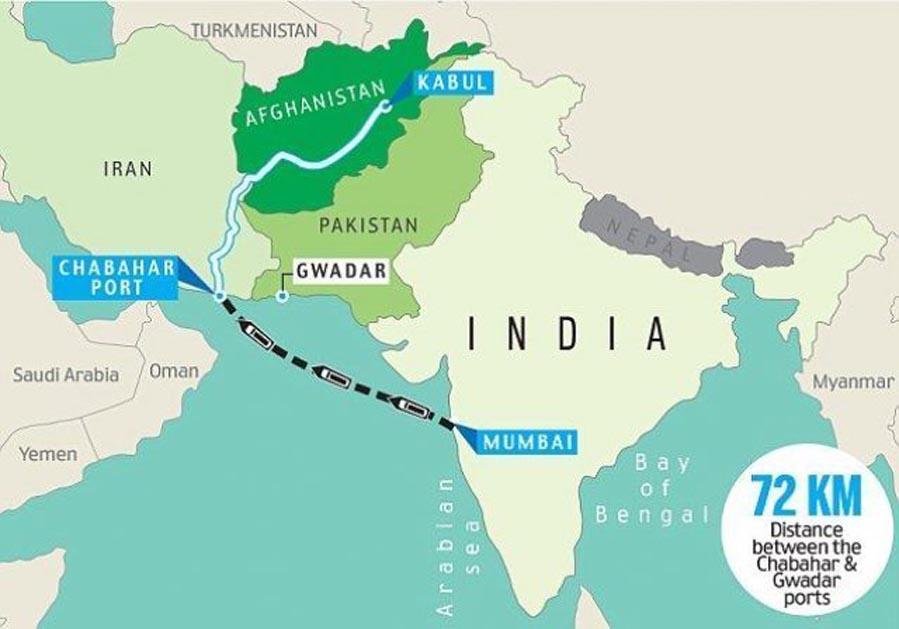
    • Iran’s Chabahar port, where India is developing two berths that it will lease for commercial operations for 10 years, is also a story of perseverance in the ties between the two countries.

    Irritants in Indo-Iran ties

    • India’s relations with Saudi Arabia, US and Israel:  Growing Saudi-India-US-Israel relations have irked Iran.
    • In retaliation, Iran, for the first time, has linked the plight of Muslims in Gaza, Yemen, and Bahrain, with those in Kashmir
    • Iran-Pak-China ties: Warming Iran-Pak-China ties have annoyed India.
    • Sluggish Chabahar port development: Slow Chabahar port development has annoyed Iran.
    • China-Iran strategic partnership:
      • An economic and security partnership deal between Iran and China was recently made public, creating a global alarm, especially for India and the US.
      • The foundation for this deal was laid during Chinese President Xi Jinping’s visit to Iran in 2016
      • The draft agreement involves Chinese investments worth $400 billion into the Iranian economy over 25 years.
      • Of this, $280 billion will be allocated for the oil and gas sector and the remaining funding will be for other core sectors like banking, telecommunications, ports and railways.
      • In return, China would get a steady supply of Iranian oil at a heavily discounted rate during the same period.
      • This deal creates a win-win situation for both countries.
      • It lifts Iran’s sanction-hit economy and helps China set a firm foothold in the Middle East.

    US sanctions:

    • Iran’s aim to develop nuclear weapons has come under strong criticism from Trump Administration since the beginning.
    • Thus, the US has withdrawn from the Iran nuclear deal in 2018 after it was signed in 2015 and imposed unilateral sanctions on Iran.
    • The US’ sanctions and aggressive policies have created a situation of economic and geostrategic uncertainty.
    • Indian investors are wary of having businesses in Iran for the fear of the US.
    • Also, India deviated from the policy of not abiding by unilateral sanctions by ceasing to purchase Iranian oil.
    • Due to this, Iran did not back India’s bid to mobilise international support against Beijing’s aggression in the Ladakh.

    Other issues:

    • Iran is against India’s decision to abrogate Article 370 and 35A.
    • It has called on India and Pakistan to show restraint and prevent the killing of innocent Kashmiris, revealing possible close ties between Pakistan and Iran.
    • Iran also voiced against “extremist Hindus and their parties” during the 2020 Delhi riots.
    • Apart from these issues, Iran also sidelined India’s ONGC from exploration rights at its Farzad B Gas field, stating that it will engage the company at a later date.

    Way forward

    • As India is treading a fine line in balancing relations with the US, China and Iran while striving to augment its political influence in West Asia, embracing one country over the other is not an option for India.
    • Therefore, a multilateral foreign policy is a way forward.
    • India must retain its involvement in the Chabahar port development because of the geostrategic significance.
    • In the immediate term, India should improve its multi-alignment credentials to absorb investments into the port projects from the public and private sector, boost maritime cooperation among littoral countries to enhance the transit of goods, and foster regional partnership for the Chabahar port development.
    • Based on the mutual geostrategic and energy interests, India could collaborate with Japan under the Asia-Africa Growth Corridor.
    • Japan’s participation would enhance the multilateral characteristics of the transit hub in the region, unlike the China-owned Gwadar port. This will further enhance multilateral investments to solidify regional economic partnerships that enable the sustainability of the port.
    • Also, India needs to evolve a better strategy on Iran beyond waiting to see how the US may react, beyond having to issue a clarification in response to Iran’s sudden provocations and beyond allowing voids of partnerships that China may fill.
    • In order to do so, India must create a new alliance of countries having similar geostrategic interests, which are also facing issues with US’ unrealistic and aggressive foreign policy strategy and China’s expansionistic policies.

    Conclusion

    While the revival of the nuclear deal could give a fillip to India’s economic ties with Iran, India’s interests in continental Asia will be served well by heeding to the calls for developing a long-term roadmap for bilateral relations.


  • (24hrs left) Free Live Answer writing Session | See how UPSC Toppers approach Mains Questions || UPSC Mains Bootcamp (18-19th Jun): Zoom workshop with rankers + Exclusive Telegram group | Register for FREE

    (24hrs left) Free Live Answer writing Session | See how UPSC Toppers approach Mains Questions || UPSC Mains Bootcamp (18-19th Jun): Zoom workshop with rankers + Exclusive Telegram group | Register for FREE

    With Mains season here let’s turn up the heat. Register for CivilsDaily’s Mega Bootcamp: 18-19th June 2022. Mains Answer Writing, Ethics, Essay, and more. Details below.
    1. Improved Answer Writing and Mains Answer's structure
2. Strategy on tackling Ethics case studies
3. Invaluable tips on Philosophical Essays
4. Inputs by Rankers on your answers
5. Access to exclusive Community on Telegram

    Session Details:

    DAY 1 – Morning Session with Rohan Kadam(AIR 295) Starts at 12:00 pm

    Morning session with Anay Navandar(AIR 32) starts at 1:00 pm

    DAY 1 – Evening session With Mukesh Kumar Gupta(AIR 499) starts at 7:00 pm

    DAY 2 – Morning Session with Soham Mandare(AIR 267) starts at 12:00 pm

    DAY 2 – Evening session with Zeeshan sir on How to tackle essay starts at 7 pm


    DAY 1:

    Meet AIR 295 Rohan Kadam and learn how he approaches, breaks down mains questions via live solving Mains 2021 questions.

    Try your hand at solving GS 1, 2, 3, 4 questions.

    Get Insight from Anay Navandar(AIR 32) of how he scored 127 in ethics and watch him solve case studies.

    Learn how Mukesh AIR 499 made a jump of 60 marks in this GS marks.

    Get 5 questions from our Last Full length Test series as homework – try solving them and discuss them on Day 2.

    DAY 2:

    Meet AIR 267 Soham Mandare, He had a score of 799 in this year’s Mains. Learn his secrets behind the score!

    Try your hand at solving GS 1, 2, 3, 4 questions and essay.

    Learn How to tackle Philosophical Essay and master them.


    UPSC Bootcamp
Session 1: Developing Mains Answer's Structure like that of UPSC Toppers + Interaction with Topper
Session 2: Interactive Answer Writing session 
Session 3: Master strategy for Ethics Case studies with Sukanya Rana and UPSC topper
Session 4: Tackling Philosophical Essays for UPSC CSE

    In this Bootcamp, we’ll be having total 4 sessions on

    1. From mediocre to UPSC worthy structure: Answer Writing with a clear mandate on improving the Structure of your answers. – Sukanya Rana and UPSC Rankers
    2. How to tackle Ethics case studies by solving handpicked case studies LIVE in the session. – Sukanya Rana and UPSC Rankers
    3. Selecting and writing Philosophical essays. – Zeeshan Hashmi
    4. LIVE writing and strategy by UPSC 2021 Rankers

    Register for the Bootcamp and we will email you the link for the Telegram group and other Mains resources.

    Topper’s sessions will discuss their strategies regarding mains answer writing and guide you through the art of structuring the answers.

  • There’s a formula for UPSC answer’s structure that gets you marks. Learn and apply it with 3 UPSC Rankers (LIVE) | UPSC Mains Bootcamp (18-19th Jun): Zoom workshop with rankers + Exclusive Telegram group | Register for FREE

    There’s a formula for UPSC answer’s structure that gets you marks. Learn and apply it with 3 UPSC Rankers (LIVE) | UPSC Mains Bootcamp (18-19th Jun): Zoom workshop with rankers + Exclusive Telegram group | Register for FREE

    With Mains season here let’s turn up the heat. Register for CivilsDaily’s Mega Bootcamp: 18-19th June 2022. Mains Answer Writing, Ethics, Essay, and more. Details below.

    1. Improved Answer Writing and Mains Answer's structure
2. Strategy on tackling Ethics case studies
3. Invaluable tips on Philosophical Essays
4. Inputs by Rankers on your answers
5. Access to exclusive Community on Telegram

    In this Bootcamp, we’ll be having total 4 sessions on

    1. From mediocre to UPSC worthy structure: Answer Writing with a clear mandate on improving the Structure of your answers. – Sukanya Rana and UPSC Rankers
    2. How to tackle Ethics case studies by solving handpicked case studies LIVE in the session. – Sukanya Rana and UPSC Rankers
    3. Selecting and writing Philosophical essays. – Zeeshan Hashmi
    4. LIVE writing and strategy by UPSC 2021 Rankers

    Register for the Bootcamp and we will email you the link for the Telegram group and other Mains resources.


    UPSC Bootcamp
Session 1: Developing Mains Answer's Structure like that of UPSC Toppers + Interaction with Topper
Session 2: Interactive Answer Writing session 
Session 3: Master strategy for Ethics Case studies with Sukanya Rana and UPSC topper
Session 4: Tackling Philosophical Essays for UPSC CSE

    We’ll be having at least 2 Topper’s sessions where they will discuss their strategies and share their resources with you.

  • The uneven toll of inflation

    Context

    This upsurge of inflation is affecting the poor more than any other social group because some of the commodities whose prices are increasing the most (like petrol and certain food items) represent a larger fraction of the budget of the most vulnerable sections of society.

    Factors fueling inflation in India

    • The Wholesale Price Index (WPI) and the Consumer Price Index (CPI) show an upward rising trend, annually, at 13.11 per cent and 6.07 per cent respectively.
    • Falling rupee: Inflation is here to stay because it has much to do with the decline in value of the rupee that has fallen to its lowest, which makes imports of oil and gas more expensive.
    • Ukraine crisis: The war in Ukraine has the same effect and pushes the price of some food items upward.

    Rising inequality

    • Impact on the poor: This upsurge of inflation is affecting the poor more because some of the commodities whose prices are increasing the most represent a larger fraction of the budget of the most vulnerable sections of society.
    • Rising inequality: As a result, inequalities — which were already on the rise — are increasing further.
    • Recently, the State of Inequality in India report showed that an Indian making Rs 3 lakh a year belonged to the top 10 per cent of the country’s wage earners. 
    •  Inequalities are also increasing among salaried people, who are privileged compared to those of the informal sector: The bottom 50 per cent account for only 22 per cent of the total salary income.
    • The situation of the lower-middle class and poor is deteriorating.
    • The Reserve Bank of India shows slow farm wage growth in nominal terms: From an average of 6.6 per cent in fiscal 2021 to 5.7 per cent in fiscal 2022 (April-November average). This is below the inflation rate.

    Inequality in healthcare

    • India’s spending on healthcare is among the lowest in the world.
    • A decent level of healthcare is available only to the ones who can afford it because of increasing out-of-pocket expenditure — the payment made directly by individuals for the health service, not covered under any financial protection scheme.
    •  Overall, these out-of-pocket expenses on healthcare are 60 per cent of the total expenditure on public health in India, which is one of the highest in the world.

    How policies are contributing to the increasing inequality?

    • High indirect taxes: The share of indirect taxes in the state’s fiscal resources has increased from 2014 to 2019 to reach 50 per cent of the total taxes in 2019.
    • Higher indirect taxes are the most unfair as it affects everyone, irrespective of their income.
    • Taxes on alcohol and petroleum products are cases in point.
    • In contrast, the big companies are flourishing, again, partly because of certain fiscal policies. 
    • Low corporate taxes: The government’s budget in 2015 substantially lowered the corporate tax.
    • Withdrawal of enhanced surcharge: In addition to these tax cuts, the government withdrew the enhanced surcharge on long- and short-term capital gains for foreign portfolio investors (FPIs) as well as domestic portfolio investors.
    • These government policies are clearly promoting the supply side at the expense of demand.
    • The central bank has raised interest rates and CRR in an attempt to curb demand, but demand in the country is already choking.

    Way forward

    • Higher allocation for MGNREGA: A higher allocation of funds for MGNREGS in rural areas, as well as the introduction of similar employment generation schemes in urban areas, should, therefore, be a priority.
    • Municipal bonds at state level: At the state level, the development of municipal bond markets could be a plausible alternative.
    • Reduction on excise duty on fuel: A reduction in the excise duty on fuel prices and easing the fuel tax burden could also supplement the disposable income and reduce the input cost burden for producers.

    Conclusion

    Though the government is opting for market-based economics, currently, India needs a mixed solution that comprises price stability via government channels and subsidies.

    UPSC 2023 countdown has begun! Get your personal guidance plan now! (Click here)


    Back2Basics: Long and short-term capital gain

    • When you buy and sell assets, the profit that you earn is called a Capital Gain.
    • Long Term Capital Gains are those that you earn when you sell an asset after 36 months (3 years) from the date on which you acquired the asset.
    • Short Term Capital Gains are those that you earn when you sell an asset in under 36 months (3 years) from the date on which you acquired the asset.
  • Freebie model of Governance

    Context

    The newly elected Punjab government’s announcement of providing up to 300 units of free power to every household has raised questions: What constitutes “freebies”?

    Two categories for providing support

    • In India government provides two types of support.
    • 1] support to low-income households for augmenting their consumption of selected goods and services.
    • 2] Government also provides incentives to support selected categories of investors and producers.
    • Different objectives: The economic objectives in these two categories are quite different.
    • The first category would include the free or subsidised provision of foodgrains and services such as health and education.
    • Examples of the second group include the central government’s recent initiative for production-linked incentives to various sectors and tax concessions.
    • In the past, incentives in the form of reduction of corporate taxes have been offered to promote investment in general, or in certain regions such as backward areas.

    What commodities should be distributed free?

    • The key question is to decide what commodities should be distributed free or at a subsidised level and what the level of subsidy should be.
    • Essential goods: The provision of foodgrains at a heavily subsidised price to target groups has found general acceptance, particularly among political parties, even though there are some critics of the measure.
    • The distribution of commodities which are considered “essential”, primarily foodgrains, faces no criticism.
    • Merit goods: There is also a category of goods which are called “merit” goods where significant positive externalities are associated with their consumption — for instance, health and education-related provisions, including mid-day meals and breakfast.
    • In such cases, subsidisation is justified: If only market prices prevail, the community will consume less than what is socially desirable.

    What should be the suitable mode of providing support?

    • The question of a suitable model for providing budgetary support arises in the context of both consumption and production-supporting initiatives.
    • 1] In the first case, budgetary support to a targeted segment of the population for augmenting their consumption of essential items may be provided either through direct income support or by a free or highly subsidised provision. 
    • Procurement set up and distribution system: When the provision of subsidised goods is involved, there may, in general, be a requirement of a procurement set-up and a public distribution system.
    • Managing procurement and distribution by government agencies involves additional costs which tend to be higher than the corresponding supply through the market because of leakages and avoidable administrative costs.
    • 2] Production-related incentives: In the case of production-related incentives, alternative methods include direct budgetary support and indirect support through tax concessions.
    •  Both have a differential impact.
    • These schemes also require to be carefully designed to avoid their misuse and minimise their costs. The provision of free power to farmers was often misused.
    • In the case of tax concessions, there have not been any convincing studies as to whether the stated initial objectives were achieved in line with the large budgetary costs.
    • The magnitudes involved amounted to 1.9 per cent and 2.5 per cent of the GDP in 2018-19 and 2019-20 respectively.

    What should be a prudent fiscal limit for funding such programmes?

    • Let us consider the case of distribution of commodities that are meant to support consumption.
    • Limited budgetary resources: This question should be considered in light of our limited budgetary resources.
    • Stagnating revenue to GDP ratio: In India, the revenue to GDP ratio has been stagnating over a long period of time.
    • During 2010-11 to 2019-20, combined revenue receipts of central and state governments, relative to GDP, have languished in the narrow range of 18.4 per cent to 20.3 per cent.
    • In contrast, in many developed and emerging market economies, this ratio tends to be much higher.
    • In 2019, these ratios were 36 per cent and 30.1 per cent for the UK and USA.

    Suggestions

    • It is advisable to limit the distribution of commodities and services at highly subsidised levels to essential and merit goods.
    • Infrastructure expansion: Production may be incentivised more effectively by other methods such as infrastructure expansion.
    • Determining the total quantum of support: In respect of production-related incentives also, greater care is required for determining the total quantum of support as well as the specific forms of such support.
    • Limit of 10 %: It would be prudent to limit overall fiscal support for the distribution of commodities to less than 10 per cent of the total expenditure of the central government and state governments until their revenue GDP or GSDP ratios are successfully increased in a sustained way.

    Conclusion

    Governments that do not pay adequate attention to the strength of their fisc eventually become exposed to the cost of the choices that they make.

    UPSC 2023 countdown has begun! Get your personal guidance plan now! (Click here)


    Back2Basics: Merit goods

    • Merit goods are the goods that are provided generally by the government to certain sections of the society.
    • Unlike in the case of pure public goods, the merit goods are not provided to the entire society; rather they are given to certain targeted people.
    • The government here believe that the deserving people may under-consume such goods and hence provides these to them at low cost or no cost.

    Positive externalities

    • A positive externality exists if the production and consumption of a good or service benefits a third party not directly involved in the market transaction.
    • For example, education directly benefits the individual and also provides benefits to society as a whole through the provision of more informed and productive citizens.
  • 16th June 2022| Daily Answer Writing Enhancement(AWE)

    Topics for Today’s questions:

    GS-1        Effects of globalization on Indian society.

    GS-2       Welfare schemes for vulnerable sections of the population by the Centre and States and the performance of these schemes; mechanisms, laws, institutions and Bodies constituted for the protection and betterment of these vulnerable sections.

    GS-3         Government Budgeting

    GS-4       Aptitude and foundational values for Civil Service, integrity, impartiality and non-partisanship, objectivity, dedication to public service, empathy, tolerance and compassion towards the weaker sections.

    Question 1)


    Q.1 Discuss the various implications of using digital currencies on Indian society. (10 Marks)


    Question 2)

    Q.2 Examine the factors responsible for the prevalence of child marriages in India. Is increasing the age at marriage a solution to the problem? (15 Marks)

    Question 3)

    Q.3 In India, governments have drawn on budgetary resources for providing support to low-income households for augmenting their consumption of selected goods and services, and also offering incentives to support selected categories of investors and producers. What should be services and goods covered under such schemes and what should be their modes of delivery? (10 Marks)

    Question 4)  

    Q.4 Integrity isn’t fidelity to your beliefs. It’s fidelity to seeking the truth. Comment. (10 Marks)


    HOW TO ATTEMPT ANSWERS IN DAILY ANSWER WRITING ENHANCEMENT(AWE)?

    1. Daily 4 questions from General studies 1, 2, 3, and 4 will be provided to you.

    2. A Mentor’s Comment will be available for all answers. This can be used as a guidance tool but we encourage you to write original answers.

    3. You can write your answer on an A4 sheet and scan/click pictures of the same.

    4.  Upload the scanned answer in the comment section of the same question.

    5. Along with the scanned answer, please share your Razor payment ID, so that paid members are given priority.

    6. If you upload the answer on the same day like the answer of 11th  February is uploaded on 11th February then your answer will be checked within 72 hours. Also, reviews will be in the order of submission- First come first serve basis

    7. If you are writing answers late, for example, 11th February is uploaded on 13th February , then these answers will be evaluated as per the mentor’s schedule.

    8. We encourage you to write answers on the same day. However, if you are uploading an answer late then tag the mentor like @Staff so that the mentor is notified about your answer.

    *In case your answer is not reviewed, reply to your answer saying *NOT CHECKED*. 

    1. For the philosophy of AWE and payment: 

  • Struggling to stay consistent? It can cost you a UPSC IAS attempt | Mentorship will keep you consistent, read AIR 28 Mourya and AIR 267 Soham’s story

    Struggling to stay consistent? It can cost you a UPSC IAS attempt | Mentorship will keep you consistent, read AIR 28 Mourya and AIR 267 Soham’s story

    We talked to 8000+ aspirants in the last year and their answers will surprise you. Also, read about Mourya and Soham’s consistency that rewarded them.

    Just 5 more minutes..

    Inconsistency in UPSC preparation is like getting up at 5 am. A night before you set up your alarm. The motivation to get up is high at this point. But in the morning, when the alarm rings, we swipe it to the right with a thought “IN 5 MINUTES…FOR SURE!!”. This snooze cycle usually continues for some time till we realize it is 8 am. Already a bad start to the day! To add to it, you will spend the whole day repenting for not being able to get up early, instead of focusing on the time you have. The same goes for UPSC preparation. You set your targets but one slight glitch and your whole preparation go off track. Till the time you yourself realize this mismanagement, it is a bit too late. Anxiety builds up, and performance levels fall. You are not able to achieve even 10% OF YOUR TRUE POTENTIAL on the D-day.

    WE ASKED 8000+ STUDENTS ONE SIMPLE QUESTION

    “WHAT IS THE BIGGEST OBSTACLE THAT YOU ARE FACING IN YOUR UPSC PREPARATION?”

    YOU WILL BE ASTOUNDED THAT ONE ANSWER WAS COMMON IN REPLIES – INCONSISTENCY.

    Many of the aspirants are Consistently Inconsistent. This means they go through these highs and lows in their preparation. They are able to study for days, week but they hit a sudden gap in preparation. Then, they find it very hard to come back. The good news is that we have the solution.

    Our philosophy behind MENTORSHIP is to get you out of this Snooze cycle. This ensures that you are the BEST VERSION of yourself in this journey. If you are under the impression that mentorship is weekly calls you attend, then you are mistaken, my friend. Trust us, your mentor will be your ‘FRIEND, PHILOSOPHER, AND GUIDE’.

    How Mentorship can fight inconsistency in preparation?

    TO EACH THEIR OWN

    Every aspirant is different. Their strengths and weaknesses are different. Their time availability is also different. Identifying this is important so you don’t end up making unrealistic targets and lose momentum.

    Your mentor will make sure you start slow but remain consistent to build your confidence. Making your schedule structured based on our experience of working with 2500+ students is our first priority. 

    When you see yourself grow, it becomes easier to motivate yourself to push boundaries. Tracking your progress can happen in many ways like mentorship calls or chat sessions or regular tests. The idea is to ensure that you don’t go off track in your preparation, and even if you do, we have your back.

    Constant guidance is important to bring consistency to your UPSC preparation. Guidance is not about clearing your doubts or asking you to study when you don’t. It is also about the evolution of your preparation. This is where you and your mentor work as a team. A constant effort to PLAN AND BUILD UP YOUR ABILITY to learn in a faster and more efficient way.

    The biggest hurdle in achieving your highest level of consistency is the emotional part. Every now and then, you. surround yourself with negative thoughts, you feel scared and depressed. Instead of resolving these emotional issues, you avoid them as it seems like a waste of your precious time. You have to understand that ignoring emotional troubles does not solve them. What your doing is building an emotional time bomb that may burst a week before your mains or prelims! This is where your MENTOR AS A FRIEND comes in. All our mentors have been through this journey. We understand your fears and anxieties. So, TALK IT OUT.

    This image has an empty alt attribute; its file name is ashish.jpg

    Don’t let inconsistency keep you away from your dreams.

    Fill up the SAMANVAYA form given below. Let us know your problems and we will find a solution to them, just like our students say “TOGETHER WE CAN AND WE WILL”.

    Mourya Bhardwaj and Soham Mandhare

    Click for Mourya’s epic on consistency and dedication.

    Both Mourya and Soham faced repeated failures in UPSC exams. While Mourya had a family and job going on was difficult. Soham faced anxiety attacks due to the hardships and struggle, his doctor advised quitting.

    But it was sheer dedication and determination that kept them consistent in the grind.

    Both of them were CivilsDaily’s mentorship students (under Sajal sir) and they vouch for the guidance and mentorship provided during this time to keep them on their toes, consistent, and always on track no matter what happens.

    Consistency rewards. Mourya eventually went on to secure AIR 28 in UPSC 2021

    Fill up the Samanvaya and we will get on a call to deal with your preparation issues.

  • IPC Sec 295A: Dealing with Hate Speech and Blasphemy

    The debate surrounding the comments by some political spokespersons has put the spotlight on the IPC Sec 295A which deals with criticism of or insult to religion.

    What is the news?

    • India does not have a formal legal framework for dealing with hate speech.
    • However, a cluster of provisions, loosely termed hate speech laws, are invoked.
    • There are primarily some laws to deal with offences against religions.

    What is Section 295A?

    • Section 295A, define the contours of free speech and its limitations with respect to offences relating to religion.
    • It prescribes punishment for deliberate and malicious acts, intended to outrage religious feelings of any class by insulting its religion or religious beliefs.
    • It calls for imprisonment of either description for a term which may extend to [three years], or with fine, or with both.
    • It has been invoked on a wide range of issues from penalising political satire and seeking bans on or withdrawal of books to even political critique on social media.

    Chapters to penalise religious offences

    Section 295A is one of the key provisions in the IPC chapter to penalise religious offences. The same chapter includes offences to penalise:

    1. Damage or defilement of a place of worship with intent to insult the religion (Section 295)
    2. Trespassing in a place of sepulture (burial) (Section 297)
    3. Uttering, words, etc, with deliberate intent to wound the religious feelings of any person (Section 298) and
    4. Disturbing a religious assembly (Section 296)

    Origins of the law

    • Colonial origins of the hate speech provisions are often criticised for the assumption that Indians were susceptible to religious excitement.
    • Section 295A was brought in 1927.
    • The antecedents of Section 295A lie in the communally charged atmosphere of North India in the 1920s.
    • The amendment was a fallout of an acquittal under Section 153A of the IPC by the Lahore High Court in 1927 in Rajpaul v Emperor, popularly known as the Rangila Rasool case.

    Frequency of use

    • The state often invokes Section 295A along with 153A of the IPC, which penalises promoting enmity between different groups on grounds of religion, race, place of birth, residence, language, etc.
    • It acts prejudicial to maintenance of harmony and Section 505 of the IPC that punishes statements conducing to public mischief.

    What about online hate speech?

    • In cases where such speech is online, Section 66A of the Information Technology Act was invoked.
    • However, in a landmark verdict in 2015, the Supreme Court struck down Section 66A as unconstitutional on the ground that the provision was “vague” and a “violation of free speech”.
    • However, the provision continues to be invoked.

    Issues with such laws

    • The broad, vague terms in the laws are often invoked in its misuse.
    • Lower conviction rates for these provisions indicate that the process — where a police officer can arrest without a warrant — is often the punishment.
    • Critics have pointed out that these laws are intended for the state to step in and restore “public order” rather than protect free speech.


    UPSC 2023 countdown has begun! Get your personal guidance plan now! (Click here)

More posts
