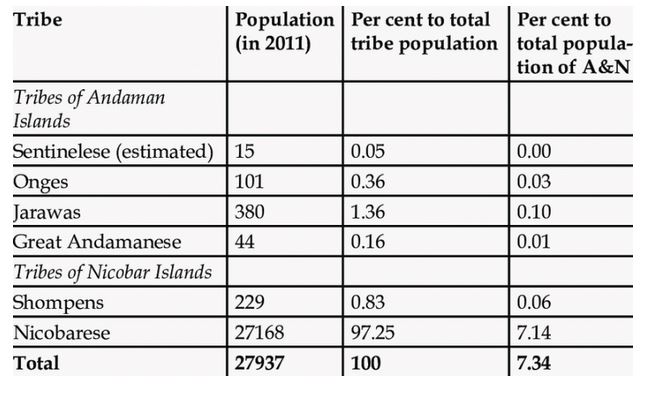
The king and queen of the “Onge tribe” welcomed a baby boy in the Andaman Islands, marking a significant moment for the tribe. With the arrival of the newborn, the tribe’s total population now stands at 136, as confirmed by an official source.
About Onge Tribe
The Onge are PVTGs (Particularly Vulnerable Tribal Groups) native to the Andaman Islands.
They have traditionally been hunter-gatherers and fishers, while also practising cultivation.
Their population significantly decreased after colonization, from 672 in 1901 to around 100.
They practice a form of animism, with ancestor worship being significant.
They traditionally make decisions through group consensus.
Today, the surviving members are confined to two reserve camps on Little Andaman: Dugong Creek in the northeast, and South Bay.
Genetically, the Onge are distantly related to East Asian populations and show affinities with Southeast Asian Negrito ethnic groups.
Other Indigenous People of Andaman and Nicobar
1. Great Andamanese Tribe
One of the largest tribes, the Great Andamanese tribe is currently settled on the Strait Island under the Andaman & Nicobar Administration. Despite their historic bravery, diseases and other challenges have reduced their population to 43 individuals as of the 2001 census.
Government initiatives: The administration provides housing, coconut plantations, and rationing to support their livelihoods and well-being.
2. Jarwas Tribe
Jarwas inhabit the Western coast of the Middle and South Andaman Islands. They are known to be hostile but have shown receptivity to friendly contact expeditions since 1974. Their present numbers are estimated at between 250–400 individuals.
Jarwas are nomadic hunters and gatherers, using traditional methods like bows and arrows for hunting and fishing.
3. Sentinelese Tribe
Sentinelese reside on the small North Sentinel Island, maintaining a wary stance towards outsiders.
Despite initial scepticism, contact expeditions have made progress since 1991, albeit with caution.
Who are the Particularly Vulnerable Tribal Groups (PVTGs)?
These groups are among the most vulnerable sections of our society as they are few in number, and have not attained any significant level of social and economic development.
They generally inhabit remote localities having poor infrastructure and administrative support.
75 such groups have been identified and categorized as Particularly Vulnerable Tribal Groups (PVTGs).
Origin of the concept
The Dhebar Commission (1960-1961) stated that within Scheduled Tribes there existed an inequality in the rate of development.
During the fourth Five Year Plan (1969-74) a sub-category was created within Scheduled Tribes to identify groups that were considered to be at a lower level of development.
This sub-category was named “Primitive tribal group”.
In 2006 the government of India proposed to renamePVTGs.
Features of PVTGs
The features of such a group include a:
Pre-agricultural system of existence
The practice of hunting and gathering
Zero or negative population growth
Extremely low level of literacy in comparison with other tribal groups
Groups that satisfied any one of the criteria were considered PTG.
PYQ:
[2019] Consider the following statements about Particularly Vulnerable Tribal Groups (PVTGs) in India:
PVTGs reside in 18 States and one Union Territory.
A stagnant or declining population is one of the criteria for determining PVTG status.
There are 95 PVTGs officially notified in the country so far.
Irular and Konda Reddi tribes are included in the list of PVTGs.
The Commerce Department is gearing up for the upcoming negotiations on the ASEAN-India FTA review. The ASEAN-India FTA, while beneficial, has led to a widening trade deficit for India.
ASEAN-India Trade in Goods Agreement (AITGA):
The AITGA, signed in 2009 and effective in 2010, aims to reduce tariffs and non-tariff barriers on goods between ASEAN and India, covering sectors like agriculture, textiles, electronics, and machinery.
AITGA is an important component of the ASEAN-India Free Trade Area (AIFTA), which aims to create a single market for goods and services among ASEAN and India.
Major Concern: Growing Trade Deficit
Since the ASEAN-India Trade in Goods Agreement (AITGA), India has been facing a growing trade deficit.
The trade deficit means India is importing more than it is exporting. In 2022-23, India imported goods worth US$87.57 billion, while it exported US$44 billion.
In 2022-23, ASEAN made up 11.3% of India’s global trade. This deficit has grown a lot this year.
Because of this, there’s a need to urgently review and change the current trade setup between ASEAN and India.
Key Areas of Negotiation
Rules of Origin (ROO): Modifications in ROO are planned to increase market access for Indian products and prevent the rerouting of goods, particularly from China, through ASEAN countries.
Trade Remedies: A new chapter on trade remedies will aim to protect domestic industries from unfair trade practices and import surges.
Exclusion of New Areas: The agreement will not expand to cover additional areas like labour, environment, MSMEs, or gender to avoid complicating the pact.
About ASEAN
Details
Establishment
Established in 1967 with the signing of the ASEAN Declaration (Bangkok Declaration).
Chairmanship
Rotates annually among member states based on alphabetical order of their names.
Objective
To promote political and economic cooperation and regional stability among member countries.
Members
Brunei, Cambodia, Indonesia, Laos, Malaysia, Myanmar, Philippines, Singapore, Thailand, Vietnam.
East Timor (Timor-Leste) applied for membership in 2011 but is not yet a member.
Objectives
Accelerate economic growth, social progress, and cultural development.
Promote regional peace and stability based on the rule of law and the UN charter.
Establish an ASEAN community comprising three pillars: ASEAN security, economic, and socio-cultural.
ASEAN Charter
Launched in 2008 to create a legal entity and establish a single free-trade area for the region.
ASEAN Intergovernmental Commission on Human Rights (AICHR) was established in 2009.
Adopted the ASEAN Human Rights Declaration in 2012.
ASEAN Plus Six
ASEAN Plus Three initiated integration efforts with East Asian countries (China, Japan, and South Korea).
Expanded to the East Asia Summit (EAS) including ASEAN Plus Three, India, Australia, and New Zealand.
India and ASEAN
A key pillar of India’s foreign policy and the foundation of Act East Policy.
India has a separate Mission to ASEAN and the East Asia Summit (EAS) in Jakarta.
ASEAN is India’s fourth-largest trading partner.
Delhi Declaration
Identifies Cooperation in the Maritime Domain as a key area of cooperation under the ASEAN-India strategic partnership.
Delhi Dialogue
Annual Track 1.5 event for discussing politico-security and economic issues between ASEAN and India.
ASEAN-India Centre (AIC)
Undertakes policy research, advocacy, and networking activities with organizations and think tanks in India and ASEAN.
Strategic Cooperation
India places ASEAN at the centre of its Indo-Pacific vision of Security and Growth for All in the Region (SAGAR).
PYQ:
[2018] Consider the following countries:
Australia
Canada
China
India
Japan
USA
Which of the above are among the ‘free-trade partners’ of ASEAN?
Narendra Modi will take the oath as the Prime Minister for a third consecutive term, following an invitation from President Droupadi Murmu to form the government.
Constitutional Provisions for PM Post
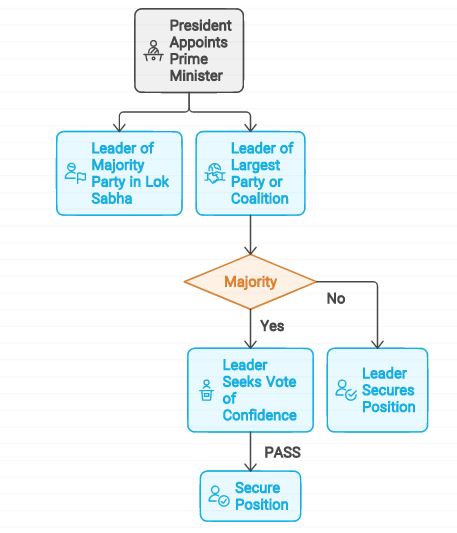
Article 75: It states that the President shall appoint the Prime Minister, who is usually the leader of the majority party in the Lok Sabha (House of the People).
Article 74: The Prime Minister is the head of the Council of Ministers and provides advice to the President on matters of governance.
Appointment of the Prime Minister
The appointment of the Prime Minister of India involves specific constitutional provisions supervised by the President. Key features related to the appointment of the Prime Minister as mentioned in the Constitution of India include:
The Prime Minister is appointed permanently by the President of India.
The President invites the leader of the majority party in the Lok Sabha to form the government.
If no political party holds a majority, the President can use discretionary powers to appoint the Prime Minister.
The President may invite the leader of the largest party or coalition to seek a vote of confidence from the Lok Sabha, with a tenure of about a month to secure this vote.
Position of Prime Minister in India’s Democratic set-up
Head of Government: The Prime Minister is the chief executive authority in the country, responsible for leading the government and overseeing the functioning of various ministries and departments.
Leader of the Council of Ministers: The Prime Minister is the leader of the Council of Ministers, which comprises cabinet ministers, ministers of state, and deputy ministers. They coordinate the activities of the government and guide policy decisions.
Advisor to the President: While the President of India is the head of state, the Prime Minister acts as the president’s chief advisor and assists in exercising executive powers.
Principal Link between President and Parliament: The Prime Minister communicates the decisions of the Council of Ministers to the President and represents the government in Parliament.
Symbol of Unity and Stability: The Prime Minister symbolizes the unity and stability of the country’s governance. They provide leadership and direction to the nation, fostering a sense of unity and purpose among the citizens.
International Representation: The Prime Minister represents India on the international stage and plays a significant role in foreign policy formulation. They engage in diplomatic relations, attend international summits, and represent India’s interests globally.
Crisis Management: During times of crisis, such as natural disasters, security threats, or economic challenges, the Prime Minister takes charge of crisis management efforts and leads the government’s response to address the situation.
Powers and Functions of the Prime Minister
The Indian Constitution outlines the powers and functions of the Prime Minister, who is appointed by the President and holds significant authority over the President, Council of Ministers, and parliamentary houses. These powers include:
Function Relative to the President: The Prime Minister serves as the main channel of communication between the President and the Council of Ministers, overseeing the administration of Union affairs and appointing key administrative officials.
Functions Relative to the Council of Ministers: The Prime Minister advises on the nomination and selection of Council Ministers, can allocate and shuffle ministerial departments, and has the authority to demand resignations from ministers. The resignation of the Prime Minister leads to the dissolution of the Council of Ministers.
Parliamentary Functions: The Prime Minister leads the lower parliamentary house (Lok Sabha), can suggest the dissolution of the Lok Sabha, and is responsible for announcing and introducing government policies in parliamentary sessions.
Miscellaneous Functions: The Prime Minister holds additional roles such as chairman of the National Water Resource Council, NITI Aayog, National Integration Council, Inter-State Council, and NDA, among others.
Appointment, Tenure, and Removal
Eligibility: According to Articles 84 and 75 of the Constitution of India, the Prime Minister must:
Be a citizen of India.
Be a member of the Lok Sabha or the Rajya Sabha, or become a member within six months of selection.
Be above 25 years of age if a Lok Sabha member, or above 30 years if a Rajya Sabha member.
Not hold any office of profit under the government of India or any state government.
Oaths of Office and Secrecy:
Before entering office, the Prime Minister must take an oath of office and secrecy in the presence of the President of India, as per the Third Schedule of the Constitution.
Tenure and Removal from Office:
The Prime Minister serves at the “pleasure of the President,” but must maintain the confidence of the Lok Sabha.
The term can end if a simple majority of Lok Sabha members no longer have confidence in the Prime Minister, known as a vote of no-confidence.
A Prime Minister can also resign from office. Morarji Desai was the first to do so while in office.
Additionally, ceasing to meet the qualifications under the Representation of the People Act, 1951, can lead to removal from office.
PYQ:
[2015] Consider the following statements:
The Executive Power of the union of India is vested in the Prime Minister.
The Prime Minister is the ex officio Chairman of the Civil Services Board.
Which of the statements given above is/are correct?
(a) 1 only
(b) 2 only
(c) Both 1 and 2
(d) Neither 1 nor 2
[2019] Consider the following statements:
The 44th Amendment to the Constitution of India introduced an Article placing the election of the Prime Minister beyond judicial review.
The Supreme Court of India struck down the 99th Amendment to the Constitution of India as being violative of the independence of judiciary.
Which of the statements given above is/are correct?
Mains: Q) From the resolution of contentious issues regarding the distribution of legislative powers by the courts, the ‘Principle of Federal Supremacy’ and ‘Harmonious Construction’ have emerged. Explain. (UPSC CSE 2019)
Q) Explain the rationale behind the Goods and Services Tax (Compensation to States) Act of 2017. How has COVID-19 impacted the GST compensation fund and created new federal tensions? (UPSC CSE 2020)
Prelims:
Q) Which one of the following in Indian polity is an essential feature that indicates that it is federal in character? (UPSC CSE 2021) (a) The independence of the judiciary is safeguarded. (b) The Union Legislature has elected representatives from constituent units. (c) The Union Cabinet can have elected representatives from regional parties. (d) The Fundamental Rights are enforceable by Courts of Law.
Note4Students:
Prelims: Co-perative federalism; NITI Aayog; GST System;
Mains: Federal Issues; Governance Issues; Regional Disparities;
Mentor comment: India is a vast and diverse country with different regions, cultures, and languages. To govern such a complex society, the Indian Constitution established a federal system of governance, dividing power between the central government and the states. This system is known as a quasi-federal system because it contains elements of both a federation and a union. Despite its importance, Indian federalism faces several challenges regional differences, centralized power, Economic insecurities for states, and communication barriers. These challenges can lead to issues like conflicts over resource allocation and decision-making.
There is a need for the even-handed treatment of all the States by the Centre and also less friction among the rich and poor States when proportionately more resources are transferred to poor States to keep rising inequality in check. The issue of governance, both at the Centre and in the States, needs to be flagged. It determines investment productivity and the pace of development. Corruption and cronyism lead to resources being wasted and a loss of social welfare.
Let’s learn.
–
Why in the News?
The results of the 2024 general election in India have led to a surprise, with regional parties performing well and set to share space in both the ruling and opposition benches in Parliament.
This development is expected to strengthen federalism, which has been fraying due to contentious Centre-State relations and the dominant Centre’s attempts to impose its will on the states.
The recent challenges faced by regional states:
Democratic Issues: The Opposition-ruled States have been complaining about stepmotherly treatment by the Centre. Protests have been held in Delhi and the State capitals.
There is a huge diversity among the States. For example, Assam is unlike Gujarat and Himachal Pradesh is very different from Tamil Nadu. A common approach is not conducive to the progress of such diverse States.
They need greater autonomy to address their issues in their unique ways.
Fiscal-Federal Issues:Kerala has complained about the inadequate transfer of resources, Karnataka about drought relief, and West Bengal about funds for the Mahatma Gandhi National Rural Employment Guarantee Scheme (MGNREGS).
The Supreme Court, expressing its helplessness, recently said that Centre-State issues need to be sorted out immediately.
About Co-operative Federalism: The Constitution of India does not explicitly contain the phrase ‘cooperative federalism,’ but the functioning of the governance and evolution of our Constitution implicitly resulted in building ‘cooperative federalism.’
Significance of Cooperative Federalism:
Need for Robust Institutions and Mechanisms:
Revenue has to be raised through taxes, non-tax sources, and borrowings. The Centre has been given a predominant role in raising resources due to its efficiency in collecting taxes centrally.
Among the major taxes, personal income tax (PIT), corporation tax, customs duty, and excise duty are collected by the Centre. So, the Centre controls most of the resources, and they have to be devolved to the States to enable them to fulfill their responsibilities.
Need for Promoting Intergovernmental Relations:
The Centre-State relations in India are plagued by inter-state tussles and resource disparities. The Finance Commission’s efforts to devolve funds proportionally to poorer States have been unsuccessful, leading to resentment from richer States.
The Centre’s allocation of resources, including expenditures and schemes, can be used to play politics and favor certain States, undermining Federalism and Autonomy.
Initiatives taken by the Government:
NITI Aayog:
NITI Aayog acts as the quintessential platform for the Government of India by bringing States together as ‘Team India’ to work towards the national development agenda.
NITI has also established models and programs for the development of infrastructure and to reignite and establish private-public partnerships, such as the Centre-state partnership model Development Support Services to States and Union Territories (DSSS) and the Sustainable Action for Transforming Human Capital (SATH) program.
Goods and Service Tax (GST) System:
The 101st Amendment to the Constitution, which introduced the GST regime, is a watershed moment in the evolution of cooperative Federalism as enshrined in the Constitution of India.
Before the implementation of GST, the Indian taxation system was a medley of Central, State, and Local area levies.
Judicial Contribution for Co-operative Federalism:
In the case of State of Rajasthan v Union of India (1977) which some state governments brought against the Janata government’s dissolution of state legislatures, the Supreme Court upheld its right to strike down a proclamation imposing the President’s rule if the action was mala fide or irrelevant considerations.
It was held that the ‘maintenance of democratic norms’ could not be regarded as an irrelevant ground for the exercise of the power of proclamation. Since then, the Indian model of federalism has been predominantly ‘cooperative’ as laid down by the Supreme Court in 1977.
Recommendations by Sarkaria Commission on Federalism (1988):
* The Indian government constituted the Sarkaria Commission in 1983 mainly created to explore the relationship between the states and the central government. * The Sarkaria Commission did not favor structural changes and regarded the existing constitutional principles and arrangements relating to the instructions as sound. However, it emphasized the need for changes in the functional or operational aspects. * It discusses the relations between the states and the center by the 8th to 12th Finance Commissions to maintain the dependence on several funds from the center.
Way Forward:
The Sixteenth Finance Commission has begun work, aiming to strengthen federalism and address the fraying of Centre-State relations.
It should ensure even-handed treatment of all states, proportionate resource transfers to poorer states, and reduce Centre domination over states.
To reduce the domination of the Centre over the States, the devolution of resources from the Centre to the States could be raised substantially from its current level of 41%.
For example, the Public Distribution System or MGNREGS are joint scheme, but the Centre asserts that it be given credit. It has penalized States that have not done so.
Q The public health system has limitations in providing universal health coverage. Do you think that the private sector can help in bridging the gap? What other viable alternatives do you suggest? (UPSC IAS/2015)
Q In order to enhance the prospects of social development, sound and adequate health care policies are needed particularly in the fields of geriatric and maternal health care. Discuss. (UPSC IAS/2020)
Mentors comment: In the last week of May, a tragic fire at a private neonatal care nursing home in New Delhi shocked everyone. Political parties started blaming each other, and the media exaggerated by incorrectly claiming that many nursing homes in Delhi operate without a license. Despite the intense media coverage, the incident has been largely forgotten, leaving the grieving parents behind. Instead of focusing on who to blame, it’s important to recognize that such tragedies are usually the result of systemic failures—in this case, the failure of health-care regulations.
Let’s learn–
Why in the news?
Health regulations are crucial, but their implementation in India needs to be thoughtful and carefully balanced.
Regulation and standards in the Indian health care system
Excessive and Complex Regulations: Some states have over 50 approvals required under multiple regulations for each healthcare facility, creating a bureaucratic burden. Despite the complexity, there is a perception among officials that the private health sector is under-regulated.
Unrealistic Standards: Many healthcare quality standards set by the government, such as those in the Clinical Establishments (Registration and Regulation) Act, 2010, and the Indian Public Health Standards (IPHS), are considered unrealistic and difficult to implement. Only a small percentage of government primary healthcare facilities meet these standards despite their aspirational goals.
Mixed health-care system in India
Diverse Healthcare Providers: India’s healthcare system includes both government and private sector providers, ranging from single-doctor clinics and small nursing homes to large corporate hospitals, each serving different population segments.
Dominance of Private Sector: The private sector delivers approximately 70% of outpatient services and 50% of inpatient services, indicating a significant reliance on private facilities for health care by the Indian population.
Regulatory and Quality Challenges: There are disparities in regulation enforcement and quality standards between the private and government sectors, with issues such as approval delays, cost of compliance, and ensuring consistent quality care across diverse facilities.
Challenges related to mixed health-care system
Regulatory Disparities: Uneven enforcement of regulations between private and government health facilities. Overzealous regulation of private facilities while government facilities face fewer consequences for similar infractions.
Approval Delays: Sluggish approval processes for private facilities, causing operational delays and financial strain. Long waiting periods for renewal applications, even when submitted well in advance.
Cost and Accessibility: High cost of services in large corporate hospitals compared to smaller clinics and nursing homes. Limited accessibility of government facilities for certain populations, despite being free or low-cost.
Differential Standards: Impractical to hold small clinics and nursing homes to the same standards as large hospitals. Need for a tiered approach to regulation, with essential and desirable standards based on facility type.
Financial Burden: High cost of compliance with regulations for smaller facilities, potentially making health services unaffordable for patients. The a need for government subsidies or funding to help smaller providers meet regulatory standards without increasing costs for patients.
Stakeholder Involvement: Insufficient involvement of health-care providers, facility owners, and community members in the formulation of regulations. Lack of representation from various types of facilities in regulatory processes.
Public Perception and Trust: Political rhetoric and sensational media coverage undermining trust in health-care providers. Potential for increased violence against health-care providers due to public mistrust.
Infrastructure and Safety: Inconsistent emphasis on essential safety measures like fire safety across facilities. Need for equitable implementation of safety standards in all healthcare buildings.
Affordable care is one need
Role of Small Providers: Single doctor clinics and small nursing homes are crucial for providing initial access and health services, particularly for middle-income and low-income populations. These smaller providers deliver a significant portion of health services at a lower cost compared to large corporate hospitals.
Supportive Regulations: There is a need for regulations that support small providers to keep healthcare costs low and affordable. Guidelines should be practical and implementable, harmonizing multiple regulations and simplifying the application process with timely approval.
Differential Approach: Regulations should recognize the different capabilities of various health facilities. Smaller clinics and nursing homes should not be held to the same standards as large hospitals to avoid escalating costs that could be transferred to patients. Essential and desirable regulatory points should be established, with regular self-assessments and inspections to ensure compliance.
Government subsidies and funding should be considered to help smaller facilities adhere to necessary regulations without increasing costs for patients.
Why do we need to Focus on the primary caregivers?
Accessibility and Affordability: Single-doctor clinics and small nursing homes provide essential health services at a lower cost, making health care more accessible and affordable for middle-income and low-income populations.
Primary Care Foundation: Promoting primary care helps manage health issues early, reducing the burden on secondary and tertiary care facilities and supporting the goals of the National Health Policy, 2017, for people-centric, accessible, and affordable health services.
Sustainable Support: Simplified, fair, and collaborative regulatory processes, along with government subsidies, can help primary-care providers operate effectively, ensuring quality and safety without escalating costs for patients.
Conclusion: Primary health care is crucial for achieving the SDG goal of universal health coverage by providing accessible, affordable, and quality health services, thus reducing the burden on higher-level care facilities and promoting overall health equity.
A parliamentary committee report in Canada has claimed India as the second-biggest foreign threat to the country’s democracy.
About the Khalistan Movement
Origins and Objectives: The Khalistan Movement is a separatist movement seeking to create an independent Sikh state called Khalistan in the Punjab region of India.
Activities in Canada: Canada has a significant Sikh population, and some members support the Khalistan Movement. This has led to tensions between Canadian Sikhs and the Indian government.
Notable Incident: The murder of Hardeep Singh Nijjar, a pro-Khalistan ideologue, in Surrey, British Columbia, on June 18, 2023, intensified these tensions.
Historical Background
Canada and India established diplomatic relations in 1947. The relationship was enhanced by personal ties between Indian Prime Minister Jawaharlal Nehru and Canadian Prime Ministers Louis St. Laurent and Lester B. Pearson in the 1940s and 1960s.
Canada provided significant aid to India under the “Colombo Plan”, including food aid, project financing, and technical assistance. India has been one of the largest recipients of Canadian bilateral aid, amounting to over $3.8 billion CAD.
Recent Developments
India and Canada have seen significant growth in bilateral trade, reaching $8.16 billion in 2023.
Canada is home to over 1.2 million people of Indian origin, who are well-integrated into the mainstream and active in politics.
The two countries have a strategic partnership underpinned by shared values of democracy and pluralism, with regular high-level interactions and long-standing people-to-people ties.
India and Canada have signed several agreements, including the Air Services Agreement, Extradition Treaty, Mutual Legal Assistance Treaty, and Nuclear Cooperation Agreement.
Challenges
Interference Allegations: Canada claims that India has expanded its interference efforts beyond countering pro-Khalistani activities to include targeting Canadian politicians, ethnic media, and Indo-Canadian communities.
Mutual Suspicion: The Canadian Security Intelligence Service has also accused India of being involved in the election process in Canada, a claim denied by India.
Ethnic and Political Dynamics: The presence of a significant pro-Khalistan population in Canada complicates bilateral relations, with domestic politics in both countries influencing diplomatic interactions.
India’s Stand
Denial of Allegations: The Indian government has consistently denied allegations of interference in Canadian affairs and the murder of Hardeep Singh Nijjar.
Counter-Terrorism: India views the Khalistan Movement as a terrorist threat and seeks to counter its activities both domestically and internationally.
Diplomatic Responses: In response to accusations from Canada, India has taken measures such as suspending visa services and issuing official statements to refute claims of interference.
Way forward:
Regular Consultations: Establish a framework for regular high-level meetings between Indian and Canadian officials to address mutual concerns and prevent misunderstandings.
Bilateral Committees: Form joint committees to handle specific issues such as security concerns, immigration, and trade disputes.
Mains question for practice:
Q Discuss the origins and objectives of the Khalistan Movement and analyse the current challenges it poses to bilateral relations between India and Canada. 15M
SEBI expands promoter definition for IPO-bound companies, including founders holding 10% or more, and their immediate relatives.
According to current SEBI regulations, a promoter is someone who controls the affairs of the company or can appoint the majority of directors or is named as such in an offer document.
What is an IPO?
An IPO is an initial public offering, in which shares of a private company are made available to the public for the first time.
An IPO allows a company to raise equity capital from public investors.
The Dutch are credited with conducting the first modern IPO by offering shares of the Dutch East India Company to the general public.
What Norms Say
Expanded Definition of Promoter: The definition of a promoter has been expanded for companies preparing for an IPO. A promoter is someone who controls the company’s affairs, can appoint the majority of directors, or is named as such in an offer document.
Previous Criteria: Founders holding 25% were previously deemed promoters due to their negative control and power to block special resolutions.
New Criteria: Founders holding 10% or more must classify themselves as promoters if they are key managerial personnel (KMP) or directors in the company. Immediate relatives on the company board or KMP will also be classified as promoters, even if they hold just 1%.
About Declassification and 31A of LODR (Listing Obligations and Disclosure Requirements) Regulations
Declassification Difficulty: The current regulations do not provide an easy path for declassifying a promoter as a public shareholder.
Rule 31A of LODR Regulations: To be declassified, a person must not hold more than 10% in the listed company along with their relatives.
Restrictive Nature: This restrictive rule makes declassification almost impossible for immediate relatives who are classified as promoters by virtue of their relationship, especially problematic for married daughters with no active role in the company.
Issue Over Subjective Definition
Subjective Nature of Promoter Definition: The definition of a promoter has been historically subjective, leading to varying interpretations and legal disputes.
Court Rulings: There have been several court rulings addressing the subjective nature of who qualifies as a promoter, highlighting inconsistencies and complexities.
Complex Criteria: Accounting standards and regulatory criteria for determining control and influence in a company are often complicated and can be interpreted in multiple ways.
Need for Objectivity: Experts argue for a more objective test to ascertain control and promoter status, which would provide clearer guidelines and reduce disputes.
Example: Vinod Kothari, Director at Vinod Kothari Consultants, points out that moving towards an objective test is a positive step, given the current complexities in determining control.
Way forward:
Standardised Guidelines: Develop clear and standardised guidelines for identifying promoters, reducing subjectivity and ensuring consistency.
Detailed Disclosures: Mandate detailed disclosures from companies about their promoters, including shareholding patterns, roles, and influence in decision-making.
Mains PYQ:
Q In the light of Satyam Scandal (2009), discuss the changes brought in corporate governance to ensure transparency and accountability. (UPSC IAS/2015)
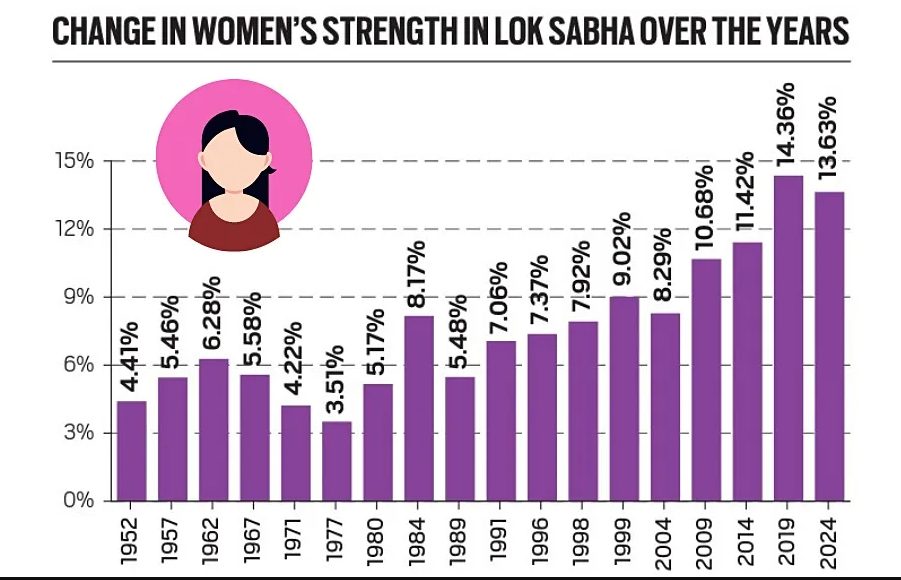
Over time, there has been a general inclination towards enhancing women’s representation in the Lok Sabha. However, the advancement has been gradual and inconsistent.
Women in Lok Sabha 2024 (PRS data):
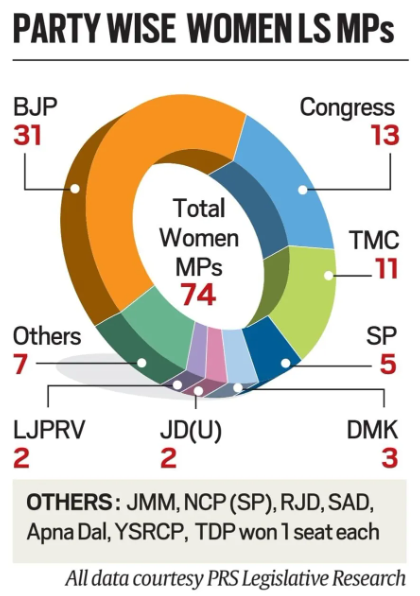
Number of Women MPs: India has elected 74 women MPs to the Lok Sabha in 2024, which is four fewer than in 2019.
Percentage of Representation: Women MPs make up just 13.63% of the elected strength of the Lower House.
Party-wise Distribution: Women MPs come from 14 different parties, with the BJP leading with 31 women MPs, followed by the Congress with 13.
Different Demographic Observations:
Trend in Representation: Over the years, there has been a slow and non-linear increase in women’s representation in the Lok Sabha.
Historical Trends: Women’s representation started at 4.41% in 1952 and peaked at 14.36% in 2019.
New Faces: Out of the 74 women MPs elected, 43 are first-time MPs, indicating a higher percentage of newcomers compared to the overall House.
Younger Representation: The average age of women MPs is 50 years, younger than the overall House age of 56 years.
Comparison with Other Countries:
International Comparison: India lags behind several countries in terms of women’s representation, with countries like South Africa, the UK, and the US having higher percentages of women MPs.
Global Rankings: Women make up 46% of MPs in South Africa, 35% in the UK, and 29% in the US.
What Needs to Be Done?
Increase in Representation: There is a need for greater efforts to increase women’s representation in the Lok Sabha to achieve gender parity.
Policy Measures: Implementation of policy measures such as reserving seats for women in the Lok Sabha could help improve representation.
Encouraging Participation: Encouraging more women to enter politics and providing support for their political careers can contribute to greater representation.
Education and Awareness: Promoting education and awareness about the importance of gender equality in politics is essential for fostering a more inclusive political environment.
Mains PYQ:
Q What are the continued challenges for Women in India against time and space? (UPSC IAS/2019)
WHO reports 33,000 new brain cancer cases yearly in India, highlighting widespread suffering.
What is brain cancer?
Brain cancer, also known as primary brain cancer, is an overgrowth of cells in the brain that form masses called brain tumours.
It is different from secondary brain cancer, which occurs when cancer that began in another part of the body spreads to the brain
The World Health Organization (WHO) Report:
Incidence of Brain Cancer: WHO reports approximately 33,000 new incidences of brain cancer annually in India.
Global Cancer Observatory 2020: Brain cancer ranks as the 19th most common type of cancer worldwide.
Use of Data Analytical Tools in Diagnosis:
Potential of Data Analytics: Utilization of data analytical tools like Next-Generation Sequencing (NGS) can simplify the diagnosis process.
Advantages: Data analysis can provide real-time results with precision, reducing the need for invasive procedures like surgeries.
Liquid Biopsy: The introduction of techniques like liquid biopsy offers a less invasive alternative to surgery, enhancing patient comfort.
Impact on Risks, Discomfort, and Pain:
Reduction of Risks: Adoption of data analytics in diagnosis can lower the risks associated with invasive procedures, ranging from short-term paralysis to death.
Enhanced Patient Experience: By offering less invasive alternatives, such as liquid biopsy, patients and their families can experience reduced discomfort and pain during the diagnostic process.
Improved Precision: Data analytics enable clinicians to detect genetic patterns indicative of cancer cells, facilitating early detection and treatment planning, ultimately leading to better outcomes for patients.
Way forward:
Emphasize the transformative potential of data analytics in oncology research, particularly in simplifying diagnosis and reducing risks and discomfort for patients.
Highlight the importance of leveraging innovative technologies like NGS to unlock new possibilities in cancer research and treatment.
Mains PYQ:
Q What are the research and developmental achievements in applied biotechnology? How will these achievements help to uplift the poorer sections of the society? (UPSC IAS/2021)
![[8 June 2024] The Hindu Op-ed: The Centre is notional, the States the real entities](https://www.civilsdaily.com/wp-content/uploads/2024/06/8-June-1568x882.jpg)
![[7th June 2024] The Hindu Op-ed: Health regulations need a base-to-top approach](https://www.civilsdaily.com/wp-content/uploads/2024/06/7-June-2nd-1568x882.jpg)