💥UPSC 2026, 2027, 2028 UAP Mentorship (March Batch) + Access XFactor Notes & Microthemes PDF

Search results for: “”

  • Reservation in Public Employment: Key Events

    This newscard is an excerpt from the original article published in the TH.

    Reservation in Promotion

    • The jurisprudence of reservation relies on the symbiotic coexistence of constitutionally guaranteed equality of opportunity in public employment under Article 16 (1) of the Constitution of India.
    • The classifications were various clauses of the same article, especially Article 16(4) and Article 16 (4 A).
    • It specifically aimed to provide reservation in promotion to Scheduled Castes and Scheduled Tribes, respectively.
    • These articles vested a discretion on the government to consider providing reservations for the socially and educationally backward sections of the society.

    Reservation not a fundamental Right

    • It is a settled law, time and again reiterated by the Supreme Court, that there is no fundamental right to reservation or promotion under Article 16(4) or Article 16(4 A) of the Constitution.
    • Rather they are enabling provisions for providing reservation, if the circumstances so warrant (Mukesh Kumar and Another vs State of Uttarakhand & Ors. 2020).
    • However, these pronouncements no way understate the constitutional directive under Article 46.
    • Article 46 mandates that the state shall promote with special care the educational and economic interests of the weaker sections of the people and in particular SCs and STs.
    • However such provisions resulted in the ever-evolving jurisprudence of affirmative action in public employment.

    Major events

    (1) Mandal storm

    • Reservation in employment which was otherwise confined to SC and STs got extended to new section called the Other Backward Classes (OBCs).
    • This was the basis of the recommendations of the Second Backward Class Commission as constituted, headed by B.P. Mandal.
    • The Mandal Commission (1980) provided for 27% reservation to OBC in central services and public sector undertakings.
    • This was over and above the existing 22.5% reservation for SCs and STs, was sought to be implemented by the V.P. Singh Government in 1990.
    • The same was assailed in the Supreme Court resulting in the historic Indra Sawhney Judgment.

    (2) Indra Sawhney Judgment (1992)

    • In the judgment, a nine-judge bench presided by CJI MH Kania upheld the constitutionality of the 27% reservation.
    • But it put a ceiling of 50% unless exceptional circumstances warranting the breach, so that the constitutionally guaranteed right to equality under Article 14 would remain secured.
    • While Article 16(1) is a fundamental right, Article 16(4) is an enabling provision and not an exception.
    • Further, the Court directed the exclusion of creamy layer by way of horizontal division of every other backward class into creamy layer and non-creamy layer.

    (3) The Constitution (Seventy-seventh Amendment) Act, 1995

    • In Indra Sawhney Case, the Supreme Court had held that Article 16(4) of the Constitution of India does not authorise reservation in the matter of promotions.
    • However, the judgment was not to affect the promotions already made and hence only prospective in operation, it was ruled.
    • By the Constitution (Seventy-seventh Amendment) Act, 1995, which, Article 16(4-A), was inserted.
    • It aimed to provide the State for making any provision for reservation in matters of promotion to any class or classes of posts in the services under the State.
    • This was to be in favour of the SCs and the STs which, in the opinion of the State, are not adequately represented in the services under the State.
    • Later, two more amendments were brought, one to ensure consequential seniority and another to secure carry forward of unfilled vacancies of a year.

    (4) M. Nagaraj (2006) Case

    • A five-judge bench of Supreme Court declared the 1995 amendment as not vocative of basic structure of the Constitution.
    • It laid down ceratin conditions which included the collection of quantifiable data showing backwardness of the class and inadequacy of representation of that class in public employment.
    • The bench held that the creamy layer among SCs and STs is to be excluded from reservation.

    (5) Jarnail Singh vs Lachhmi Narain Gupta (2018)

    • It was authored by Justice Rohinton Nariman and indicates a critical turn in the jurisprudence of reservation.
    • In this case, a constitution bench of Supreme Court was called on to examine wisdom of the 2006 judgment.
    • This task was to examine the constitutionally recognised socio-economic backwardness of the SCs and STs which may not require any further substantiation.
    • It was also contended that the requirement to identify creamy lawyer among SC and STs fell foul of Indra Sawhney decision.
    • The constitution bench invalidated the requirement to collect quantifiable data in relation to SCs and STs.
    • It upheld the principle of applicability of creamy lawyer in relation to SCs and STs.

    (6) The Constitution (103rd Amendment) Act, 2019

    • The 10% reservation for Economically Weaker Sections (EWS) other SCs, STs and backward classes for government jobs and admission in educational institutions.
    • This is currently under challenge before the Supreme Court which has referred the same to a constitution bench.
    • This was a critical milestone to specifically include economic backwardness without social backwardness as is traditionally seen.

    (7) Dr. Jaishri Laxmanrao Patil vs Chief Minister (2021)

    • Despite the Indra Sawhney ruling, there have been attempts on the part of many States to breach the rule by way of expanding the reservation coverage.
    • The Maharashtra Socially and Educationally Backward Classes Act 2018, (Maratha reservation law) came under challenge before the Supreme Court.
    • This case was referred to a bench of five judges to question whether the 1992 judgment needs a relook.
    • Interestingly, the Supreme Court affirmed the Indra Sawhney decision, and struck down Section 4(1)(a) and Section 4(1)(b) of the Act which provided 12% reservation for Marathas in educational institutions and 13% reservation in public employment respectively.
    • This judgment gave out a strong message that some State governments blatantly disregard the stipulated ceiling on electoral gains rather than any exceptional circumstances.


    UPSC 2023 countdown has begun! Get your personal guidance plan now! (Click here)

  • Price Rise and GST

    The GST regime is due for an overhaul in tax rates levied on different products because of structural anomalies and to reduce the multiple tax slabs.

    What is GST?

    • GST launched in India on 1 July 2017 is a comprehensive indirect tax for the entire country.
    • It is charged at the time of supply and depends on the destination of consumption.
    • For instance, if a good is manufactured in state A but consumed in state B, then the revenue generated through GST collection is credited to the state of consumption (state B) and not to the state of production (state A).
    • GST, being a consumption-based tax, resulted in loss of revenue for manufacturing-heavy states.

    What are GST Slabs?

    • In India, almost 500+ services and over 1300 products fall under the 4 major GST slabs.
    • There are five broad tax rates of zero, 5%, 12%, 18% and 28%, plus a cess levied over and above the 28% on some ‘sin’ goods.
    • The GST Council periodically revises the items under each slab rate to adjust them according to industry demands and market trends.
    • The updated structure ensures that the essential items fall under lower tax brackets, while luxury products and services entail higher GST rates.
    • The 28% rate is levied on demerit goods such as tobacco products, automobiles, and aerated drinks, along with an additional GST compensation cess.

    Why rationalize GST slabs?

    • From businesses’ viewpoint, there are just too many tax rate slabs, compounded by aberrations in the duty structure through their supply chains with some inputs are taxed more than the final product.
    • These are far too many rates and do not necessarily constitute a Good and Simple Tax.
    • Multiple rate changes since the introduction of the GST regime in July 2017 have brought the effective GST rate to 11.6% from the original revenue-neutral rate of 15.5%.
    • Merging the 12% and 18% GST rates into any tax rate lower than 18% may result in revenue loss.

    Haven’t GST revenues been hitting new records?

    • Yes, they have – GST revenues have scaled fresh highs in three of the first four months of 2022, going past ₹1.67 lakh crore in April.
    • But there is another key factor — the runaway pace of inflation.
    • Wholesale price inflation, which captures producers’ costs, has been over 10% for over a year and peaked at 15.1% in April.
    • Inflation faced by consumers on the ground has spiked to a near-eight year high of 7.8% in April.
    • The rise in prices was the single most important factor for higher tax inflows along with higher imports.

    Can we expect the rate reset this year?

    • Any re-arrangement of GST rates will entail some products being taxed higher, with concomitant ripple effects on prices.
    • The Centre and the States are not unmindful of the desperate need to rationalise the rate slabs and structure but we just need to get the timing right.
    • Presently inflation is the top worry.
    • With inflation, much of it imported through pricier fuels, commodities and food items, expected to hover high through the year, the GST rate reset hopes appear bleak in 2022-23.


    UPSC 2023 countdown has begun! Get your personal guidance plan now! (Click here)

  • Monsoon sets in over Kerala

    The monsoon has reached Kerala, the India Meteorological Department (IMD).

    What does the “Onset of Monsoon” mean?

    • The onset of the monsoon over Kerala marks the beginning of the four-month — June-September — southwest monsoon season over India.
    • It brings more than 70 per cent of the country’s annual rainfall. This marks a significant day in India’s economic calendar.
    • IMD announces it only after certain newly defined and measurable parameters, adopted in 2016, are met.
    • Broadly, the IMD checks for the consistency of rainfall over a defined geography, its intensity, and wind speed.

    (1) Rainfall

    • The IMD declares the onset of the monsoon if at least 60% of 14 designated meteorological stations in Kerala and Lakshadweep.
    • The 14 enlisted stations are: Minicoy, Amini, Thiruvananthapuram, Punalur, Kollam, Alappuzha, Kottayam, Kochi, Thrissur, Kozhikode, Thalassery, Kannur, Kasaragod, and Mangaluru.
    • It records at least 2.5 mm of rain for two consecutive days at any time after May 10.
    • In such a situation, the onset over Kerala is declared on the second day, provided specific wind and temperature criteria are also fulfilled.

    (2) Wind field

    • The depth of westerlies should be up to 600 hectopascal (1 hPa is equal to 1 millibar of pressure) in the area bound by the equator to 10ºN latitude, and from longitude 55ºE to 80ºE.
    • The zonal wind speed over the area bound by 5-10ºN latitude and 70-80ºE longitude should be of the order of 15-20 knots (28-37 kph) at 925 hPa.

    (3) Heat

    • According to IMD, the INSAT-derived Outgoing Longwave Radiation (OLR) value (a measure of the energy emitted to space by the Earth’s surface, oceans, and atmosphere) should be below 200 watt per sq m (wm2).
    • This is measured in the box confined by 5-10ºN latitude and 70-75ºE latitude.

    Is it unusual for the monsoon to hit the Kerala coast early?

    • Neither early nor late onset of the monsoon is unusual.
    • In 2018 and 2017, the onset over Kerala occurred on May 29 and May 30, respectively.
    • In 2010, onset was realised on May 31.
    • In 2020 and 2013, the monsoon was exactly on time, hitting the Kerala coast on June 1.

    Does an early onset foretell a good monsoon?

    • No, it does not — just as a delay does not foretell a poor monsoon.
    • The onset is just an event that happens during the progress of the monsoon over the Indian subcontinent.
    • A delay of a few days, or perhaps the monsoon arriving a few days early, has no bearing on the quality or amount of rainfall.

    How does the monsoon spread across the country after hitting Kerala coast?

    • The northward progression of the monsoon after it has hit the Kerala coast depends on a lot of local factors, including the creation of low pressure areas.
    • Though this year monsoon has arrived early, it is possible that despite a late onset over Kerala, other parts of the country start getting rain on time.
    • After its onset over Kerala, the monsoon spreads over the entire country by July 15.

    Back2Basics:

    Various terms related to Indian Monsoon


    UPSC 2023 countdown has begun! Get your personal guidance plan now! (Click here)

  • What is the West Nile Virus?

    The Kerala health department is on alert after the death occurred due to the West Nile Virus.

    West Nile Virus

    • The West Nile Virus is a mosquito-borne, single-stranded RNA virus.
    • According to the WHO, it is a member of the flavivirus genus and belongs to the Japanese Encephalitis antigenic complex of the family Flaviviridae.

    How does it spread?

    • Culex species of mosquitoes act as the principal vectors for transmission.
    • It is transmitted by infected mosquitoes between and among humans and animals, including birds, which are the reservoir host of the virus.
    • Mosquitoes become infected when they feed on infected birds, which circulate the virus in their blood for a few days.
    • The virus eventually gets into the mosquito’s salivary glands.
    • During later blood meals (when mosquitoes bite), the virus may be injected into humans and animals, where it can multiply and possibly cause illness.
    • WNV can also spread through blood transfusion, from an infected mother to her child, or through exposure to the virus in laboratories.
    • It is not known to spread by contact with infected humans or animals.

    Symptoms of WNV infection

    • The disease is asymptomatic in 80% of the infected people.
    • The rest develop what is called the West Nile fever or severe West Nile disease.
    • In these 20% cases, the symptoms include fever, headache, fatigue, body aches, nausea, rash, and swollen glands.
    • Severe infection can lead to encephalitis, meningitis, paralysis, and even death.
    • It is estimated that approximately 1 in 150 persons infected with the West Nile Virus will develop a more severe form of the disease.
    • Recovery from severe illness might take several weeks or months.
    • It usually turns fatal in persons with co-morbidities and immuno-compromised persons (such as transplant patients).


    UPSC 2023 countdown has begun! Get your personal guidance plan now! (Click here)

  • Imp: Must Read Modern History Notes for Prelims 2022

    Talk to our mentors for a Roadmap to 2023 Attempt. Click Here


    • With almost absolute power the Governor-General and viceroy played a significant role in the shaping history of the country. Following are some of these important figures and significant events and major reforms carried out by them.

       Governor Generals of Bengal/India (Period)

        Important events/Reforms

          Warren Hastings

           (1773-1785)

      • Regulating Act of 1773.
      • First Governor-General of Bengal.
      • End of the dual system of administration (1765-1772).
      • Supreme Court at Calcutta.
      • Wrote Introduction to the first English translation of Gita.
      • Founded Madarasa Aliya at Calcutta.

           Lord Cornwallis

           (1786-1793)

      • Separation of three branches of service: commercial, judicial and revenue.
      • Permanent Land Revenue Settlement of Bengal-1793.
      • Reformed, modernised and rationalised the civil service.
      • Introduced the Cornwallis Code.
      • Sanskrit College, Varanasi.

           Lord Wellesley

           (1797-1805)

      • Introduction of Subsidiary Alliance System.
      • Fourth Anglo-Mysore war.
      • Fort William College, Calcutta.

           Lord Hastings

           (1813-1823)


      • Anglo-Nepal War (1814-16)
      • Third Anglo-Maratha War-(1817-19) and dissolution of Maratha confederacy.
      • Introduction of Ryotwari System of Thomas Munro, Governor of Madras-1820.

           Lord William Bentinck

           (1828-1835)

      • Charter Act of 1833.
      • Abolition of Sati-1829.
      • Resolution of 1835 and Education reforms and introduction of English as the official language.
      • The annexation of Mysore-1831, Coorg, and Central Cachar-1831.

           Lord Dalhousie

           (1848-1856)

      • Introduction of the Doctrine of Lapse and annexations of Satara-1848, Jaitpur and Sambhalpur-1849, Udaipur-1852, Jhansi-1853, Nagpur-1854 and Awadh-1856.
      • Wood’s Dispatch of 1854.
      • Railway Minute of 1853.
      • Telegraph and Postal reforms.
      • Widow Remarriage Act-1856.

           Lord Canning

           (1856-1857)

      • Establishment of universities at Bombay, Madras and Calcutta.
      • Mutiny of 1857.
      Governor-General and Viceroy of India (Period)                                Important events/Reforms
       Lord Canning


      (1858-1862)

      • First Voiceroy of India.
      • Transfer of control from East India Company to the Crown by the Government of India Act 1858
      • Indian Councils Act-1861

           Lord Mayo

           (1869-1872)

      • Opening of Rajkot College in Kathiawad and Mayo College at Ajmer for political training of Indian Princes.
      • Statistical Survey of India was established.
      • Department of Agriculture and Commerce was established.
      • Introduction of state railways.

           Lord Lytton

           (1876-1880)

      • The Great Famine of 1876 affecting Bombay, Madras, Mysore, Hyderabad, Central India and Punjab.
      • Appointment of Famine Commission under the presidency of Richard Strachey.
      • Vernacular Press Act was passed- 1878.
      • The Arms Act-1878.

           Lord Ripon

           (1880-1884)

      • Education Commission 1882 under William Hunter-1882.
      • Ilbert Bill controversy.
      • Repeal of Vernacular Press Act in 1882.
      • The First Factory Act in 1881 to improve labour conditions.
      • Government resolution on local self government-1882.

           Lord Dufferin

           (1884-1888)

      • Establishment of Indian National Congress.

           Lord Lansdowne

          (1888-1894)

      • The categorisation of civil services into imperial, provincial and subordinate.
      • Indian Councils Act-1892
      • Durand Commission (1893) was set up to define the Durand Line between India and Afghanistan.

           Lord Curzon

           (1899-1905)

      • Police Commission (1902) was appointed under Sir Andrew Frazer.
      • University Commission (1902) was appointed and Universities Act (1904) was passed.
      • Department of Commerce and Industry was established.
      • Calcutta Corporation Act-1899
      • Partition of Bengal (1905).

           Lord Minto-II

           (1905-1910)

      • Popularisation of anti-partition and Swadeshi Movements.
      • Split in Indian National Congress at Surat in 1907.
      • Indian Muslim League was established by Aga Khan (1907)
      • Morley-Minto reforms or Indian Councils Act 1909.

           Lord Hardinge-II

           (1910-1916)

      • Transfer of capital from Calcutta to Delhi (1911).
      • Establishment of Hindu Mahasabha (1915) by Madan Mohan Malviya.
           Lord Chelmsford


          (1916-1921)

      • Home Rule League was formed by Annie Besant and Tilak (1916)
      • Lucknow session of Congress (1916).
      • Lucknow Pact between Congress and Muslim League (1916).
      • Champaran Satyagraha (1918), and Satyagraha at Ahmadabad (1918).
      • Montague’s August Declaration.
      • Government of Indian Act- 1919
      • Jallianwalla Bagh massacre (1919).
      • Non-Cooperation and Khilafat Movements were launched.
      • Foundation of Women’s University at Poona (1916) and Saddler’s Commission was appointed for reforms in educational policy.
      • Appointment of S. P. Sinha as governor of Bihar first Indian to do so.

           Lord Reading

           (1921-1926)

      • The Chaura-Chauri Incident-Feb5, 1922 and withdrawal of Non-Cooperation movement.
      • Moplah rebellion in Kerala (1921).
      • Repeal of the Press Act of 1910 and Rowlatt Act of 1919.
      • Kakori train robbery (1925)
      • Establishment of Swaraj Party (1922).
      • The decision to hold a simultaneous examination for ICS in Delhi and London with effect from 1923.

           Lord Irwin

           (1926-1931)

      • Simon Commission-1928
      • Appointment of the Harcourt Butler Indian States Commission (1927)
      • Murder of Saunders and Bomb blast in the Assembly Hall of Delhi-1929
      • Lahore session of Congress 1929 and Purna Swaraj Resolution.
      • Dandi March (12 March, 1929) and launch of Civil Disobedience Movement.

          Lord Willingdon

          (1931-1936)

      • Second Round Table Conference and failure of the conference, resumption of the Civil Disobedience Movement.
      • Announcement of the Communal Award (1932).
      • Poona Pact (1932)
      • Third Round Table Conference 1932.
      • The Government of India Act, 1935.
      • Establishment of All India Kisan Sabha 1936.
      • Establishment of Congress Socialist Party by Acharya Narendra Dev and Jayaprakash Narayan (1934)

           Lord Linlithgow

           (1936-1944)

      • First general elections were held and Congress attained absolute majority (1936-1937).
      • Congress ministers resigned (1937) after the outbreak of WW-II
      • Subhash Chandra Bose elected as the president of Congress-1938.
      • Lahore Resolution by Muslim League for the demand of separate state for Muslims.
      • August Offer by the viceroy-1940.
      • Cripp’s Mission to India
      • Passing of the Quit India Resolution by Congress-1942

           Lord Wavell

           (1944-1947)

      • C Rajgopalachari’s CR Formula (1944) and Gandhi-Jinnah Talks failed.
      • Wavell Plan and the Shimla Conference (1942)
      • Cabinet Mission and Congress accepted its plan 1946
      • Observance of the ‘Direct Action Day’ (16 August 1946) by the Muslim League.
      • Elections to the Constituent Assembly and formation of Interim Government by the Congress (September 1946).
      • Announcement of the end of British rule in India by Clement Attlee on February 20, 1946

           Lord Mountbatten

           (1947-48)

      • June Third Plan (June 3, 1947) announced.
      • Introduction of Indian Independence Bill in the House of Commons.
      • Appointment of two boundary commissions under Sir Cyril Radcliff for the partition of Bengal and Punjab.

    Important Acts During British India

    In India, the British Government passed various laws and acts before the formulation of the constitution. The Regulating Act of 1773 was enacted as a first step to regulate the working of East India Company. However, the Indian Independence Act, 1947 finally ended the British rule in India and declared India as an independent and sovereign nation with effect from August 15, 1947.

    The Regulating Act of 1773

    • The Regulating Act of 1773 was enacted as a first step to regulate the working of East India Company
    • The Gov of Bengal was made Gov General of Bengal. He was assisted by 4 people. This 4+1 becomes became Supreme Council of Bengal also known as the GG’s Exec Council.
    • A Supreme Court was established in Bengal comprising of a chief justice and three other judges

    Pitts’s India Act, 1784

    • We see a shrinking of the Council from 4 members to 3 members. Hence 3+1 is the renewed GG’s Executive Council.
    • Board of control was established to control the civil, military and revenue affairs of the company
    • The Court of Proprietors was no more empowered to revoke or suspend the resolution of the directors approved by the Board of Control.

    Charter Act of 1833

    • The Governor-General of Bengal was made the Governor-General of India. The first Governor-General of India was William Bentinck.
    • He was given legislative powers over entire India including the Governors of Bombay and Madras.
    • The company lost the status of a commercial body and was made purely an administrative body.
    • This Act. was the first law to distinguish between the executive and legislative powers of the Gov General.
    • A 4th member was introduced who could only discuss and vote only on the legislative matter.
    • Council of India = [(3+1) +  1(4th member also called the Law Member)]
    • The first such Law Member was Macaulay. This Council of India was, to a certain extent, the Legislature. Strength of the Executive remained 3+1 .

    Charter Act of 1853

    • From here on, we see a gradual increase in the membership of the Council and further separation of powers.
    • Access to compete in civil services for Indians.
    • It brought out the separation in the legislative and executive functions of the Governor-General’s council.
    • The 4th member (Law Member)was included as a full-time Member in the GG’s Executive Council. His position was taken by 6 Members referred to as Legislative Councillors.
    • Council of India = [(4+1) + 6(Legislative Councillors) + 1 Commander-in-Chief]
    • 6 Councillors were,
      1. 1 Chief Judge of SC of Calcutta.
      2. 1 Judge of SC of Calcutta
      3. 4 members of the ICS

    Government of India Act, 1858

    • India was to be governed by and in the name of the crown through Viceroy, who would be the representative of the crown in India.
    • The designation of Governor-General of India was changed to Viceroy. Thus, Governor-General Lord Canning became the first Viceroy of India
    • Board of Control and Board of directors were abolished transferring all their powers to British Crown
    • A new office ‘secretary of state was created with a 15 member council of India to assist him. Indian Councils Act, 1861
    • The major focus of the act was on administration in India. It was the first step to associate Indians to legislation.
    • The act provided that the viceroy should nominate some Indians as non-official members in the legislative council.
    • The legislative powers of Madras and Bombay presidencies were restored.
      It provided for the establishment of legislative councils for Bengal, North-Western Frontier Province (NWFP) and Punjab.
    • Viceroy was empowered to issue ordinances during an emergency without the concurrence of the legislative council.

    Indian Councils Act of 1861

    • After 1861, the Council was called Imperial Legislative Council(ILC) or Indian Legislative Council(ILC). The Executive was further enhanced by 1 member.
    • The Viceroy now had the power to Nominate 6 – 12 Non-Official members in the Legislature who would be holding the office for 2 years.
    • ILC = [(5+1) + (Additional Members -> Minimum 6, Maximum 12)]
    • The composition of Additional Members was as follows:
      1. 50% Nominated Official Members
      2. 50% Nominated Non-Official Members
    • The Act thus sowed the seed for the future Legislative as an independent entity separate from the Executive Council.

    Indian Councils Act of 1892 

    • Due to the excessive demand of the Congress, the Additional Members were increased. Additional Members -> Minimum 10, Maximum 12.
    • ILC = [(5+1) + (Additional Members -> Minimum 10, Maximum 16)]

    The composition of Additional Members was as follows:

    • Nominated official members (those nominated by the Governor-General and were government officials)
    • 5 Nominated Non-Officials (nominated by the Governor-General but were not government officials)
    • 4 Nominated by the Provincial Legislative Councils of Bengal Presidency, Bombay Presidency, Madras Presidency and North-Western Provinces.
    • 1 Nominated by the Chamber of Commerce in Calcutta.

    Indian Councils Act of 1909: The Morley-Minto reforms

    • It introduced for the first time the method of election.
    • The additional members of the Governor-General Council were increased from 16 to a maximum of 60.
    • The composition of Additional Members was as follows:
      1. Nominated official members (those nominated by the Governor-General and were government officials)
      2. Nominated non-official members (nominated by the Governor-General but were not government officials)
      3. Elected Members (elected by different categories of Indian people)
    • It provided for the association of Indians in the executive council of the Viceroy and Governors. Satyendra Prasad Sinha joined the Viceroy’s executive council as a law member.
    • It introduced Separate Electorate for Muslims.

    Indian Councils Act of 1919: The Montagu-Chelmsford Reforms

    • Central Legislature thereafter called the Indian Legislature was reconstituted on the enlarged and more representative character.
    • The act set up bicameral legislatures at the centre consisting of two houses- the Council of the States (Upper House) and the Central Legislative Assembly (Lower House).
    • It consisted of the Council of State consisted of 60 members of whom 34 members were elected and the Legislative Assembly consisted of about 145 members, of whom about 104 were elected and the rest nominated.
    • Of the nominated members, about 26 were officials.  The powers of both the Chambers of the Indian Legislature were identical except that the power to vote supply was granted only to the Legislative Assembly.
    • The central and provincial subjects were demarcated and separated.
    • The Provincial subjects were further divided into Transferred Subjects and Reserved Subjects, the legislative council had no say in the latter. This was known as the system of Diarchy.
    • The principle of separate electorate was further extended to Sikhs, Indian Christians, Anglo-Indians and Europeans.
    • It provided for the appointment of a statutory commission to report the working of the act after ten years

    The Government of India Act 1935

    • It marked the next great stride in the evolution of the Legislatures.
    • The Federal Legislature was to consist of two Houses, the House of Assembly called the Federal  Assembly and the Council of States.
    • The Federal Assembly was to consist of 375 members, 250 to represent Provinces and 125 to represent the Indian States, nominated by the Rulers.
    • The representatives of the Provinces were to be elected not directly but indirectly by the Provincial Assemblies.
    • The term of the Assembly was fixed as five years.
    • The Council of State was to be a permanent body not subject to dissolution, but one-third of the members should retire every three years.
    • It was to consist of 260 members.  104 representatives of Indian States, six to be nominated by the Governor-General, 128 to be directly elected by territorial communal constituencies and 22 to be set apart for smaller minorities, women and depressed classes.
    • The two Houses had in general equal powers but demands for supply votes and financial Bills were to originate in the Assembly.
    • The principle of Separate Electorate was extended to depressed classes, women and workers.
    • Provided for the formation of Reserve bank of India

    Indian Independence Act, 1947

    • The act formalized the Lord Mountbatten Plan regarding the independence of India on June 3, 1947.
    • The Act ended the British rule in India and declared India as an independent and sovereign nation with effect from August 15, 1947.
    • Provided for the partition of India into two dominions of India and Pakistan
    • The office of Viceroy was abolished and a Governor-General was to be appointed in each of the dominions
    • The Constituent Assemblies of the two dominions were to have powers to legislate for their respective territories.
    • Princely states were free to join any of the two dominions or to remain independent.
  • [Sansad TV] Mudda Aapka: Indo-Pacific Economic Framework (IPEF)

    UPSC 2023 countdown has begun! Get your personal guidance plan now! (Click here)
    Context

    • India agreed to be a part of the Indo-Pacific Economic Framework for Prosperity (IPEF), a US-led economic grouping comprising 12 countries.
    • The recent Quad meet in Tokyo initiated the path for negotiations among the ‘founding members.’

    What is IPEF?

    • It is a US-led framework for participating countries to solidify their relationships and engage in crucial economic and trade matters that concern the region, such as building resilient supply chains battered by the pandemic.
    • It is not a free trade agreement. No market access or tariff reductions have been outlined, although experts say it can pave the way to trade deals. 

    Members of IPEF

    • The member nations include Australia, Brunei, India, Indonesia, Japan, South Korea, Malaysia, New Zealand, the Philippines, Singapore, Thailand and Vietnam.
    • It includes seven out of 10 members of the Association of South East Asian Nations (ASEAN), all four Quad countries, and New Zealand.
    • Together, these countries account for 40 per cent of the global GDP. 

    Four pillars of IPEF

    1. Trade that will include digital economy and emerging technology, labor commitments, the environment, trade facilitation, transparency and good regulatory practices, and corporate accountability, standards on cross-border data flow and data localisations;
    2. Supply chain resilience to develop “a first-of-its-kind supply chain agreement” that would anticipate and prevent disruptions;
    3. Clean energy and decarbonization that will include agreements on “high-ambition commitments” such as renewable energy targets, carbon removal purchasing commitments, energy efficiency standards, and new measures to combat methane emissions; and
    4. Tax and anti-corruption, with commitments to enact and enforce “effective tax, anti-money laundering, anti-bribery schemes in line with [American] values”.

    How do members participate?  

    • Countries are free to join (or not join) initiatives under any of the stipulated pillars but are expected to adhere to all commitments once they enrol.
    • Negotiations are meant to determine and list the provisions under each pillar and open the floor for countries to choose their ‘commitments’.
    • The framework would be open to other countries willing to join in the future provided they are willing to adhere to the stipulated goals and other necessary obligations.

    Reasons for the creation of IPEF

    • US regaining lost credibility: IPEF is also seen as a means by which the US is trying to regain credibility in the region after Trump pulled out of the Trans Pacific Partnership TPP).
    • Rising Chinese influence: Since then, there has been concern over the absence of a credible US economic and trade strategy to counter China’s economic influence in the region.
    • Competing RCEP: It is also in the 14-member Regional Comprehensive Economic Partnership, of which the US is not a member (India withdrew from RCEP).
    • “Pivot to Asia” strategy: US has intensified its engagement with the wider Asia-Pacific region to advance its economic and geopolitical interests.

    India’s perception of IPEF

    • PM Modi described the grouping as born from a collective desire to make the Indo-Pacific region an engine of global economic growth.
    • India has called for common and creative solutions to tackle economic challenges in the Indo-Pacific region.

    What does it have to do with China?  

    • The US strategists believe the US lacks an economic and trade strategy to counter China’s increasing economic influence in the region since 2017.
    • US companies are looking to move away from manufacturing in China.
    • IPEF would therefore offer an advantage to participating countries, allowing them to bring those businesses into their territory.
    • However, it officially excluded Taiwan despite its willingness and economic merit to join.
    • This exhibits Washington’s geopolitical caution.

    Reactions from the opponents

    • Chinese Foreign Minister Wang Yi criticized the initiative as an attempt to further economic decoupling from China.
    • He argued that the initiative, and the US Indo-Pacific strategy as a whole, created divisions and incited confrontation. It is destined to be ultimately be a failure.
    • Taiwan was excluded in order to appease key “fence-sitter” countries such as Indonesia whose governments feared angering China.

    Issues with IPEF framework

    • IPEF would neither constitute a ‘free trade agreement,’ nor a forum to discuss tariff reductions or increasing market access.
    • Unlike a traditional trade agreement, the US administration will not need congressional approval to act under the IPEF. Hence its legal status is questionable.
    • This also raises doubts among potential participants about their reluctance to offer significant concessions under the agreement.
    • The volatility of US domestic politics has raised concerns about IPEF’s durability.
    • Unlike traditional FTAs, the IPEF does not subscribe to the single undertaking principle, where all items on the agenda are negotiated simultaneously.

    Given the divisive nature of American politics, it is unclear whether the IPEF will survive past the Biden administration.

    Way forward

    • The IPEF’s launch in Tokyo was symbolic in nature; bringing the IPEF to fruition will involve significant domestic and international challenges.
    • Without ratification by Congress, the IPEF’s fortunes will remain in limbo.
    • Going forward, the US and the founding partners need to develop the process and criteria by which other countries from the region will be invited to join the negotiations on the IPEF.

    Conclusion

    • The Quad’s plan would take several years to ultimately fructify but it is moving in the right direction.
    • There is no doubt these plans will extend to the new economic alliance as many of its members are powerhouses in the technology sector.

    UPSC 2023 countdown has begun! Get your personal guidance plan now! (Click here)

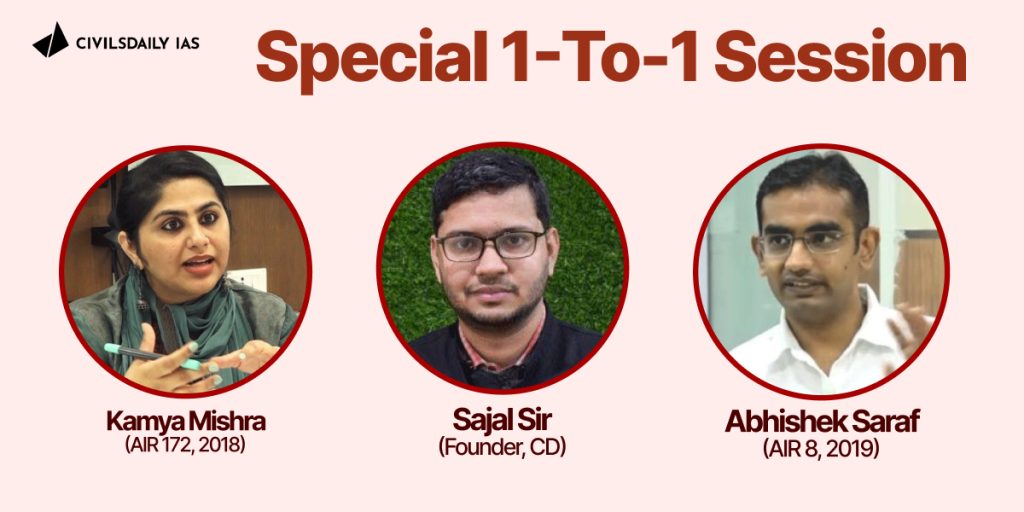
  • (15 minutes to go-Direct Joining Link) 1-1 with youngest IPS Kamya Mishra and IAS, Abhishek Saraf | Gear your preparation in the right direction |  (FREE)

    (15 minutes to go-Direct Joining Link) 1-1 with youngest IPS Kamya Mishra and IAS, Abhishek Saraf | Gear your preparation in the right direction | (FREE)

    Join Zoom Meeting: 

    https://us06web.zoom.us/j/85772760934?pwd=VWZ3cUovYzFFbHB4R2g3T1F4VkVkUT09

    Meeting ID: 857 7276 0934

    Passcode: 834463

    *Exceptional Tips on How to Achieve your UPSC Goal Along With Your College Degree || Learn from Youngest IPS Kamya & IAS Abhishek*

    Date & Time: *May 31, 2022 @07:00 PM (Start Log in by 06:45 PM) India*

    ‘College is such a utopia where UPSC is dreamt’Civilsdaily

    Going to college and prepping for UPSC is not an easy task, Because UPSC is no doubt a higher bar to cross. But it can be achieved in the very 1st attempt If your dream is true. Inculcate these brainchild formulas of toppers & senior mentors.

    Like a seed that sprouts out and wants to stand high and competent but often fails due to lack of nourishment. Likewise, the endeavor of becoming a civil servant and sitting for the most prestigious exam, and serving the nation kindles a student from his / her college days but how many in reality can sail through the dreams? It has only a 0.001% success rate. The lack of right-tracked 360 guidance and proper knowledge and understanding leads to the disastrous failure of the dreams. So, dare to dream, beat all odds with this Exceptional Live Session.

    Webinar Details:

    Grasp the opportunity to get exceptional tips on ‘how to achieve your goal along with your college degree’. This entire webinar is free. All aspirants are wholeheartedly welcome to attend.

    Date: 31st May 2022 (Tuesday)

    Time: 7 PM to 8 PM

    Strategies & Approaches, in This Free Live Webinar:

    1. How to start your preparation during your College days and acquired the day 0 advantage. Is there any scope for College Curriculum integration with the UPSC syllabus? Will also be discussed thoroughly.
    2. How to overcome every challenge of college life! How to remain convinced that UPSC is the right path for you? How to understand constraints!
    3. What is the best strategy for College Students: Cracking UPSC / Govt Exams by investing less than 2 hours a day. Will be elaborated by a top senior mentor.
    4. How Mastering General Studies gives you an extra 50% edge in All Govt Competitive Exams.
    5. Why should you prepare under the guidance of a topper’s mentor? What is the Role of Mentors in UPSC / Govt Exam Preparation? Role of GS in other Govt / MNCs exams.
    6. What is ‘Pattern Analysis’? What are the toppers’ tips to crack UPSC? Why choose IAS! All these will be the central part of this Q & A session.
    7. Many untold secrets in ‘Life of an IAS officer’, ‘Challenges of being a Female IPS officer’, ‘Tips for Cracking IES’, Etc. will be discussed in depth.

    About the hosts:

    Abhishek Saraf (AIR 8): He took the JEE exam after finishing his 12th grade and received an All-India Rank of 6. In 2013, he graduated from IIT Kanpur with a bachelor’s degree. He secured 8th rank all over India in the IAS exam during his 4th attempt by choosing civil engineering as his optional subject. He was an IES officer already before he cracked the IAS exam. 

    IPS Kamya Mishra: (also known as Lady Singham) Kamyaa Mishra is an Indian civil servant and IPS officer at the age of 21. She clears the UPSC exam (2018) on her first attempt and secured AIR 172. Currently, she is serving as an assistant superintendent of police in the Patna district, Bihar.

    Sajal Singh: (Founder of Civilsdaily) Sajal Singh is an MS Economics from Gokhale Institute of Politics and Economics, and MS Financial Economics from Carleton University Canada. NET(JRF) in Economics qualified. He had obtained the highest marks in GS papers in UPSC Mains 2017 and appeared in several UPSC CS interviews. He also heads the Civilsdaily flagship Smash Mains initiative with an over 80% success ratio in the Mains exam. He has mentored over 600+ successful IAS candidates and over 200+ successful PCS candidates.

    Civilsdaily’s 2021 Hall Of Fame Rankers

    WISH YOU ALL THE VERY BEST.

  • (Direct Joining Link) Q & A session: Struggling with consistency! Learn and apply powerful secret tips to stay consistent, webinar with Rahul Vadar, senior IAS mentor

    (Direct Joining Link) Q & A session: Struggling with consistency! Learn and apply powerful secret tips to stay consistent, webinar with Rahul Vadar, senior IAS mentor

    *Struggling with consistency? Learn and apply powerful secret tips to stay consistent // By Rahul, Mentor, Civilsdaily*

    Join Zoom Meeting: https://us06web.zoom.us/j/83901669816?pwd=ZWRLL2hwODdKZU5zVXdXOWJsbUZJQT09
    Meeting ID: 839 0166 9816

    Passcode: 649176


    Date & Time: *May 29, 2022 @04:00 PM (Login commense @03:45 PM Onwards) India*

    Do not miss this opportunity to understand the nuances of UPSC preparation if you plan to appear in 2023. Rahul Sir will hold a Q&A Session where beginners and veterans can clarify their doubts.

    Most of the UPSC-CSE-2021 toppers like Satyam Gandhi (AIR 10), Ria Dabi (AIR 15), Yash Jaluka (AIR 4), and Mamta Yadav (AIR 5), and Shashwat Tripurari (AIR 19) cleared the exam as fresh graduates in their very first attempt. How were they able to do it?

    This is what Civilsdaily mentor Rahul sir would be discussing in the upcoming webinar.

    If education, geographical and economic background doesn’t matter, then what does? Attitude, or precisely consistency. If you are persistent and adamant to clear UPSC- CSE and have given more than two attempts till now, then you must replace that with consistency. Because, being persistent might lead you to the door, but it’s consistency that unlocks it.

    Webinar Details:

    Date: 29th May 2022 (Sunday)

    Time: 4 PM to 5 PM

    Grasp the opportunity to get exceptional tips on ‘how to maintain consistency to achieve your goal’. This entire webinar is free. All aspirants are wholeheartedly welcome to attend.

    Strategies & Approaches, in This Free Live Webinar by Rahul Sir!

    1. Best, authentic, minimum materials for current affairs, optional subject & Gs papers. Do’s & Don’t, How to read & revise in a consistent manner. Because consistency + being persistent are all that matter.
    1. If your answers should reflect the editorial standards of The Hindu, which is the best source? How will the source help you to maintain consistency?
    1. How toppers prioritize division of time for different subjects! How to fix time to read & get consistent in your answer writing structure, improve the content
    2. How to create a basic funda to get rid of social media. How to save 40 hours in a week from making notes on current affairs.
    3. How to evaluate your progress! & how to remember Map/diagram/flowchart/, It will help to get extra 0.25-0.5 marks across 80 questions of GS papers.
    4. How to enhance writing patterns, where to take mock regularly, how many mock tests are fit, Etc. will be discussed in this live webinar.
    5.  The untold secret of our ‘Hall of Fame’ toppers is that they never break their consistency so that the entire syllabus is covered 100% & becoming an IAS dream is finally achieved.

    About Rahul Sir:

    Rahul sir is a mentor with CivilsDaily for more than 2+ years and is now mentoring more than 1500 students. His experience of writing in all the 5 UPSC-CSE Prelims & MAINS exams,and attending the interview twice, makes him an appropriate guide to address this compulsory matter.

    Wish You All The Best.

  • What are Community Forest Rights?

    The Chhattisgarh government has become the only second state in the country to recognize the Community Forest Resource (CFR) rights of a village inside a national park.

    What is the news?

    • The CFR rights of tribals living in a hamlet inside the Kanger Ghati National Park in Bastar district, were recognised.
    • It gave the community the power to formulate rules for forest use.

    Try this PYQ first:

    Q.Under the Scheduled Tribes and Other Traditional Forest Dwellers (Recognition of Forest Rights) Act, 2006, who shall be the authority to initiate the process for determining the nature and extent of individual or community forest rights or both?

    (a) State Forest Department

    (b) District Collector/Deputy Commissioner

    (c) Tahsildar/Block Development Officer/Mandal Revenue Officer

    (d) Gram Sabha


    Post your answers here.

    What is a Community Forest?

    • The community forest resource area is the common forest land that has been traditionally protected and conserved for sustainable use by a particular community.
    • The community uses it to access resources available within the traditional and customary boundary of the village; and for seasonal use of landscape in case of pastoralist communities.
    • Each CFR area has a customary boundary with identifiable landmarks recognised by the community and its neighboring villages.
    • It may include forest of any category – revenue forest, classified & unclassified forest, deemed forest, DLC land, reserve forest, protected forest, sanctuary and national parks etc.

    Legal basis for Community Forest Resource (CFR) rights

    • The CFR rights are acknowledged under the Section 3(1) (i) of the Scheduled Tribes and Other Traditional Forest Dwellers (Recognition of Forest Rights) Act.
    • This is commonly referred to as the Forest Rights Act or the FRA.
    • It aims to provide for recognition of the right to “protect, regenerate or conserve or manage” the community forest resource.
    • These rights allow the community to formulate rules for forest use by itself and others and thereby discharge its responsibilities under Section 5 of the FRA.

    Nature of rights included

    • CFR rights, along with Community Rights (CRs) under Sections 3(1)(b) and 3(1)(c), which include: nistar rights and rights over non-timber forest products, ensure sustainable livelihoods of the community.
    • ‘Nistar’ means the concession granted for removal from forest coupes (small trees) on payment at stipulated rates, specified forest produce for bonafide domestic use, but not for barter or sale.
    • These rights give the authority to the Gram Sabha to adopt local traditional practices of forest conservation and management within the community forest resource boundary.

    Why is the recognition of CFR rights important?

    • Aimed at undoing the “historic injustice” meted out to forest-dependent communities due to curtailment of their customary rights over forests, the FRA came into force in 2008.
    • It is important as it recognises the community’s right to use, manage and conserve forest resources, and to legally hold forest land that these communities have used for cultivation and residence.
    • It also underlines the integral role that forest dwellers play in the sustainability of forests and in the conservation of biodiversity.
    • It is of greater significance inside protected forests like national parks, sanctuaries and tiger reserves as traditional dwellers then become a part of management of the protected forests.

    How many CFR certificates have been given in Chhattisgarh?

    • According to state government officials, Chhattisgarh has recognised nearly 4,000 CFR rights in the state.
    • Kanger Ghati National Park is the second national park, after Simlipal in Odisha, where CFR rights have been recognised.


    UPSC 2023 countdown has begun! Get your personal guidance plan now! (Click here)

  • Allow Surrogacy For Single Men, Mothers: Delhi HC

    The Delhi High Court issued a notice to the Union government on a petition challenging some provisions of the Surrogacy (Regulation) Act and the Assisted Reproductive Technology (Regulation) Act.

    Issues raised by the petition

    • Currently, the laws does not allow single men to have child through surrogacy.
    • Married women can only avail surrogacy services if they are unable to produce a child due to medical conditions.
    • Otherwise, for women to avail of surrogacy services, they must be aged between 35 and 45 and widowed or divorced.
    • Women can only offer surrogacy if they are aged between 25 and 35 and married with at least one biological child.
    • The laws also require a surrogate to be genetically related to the couple who intend to have a child through this method, their petition said.

    Basis of the Petition

    • The personal decision of a single person about the birth of a baby through surrogacy, i.e., the right of reproductive autonomy is a facet of the right to privacy guaranteed under Article 21 of the Constitution.
    • Thus, the right to privacy of every citizen or person affecting a decision to bear or beget a child through surrogacy cannot be taken away.

    Distinct features of the Surrogacy (Regulation) Act, 2021

    • Definition of surrogacy: It defines surrogacy as a practice where a woman gives birth to a child for an intending couple with the intention to hand over the child after the birth to the intending couple.
    • Regulation of surrogacy: It prohibits commercial surrogacy, but allows altruistic surrogacy which involves no monetary compensation to the surrogate mother other than the medical expenses and insurance.
    • Purposes for which surrogacy is permitted: Surrogacy is permitted when it is: (i) for intending couples who suffer from proven infertility; (ii) altruistic; (iii) not for commercial purposes; (iv) not for producing children for sale, prostitution or other forms of exploitation; and (v) for any condition or disease specified through regulations.
    • Eligibility criteria: The intending couple should have a ‘certificate of essentiality’ and a ‘certificate of eligibility’ issued by the appropriate authority ex. District Medical Board.

    Eligibility criteria for surrogate mother:

    • To obtain a certificate of eligibility from the appropriate authority, the surrogate mother has to be:
    1. A close relative of the intending couple;
    2. A married woman having a child of her own;
    3. 25 to 35 years old;
    4. A surrogate only once in her lifetime; and
    5. Possess a certificate of medical and psychological fitness for surrogacy.
    • Further, the surrogate mother cannot provide her own gametes for surrogacy.

    Also read

    [Burning Issue] Surrogacy in India

    UPSC 2023 countdown has begun! Get your personal guidance plan now! (Click here)

More posts