💥UPSC 2026, 2027, 2028 UAP Mentorship (March Batch) + Access XFactor Notes & Microthemes PDF

Search results for: “”

  • Civil Registration System Report, 2020

    The Civil Registration System (CRS) report 2020 was released at least a month before its schedule.

    What is Civil Registration System (CRS)?

    • The CRS collates data on all births and deaths registered with local authorities across India.
    • The CRS report is released by the Registrar-General of India.
    • It releases its report around 18 months after a year ends.

    Significance of the 2020 Report

    • The 2020 report was released at least a month before schedule.
    • Such data can be of significance during a pandemic as possible covid-19 deaths may not have been categorized as such in official records.
    • The CRS can help us reach an estimate by using the “excess deaths” approach.
    • It is the difference between the total number of deaths registered in a pandemic year and the number of deaths that normally take place in a year.

    Why was the data released ahead of schedule?

    • India and the WHO are locked in a tussle over the latter’s excess death estimates that would give a sense of pandemic-linked fatalities globally in 2020-21.
    • India has reportedly stalled WHO’s efforts to release the data, claiming flawed methodology.
    • WHO is set to release its estimates today, a possible reason that India released CRS data early.

    Why is India contesting the WHO approach?

    • One key objection by India is that WHO has classified it as a Tier 2 country and hence used a different modelling process to estimate excess deaths from that used for Tier 1 countries.
    • WHO says all countries that made available their full all-cause mortality data for the pandemic period were classified as Tier 1.
    • India is in Tier 2 because it didn’t share official data with WHO.
    • Hence, alternative data and modelling methods had to be adopted, adjusting for factors such as income levels, covid-19 reporting rates, and test positivity rates.

    What does the 2020 data show?

    (a) Covid deaths

    • The CRS report for 2020 has recorded deaths of 8.12 million Indians, 6.2% more than 2019.
    • Normally, an unusual increase in deaths would be linked to the pandemic. However, in India, not all deaths are registered.
    • Thus, a rise could simply be because of more families getting deaths registered.
    • The CRS for 2021, which saw more Covid deaths, may not be out until next year.

    (b) Improvements in sex ratio

    • Highest Sex Ratio at Birth (SRB) based on registered events has been reported by Ladakh (1,104) followed by Arunachal Pradesh (1,011), A&N Islands (984), Tripura (974), and Kerala (969).
    • The lowest sex ratio was reported by Manipur (880), followed by Dadra and Nagar Haveli and Daman and Diu (898), Gujarat (909), Haryana (916) and Madhya Pradesh (921).


    UPSC 2023 countdown has begun! Get your personal guidance plan now! (Click here)

  • Most Important Keywords from Ancient Indian History for Prelims 2022

    It is a part of our Nikaalo Prelims 2022 Initiative. You can join our official space on habitat to ask your doubts with the mentors and decode Prelims.

    These keywords are taken from Upinder Singh book which is a very high relevant source for Prelims but bulky for an Aspirant to cover.


    Agrahara: Land or village gifted by a king 

    Ahimsa: Non-injury, non-violence 

    Ajivikas: An ancient religious sect, associated with Makkhali Gosala 

    Akam: Sangam love poems 

    Alvars: The Vaishnava saint-poets of early medieval South India

    Anekantavada: The Jaina doctrine of the manifold nature of reality

    Antarala: The vestibule or antechamber of a temple

    Araghatta: The Persian wheel, or a similar contrivance

    Aranyakas: literally ‘forest books’; part of the Vedic corpus

    Ardhamandapa: The hall preceding the sanctum in a temple

    Ariya-sachchani: The Four Noble Truths related to suffering; an important part of the Buddha’s teaching

    Ayyavole: A powerful merchant guild of early medieval South India 

    Bands: Small and usually nomadic communities, usually related to each other through kinship

    Brahmadeya: Land gifted to Brahmanas, generally by kings.

    ​​Charana: School of Vedic study 

    Charvaka: An atheistic materialism philosophical school, also known as Lokayata

    Dhamma: A Pali word (Sanskrit, dharma), referring to the ideal conduct of an individual living in society.

    Dhammachakka-pavattana: Pali, literally ‘turning the wheel of dhamma’; the Buddha’s first sermon in the deer park near Benaras 

    Dhamma-mahamatas: A new cadre of officials created by Ashoka to propagate dhamma.

    Dvija: literally ‘twice born’: Those entitled to the performance of the upanayana (sacred thread) ceremony, which is considered analogous to a second birth, viz., the upper three varnas, namely the Brahmanas, Kshatriyas, and Vaishyas.

    Four Noble Truths(Ariya-sachchani): An important part of the Buddha’s teaching, viz., there is suffering; it has a cause; it can be eliminated; and the way to eliminate it is to follow the Eight-fold Path

    Gahapati: Pali for Sanskrit grihapati, i.e., householder; a wealthy property-owner 

    Gaja-Lakshmi: A popular representation of the goddess Lakshmi, flanked by two elephants, sometimes holding jars in their trunks gana: a word which has many meanings, including an oligarchy 

    Garbha-griha: The inner sanctum of a temple, where the image of the main deity is placed and worshipped.

    Hundikas: Bills of exchange used by traders in early medieval India

    Kani rights: Rights over land in early medieval South India, sometimes also associated with certain duties and obligations 

    Kara-shasanas: Tax-paying agraharas

    kottam: Settlement clusters in the Pallava kingdom, similar to the nadus 

    Kraya-shasana: A secular land-sale deed 

    Kshatra: Secular power kshatrapa: a viceroy or subordinate ruler of the Scytho-Parthians; a title assumed by kings of the Kshaharata and Kardamaka dynasties

    Madhayamaka: A major Mahayana school founded by Nagarjuna, in which the idea of shunyata (emptiness) is of great importance.

    Mandapika: A local centre of exchange, in between small periodic markets and larger trade centres Manigramam: a powerful merchant guild of early medieval South India.

    Mahakshatrapa: Viceroy, subordinate ruler; a title assumed by some kings of the Kshaharata and Kardamaka dynasties

    Menhir: A type of megalithic burial, marked by a single, large, standing stone.

    Nagarakkani: Land owned and managed by the nagaram 

    Nagarams: Market or commercial centres in early medieval South India N

    Agarattar: The corporate organization of the nagaram

    Nattar: The leading men of the nadu (locality) in early medieval South India.

    Nibbana: A term used often in the Buddhist tradition for liberation from the cycle of birth and death

    Niyoga: levirate; the ancient custom of a widow cohabiting with her brother-in-law or another man in order to produce sons.

    Paramitas: Perfections whose attainment led to the bodhisattva path; a Mahayana idea Paribbajaka: Pali, literally, ‘wanderer’, renunciant pariharas: exemptions and privileges granted to donees in royal land grants parinibbana: the passing away of the Buddha Patichcha-samuppada: Pali, the law of dependent origination; a part of the Buddha’s teaching

    Periyapuranam: A 12th century work containing hagiographies of the Nayanmar saints

    Pramanas: grounds of knowledge 

    Prashasti: Panegyric 

    Pravara: The names of one, two, three, or five supposed ancestral rishis, connected with the gotra system of the Brahmanas

    Puram: War poems of the Sangam corpus 

    Purva Mimamsa: A school of Vedic exegesis

    Samana: A Pali word (Sanskrit shramana); literally, ‘one who strives’, a renunciant 

    Samanta: Subordinate ruler; feudatory 

    Samhita: A collection of hymns, associated with the Vedas 

    Samkhya: A very ancient philosophical school which views the world as consisting of two fundamental categories of purusha (the spiritual principle) and prakriti (matter or nature)

    Sandhara: A temple style with an enclosed passage for circumambulation

    Sangam literature: Texts in old Tamil, comprising the earliest parts of the Ettutokai, Pattuppattu, and Tolkappiyam.

    Sapindas: People who are held to be related to each other, an important category in Dharmashastra discussions on rules of marriage, inheritance, and rules of purity and impurity to be observed among relatives when a person died 

    Saptanga rajya: Literally ‘the seven-limbed state’, the Arthashastra concept of the state as consisting of seven elements.

    Setthi: Pali (Sanskrit sreshthin); a high-level businessman associated with trade and money-lending 

    Shakha: A recension of a Veda

    Siddhamatrika: An ancient script, known from the 6th century CE; also known as Kutila

    Syadavada: Literally ‘doctrine of maybe’; the Jaina doctrine of the partial nature of all statements about reality

    Taniyur: A special status given to certain brahmadeyas in early medieval South India, making them independent of the nadu wherein they were located

    Tevaram: A collection of hymns, part of the canon of South Indian Shaiva bhakti

    Tipitaka: Pali, literally ‘the three baskets’ or ‘three collections’, Buddhist canonical texts; the Pali Tipitaka is the canon of the Theravada school 

    Tirthankara: Literally, ‘ford builder’; a Jaina saint 

    Tirumurai: The canon of South Indian Shaiva bhakti 

    Tiruttondar-Tiruvantai: A work by Nambi Andar Nambi, which gives a short hagiography of the Nayanmar saints 

    Tiruttondar-Tokai: A work by Sundarar, which lists 62 Nayanmar saints torana: the gateway of a shrine

    Vatteluttu: An ancient South Indian script used for writing Tamil

    Vellala/vellalar: Cultivating groups of South India 

    Vellanvagai: Non-brahmadeya villages of early medieval South India; same as ur 

    Vendar: The three ‘crowned kings’ of early historical South India, i.e., the Cholas, Cheras, and Pandyas

    Viragal: The word for a ‘hero stone’ in the Tamil Nadu area

    Yajamana: The person for whom the yajna (sacrifice) is performed and who bears its expenses Yajna: sacrifice 

    Yakshas: Deities associated with water, fertility, trees, forests, and the wilderness 

    Yakshis: Female deities associated with fertility, consorts of yakshas 

    Yavana: Greeks, foreigners from the West 

    Yoga: A philosophical school which aimed at focusing the mind to achieve complete tranquility and control 

    Yogachara: A major Mahayana school which attached great importance to meditation as a means of attaining the highest goal
    Yupa: Sacrificial post

  • India-Germany relations

    Context

    Prime Minister Narendra Modi’s visit to Berlin for the sixth Indo-German Inter-Governmental Consultations (IGC) is significant for its timing and substantial results.

    Strategic and economic importance of India-German ties

    • The timing of the IGC, which Germany chose not to delay, showed outreach to India and the Indo-Pacific.
    • Impact of pandemic on economy: The pandemic hit German economy and sanctions on Russia will further dent its prospects.
    • The country requires new markets for trade and investment.
    • India is an important partner in this regard due to its sustained economic growth and market size.
    • Ukraine crisis: The Ukraine crisis created an urgency to engage with India as part of Germany’s fledgling Indo-Pacific policy.

    Opportunities for India

    • As Germany does the reassessment of China’s role in world affairs it creates an opportunity for India.
    • The Bundestag will discuss the situation of Uyghurs in China’s Xinjiang on May 7.
    • Any departures from China will bring business engagement to India.
    • Germany and India do not have a traditional strategic partnership.
    • It is a green partnership based on trade, investment, technology, functional collaboration, skill development, and sustainability.
    • There are several initiatives like the Indo-German energy forum, environmental forum, partnership on urban mobility, skill development and science and technology.
    • The biggest gain from the IGC has been the Joint Declaration of Intent (JDI) establishing the Green and Sustainable Development Partnership.
    • This will raise the quality and quantum of the existing partnership between the two countries.
    • Germany is reaching out with new and additional financing of €10 billion to fund green projects in India under public, private and PPP models.
    • To support this, a ministerial segment is being introduced under the IGC.
    • The IGC is the only such format that India has with any country.
    • Another significant development is the JDI on Triangular Development Cooperation for projects in third countries.
    • This will provide avenues to work together in the Indo-Pacific, Africa and beyond.
    • The Indo-German Education Partnership, which the German Bundestag passed in 2016 as a New Passage to India, has borne fruit — from about 4,000 students in 2015, there are nearly 29,000 Indian students in Germany.
    • The Indo-German Science and Technology Centre has made valuable contributions.
    • Now, under the energy partnership, the Green Hydrogen Task Force will develop a Green Hydrogen Roadmap.
    • This will attempt to take R&D to the level of commercialisation.
    • The JDI on migration and mobility is an important step taken during this IGC.

    Conclusion

    A new period is reflecting new priorities in view of crises like the pandemic, the economic downturn and now, Ukraine. The German response to India as evidenced through the IGC has been promising. Both sides may justifiably call it a defining moment in the Indo-German partnership.

    UPSC 2023 countdown has begun! Get your personal guidance plan now! (Click here)

  • Bill assent, a delay and the Governor’s options

    Context

    The State of Tamil Nadu has been witnessing a confrontation between the elected government and the State Governor on the question of giving assent to the National Eligibility cum Entrance Test (NEET) Bill passed by the State Assembly.

    Position of Governor in Constitutional setup in India:

    • Appointee of the President: The Governor is an appointee of the President, which means the Union government.
    • Although Article 154(1) of the Constitution vests in the Governor the executive power of the State, he is required to exercise that power in accordance with the Constitution.
    • In other words, the Governor can act only on the aid and advice of the Council of Ministers.
    • It is a settled constitutional position that the Governor is only a constitutional head and the executive power of the State is exercised by the Council of Ministers.
    • In Shamsher Singh vs State of Punjab (1974), the Supreme Court had clearly affirmed this position.
    • Dr. Ambedkar explained the position of the Governor in the Constituent Assembly as follows: “The Governor under the Constitution has no functions which he can discharge by himself: no functions at all.”
    • The Sarkaria Commission restates this position in its report, “it is a well-recognized principle that so long as the council of ministers enjoys [the] confidence of the Assembly its advice in these matters, unless patently unconstitutional, must be deemed as binding on the governor”.
    • In 2016, a five-judge constitution Bench of the Supreme Court (the Nabam Rebia case) reaffirmed the above position on the governors’ powers in our constitutional setup.

    What exactly are the options before the Governor in the matter of giving assent to a Bill passed by the Assembly?

    • Assent of the Governor or the President is necessary for a Bill to become law.
    • Four options: Article 200 of the Constitution provides for four alternative courses of action for a Governor when a Bill after being passed by the legislature is presented to him for his assent.
    • 1] The Governor can give his assent straightaway.
    • 2] The Governor can withhold his assent.
    • 3] He may also reserve it for the consideration of the President, in which case the assent is given or withheld by the President.
    • 4] The fourth option is to return the Bill to the legislature with the request that it may reconsider the Bill or any particular provision of the Bill.
    • When such a message is received from the Governor, the legislature is required to reconsider his recommendations quickly.
    • However, if the legislature again passes the Bill without accepting any of the amendments suggested by the Governor he is constitutionally bound to give assent to the Bill.

    Issue of the NEET Bill

    • The Governor of Tamil Nadu returned the NEET Bill to the Assembly for reconsideration of the Bill.
    • Accordingly, the Assembly held a special session in the first week of February and passed it again and presented it to the Governor for his assent.
    • He has not assented to the Bill so far.
    • While it is true that Article 200 does not lay down any time frame for the Governor to take action under this Article, it is imperative on the part of the Governor to exercise one of the options contained therein.
    • The option mentioned in Article 200 is meant to be exercised by the Governor without delay.
    • Non-action is not an option: Although Article 200 does not say by what time the Governor should take the next step, it clearly and unambiguously states the options for him to exercise.
    • It is obvious that if the Governor does not exercise any of those options he will not be acting in conformity with the Constitution because non-action is not an option contained in Article 200.
    • In fact, the words used in Article 200 “… it shall be presented to the governor and the governor shall declare….” indicates that the Constitution requires the Governor to act without delay upon the presentation of the Bill.
    • In view of the mandatory provision in the proviso to Article 200, it is clear that the Constitution does not permit the Governor to sit on a Bill after the Assembly re-submits it to him after reconsideration.

    Takeaways

    • Giving assent to a Bill passed by the legislature is a part of the legislative process and not of the executive power.
    •  Withholding of assent, though an option, is not normally exercised by Governors because it will be an extremely unpopular step.
    • Besides, withholding assent to a Bill by the Governor, an appointee of the President, neutralises the entire legislative exercise by an elected legislature enjoying the support of the people.
    • This option is undemocratic and essentially against federalism. 
    • Practices in UK and Australia: In the United Kingdom it is unconstitutional for the monarch to refuse to assent to a Bill passed by Parliament.
    • Similarly, in Australia, refusal of assent to a Bill by the crown is considered repugnant to the federal system.

    Conclusion

    In our constitutional system, the Governor or the President is not personally responsible for their acts. But when a Governor does not take any decision on a Bill which is put up for his assent, he is not acting in exercise and performance of the duties cast upon him.

    UPSC 2023 countdown has begun! Get your personal guidance plan now! (Click here)

  • How a trade deal with EU could shape up?

    After signing comprehensive economic and trade agreements with the United Arab Emirates (UAE) and Australia, India has stepped up efforts to negotiate a free trade agreement (FTA) with the European Union (EU).

    What is a Free Trade Agreement (FTA)?

    • A FTA is a pact between two or more nations to reduce barriers to imports and exports among them.
    • Under a free trade policy, goods and services can be bought and sold across international borders with little or no government tariffs, quotas, subsidies, or prohibitions to inhibit their exchange.
    • The concept of free trade is the opposite of trade protectionism or economic isolationism.
    • Countries often agree to FTAs if their economic structures are complementary, not competitive.

    India-EU Trade Ties

    • The EU is India’s third largest trading partner, accounting for 11.8% of India’s total trade in 2020-21, after the US (12.61%) and China (12.59%).
    • It is India’s second-largest export destination after the US.
    • India is the EU’s tenth largest trading partner, accounting for 1.8% of the EU’s total trade in goods in 2020.
    • The EU is also a major source of FDI in India. Between April 2000 and March 2021, FDI flows from the EU to India totalled $88.32 billion.

    How would the FTA help India?

    • It will help Indian exporters gain competitive advantage in the EU markets while helping domestic manufacturers get cheaper access to imports from the EU.
    • India’s major exports to the EU include mineral fuels, mechanical appliances, electrical and electronic machineries, organic chemicals, automobiles and auto components, pharmaceuticals, precious stones, and iron and steel products.
    • The untapped export potential for India in the seven major markets of the EU—Germany, France, Italy, the Netherlands, Spain, Belgium, and Switzerland—is around $26.8 billion.

    Why is the FTA important for the EU?

    • After Brexit, the EU is trying to clinch trade deals to diversify supply chains and find profitable exporting destinations for European companies.
    • The EU is looking for a large market as intra-EU trade remains stagnant and trade with the UK shrinks because of new institutional trade barriers.
    • The FTA with India will also help the EU reduce trade ties with Russia.

    What are the key stumbling blocks?

    • A major point of contention has been the EU’s demand for  reduction in India’s tariff rate.
    • Earlier talks did not resolve issues involving trade in agriculture and services, digital trade, intellectual property rights, and commitments on sustainable development issues such as environmental, social, and labour rights.
    • Visa requirements and work permits for Indian workers to the EU have been a major bone of contention.
    • Restrictions on transfer of personal data from the EU to other countries is a barrier for trade in digital services.

    What is the likelihood of an agreement?

    • The two sides have set the ball rolling on the FTA.
    • The president of the European Commission recently agreed to establish a trade and technology council to deliberate on data protection regulations and strengthening digital trade between India and the EU.
    • PM Modi’s recent visit to three key EU member countries is expected to further reinvigorate the FTA talks.

    Also read

    [Burning Issue] India-EU Relations


    UPSC 2023 countdown has begun! Get your personal guidance plan now! (Click here)

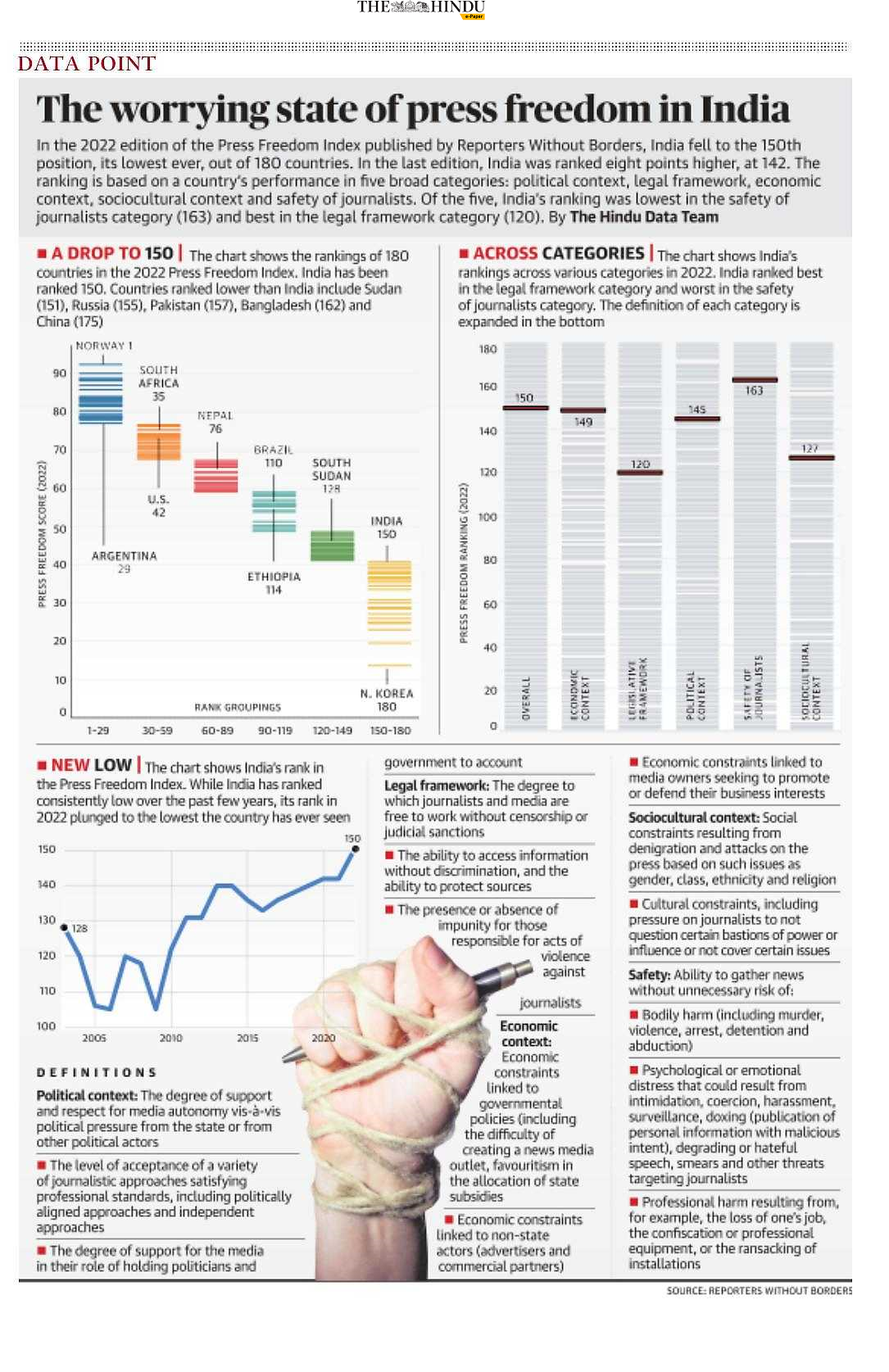
  • India slips to 150 in Press Freedom Index

    India has reached 150th position in the World Press Freedom Index, dropping further from its last year’s 142nd rank out of 180 countries.

    What is Press Freedom Index?

    • The PFI is an annual ranking of countries compiled and published by Reporters Without Borders since 2002.
    • It is based upon the organisation’s own assessment of the countries’ press freedom records in the previous year.
    • It intends to reflect the degree of freedom that journalists, news organisations, and netizens have in each country, and the efforts made by authorities to respect this freedom.
    • It does not measure the quality of journalism in the countries it assesses, nor does it look at human rights violations in general.

    Highlights of the 2022 report

    (a) Best performing countries

    • Norway– 1st
    • Denmark– 2nd
    • Sweden– 3rd
    • Estonia– 4th
    • Finland– 5th

    (b) Worst performers

    • North Korea remained at the bottom of the list, while Russia was placed at 155th position, slipping from 150th last year.
    • As per the global media watchdog, China climbed up by two positions ranking at 175th position, as compared to 177th position last year.

     (c) Performance in our neighbourhood

    • Besides India, its neighbours except Nepal have also slid down.
    • While Pakistan is at 157th position, Sri Lanka ranks at 146th, Bangladesh at 162nd and Maynmar at 176th position.

    Back2Basics: Freedom of Press and Constitutional Provisions

    • The Supreme Court in Romesh Thappar v. the State of Madras, 1950 observed that freedom of the press lay at the foundation of all democratic organisations.
    • It is guaranteed under the freedom of speech and expression under Article 19, which deals with ‘Protection of certain rights regarding freedom of speech, etc.
    • Freedom of the press is not expressly protected by the Indian legal system but it is impliedly protected under article 19(1) (a) of the constitution.
    • The freedom of the press is also not absolute.

    Reasonable restrictions

    • A law could impose only those restrictions on the exercise of this right, it faces certain restrictions under article 19(2), which is as follows:
    1. Sovereignty and integrity of India
    2. Security of the State,
    3. Friendly relations with foreign States
    4. Public order, decency or morality
    5. Contempt of court
    6. Defamation
    7. Incitement to an offence


    UPSC 2023 countdown has begun! Get your personal guidance plan now! (Click here)

  • France pulls out of P-75I Project

    Ahead of PM Modi’s scheduled visit, France has denounced its participation in the P-75 India (P-75I) project under which six conventional submarines are to be built in India for the Indian Navy.

    Why did France pull out?

    • The reason was that the Request for Proposal (RFP) requires that the fuel cell AIP be sea proven, which not the case is for us yet since the French Navy does not use such a propulsion system.
    • AIP refers to Air-Independent Propulsion, a technology for conventional — that is, non-nuclear — submarines.

    Backgrounder: Project 75

    • Project 75 India is a part of India’s thirty-year-old submarine building plan by which all the six submarines which are under the project should already be sailing and it should have been followed by the submarines now for which the RFP has been issued.
    • It is a long-awaited and long-overdue project.
    • This should have happened way back but it got delayed because it was difficult to find a strategic partnership model.

    What is P-75I?

    • The Project 75I-class submarine is a follow-on of the Project 75 Kalvari-class submarine for the Indian Navy.
    • In the late 1990s, around the time of Kargil war, a three-decade plan took shape for indigenous construction of submarines.
    • It was known to have two separate series of submarine building lines – codenamed Project 75 and Project 75I — in collaboration with foreign entities.
    • Under this project, the Indian Navy intends to acquire six diesel-electric submarines, which will also feature advanced air-independent propulsion systems.
    • This is for enabling them to stay submerged for longer duration and substantially increase their operational range.

    What is the status of the project?

    • The navy is slightly behind the curve on P-75I.
    • The project faces choppy waters; the Naval Group has already announced it is pulling out, and sources said the Russian and Spanish companies might also not proceed with their bids.
    • Among the concerns, is the requirement to demonstrate a sea-proven fuel cell AIP.
    • While some manufacturers may have the technology, it may not have been proven at sea yet.
    • Another problem for the OEMs is the transfer of technology, which is built into the process.

    Why does the Navy want AIP subs?

    • Simply put, AIP technology allows a conventional submarine to remain submerged for much longer than ordinary diesel-electric submarines.
    • All conventional submarines have to surface to run their generators that recharge the batteries that allow the boat to function under water.
    • However, the more frequently a submarine surfaces, the higher the chances of it being detected.
    • AIP allows a submarine to remain submerged for more than a fortnight, compared to two to three days for diesel-electric boats.
    • IP has a force multiplier effect on lethality of a diesel electric submarine as it enhances the submerged endurance of the boat several folds.

    What submarines does India have now?

    • India has 16 conventional diesel-electric submarines, which are classified as SSKs.
    • After the last two Kalvari Class subs are commissioned under P-75, this number will go up to 18.
    • India also has two nuclear ballistic submarines, classified SSBN.

    Strategic importance of submarines development

    • Ageing arsenal: Currently, India has less number of submarines than what is required with some more of those from both types being at various stages of construction.
    • Combat roles in near future: The nuclear powered and diesel-electric submarines have their designated roles in the Carrier Battle Groups, which are formations of ships and submarines with Aircraft Carriers at the lead role.
    • Strategic deterrence: As per the basic principles of submarine deployment and the minimum requirement for India to create a strategic deterrence, there is a specific number of submarines of both types that India needs to have in active service.

    Significance of P-75 I

    • ‘Make in India’ Projects: It will serve to facilitate faster and more significant absorption of technology and create a tiered industrial ecosystem for submarine construction in India.
    • Self-Reliance: From a strategic perspective, this will help reduce current dependence on imports and gradually ensure greater self-reliance and dependability of supplies from indigenous sources.
    • Securing Indo-Pacific: China is increasing its presence in the Indian Ocean Region (IOR) and this is creating pressure on the Indian Navy in sprucing up the submarine arm.


    UPSC 2023 countdown has begun! Get your personal guidance plan now! (Click here)

  • Russia officially quits the International Space Station (ISS)

    Russia is responding to the Western sanctions. It has decided to walk out of the International Space Station.

    International Space Station

    • The ISS was launched in 1998 as part of joint efforts by the U.S., Russia, Japan, Canada and Europe.
    • The idea of a space station originated in the 1984 State of the Union address by former U.S. President Ronald Reagan.
    • The space station was assembled over many years, and it operates in low-earth orbit.
    • Since its inception, it has served as a laboratory suspended in space and has aided multiple scientific and technological developments.
    • The ISS was originally built to operate for 15 years.

    Why was ISS launched?

    • A space station permits quantum leaps in research in science, communications, and in metals and lifesaving medicines which could be manufactured only in space.
    • ISS has consistently maintained human presence for the past 21 years, providing astronauts with sophisticated technologies for scientific research.

    What is Russia’s role in maintaining the ISS?

    • The ISS is built with the co-operation of scientists from five international space agencies — NASA of the U.S., Roscosmos of Russia, JAXA of Japan, Canadian Space Agency and the European Space Agency.
    • Each agency has a role to play and a share in the upkeep of the ISS.
    • Both in terms of expense and effort, it is not a feat that a single country can support.
    • Russia’s part in the collaboration is the module responsible for making course corrections to the orbit of the ISS.
    • They also ferry astronauts to the ISS from the Earth and back.
    • Until SpaceX’s dragon spacecraft came into the picture the Russian spacecrafts were the only way of reaching the ISS and returning.


    UPSC 2023 countdown has begun! Get your personal guidance plan now! (Click here)

  • Advanced Towed Artillery Gun System (ATAGS) passes validation trials

    The indigenous Advanced Towed Artillery Gun System (ATAGS) developed by the Defence Research and Development Organisation (DRDO) successfully completed the validation trials.

    Why in news?

    • The ATAGS has demonstrated a range of over 45 km, making it the “most consistent and accurate gun in the world”.

    ATAG System

    • The ATAGS is a 155-mm, 52-calibre artillery gun jointly developed by the DRDO in partnership with Bharat Forge of the Kalyani Group and the Tata Power SED.
    • ATAGS has greater than 95% of indigenous content. It set a world record for the longest unassisted projectile range of 48 kilometres.

    Its features

    • The gun consists of a barrel, breech mechanism, muzzle brake and recoil mechanism to fire 155 mm calibre ammunition with a firing range of 48 km.
    • It has an all-electric drive to ensure reliability and minimum maintenance over a long period of time.
    • It has advanced features like high mobility, quick deployability, auxiliary power mode, advanced communication system, automatic command and control system with night capability in direct fire mode.


    UPSC 2023 countdown has begun! Get your personal guidance plan now! (Click here)


More posts